تخطَّ إلى المحتوى
f

faisal aziz

@alkhunizan

2550البرومبتات
0تصويتات مستلمة
0مساهمات
تاريخ الانضمام منذ 4 أشهر
2550 مساهمات في العام الماضي
نوفمبر
ديسمبر
يناير
فبراير
مارس
أبريل
مايو
يونيو
يوليو
أغسطس
سبتمبر
أكتوبر
ن
ر
ج
أقل
أكثر
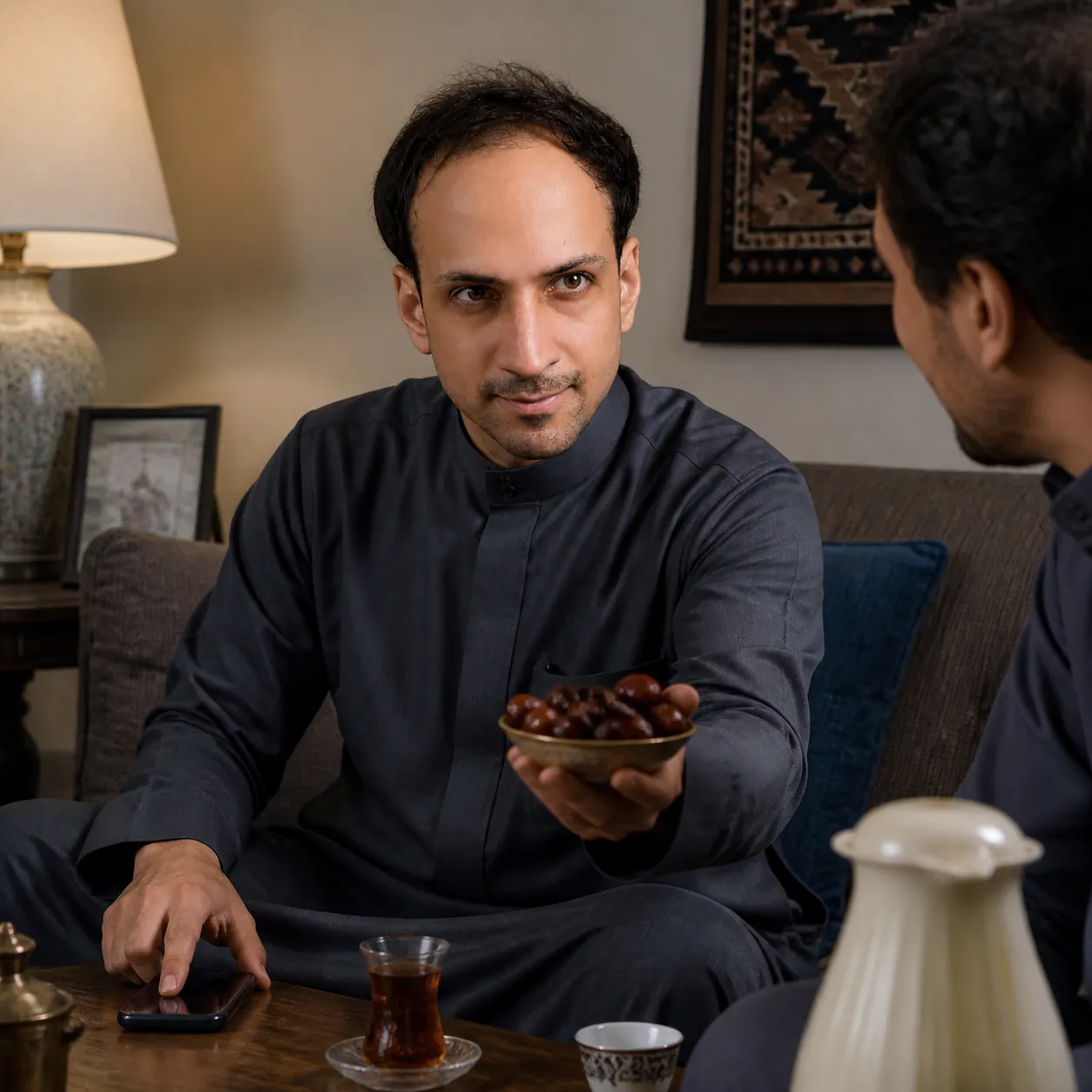
The Phone Left Face-Down — AI Portrait Prompt
صورةAI Portraits

Turn your own photo into a quiet observational portrait in a relative's front room, an older cousin talking from the next seat. Keeps your face unchanged.

من نص البرومبت

Use the attached reference photo as the identity reference: keep the same face, skin tone, hair and features as the person in that photo, without beautifying, aging or altering them. Create a square 1:1 museum-catalog frame with a strong first read and a slower second read at exactly 2880x2880 pixels. Location: a relative's front room, an older cousin talking from the next seat. Show the subject in a charcoal traditional Gulf outfit with the collar buttoned to the top, passing a dish of dates toward the seat beside them. Hide the whole argument in this ordinary moment: a phone laid face-down under one fingertip that stayed on its back long after the screen went dark beneath it raises the question of where the unedited version of a person goes. Explore what separates good manners from censorship when both look identical from outside; expression composed and unremarkable, carrying agreeable attention, the weight held where courtesy hides it. Use a quiet 35mm three-quarter view that keeps the whole room's ordinariness inside the frame. Make the composition keep the second person partial at the frame's edge. Render it as quiet observational photography combining plain interior realism, believable household detail, unforced composition, and truthful contemporary Saudi texture, using plain evening interior lighting with one nearby lamp lifting the near shoulder slightly and a palette of cool grey, bone porcelain, and a single steeped-tea amber. Photorealistic: this must read as a real photograph from a physical camera, never an illustration, painting, or 3D render. Resolve real surface detail: thread ends and slight pilling on worn cloth, hairline chips at every hard corner, and stone that is porous rather than smooth. Keep one identity-locked person, credible hands and fingers, natural fabric, and coherent scale, contact, reflections, shadows, airflow, deformation, and materials. Background people only when essential, always secondary and clearly different. Avoid double exposure, motion-blur trails, glowing overlays, mirror-split faces, and any pill-bottle or diagnosis prop. No text, labels, logos, signatures, watermarks, random symbols, plastic skin, excessive bloom, or glossy AI finish.
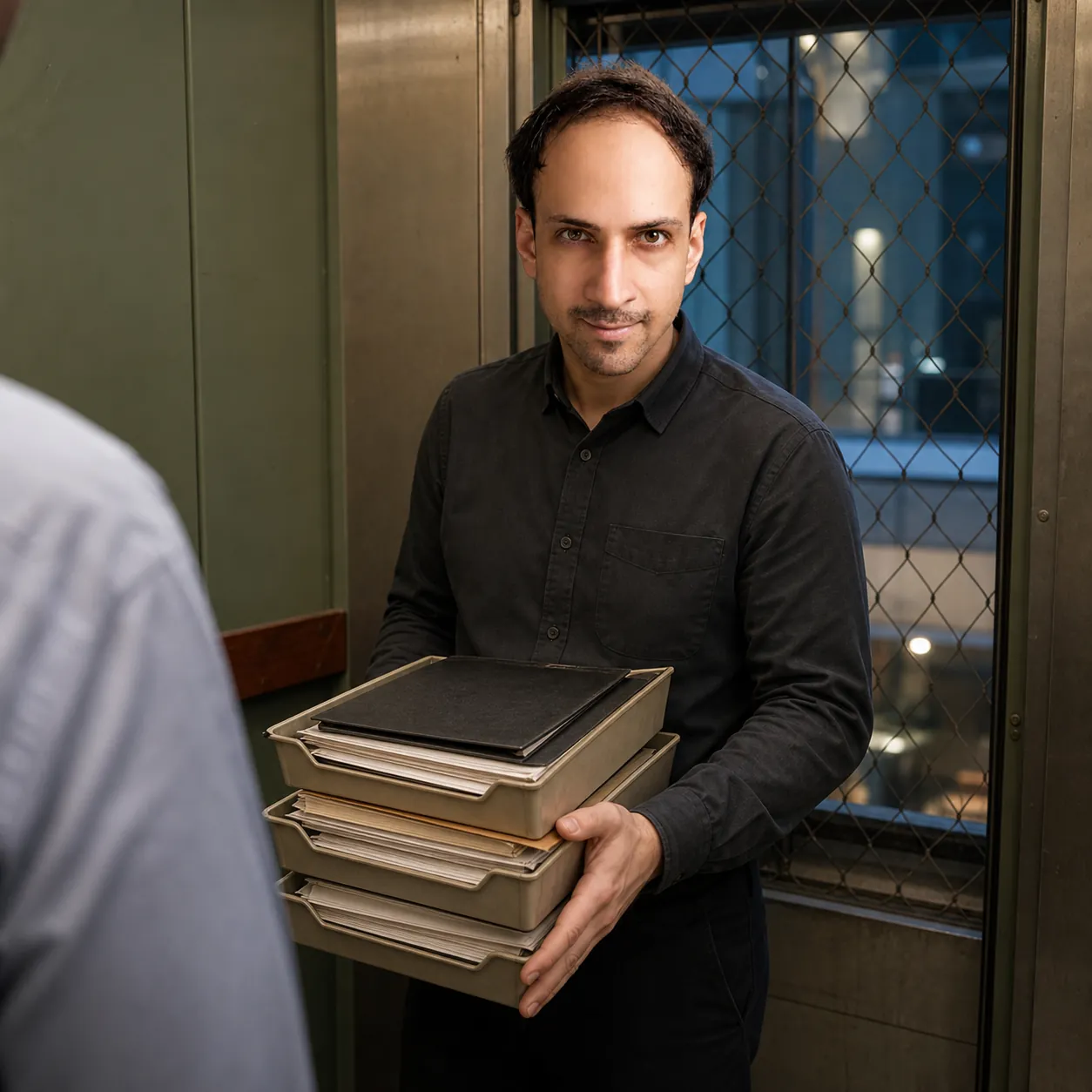
A Tray in the Service Lift — AI Portrait Prompt
صورةAI Portraits

Turn your own photo into a portrait in a service lift rising slowly between two floors of an office tower. Keeps your face unchanged.

من نص البرومبت

Use the attached reference photo as the identity reference: keep the same face, skin tone, hair and features as the person in that photo, without beautifying, aging or altering them. Create a square 1:1 museum-catalog frame with a strong first read and a slower second read at exactly 2880x2880 pixels. Location: a service lift rising slowly between two floors of an office tower. Show the subject in a charcoal work shirt buttoned at the cuffs and dark trousers, keeping a stacked tray level against their chest. Let the weight sit here and look like nothing: a posture that nobody standing near them has seen change, one shoulder squared past comfort and held there since the greetings proves that not speaking is labour rather than the space labour leaves. Explore where the effort goes when a sentence is stopped before it starts; expression composed and unremarkable, carrying settled patience, the weight held with nothing given away. Use a 50mm eye-level view at conversational distance, natural perspective, with the second person partly in frame. Make the composition give another person's sleeve one honest corner of the frame. Render it as restrained contemporary portrait realism combining lived-in interiors, believable social distance, unexaggerated expression, and precise but invisible art direction, using open shade after sunset, sky-blue ambient with one warm interior spill and a palette of pale sand, graphite, and the dull green of enamel. Photorealistic: this must read as a real photograph from a physical camera, never an illustration, painting, or 3D render. Resolve real surface detail: fine lint on dark fabric, water spotting on steel, and the soft rounding of edges that have been used for years. Keep one identity-locked person, credible hands and fingers, natural fabric, and coherent scale, contact, reflections, shadows, airflow, deformation, and materials. Background people only when essential, always secondary and clearly different. Avoid fingers to lips, taped mouths, hands over the face, tearful eyes, and staring out windows. No text, labels, logos, signatures, watermarks, random symbols, plastic skin, excessive bloom, or glossy AI finish.
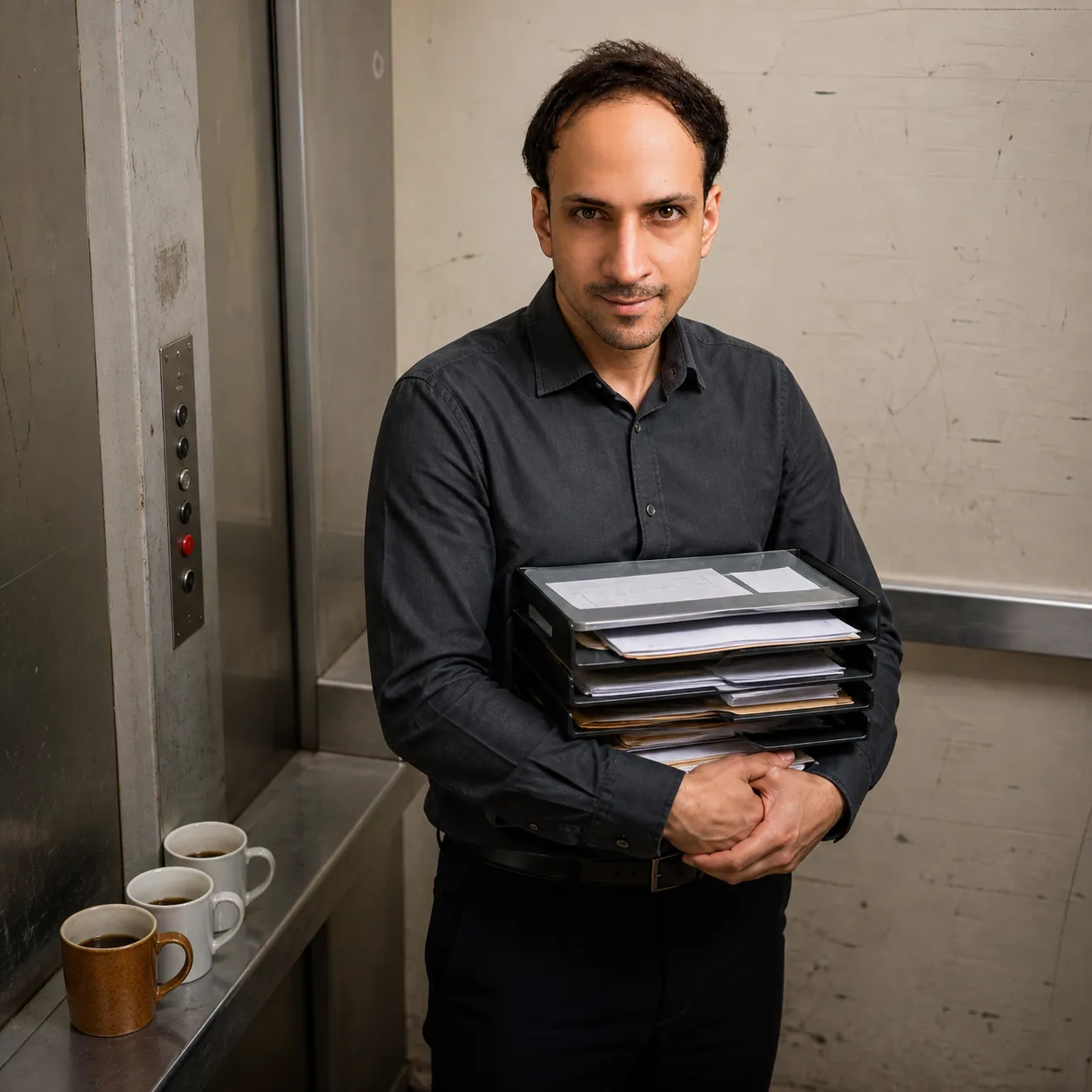
Between Two Floors — AI Portrait Prompt
صورةAI Portraits

Turn your own photo into a photorealistic portrait in a service lift rising slowly between two floors of an office tower. Keeps your face unchanged.

من نص البرومبت

Use the attached reference photo as the identity reference: keep the same face, skin tone, hair and features as the person in that photo, without beautifying, aging or altering them. Create a square 1:1 museum-catalog frame with a strong first read and a slower second read at exactly 2880x2880 pixels. Location: a service lift rising slowly between two floors of an office tower. Show the subject in a charcoal work shirt buttoned at the cuffs and dark trousers, keeping a stacked tray level against their chest. Build the frame on this unremarkable detail: a cup of their own gone cold at their elbow, set down beside others that have each been refilled twice does continuous work that will produce nothing anyone can point at. Explore how long a person can hold something before the holding starts to show; expression composed and unremarkable, carrying mild attentiveness, the weight held in the arms, not the face. Shoot with an 85mm at a modest aperture, keeping their hands and face equally legible. Make the composition hold them still while everything around them has just moved. Render it as museum-grade reportage portraiture drawn from unposed body language, true domestic materials, accurate colour, and patient framing, using flat late-afternoon daylight with the contrast kept low and shadows open and a palette of milk white, warm concrete, and a single date-brown accent. Photorealistic: this must read as a real photograph from a physical camera, never an illustration, painting, or 3D render. Resolve real surface detail: hair with individual strands catching light, fine hairs of uneven length, and skin oil giving a low uneven sheen. Keep one identity-locked person, credible hands and fingers, natural fabric, and coherent scale, contact, reflections, shadows, airflow, deformation, and materials. Background people only when essential, always secondary and clearly different. Avoid head-in-hands poses, pill bottles, therapy couches, heroic inspirational posing, and any object announcing mental illness. No text, labels, logos, signatures, watermarks, random symbols, plastic skin, excessive bloom, or glossy AI finish.

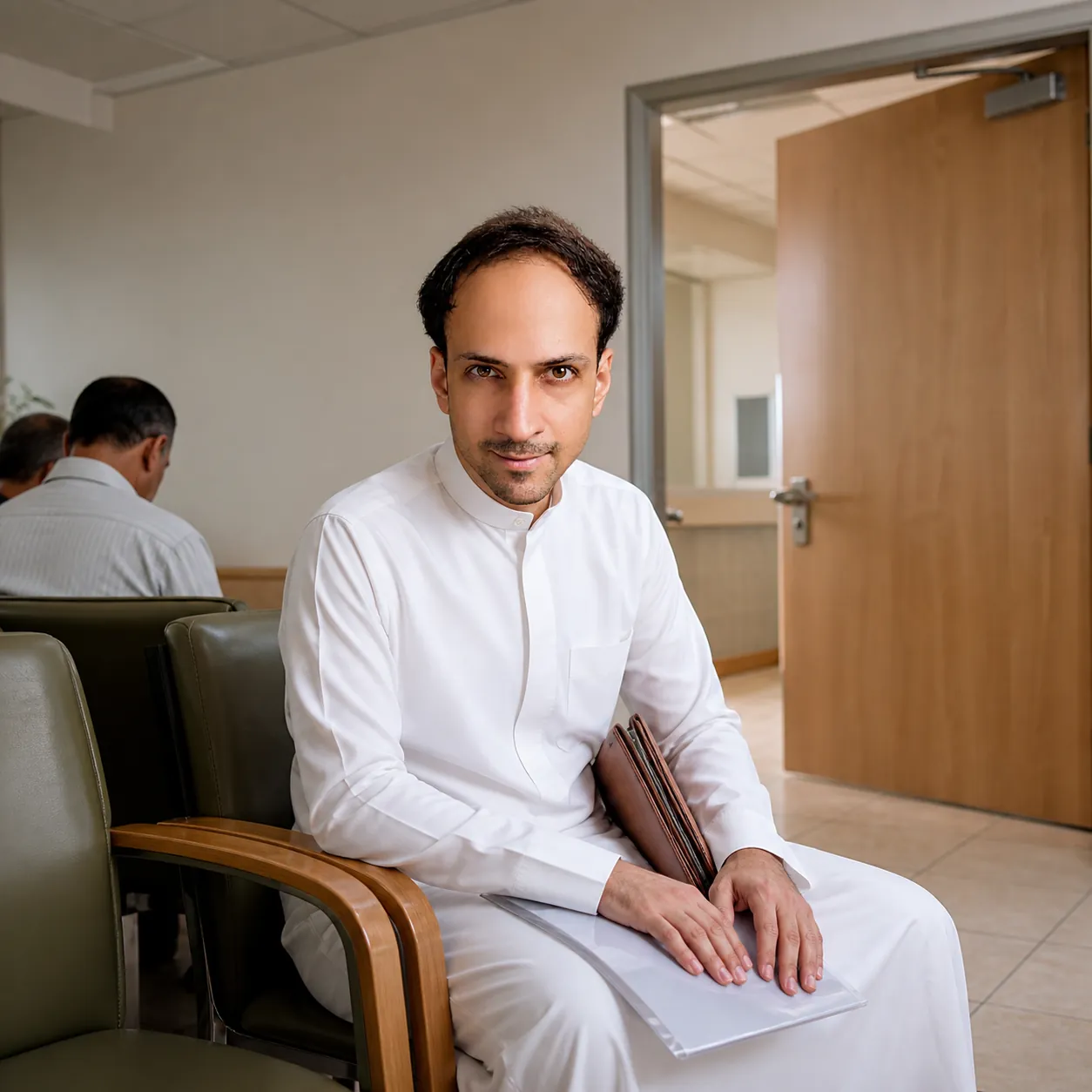
The Door Left Wide — AI Portrait Prompt
صورةAI Portraits

Turn your own photo into a portrait in a municipal services waiting row where another person's name is being called. Keeps your face unchanged.

من نص البرومبت

Use the attached reference photo as the identity reference: keep the same face, skin tone, hair and features as the person in that photo, without beautifying, aging or altering them. Create a square 1:1 museum-catalog frame with a strong first read and a slower second read at exactly 2880x2880 pixels. Location: a municipal services waiting row where another person's name is being called. Show the subject in a white traditional Gulf outfit with a folded document wallet under one arm, holding a slim plastic folder flat against their knee. Hide the whole argument in this ordinary moment: a door standing open at the full arc that it is usually stopped short of with its handle already released and motionless buries the whole proposition in a movement nobody present would think twice about. Explore whether the practised version of a person counts as the real one; expression composed and unremarkable, carrying practised warmth, the weight held where courtesy hides it. Use a quiet 35mm three-quarter view that keeps the whole room's ordinariness inside the frame. Make the composition leave one plain area of wall doing nothing at all. Render it as unadorned documentary portraiture built from available-light realism, ordinary domestic staging, restrained editorial framing, and honest skin rendering, using overcast daylight balanced against a cool interior fitting, skin texture fully readable and a palette of warm off-white, pale oak, and one muted olive accent. Photorealistic: this must read as a real photograph from a physical camera, never an illustration, painting, or 3D render. Resolve real surface detail: wood grain read at honest scale, matte and gloss clearly separated, and no surface uniformly clean. Keep one identity-locked person, credible hands and fingers, natural fabric, and coherent scale, contact, reflections, shadows, airflow, deformation, and materials. Background people only when essential, always secondary and clearly different. Avoid visible sadness, head in hands, staring through windows, clock faces, and thought-bubble symbolism. No text, labels, logos, signatures, watermarks, random symbols, plastic skin, excessive bloom, or glossy AI finish.
A Fingertip on a Dark Phone — AI Portrait Prompt
صورةAI Portraits

Turn your own photo into a plain-spoken editorial portrait in a corner shop counter where the owner is bagging the last item. Keeps your face unchanged.

من نص البرومبت

Use the attached reference photo as the identity reference: keep the same face, skin tone, hair and features as the person in that photo, without beautifying, aging or altering them. Create a square 1:1 museum-catalog frame with a strong first read and a slower second read at exactly 2880x2880 pixels. Location: a corner shop counter where the owner is bagging the last item. Show the subject in a grey zip-up over a white tee with the hood lying flat, hooking a plastic bag's handles over two fingers. Photograph this as though nothing were happening: a phone laid face-down under one fingertip that stayed on its back long after the screen went dark beneath it buries the whole proposition in a movement nobody present would think twice about. Explore what separates good manners from censorship when both look identical from outside; expression composed and unremarkable, carrying workaday calm, the weight held inside half a second. Frame at chest height so the stilled hand and their face share one focal plane. Make the composition let the scene read as finished until the eye returns. Render it as plain-spoken editorial portraiture combining everyday civic settings, accurate material texture, calm unposed body language, and unexaggerated colour, using even ceiling fluorescents softened by a pale wall, shadows kept shallow and honest and a palette of dust beige, brushed aluminium, and one deep navy note. Photorealistic: this must read as a real photograph from a physical camera, never an illustration, painting, or 3D render. Resolve real surface detail: glass with real thickness at its edge, reflections that carry the room's actual colour, and dust visible only at grazing angles. Keep one identity-locked person, credible hands and fingers, natural fabric, and coherent scale, contact, reflections, shadows, airflow, deformation, and materials. Background people only when essential, always secondary and clearly different. Avoid visible sadness, head in hands, staring through windows, clock faces, and thought-bubble symbolism. No text, labels, logos, signatures, watermarks, random symbols, plastic skin, excessive bloom, or glossy AI finish.
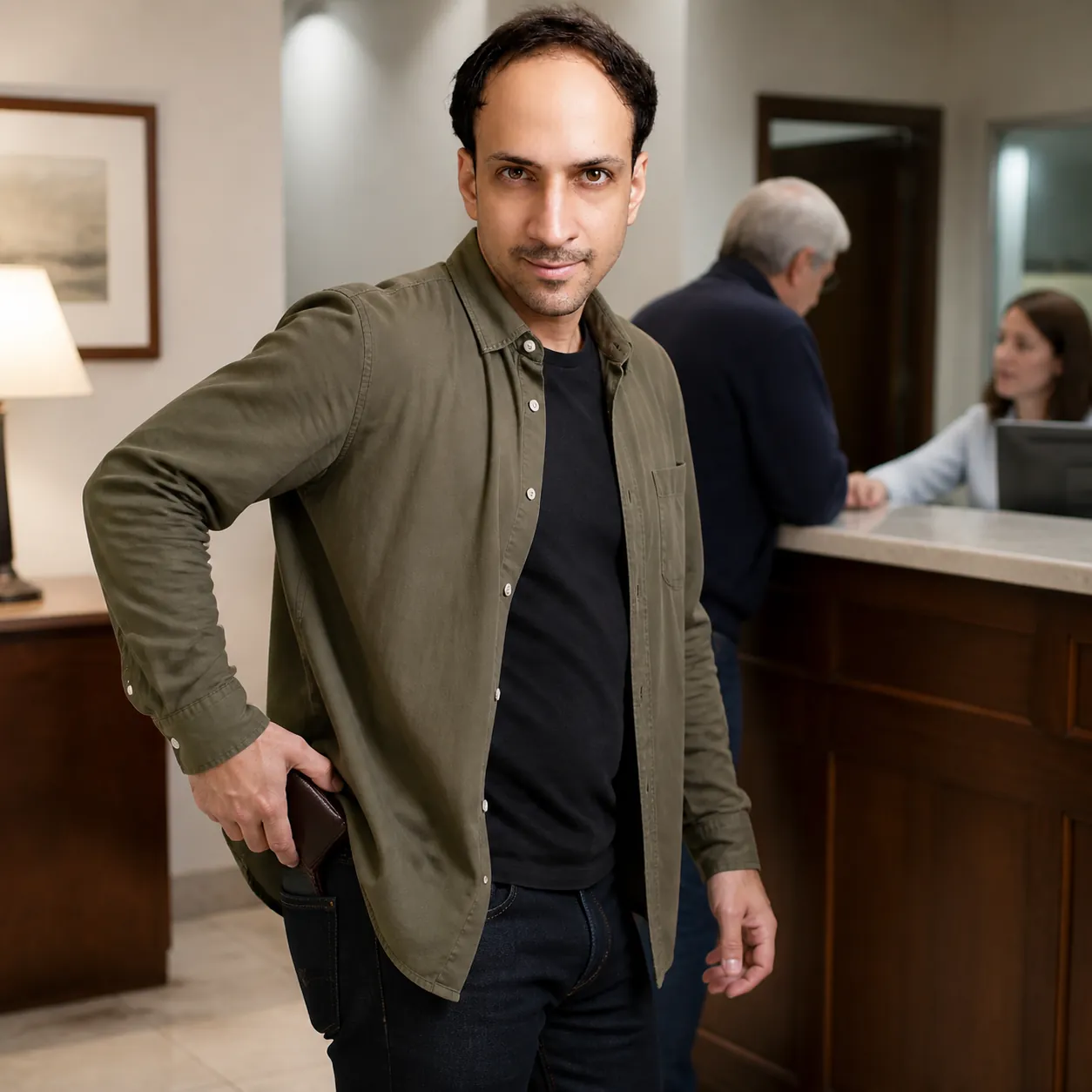
Clinic Counter, Unfinished Button — AI Portrait Prompt
صورةAI Portraits

Turn your own photo into a portrait in a clinic billing counter where the customer ahead is still being served. Keeps your face unchanged.

من نص البرومبت

Use the attached reference photo as the identity reference: keep the same face, skin tone, hair and features as the person in that photo, without beautifying, aging or altering them. Create a square 1:1 museum-catalog frame with a strong first read and a slower second read at exactly 2880x2880 pixels. Location: a clinic billing counter where the customer ahead is still being served. Show the subject in a soft olive overshirt over a plain tee and dark jeans, tucking a plain leather wallet back into their hip pocket. Let the weight sit here and look like nothing: a shirt cuff with one button pushed halfway into a hole that it never finished entering while the wrist stayed open buries the whole proposition in a movement nobody present would think twice about. Explore where the first answer goes once the second one has been chosen; expression composed and unremarkable, carrying quiet competence, the weight held where courtesy hides it. Use an unhurried 50mm eye-level view at conversational distance, natural perspective, depth of field restrained. Make the composition give the stopped detail no more emphasis than its surroundings. Render it as plain-spoken editorial portraiture combining everyday civic settings, accurate material texture, calm unposed body language, and unexaggerated colour, using plain evening interior lighting with one nearby lamp lifting the near shoulder slightly and a palette of plaster white, worn walnut, and one low brick red. Photorealistic: this must read as a real photograph from a physical camera, never an illustration, painting, or 3D render. Resolve real surface detail: fine lint on dark fabric, water spotting on steel, and the soft rounding of edges that have been used for years. Keep one identity-locked person, credible hands and fingers, natural fabric, and coherent scale, contact, reflections, shadows, airflow, deformation, and materials. Background people only when essential, always secondary and clearly different. Avoid visible sadness, head in hands, staring through windows, clock faces, and thought-bubble symbolism. No text, labels, logos, signatures, watermarks, random symbols, plastic skin, excessive bloom, or glossy AI finish.
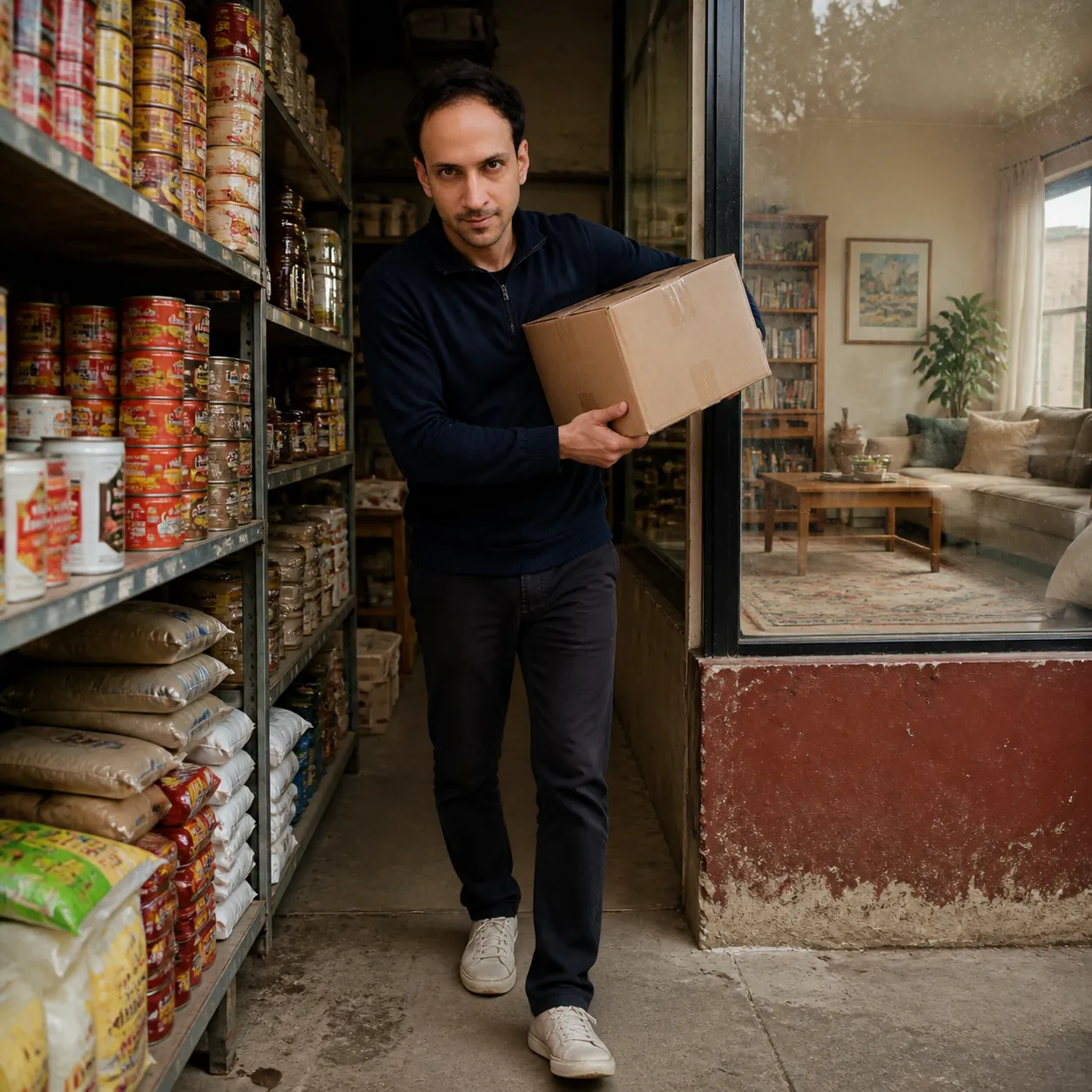
Shop Aisle at Closing — AI Portrait Prompt
صورةAI Portraits

Turn your own photo into a museum-grade chore portrait in a neighbourhood corner shop aisle of shelved tins and sacks at closing. Keeps your face unchanged.

من نص البرومبت

Use the attached reference photo as the identity reference: keep the same face, skin tone, hair and features as the person in that photo, without beautifying, aging or altering them. Create a square 1:1 museum-catalog frame with a strong first read and a slower second read at exactly 2880x2880 pixels. Location: a neighbourhood corner shop aisle of shelved tins and sacks at closing. Show the subject in a navy quarter-zip over straight dark trousers and plain trainers, lifting one plain carton into the crook of their arm. Let one honest object carry what the face will not: a living room of four years' residence seen through its own window glass, every object correct and arranged like a set measures the distance between doing a thing and being there for it. Explore why the smallest grounding act costs more effort than the chore around it; expression occupied, not expressive, carrying flat competence, difficulty stated in the plainest available terms. Use an eye-level 50mm view at counter height with restrained depth and no perspective stretch. Make the composition place the point of contact nearer the lens. Render it as museum-grade chore photography combining high-fidelity skin, accurate steel and glass reflections, matter-of-fact staging, and observational framing, using early indirect daylight with low contrast and honest skin texture throughout and a palette of warm grey concrete, dry sand, and one muted brick red. Photorealistic: this must read as a real photograph from a physical camera, never an illustration, painting, or 3D render. Resolve real surface detail: fine grit in the texture of concrete, efflorescence at damp edges, and hairline cracks that follow stress. Keep one identity-locked person, credible hands and fingers, natural fabric, and coherent scale, contact, reflections, shadows, airflow, deformation, and materials. Background people only when essential, always secondary and clearly different. Avoid double exposures, transparent bodies, out-of-body views, and mirrors returning a different person. No text, labels, logos, signatures, watermarks, random symbols, plastic skin, excessive bloom, or glossy AI finish.
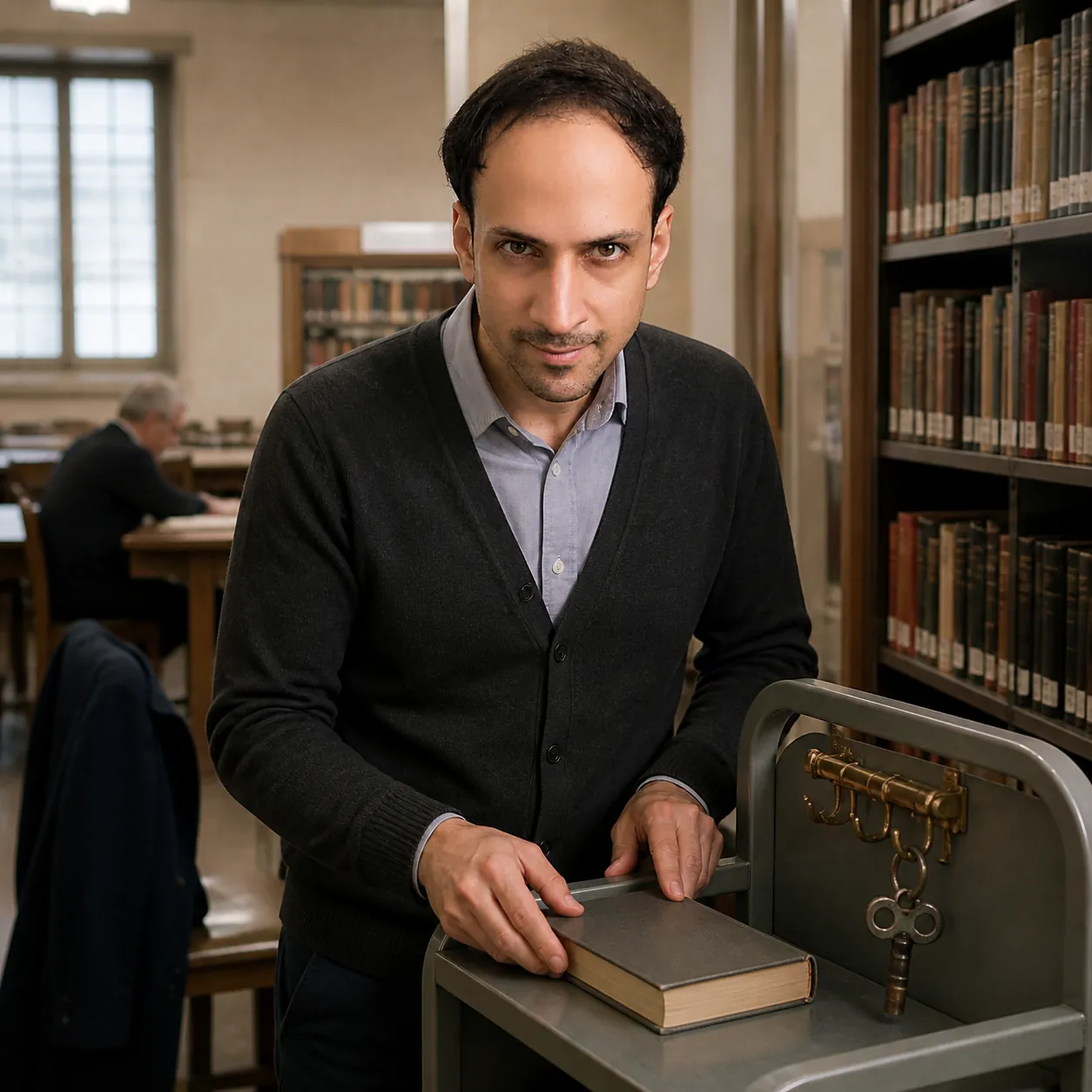
Library Returns and a Clock Key — AI Portrait Prompt
صورةAI Portraits

Turn your own photo into a modest editorial portrait in a library reading room with one other reader's coat on a chair. Keeps your face unchanged.

من نص البرومبت

Use the attached reference photo as the identity reference: keep the same face, skin tone, hair and features as the person in that photo, without beautifying, aging or altering them. Create a square 1:1 museum-catalog frame with a strong first read and a slower second read at exactly 2880x2880 pixels. Location: a library reading room with one other reader's coat on a chair. Show the subject in a thin charcoal cardigan over a plain buttoned shirt, laying a closed book flat on the returns trolley. Hide the whole argument in this ordinary moment: a clock key whose bow has worn thin on the two sides used by their fingers, hung on its own hook keeps an honest count of its own repetitions without asking anyone to notice. Explore how a person decides that tomorrow's identical task is not bad news; expression composed and unremarkable, carrying unhurried attention, the weight held entirely inside the routine. Use a steady waist-level 35mm framing that keeps the whole small task inside one honest rectangle. Make the composition give equal weight to their face and the used surface. Render it as modest editorial realism combining lived-in interior detail, physically correct wear patterns, sober color handling, and completely undramatic staging, using late-afternoon indoor light with no direct sun, cool and completely undramatic and a palette of sand beige, graphite, and a quiet stripe of brass. Photorealistic: this must read as a real photograph from a physical camera, never an illustration, painting, or 3D render. Resolve real surface detail: visible weave in cloth, fine scratches on metal, and the faint unevenness of painted walls. Keep one identity-locked person, credible hands and fingers, natural fabric, and coherent scale, contact, reflections, shadows, airflow, deformation, and materials. Background people only when essential, always secondary and clearly different. Avoid visible sadness, head-in-hands poses, staring out of windows, sighing postures, and any object announcing illness. No text, labels, logos, signatures, watermarks, random symbols, plastic skin, excessive bloom, or glossy AI finish.
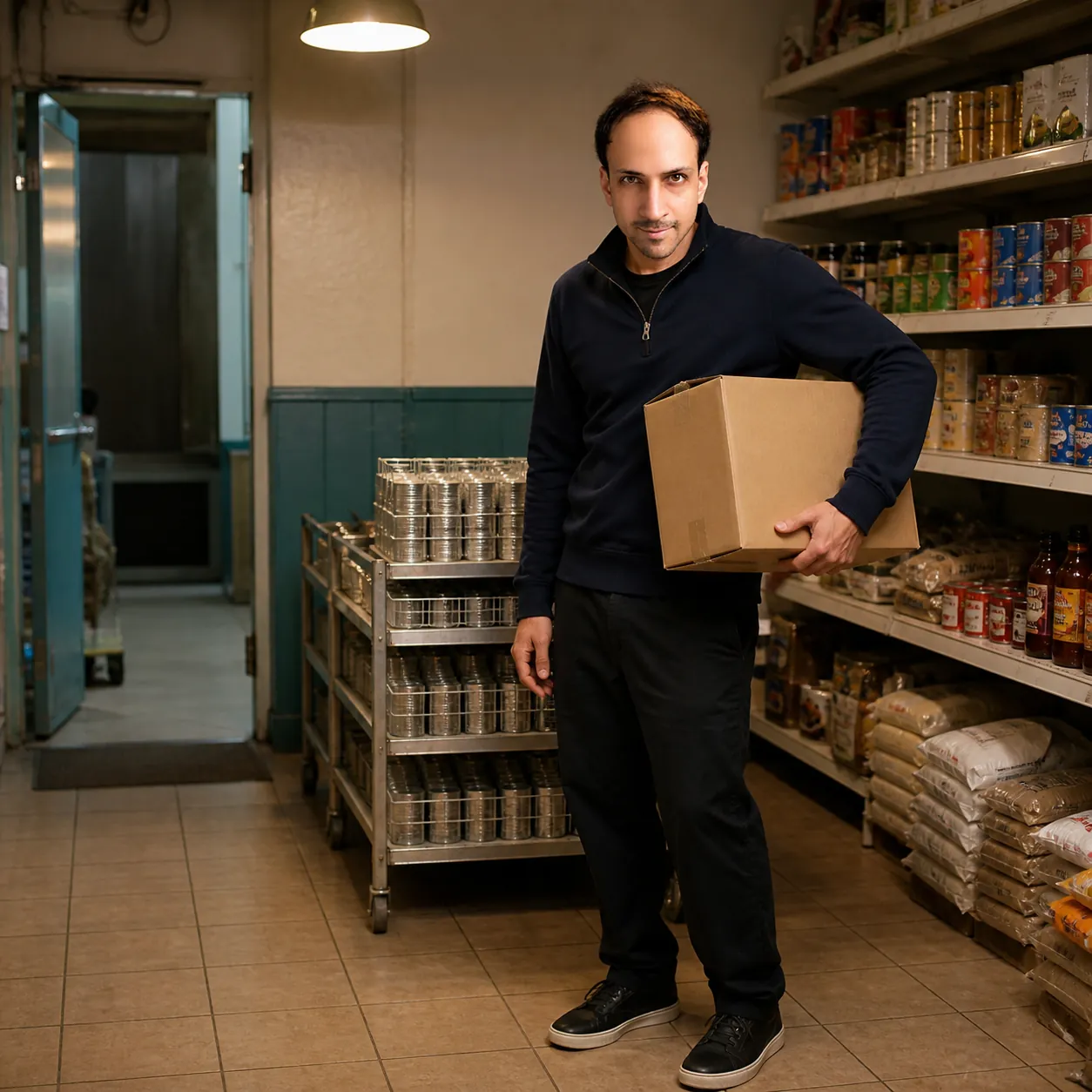
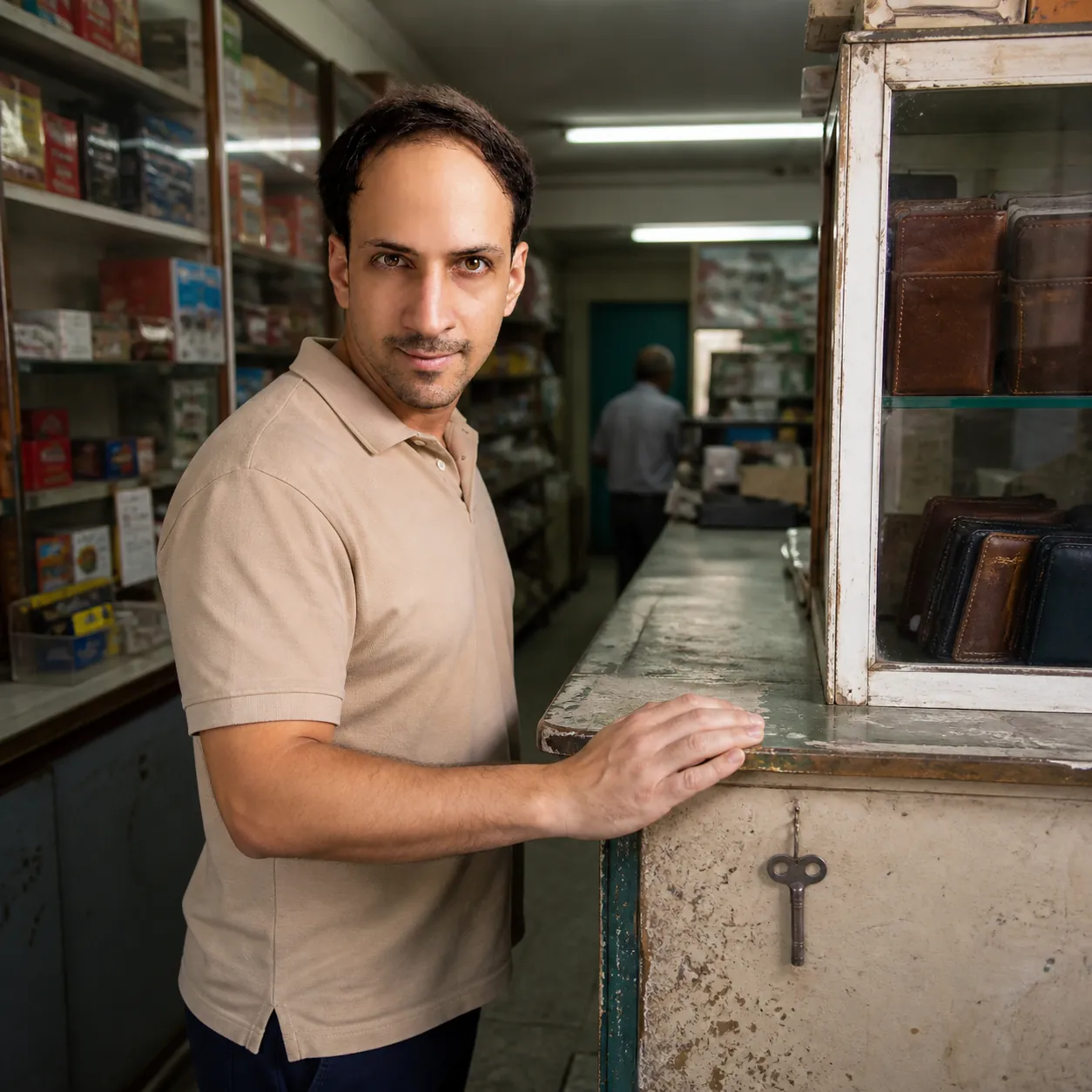
The Worn Clock Key — AI Portrait Prompt
صورةAI Portraits

Turn your own photo into a quiet observational portrait in a corner shop's counter end, the owner's sleeve visible beyond it. Keeps your face unchanged.

من نص البرومبت

Use the attached reference photo as the identity reference: keep the same face, skin tone, hair and features as the person in that photo, without beautifying, aging or altering them. Create a square 1:1 museum-catalog frame with a strong first read and a slower second read at exactly 2880x2880 pixels. Location: a corner shop's counter end, the owner's sleeve visible beyond it. Show the subject in a light beige polo shirt and dark unremarkable trousers, resting one open palm on the counter's worn edge. Make this the only tell, easy to miss: a clock key whose bow has worn thin on the two sides used by their fingers, hung on its own hook lets accumulated wear stand as the only proof that any of this recurred. Explore how a person decides that tomorrow's identical task is not bad news; expression composed and unremarkable, carrying matter-of-fact care, the weight held where competence covers it completely. Place the camera slightly behind their shoulder so the worn surface and their face both register. Make the composition read as unremarkable until the eye finds the wear. Render it as quiet observational photography combining ordinary interior realism, accurate surface aging, unmannered composition, and naturally readable skin texture, using ordinary ceiling fluorescents softened by distance, leaving mild shadows under everything and a palette of cool cement, faded ivory, and one thread of teal. Photorealistic: this must read as a real photograph from a physical camera, never an illustration, painting, or 3D render. Resolve real surface detail: leather creased along the lines of use, stitching slightly irregular, and edges burnished from contact. Keep one identity-locked person, credible hands and fingers, natural fabric, and coherent scale, contact, reflections, shadows, airflow, deformation, and materials. Background people only when essential, always secondary and clearly different. Avoid boulder or mountain symbolism, hamster wheels, spinning clock faces, treadmills, and weary shoulder-slumped posture. No text, labels, logos, signatures, watermarks, random symbols, plastic skin, excessive bloom, or glossy AI finish.
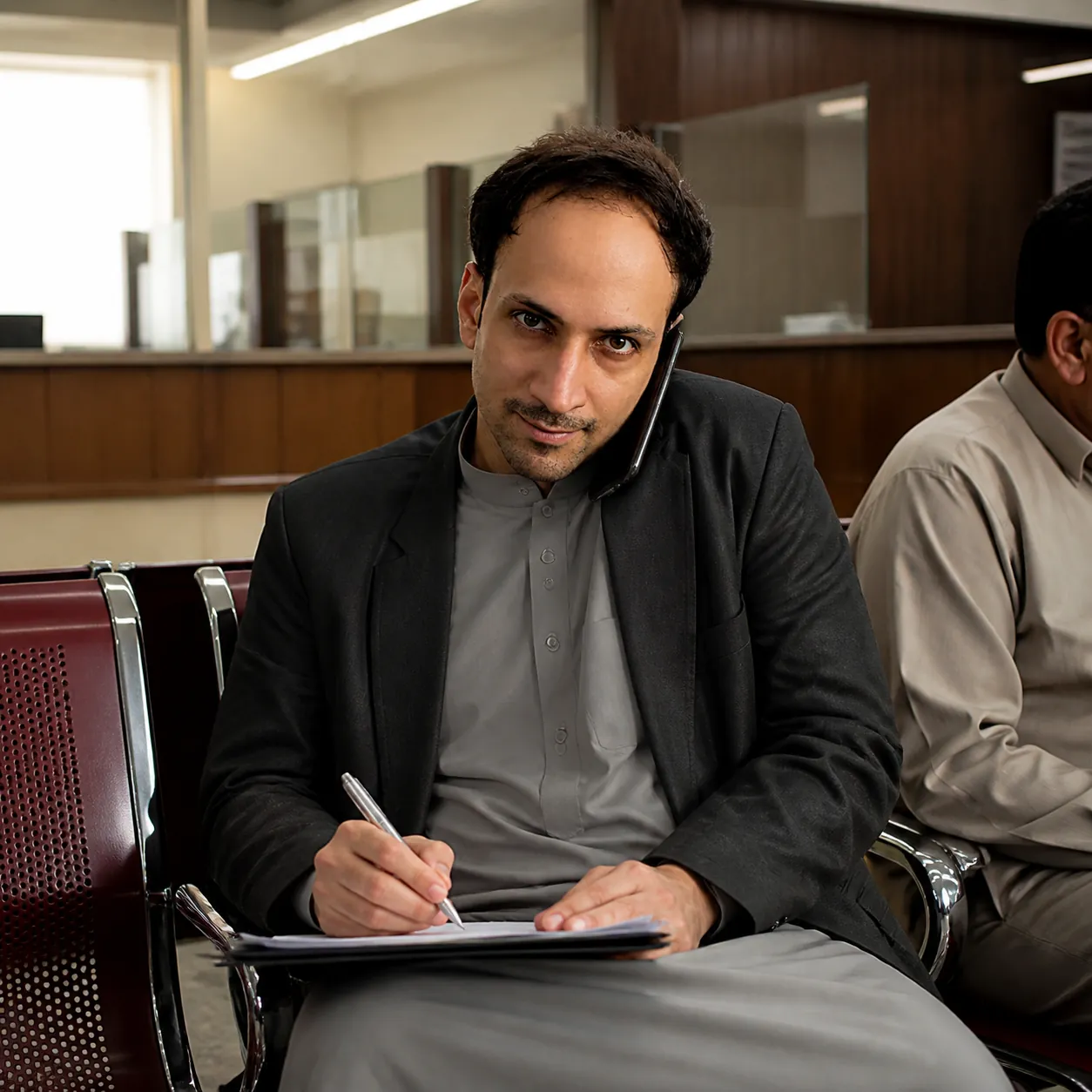
Carton at Closing Time — AI Portrait Prompt
صورةAI Portraits

Turn your own photo into a photorealistic portrait in a neighbourhood corner shop aisle of shelved tins and sacks at closing. Keeps your face unchanged.

من نص البرومبت

Use the attached reference photo as the identity reference: keep the same face, skin tone, hair and features as the person in that photo, without beautifying, aging or altering them. Create a square 1:1 museum-catalog frame with a strong first read and a slower second read at exactly 2880x2880 pixels. Location: a neighbourhood corner shop aisle of shelved tins and sacks at closing. Show the subject in a navy quarter-zip over straight dark trousers and plain trainers, lifting one plain carton into the crook of their arm. Make this piece of unglamorous evidence the whole argument: a draining rack stacked into faultless ranks by a washing-up they have no memory of beginning or finishing lets the work go on at full strength on a borrowed sort of day. Explore why a task can be finished perfectly and remembered by nobody; expression occupied, not expressive, carrying unhurried checking, difficulty stated quietly, the way work states things. Use a 90mm portrait length that compresses the room gently without flattening their hands. Make the composition leave the tidied half of the room emptier. Render it as quiet interior portraiture assembled from truthful domestic light, worn everyday surfaces, precise object placement, and human-centred documentary realism, using one warm ceiling fitting doing all the work, shadows soft and readable and a palette of pale plaster, unbleached cotton, and a narrow band of teal. Photorealistic: this must read as a real photograph from a physical camera, never an illustration, painting, or 3D render. Resolve real surface detail: paper fibre visible at cut edges, plastic that shows mould lines, and paint thicker where a brush turned. Keep one identity-locked person, credible hands and fingers, natural fabric, and coherent scale, contact, reflections, shadows, airflow, deformation, and materials. Background people only when essential, always secondary and clearly different. Avoid hero poses, golden-hour styling, posing at camera, and melancholy without visible labour. No text, labels, logos, signatures, watermarks, random symbols, plastic skin, excessive bloom, or glossy AI finish.
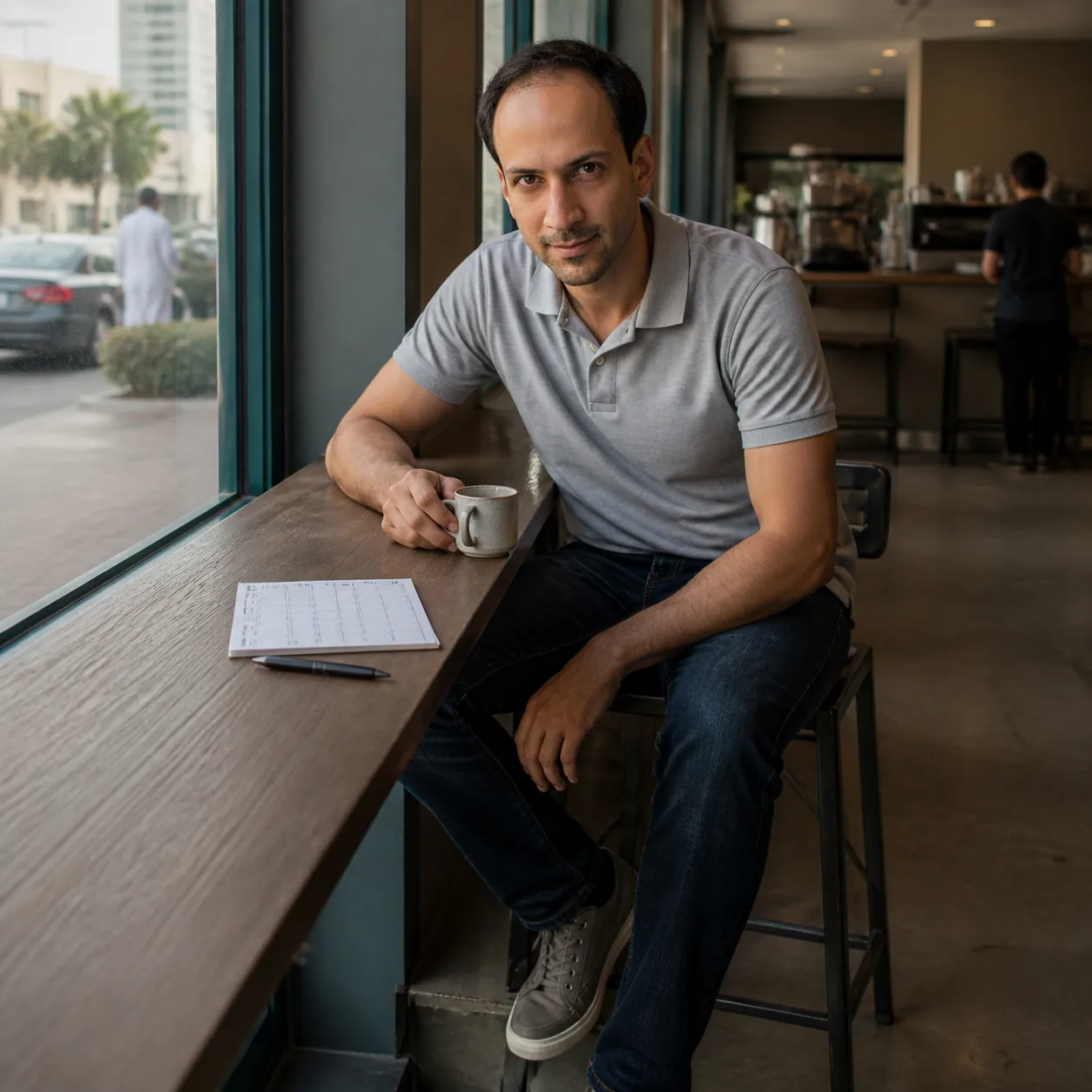
Folder Across the Knees — AI Portrait Prompt
صورةAI Portraits

Turn your own photo into a portrait in a municipal service office waiting row of bolted seats under strip lighting. Keeps your face unchanged.

من نص البرومبت

Use the attached reference photo as the identity reference: keep the same face, skin tone, hair and features as the person in that photo, without beautifying, aging or altering them. Create a square 1:1 museum-catalog frame with a strong first read and a slower second read at exactly 2880x2880 pixels. Location: a municipal service office waiting row of bolted seats under strip lighting. Show the subject in a plain grey traditional Gulf outfit under a thin charcoal blazer, setting a slim folder flat across their knees. Photograph this as though nothing were happening: a phone held against their shoulder while their free hand keeps working at the speed it had before the call came says the closest true thing the available language will actually hold. Explore how an ordinary exchange can hold something neither person has words for; expression composed and unremarkable, carrying neighbourly evenness, the weight held just behind the courtesy. Frame the subject at chest height so their hands and face stay equally readable in one plane. Make the composition keep the second person partial and never the focus. Render it as unforced documentary portraiture built from natural domestic staging, honest skin rendering, restrained contemporary styling, and patient observational timing, using flat afternoon daylight through a plain window, shadows soft and unremarkable and a palette of sand beige, dark brown, and one brick-red thread. Photorealistic: this must read as a real photograph from a physical camera, never an illustration, painting, or 3D render. Resolve real surface detail: brass darkened in the recesses and bright where thumbs land, and lacquer crazed rather than perfect. Keep one identity-locked person, credible hands and fingers, natural fabric, and coherent scale, contact, reflections, shadows, airflow, deformation, and materials. Background people only when essential, always secondary and clearly different. Avoid tears, head in hands, staring through windows, hunched silhouettes, and any object announcing illness. No text, labels, logos, signatures, watermarks, random symbols, plastic skin, excessive bloom, or glossy AI finish.
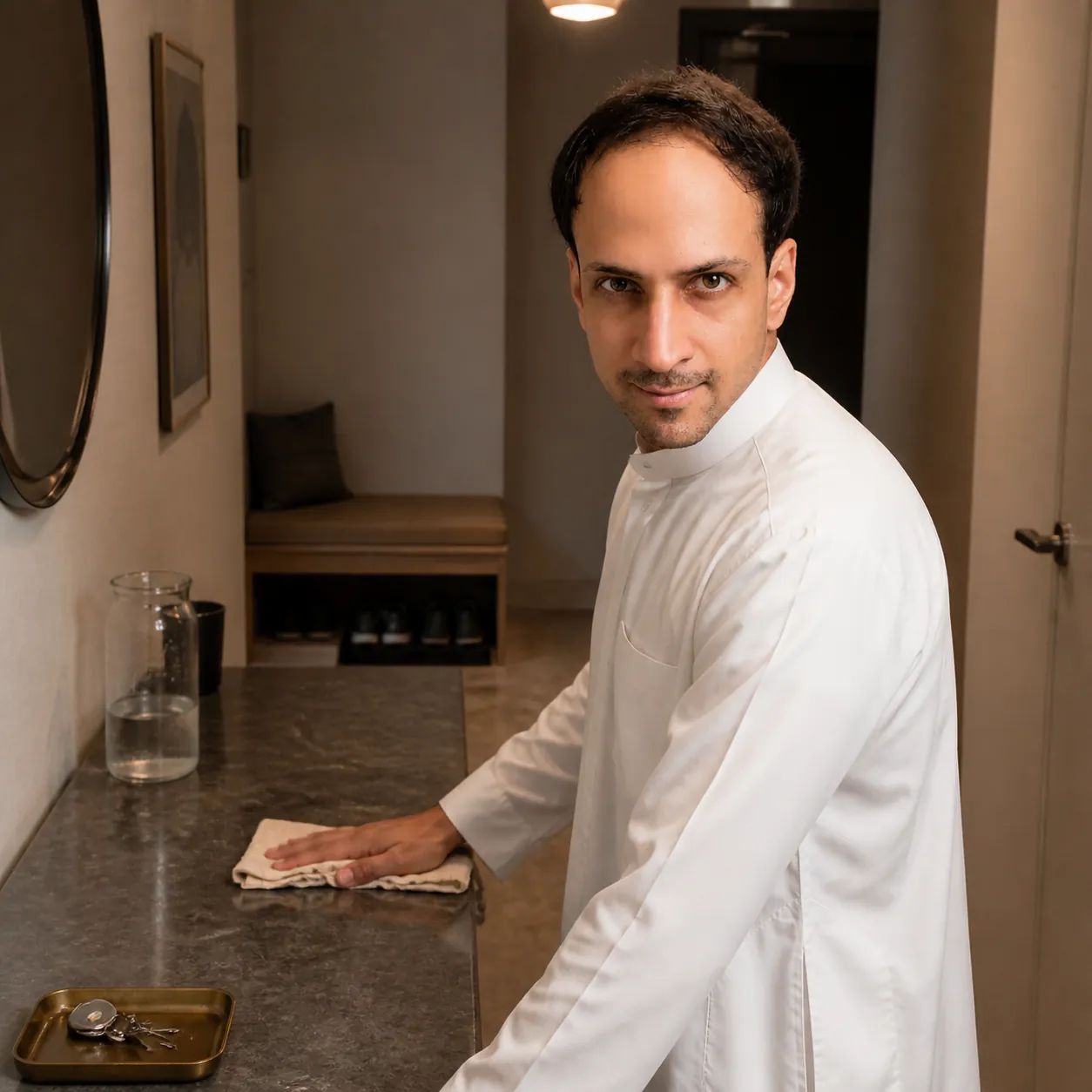
The Unmarked Column — AI Portrait Prompt
صورةAI Portraits

Turn your own photo into an observational portrait in a neighbourhood café's window counter in the flat hour after lunch. Keeps your face unchanged.

من نص البرومبت

Use the attached reference photo as the identity reference: keep the same face, skin tone, hair and features as the person in that photo, without beautifying, aging or altering them. Create a square 1:1 museum-catalog frame with a strong first read and a slower second read at exactly 2880x2880 pixels. Location: a neighbourhood café's window counter in the flat hour after lunch. Show the subject in a soft grey polo, dark jeans, and plain canvas shoes, turning a cup handle toward their own hand. Build the frame on this unremarkable detail: a pocket card ruled into a week whose one column stays unmarked, kept as square as the rest carries the load of the whole scene on what is not there. Explore why an unfilled day can be the load-bearing part of a working week; expression composed and unremarkable, carrying practical calm, the weight held below anyone's threshold of notice. Shoot at 85mm from standing height, keeping the room's geometry honest behind them. Make the composition let the gap fall exactly on a natural sightline. Render it as observational realism combining everyday Saudi interiors, accurate domestic surfaces, unforced natural behaviour, and calm photojournalistic discipline, using even mixed light from a glazed frontage and switched-on ceiling panels and a palette of oatmeal, slate grey, and a narrow band of teal. Photorealistic: this must read as a real photograph from a physical camera, never an illustration, painting, or 3D render. Resolve real surface detail: dust settled where nobody wipes, fingerprint haze on glass, and edges rubbed pale by handling. Keep one identity-locked person, credible hands and fingers, natural fabric, and coherent scale, contact, reflections, shadows, airflow, deformation, and materials. Background people only when essential, always secondary and clearly different. Avoid symbolic empty chairs, dust-sheeted furniture, framed portraits, theatrical shadows, and medication props. No text, labels, logos, signatures, watermarks, random symbols, plastic skin, excessive bloom, or glossy AI finish.
Shoes Lined Under the Bench — AI Portrait Prompt
صورةAI Portraits

Turn your own photo into a museum-grade chore portrait in an apartment entrance hall with a shoe bench and a key tray. Keeps your face unchanged.

من نص البرومبت

Use the attached reference photo as the identity reference: keep the same face, skin tone, hair and features as the person in that photo, without beautifying, aging or altering them. Create a square 1:1 museum-catalog frame with a strong first read and a slower second read at exactly 2880x2880 pixels. Location: an apartment entrance hall with a shoe bench and a key tray. Show the subject in a plain white traditional Gulf outfit with the sleeves shaken straight, lining both shoes parallel under the bench. Build the image around this small, exact tableau: a wiped stone counter touched a second time with one bare palm, purely for the confirmation that comes back through the skin lets the work go on at full strength on a borrowed sort of day. Explore whether competence counts as presence when the two arrive separately; expression occupied, not expressive, carrying practised routine, difficulty stated quietly, the way work states things. Frame just behind their shoulder so the finished work leads and their face stays readable. Make the composition hold plain air between their hand and the object. Render it as museum-grade chore photography combining high-fidelity skin, accurate steel and glass reflections, matter-of-fact staging, and observational framing, using one warm ceiling fitting doing all the work, shadows soft and readable and a palette of oat linen, cool graphite, and one thin line of brass. Photorealistic: this must read as a real photograph from a physical camera, never an illustration, painting, or 3D render. Resolve real surface detail: condensation beading at true size, liquid meniscus curving against glass, and wet surfaces darker than dry ones. Keep one identity-locked person, credible hands and fingers, natural fabric, and coherent scale, contact, reflections, shadows, airflow, deformation, and materials. Background people only when essential, always secondary and clearly different. Avoid hero poses, golden-hour styling, posing at camera, and melancholy without visible labour. No text, labels, logos, signatures, watermarks, random symbols, plastic skin, excessive bloom, or glossy AI finish.
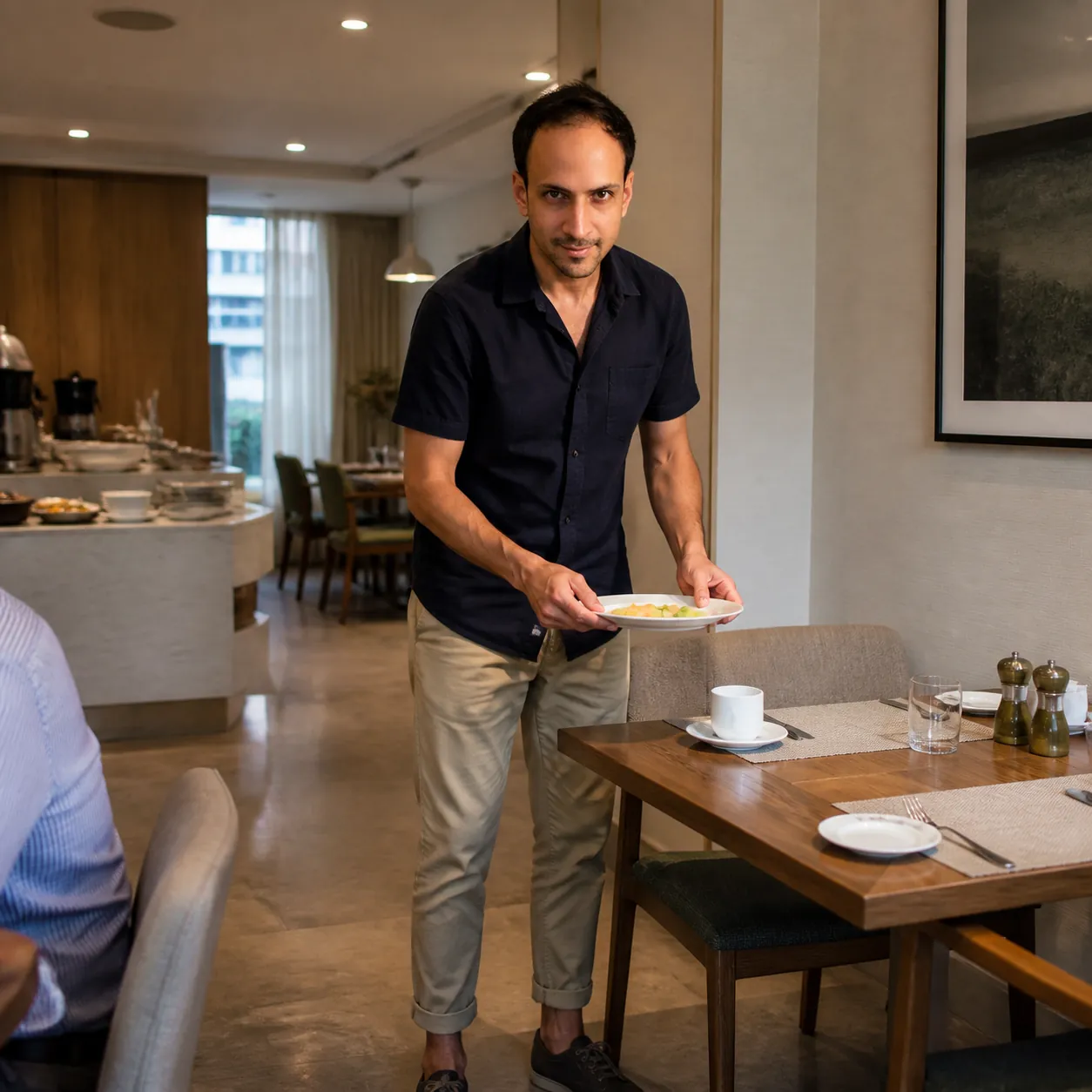
The Even Row — AI Portrait Prompt
صورةAI Portraits

Turn your own photo into a quiet documentary portrait in a hotel breakfast room emptying as the last service winds down. Keeps your face unchanged.

من نص البرومبت

Use the attached reference photo as the identity reference: keep the same face, skin tone, hair and features as the person in that photo, without beautifying, aging or altering them. Create a square 1:1 museum-catalog frame with a strong first read and a slower second read at exactly 2880x2880 pixels. Location: a hotel breakfast room emptying as the last service winds down. Show the subject in a navy short-sleeve shirt and travel-creased chinos, cuffs turned once, carrying a plate to the table by the wall. Hide the whole argument in this ordinary moment: a matched set of ordinary objects that is missing one, the rest respaced so evenly the row reads complete makes its clearest statement out of the one thing withheld. Explore how an even row can be the most tended thing in a room; expression composed and unremarkable, carrying polite readiness, the weight held without disturbing one surface. Use a quiet wide view including one neighbouring person only as a partial sleeve. Make the composition hold the room's lines true so nothing appears staged. Render it as quiet documentary portraiture built from unstyled interiors, true-to-life materials, restrained editorial framing, and honest human observation, using even mixed light from a glazed frontage and switched-on ceiling panels and a palette of warm grey, bone, and one muted olive accent. Photorealistic: this must read as a real photograph from a physical camera, never an illustration, painting, or 3D render. Resolve real surface detail: wood grain read at honest scale, matte and gloss clearly separated, and no surface uniformly clean. Keep one identity-locked person, credible hands and fingers, natural fabric, and coherent scale, contact, reflections, shadows, airflow, deformation, and materials. Background people only when essential, always secondary and clearly different. Avoid visible sadness, head in hands, staring through windows, candles, and memorial arrangements. No text, labels, logos, signatures, watermarks, random symbols, plastic skin, excessive bloom, or glossy AI finish.
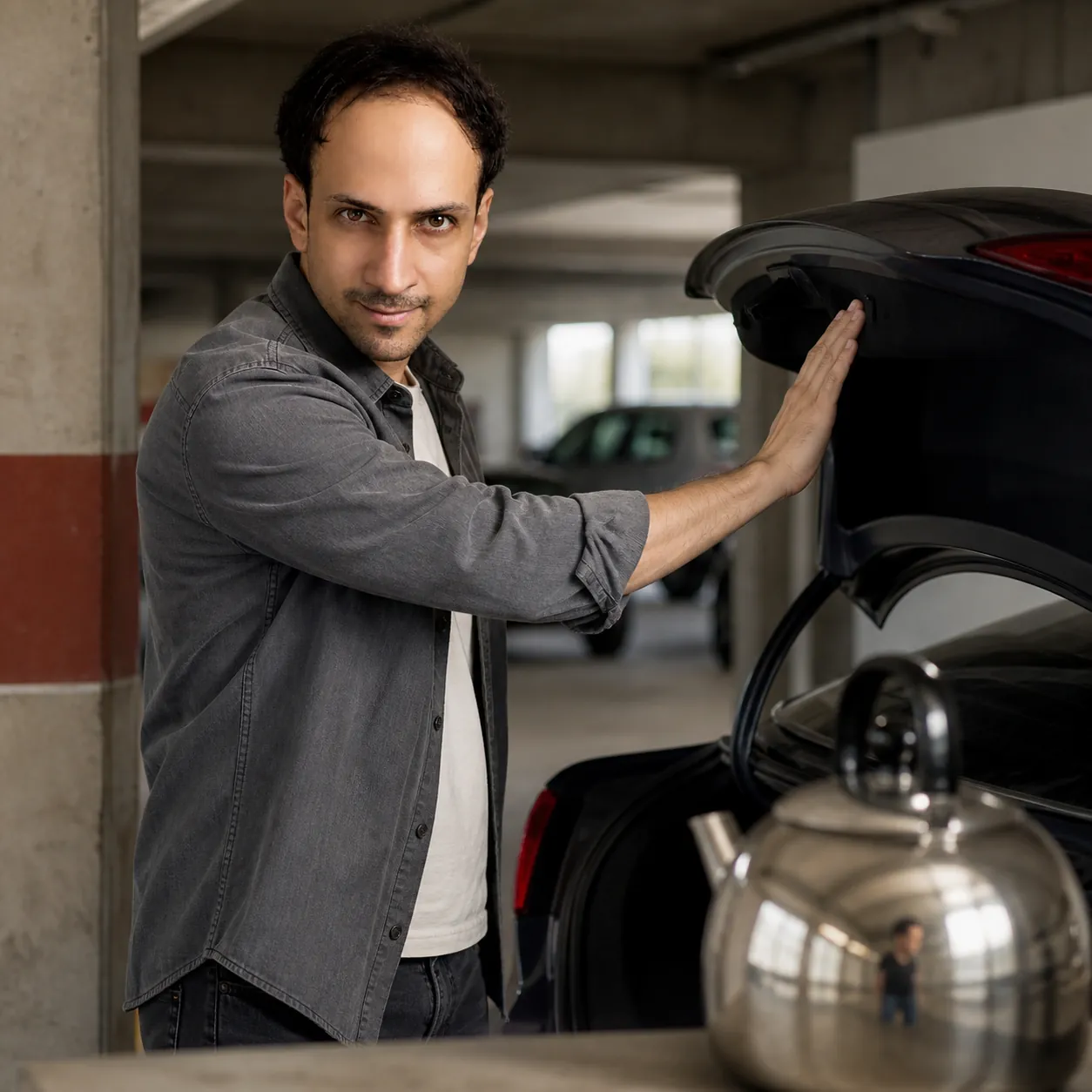
Boot Closed With a Flat Hand — AI Portrait Prompt
صورةAI Portraits

Turn your own photo into a gallery-scale household portrait in an underground residential car park bay beside your own parked car. Keeps your face unchanged.

من نص البرومبت

Use the attached reference photo as the identity reference: keep the same face, skin tone, hair and features as the person in that photo, without beautifying, aging or altering them. Create a square 1:1 museum-catalog frame with a strong first read and a slower second read at exactly 2880x2880 pixels. Location: an underground residential car park bay beside their own parked car. Show the subject in a stone-grey overshirt over a plain tee and dark jeans, closing the car boot with one flat hand. Build the image around this small, exact tableau: a kettle's curved flank returning a small, warped reflection of them that takes a moment longer to resolve than it should measures the distance between doing a thing and being there for it. Explore what a plain object can confirm that looking at it cannot; expression occupied, not expressive, carrying quiet method, difficulty stated as an ordinary fact. Frame just behind their shoulder so the finished work leads and their face stays readable. Make the composition hold plain air between their hand and the object. Render it as gallery-scale household realism built from credible hands, correct water and fabric behaviour, and calm compositional discipline, using flat overcast daylight through a single pane with no directional drama and a palette of warm grey concrete, dry sand, and one muted brick red. Photorealistic: this must read as a real photograph from a physical camera, never an illustration, painting, or 3D render. Resolve real surface detail: glass with real thickness at its edge, reflections that carry the room's actual colour, and dust visible only at grazing angles. Keep one identity-locked person, credible hands and fingers, natural fabric, and coherent scale, contact, reflections, shadows, airflow, deformation, and materials. Background people only when essential, always secondary and clearly different. Avoid double exposures, transparent bodies, out-of-body views, and mirrors returning a different person. No text, labels, logos, signatures, watermarks, random symbols, plastic skin, excessive bloom, or glossy AI finish.
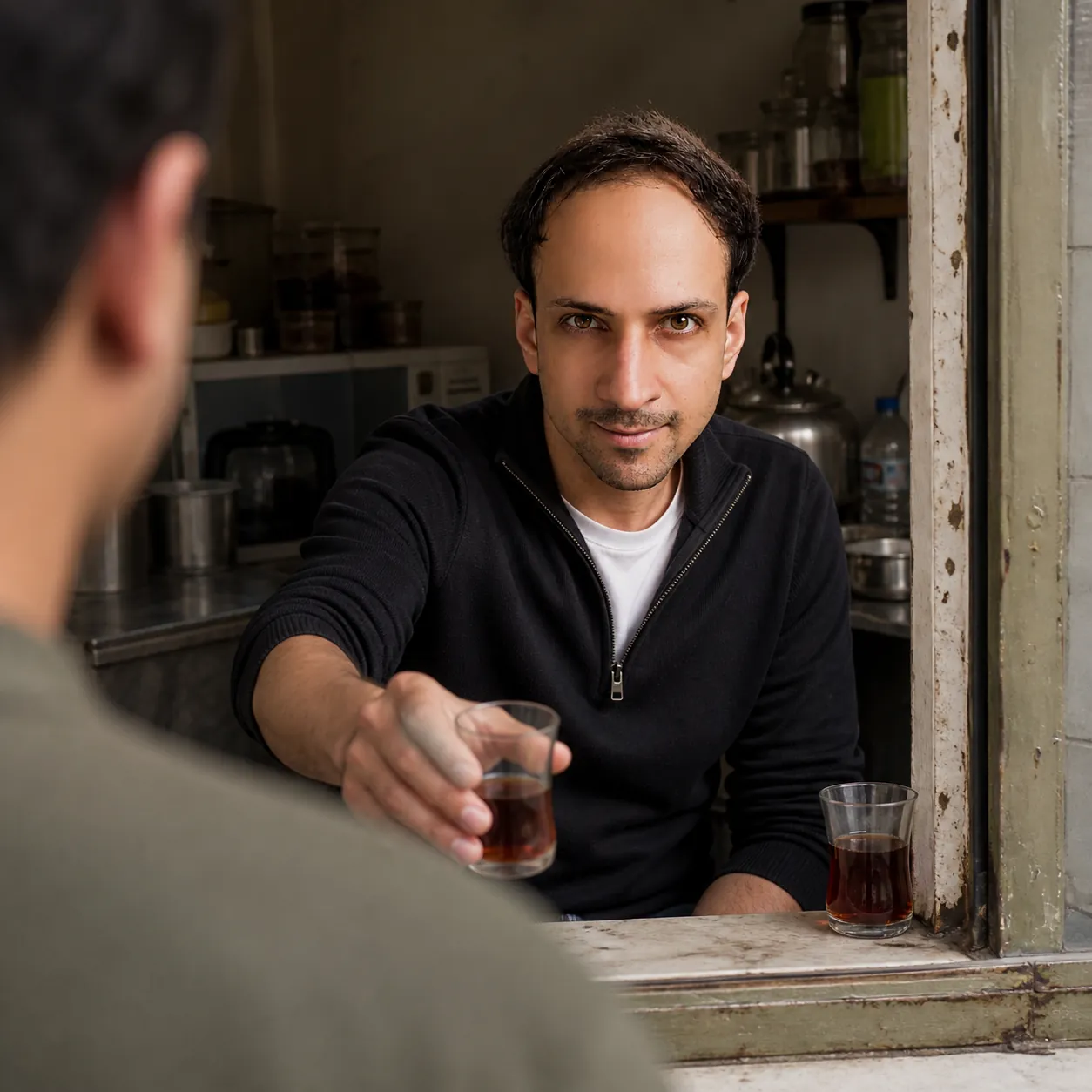
Hot Glass at the Tea Stall — AI Portrait Prompt
صورةAI Portraits

Turn your own photo into a photorealistic portrait in a pavement tea stall window where the seller works just inside. Keeps your face unchanged.

من نص البرومبت

Use the attached reference photo as the identity reference: keep the same face, skin tone, hair and features as the person in that photo, without beautifying, aging or altering them. Create a square 1:1 museum-catalog frame with a strong first read and a slower second read at exactly 2880x2880 pixels. Location: a pavement tea stall window where the seller works just inside. Show the subject in a black quarter-zip over a plain white tee with sleeves pushed back, taking a hot glass by its rim between finger and thumb. Make this the only tell, easy to miss: a glass set down beside them, its surface gone still, inside a pause that has outlasted the exchange it belongs to spends time where a sentence should have gone and loses nothing. Explore how courtesy and accuracy can both be satisfied by one short reply; expression composed and unremarkable, carrying relaxed readiness, the weight held just behind the courtesy. Place the lens slightly behind a second person's shoulder, keeping that shoulder soft and never blocking them. Make the composition give the delayed hand as much space as the face. Render it as plain reportage photography made from ordinary contemporary Saudi interiors, believable props, natural posture, and completely undramatic lighting choices, using flat afternoon daylight through a plain window, shadows soft and unremarkable and a palette of warm grey, pale plaster, and one muted olive accent. Photorealistic: this must read as a real photograph from a physical camera, never an illustration, painting, or 3D render. Resolve real surface detail: floor finish worn along the walked line, skirting marked at shoe height, and corners darker than the open floor. Keep one identity-locked person, credible hands and fingers, natural fabric, and coherent scale, contact, reflections, shadows, airflow, deformation, and materials. Background people only when essential, always secondary and clearly different. Avoid rain-streaked glass, shadow-bar drama, clasped praying hands, symbolic empty chairs, and heroic poster framing. No text, labels, logos, signatures, watermarks, random symbols, plastic skin, excessive bloom, or glossy AI finish.
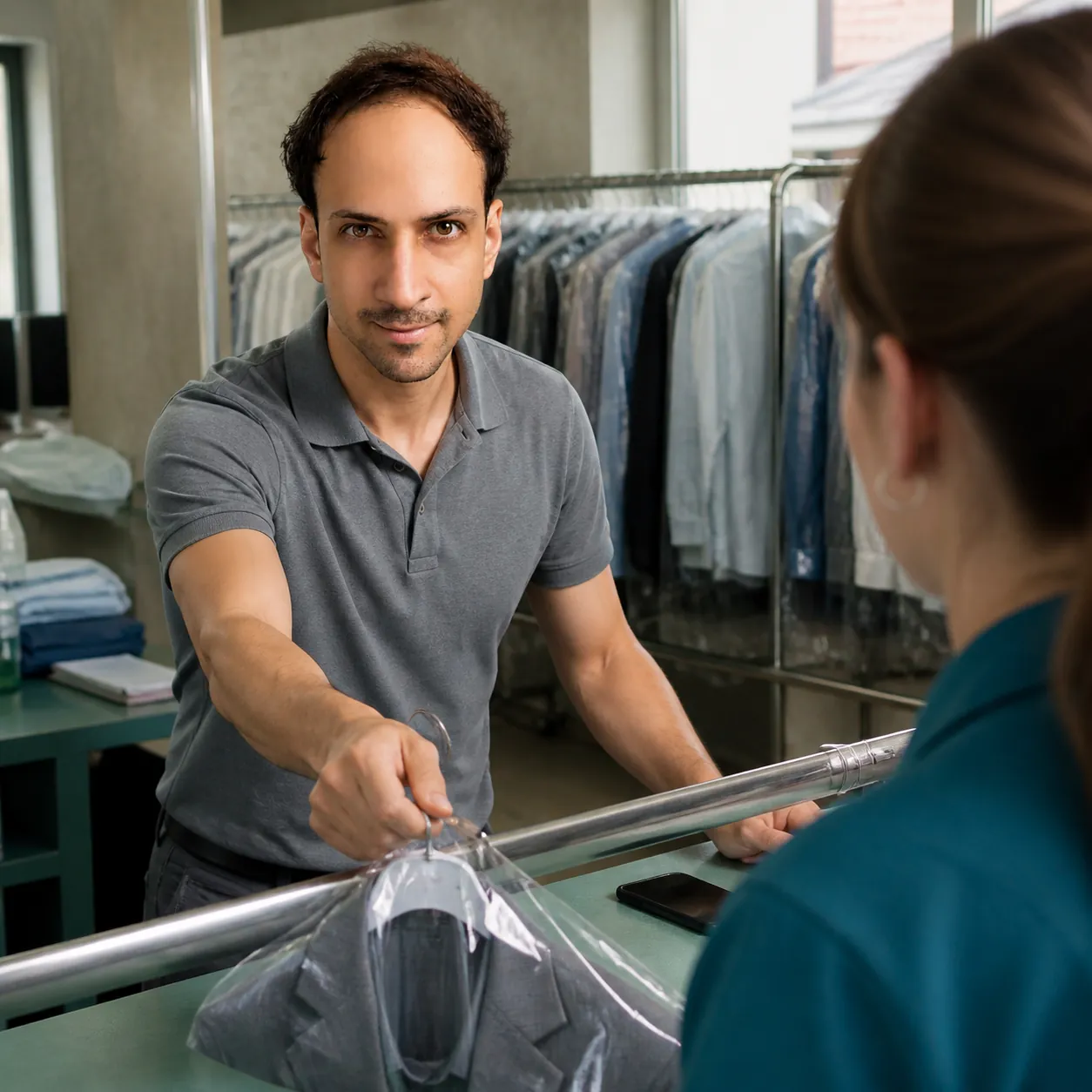
At the Dry Cleaner's Counter — AI Portrait Prompt
صورةAI Portraits

Turn your own photo into a photorealistic portrait in a dry cleaner's counter where pressed garments turn on the rail behind. Keeps your face unchanged.

من نص البرومبت

Use the attached reference photo as the identity reference: keep the same face, skin tone, hair and features as the person in that photo, without beautifying, aging or altering them. Create a square 1:1 museum-catalog frame with a strong first read and a slower second read at exactly 2880x2880 pixels. Location: a dry cleaner's counter where pressed garments turn on the rail behind. Show the subject in a stone-grey polo and dark trousers with one folded cuff, sliding a hanger along the counter rail toward the attendant. Photograph this as though nothing were happening: a phone lowered face-down within a second of a long answer becoming the short one they finally sent says the closest true thing the available language will actually hold. Explore what a person owes a question their language was never built to answer; expression composed and unremarkable, carrying steady friendliness, the weight held inside the ordinary tempo. Frame the subject at chest height so their hands and their face stay equally readable in one plane. Make the composition leave the strongest evidence at the edge of the frame. Render it as gallery-grade quiet realism assembling lived-in rooms, precise gesture observation, muted material texture, and framing that never announces its subject, using flat afternoon daylight through a plain window, shadows soft and unremarkable and a palette of cool concrete, off-white, and a single dusty teal. Photorealistic: this must read as a real photograph from a physical camera, never an illustration, painting, or 3D render. Resolve real surface detail: glass with real thickness at its edge, reflections that carry the room's actual colour, and dust visible only at grazing angles. Keep one identity-locked person, credible hands and fingers, natural fabric, and coherent scale, contact, reflections, shadows, airflow, deformation, and materials. Background people only when essential, always secondary and clearly different. Avoid tears, head in hands, staring through windows, hunched silhouettes, and any object announcing illness. No text, labels, logos, signatures, watermarks, random symbols, plastic skin, excessive bloom, or glossy AI finish.
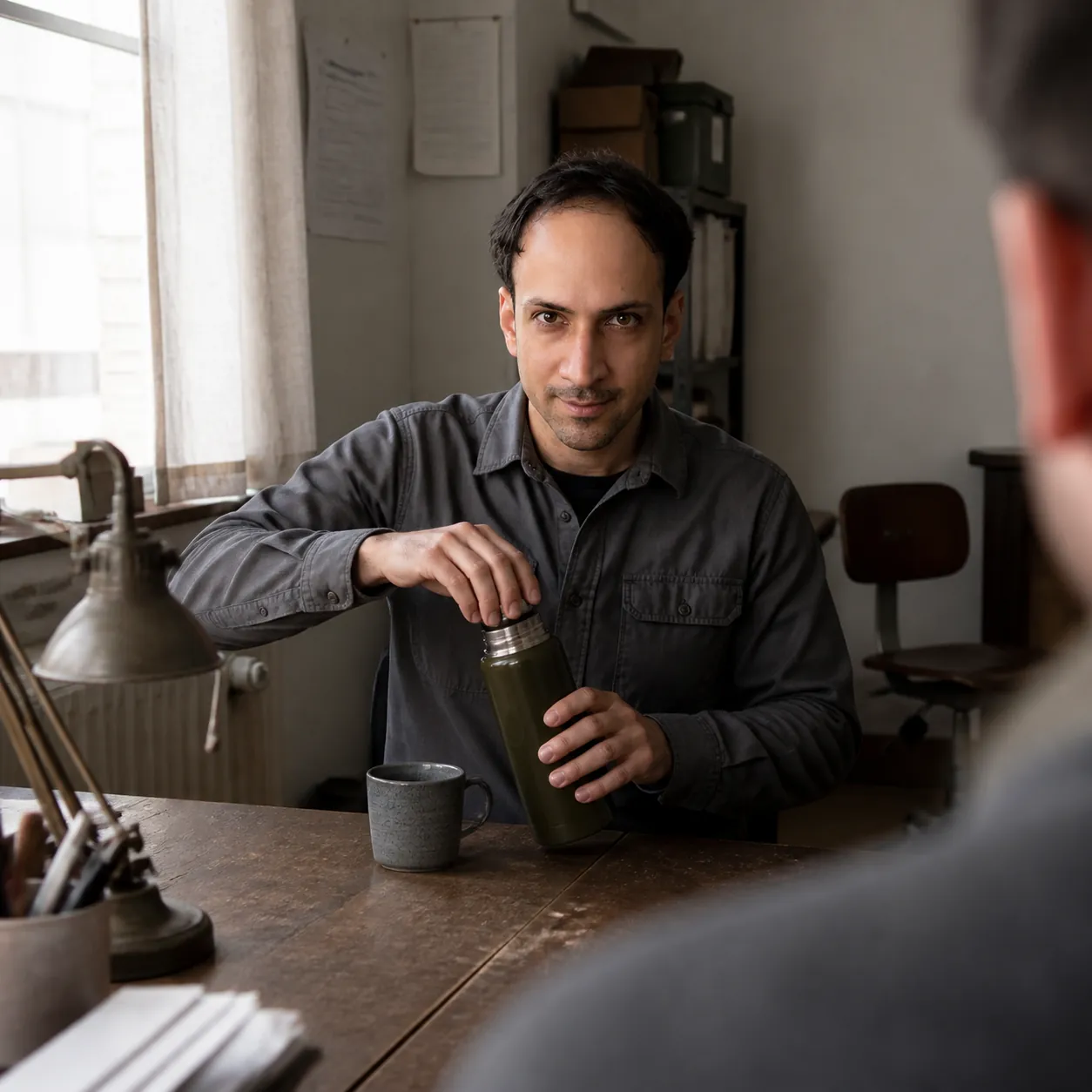
Flask Closed After One Cup — AI Portrait Prompt
صورةAI Portraits

Turn your own photo into a portrait in a small workshop office where a second chair sits pushed back. Keeps your face unchanged.

من نص البرومبت

Use the attached reference photo as the identity reference: keep the same face, skin tone, hair and features as the person in that photo, without beautifying, aging or altering them. Create a square 1:1 museum-catalog frame with a strong first read and a slower second read at exactly 2880x2880 pixels. Location: a small workshop office where a second chair sits pushed back. Show the subject in a grey work shirt with the sleeves buttoned at the wrist, screwing a flask lid closed after filling one cup. Make this the only tell, easy to miss: a hand that presses flat against the nearest surface, its fingers a fraction wider apart than any resting hand would keep them assigns the whole cost to a later hour with nobody else in it. Explore why the calm everyone relies on is the most expensive thing they own; expression composed and unremarkable, carrying settled politeness, the weight held until the room empties. Place the lens slightly behind another person's shoulder without letting that shoulder crowd or obscure them. Make the composition hold more empty room than the moment seems to need. Render it as gallery-grade domestic reportage built from truthful available light, unglamorous room detail, natural fabric behavior, and unhurried human presence, using flat daylight through a curtained window with soft, unremarkable shadow falloff and a palette of soft taupe, cool white, and a single olive-green note. Photorealistic: this must read as a real photograph from a physical camera, never an illustration, painting, or 3D render. Resolve real surface detail: paper fibre visible at cut edges, plastic that shows mould lines, and paint thicker where a brush turned. Keep one identity-locked person, credible hands and fingers, natural fabric, and coherent scale, contact, reflections, shadows, airflow, deformation, and materials. Background people only when essential, always secondary and clearly different. Avoid pill bottles, loosened ties, clenched fists, rain-streaked glass, and any heroic stoic-warrior posing. No text, labels, logos, signatures, watermarks, random symbols, plastic skin, excessive bloom, or glossy AI finish.
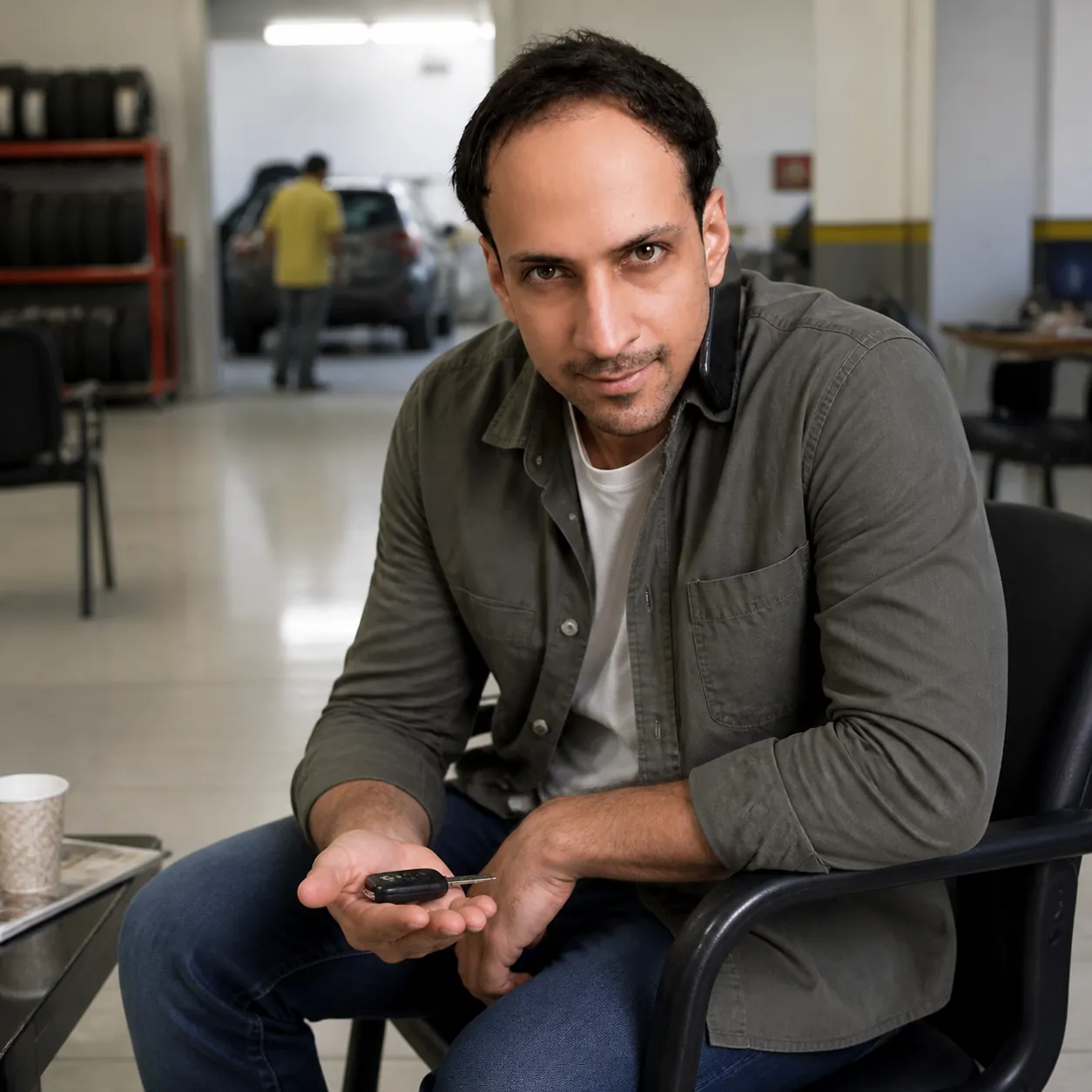
Car Key in the Waiting Corner — AI Portrait Prompt
صورةAI Portraits

Turn your own photo into a photorealistic portrait in a tyre shop's customer corner with plastic chairs and a low table. Keeps your face unchanged.

من نص البرومبت

Use the attached reference photo as the identity reference: keep the same face, skin tone, hair and features as the person in that photo, without beautifying, aging or altering them. Create a square 1:1 museum-catalog frame with a strong first read and a slower second read at exactly 2880x2880 pixels. Location: a tyre shop's customer corner with plastic chairs and a low table. Show the subject in a faded olive work shirt over a white undershirt and jeans, turning a car key over once in their palm. Build the frame on this unremarkable detail: a phone held against their shoulder while their free hand keeps working at the speed it had before the call came spends time where a sentence should have gone and loses nothing. Explore how an ordinary exchange can hold something neither person has words for; expression composed and unremarkable, carrying unremarkable ease, the weight held without disturbing the exchange. Shoot a quiet 85mm portrait from standing height, with the room's ordinary depth left intact behind them. Make the composition leave the strongest evidence at the edge of the frame. Render it as plain reportage photography made from ordinary contemporary Saudi interiors, believable props, natural posture, and completely undramatic lighting choices, using overhead office fluorescents evened out by daylight from the corridor beyond and a palette of steel grey, milk white, and a quiet mustard accent. Photorealistic: this must read as a real photograph from a physical camera, never an illustration, painting, or 3D render. Resolve real surface detail: hair with individual strands catching light, short hairs of uneven length, and skin oil giving a low uneven sheen. Keep one identity-locked person, credible hands and fingers, natural fabric, and coherent scale, contact, reflections, shadows, airflow, deformation, and materials. Background people only when essential, always secondary and clearly different. Avoid rain-streaked glass, shadow-bar drama, clasped praying hands, symbolic empty chairs, and heroic poster framing. No text, labels, logos, signatures, watermarks, random symbols, plastic skin, excessive bloom, or glossy AI finish.
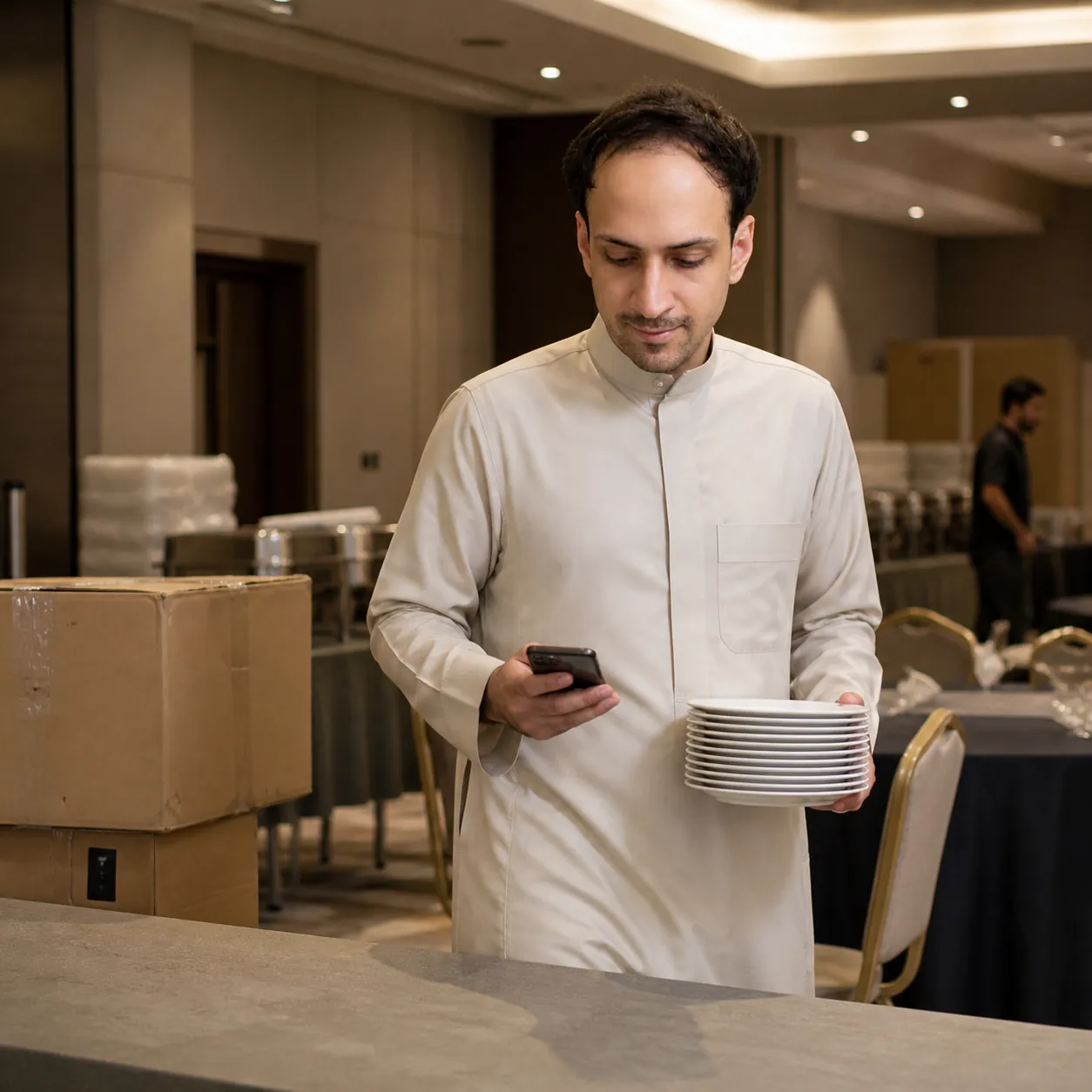
Laying Out the Function Hall — AI Portrait Prompt
صورةAI Portraits

Turn your own photo into a plain reportage portrait in a rented function hall being laid out for the evening. Keeps your face unchanged.

من نص البرومبت

Use the attached reference photo as the identity reference: keep the same face, skin tone, hair and features as the person in that photo, without beautifying, aging or altering them. Create a square 1:1 museum-catalog frame with a strong first read and a slower second read at exactly 2880x2880 pixels. Location: a rented function hall being laid out for the evening. Show the subject in a light beige traditional Gulf outfit with its sleeves shaken straight, walking a stack of side plates along the table. Build the frame on this unremarkable detail: a phone whose list stays tilted out of readable view, their thumb crossing one place without slowing for it makes its clearest statement out of the one thing withheld. Explore what a person says by moving steadily past one place in a list; expression composed and unremarkable, carrying polite readiness, the weight held where the eye never stops. Shoot at 85mm from standing height, keeping the room's geometry honest behind them. Make the composition let the gap fall exactly on a natural sightline. Render it as plain reportage realism using real furniture, accurate light falloff, unposed body language, and museum-grade material detail, using warm interior downlights at their usual setting, shadows soft and unremarkable and a palette of warm grey, bone, and one muted olive accent. Photorealistic: this must read as a real photograph from a physical camera, never an illustration, painting, or 3D render. Resolve real surface detail: label-free packaging showing carton fibre, cardboard bruised at the corners, and tape lifting slightly at one end. Keep one identity-locked person, credible hands and fingers, natural fabric, and coherent scale, contact, reflections, shadows, airflow, deformation, and materials. Background people only when essential, always secondary and clearly different. Avoid visible sadness, head in hands, staring through windows, candles, and memorial arrangements. No text, labels, logos, signatures, watermarks, random symbols, plastic skin, excessive bloom, or glossy AI finish.
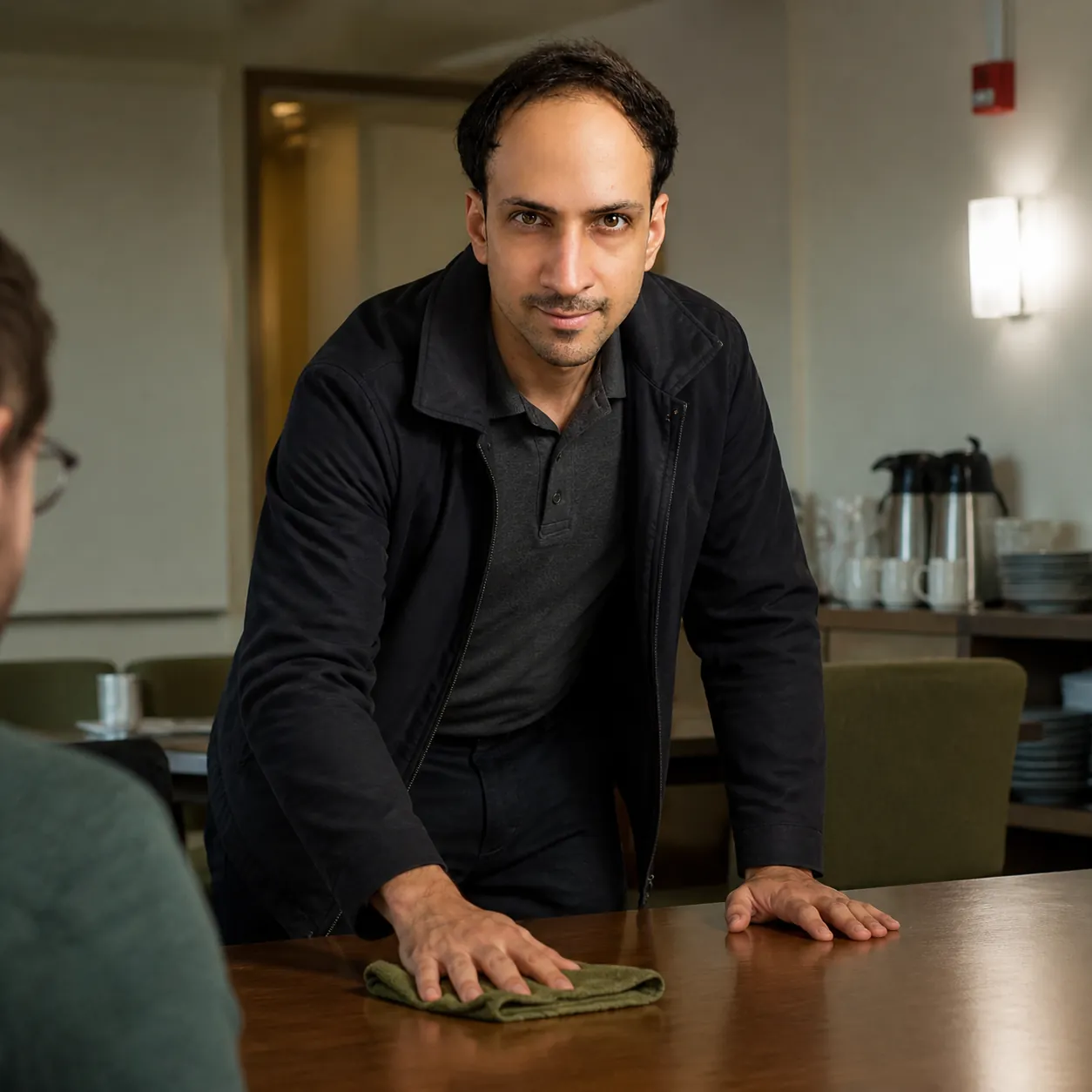
Jacket On in the Staff Room — AI Portrait Prompt
صورةAI Portraits

Turn your own photo into a portrait in a university staff room emptying out after a long afternoon meeting. Keeps your face unchanged.

من نص البرومبت

Use the attached reference photo as the identity reference: keep the same face, skin tone, hair and features as the person in that photo, without beautifying, aging or altering them. Create a square 1:1 museum-catalog frame with a strong first read and a slower second read at exactly 2880x2880 pixels. Location: a university staff room emptying out after a long afternoon meeting. Show the subject in a slate knit polo tucked into dark chinos, wiping the table's far end with a folded cloth. Photograph this as though nothing were happening: an outdoor jacket still on their shoulders well inside the building, where every reason to keep it on stopped applying minutes ago assigns the whole cost to a later hour with nobody else in it. Explore why nobody thinks to ask what the steadiest person in the room spent; expression composed and unremarkable, carrying unhurried civility, the weight held just under the courtesy. Frame the subject at mid-torso from a seated companion's height so their hands and face share one plane. Make the composition keep one other person present only as a partial edge. Render it as gallery-grade domestic reportage built from truthful available light, unglamorous room detail, natural fabric behavior, and unhurried human presence, using mixed household light from two practicals, neither one dramatic nor flattering and a palette of soft taupe, cool white, and a single olive-green note. Photorealistic: this must read as a real photograph from a physical camera, never an illustration, painting, or 3D render. Resolve real surface detail: skin that reddens slightly under pressure, nail beds with honest colour, and knuckle creases that fold rather than blur. Keep one identity-locked person, credible hands and fingers, natural fabric, and coherent scale, contact, reflections, shadows, airflow, deformation, and materials. Background people only when essential, always secondary and clearly different. Avoid pill bottles, loosened ties, clenched fists, rain-streaked glass, and any heroic stoic-warrior posing. No text, labels, logos, signatures, watermarks, random symbols, plastic skin, excessive bloom, or glossy AI finish.
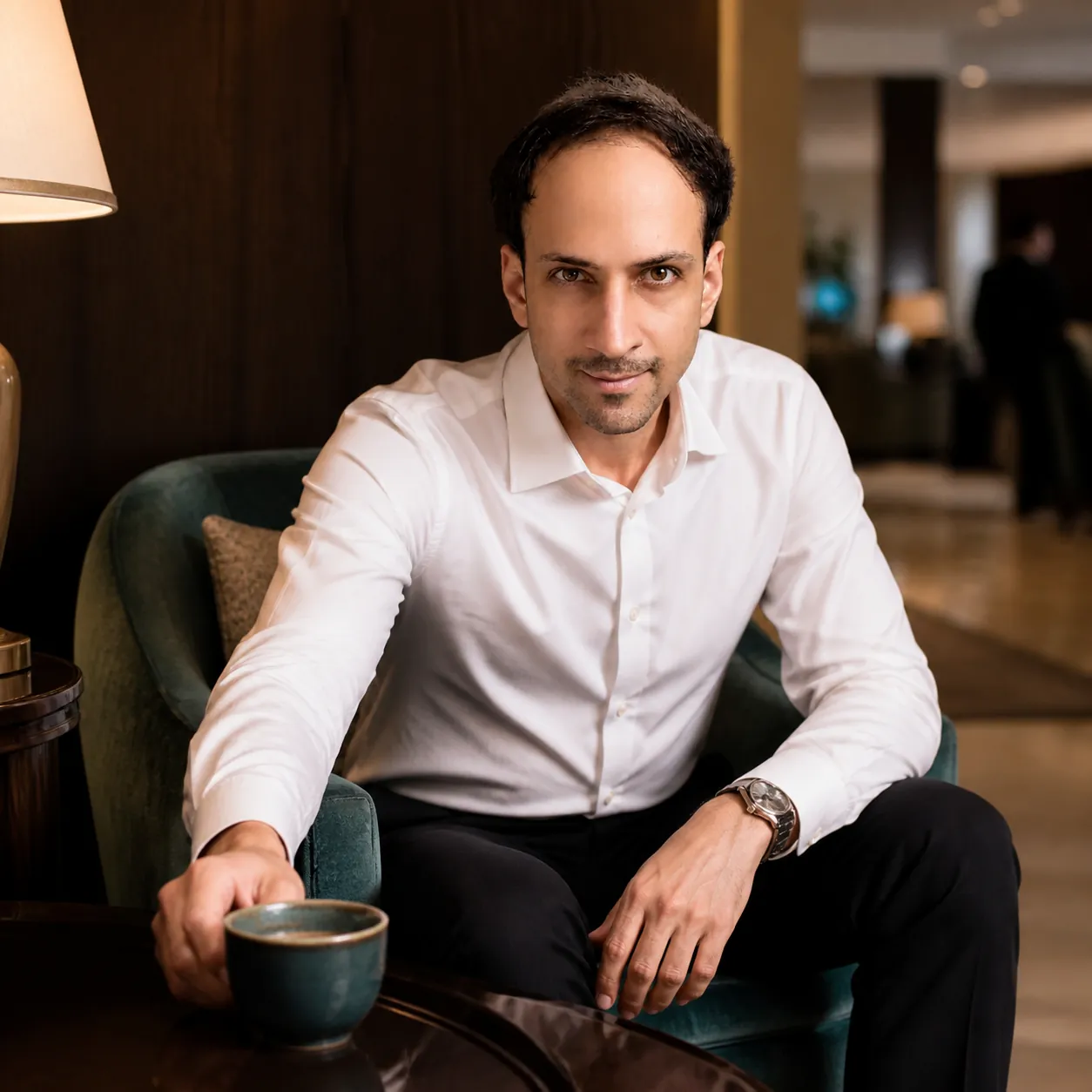
A Second Correction — AI Portrait Prompt
صورةAI Portraits

Turn your own photo into an unforced documentary portrait in a hotel lobby alcove where a colleague has stepped away briefly. Keeps your face unchanged.

من نص البرومبت

Use the attached reference photo as the identity reference: keep the same face, skin tone, hair and features as the person in that photo, without beautifying, aging or altering them. Create a square 1:1 museum-catalog frame with a strong first read and a slower second read at exactly 2880x2880 pixels. Location: a hotel lobby alcove where a colleague has stepped away briefly. Show the subject in a pressed white shirt with the cuffs buttoned and dark trousers, setting a coffee cup down on the low side table. Let the weight sit here and look like nothing: a second correction laid onto something already straight by a hand that had finished with it a full minute ago prices a calm that everyone else has always mistaken for a personality. Explore how composure can be flawless and expensive at exactly the same moment; expression composed and unremarkable, carrying plain steadiness, the weight held just under the courtesy. Use a 50mm eye-level view at conversational distance with natural perspective and shallow but honest depth. Make the composition read as an ordinary photograph until the second look. Render it as unforced documentary portraiture built from ordinary domestic realism, restrained contemporary art direction, honest skin rendering, and patient observational framing, using mixed household light from two practicals, neither one dramatic nor flattering and a palette of oat white, dark walnut, and one restrained teal accent. Photorealistic: this must read as a real photograph from a physical camera, never an illustration, painting, or 3D render. Resolve real surface detail: the difference between a wiped surface and a clean one, faint tide marks on ceramic, and metal dulled unevenly by touch. Keep one identity-locked person, credible hands and fingers, natural fabric, and coherent scale, contact, reflections, shadows, airflow, deformation, and materials. Background people only when essential, always secondary and clearly different. Avoid head in hands, slumped shoulders, staring out of windows, visible tears, and sad-eyed lighting. No text, labels, logos, signatures, watermarks, random symbols, plastic skin, excessive bloom, or glossy AI finish.
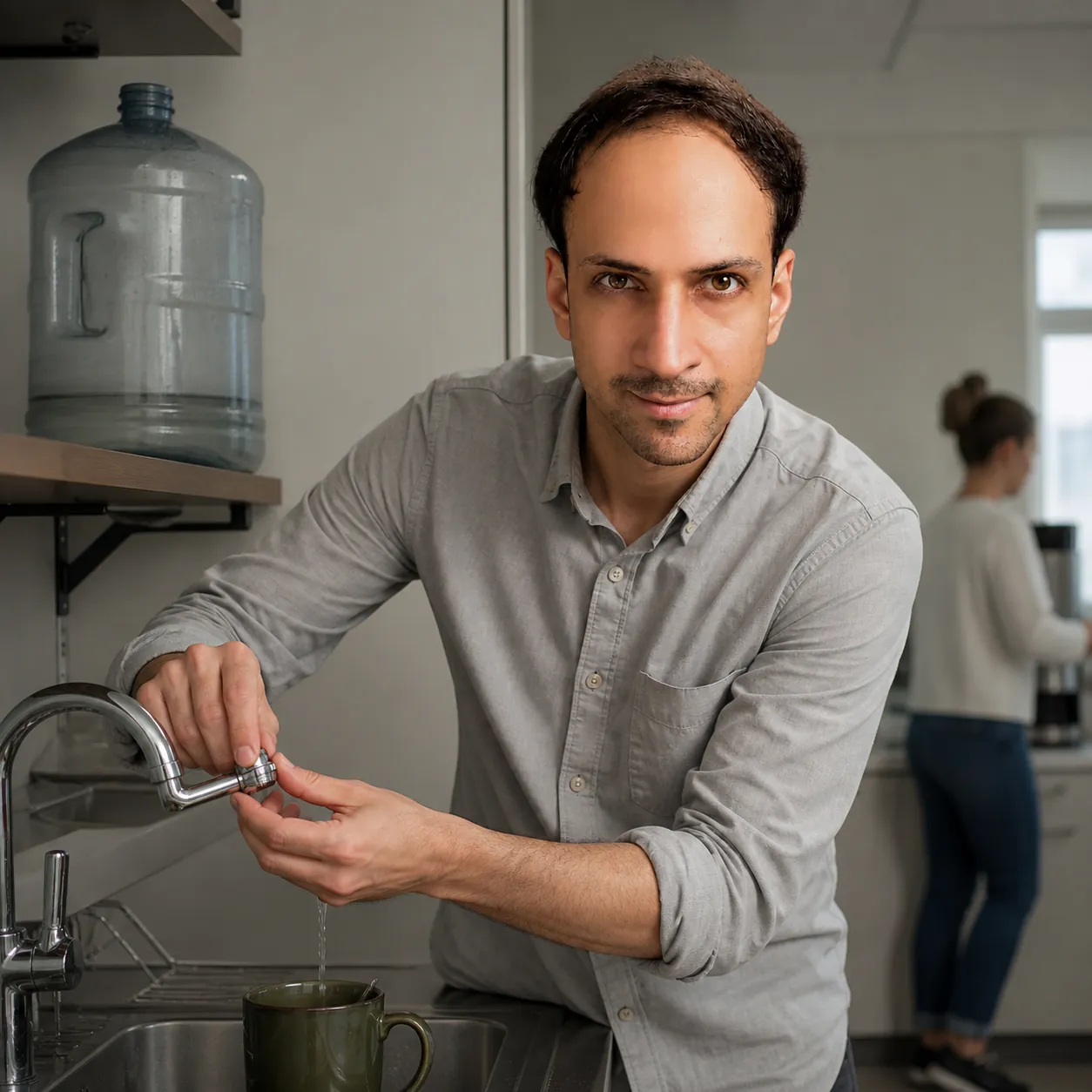
The Jug's Pale Ring — AI Portrait Prompt
صورةAI Portraits

Turn your own photo into a plain documentary portrait in a shared office pantry where a colleague's mug is already draining. Keeps your face unchanged.

من نص البرومبت

Use the attached reference photo as the identity reference: keep the same face, skin tone, hair and features as the person in that photo, without beautifying, aging or altering them. Create a square 1:1 museum-catalog frame with a strong first read and a slower second read at exactly 2880x2880 pixels. Location: a shared office pantry where a colleague's mug is already draining. Show the subject in a pale grey shirt with the sleeves turned back once each, screwing an aerator back onto the tap by hand. Let the weight sit here and look like nothing: a full water jug set back on the shelf where its base has printed a pale ring over hundreds of fillings keeps an honest count of its own repetitions without asking anyone to notice. Explore why a thing done for the hundredth time can still be done properly; expression composed and unremarkable, carrying plain competence, the weight held nowhere the picture can show it. Use a 50mm eye-level view at conversational distance with natural, modest perspective. Make the composition let the worn mark sit lower than their hands. Render it as plain documentary portraiture built from unstaged domestic realism, honest material wear, restrained editorial framing, and unforced human presence, using flat overcast daylight through one window, even across the room and unglamorous and a palette of warm grey, unbleached cotton, and one muted olive accent. Photorealistic: this must read as a real photograph from a physical camera, never an illustration, painting, or 3D render. Resolve real surface detail: true skin texture with pores and fine hair at the hairline, and fabric that creases where it is actually stressed. Keep one identity-locked person, credible hands and fingers, natural fabric, and coherent scale, contact, reflections, shadows, airflow, deformation, and materials. Background people only when essential, always secondary and clearly different. Avoid visible sadness, head-in-hands poses, staring out of windows, sighing postures, and any object announcing illness. No text, labels, logos, signatures, watermarks, random symbols, plastic skin, excessive bloom, or glossy AI finish.

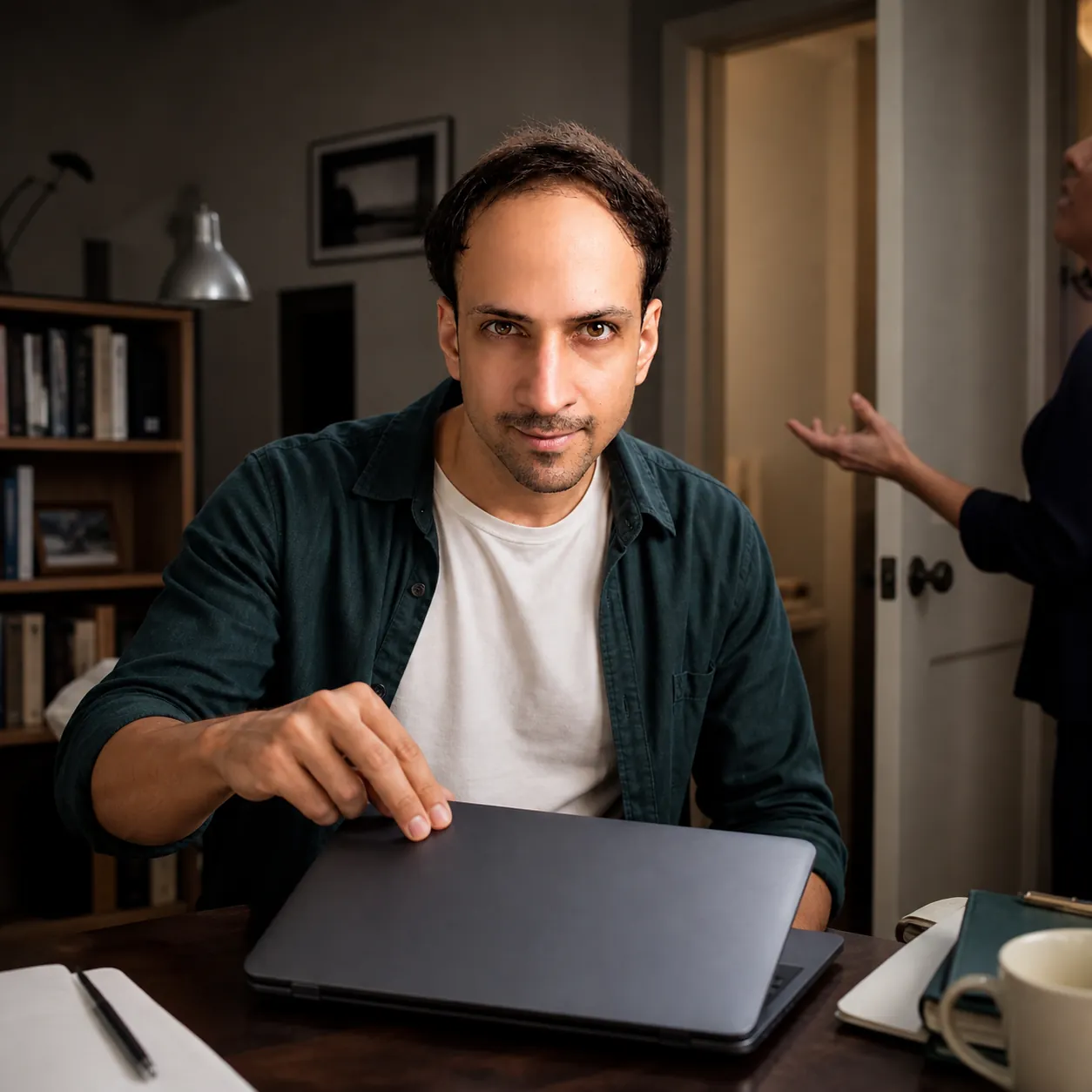
Closing the Laptop Lid — AI Portrait Prompt
صورةAI Portraits

Turn your own photo into a museum-scale contemporary portrait in a home study with a voice carrying through the half-open door. Keeps your face unchanged.

من نص البرومبت

Use the attached reference photo as the identity reference: keep the same face, skin tone, hair and features as the person in that photo, without beautifying, aging or altering them. Create a square 1:1 museum-catalog frame with a strong first read and a slower second read at exactly 2880x2880 pixels. Location: a home study with a voice carrying through the half-open door. Show the subject in a plain white tee beneath an open cotton overshirt, closing a laptop lid with two unhurried fingers. Hide the whole argument in this ordinary moment: a half-completed motion still held at the exact height that it reached when another voice in the room began a sentence prices a calm that everyone else has always mistaken for a personality. Explore what a steady person is actually paying, and to whom, and when it comes due; expression composed and unremarkable, carrying plain steadiness, the weight held off the visible ledger. Use a quiet 40mm frame that includes the doorway they have not yet walked through. Make the composition keep one other person present only as a partial edge. Render it as museum-scale contemporary portraiture combining sober documentary craft, accurate everyday surfaces, believable clothing weight, and emotionally intelligent restraint, using plain fluorescent ceiling light typical of a working room after hours and a palette of oat white, dark walnut, and one restrained teal accent. Photorealistic: this must read as a real photograph from a physical camera, never an illustration, painting, or 3D render. Resolve real surface detail: visible weave in cloth, fine scratches on metal, and the faint unevenness of painted walls. Keep one identity-locked person, credible hands and fingers, natural fabric, and coherent scale, contact, reflections, shadows, airflow, deformation, and materials. Background people only when essential, always secondary and clearly different. Avoid head in hands, slumped shoulders, staring out of windows, visible tears, and sad-eyed lighting. No text, labels, logos, signatures, watermarks, random symbols, plastic skin, excessive bloom, or glossy AI finish.