Treat that reference as the character anchor and change only the scene. Create a square 1:1 museum-catalog frame with a strong first read and a slower...
من نص البرومبت
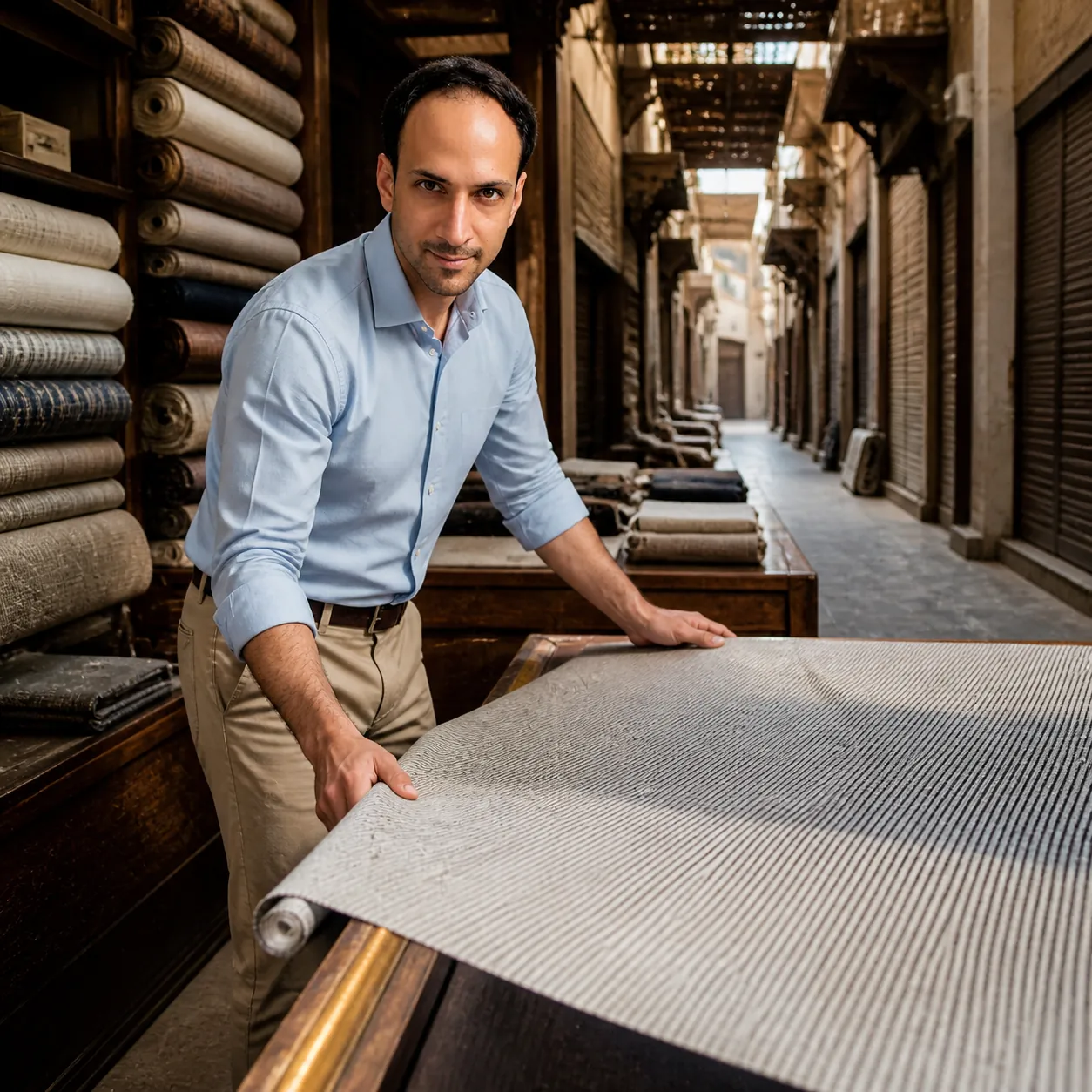
Use the attached reference photo as the identity reference: keep the same face, skin tone, hair and features as the person in that photo, without beautifying, aging or altering them. Treat that reference as the character anchor and change only the scene. Create a square 1:1 museum-catalog frame with a strong first read and a slower second read at exactly 2880x2880 pixels. Location: a covered textile souq aisle before opening, bolts shelved high. Show the subject in a light-blue casual shirt tucked into pressed sand chinos, unrolling a forearm's length of cloth across the counter. Use this advanced image-making device as the core logic: a corridor of two woven wire fences one stride apart, through which giant slow bands roll at any shift of viewpoint gives stillness a pulse the camera can record without any trick. Explore whether motion the eye reports but the world denies still counts as real; direct expression and posture toward still absorption, never melodrama or ad-like confidence. Use a restrained 35mm view with verticals kept true, the subject at one-third and the patterned field beyond. Make the composition give the emergent pattern more visual weight than either honest layer. Render it as museum-grade optical demonstration realism combining true moiré geometry, tactile weave detail, faithful shadow behavior, and calm editorial framing, using cool ambient daylight lifted by one warm bounce off nearby wood and a palette of bone linen, graphite line-work, and a low brass accent. Photorealistic: this must read as a real photograph from a physical camera, never an illustration, painting, or 3D render. Resolve real surface detail: thread ends and slight pilling on worn cloth, hairline chips at every hard corner, and stone that is porous rather than smooth. Keep one identity-locked person, credible hands and fingers, natural fabric, and coherent scale, contact, reflections, shadows, airflow, deformation, and materials. Background people only when essential, always secondary and clearly different. Avoid kaleidoscope symmetry, fake motion blur, rainbow chromatic fringing, and funhouse distortion of their features. No text, labels, logos, signatures, watermarks, random symbols, plastic skin, excessive bloom, or glossy AI finish.