جاري التحميل...


جاري التحميل...
Create a square 1:1 museum-catalog frame with a strong first read and a slower second read. Location: a long apartment hallway lit by one low amber...
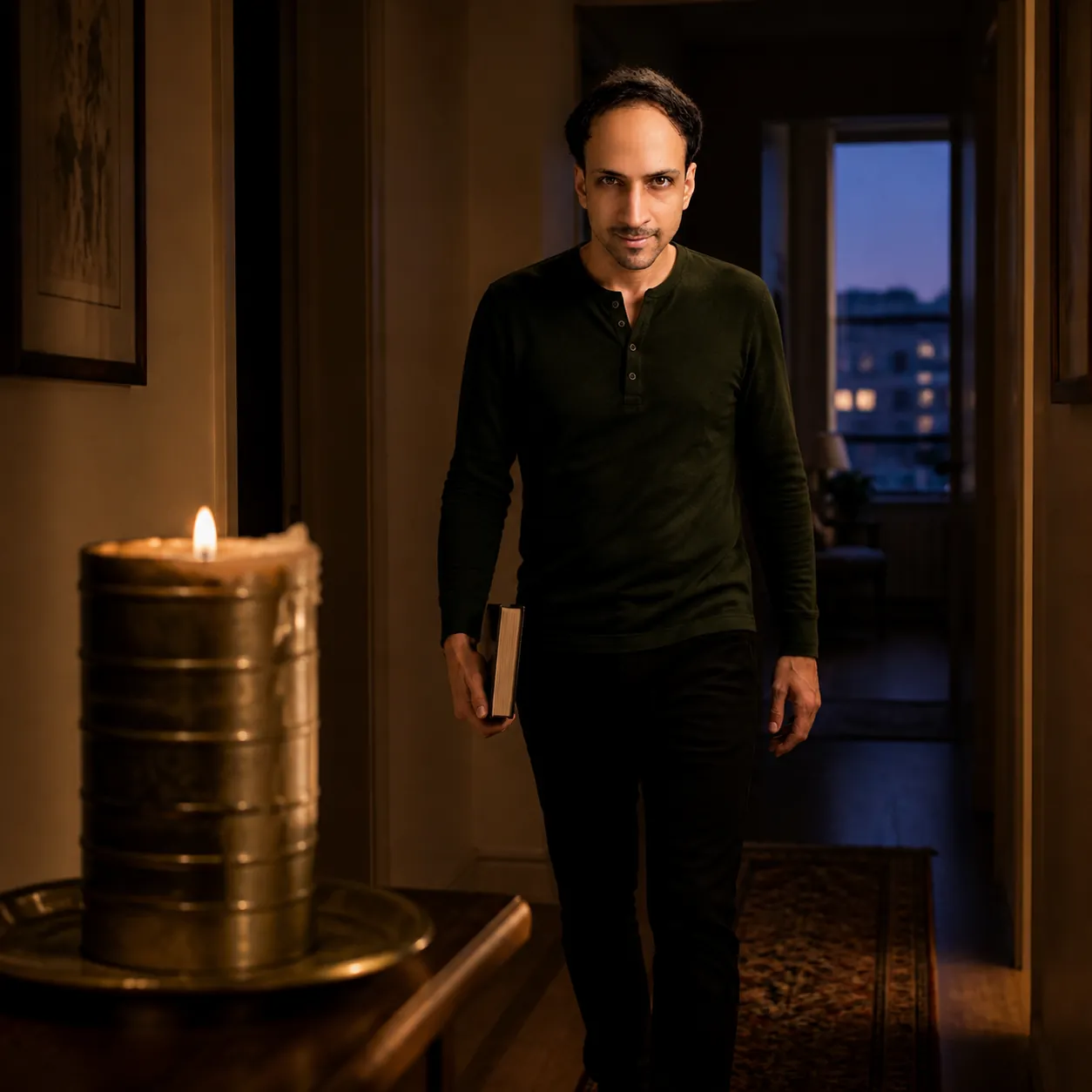
Use the attached reference photo as the identity reference: keep the same face, skin tone, hair and features as the person in that photo, without beautifying, aging or altering them. Create a square 1:1 museum-catalog frame with a strong first read and a slower second read. Location: a long apartment hallway lit by one low amber nightlight. Show the subject in a dark green henley and soft black trousers, walking one slow step with a book kept closed at their side. The impossible-looking event must obey this clear system: a thick candle cast with brass hour rings whose flame has burned down to the ring marked for sleep gives the evening a working mechanism instead of a willpower test. Explore what brightness actually costs when it is finally itemized; direct expression and posture toward grounded acceptance, never melodrama or ad-like confidence. Use a 100mm macro-to-portrait hybrid: one clockwork detail near the lens and the person in the reference photo's face readable beyond it, both physically plausible. Make the composition let the last lit object be the one they are finished with. Render it as gallery-grade twilight photography built from real graded light, quiet domestic architecture, accurate skin rendering in low lux, and unhurried observational framing, using quiet blue-hour ambient light with one low-intensity tungsten interior source and a palette of warm parchment, dark walnut, and a strip of dusk violet. Keep one identity-locked person, credible hands and fingers, natural fabric, and coherent scale, contact, reflections, shadows, airflow, deformation, and materials. Background people only when essential, always secondary and clearly different. Avoid glowing smartphone screens, blue-lit doomscrolling, alarm-clock clichés, sleeping-pill imagery, and insomnia dramatics. No text, labels, logos, signatures, watermarks, random symbols, plastic skin, excessive bloom, or glossy AI finish.
Treat that reference as the character anchor and change only the scene. Create a square 1:1 museum-catalog frame with a strong first read and a slower...
Treat that reference as the character anchor and change only the scene. Create a square 1:1 museum-catalog frame with a strong first read and a slower...
Treat that reference as the character anchor and change only the scene. Create a square 1:1 museum-catalog frame with a strong first read and a slower...
Treat that reference as the character anchor and change only the scene. Create a square 1:1 museum-catalog frame with a strong first read and a slower...
Treat that reference as the character anchor and change only the scene. Create a square 1:1 museum-catalog frame with a strong first read and a slower...
Treat that reference as the character anchor and change only the scene. Create a square 1:1 museum-catalog frame with a strong first read and a slower...
Treat that reference as the character anchor and change only the scene. Create a square 1:1 museum-catalog frame with a strong first read and a slower...
Treat that reference as the character anchor and change only the scene. Create a square 1:1 museum-catalog frame with a strong first read and a slower...
Treat that reference as the character anchor and change only the scene. Create a square 1:1 museum-catalog frame with a strong first read and a slower...
Treat that reference as the character anchor and change only the scene. Create a square 1:1 museum-catalog frame with a strong first read and a slower...
Treat that reference as the character anchor and change only the scene. Create a square 1:1 museum-catalog frame with a strong first read and a slower...
Treat that reference as the character anchor and change only the scene. Create a square 1:1 museum-catalog frame with a strong first read and a slower...