جاري التحميل...


جاري التحميل...
Build a vertical 4:5 layout containing exactly 7 panels, read top to bottom. Keep the same wardrobe, facial landmarks, apparent age, hairline, facial hair...
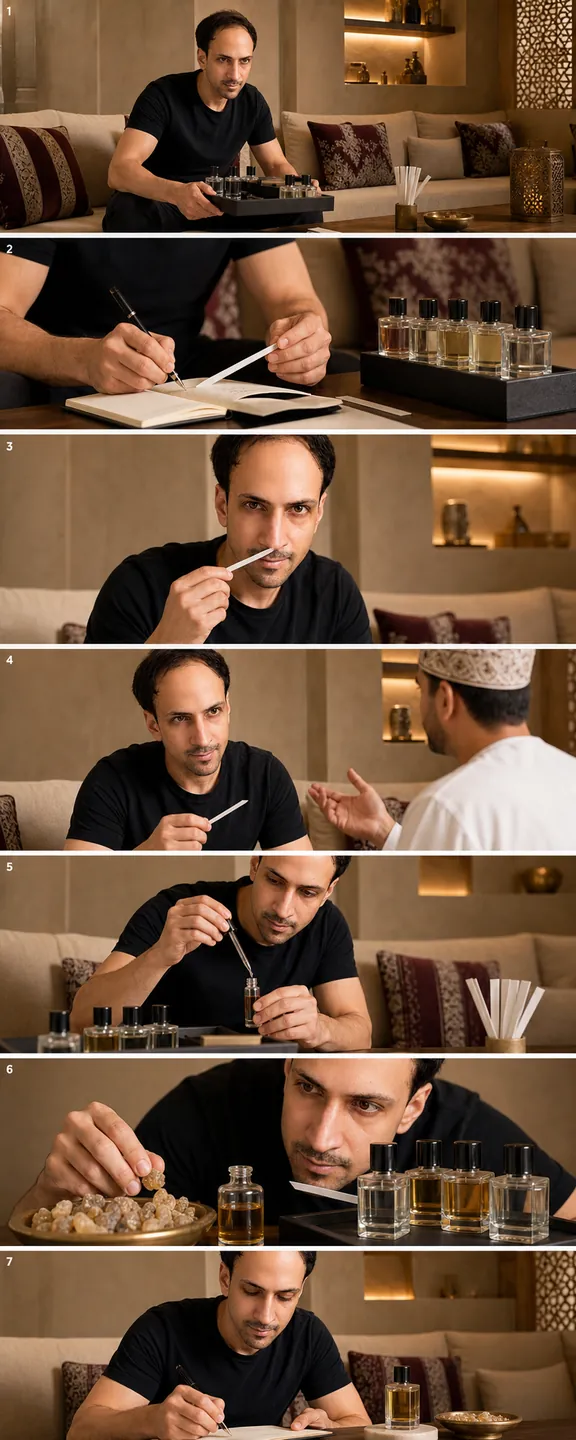
Use the attached reference photo as the identity reference: keep the same face, skin tone, hair and features as the person in that photo, without beautifying, aging or altering them. Build a vertical 4:5 layout containing exactly 7 panels, read top to bottom. Keep the same wardrobe, facial landmarks, apparent age, hairline, facial hair and environmental continuity across every panel unless a panel description explicitly changes a prop. Panel 1: establish a contemporary majlis used for a private fragrance presentation before the main action, with the person entering or settling into the space and the visual problem clearly readable. Panel 2: move closer to their hands as they prepare for the task, preserving wardrobe and object continuity. Panel 3: show the exact moment of them smelling a blotter at the correct distance with a thoughtful pause, keeping their recognizable face and natural posture consistent. Panel 4: introduce a modest complication or second person’s response, never changing the person’s identity or wardrobe. Panel 5: show the adjustment they make after noticing what the situation actually needs. Panel 6: capture the immediate result: raw material, evaluation, and finished fragrance become one continuous story. Panel 7: end on a quiet coda in the same environment, with one changed object or gesture proving that the sequence has moved forward. Use clean, consistent gutters and no accidental extra frames, repeated panels, or duplicated versions of the person. Render the sequence as medium-format still-life portraiture with golden-hour light reflected from sand-colored concrete rather than direct sun and cream, walnut, and faded burgundy. The emotional progression should move toward creative absorption without neglecting the body through posture and action, not facial redesign. Pair one raw material with one finished surface so craft and luxury occupy the same frame. Permit only tiny panel numbers “1” through “7” in the upper-left corner of each panel; add no other wording. Keep hands, object continuity, body scale, and perspective believable.
Turn your own photo into a quiet observational portrait in a low majlis table where a brass tray gathers glasses and dallah. Keeps your face unchanged.
Turn your own photo into a quiet observational portrait in the kitchen of your flat at night with one counter lamp on. Keeps your face unchanged.
Turn your own photo into a photorealistic portrait in the flat roof of the family house as the last daylight drains. Keeps your face unchanged.
Turn your own photo into a photorealistic portrait in your old school's corridor where the banister ends in a shine every pupil made. Keeps your face unchanged.
Turn your own photo into a candid reflex-moment portrait in a supermarket aisle stacked to the ceiling under flat white light. Keeps your face unchanged.
Turn your own photo into a patient observational portrait in a bus shelter's strip of shade on a wide afternoon road. Keeps your face unchanged.
Turn your own photo into a gallery-scale documentary portrait in an office floor at the end of the day, most desks dark. Keeps your face unchanged.
Turn your own photo into a candid reflex-moment portrait in a long office corridor of doors and cool fluorescent calm. Keeps your face unchanged.
Turn your own photo into an understated editorial portrait in the driver's seat of a parked family car with the engine off. Keeps your face unchanged.
Turn your own photo into a photorealistic portrait in the family farm gate, its latch bright and its chain thinned link by link. Keeps your face unchanged.
Turn your own photo into a photorealistic portrait in a small tailor's shop while a hem is finished somewhere behind the counter. Keeps your face unchanged.
Turn your own photo into a photorealistic portrait in a staff-room table in the slow hour of a night shift. Keeps your face unchanged.