جاري التحميل...


جاري التحميل...
Turn your own photo into a workshop still-life portrait in a tailor's cutting room with bolts of cloth shelved to the ceiling. Keeps your face unchanged.
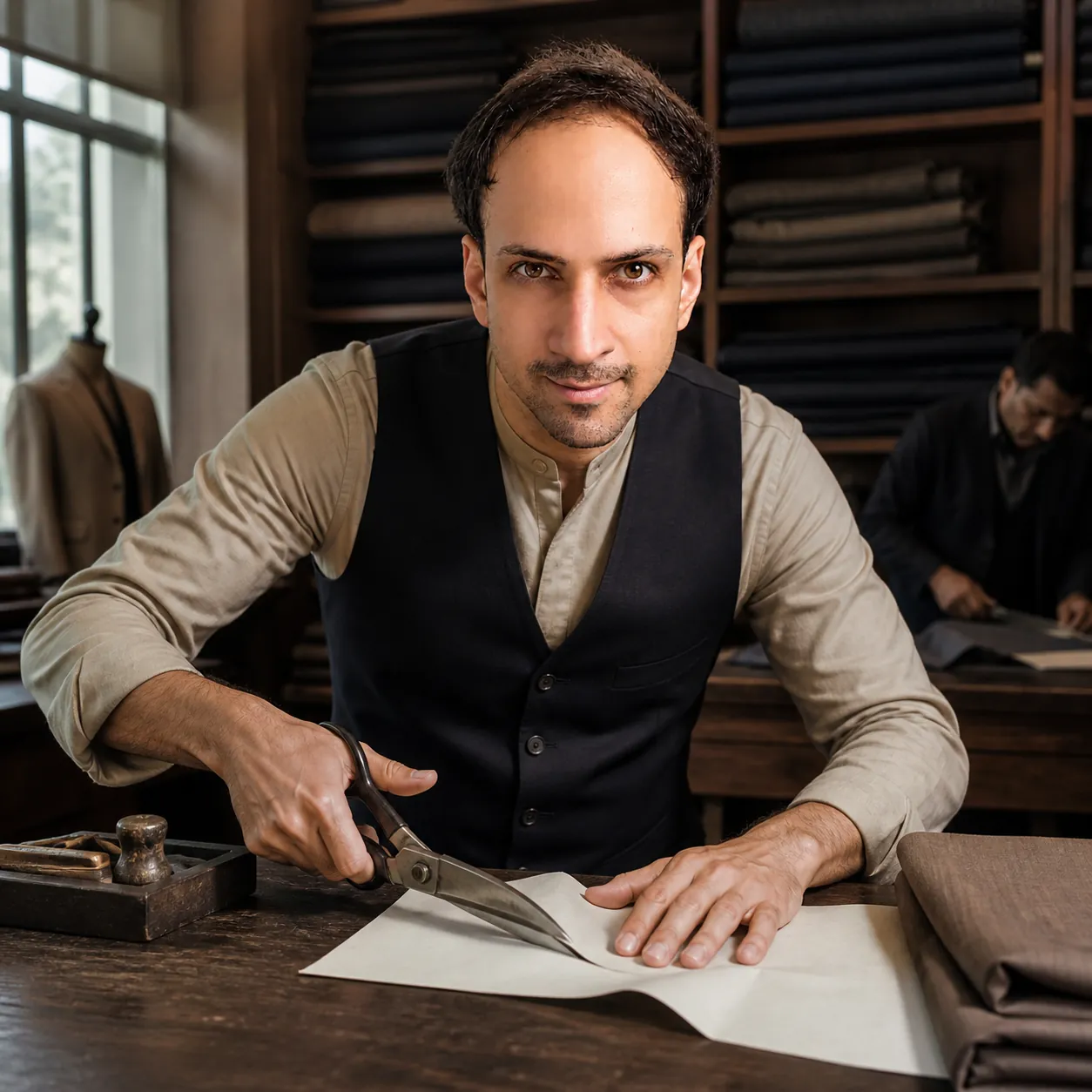
Use the attached reference photo as the identity reference: keep the same face, skin tone, hair and features as the person in that photo, without beautifying, aging or altering them. Create a square 1:1 museum-catalog frame with a strong first read and a slower second read at exactly 2880x2880 pixels. Location: a tailor's cutting room with bolts of cloth shelved to the ceiling. Show the subject in a pressed sand-toned traditional Gulf outfit under a dark tailored vest, closing long shears through paper in one slow test cut. Treat this mechanism as the frame’s governing rule: a whetstone crosshatched in pencil that fades evenly under a flattening plate until one grey trace marks the last low spot reads out the whole difference between nearly true and finally true. Explore how a hand guided by patience can find errors no eye can see; direct expression and posture toward attentive stillness, never melodrama or ad-like confidence. Frame across the benchtop at hand height so the calibration and their eyes share one focal plane. Make the composition surround one micron-scale event with generous, calm negative space. Render it as workshop still-life portraiture combining truthful tool physics, visible micro-texture on steel and skin, disciplined shadow work, and museum-label sobriety, using cool window daylight from one side with soft honest falloff into shadow and a palette of dark walnut, dull iron, and one russet leather band. Photorealistic: this must read as a real photograph from a physical camera, never an illustration, painting, or 3D render. Resolve real surface detail: leather creased along the lines of use, stitching slightly irregular, and edges burnished from contact. Keep one identity-locked person, credible hands and fingers, natural fabric, and coherent scale, contact, reflections, shadows, airflow, deformation, and materials. Background people only when essential, always secondary and clearly different. Avoid impossible mirror gleam, floating measurement holograms, oversized cartoon calipers, and artfully scattered screws. No text, labels, logos, signatures, watermarks, random symbols, plastic skin, excessive bloom, or glossy AI finish.
Turn your own photo into a photorealistic portrait in the landing of your building's stairs, one floor short of home. Keeps your face unchanged.
Turn your own photo into a photorealistic portrait in a staff-room table in the slow hour of a night shift. Keeps your face unchanged.
Turn your own photo into a photorealistic portrait in your old school's corridor where the banister ends in a shine every pupil made. Keeps your face unchanged.
Turn your own photo into a candid reflex-moment portrait in a supermarket aisle stacked to the ceiling under flat white light. Keeps your face unchanged.
Turn your own photo into a photorealistic portrait in the flat roof of the family house as the last daylight drains. Keeps your face unchanged.
Turn your own photo into a portrait in your grandfather's workshop where tool handles hang darkened at your grips. Keeps your face unchanged.
Turn your own photo into a quiet cinematic portrait in a gym bench between sets with a towel folded over the bar. Keeps your face unchanged.
Turn your own photo into a photorealistic portrait in a house courtyard at dusk with the heat lifting off the tiles. Keeps your face unchanged.
Turn your own photo into a quiet observational portrait in a low majlis table where a brass tray gathers glasses and dallah. Keeps your face unchanged.
Turn your own photo into a photorealistic portrait in a gym bench between sets with a towel folded over the bar. Keeps your face unchanged.
Turn your own photo into an understated editorial portrait in the driver's seat of a parked family car with the engine off. Keeps your face unchanged.
Turn your own photo into a quiet observational portrait in a small residential lift with another person's shoulder at the frame edge. Keeps your face unchanged.