جاري التحميل...


جاري التحميل...
Create a square 1:1 museum-catalog frame with a strong first read and a slower second read at exactly 2880x2880 pixels. Location: a restored Najdi mud-brick...
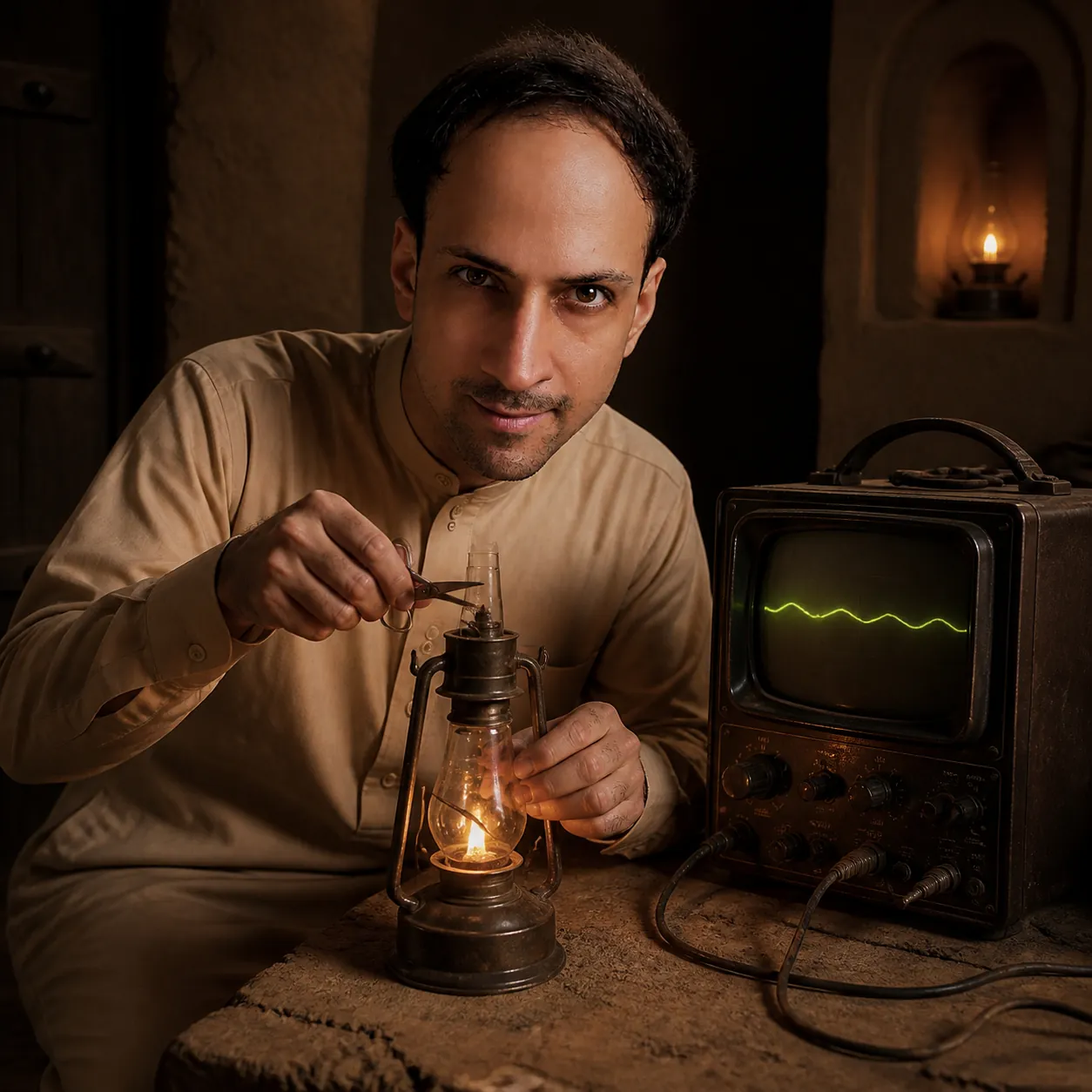
Use the attached reference photo as the identity reference: keep the same face, skin tone, hair and features as the person in that photo, without beautifying, aging or altering them. Create a square 1:1 museum-catalog frame with a strong first read and a slower second read at exactly 2880x2880 pixels. Location: a restored Najdi mud-brick room lit by one low lantern. Show them in a plain sand-colored traditional Gulf outfit, sleeves buttoned at the wrist, trimming a lantern wick to a lower flame. Build the artwork around this material rule: an analog oscilloscope whose sealed electron beam draws one slow green wave across the phosphor of a darkened screen brings a feared force close enough to study without any bravado. Explore how patience turns a feared phenomenon into a legible companion; direct expression and posture toward unhurried scrutiny, never melodrama or ad-like confidence. Use a restrained 35mm environmental view with the subject anchored off-center and hands never distorted. Make the composition hold the apparatus, their hands, and their gaze in one triangle. Render it as evidence-grade scientific photography pairing honest discharge phenomena, calibrated near-darkness exposure, believable period instrumentation, and quiet, unhurried human-scale storytelling, using one low practical lamp with the room allowed to fall away dark and a palette of soot black, aged bakelite brown, and dim neon amber. Photorealistic: this must read as a real photograph from a physical camera, never an illustration, painting, or 3D render. Resolve real surface detail: hair with individual strands catching light, fine flyaway hairs of uneven length, and skin oil giving a low uneven sheen. Keep one identity-locked person, credible hands and fingers, natural fabric, and coherent scale, contact, reflections, shadows, airflow, deformation, and materials. Background people only when essential, always secondary and clearly different. Avoid sci-fi energy balls, fractal screen-saver overlays, sparks showering from hands, wizard-lightning fingertips, and ultraviolet glow gimmicks. No text, labels, logos, signatures, watermarks, random symbols, plastic skin, excessive bloom, or glossy AI finish.
Create a square 1:1 museum-catalog frame with a strong first read and a slower second read at exactly 2880x2880 pixels. Location: a tailor's atelier after...
Create a square 1:1 museum-catalog frame with a strong first read and a slower second read at exactly 2880x2880 pixels. Location: the projection booth of a...
Create a square 1:1 museum-catalog frame with a strong first read and a slower second read at exactly 2880x2880 pixels. Location: a mud-brick alley in old...
Create a square 1:1 museum-catalog frame with a strong first read and a slower second read at exactly 2880x2880 pixels. Location: a canvas-shaded field...
Create a square 1:1 museum-catalog frame with a strong first read and a slower second read at exactly 2880x2880 pixels. Location: the swept courtyard of a...
Create a square 1:1 museum-catalog frame with a strong first read and a slower second read at exactly 2880x2880 pixels. Location: a mud-brick alley in old...
Treat that reference as the character anchor and change only the scene. Create a square 1:1 museum-catalog frame with a strong first read and a slower...
Create a square 1:1 museum-catalog frame with a strong first read and a slower second read at exactly 2880x2880 pixels. Location: a tiled hotel courtyard...
Create a square 1:1 museum-catalog frame with a strong first read and a slower second read at exactly 2880x2880 pixels. Location: a decommissioned pump...
Create a square 1:1 museum-catalog frame with a strong first read and a slower second read at exactly 2880x2880 pixels. Location: a sabkha salt flat at...
Create a square 1:1 museum-catalog frame with a strong first read and a slower second read at exactly 2880x2880 pixels. Location: a small teaching...
Treat that reference as the character anchor and change only the scene. Create a square 1:1 museum-catalog frame with a strong first read and a slower...