جاري التحميل...


جاري التحميل...
Turn your own photo into a portrait in an architect's daylighting office with section drawings pinned above a sill. Keeps your face unchanged.
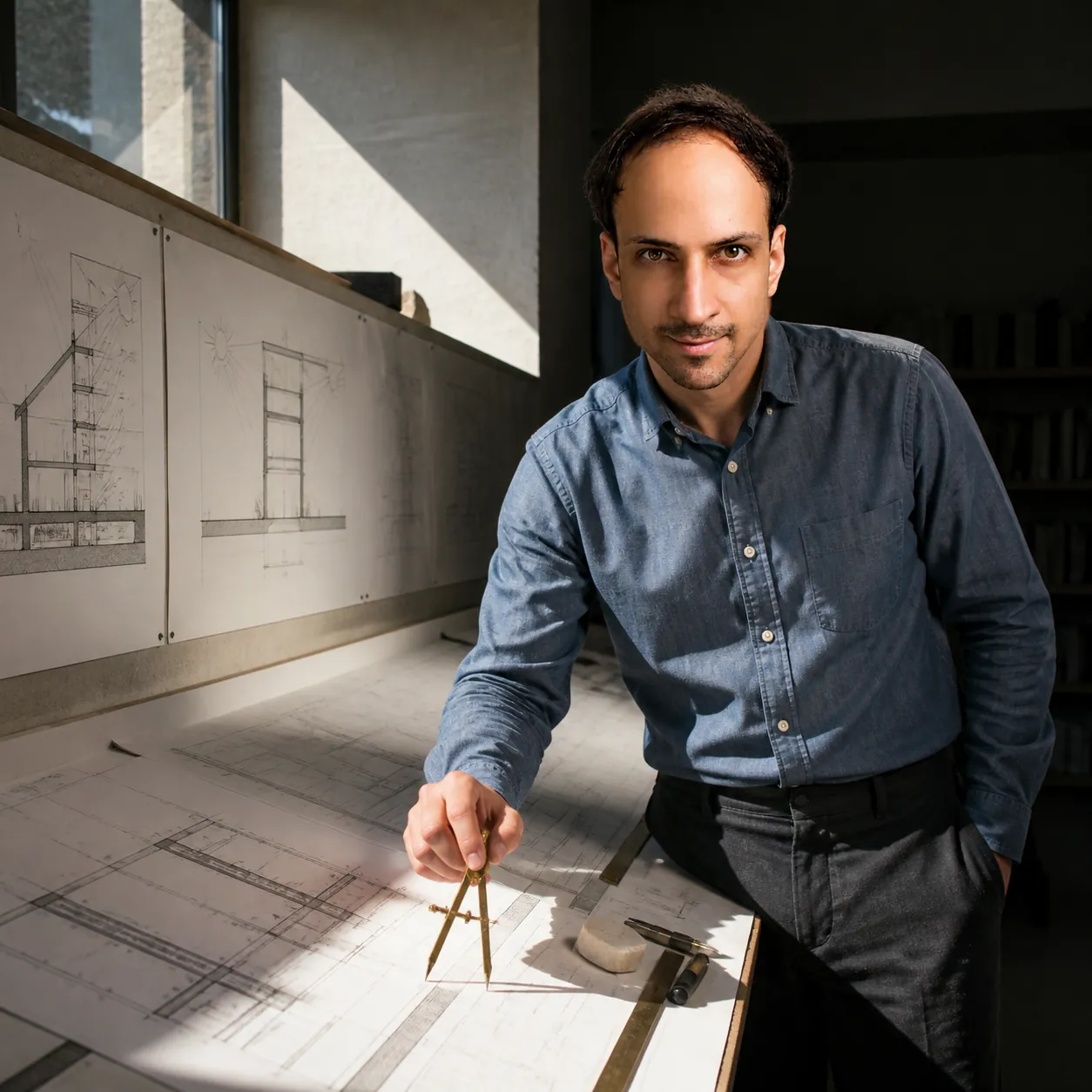
Use the attached reference photo as the identity reference: keep the same face, skin tone, hair and features as the person in that photo, without beautifying, aging or altering them. Create a square 1:1 museum-catalog frame with a strong first read and a slower second read at exactly 2880x2880 pixels. Location: an architect's daylighting office with section drawings pinned above a sill. Show the subject in a pressed chambray shirt tucked into charcoal wool trousers, walking a brass divider across a pinned section drawing. Treat this mechanism as the frame’s governing rule: a bank of degree-indexed louvres whose every notch admits a known geometric fraction of the full unfiltered beam treats morning light as a nutrient with a dose, not a mood. Explore whether stone and plaster can hold a duty of care better than machinery; direct expression and posture toward measured trust, never melodrama or ad-like confidence. Frame at chest height across the lit surface so the geometry of the beam and their eyes share focus. Make the composition divide the frame honestly between lit dose and unlit room. Render it as solar-architecture portraiture built from real beam geometry, documentary daylight realism, hand-finished plaster materiality, and quietly clinical art direction, using low-angle morning sun raking one wall while the room stays cool and dim and a palette of chalk, unpolished brass, and deep shadow blue. Photorealistic: this must read as a real photograph from a physical camera, never an illustration, painting, or 3D render. Resolve real surface detail: grout darker than tile, sealant slightly yellowed, and every joint showing a real tolerance gap. Keep one identity-locked person, credible hands and fingers, natural fabric, and coherent scale, contact, reflections, shadows, airflow, deformation, and materials. Background people only when essential, always secondary and clearly different. Avoid god-ray haze shafts, lens-flare starbursts, glowing dust volumetrics, stained-glass rainbows, and any halo behind their head. No text, labels, logos, signatures, watermarks, random symbols, plastic skin, excessive bloom, or glossy AI finish.
Turn your own photo into a photorealistic portrait in the family farm gate, its latch bright and its chain thinned link by link. Keeps your face unchanged.
Turn your own photo into a photorealistic portrait in the flat roof of the family house as the last daylight drains. Keeps your face unchanged.
Turn your own photo into a photorealistic portrait in your old school's corridor where the banister ends in a shine every pupil made. Keeps your face unchanged.
Turn your own photo into a quiet cinematic portrait in a gym bench between sets with a towel folded over the bar. Keeps your face unchanged.
Turn your own photo into a quiet observational portrait in a low majlis table where a brass tray gathers glasses and dallah. Keeps your face unchanged.
Turn your own photo into a candid reflex-moment portrait in a supermarket aisle stacked to the ceiling under flat white light. Keeps your face unchanged.
Turn your own photo into an understated editorial portrait in the driver's seat of a parked family car with the engine off. Keeps your face unchanged.
Turn your own photo into a quiet observational portrait in a small residential lift with another person's shoulder at the frame edge. Keeps your face unchanged.
Turn your own photo into a photorealistic portrait in a small tailor's shop while a hem is finished somewhere behind the counter. Keeps your face unchanged.
Turn your own photo into a portrait in the corner of your kitchen where the kettle sits between window and sink. Keeps your face unchanged.
Turn your own photo into a patient observational portrait in a bus shelter's strip of shade on a wide afternoon road. Keeps your face unchanged.
Turn your own photo into a gallery-scale documentary portrait in an office floor at the end of the day, most desks dark. Keeps your face unchanged.