جاري التحميل...


جاري التحميل...
Turn your own photo into a close-quarters craft portrait in a violin maker's bench beneath a row of unfinished instruments. Keeps your face unchanged.
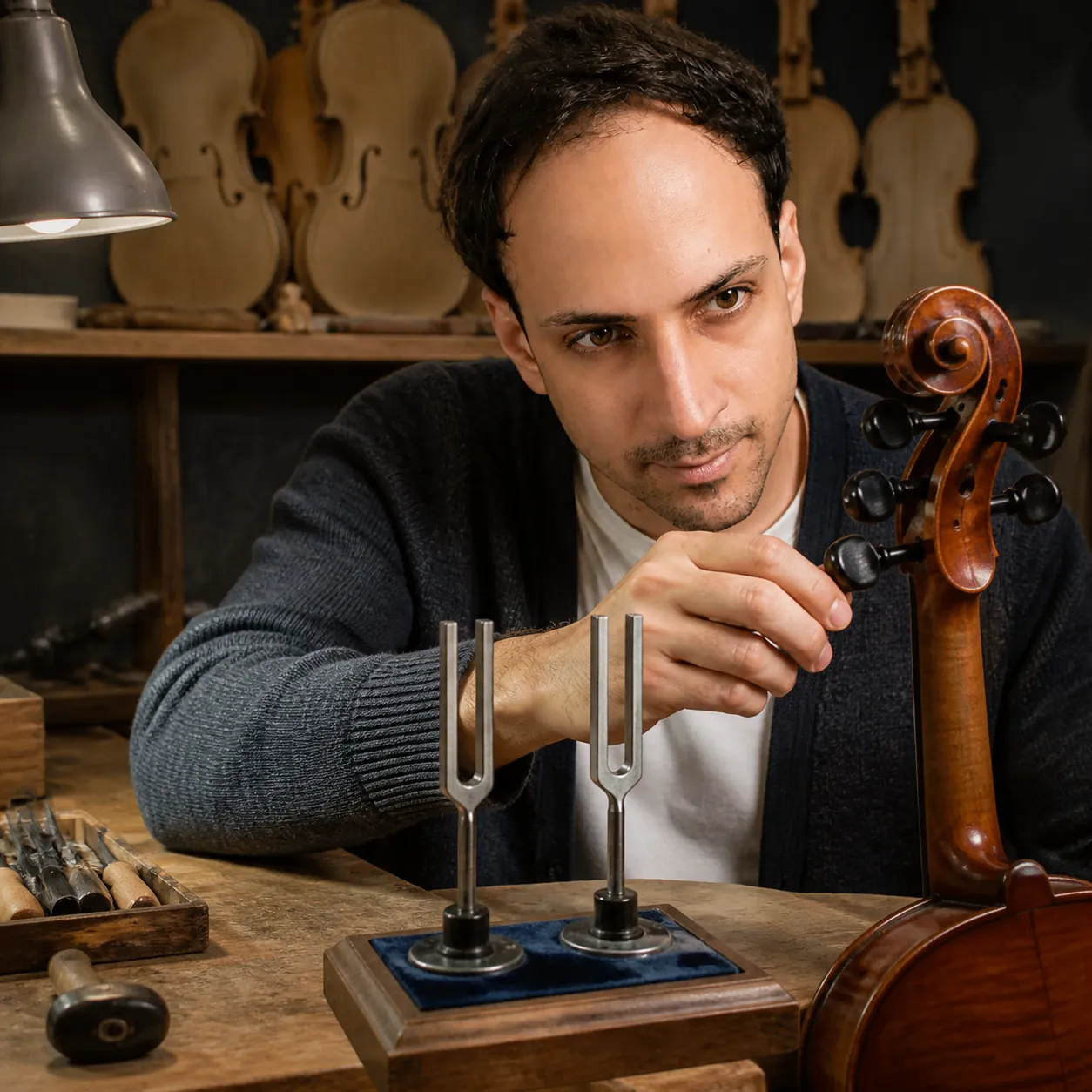
Use the attached reference photo as the identity reference: keep the same face, skin tone, hair and features as the person in that photo, without beautifying, aging or altering them. Create a square 1:1 museum-catalog frame with a strong first read and a slower second read at exactly 2880x2880 pixels. Location: a violin maker's bench beneath a row of unfinished instruments. Show the subject in a fine-knit charcoal cardigan over a soft white shirt, turning a tuning peg a breath at a time. Treat this mechanism as the frame’s governing rule: a pair of steel tuning forks whose slow shared throb stretches toward silence with every measured stroke of their file turns patient maintenance into evidence the naked eye can verify at a glance. Explore whether a mind settles because the hands do, or the other way around; direct expression and posture toward quiet rigor, never melodrama or ad-like confidence. Frame across the benchtop at hand height so the calibration and their eyes share one focal plane. Make the composition reserve peak sharpness for the smallest point under correction. Render it as close-quarters craft portraiture built from real hand-calibration technique, macro-documentary realism, oiled-steel and stone materiality, and unhurried editorial restraint, using a single shaded bench lamp pooling light tightly around the work and a palette of gunmetal, chalk white, and one stripe of Prussian blue. Photorealistic: this must read as a real photograph from a physical camera, never an illustration, painting, or 3D render. Resolve real surface detail: grout darker than tile, sealant slightly yellowed, and every joint showing a real tolerance gap. Keep one identity-locked person, credible hands and fingers, natural fabric, and coherent scale, contact, reflections, shadows, airflow, deformation, and materials. Background people only when essential, always secondary and clearly different. Avoid sparking grinder wheels, glowing forge steel, sawdust clouds, and staged rustic tool walls. No text, labels, logos, signatures, watermarks, random symbols, plastic skin, excessive bloom, or glossy AI finish.
Turn your own photo into a portrait in the corner of your kitchen where the kettle sits between window and sink. Keeps your face unchanged.
Turn your own photo into a photorealistic portrait in your mother's kitchen table with its patterned oilcloth cover. Keeps your face unchanged.
Turn your own photo into a photorealistic portrait in a gym bench between sets with a towel folded over the bar. Keeps your face unchanged.
Turn your own photo into a photorealistic portrait in the landing of your building's stairs, one floor short of home. Keeps your face unchanged.
Turn your own photo into a candid reflex-moment portrait in a supermarket aisle stacked to the ceiling under flat white light. Keeps your face unchanged.
Turn your own photo into a quiet observational portrait in a small residential lift with another person's shoulder at the frame edge. Keeps your face unchanged.
Turn your own photo into a photorealistic portrait in the family farm gate, its latch bright and its chain thinned link by link. Keeps your face unchanged.
Turn your own photo into a photorealistic portrait in a staff-room table in the slow hour of a night shift. Keeps your face unchanged.
Turn your own photo into a photorealistic portrait in a mosque entrance where the shoe shelf's front edge is worn round. Keeps your face unchanged.
Turn your own photo into a photorealistic portrait in the flat roof of the family house as the last daylight drains. Keeps your face unchanged.
Turn your own photo into a quiet observational portrait in the kitchen of your flat at night with one counter lamp on. Keeps your face unchanged.
Turn your own photo into a candid reflex-moment portrait in a long office corridor of doors and cool fluorescent calm. Keeps your face unchanged.