جاري التحميل...


جاري التحميل...
Turn your own photo into a portrait in the open shaft of a two-storey stairwell above a tiled floor. Keeps your face unchanged.
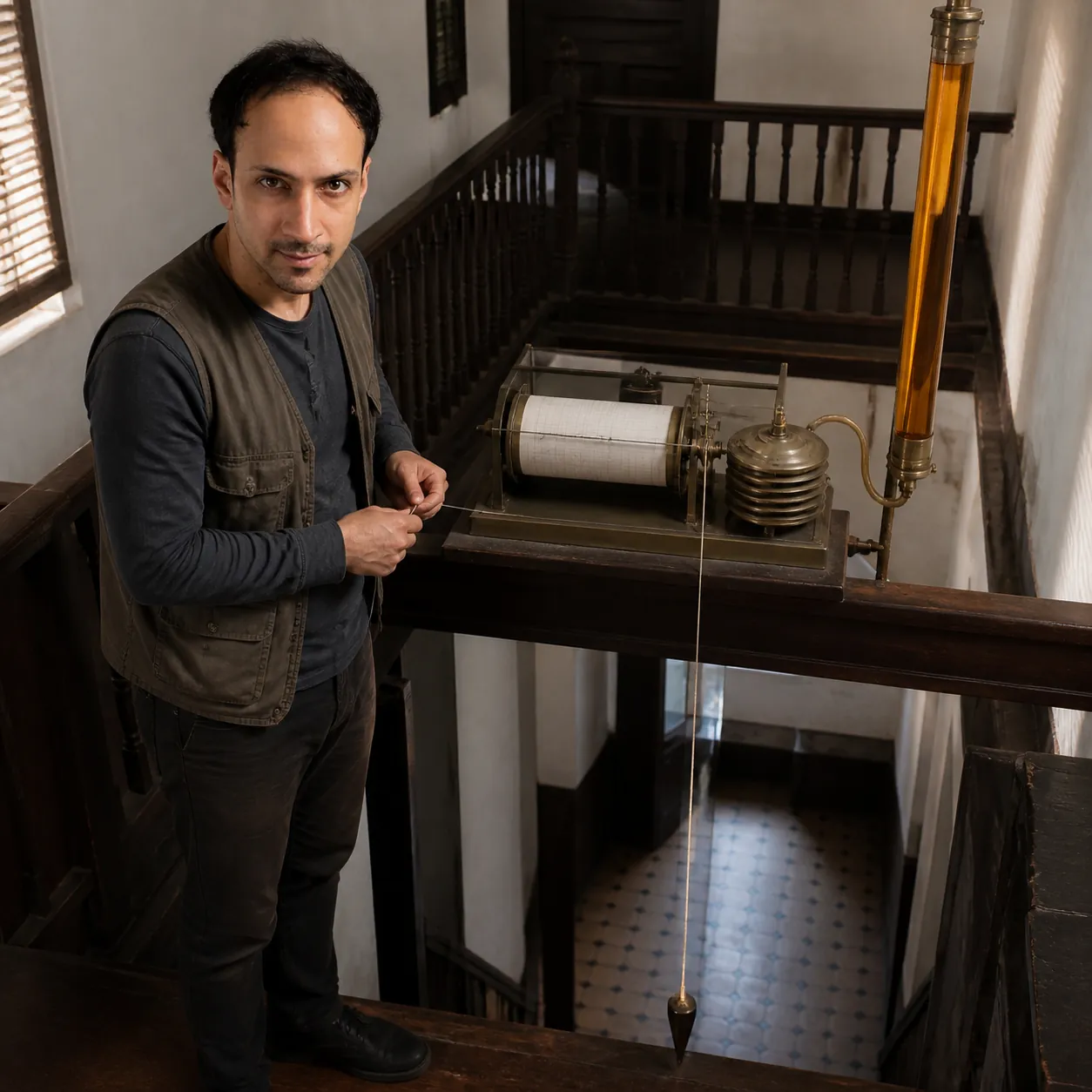
Use the attached reference photo as the identity reference: keep the same face, skin tone, hair and features as the person in that photo, without beautifying, aging or altering them. Create a square 1:1 museum-catalog frame with a strong first read and a slower second read at exactly 2880x2880 pixels. Location: the open shaft of a two-storey stairwell above a tiled floor. Show the subject in a graphite crewneck under a lightweight canvas work vest, paying a plumb line down through the open shaft. Build the artwork around this material rule: a clock-driven barograph drum whose pen draws one unbroken line as a sealed bellows breathes with the passing air holds a slow shift still long enough for judgment to consult it. Explore what a slow drift becomes once someone builds a way to watch it; direct expression and posture toward unhurried candor, never melodrama or ad-like confidence. Frame from the far end of the room so the signal's whole route stays visible. Make the composition let one connecting line leave the frame without resolving. Render it as gallery-grade documentary imagery built from real pneumatic linkages, believable wear on brass, low-drama interior lighting, and patient human presence, using late-afternoon light entering through louvers as thin parallel bands and a palette of chalk white, dark walnut, and a single amber column. Photorealistic: this must read as a real photograph from a physical camera, never an illustration, painting, or 3D render. Resolve real surface detail: cotton that hangs by its own weight, seams that pucker very slightly, and collars softened by washing. Keep one identity-locked person, credible hands and fingers, natural fabric, and coherent scale, contact, reflections, shadows, airflow, deformation, and materials. Background people only when essential, always secondary and clearly different. Avoid brass-gear collage backdrops, cartoon telegraph keys, neon signal beams, mercury spills, and floating typographic message overlays. No text, labels, logos, signatures, watermarks, random symbols, plastic skin, excessive bloom, or glossy AI finish.
Turn your own photo into a quiet cinematic portrait in a gym bench between sets with a towel folded over the bar. Keeps your face unchanged.
Turn your own photo into a portrait in your grandfather's workshop where tool handles hang darkened at your grips. Keeps your face unchanged.
Turn your own photo into a photorealistic portrait in a mosque entrance where the shoe shelf's front edge is worn round. Keeps your face unchanged.
Turn your own photo into a gallery-scale documentary portrait in an office floor at the end of the day, most desks dark. Keeps your face unchanged.
Turn your own photo into a patient observational portrait in a bus shelter's strip of shade on a wide afternoon road. Keeps your face unchanged.
Turn your own photo into a quiet observational portrait in a low majlis table where a brass tray gathers glasses and dallah. Keeps your face unchanged.
Turn your own photo into a portrait in the corner of your kitchen where the kettle sits between window and sink. Keeps your face unchanged.
Turn your own photo into a photorealistic portrait in the flat roof of the family house as the last daylight drains. Keeps your face unchanged.
Turn your own photo into a photorealistic portrait in a house courtyard at dusk with the heat lifting off the tiles. Keeps your face unchanged.
Turn your own photo into a photorealistic portrait in the landing of your building's stairs, one floor short of home. Keeps your face unchanged.
Turn your own photo into a photorealistic portrait in the hallway of your apartment between the bedroom and kitchen doors. Keeps your face unchanged.
Turn your own photo into a photorealistic portrait in the family farm gate, its latch bright and its chain thinned link by link. Keeps your face unchanged.