جاري التحميل...


جاري التحميل...
Create a fold-out narrative strip containing exactly 7 panels, read left to right. Keep the same wardrobe, facial landmarks, apparent age, hairline, facial...
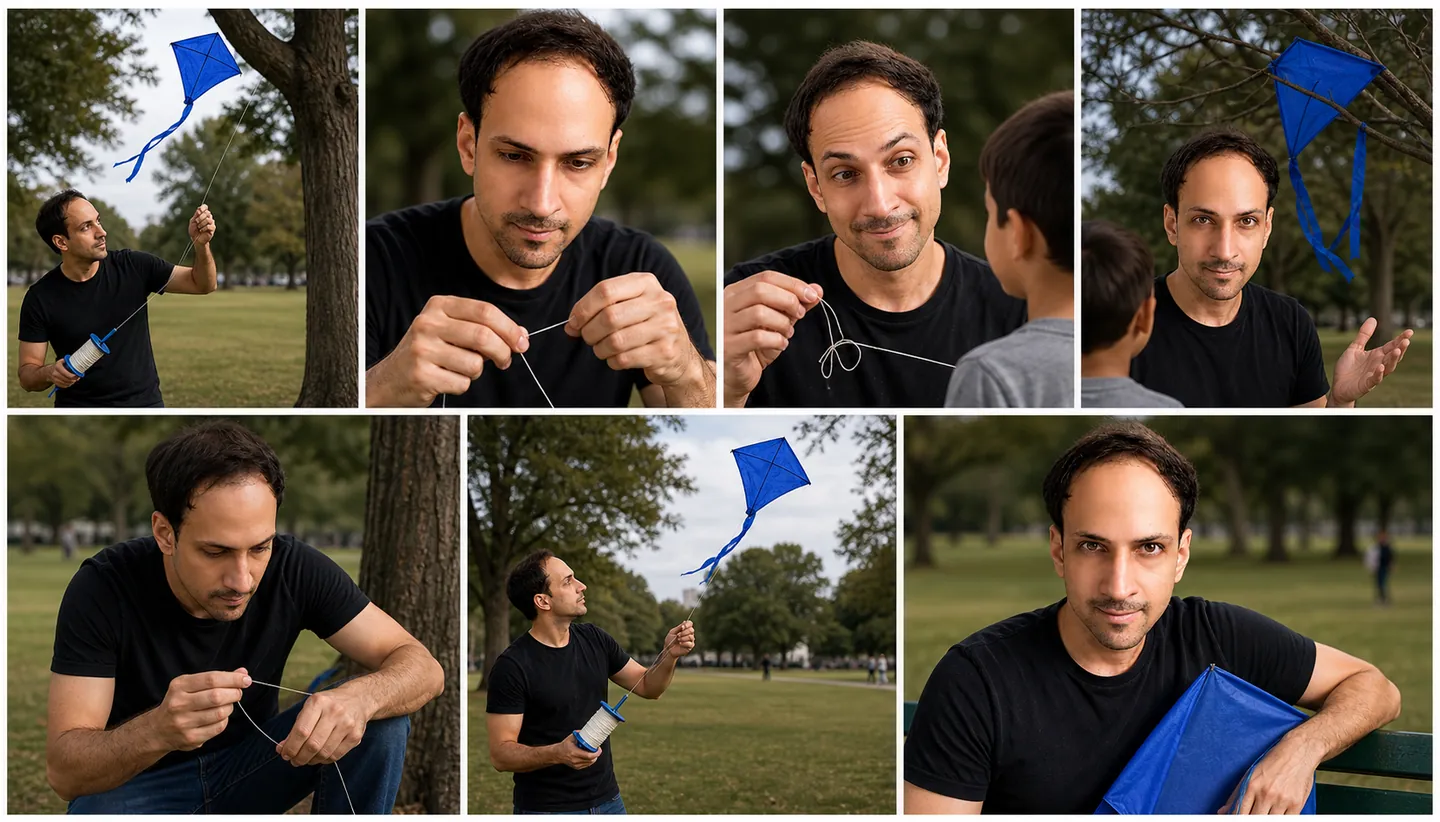
Use the attached reference photo as the identity reference: keep the same face, skin tone, hair and features as the person in that photo, without beautifying, aging or altering them. Create a fold-out narrative strip containing exactly 7 panels, read left to right. Keep the same wardrobe, facial landmarks, apparent age, hairline, facial hair and environmental continuity across every panel unless a panel description explicitly changes a prop. Panel 1: establish a neighborhood park with a kite pulling harder than expected before the main action, with the person entering or settling into the space and the visual problem clearly readable. Panel 2: move closer to their hands as they prepare for the task, preserving wardrobe and object continuity. Panel 3: show the exact moment of them turning a minor mistake into a shared joke, keeping their recognizable face and natural posture consistent. Panel 4: introduce a modest complication or second person’s response, never changing the person’s identity or wardrobe. Panel 5: show the adjustment they make after noticing what the situation actually needs. Panel 6: capture the immediate result: the joke is discovered gradually rather than announced. Panel 7: end on a quiet coda in the same environment, with one changed object or gesture proving that the sequence has moved forward. Use clean, consistent gutters and no accidental extra frames, repeated panels, or duplicated versions of the person. Render the sequence as direct-flash humor portraiture with restrained color with clean studio light shaped like a broad window, with gentle falloff and no plastic retouching and clean neutrals with one cobalt accent. The emotional progression should move toward human vulnerability without melodrama through posture and action, not facial redesign. Let one object violate the otherwise orderly pattern. Do not include captions or any other text. Keep hands, object continuity, body scale, and perspective believable.
Turn your own photo into a photorealistic portrait in a small tailor's shop while a hem is finished somewhere behind the counter. Keeps your face unchanged.
Turn your own photo into a quiet observational portrait in a small residential lift with another person's shoulder at the frame edge. Keeps your face unchanged.
Turn your own photo into a portrait in the corner of your kitchen where the kettle sits between window and sink. Keeps your face unchanged.
Turn your own photo into a candid reflex-moment portrait in a long office corridor of doors and cool fluorescent calm. Keeps your face unchanged.
Turn your own photo into a photorealistic portrait in your old school's corridor where the banister ends in a shine every pupil made. Keeps your face unchanged.
Turn your own photo into a photorealistic portrait in the hallway of your apartment between the bedroom and kitchen doors. Keeps your face unchanged.
Turn your own photo into an understated editorial portrait in the driver's seat of a parked family car with the engine off. Keeps your face unchanged.
Turn your own photo into a candid reflex-moment portrait in a supermarket aisle stacked to the ceiling under flat white light. Keeps your face unchanged.
Turn your own photo into a quiet cinematic portrait in a bus shelter's strip of shade on a wide afternoon road. Keeps your face unchanged.
Turn your own photo into a quiet observational portrait in a low majlis table where a brass tray gathers glasses and dallah. Keeps your face unchanged.
Turn your own photo into a photorealistic portrait in a staff-room table in the slow hour of a night shift. Keeps your face unchanged.
Turn your own photo into a photorealistic portrait in a mosque entrance where the shoe shelf's front edge is worn round. Keeps your face unchanged.