جاري التحميل...


جاري التحميل...
Create a square 1:1 museum-catalog frame with a strong first read and a slower second read at exactly 2880x2880 pixels. Location: a campus stairwell...
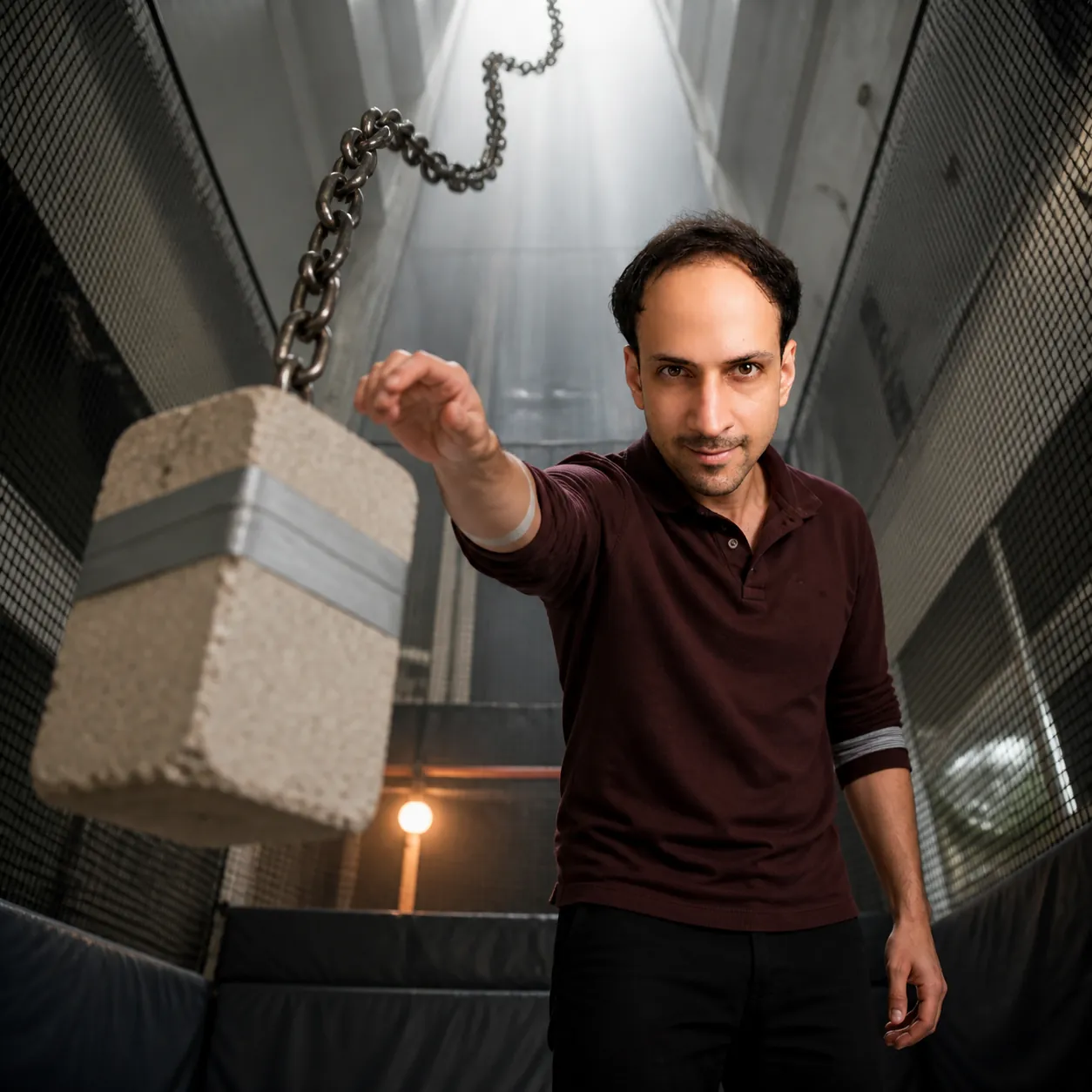
Use the attached reference photo as the identity reference: keep the same face, skin tone, hair and features as the person in that photo, without beautifying, aging or altering them. Create a square 1:1 museum-catalog frame with a strong first read and a slower second read at exactly 2880x2880 pixels. Location: a campus stairwell converted to a padded two-storey mini drop lane. Show the subject in a maroon rugby-knit pullover with sleeves pushed back to the elbow, marking the release height with one strip of tape. The impossible-looking event must obey this clear system: a heavy hoist chain that goes suddenly slack the instant the tower lets go, its last taut curve floating turns one honestly borrowed second into proof that weight is circumstance, not essence. Explore what ordinary matter does when its oldest constant takes one second off; direct expression and posture toward reverent precision, never melodrama or ad-like confidence. Use a 90mm near-far pairing: one suspended detail sharp near the lens and the person in the reference photo's grounded face readable beyond it. Make the composition hold every floating edge sharper than any grounded surface. Render it as conceptual physics portraiture pairing genuine microgravity evidence, a falling-camera perspective, restrained contemporary art direction, and grounded human dignity, using cold shaft-light falling from far above, softened by dust in the air and a palette of bone grey, netting black, and a single amber lamp. Photorealistic: this must read as a real photograph from a physical camera, never an illustration, painting, or 3D render. Resolve real surface detail: glass with real thickness at its edge, reflections that carry the room's actual colour, and dust visible only at grazing angles. Keep one identity-locked person, credible hands and fingers, natural fabric, and coherent scale, contact, reflections, shadows, airflow, deformation, and materials. Background people only when essential, always secondary and clearly different. Avoid floating-hair astronaut poses, levitating people, swirling CGI water tentacles, and sci-fi antigravity glow. No text, labels, logos, signatures, watermarks, random symbols, plastic skin, excessive bloom, or glossy AI finish.
Treat that reference as the character anchor and change only the scene. Create a square 1:1 museum-catalog frame with a strong first read and a slower...
Treat that reference as the character anchor and change only the scene. Create a square 1:1 museum-catalog frame with a strong first read and a slower...
Treat that reference as the character anchor and change only the scene. Create a square 1:1 museum-catalog frame with a strong first read and a slower...
Treat that reference as the character anchor and change only the scene. Create a square 1:1 museum-catalog frame with a strong first read and a slower...
Treat that reference as the character anchor and change only the scene. Create a square 1:1 museum-catalog frame with a strong first read and a slower...
Treat that reference as the character anchor and change only the scene. Create a square 1:1 museum-catalog frame with a strong first read and a slower...
Treat that reference as the character anchor and change only the scene. Create a square 1:1 museum-catalog frame with a strong first read and a slower...
Treat that reference as the character anchor and change only the scene. Create a square 1:1 museum-catalog frame with a strong first read and a slower...
Treat that reference as the character anchor and change only the scene. Create a square 1:1 museum-catalog frame with a strong first read and a slower...
Treat that reference as the character anchor and change only the scene. Create a square 1:1 museum-catalog frame with a strong first read and a slower...
Treat that reference as the character anchor and change only the scene. Create a square 1:1 museum-catalog frame with a strong first read and a slower...
Treat that reference as the character anchor and change only the scene. Create a square 1:1 museum-catalog frame with a strong first read and a slower...