جاري التحميل...


جاري التحميل...
Create a square 1:1 museum-catalog frame with a strong first read and a slower second read at exactly 2880x2880 pixels. Location: a textile conservation...
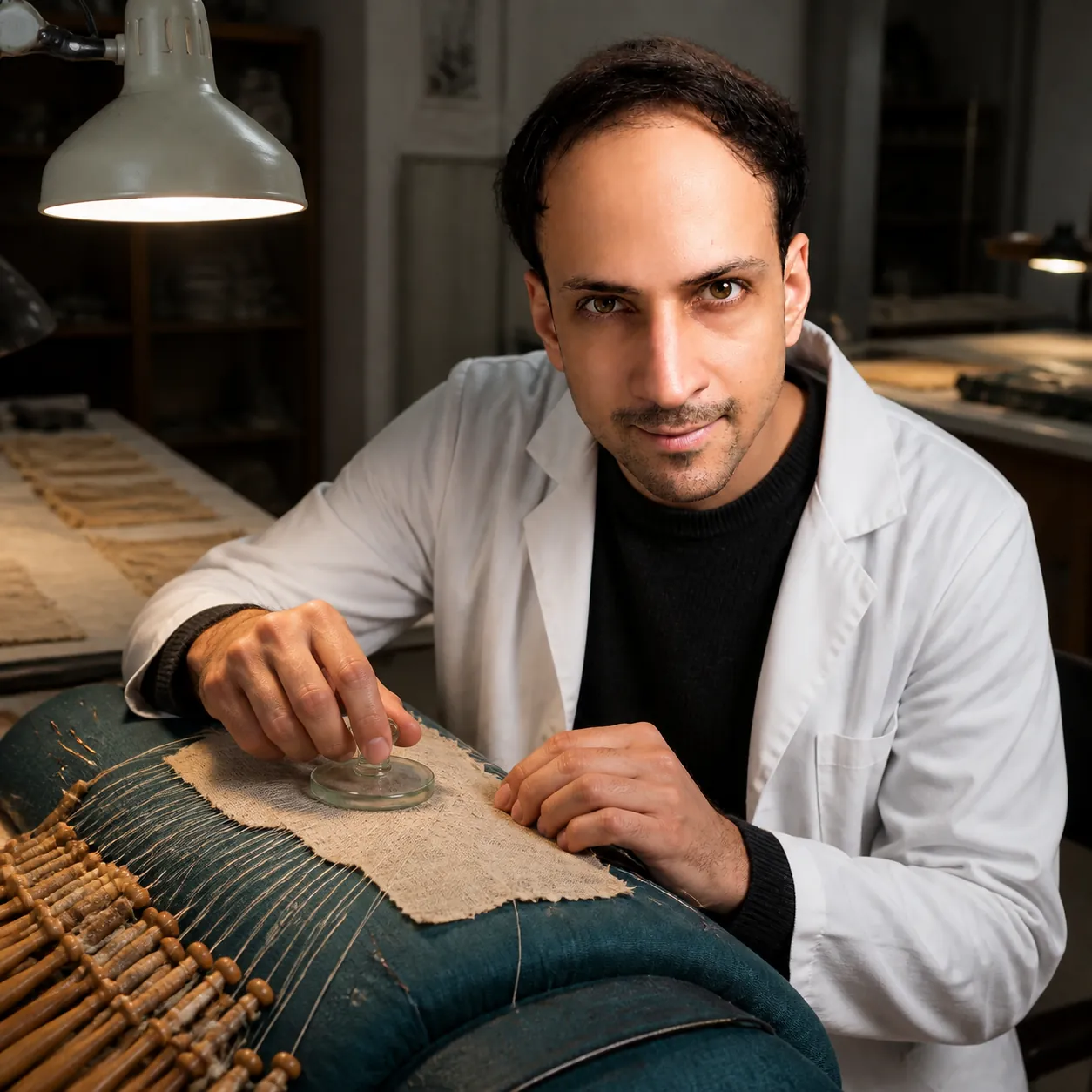
Use the attached reference photo as the identity reference: keep the same face, skin tone, hair and features as the person in that photo, without beautifying, aging or altering them. Create a square 1:1 museum-catalog frame with a strong first read and a slower second read at exactly 2880x2880 pixels. Location: a textile conservation room with a long padded table and raking lamps. Show the subject in a white lab coat open over a dark knit shirt, pinning a linen fragment gently under a glass weight. Treat this mechanism as the frame’s governing rule: a bobbin-lace pillow where dozens of paired threads cross through a fence of pins, the finished inches holding shape unpinned turns repeated effort into a physical route the hand can find again. Explore where in a working life there is room to thread something genuinely new; direct expression and posture toward attentive humility, never melodrama or ad-like confidence. Use a composed 35mm width that places them beside the work, never looming over it. Make the composition let one bright new line cross a field of dulled ones. Render it as craft-documentary portraiture built from real fiber mechanics, patient workshop realism, archival material fidelity, and emotionally restrained editorial composition, using one warm work lamp pooled on the task with soft surrounding dusk and a palette of raw linen, aged brass, and one deep teal band. Photorealistic: this must read as a real photograph from a physical camera, never an illustration, painting, or 3D render. Resolve real surface detail: grout darker than tile, sealant slightly yellowed, and every joint showing a real tolerance gap. Keep one identity-locked person, credible hands and fingers, natural fabric, and coherent scale, contact, reflections, shadows, airflow, deformation, and materials. Background people only when essential, always secondary and clearly different. Avoid glowing neural filaments, brain-shaped tangles, circuit-board overlays, holographic wiring diagrams, and sparks jumping between cables. No text, labels, logos, signatures, watermarks, random symbols, plastic skin, excessive bloom, or glossy AI finish.
Treat that reference as the character anchor and change only the scene. Create a square 1:1 museum-catalog frame with a strong first read and a slower...
Treat that reference as the character anchor and change only the scene. Create a square 1:1 museum-catalog frame with a strong first read and a slower...
Treat that reference as the character anchor and change only the scene. Create a square 1:1 museum-catalog frame with a strong first read and a slower...
Treat that reference as the character anchor and change only the scene. Create a square 1:1 museum-catalog frame with a strong first read and a slower...
Treat that reference as the character anchor and change only the scene. Create a square 1:1 museum-catalog frame with a strong first read and a slower...
Treat that reference as the character anchor and change only the scene. Create a square 1:1 museum-catalog frame with a strong first read and a slower...
Treat that reference as the character anchor and change only the scene. Create a square 1:1 museum-catalog frame with a strong first read and a slower...
Treat that reference as the character anchor and change only the scene. Create a square 1:1 museum-catalog frame with a strong first read and a slower...
Treat that reference as the character anchor and change only the scene. Create a square 1:1 museum-catalog frame with a strong first read and a slower...
Treat that reference as the character anchor and change only the scene. Create a square 1:1 museum-catalog frame with a strong first read and a slower...
Treat that reference as the character anchor and change only the scene. Create a square 1:1 museum-catalog frame with a strong first read and a slower...
Treat that reference as the character anchor and change only the scene. Create a square 1:1 museum-catalog frame with a strong first read and a slower...