تخطَّ إلى المحتوى

برومبتات الصور

برومبتات لمولدات الصور: بورتريهات وفن وتصوير.

تم العثور على 4209
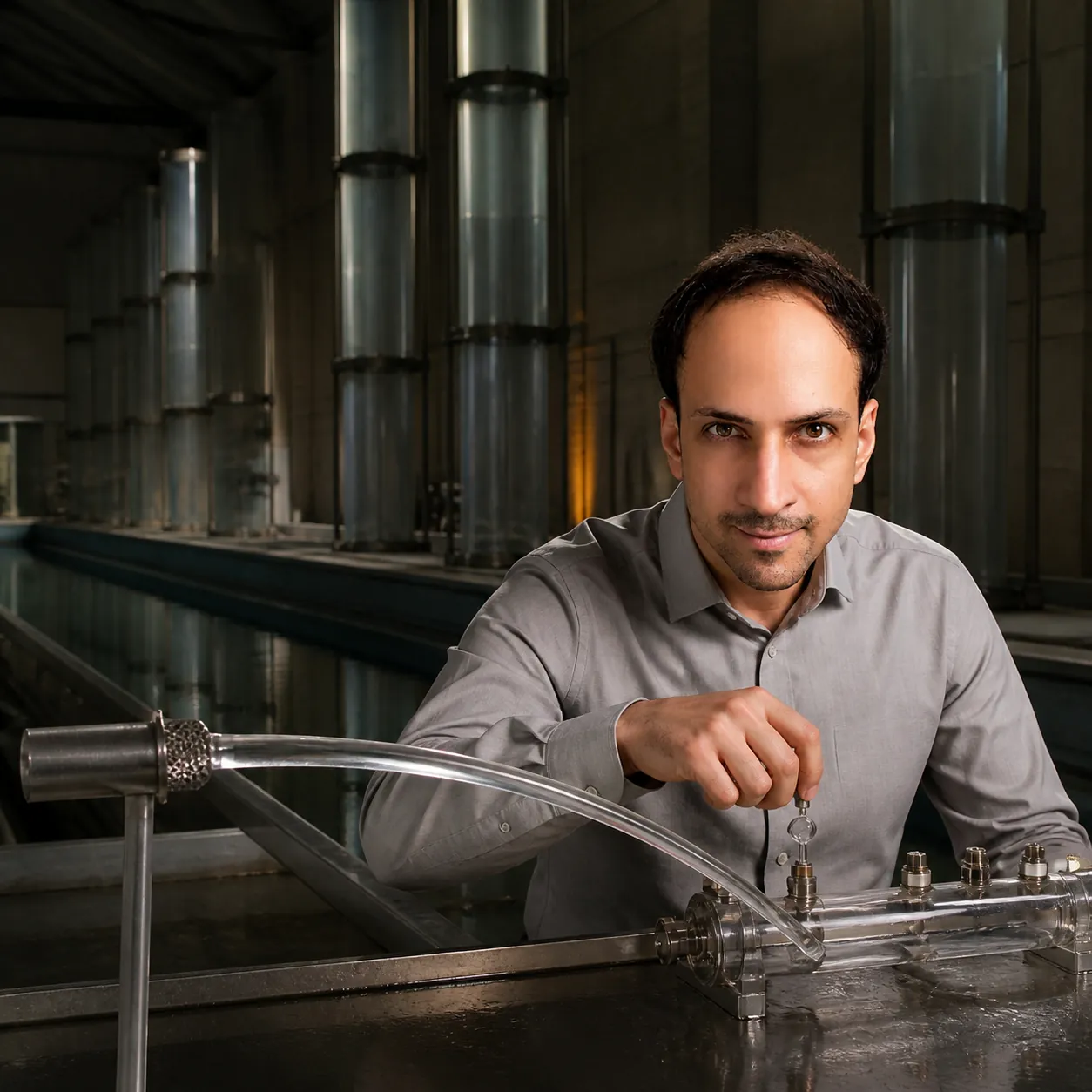
Bent Glass Arc in the Hydraulics Hall — AI Portrait Prompt
صورةAI Portraits

Turn your own photo into a quiet kinetic-art portrait in a university hydraulics hall of tall standpipes and long still channels. Keeps your face unchanged.

من نص البرومبت

Use the attached reference photo as the identity reference: keep the same face, skin tone, hair and features as the person in that photo, without beautifying, aging or altering them. Create a square 1:1 museum-catalog frame with a strong first read and a slower second read at exactly 2880x2880 pixels. Location: a university hydraulics hall of tall standpipes and long still channels. Show the subject in a pressed pale-grey shirt with sleeves buttoned at the wrist, bleeding one air bubble from a clear manifold line. Treat this mechanism as the frame’s governing rule: an arc of water from a honeycomb-straightened nozzle that stands so clear and still it reads as a rod of bent glass puts continuous motion through a form that never once looks hurried. Explore why water that keeps perfect order looks more impossible than water in chaos; direct expression and posture toward gentle vigilance, never melodrama or ad-like confidence. Use a calm wide 35mm view that keeps verticals true and places them just off the flow's axis. Make the composition hold clean empty space where turbulence would have been. Render it as quiet kinetic-art portraiture combining working flow sculpture, honest wet-surface materiality, calm controlled studio styling, and unforced human presence, using one low raking beam that turns every smooth surface into readable contour and a palette of brushed steel, water grey, and one amber gleam. Photorealistic: this must read as a real photograph from a physical camera, never an illustration, painting, or 3D render. Resolve real surface detail: paper fibre visible at cut edges, plastic that shows mould lines, and paint thicker where a brush turned. Keep one identity-locked person, credible hands and fingers, natural fabric, and coherent scale, contact, reflections, shadows, airflow, deformation, and materials. Background people only when essential, always secondary and clearly different. Avoid stock waterfall mist, whirlpool vortices, ripple-covered surfaces, levitating water spheres, and dramatic slow-motion splash photography. No text, labels, logos, signatures, watermarks, random symbols, plastic skin, excessive bloom, or glossy AI finish.
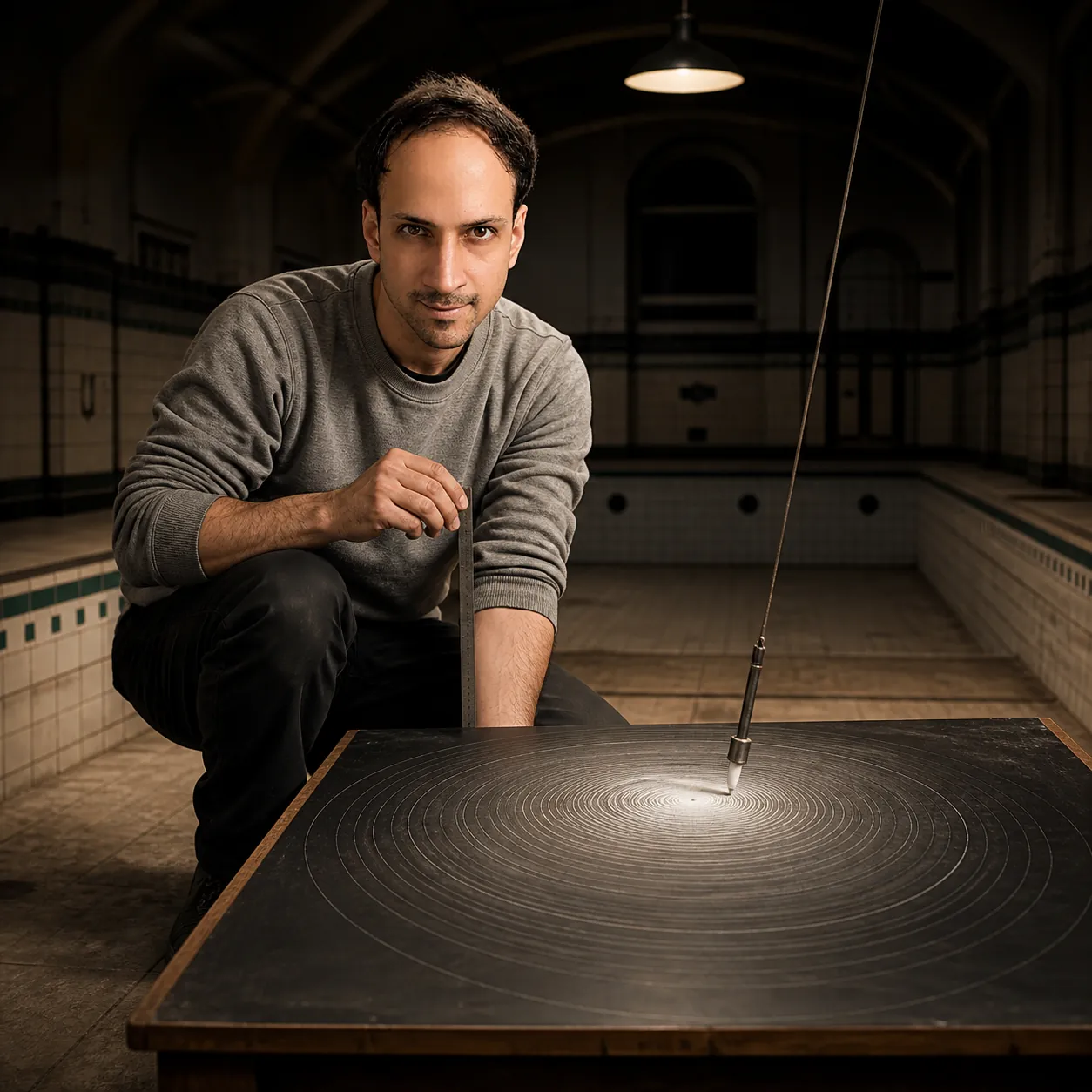
Shrinking Arcs by the Pool — AI Portrait Prompt
صورةAI Portraits

Turn your own photo into a gallery-grade demonstration portrait in a drained indoor pool hall, tiles echoing every small sound. Keeps your face unchanged.

من نص البرومبت

Use the attached reference photo as the identity reference: keep the same face, skin tone, hair and features as the person in that photo, without beautifying, aging or altering them. Create a square 1:1 museum-catalog frame with a strong first read and a slower second read at exactly 2880x2880 pixels. Location: a drained indoor pool hall, tiles echoing every small sound. Show the subject in a heather-grey sweatshirt and dark tapered work trousers, measuring a drop height against their own forearm. Build the artwork around this material rule: a chalk stick held by a long pendulum that sweeps a slate board in arcs growing slightly shorter each pass leaves authorship with gravity while the machine merely steadies the pen. Explore why an ending written into the drawing makes it more beautiful, not less; direct expression and posture toward quiet astonishment, never melodrama or ad-like confidence. Use an 85mm portrait distance with the freshest line of the drawing sharp in the foreground. Make the composition align the stillest object with the fastest line. Render it as gallery-grade demonstration photography built from lawful gravity-driven motion, physically exact trace geometry, quiet heritage interiors, and unforced human presence, using a single shaded bulb hung high, its cone stopping short of the walls and a palette of graphite, raw linen, and one deep bottle-green accent. Photorealistic: this must read as a real photograph from a physical camera, never an illustration, painting, or 3D render. Resolve real surface detail: hair with individual strands catching light, fine hairs of uneven length, and skin oil giving a low uneven sheen. Keep one identity-locked person, credible hands and fingers, natural fabric, and coherent scale, contact, reflections, shadows, airflow, deformation, and materials. Background people only when essential, always secondary and clearly different. Avoid hypnotist's watch iconography, perpetual-motion fantasy rigs, laser-perfect printed curves, cosmic nebula backdrops, and pendulums hung from nothing. No text, labels, logos, signatures, watermarks, random symbols, plastic skin, excessive bloom, or glossy AI finish.
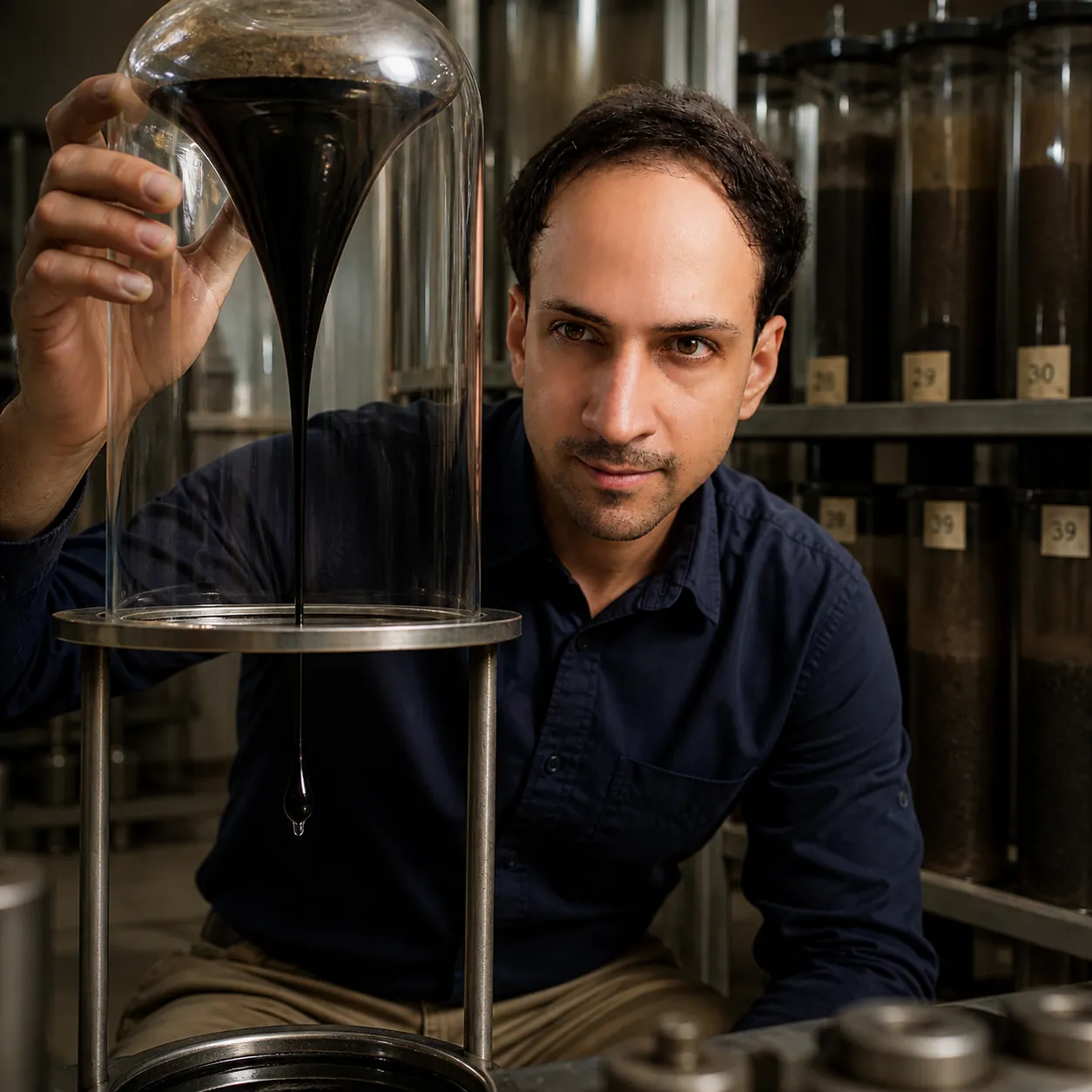
The Decade-Long Pitch Drop — AI Portrait Prompt
صورةAI Portraits

Turn your own photo into a portrait in a drilling-fluids test room with numbered sample columns on shelves. Keeps your face unchanged.

من نص البرومبت

Use the attached reference photo as the identity reference: keep the same face, skin tone, hair and features as the person in that photo, without beautifying, aging or altering them. Create a square 1:1 museum-catalog frame with a strong first read and a slower second read at exactly 2880x2880 pixels. Location: a drilling-fluids test room with numbered sample columns on shelves. Show the subject in pressed khaki field trousers and a navy technical shirt, holding one sample column up to the light. The impossible-looking event must obey this clear system: a bell-jarred funnel of black pitch whose single pendant drop has been lengthening for most of a decade holds a small lawful contradiction still enough to be studied. Explore what a material's refusal reveals about the question it was asked; direct expression and posture toward patient scrutiny, never melodrama or ad-like confidence. Use a 90mm close-working lens: the fluid's response sharp near the frame's base and their attentive face readable above it. Make the composition anchor the brightest highlight on the material, never on them. Render it as museum-grade demonstration realism combining faithful fluid behavior, tactile material surfaces, patient observational portrait photography, and physically accurate weight and reflection, using one low raking key across the fluid surface with soft neutral fill and a palette of mud brown, brushed steel, and muted glass green. Photorealistic: this must read as a real photograph from a physical camera, never an illustration, painting, or 3D render. Resolve real surface detail: condensation beading at true size, liquid meniscus curving against glass, and wet surfaces darker than dry ones. Keep one identity-locked person, credible hands and fingers, natural fabric, and coherent scale, contact, reflections, shadows, airflow, deformation, and materials. Background people only when essential, always secondary and clearly different. Avoid frozen splash crowns, CGI liquid-metal morphing, glowing sci-fi gels, food-fight mess on clothing, and impossible floating blobs. No text, labels, logos, signatures, watermarks, random symbols, plastic skin, excessive bloom, or glossy AI finish.
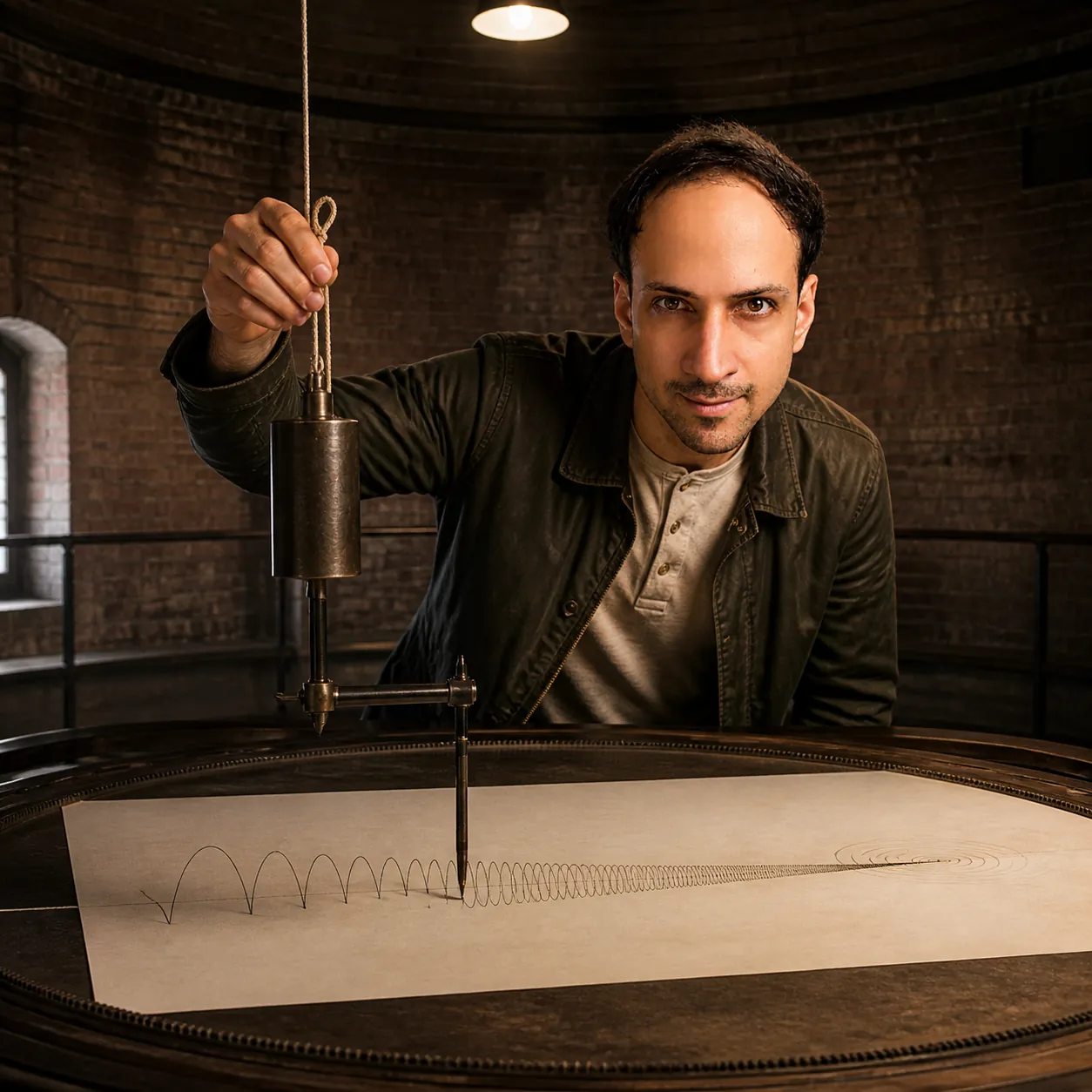
Decaying Wave in the Water Tower — AI Portrait Prompt
صورةAI Portraits

Turn your own photo into a kinetic-sculpture documentary portrait in the round brick chamber of a decommissioned water tower. Keeps your face unchanged.

من نص البرومبت

Use the attached reference photo as the identity reference: keep the same face, skin tone, hair and features as the person in that photo, without beautifying, aging or altering them. Create a square 1:1 museum-catalog frame with a strong first read and a slower second read at exactly 2880x2880 pixels. Location: the round brick chamber of a decommissioned water tower. Show the subject in a waxed olive field jacket over a cream henley, loading a knot with one slow downward pull. Treat this mechanism as the frame’s governing rule: a swinging ink pen over a paper strip that a descending weight pulls steadily, writing one long decaying wave turns the planet's steady pull into a signature anyone can read. Explore whether patience is a virtue here or simply the machine's operating speed; direct expression and posture toward steady humility, never melodrama or ad-like confidence. Frame at the height of the swinging mass so the trace recedes in true perspective. Make the composition let the drawing's shrinking center sit off-axis from their eyes. Render it as kinetic-sculpture documentary portraiture built from real pendulum apparatus, archival ink materiality, long-exposure honesty, and museum-quality restraint in every surface, using a single shaded bulb hung high, its cone stopping short of the walls and a palette of walnut brown, bone-dry plaster, and one glint of steel. Photorealistic: this must read as a real photograph from a physical camera, never an illustration, painting, or 3D render. Resolve real surface detail: grout darker than tile, sealant slightly yellowed, and every joint showing a real tolerance gap. Keep one identity-locked person, credible hands and fingers, natural fabric, and coherent scale, contact, reflections, shadows, airflow, deformation, and materials. Background people only when essential, always secondary and clearly different. Avoid glowing neon spirograph swirls, levitating pens, CGI particle trails, sacred-geometry overlays, and face-smearing motion blur. No text, labels, logos, signatures, watermarks, random symbols, plastic skin, excessive bloom, or glossy AI finish.
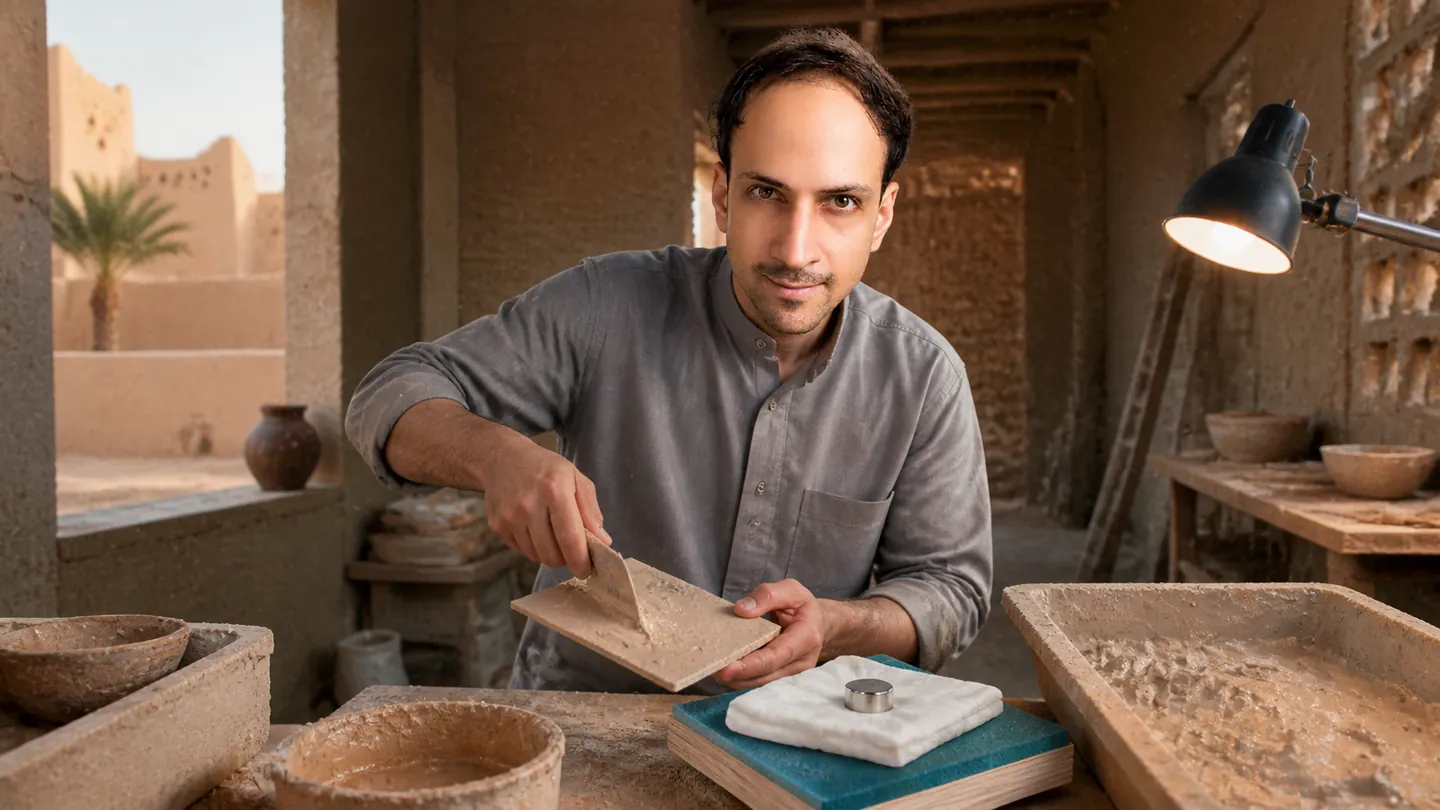
Diriyah Bay and the Folding Pad — AI Portrait Prompt
صورةAI Portraits

Turn your own photo into a portrait in a mud-brick restoration bay in Diriyah with troughs of resting plaster. Keeps your face unchanged.

من نص البرومبت

Use the attached reference photo as the identity reference: keep the same face, skin tone, hair and features as the person in that photo, without beautifying, aging or altering them. Compose a wide 16:9 narrative image where environment and subject carry equal meaning at exactly 3808x2144 pixels. Location: a mud-brick restoration bay in Diriyah with troughs of resting plaster. Show the subject in a plain ash-grey traditional Gulf outfit with sleeves folded back twice, loading a hawk board with one clean trowel stroke. Build the artwork around this material rule: a flexible white pad of engineered shear-thickening fluid that folds softly in their fingers yet stops a dropped steel slug outright shows ordinary matter answering with something uncomfortably close to judgment. Explore how the same handful of matter can honestly hold two opposite verdicts; direct expression and posture toward patient scrutiny, never melodrama or ad-like confidence. Use an eye-level 80mm medium-format viewpoint with honest perspective and gentle depth of field. Make the composition give the substance's reply the same visual weight as their face. Render it as conceptual materials-science portraiture combining working bench apparatus, truthful viscosity and yield behavior, restrained contemporary art direction, and human-centered editorial calm, using cool window daylight from one side, balanced by a warm bench lamp and a palette of putty grey, birch ply, and a single teal accent. Photorealistic: this must read as a real photograph from a physical camera, never an illustration, painting, or 3D render. Give truthful depth cues: overlapping planes and shadows softening as they travel. Resolve real surface detail: rubber gone chalky with age, painted metal chipped to primer, and plastic yellowed only where light reaches it. Keep one identity-locked person, credible hands and fingers, natural fabric, and coherent scale, contact, reflections, shadows, airflow, deformation, and materials. Background people only when essential, always secondary and clearly different. Avoid frozen splash crowns, CGI liquid-metal morphing, glowing sci-fi gels, food-fight mess on clothing, and impossible floating blobs. No text, labels, logos, signatures, watermarks, random symbols, plastic skin, excessive bloom, or glossy AI finish.
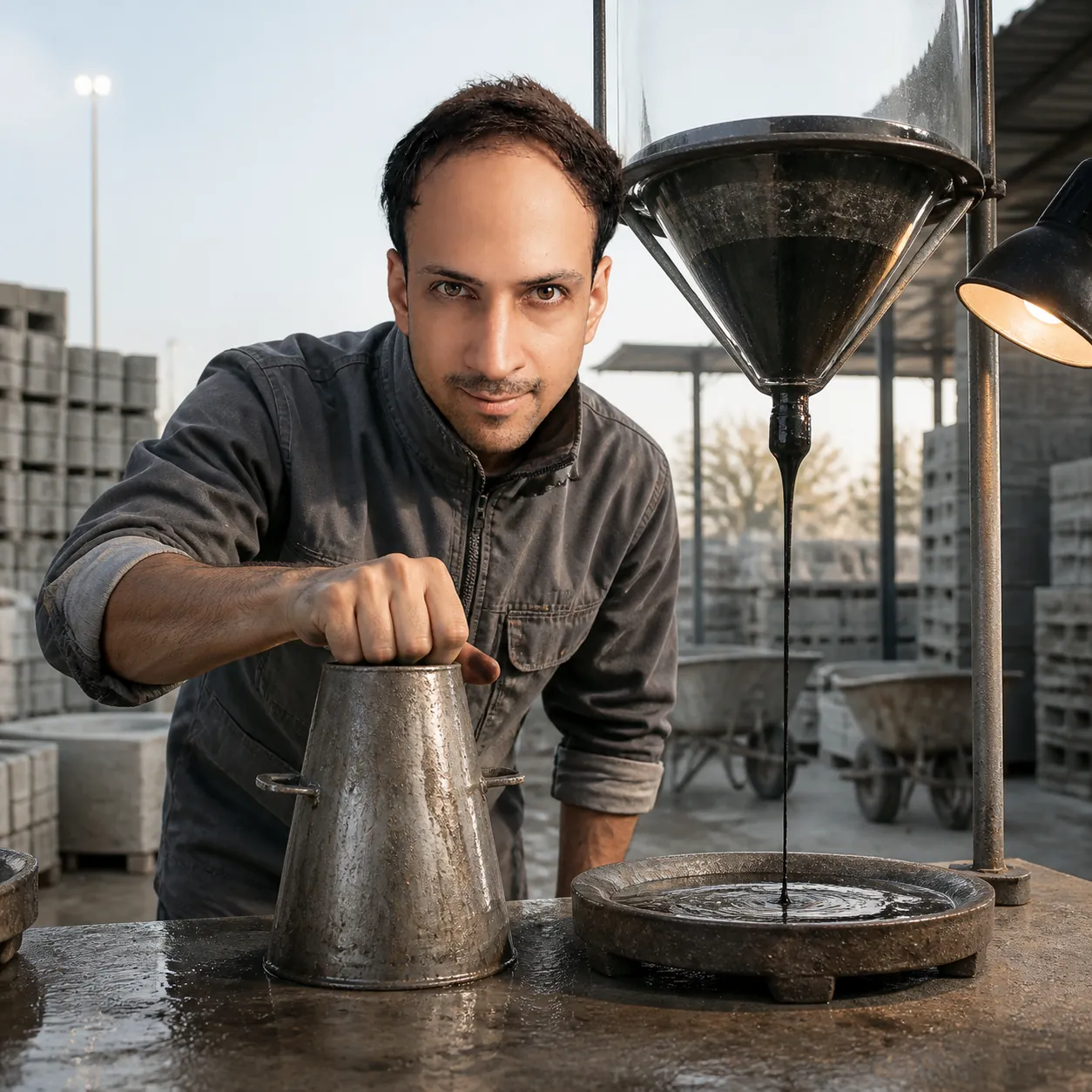
Pitch Drop at the Concrete Yard — AI Portrait Prompt
صورةAI Portraits

Turn your own photo into a portrait in a Riyadh concrete materials yard at early morning, slump boards hosed clean. Keeps your face unchanged.

من نص البرومبت

Use the attached reference photo as the identity reference: keep the same face, skin tone, hair and features as the person in that photo, without beautifying, aging or altering them. Create a square 1:1 museum-catalog frame with a strong first read and a slower second read at exactly 2880x2880 pixels. Location: a Riyadh concrete materials yard at early morning, slump boards hosed clean. Show the subject in a high-collared grey work jacket with rolled cuffs, tapping a steel slump cone free with one knuckle. Build the artwork around this material rule: a bell-jarred funnel of black pitch whose single pendant drop has been lengthening for most of a decade answers the manner of a force rather than its size. Explore what a material's refusal reveals about the question it was asked; direct expression and posture toward grounded wonder, never melodrama or ad-like confidence. Frame from just above the work surface so the material's decision and their eyes sit in one plane of focus. Make the composition keep every contour of the fluid sharper than the room behind. Render it as quiet kinetic still-life portraiture built from genuine non-Newtonian samples, honest studio texture, believable hand-scale staging, and patient documentary framing, using cool window daylight from one side, balanced by a warm bench lamp and a palette of chalk white, wet slate, and one seam of ochre. Photorealistic: this must read as a real photograph from a physical camera, never an illustration, painting, or 3D render. Resolve real surface detail: label-free packaging showing carton fibre, cardboard bruised at the corners, and tape lifting slightly at one end. Keep one identity-locked person, credible hands and fingers, natural fabric, and coherent scale, contact, reflections, shadows, airflow, deformation, and materials. Background people only when essential, always secondary and clearly different. Avoid rainbow slime aesthetics, splattered goo on skin, speaker-driven paint splashes, and ASMR dripping close-ups. No text, labels, logos, signatures, watermarks, random symbols, plastic skin, excessive bloom, or glossy AI finish.
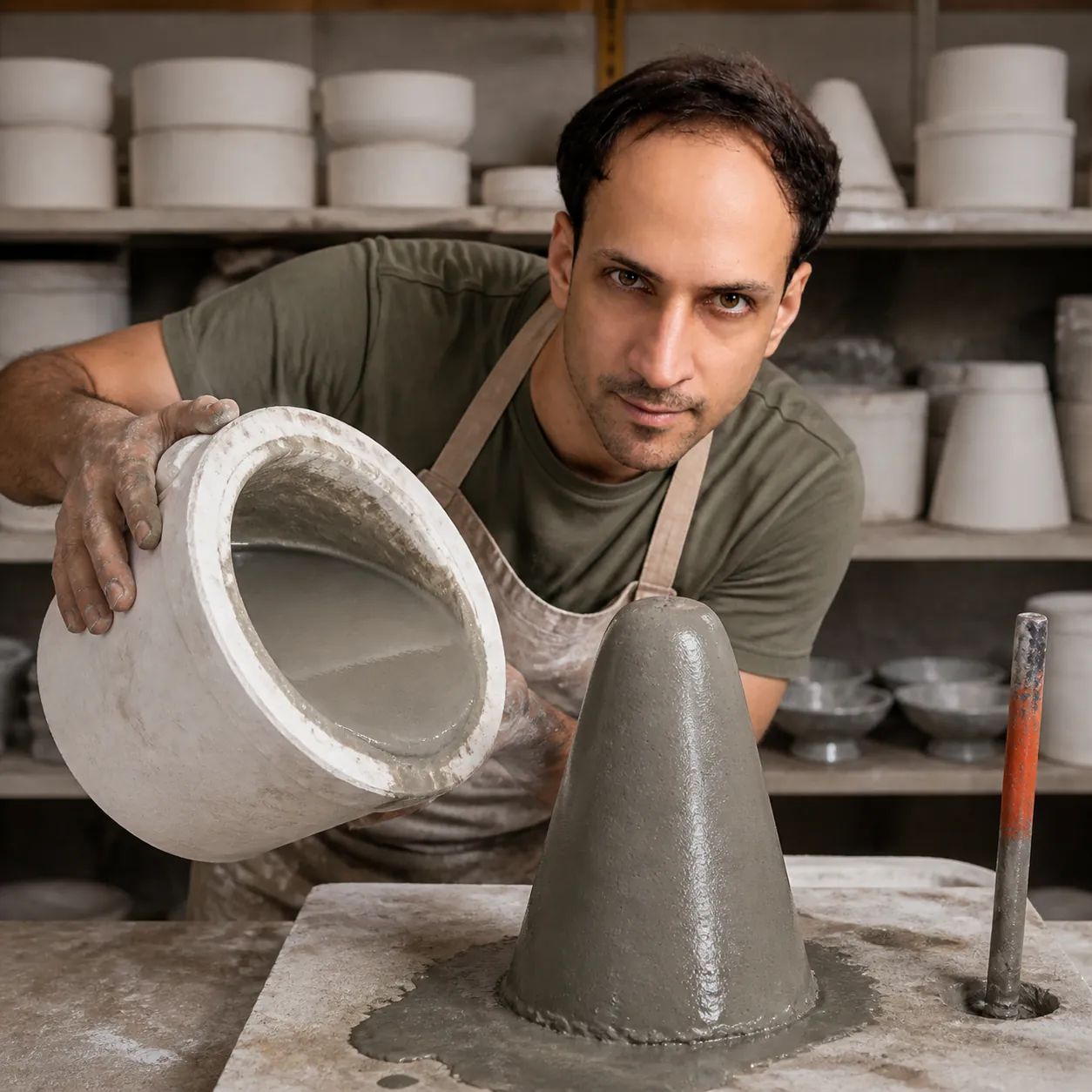
Concrete Cone at the Casting Bench — AI Portrait Prompt
صورةAI Portraits

Turn your own photo into a portrait in a ceramics slip-casting bench ringed with plaster molds drying white. Keeps your face unchanged.

من نص البرومبت

Use the attached reference photo as the identity reference: keep the same face, skin tone, hair and features as the person in that photo, without beautifying, aging or altering them. Create a square 1:1 museum-catalog frame with a strong first read and a slower second read at exactly 2880x2880 pixels. Location: a ceramics slip-casting bench ringed with plaster molds drying white. Show the subject in a clay-dusted canvas apron over a plain olive tee, tilting a filled mold to check the slip's level. Build the artwork around this material rule: a cone of fresh grey concrete that holds its molded shape on the board until a vibrating poker touches its base holds a small lawful contradiction still enough to be studied. Explore why more force can buy less motion when matter sets the terms; direct expression and posture toward earned respect, never melodrama or ad-like confidence. Frame from just above the work surface so the material's decision and their eyes sit in one plane of focus. Make the composition keep every contour of the fluid sharper than the room behind. Render it as museum-grade demonstration realism combining faithful fluid behavior, tactile material surfaces, patient observational portrait photography, and physically accurate weight and reflection, using diffused overhead panels dimmed low enough to keep every reflection readable and a palette of wet cement, ivory, and one line of safety orange. Photorealistic: this must read as a real photograph from a physical camera, never an illustration, painting, or 3D render. Resolve real surface detail: dust settled where nobody wipes, fingerprint haze on glass, and edges rubbed pale by handling. Keep one identity-locked person, credible hands and fingers, natural fabric, and coherent scale, contact, reflections, shadows, airflow, deformation, and materials. Background people only when essential, always secondary and clearly different. Avoid frozen splash crowns, CGI liquid-metal morphing, glowing sci-fi gels, food-fight mess on clothing, and impossible floating blobs. No text, labels, logos, signatures, watermarks, random symbols, plastic skin, excessive bloom, or glossy AI finish.
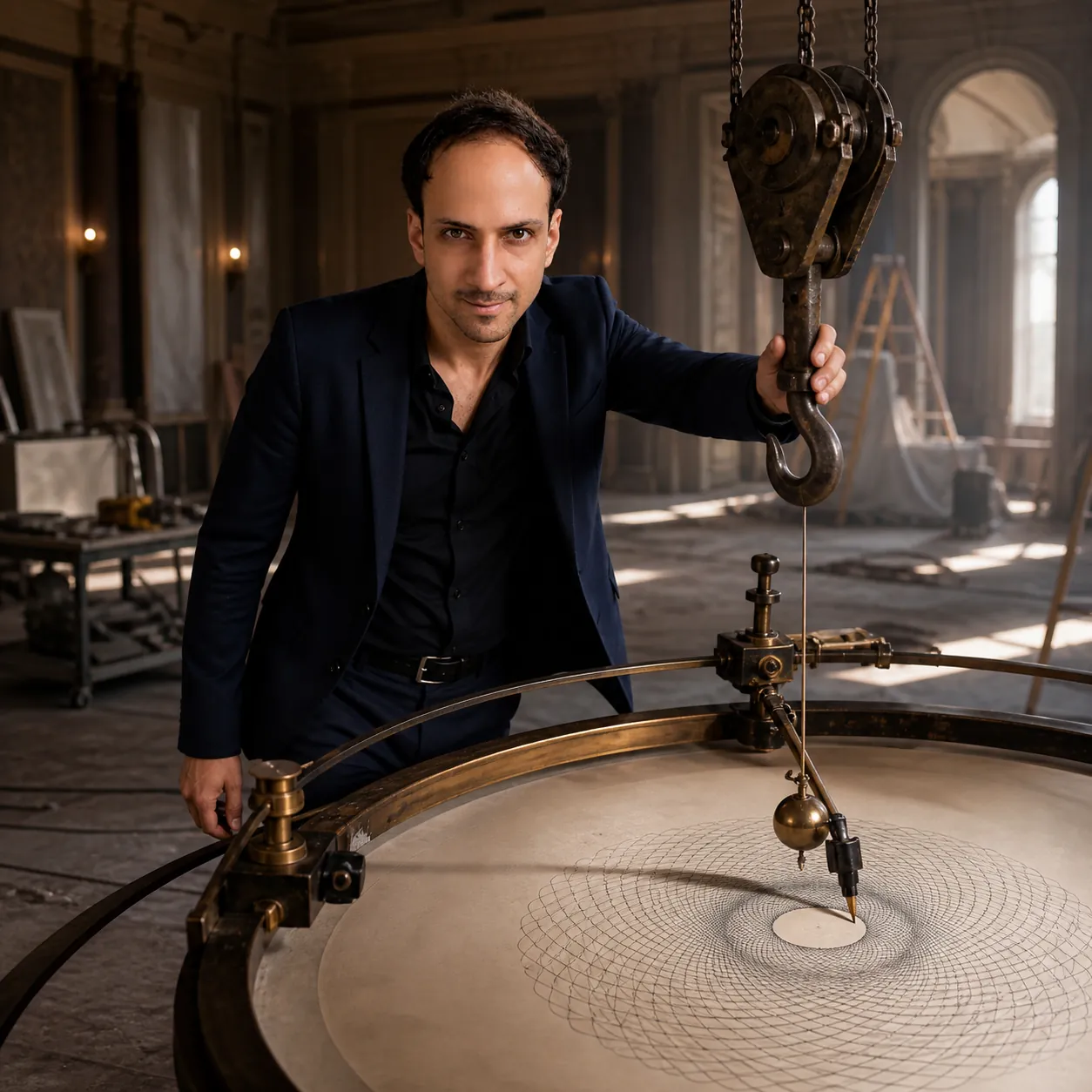
Ballroom Under Renovation — AI Portrait Prompt
صورةAI Portraits

Turn your own photo into a slow-apparatus editorial portrait in a hotel ballroom mid-renovation, its chandelier lowered and gone. Keeps your face unchanged.

من نص البرومبت

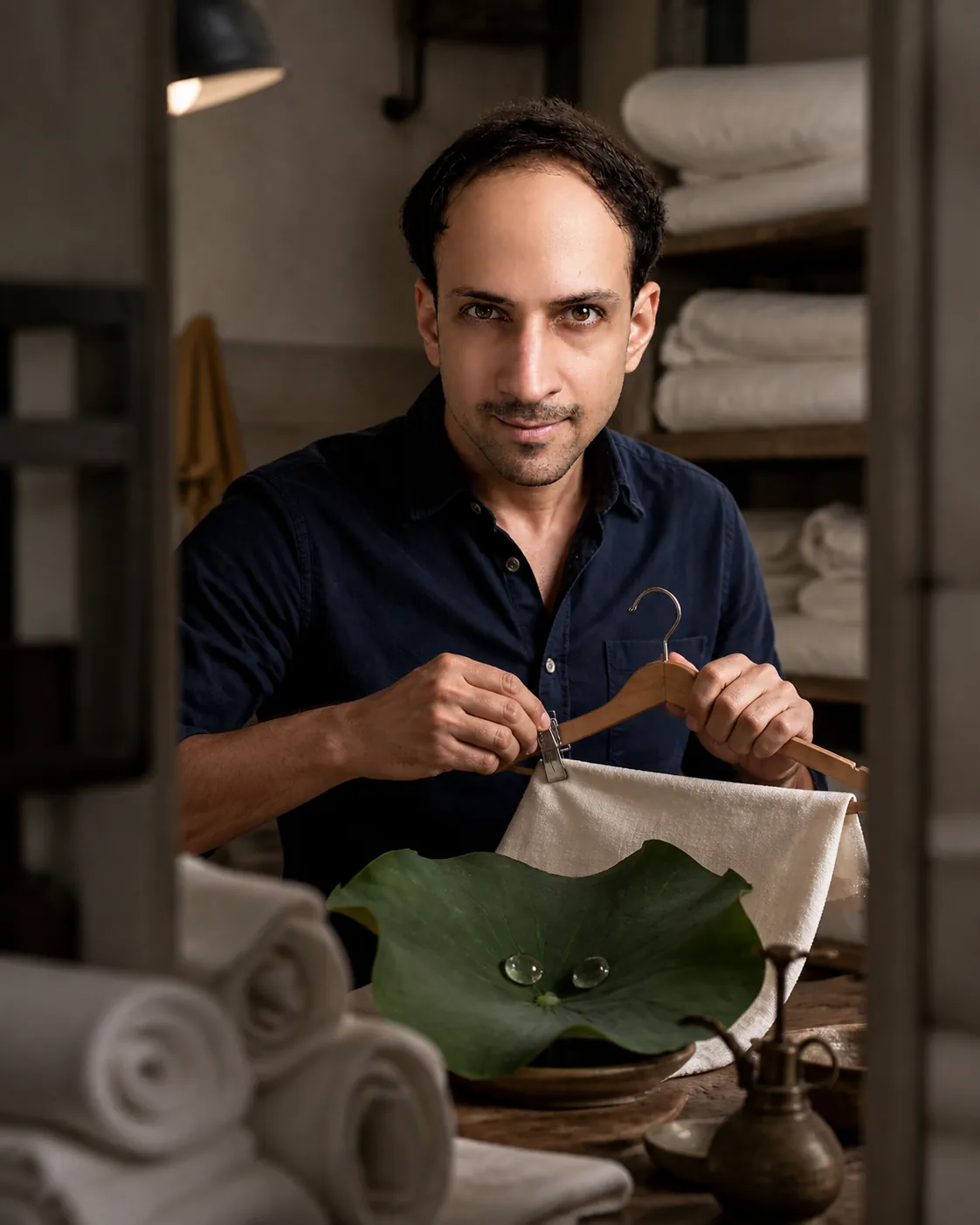
Use the attached reference photo as the identity reference: keep the same face, skin tone, hair and features as the person in that photo, without beautifying, aging or altering them. Create a square 1:1 museum-catalog frame with a strong first read and a slower second read at exactly 2880x2880 pixels. Location: a hotel ballroom mid-renovation, its chandelier lowered and gone. Show the subject in a midnight-blue suit worn without a tie, collar open, guiding the empty hoist hook to a dead stop. Build the artwork around this material rule: a rotary harmonograph whose gimbaled pendulum circles the paper table slowly beneath a second pendulum's laterally swinging pen turns the planet's steady pull into a signature anyone can read. Explore what friction is writing when every lap comes back slightly smaller; direct expression and posture toward solemn delight, never melodrama or ad-like confidence. Use an 85mm portrait distance with the freshest line of the drawing sharp in the foreground. Make the composition grant the drawing more area than the person. Render it as slow-apparatus editorial realism combining working drawing machines, honest wear on tools, accurate suspended-mass behavior, and reserved contemporary art direction, using late window light crossing the floor at a long shallow angle and a palette of lamp-soot black, unbleached paper, and one line of brass. Photorealistic: this must read as a real photograph from a physical camera, never an illustration, painting, or 3D render. Resolve real surface detail: label-free packaging showing carton fibre, cardboard bruised at the corners, and tape lifting slightly at one end. Keep one identity-locked person, credible hands and fingers, natural fabric, and coherent scale, contact, reflections, shadows, airflow, deformation, and materials. Background people only when essential, always secondary and clearly different. Avoid glowing neon spirograph swirls, levitating pens, CGI particle trails, sacred-geometry overlays, and face-smearing motion blur. No text, labels, logos, signatures, watermarks, random symbols, plastic skin, excessive bloom, or glossy AI finish.
Lotus Droplets in the Textile Room — AI Portrait Prompt
صورةAI Portraits

Turn your own photo into a museum-grade demonstration portrait in a textile finishing room with bolts of white cloth racked. Keeps your face unchanged.

من نص البرومبت

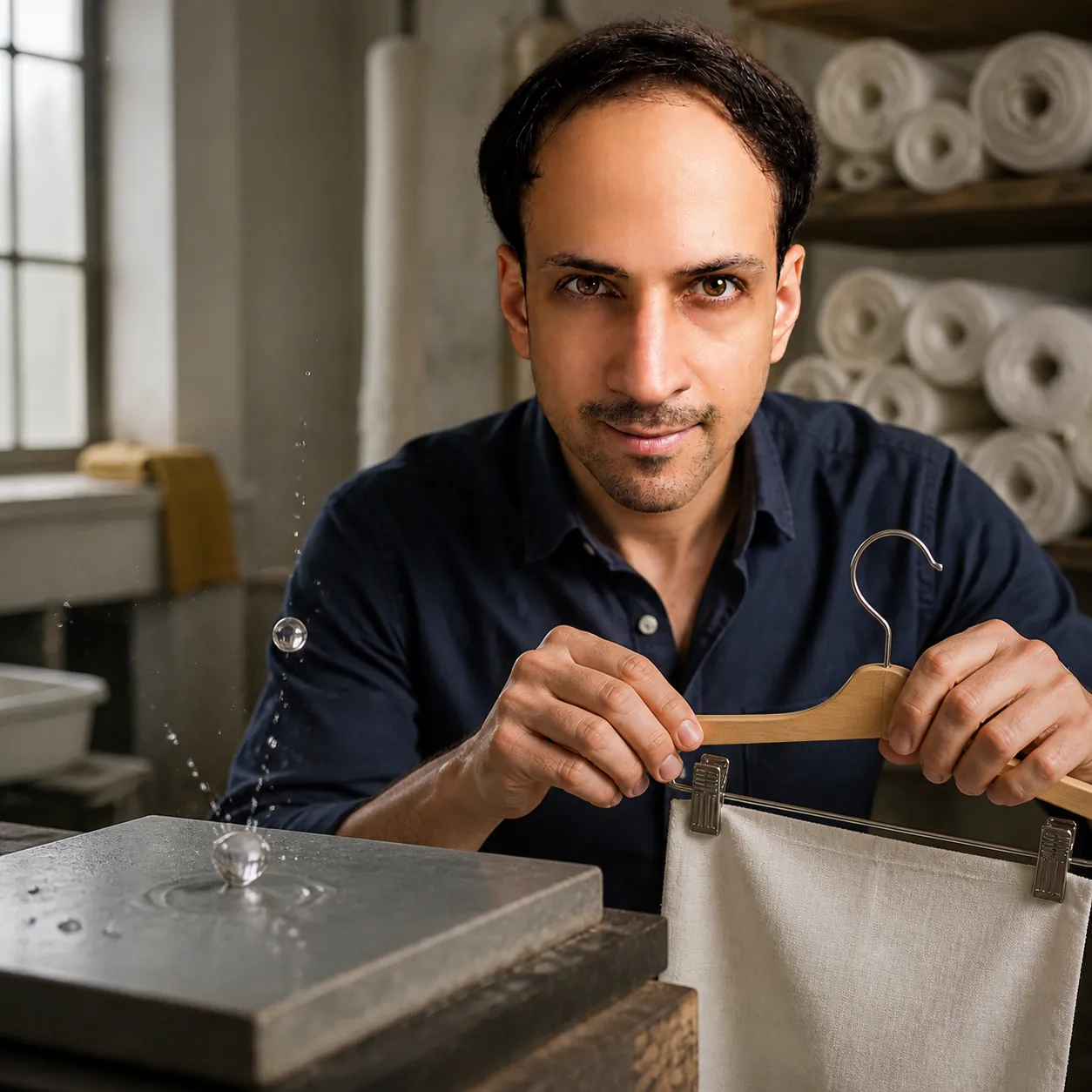
Use the attached reference photo as the identity reference: keep the same face, skin tone, hair and features as the person in that photo, without beautifying, aging or altering them. Build a portrait 4:5 editorial artwork with protected negative space and a fully readable face at exactly 2560x3200 pixels. Location: a textile finishing room with bolts of white cloth racked. Show the subject in a pressed indigo work shirt buttoned to one below the collar, clipping a cloth sample onto a wooden hanger. The impossible-looking event must obey this clear system: a fresh lotus leaf on which dyed droplets stand as near-perfect spheres and gather dust as they roll keeps the guarded surface dry no matter how the water arrives. Explore why a surface's firmest refusal reads as courtesy rather than hostility; direct expression and posture toward restrained delight, never melodrama or ad-like confidence. Frame through a real doorway or shelf edge, foreground soft, the person and the water both sharp. Make the composition let matte dryness dominate and glints stay few and earned. Render it as museum-grade demonstration realism combining faithful contact-angle physics, tactile fabric and metal surfaces, honest water optics, and unhurried portrait photography, using one low raking lamp that gives the water a single small specular point and a palette of pale cement, warm oat, and one measure of saffron. Photorealistic: this must read as a real photograph from a physical camera, never an illustration, painting, or 3D render. Resolve real surface detail: dust settled where nobody wipes, fingerprint haze on glass, and edges rubbed pale by handling. Keep one identity-locked person, credible hands and fingers, natural fabric, and coherent scale, contact, reflections, shadows, airflow, deformation, and materials. Background people only when essential, always secondary and clearly different. Avoid cartoon dewdrop gloss, rainbow refraction overload, levitating water blobs, spiritual lotus kitsch, and hoses spraying dramatic mist. No text, labels, logos, signatures, watermarks, random symbols, plastic skin, excessive bloom, or glossy AI finish.
Leaping Dew on a Chilled Plate — AI Portrait Prompt
صورةAI Portraits

Turn your own photo into a high-concept wetting-science portrait in a textile finishing room with bolts of white cloth racked. Keeps your face unchanged.

من نص البرومبت

Use the attached reference photo as the identity reference: keep the same face, skin tone, hair and features as the person in that photo, without beautifying, aging or altering them. Create a square 1:1 museum-catalog frame with a strong first read and a slower second read at exactly 2880x2880 pixels. Location: a textile finishing room with bolts of white cloth racked. Show the subject in a pressed indigo work shirt buttoned to one below the collar, clipping a cloth sample onto a wooden hanger. The impossible-looking event must obey this clear system: a chilled coated plate whose condensing dew droplets merge and fling themselves clear of the surface without any push turns refusal into something the eye can verify at arm's length. Explore how ordinary water earns the poise of a rarer, heavier liquid; direct expression and posture toward earned calm, never melodrama or ad-like confidence. Use a 90mm macro-to-portrait hybrid: the water's nearest detail sharp by the lens, their face readable beyond it. Make the composition let matte dryness dominate and glints stay few and earned. Render it as high-concept wetting-science portraiture built from real superhydrophobic materials, documentary calm, droplet-true refraction and reflection, and quietly exact bench craft, using clean side-window daylight that keeps every highlight on the water small and honest and a palette of pale cement, warm oat, and one measure of saffron. Photorealistic: this must read as a real photograph from a physical camera, never an illustration, painting, or 3D render. Resolve real surface detail: brass darkened in the recesses and bright where thumbs land, and lacquer crazed rather than perfect. Keep one identity-locked person, credible hands and fingers, natural fabric, and coherent scale, contact, reflections, shadows, airflow, deformation, and materials. Background people only when essential, always secondary and clearly different. Avoid CGI chrome water, crown-splash stock shots, glowing droplets, force-field ripples, and glycerin beads faked on every surface. No text, labels, logos, signatures, watermarks, random symbols, plastic skin, excessive bloom, or glossy AI finish.
Chaos Written in Light — AI Portrait Prompt
صورةAI Portraits

Turn your own photo into a portrait in a tiered university lecture hall, empty seats rising into shadow. Keeps your face unchanged.

من نص البرومبت

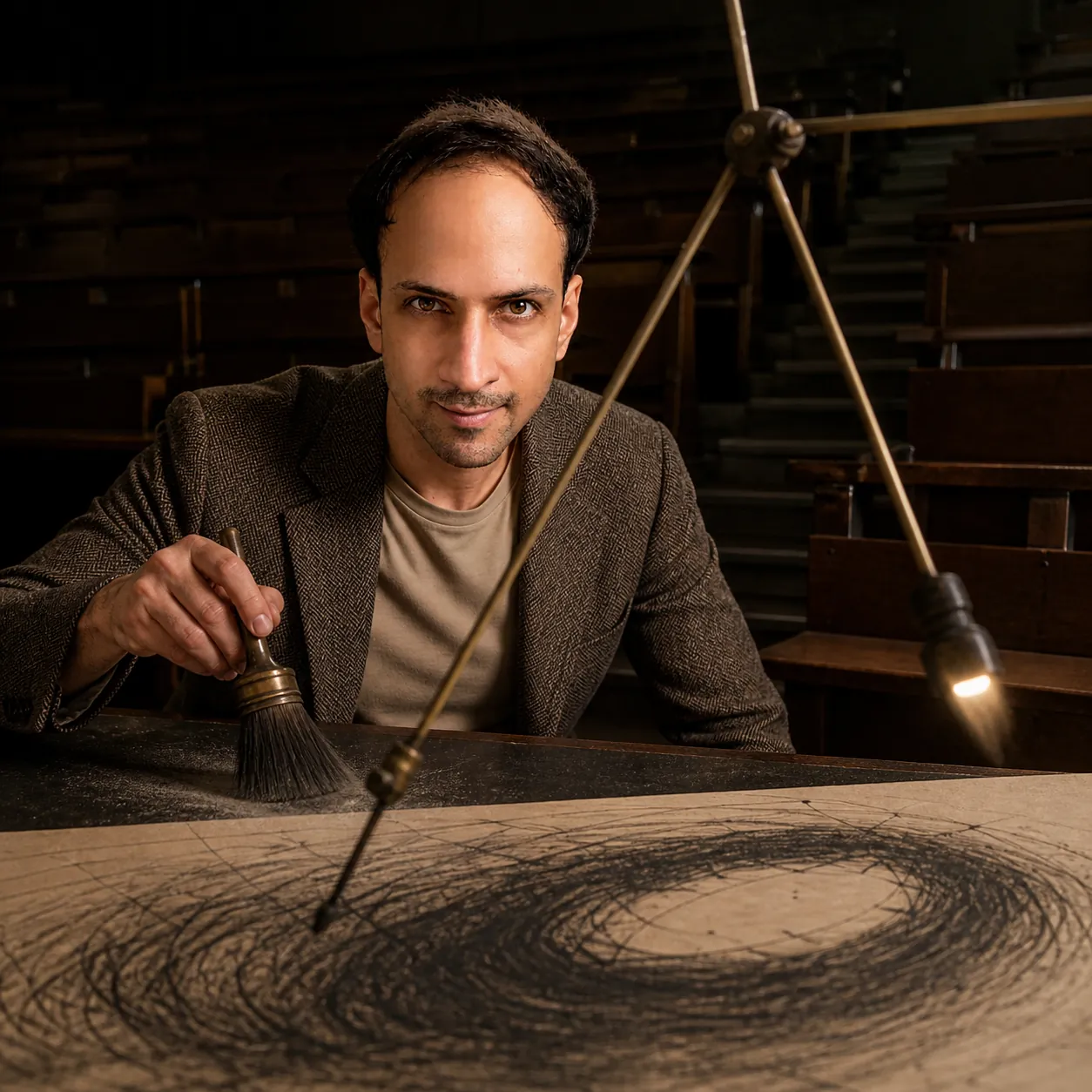
Use the attached reference photo as the identity reference: keep the same face, skin tone, hair and features as the person in that photo, without beautifying, aging or altering them. Create a square 1:1 museum-catalog frame with a strong first read and a slower second read at exactly 2880x2880 pixels. Location: a tiered university lecture hall, empty seats rising into shadow. Show the subject in a brown herringbone blazer over a plain sand-colored shirt, brushing dust from the bench top with a wide soft brush. Use this advanced image-making device as the core logic: a chaotic double pendulum whose small tip light writes one long-exposure scrawl that never once repeats its own path turns the planet's steady pull into a signature anyone can read. Explore what it changes to see time spent rather than time counted; direct expression and posture toward solemn delight, never melodrama or ad-like confidence. Frame from across the pendulum's plane so its arc crosses the foreground and their face stays clear. Make the composition hold one unfinished pass mid-stroke at the frame's edge. Render it as kinetic-sculpture documentary portraiture built from real pendulum apparatus, archival ink materiality, long-exposure honesty, and museum-quality restraint in every surface, using dim ambient darkness held back by two small warm practicals and a palette of lamp-soot black, unbleached paper, and one line of brass. Photorealistic: this must read as a real photograph from a physical camera, never an illustration, painting, or 3D render. Resolve real surface detail: wood grain read at honest scale, matte and gloss clearly separated, and no surface uniformly clean. Keep one identity-locked person, credible hands and fingers, natural fabric, and coherent scale, contact, reflections, shadows, airflow, deformation, and materials. Background people only when essential, always secondary and clearly different. Avoid glowing neon spirograph swirls, levitating pens, CGI particle trails, sacred-geometry overlays, and face-smearing motion blur. No text, labels, logos, signatures, watermarks, random symbols, plastic skin, excessive bloom, or glossy AI finish.
Mirror Sheet at Wadi Hanifah — AI Portrait Prompt
صورةAI Portraits

Turn your own photo into a large-format hydro-engineering portrait in a maintenance walkway beside a low Wadi Hanifah check weir. Keeps your face unchanged.

من نص البرومبت

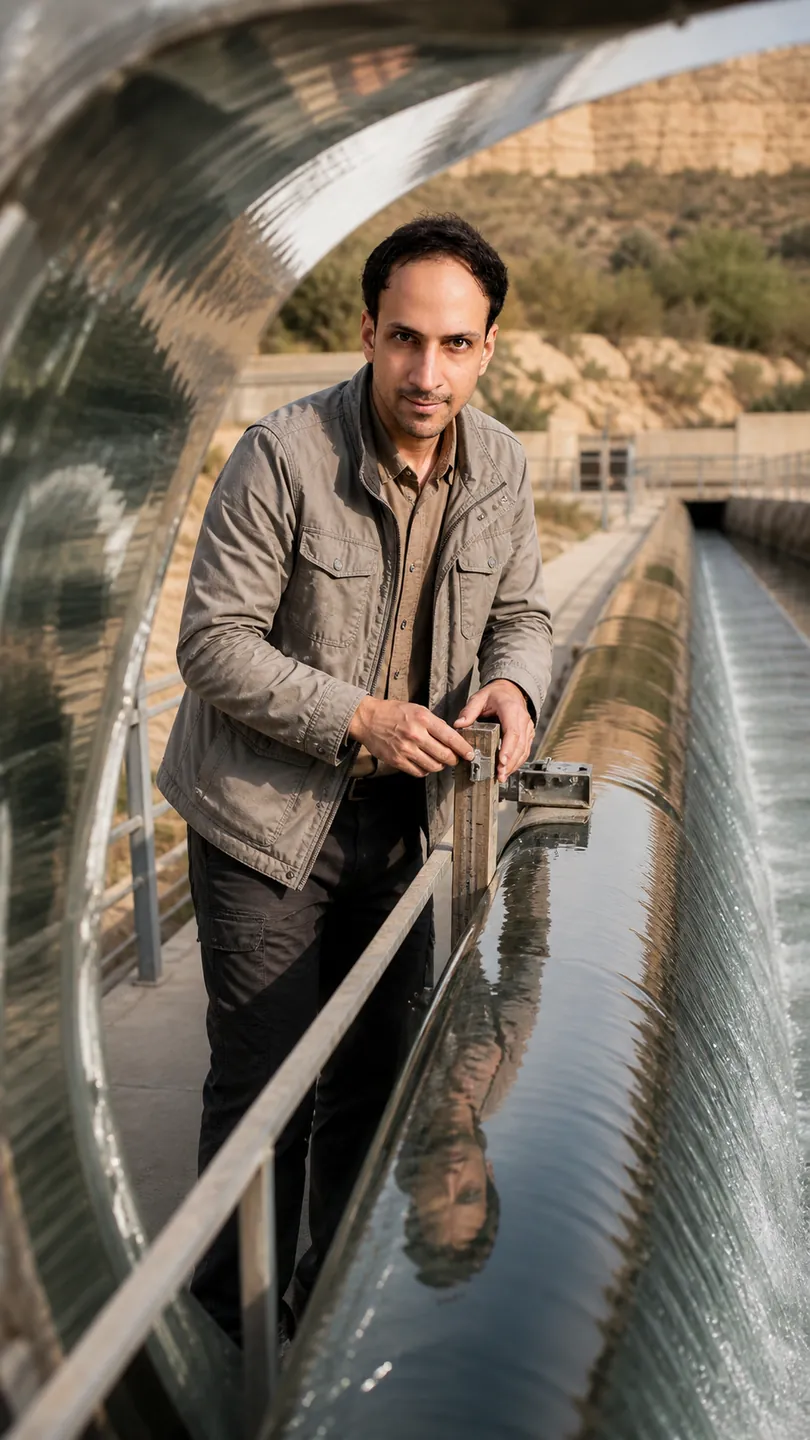
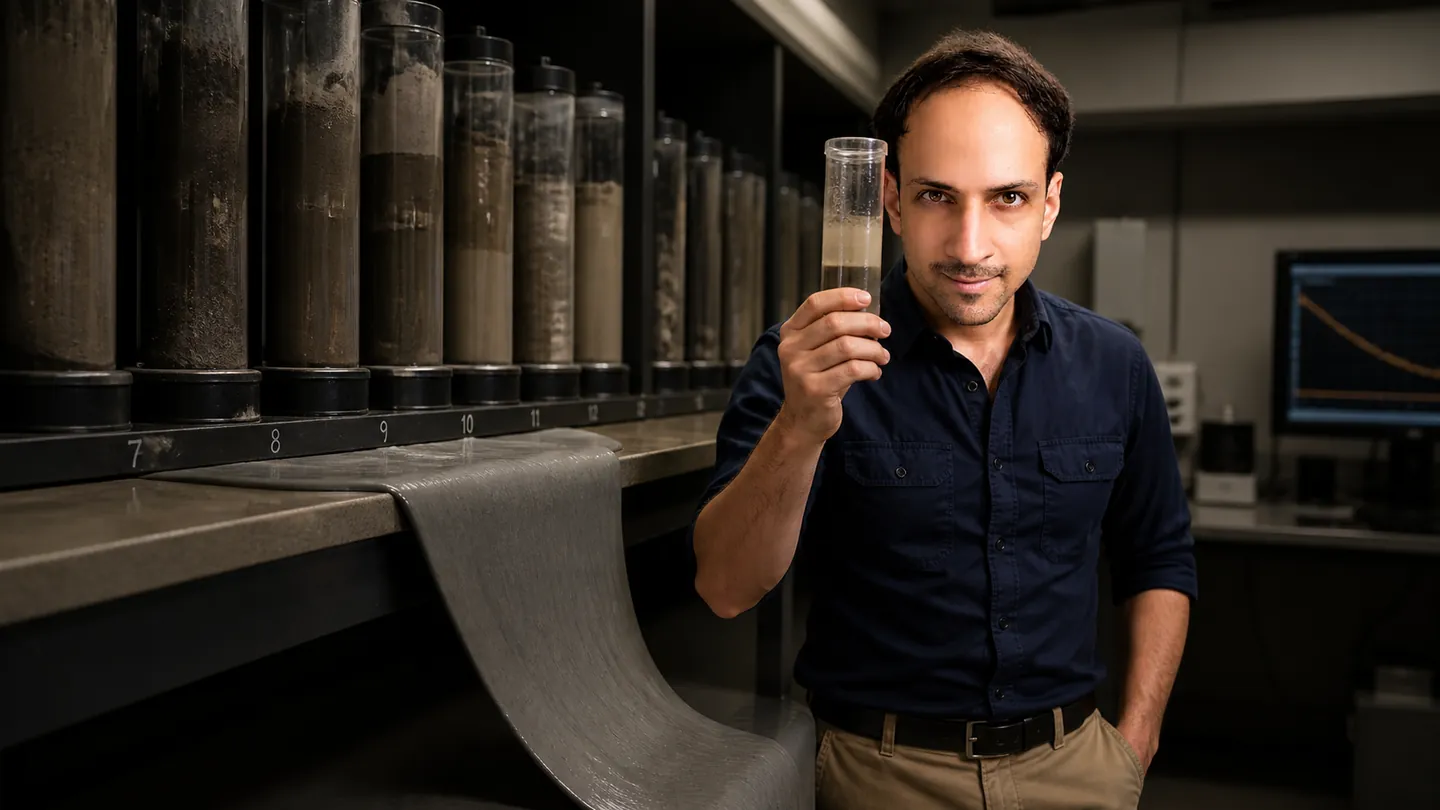
Use the attached reference photo as the identity reference: keep the same face, skin tone, hair and features as the person in that photo, without beautifying, aging or altering them. Design a full-height 9:16 cinematic artwork that reads on a phone and rewards gallery-scale inspection at exactly 2144x3808 pixels. Location: a maintenance walkway beside a low Wadi Hanifah check weir. Show the subject in a sand-grey field jacket over a tan shirt and dark workwear trousers, hooking a measuring staff onto the parapet rail. Make one rigorous physical condition the conceptual engine: a sheet of water that slides over a machined weir crest so evenly it holds one unbroken, believable reflection reveals what a liquid becomes when turbulence is lawfully withheld. Explore how a moving surface can hold an image that refuses to move; direct expression and posture toward gentle vigilance, never melodrama or ad-like confidence. Frame through the clear apparatus itself, refraction bending the background while their face stays undistorted and sharp. Make the composition keep the flow's stillest passage sharpest and the room soft. Render it as large-format hydro-engineering portraiture built from real channel flows, precise wet-metal detailing, truthful surface optics, and patient documentary framing, using clean skylight softly refracted through moving water onto pale stone and a palette of bone white, clear-water celadon, and a line of indigo. Photorealistic: this must read as a real photograph from a physical camera, never an illustration, painting, or 3D render. Give the space honest scale: real distance between foreground, subject, and far wall. Resolve real surface detail: condensation beading at true size, liquid meniscus curving against glass, and wet surfaces darker than dry ones. Keep one identity-locked person, credible hands and fingers, natural fabric, and coherent scale, contact, reflections, shadows, airflow, deformation, and materials. Background people only when essential, always secondary and clearly different. Avoid stock waterfall mist, whirlpool vortices, ripple-covered surfaces, levitating water spheres, and dramatic slow-motion splash photography. No text, labels, logos, signatures, watermarks, random symbols, plastic skin, excessive bloom, or glossy AI finish.
Overnight Putty Creep — AI Portrait Prompt
صورةAI Portraits

Turn your own photo into a portrait in a drilling-fluids test room with numbered sample columns on shelves. Keeps your face unchanged.

من نص البرومبت

Use the attached reference photo as the identity reference: keep the same face, skin tone, hair and features as the person in that photo, without beautifying, aging or altering them. Compose a wide 16:9 narrative image where environment and subject carry equal meaning at exactly 3808x2144 pixels. Location: a drilling-fluids test room with numbered sample columns on shelves. Show the subject in pressed khaki field trousers and a navy technical shirt, holding one sample column up to the light. Build the artwork around this material rule: a bar of silicone bounce putty that has crept overnight across the shelf edge in one smooth unbroken glacier tongue treats speed as a question and stiffness as one possible answer. Explore whether patience is a property of minds or simply of timescales; direct expression and posture toward thoughtful reserve, never melodrama or ad-like confidence. Use an eye-level 80mm medium-format viewpoint with honest perspective and gentle depth of field. Make the composition give the substance's reply the same visual weight as their face. Render it as precise rheological portrait realism grounded in laboratory-true material response, calm documentary texture, instrument-grade staging, and quietly humane composition, using diffused overhead panels dimmed low enough to keep every reflection readable and a palette of pitch black, pale plaster, and one amber glint. Photorealistic: this must read as a real photograph from a physical camera, never an illustration, painting, or 3D render. Give truthful depth cues: overlapping planes and shadows softening as they travel. Resolve real surface detail: wood grain read at honest scale, matte and gloss clearly separated, and no surface uniformly clean. Keep one identity-locked person, credible hands and fingers, natural fabric, and coherent scale, contact, reflections, shadows, airflow, deformation, and materials. Background people only when essential, always secondary and clearly different. Avoid rainbow slime aesthetics, splattered goo on skin, speaker-driven paint splashes, and ASMR dripping close-ups. No text, labels, logos, signatures, watermarks, random symbols, plastic skin, excessive bloom, or glossy AI finish.
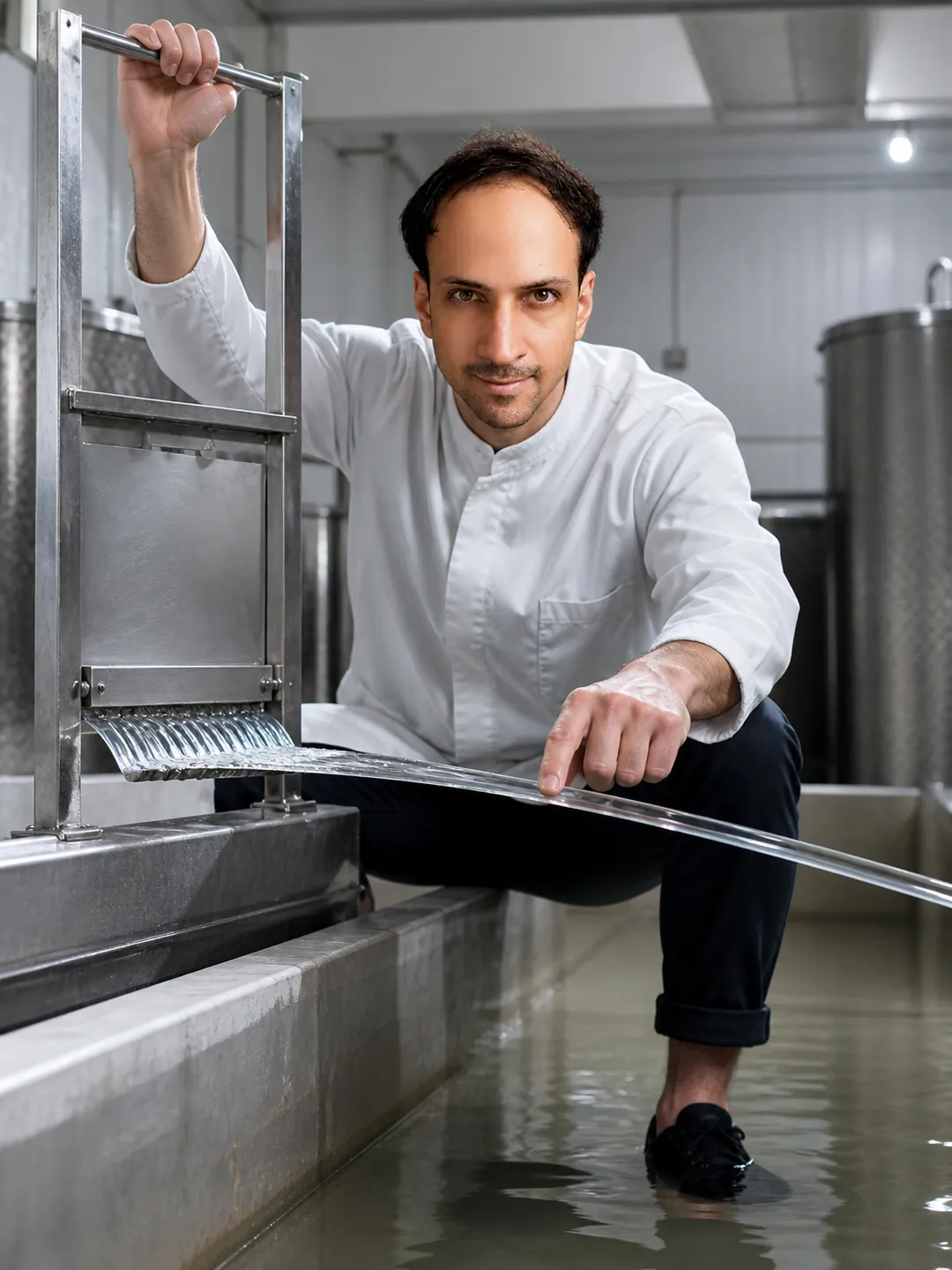
Glass Arc in the Honey House — AI Portrait Prompt
صورةAI Portraits

Turn your own photo into a portrait in a small honey-house of steel settling tanks and scrubbed concrete. Keeps your face unchanged.

من نص البرومبت

Use the attached reference photo as the identity reference: keep the same face, skin tone, hair and features as the person in that photo, without beautifying, aging or altering them. Use a formal 3:4 environmental portrait with complete hands and meaningful objects inside frame at exactly 2480x3312 pixels. Location: a small honey-house of steel settling tanks and scrubbed concrete. Show the subject in a white food-grade smock over rolled dark chinos, raising a small steel gate above a settling tank. Use this advanced image-making device as the core logic: an arc of water from a honeycomb-straightened nozzle that stands so clear and still it reads as a rod of bent glass treats smoothness as strict evidence of law rather than as polish. Explore why water that keeps perfect order looks more impossible than water in chaos; direct expression and posture toward clear-eyed patience, never melodrama or ad-like confidence. Use an eye-level 60mm medium-format viewpoint with honest perspective and gently limited depth of field. Make the composition let one unbroken waterline run the frame's full width. Render it as high-concept flow portraiture staged with real laminar apparatus, calibrated documentary lighting, optically true refraction, and quietly intelligent restraint, using even overhead lab light shaped by baffles into calm directional zones and a palette of bone white, clear-water celadon, and a line of indigo. Photorealistic: this must read as a real photograph from a physical camera, never an illustration, painting, or 3D render. Resolve real surface detail: skin that reddens slightly under pressure, nail beds with honest colour, and knuckle creases that fold rather than blur. Keep one identity-locked person, credible hands and fingers, natural fabric, and coherent scale, contact, reflections, shadows, airflow, deformation, and materials. Background people only when essential, always secondary and clearly different. Avoid stock waterfall mist, whirlpool vortices, ripple-covered surfaces, levitating water spheres, and dramatic slow-motion splash photography. No text, labels, logos, signatures, watermarks, random symbols, plastic skin, excessive bloom, or glossy AI finish.
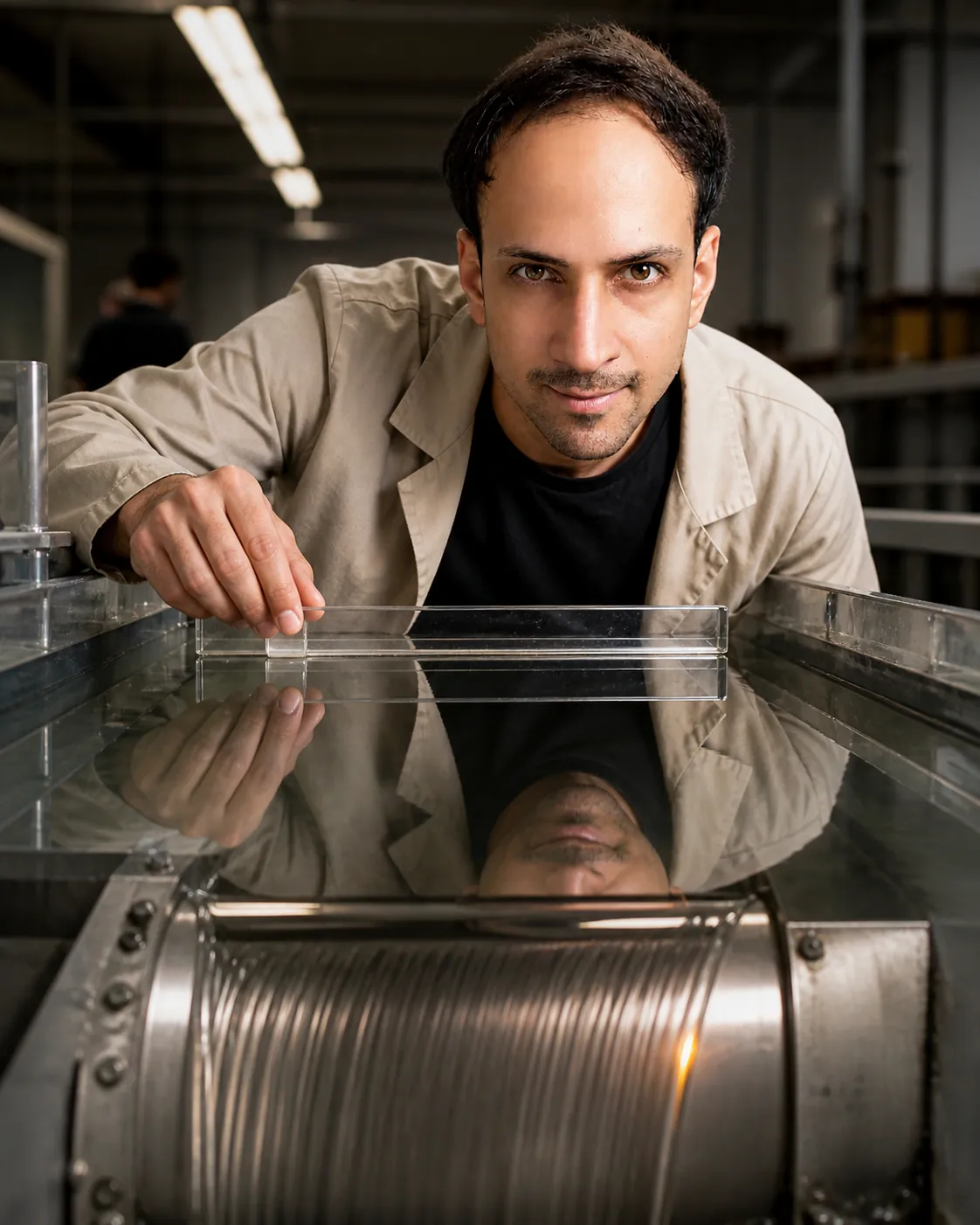
Mirror Weir in the Flume Lab — AI Portrait Prompt
صورةAI Portraits

Turn your own photo into a museum-scale demonstration portrait in a fluid-dynamics teaching lab built around one long clear flume. Keeps your face unchanged.

من نص البرومبت

Use the attached reference photo as the identity reference: keep the same face, skin tone, hair and features as the person in that photo, without beautifying, aging or altering them. Build a portrait 4:5 editorial artwork with protected negative space and a fully readable face at exactly 2560x3200 pixels. Location: a fluid-dynamics teaching lab built around one long clear flume. Show the subject in a putty-colored lab coat open over a plain black tee, skimming the flume's surface with a clear acrylic straightedge. Build the artwork around this material rule: a sheet of water that slides over a machined weir crest so evenly it holds one unbroken, believable reflection shows order arising in a substance famous for refusing to hold any. Explore how a moving surface can hold an image that refuses to move; direct expression and posture toward steady reverence, never melodrama or ad-like confidence. Use a 90mm close-portrait hybrid: one smooth stream sharp near the lens and their face readable beyond it. Make the composition give the dye's edge more acuity than any highlight. Render it as museum-scale demonstration realism combining faithful portrait photography, glass-smooth water rendered without exaggeration, machined hydraulic hardware, and physically exact reflections, using even overhead lab light shaped by baffles into calm directional zones and a palette of brushed steel, water grey, and one amber gleam. Photorealistic: this must read as a real photograph from a physical camera, never an illustration, painting, or 3D render. Resolve real surface detail: cotton that hangs by its own weight, seams that pucker very slightly, and collars softened by washing. Keep one identity-locked person, credible hands and fingers, natural fabric, and coherent scale, contact, reflections, shadows, airflow, deformation, and materials. Background people only when essential, always secondary and clearly different. Avoid stock waterfall mist, whirlpool vortices, ripple-covered surfaces, levitating water spheres, and dramatic slow-motion splash photography. No text, labels, logos, signatures, watermarks, random symbols, plastic skin, excessive bloom, or glossy AI finish.
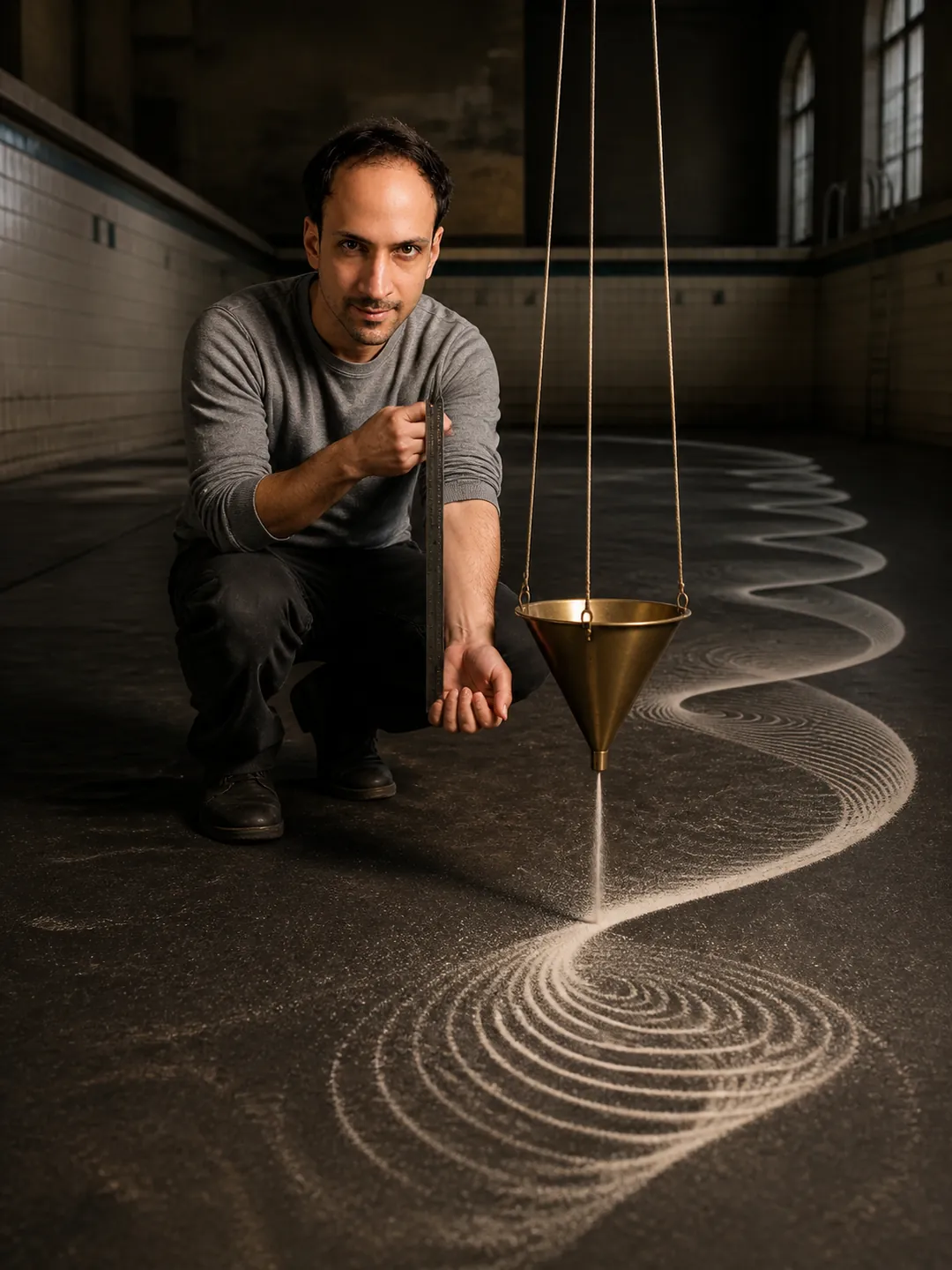
Sand Pendulum in the Drained Pool Hall — AI Portrait Prompt
صورةAI Portraits

Turn your own photo into a kinetic-sculpture documentary portrait in a drained indoor pool hall, tiles echoing every small sound. Keeps your face unchanged.

من نص البرومبت

Use the attached reference photo as the identity reference: keep the same face, skin tone, hair and features as the person in that photo, without beautifying, aging or altering them. Use a formal 3:4 environmental portrait with complete hands and meaningful objects inside frame at exactly 2480x3312 pixels. Location: a drained indoor pool hall, tiles echoing every small sound. Show them in a heather-grey sweatshirt and dark tapered work trousers, measuring a drop height against their own forearm. The impossible-looking event must obey this clear system: a brass funnel of white sand that swings on long cords, pouring its own path onto a dark floor puts down a mark that no living hand ever touches. Explore how much credit a person deserves for a drawing they only set in motion; direct expression and posture toward modest pride, never melodrama or ad-like confidence. Frame at the height of the swinging mass so the trace recedes in true perspective. Make the composition hold one unfinished pass mid-stroke at the frame's edge. Render it as kinetic-sculpture documentary portraiture built from real pendulum apparatus, archival ink materiality, long-exposure honesty, and museum-quality restraint in every surface, using one low raking beam that lifts the trace into shallow relief and a palette of lamp-soot black, unbleached paper, and one line of brass. Photorealistic: this must read as a real photograph from a physical camera, never an illustration, painting, or 3D render. Resolve real surface detail: hair with individual strands catching light, short hairs of uneven length, and skin oil giving a low uneven sheen. Keep one identity-locked person, credible hands and fingers, natural fabric, and coherent scale, contact, reflections, shadows, airflow, deformation, and materials. Background people only when essential, always secondary and clearly different. Avoid hypnotist's watch iconography, perpetual-motion fantasy rigs, laser-perfect printed curves, cosmic nebula backdrops, and pendulums hung from nothing. No text, labels, logos, signatures, watermarks, random symbols, plastic skin, excessive bloom, or glossy AI finish.
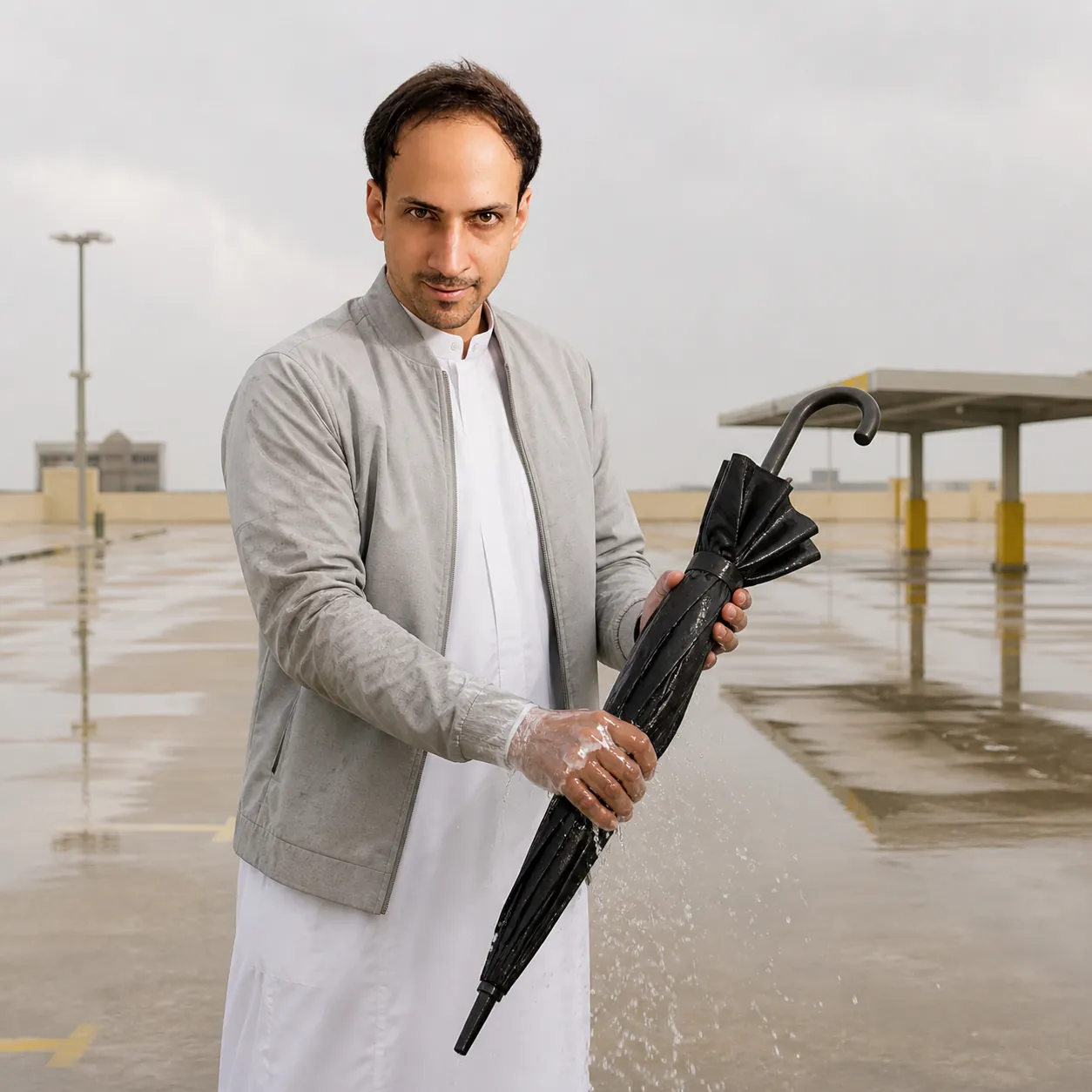
Silver Air Hand After Rain — AI Portrait Prompt
صورةAI Portraits

Turn your own photo into a museum-grade demonstration portrait in an open-air car park just after Riyadh's first brief rain. Keeps your face unchanged.

من نص البرومبت

Use the attached reference photo as the identity reference: keep the same face, skin tone, hair and features as the person in that photo, without beautifying, aging or altering them. Create a square 1:1 museum-catalog frame with a strong first read and a slower second read at exactly 2880x2880 pixels. Location: an open-air car park just after Riyadh's first brief rain. Show the subject in a plain white traditional Gulf outfit under a light grey jacket, closing an umbrella and shaking it once. Treat this mechanism as the frame’s governing rule: a coated hand submerged to the wrist that stays wrapped in a mirror-bright film of trapped air proves that texture too small to see decides what water may touch. Explore how dryness can be engineered as deliberately as any built structure; direct expression and posture toward gentle disbelief, never melodrama or ad-like confidence. Frame level with the work surface so the water's silhouette reads clean against the room. Make the composition hold generous negative space above the water's smallest detail. Render it as museum-grade demonstration realism combining faithful contact-angle physics, tactile fabric and metal surfaces, honest water optics, and unhurried portrait photography, using soft overcast skylight with shadows opened by one matte white bounce and a palette of pale cement, warm oat, and one measure of saffron. Photorealistic: this must read as a real photograph from a physical camera, never an illustration, painting, or 3D render. Resolve real surface detail: leather creased along the lines of use, stitching slightly irregular, and edges burnished from contact. Keep one identity-locked person, credible hands and fingers, natural fabric, and coherent scale, contact, reflections, shadows, airflow, deformation, and materials. Background people only when essential, always secondary and clearly different. Avoid cartoon dewdrop gloss, rainbow refraction overload, levitating water blobs, spiritual lotus kitsch, and hoses spraying dramatic mist. No text, labels, logos, signatures, watermarks, random symbols, plastic skin, excessive bloom, or glossy AI finish.
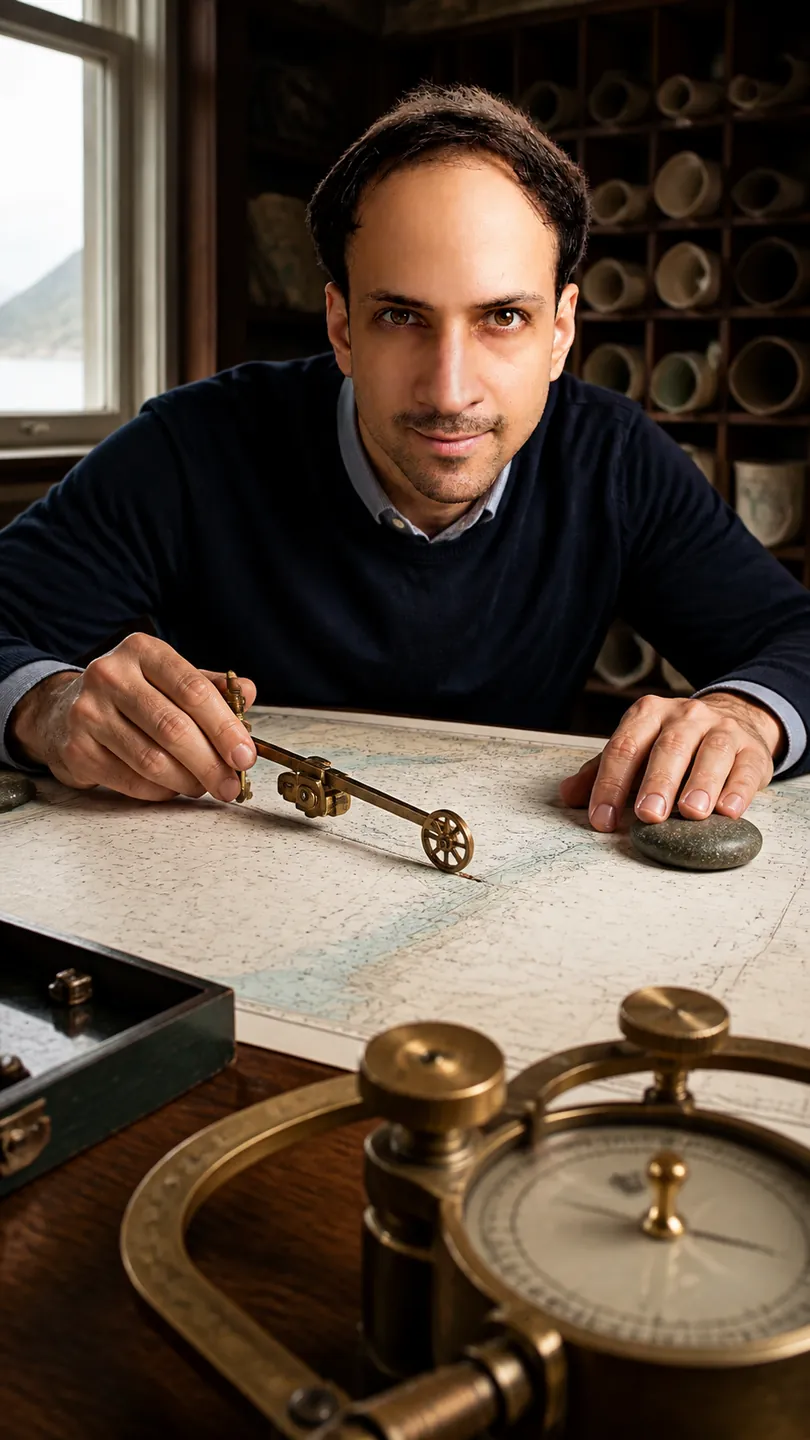
Planimeter in the Survey Office — AI Portrait Prompt
صورةAI Portraits

Turn your own photo into a portrait in a hydrographic survey office with rolled coastal charts in pigeonholes. Keeps your face unchanged.

من نص البرومبت

Use the attached reference photo as the identity reference: keep the same face, skin tone, hair and features as the person in that photo, without beautifying, aging or altering them. Design a full-height 9:16 cinematic artwork that reads on a phone and rewards gallery-scale inspection at exactly 2144x3808 pixels. Location: a hydrographic survey office with rolled coastal charts in pigeonholes. Show them in a navy lambswool sweater over a pale chambray shirt, flattening a rolled chart under two smooth stone weights. Treat this mechanism as the frame’s governing rule: a polar planimeter whose small measuring wheel, dragged around a lake's mapped shoreline, totals the enclosed area on one dial keeps every step of its reasoning open to a patient observer's eye. Explore what trust means when every step of a computation stays visible; direct expression and posture toward calm precision, never melodrama or ad-like confidence. Use a 90mm hybrid view: one machined detail near the lens, their readable face beyond. Make the composition keep every moving part inside the frame except one. Render it as gallery-grade technical realism built on lawful mechanism kinematics, precise engraved detail, tactile wood-and-metal textures, and emotionally intelligent portrait lighting, using cool north skylight fill with soft falloff into wood-paneled shadow and a palette of aged brass, deep walnut, and one verdigris accent. Photorealistic: this must read as a real photograph from a physical camera, never an illustration, painting, or 3D render. Give the frame volume: faint density deepest in the room, contrast easing at the edges. Resolve real surface detail: dust settled where nobody wipes, fingerprint haze on glass, and edges rubbed pale by handling. Keep one identity-locked person, credible hands and fingers, natural fabric, and coherent scale, contact, reflections, shadows, airflow, deformation, and materials. Background people only when essential, always secondary and clearly different. Avoid floating weightless gears, sepia steampunk grading, cog-filled head silhouettes, Roman-numeral dials, and oversized watch-movement props. No text, labels, logos, signatures, watermarks, random symbols, plastic skin, excessive bloom, or glossy AI finish.
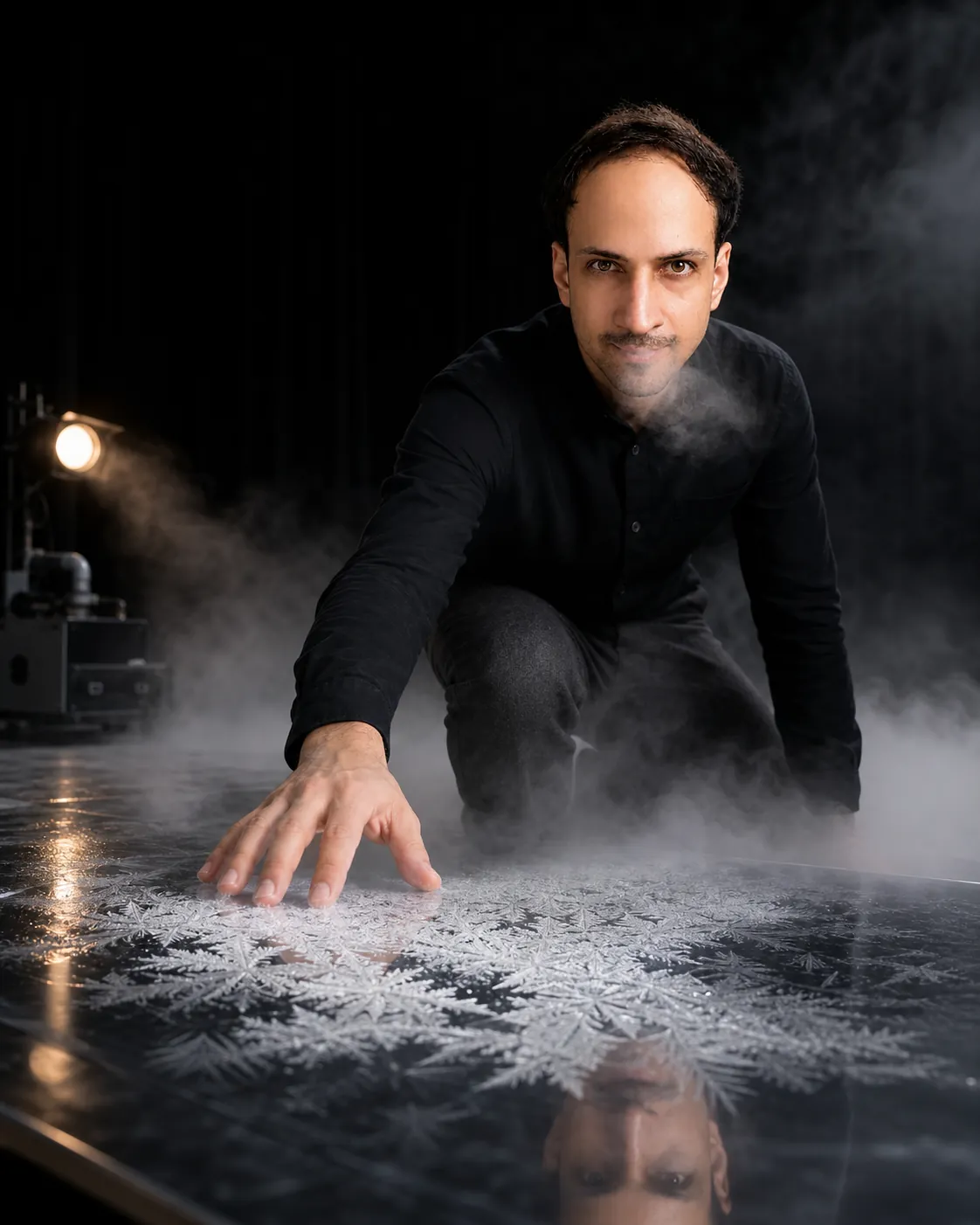
Breath on Frozen Steel in the Black-Box Theater — AI Portrait Prompt
صورةAI Portraits

Turn your own photo into a photorealistic portrait in an empty black-box theater with one fog machine cooling at stage left. Keeps your face unchanged.

من نص البرومبت

Use the attached reference photo as the identity reference: keep the same face, skin tone, hair and features as the person in that photo, without beautifying, aging or altering them. Build a portrait 4:5 editorial artwork with protected negative space and a fully readable face at exactly 2560x3200 pixels. Location: an empty black-box theater with one fog machine cooling at stage left. Show them in a plain black shirt buttoned to the collar and grey wool trousers, sweeping one open palm slowly through knee-deep fog. Make one rigorous physical condition the conceptual engine: a mirror-polished steel plate chilled far below freezing, on which a single exhaled breath blooms instantly into white frost turns weather-scale physics into an event small enough to stand beside. Explore what cold can build when it is given matter, stillness, and time; direct expression and posture toward hushed vigilance, never melodrama or ad-like confidence. Frame level with the cold surface so the advancing boundary leads the eye to their steady gaze. Make the composition grant the smallest cold detail more acuity than any warm surface. Render it as scientific still-life portraiture merging chilled-metal materiality, accurate condensation optics, believable breath and fog rendering, and human-centered documentary restraint, using thin winter daylight through cold glass with long soft shadows and a palette of chalk white, deep graphite, and one warm lamp gold. Photorealistic: this must read as a real photograph from a physical camera, never an illustration, painting, or 3D render. Resolve real surface detail: the difference between a wiped surface and a clean one, faint tide marks on ceramic, and metal dulled unevenly by touch. Keep one identity-locked person, credible hands and fingers, natural fabric, and coherent scale, contact, reflections, shadows, airflow, deformation, and materials. Background people only when essential, always secondary and clearly different. Avoid glowing magic ice, snowflake clip-art overlays, superhero freeze beams, CGI shatter shards, and fairy-tale crystal palaces. No text, labels, logos, signatures, watermarks, random symbols, plastic skin, excessive bloom, or glossy AI finish.
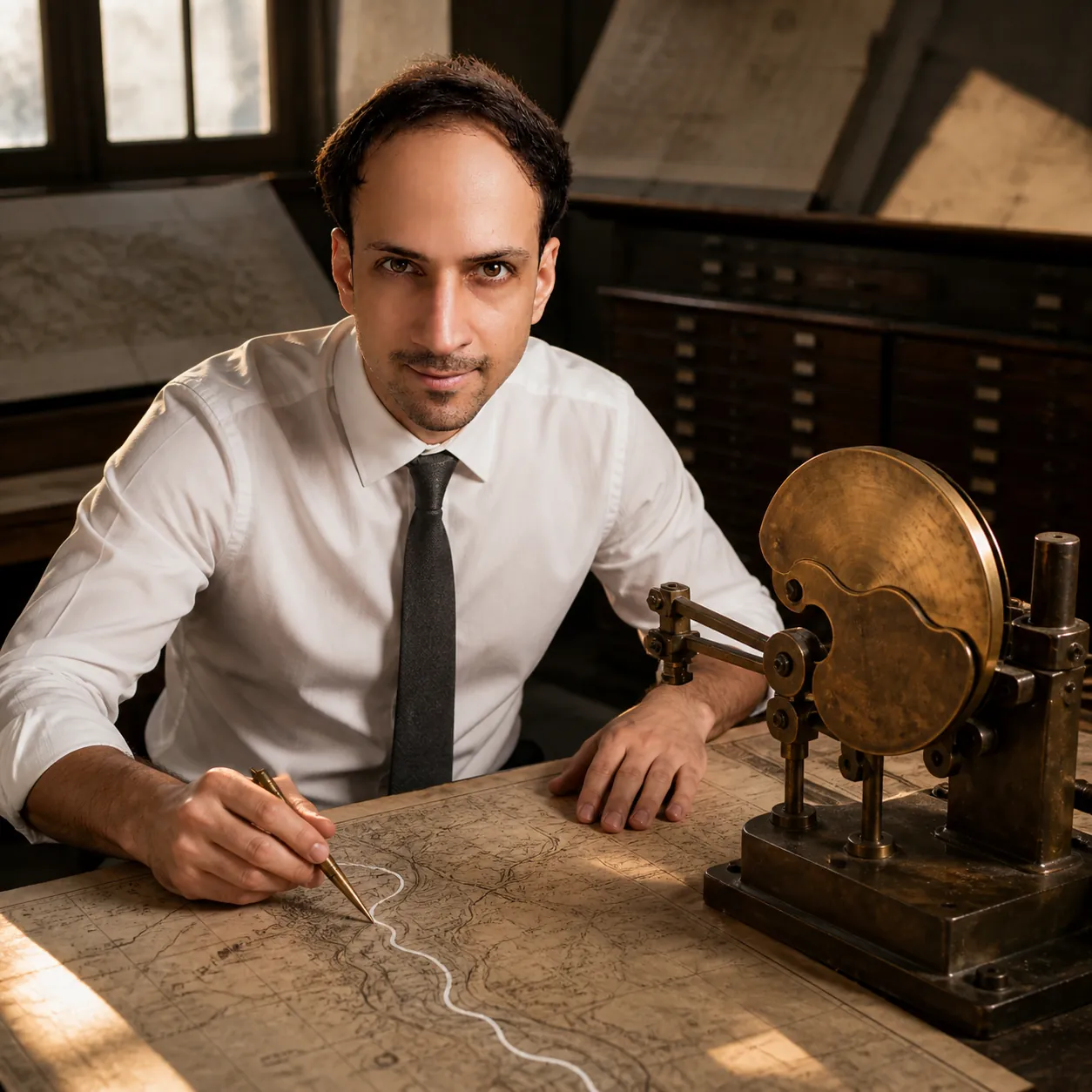
Curve Cut in Brass — AI Portrait Prompt
صورةAI Portraits

Turn your own photo into an engineering-heritage portrait in a national map room with a wide tilted table and drawer cabinets. Keeps your face unchanged.

من نص البرومبت

Use the attached reference photo as the identity reference: keep the same face, skin tone, hair and features as the person in that photo, without beautifying, aging or altering them. Create a square 1:1 museum-catalog frame with a strong first read and a slower second read at exactly 2880x2880 pixels. Location: a national map room with a wide tilted table and drawer cabinets. Show them in a pressed white shirt with a slate wool tie, no jacket, tracing a wadi's outline with a steady stylus. Make one rigorous physical condition the conceptual engine: a machined brass cam whose milled edge encodes a full mathematical curve, read by a follower arm as it slowly rotates performs real mathematics through nothing but shaped matter and lawful motion. Explore how a century-old mechanism can still out-argue a glowing screen; direct expression and posture toward lucid respect, never melodrama or ad-like confidence. Use an eye-level 85mm portrait perspective with honest depth of field and no distortion. Make the composition grant old machined wear the same dignity as their face. Render it as engineering-heritage photography combining working mechanical calculation, true kinematic detail, softly aged material finishes, and restrained human-centered contemporary framing, using late golden hour entering low and level, gilding brass without glare and a palette of dark slate, oiled bronze, and one chalk-white line. Photorealistic: this must read as a real photograph from a physical camera, never an illustration, painting, or 3D render. Resolve real surface detail: fine grit in the texture of concrete, efflorescence at damp edges, and hairline cracks that follow stress. Keep one identity-locked person, credible hands and fingers, natural fabric, and coherent scale, contact, reflections, shadows, airflow, deformation, and materials. Background people only when essential, always secondary and clearly different. Avoid steampunk goggles, glued-on decorative cogs, glowing holographic overlays, impossible gear meshes, and clock faces. No text, labels, logos, signatures, watermarks, random symbols, plastic skin, excessive bloom, or glossy AI finish.
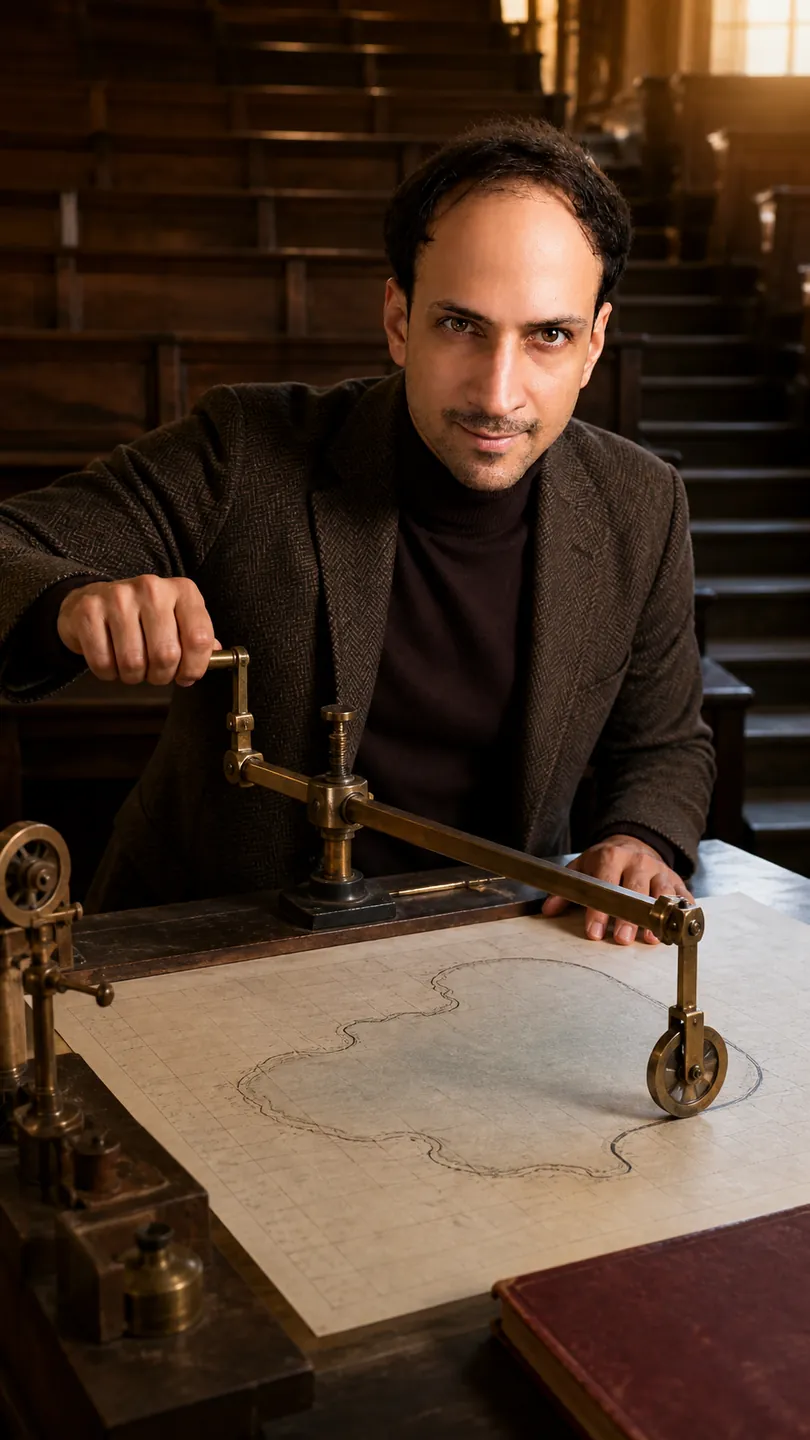
Planimeter in the Old Lecture Theatre — AI Portrait Prompt
صورةAI Portraits

Turn your own photo into a portrait in an old lecture theatre with steep wooden seating and a demonstration bench. Keeps your face unchanged.

من نص البرومبت

Use the attached reference photo as the identity reference: keep the same face, skin tone, hair and features as the person in that photo, without beautifying, aging or altering them. Design a full-height 9:16 cinematic artwork that reads on a phone and rewards gallery-scale inspection at exactly 2144x3808 pixels. Location: an old lecture theatre with steep wooden seating and a demonstration bench. Show them in a brown herringbone jacket over a fine merino roll-neck, turning a demonstration handle one slow full revolution. Use this advanced image-making device as the core logic: a polar planimeter whose small measuring wheel, dragged around a lake's mapped shoreline, totals the enclosed area on one dial slows abstract thought to a speed the eye can follow and verify. Explore what trust means when every step of a computation stays visible; direct expression and posture toward sober delight, never melodrama or ad-like confidence. Frame level with the mechanism so its motion and their eyes share one focal plane. Make the composition grant old machined wear the same dignity as their face. Render it as engineering-heritage photography combining working mechanical calculation, true kinematic detail, softly aged material finishes, and restrained human-centered contemporary framing, using late golden hour entering low and level, gilding brass without glare and a palette of gunmetal grey, ivory paper, and one burgundy bookcloth accent. Photorealistic: this must read as a real photograph from a physical camera, never an illustration, painting, or 3D render. Give truthful depth cues: overlapping planes and shadows softening as they travel. Resolve real surface detail: fine lint on dark fabric, water spotting on steel, and the soft rounding of edges that have been used for years. Keep one identity-locked person, credible hands and fingers, natural fabric, and coherent scale, contact, reflections, shadows, airflow, deformation, and materials. Background people only when essential, always secondary and clearly different. Avoid steampunk goggles, glued-on decorative cogs, glowing holographic overlays, impossible gear meshes, and clock faces. No text, labels, logos, signatures, watermarks, random symbols, plastic skin, excessive bloom, or glossy AI finish.
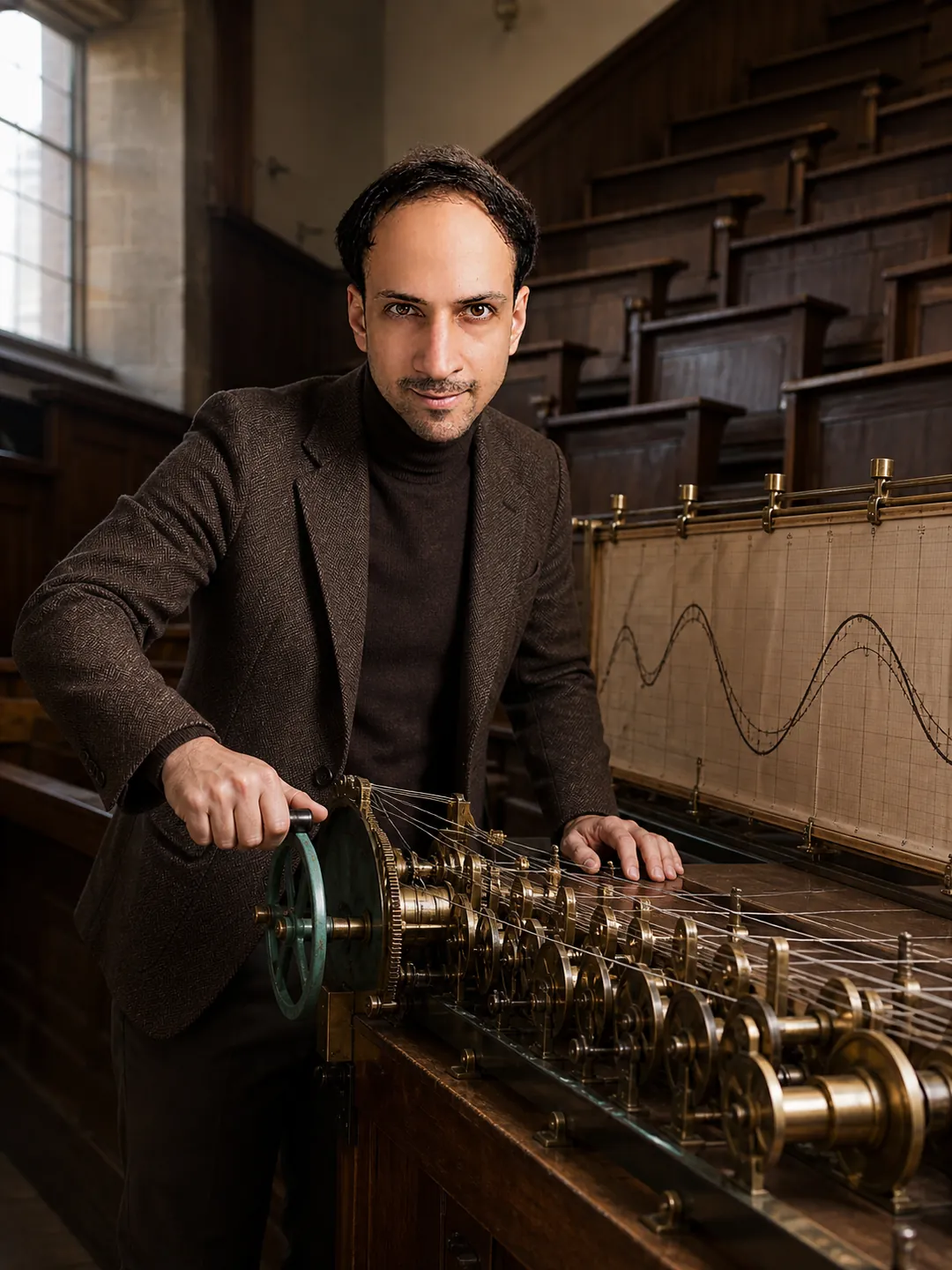
Tide Predictor in the Old Lecture Theatre — AI Portrait Prompt
صورةAI Portraits

Turn your own photo into a portrait in an old lecture theatre with steep wooden seating and a demonstration bench. Keeps your face unchanged.

من نص البرومبت

Use the attached reference photo as the identity reference: keep the same face, skin tone, hair and features as the person in that photo, without beautifying, aging or altering them. Use a formal 3:4 environmental portrait with complete hands and meaningful objects inside frame at exactly 2480x3312 pixels. Location: an old lecture theatre with steep wooden seating and a demonstration bench. Show them in a brown herringbone jacket over a fine merino roll-neck, turning a demonstration handle one slow full revolution. The impossible-looking event must obey this clear system: a tide-predicting machine whose fine wire, wrapped over a dozen geared pulleys, sums ocean harmonics into one drawn curve wears its accuracy openly, letting any error show as visible misalignment. Explore how motion becomes arithmetic the moment its parts are shaped with intent; direct expression and posture toward unhurried certainty, never melodrama or ad-like confidence. Use a composed 35mm environmental view placing them and the machine as equal patient subjects. Make the composition hold quiet empty space where the finished answer will arrive. Render it as museum-grade mechanism portraiture built from historically accurate analog computers, brushed-brass materiality, honest documentary realism, and quiet patient editorial composition, using low raking window sun that carves each machined edge into readable shadow and a palette of aged brass, deep walnut, and one verdigris accent. Photorealistic: this must read as a real photograph from a physical camera, never an illustration, painting, or 3D render. Resolve real surface detail: hair with individual strands catching light, short hairs of uneven length, and skin oil giving a low uneven sheen. Keep one identity-locked person, credible hands and fingers, natural fabric, and coherent scale, contact, reflections, shadows, airflow, deformation, and materials. Background people only when essential, always secondary and clearly different. Avoid floating weightless gears, sepia steampunk grading, cog-filled head silhouettes, Roman-numeral dials, and oversized watch-movement props. No text, labels, logos, signatures, watermarks, random symbols, plastic skin, excessive bloom, or glossy AI finish.
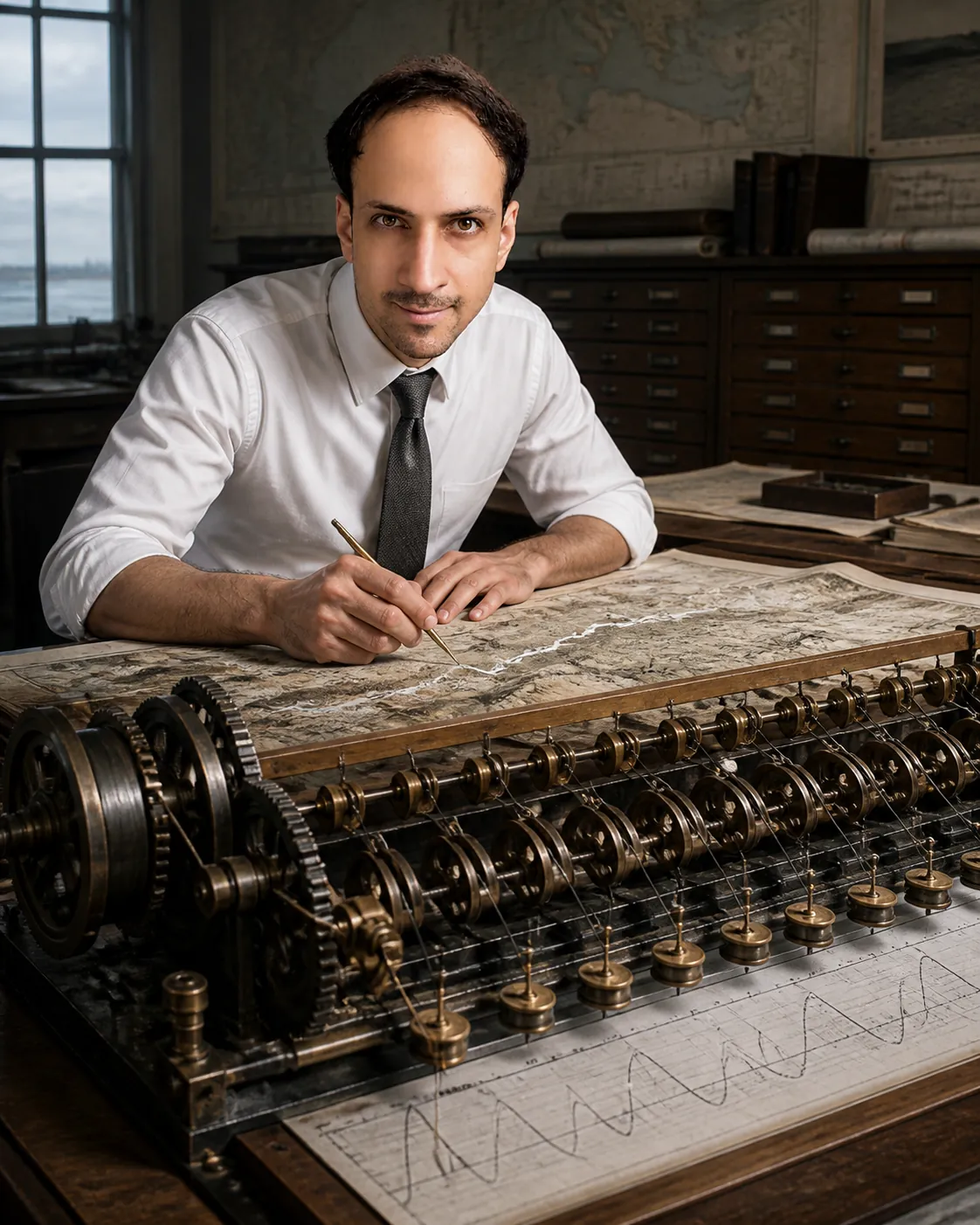
Tide Predictor in the National Map Room — AI Portrait Prompt
صورةAI Portraits

Turn your own photo into a gallery-grade technical portrait in a national map room with a wide tilted table and drawer cabinets. Keeps your face unchanged.

من نص البرومبت

Use the attached reference photo as the identity reference: keep the same face, skin tone, hair and features as the person in that photo, without beautifying, aging or altering them. Build a portrait 4:5 editorial artwork with protected negative space and a fully readable face at exactly 2560x3200 pixels. Location: a national map room with a wide tilted table and drawer cabinets. Show them in a pressed white shirt with a slate wool tie, no jacket, tracing a wadi's outline with a steady stylus. Make one rigorous physical condition the conceptual engine: a tide-predicting machine whose fine wire, wrapped over a dozen geared pulleys, sums ocean harmonics into one drawn curve shows how much of the world reduces to ratio and constrained motion. Explore how motion becomes arithmetic the moment its parts are shaped with intent; direct expression and posture toward grounded wonder, never melodrama or ad-like confidence. Frame level with the mechanism so its motion and their eyes share one focal plane. Make the composition grant old machined wear the same dignity as their face. Render it as gallery-grade technical realism built on lawful mechanism kinematics, precise engraved detail, tactile wood-and-metal textures, and emotionally intelligent portrait lighting, using diffuse overcast daylight held to gentle contrast so engravings stay legible and a palette of dark slate, oiled bronze, and one chalk-white line. Photorealistic: this must read as a real photograph from a physical camera, never an illustration, painting, or 3D render. Resolve real surface detail: fine grit in the texture of concrete, efflorescence at damp edges, and hairline cracks that follow stress. Keep one identity-locked person, credible hands and fingers, natural fabric, and coherent scale, contact, reflections, shadows, airflow, deformation, and materials. Background people only when essential, always secondary and clearly different. Avoid steampunk goggles, glued-on decorative cogs, glowing holographic overlays, impossible gear meshes, and clock faces. No text, labels, logos, signatures, watermarks, random symbols, plastic skin, excessive bloom, or glossy AI finish.

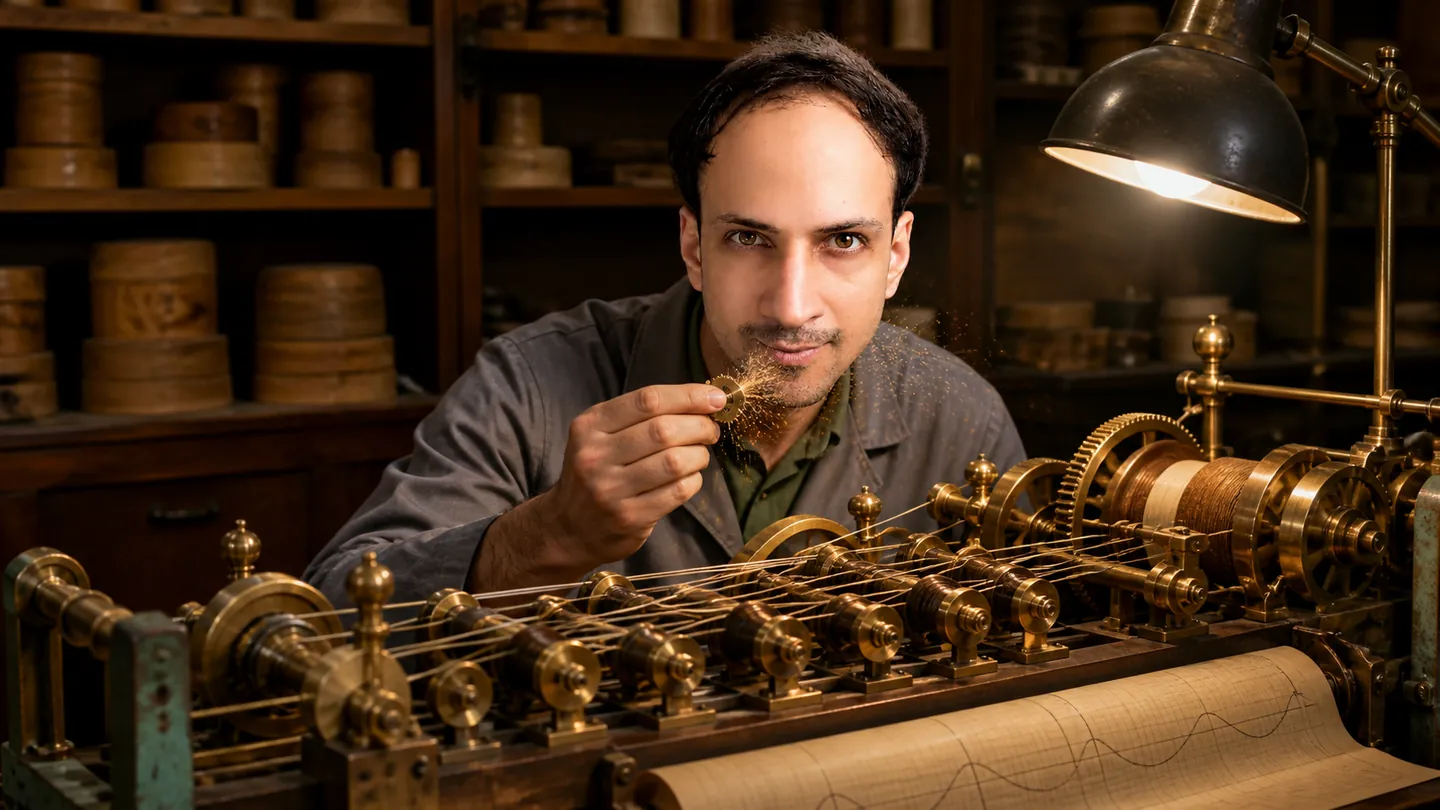
Tide Predictor in the Pattern Shop — AI Portrait Prompt
صورةAI Portraits

Turn your own photo into a museum-grade mechanism portrait in a university pattern shop lined with wooden casting molds on shelves. Keeps your face unchanged.

من نص البرومبت

Use the attached reference photo as the identity reference: keep the same face, skin tone, hair and features as the person in that photo, without beautifying, aging or altering them. Compose a wide 16:9 narrative image where environment and subject carry equal meaning at exactly 3808x2144 pixels. Location: a university pattern shop lined with wooden casting molds on shelves. Show them in a grey twill shop coat over an olive cotton shirt, blowing brass filings from a fresh-cut gear blank. The impossible-looking event must obey this clear system: a tide-predicting machine whose fine wire, wrapped over a dozen geared pulleys, sums ocean harmonics into one drawn curve runs on a hand's effort alone, no current invited anywhere. Explore how motion becomes arithmetic the moment its parts are shaped with intent; direct expression and posture toward attentive humility, never melodrama or ad-like confidence. Frame level with the mechanism so its motion and their eyes share one focal plane. Make the composition grant old machined wear the same dignity as their face. Render it as museum-grade mechanism portraiture built from historically accurate analog computers, brushed-brass materiality, honest documentary realism, and quiet patient editorial composition, using one warm tungsten work lamp pooled tightly over the mechanism and hands and a palette of aged brass, deep walnut, and one verdigris accent. Photorealistic: this must read as a real photograph from a physical camera, never an illustration, painting, or 3D render. Give the frame volume: faint density deepest in the room, contrast easing at the edges. Resolve real surface detail: grout darker than tile, sealant slightly yellowed, and every joint showing a real tolerance gap. Keep one identity-locked person, credible hands and fingers, natural fabric, and coherent scale, contact, reflections, shadows, airflow, deformation, and materials. Background people only when essential, always secondary and clearly different. Avoid steampunk goggles, glued-on decorative cogs, glowing holographic overlays, impossible gear meshes, and clock faces. No text, labels, logos, signatures, watermarks, random symbols, plastic skin, excessive bloom, or glossy AI finish.
