تخطَّ إلى المحتوى

برومبتات الصور

برومبتات لمولدات الصور: بورتريهات وفن وتصوير.

تم العثور على 4209
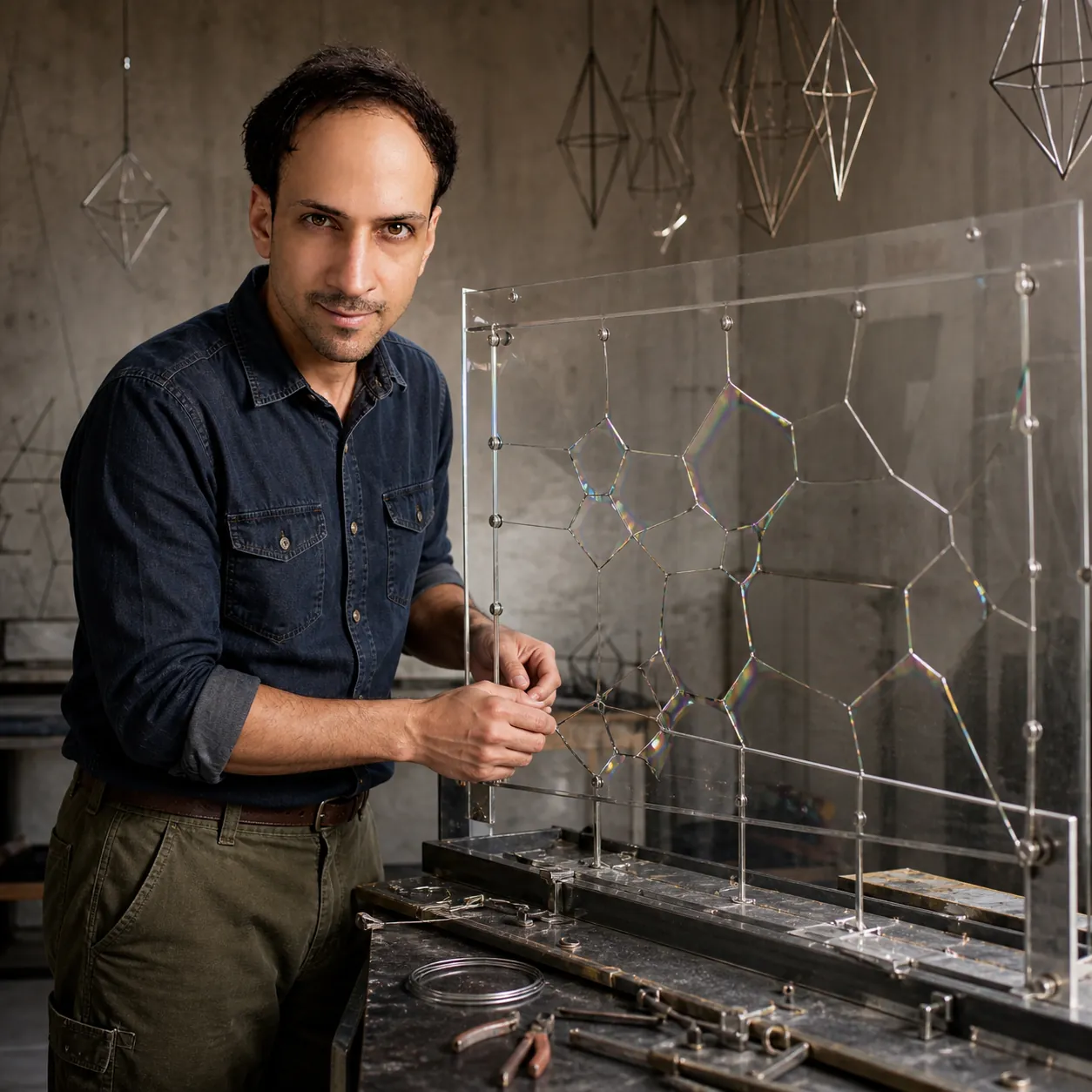
Iridescent Proof: Wire Artist's Studio — AI Portrait Prompt
صورةAI Portraits

Turn your own photo into a high-concept surface-tension portrait in a wire artist's studio hung with bent geometric frames. Keeps your face unchanged.

من نص البرومبت

Use the attached reference photo as the identity reference: keep the same face, skin tone, hair and features as the person in that photo, without beautifying, aging or altering them. Create a square 1:1 museum-catalog frame with a strong first read and a slower second read at exactly 2880x2880 pixels. Location: a wire artist's studio hung with bent geometric frames. Show them in a dark denim work shirt tucked into olive canvas trousers, easing a fresh bend into a length of wire. Treat this mechanism as the frame’s governing rule: a soap network between two clear plates and steel pins that links every pin with the shortest possible roads catches mathematics choosing the least surface right in front of them. Explore whether watching a problem solve itself can count as understanding it; direct expression and posture toward careful wonder, never melodrama or ad-like confidence. Use a 24mm environmental view with true verticals, placing them beside the apparatus rather than behind it. Make the composition give the film's colored bands more resolution than their clothing. Render it as high-concept surface-tension portraiture built from real minimal-surface demonstrations, documentary realism, laboratory-grade wire craft, and emotionally restrained human composition, using low side daylight kept off the background so the colors read true and a palette of warm concrete, soap-water grey, and a low gold shimmer. Photorealistic: this must read as a real photograph from a physical camera, never an illustration, painting, or 3D render. Resolve real surface detail: grout darker than tile, sealant slightly yellowed, and every joint showing a real tolerance gap. Keep one identity-locked person, credible hands and fingers, natural fabric, and coherent scale, contact, reflections, shadows, airflow, deformation, and materials. Background people only when essential, always secondary and clearly different. Avoid party-bubble clusters, rainbow oil-slick swirls, CGI-perfect spheres, sparkle overlays, and any child-with-wand whimsy. No text, labels, logos, signatures, watermarks, random symbols, plastic skin, excessive bloom, or glossy AI finish.
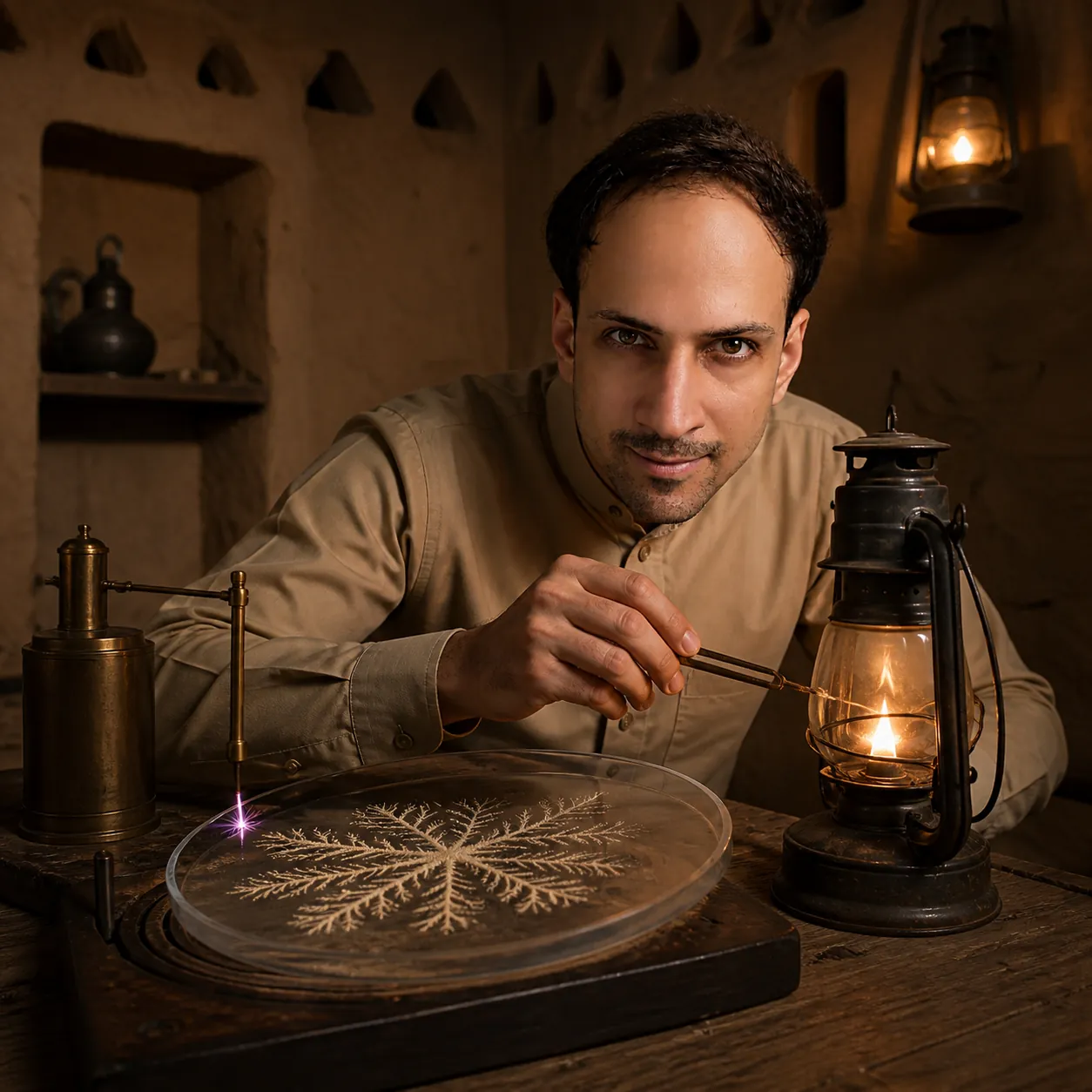
Charge Confesses: Restored Najdi Mud-Brick Room — AI Portrait Prompt
صورةAI Portraits

Turn your own photo into a photorealistic portrait in a restored Najdi mud-brick room lit by one low lantern. Keeps your face unchanged.

من نص البرومبت

Use the attached reference photo as the identity reference: keep the same face, skin tone, hair and features as the person in that photo, without beautifying, aging or altering them. Create a square 1:1 museum-catalog frame with a strong first read and a slower second read at exactly 2880x2880 pixels. Location: a restored Najdi mud-brick room lit by one low lantern. Show them in a plain sand-colored traditional Gulf outfit, sleeves buttoned at the wrist, trimming a lantern wick to a lower flame. Make one rigorous physical condition the conceptual engine: a resin plate over which sifted pale powder settles into a branching star, mapping charge left by one earlier spark turns activity far too fast to witness into a form calm enough to study. Explore how one force can write so differently across glass, wood, and air; direct expression and posture toward vigilant calm, never melodrama or ad-like confidence. Use an eye-level 85mm portrait view with honest perspective and one plane of disciplined focus. Make the composition let the brightest point be the smallest thing in frame. Render it as gallery-caliber physics portraiture merging real electrical signatures, charcoal-dark tonal control, precise glass-and-char material rendering, and steady observational calm, using deep dusk ambience shaped by one hooded lamp aimed at the work and a palette of smoked glass grey, desert sand, and a rose-plasma accent. Photorealistic: this must read as a real photograph from a physical camera, never an illustration, painting, or 3D render. Resolve real surface detail: fine lint on dark fabric, water spotting on steel, and the soft rounding of edges that have been used for years. Keep one identity-locked person, credible hands and fingers, natural fabric, and coherent scale, contact, reflections, shadows, airflow, deformation, and materials. Background people only when essential, always secondary and clearly different. Avoid Tesla-coil showmanship, storm lightning skies, arcs crawling on skin, glowing superhero eyes, and cyberpunk neon haze. No text, labels, logos, signatures, watermarks, random symbols, plastic skin, excessive bloom, or glossy AI finish.
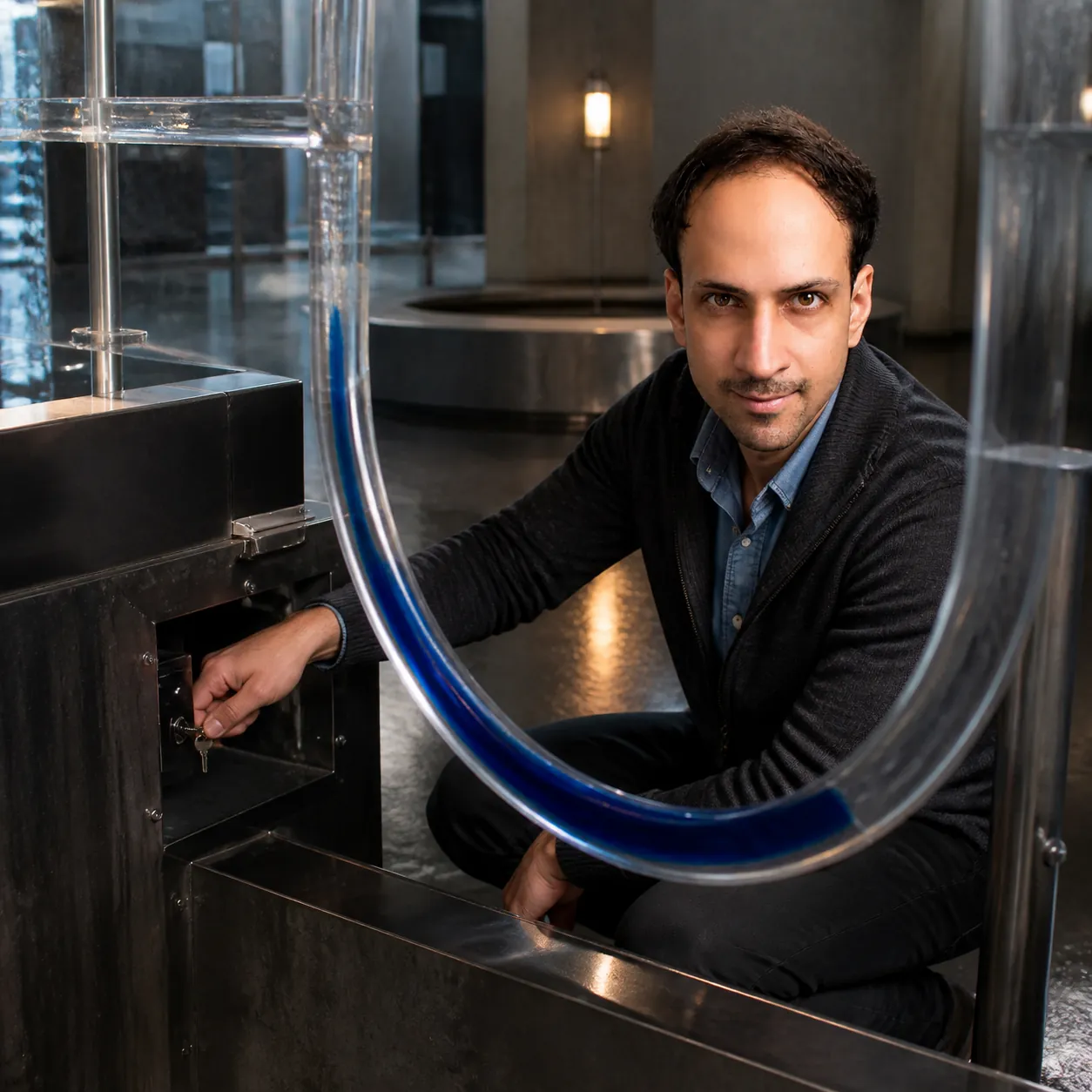
Laminar Calm: Science-Center Water Gallery — AI Portrait Prompt
صورةAI Portraits

Turn your own photo into a quiet kinetic-art portrait in a science-center water gallery after closing, one exhibit left running. Keeps your face unchanged.

من نص البرومبت

Use the attached reference photo as the identity reference: keep the same face, skin tone, hair and features as the person in that photo, without beautifying, aging or altering them. Create a square 1:1 museum-catalog frame with a strong first read and a slower second read at exactly 2880x2880 pixels. Location: a science-center water gallery after closing, one exhibit left running. Show the subject in a charcoal zip cardigan over an open-collar chambray shirt, keying open a low service panel beside the exhibit. Use this advanced image-making device as the core logic: a flat stripe of dye in a wide clear tube that the moving water stretches into one clean, deepening parabola puts continuous motion through a form that never once looks hurried. Explore where the boundary lies between a working flow and the sculpture it resembles; direct expression and posture toward composed fascination, never melodrama or ad-like confidence. Frame through the clear apparatus itself, refraction bending the background while their face stays undistorted and sharp. Make the composition hold clean empty space where turbulence would have been. Render it as quiet kinetic-art portraiture combining working flow sculpture, honest wet-surface materiality, calm controlled studio styling, and unforced human presence, using cool diffuse daylight with a single warm practical reflected in wet metal and a palette of dark basalt, damp concrete, and one seam of copper. Photorealistic: this must read as a real photograph from a physical camera, never an illustration, painting, or 3D render. Resolve real surface detail: rubber gone chalky with age, painted metal chipped to primer, and plastic yellowed only where light reaches it. Keep one identity-locked person, credible hands and fingers, natural fabric, and coherent scale, contact, reflections, shadows, airflow, deformation, and materials. Background people only when essential, always secondary and clearly different. Avoid stock waterfall mist, whirlpool vortices, ripple-covered surfaces, levitating water spheres, and dramatic slow-motion splash photography. No text, labels, logos, signatures, watermarks, random symbols, plastic skin, excessive bloom, or glossy AI finish.
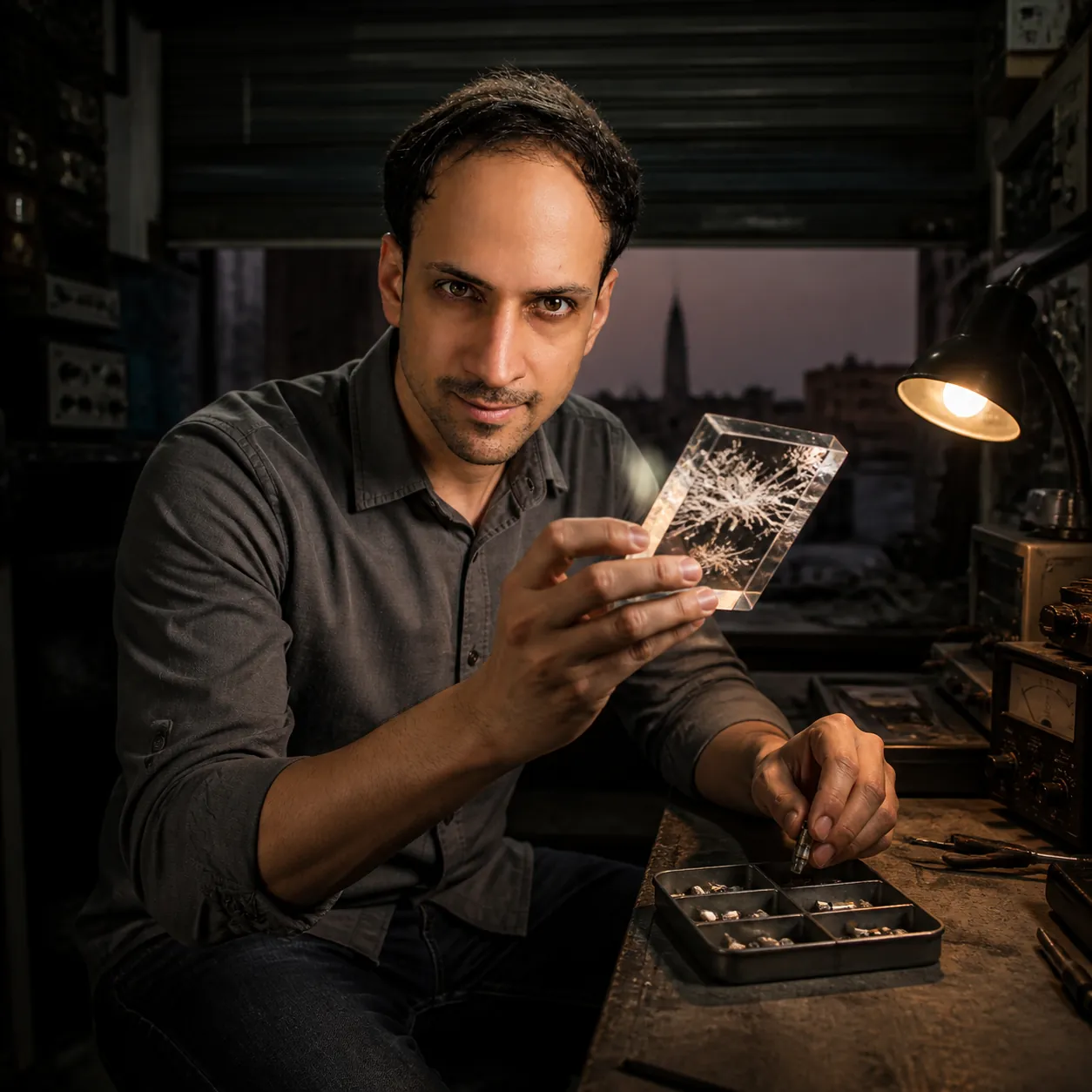
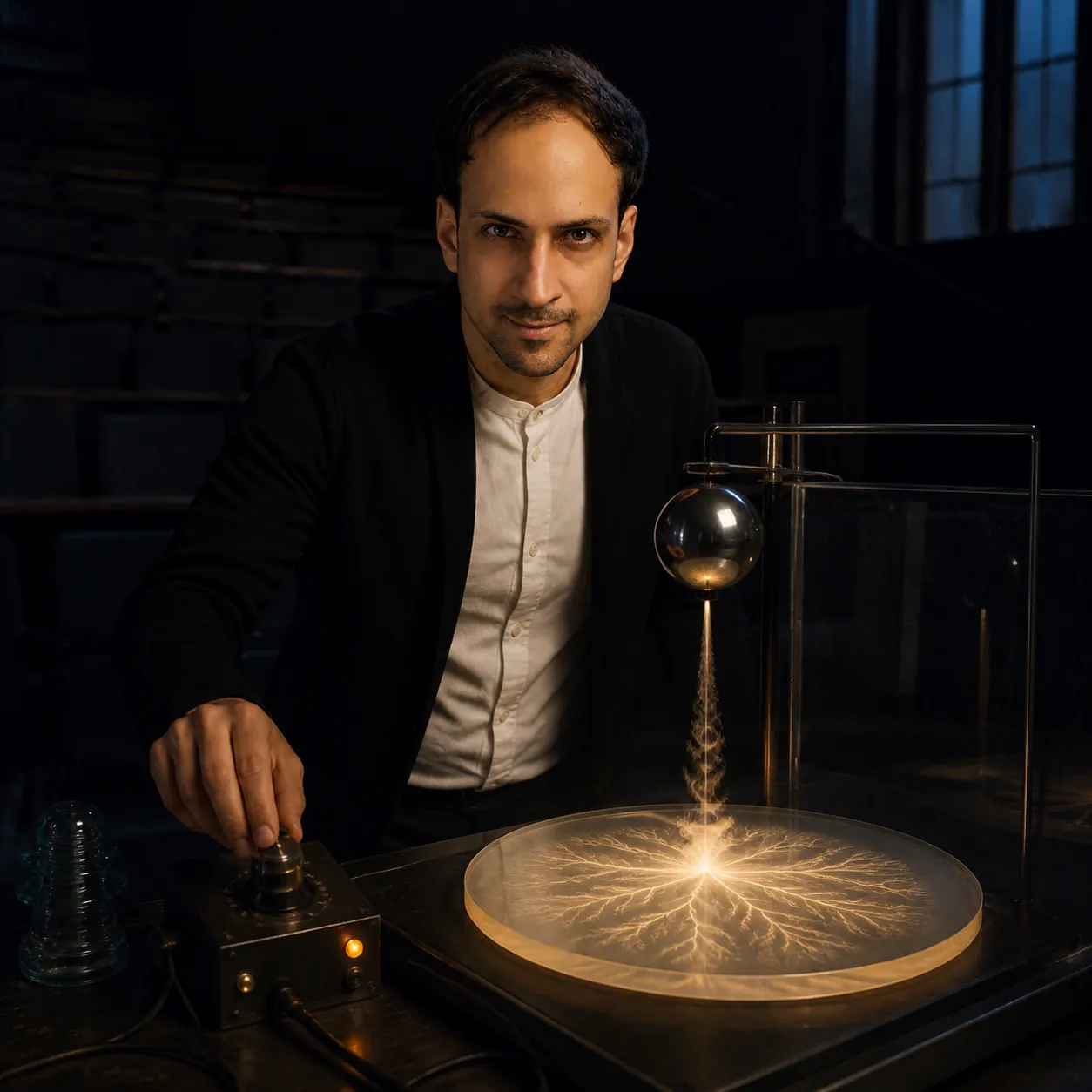
Charge Confesses: Empty Science-Museum Demonstration — AI Portrait Prompt
صورةAI Portraits

Turn your own photo into a low-light demonstration portrait in an empty science-museum demonstration theater, house lights taken low. Keeps your face unchanged.

من نص البرومبت

Use the attached reference photo as the identity reference: keep the same face, skin tone, hair and features as the person in that photo, without beautifying, aging or altering them. Create a square 1:1 museum-catalog frame with a strong first read and a slower second read at exactly 2880x2880 pixels. Location: an empty science-museum demonstration theater, house lights taken low. Show them in a soft black cardigan over a white collarless shirt, dimming a rotary dimmer to its last warm step. Build the artwork around this material rule: a resin plate over which sifted pale powder settles into a branching star, mapping charge left by one earlier spark brings a feared force close enough to study without any bravado. Explore how one force can write so differently across glass, wood, and air; direct expression and posture toward unhurried scrutiny, never melodrama or ad-like confidence. Use a restrained 35mm environmental view with the subject anchored off-center and hands never distorted. Make the composition keep their face half a stop dimmer than the demonstration. Render it as low-light demonstration realism combining true plasma color science, patient long-exposure discipline, tactile bench materiality, and dignified editorial portrait craft, using late blue window light mixed with one warm low-wattage source and a palette of midnight blue-black, brushed nickel, and one phosphor-green line. Photorealistic: this must read as a real photograph from a physical camera, never an illustration, painting, or 3D render. Resolve real surface detail: dust settled where nobody wipes, fingerprint haze on glass, and edges rubbed pale by handling. Keep one identity-locked person, credible hands and fingers, natural fabric, and coherent scale, contact, reflections, shadows, airflow, deformation, and materials. Background people only when essential, always secondary and clearly different. Avoid sci-fi energy balls, fractal screen-saver overlays, sparks showering from hands, wizard-lightning fingertips, and ultraviolet glow gimmicks. No text, labels, logos, signatures, watermarks, random symbols, plastic skin, excessive bloom, or glossy AI finish.
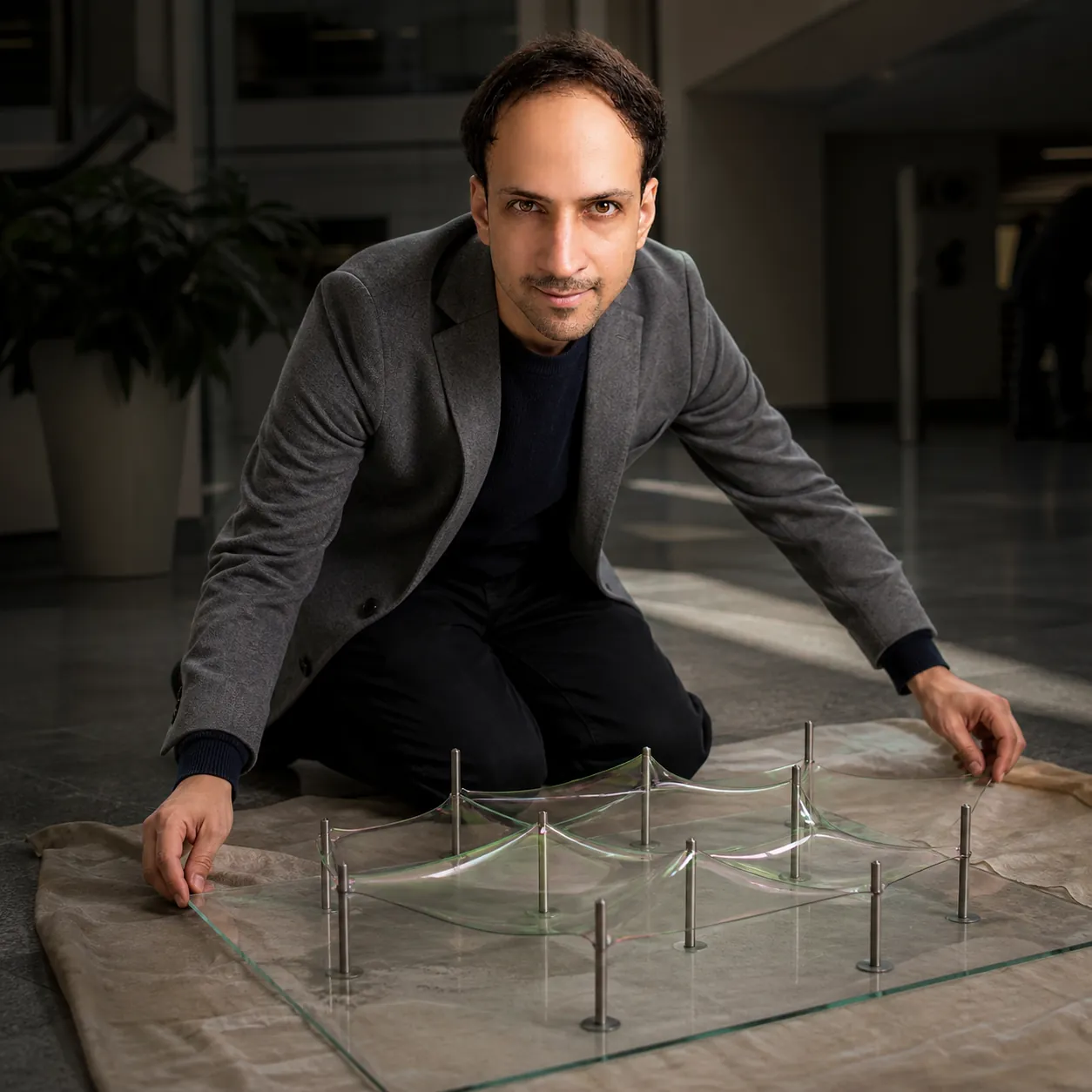
Lightning's Autograph: Narrow Electronics Repair Shop — AI Portrait Prompt
صورةAI Portraits

Turn your own photo into a high-voltage archival portrait in a narrow electronics repair shop in Riyadh, shutters half down at dusk. Keeps your face unchanged.

من نص البرومبت

Use the attached reference photo as the identity reference: keep the same face, skin tone, hair and features as the person in that photo, without beautifying, aging or altering them. Create a square 1:1 museum-catalog frame with a strong first read and a slower second read at exactly 2880x2880 pixels. Location: a narrow electronics repair shop in Riyadh, shutters half down at dusk. Show them in a graphite-grey service shirt with a folded cuff and dark jeans, sorting three cold fuses into a partitioned tin. Make one rigorous physical condition the conceptual engine: a clear acrylic block they tilt toward a lamp, holding a frozen white fern of fractures where a trapped charge once escaped turns activity far too fast to witness into a form calm enough to study. Explore why the fastest events in nature can leave the most patient evidence; direct expression and posture toward hushed reverence, never melodrama or ad-like confidence. Use an eye-level 85mm portrait view with honest perspective and one plane of disciplined focus. Make the composition let the brightest point be the smallest thing in frame. Render it as high-voltage archival portraiture built from sealed and lawful apparatus, deep-shadow documentary realism, physically true glass reflections, and museum-label restraint, using near-darkness held back by one small tungsten lamp at the bench and a palette of deep charcoal, gunmetal grey, and one violet whisper. Photorealistic: this must read as a real photograph from a physical camera, never an illustration, painting, or 3D render. Resolve real surface detail: true skin texture with pores and fine hair at the hairline, and fabric that creases where it is actually stressed. Keep one identity-locked person, credible hands and fingers, natural fabric, and coherent scale, contact, reflections, shadows, airflow, deformation, and materials. Background people only when essential, always secondary and clearly different. Avoid Tesla-coil showmanship, storm lightning skies, arcs crawling on skin, glowing superhero eyes, and cyberpunk neon haze. No text, labels, logos, signatures, watermarks, random symbols, plastic skin, excessive bloom, or glossy AI finish.
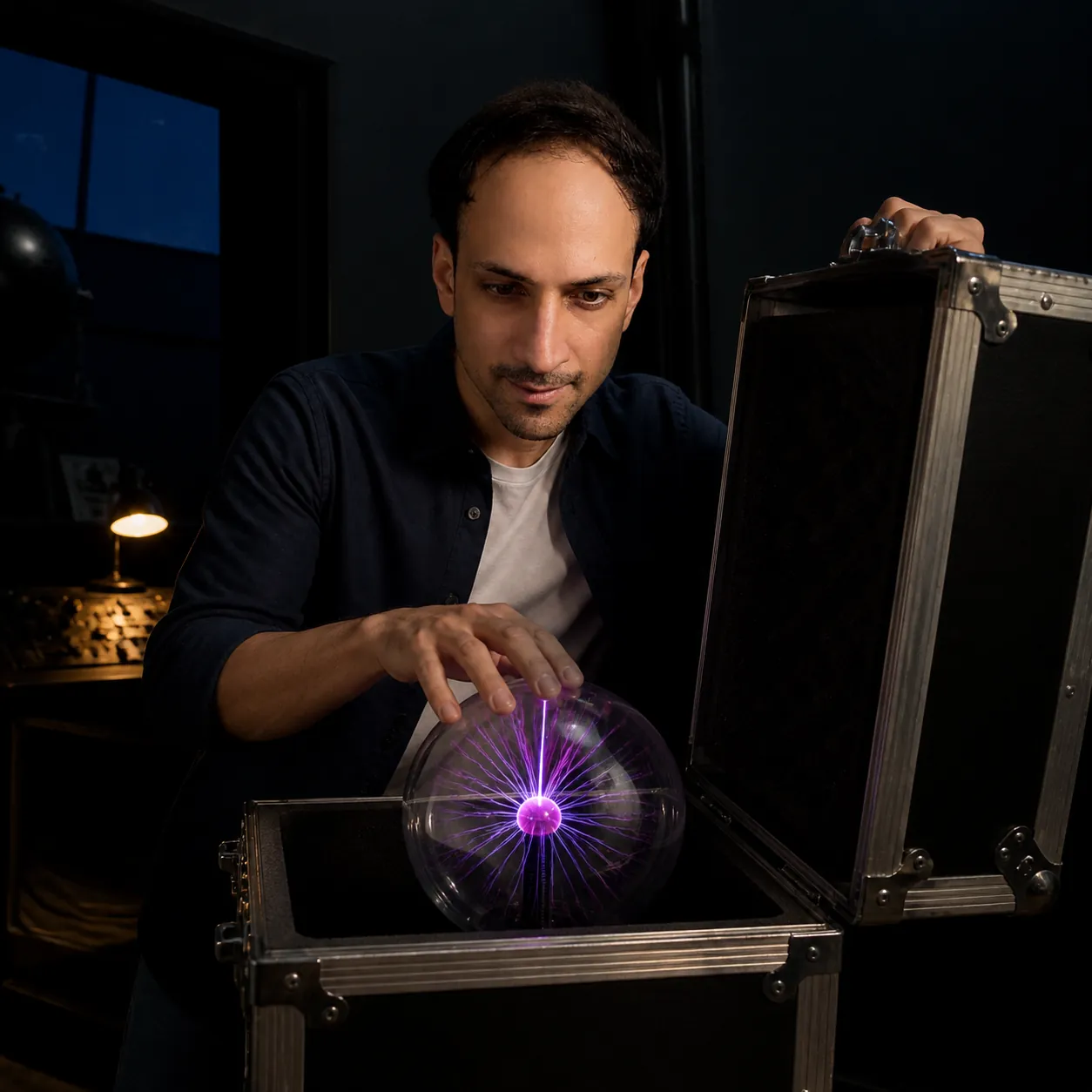
Iridescent Proof: Daylit Atrium — AI Portrait Prompt
صورةAI Portraits

Turn your own photo into a conceptual physics portrait in the daylit atrium of a quiet office building on a Friday. Keeps your face unchanged.

من نص البرومبت

Use the attached reference photo as the identity reference: keep the same face, skin tone, hair and features as the person in that photo, without beautifying, aging or altering them. Create a square 1:1 museum-catalog frame with a strong first read and a slower second read at exactly 2880x2880 pixels. Location: the daylit atrium of a quiet office building on a Friday. Show them in an unstructured stone-grey blazer over a fine navy knit, unfolding a drop cloth across the stone floor. Use this advanced image-making device as the core logic: a soap network between two clear plates and steel pins that links every pin with the shortest possible roads keeps its composure while thinning lawfully toward a collapse it cannot refuse. Explore whether watching a problem solve itself can count as understanding it; direct expression and posture toward unhurried attention, never melodrama or ad-like confidence. Use a 105mm near-macro portrait blend, one iridescent border sharp near the lens and their attentive face readable beyond. Make the composition hold their hands and the fragile surface in one patient plane. Render it as conceptual physics portraiture blending exact interference color, honest wet materiality, unhurried editorial framing, and quietly human-scale scientific staging, using a single softened practical raking the surface with the room falling dark and a palette of deep charcoal, unpolished tin, and one green interference stripe. Photorealistic: this must read as a real photograph from a physical camera, never an illustration, painting, or 3D render. Resolve real surface detail: rubber gone chalky with age, painted metal chipped to primer, and plastic yellowed only where light reaches it. Keep one identity-locked person, credible hands and fingers, natural fabric, and coherent scale, contact, reflections, shadows, airflow, deformation, and materials. Background people only when essential, always secondary and clearly different. Avoid psychedelic color grading, floating foam confetti, glassy chrome bubbles, dish-soap advertising gloss, and impossible unbroken membranes. No text, labels, logos, signatures, watermarks, random symbols, plastic skin, excessive bloom, or glossy AI finish.
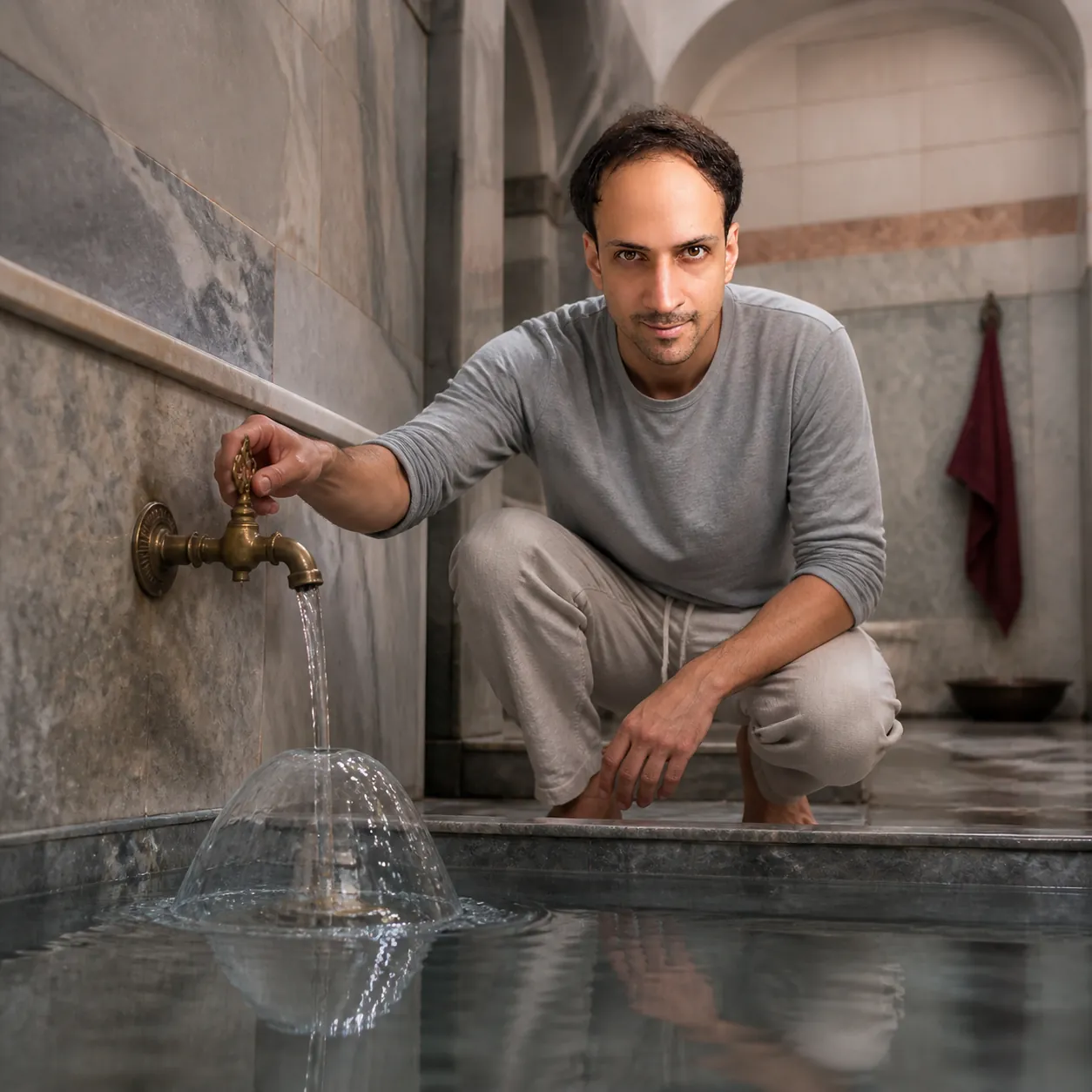
Branching Verdict: Control Alcove — AI Portrait Prompt
صورةAI Portraits

Turn your own photo into a photorealistic portrait in the control alcove of a small planetarium between shows. Keeps your face unchanged.

من نص البرومبت

Use the attached reference photo as the identity reference: keep the same face, skin tone, hair and features as the person in that photo, without beautifying, aging or altering them. Create a square 1:1 museum-catalog frame with a strong first read and a slower second read at exactly 2880x2880 pixels. Location: the control alcove of a small planetarium between shows. Show them in a midnight-blue overshirt buttoned once over a white tee, unlatching a flight case and lifting its lid upright. Use this advanced image-making device as the core logic: a sealed plasma globe whose slender violet filaments abandon their drift and gather beneath their fingertip resting on the cold glass turns activity far too fast to witness into a form calm enough to study. Explore how a discharge decides its path when every option looks identical; direct expression and posture toward guarded wonder, never melodrama or ad-like confidence. Frame from a low three-quarter angle so the demonstration sits between the lens and their attention. Make the composition surround the lit evidence with generous, honest darkness. Render it as gallery-caliber physics portraiture merging real electrical signatures, charcoal-dark tonal control, precise glass-and-char material rendering, and steady observational calm, using late blue window light mixed with one warm low-wattage source and a palette of soot black, aged bakelite brown, and dim neon amber. Photorealistic: this must read as a real photograph from a physical camera, never an illustration, painting, or 3D render. Resolve real surface detail: visible weave in cloth, fine scratches on metal, and the faint unevenness of painted walls. Keep one identity-locked person, credible hands and fingers, natural fabric, and coherent scale, contact, reflections, shadows, airflow, deformation, and materials. Background people only when essential, always secondary and clearly different. Avoid Tesla-coil showmanship, storm lightning skies, arcs crawling on skin, glowing superhero eyes, and cyberpunk neon haze. No text, labels, logos, signatures, watermarks, random symbols, plastic skin, excessive bloom, or glossy AI finish.
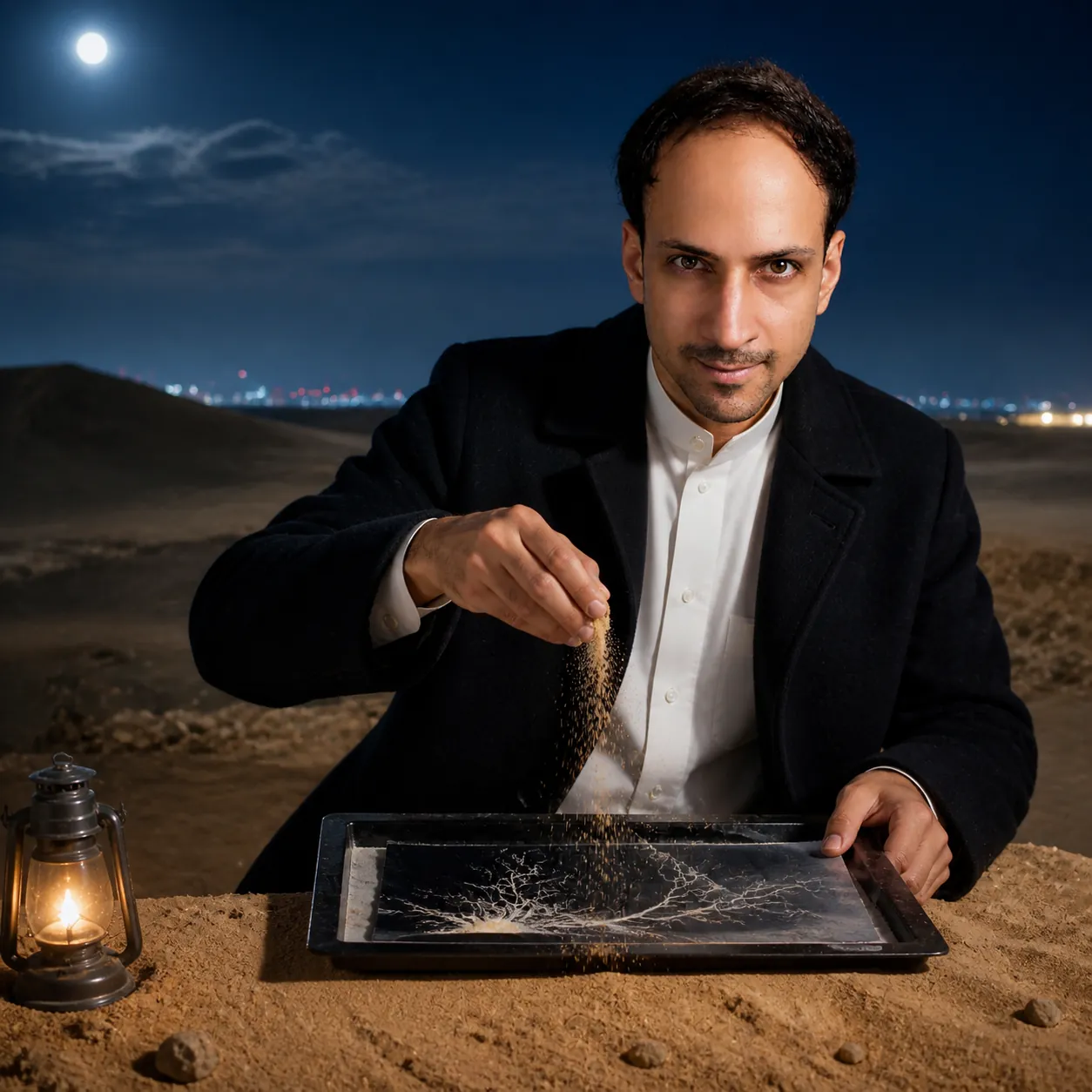
Water Bell in the Old Hammam — AI Portrait Prompt
صورةAI Portraits

Turn your own photo into a quiet kinetic-art portrait in the marble anteroom of an old hammam, one basin slowly filling. Keeps your face unchanged.

من نص البرومبت

Use the attached reference photo as the identity reference: keep the same face, skin tone, hair and features as the person in that photo, without beautifying, aging or altering them. Create a square 1:1 museum-catalog frame with a strong first read and a slower second read at exactly 2880x2880 pixels. Location: the marble anteroom of an old hammam, one basin slowly filling. Show the subject in a light grey crew-neck and drawstring linen trousers, sleeves pushed up, drawing a worn brass tap to exact half flow. Treat this mechanism as the frame’s governing rule: a transparent bell of flowing water that flares from a jet striking a small disc and holds its curved shape utterly still puts continuous motion through a form that never once looks hurried. Explore what discipline looks like in a material famous for taking any shape; direct expression and posture toward clear-eyed patience, never melodrama or ad-like confidence. Use a calm wide 35mm view that keeps verticals true and places them just off the flow's axis. Make the composition let one unbroken waterline run the frame's full width. Render it as quiet kinetic-art portraiture combining working flow sculpture, honest wet-surface materiality, calm controlled studio styling, and unforced human presence, using clean skylight softly refracted through moving water onto pale stone and a palette of wet slate, glass green, and one crimson thread. Photorealistic: this must read as a real photograph from a physical camera, never an illustration, painting, or 3D render. Resolve real surface detail: floor finish worn along the walked line, skirting marked at shoe height, and corners darker than the open floor. Keep one identity-locked person, credible hands and fingers, natural fabric, and coherent scale, contact, reflections, shadows, airflow, deformation, and materials. Background people only when essential, always secondary and clearly different. Avoid stock waterfall mist, whirlpool vortices, ripple-covered surfaces, levitating water spheres, and dramatic slow-motion splash photography. No text, labels, logos, signatures, watermarks, random symbols, plastic skin, excessive bloom, or glossy AI finish.
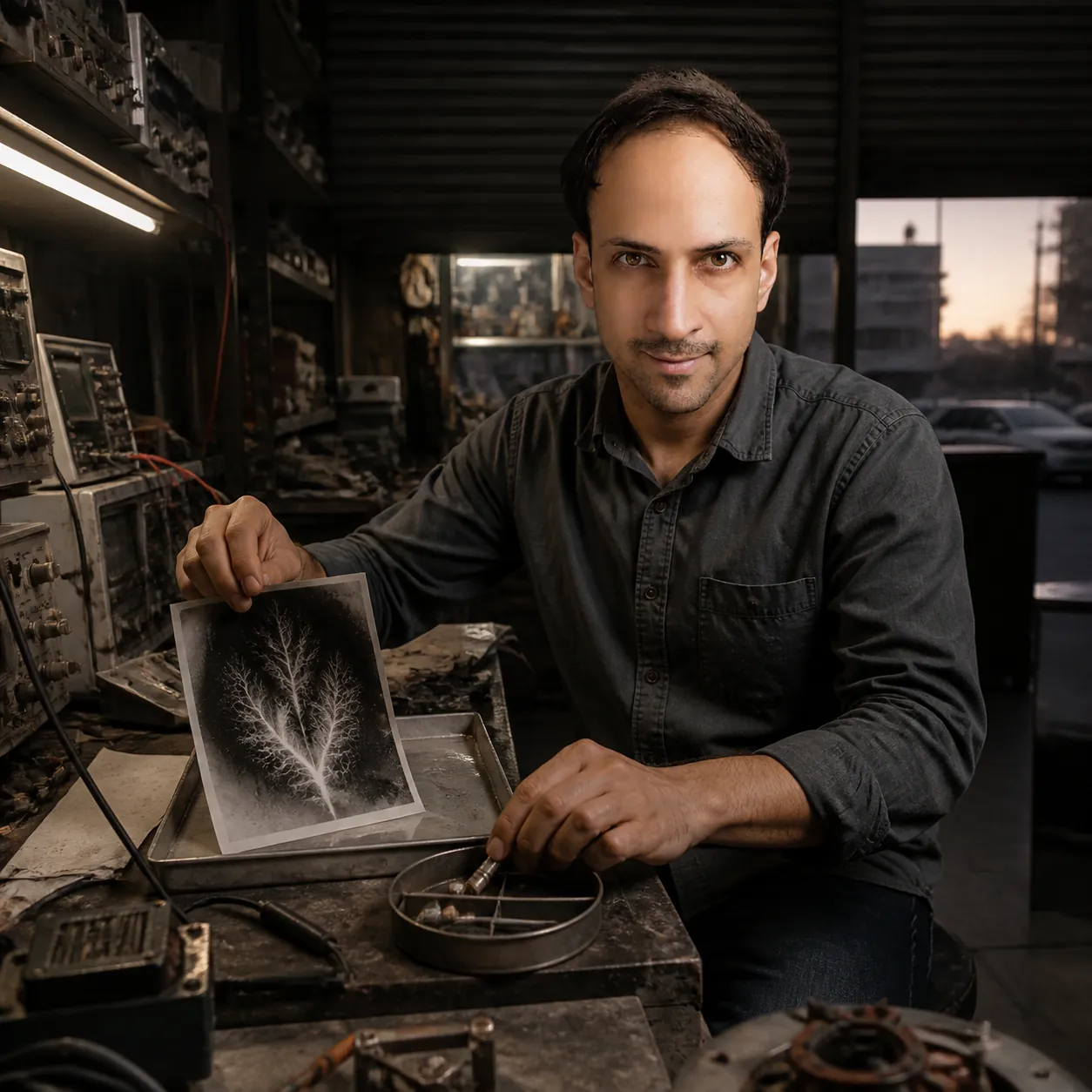
Quiet Kilovolts: Moonlit Sand Rise — AI Portrait Prompt
صورةAI Portraits

Turn your own photo into a low-light demonstration portrait in a moonlit sand rise at the desert's edge outside Riyadh. Keeps your face unchanged.

من نص البرومبت

Use the attached reference photo as the identity reference: keep the same face, skin tone, hair and features as the person in that photo, without beautifying, aging or altering them. Create a square 1:1 museum-catalog frame with a strong first read and a slower second read at exactly 2880x2880 pixels. Location: a moonlit sand rise at the desert's edge outside Riyadh. Show them in a dark wool overcoat over a plain white traditional Gulf outfit, sifting a palmful of cool sand back onto the rise. Make one rigorous physical condition the conceptual engine: a developed sheet-film photogram they lift from a blotter, blackened in feathery branches where a surface discharge exposed it directly turns activity far too fast to witness into a form calm enough to study. Explore whether danger observed lawfully becomes knowledge or remains a dare; direct expression and posture toward hushed reverence, never melodrama or ad-like confidence. Use an eye-level 85mm portrait view with honest perspective and one plane of disciplined focus. Make the composition keep their face half a stop dimmer than the demonstration. Render it as low-light demonstration realism combining true plasma color science, patient long-exposure discipline, tactile bench materiality, and dignified editorial portrait craft, using late blue window light mixed with one warm low-wattage source and a palette of midnight blue-black, brushed nickel, and one phosphor-green line. Photorealistic: this must read as a real photograph from a physical camera, never an illustration, painting, or 3D render. Resolve real surface detail: fine grit in the texture of concrete, efflorescence at damp edges, and hairline cracks that follow stress. Keep one identity-locked person, credible hands and fingers, natural fabric, and coherent scale, contact, reflections, shadows, airflow, deformation, and materials. Background people only when essential, always secondary and clearly different. Avoid Tesla-coil showmanship, storm lightning skies, arcs crawling on skin, glowing superhero eyes, and cyberpunk neon haze. No text, labels, logos, signatures, watermarks, random symbols, plastic skin, excessive bloom, or glossy AI finish.
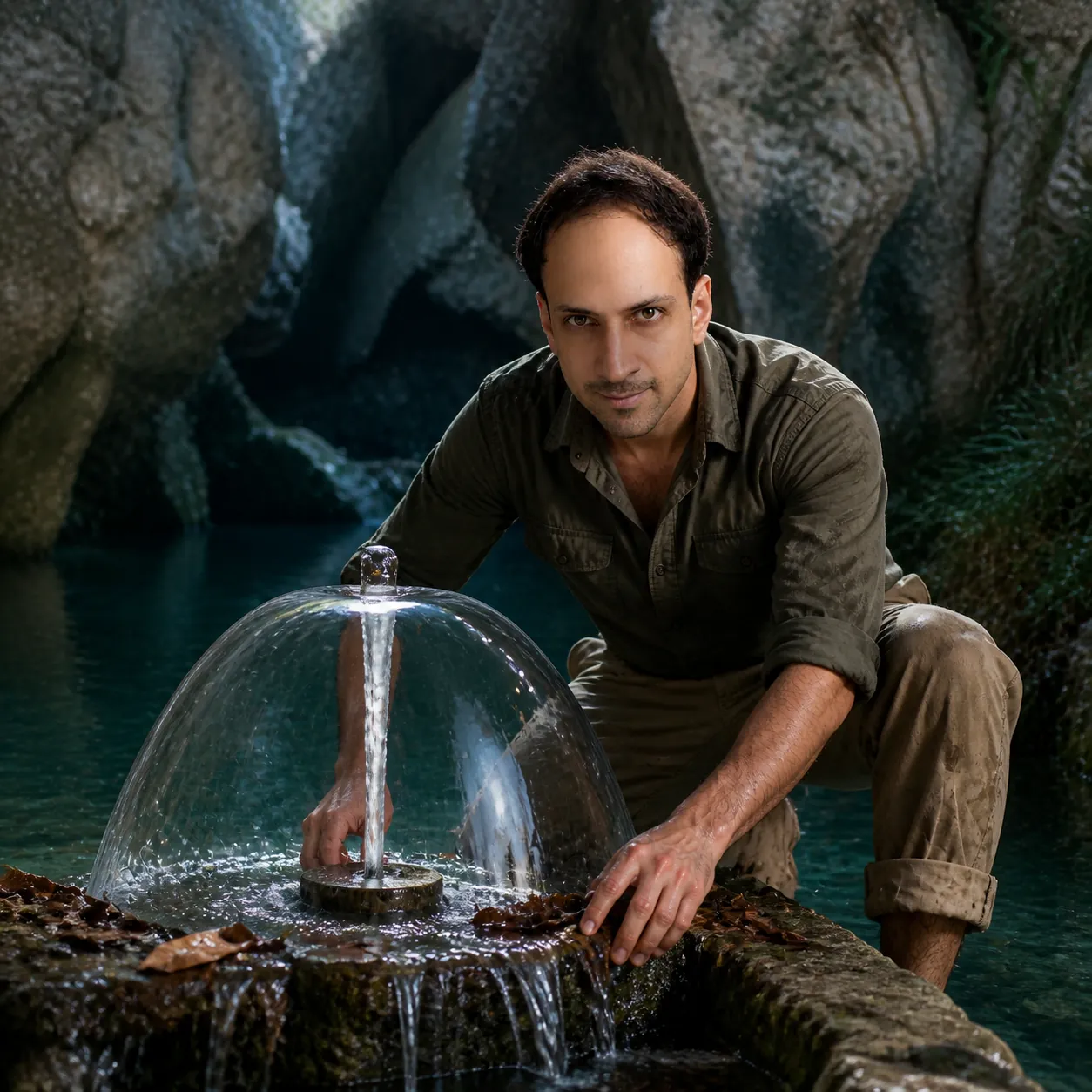
Quiet Kilovolts: Narrow Electronics Repair Shop — AI Portrait Prompt
صورةAI Portraits

Turn your own photo into a photorealistic portrait in a narrow electronics repair shop in Riyadh, shutters half down at dusk. Keeps your face unchanged.

من نص البرومبت

Use the attached reference photo as the identity reference: keep the same face, skin tone, hair and features as the person in that photo, without beautifying, aging or altering them. Create a square 1:1 museum-catalog frame with a strong first read and a slower second read at exactly 2880x2880 pixels. Location: a narrow electronics repair shop in Riyadh, shutters half down at dusk. Show them in a graphite-grey service shirt with a folded cuff and dark jeans, sorting three cold fuses into a partitioned tin. Build the artwork around this material rule: a developed sheet-film photogram they lift from a blotter, blackened in feathery branches where a surface discharge exposed it directly brings a feared force close enough to study without any bravado. Explore whether danger observed lawfully becomes knowledge or remains a dare; direct expression and posture toward disciplined marvel, never melodrama or ad-like confidence. Use a restrained 35mm environmental view with the subject anchored off-center and hands never distorted. Make the composition hold the apparatus, their hands, and their gaze in one triangle. Render it as gallery-caliber physics portraiture merging real electrical signatures, charcoal-dark tonal control, precise glass-and-char material rendering, and steady observational calm, using a single backlight through frosted glass, edges kept in soft shadow and a palette of charred oak, pale ivory, and one ember-orange thread. Photorealistic: this must read as a real photograph from a physical camera, never an illustration, painting, or 3D render. Resolve real surface detail: cotton that hangs by its own weight, seams that pucker very slightly, and collars softened by washing. Keep one identity-locked person, credible hands and fingers, natural fabric, and coherent scale, contact, reflections, shadows, airflow, deformation, and materials. Background people only when essential, always secondary and clearly different. Avoid sci-fi energy balls, fractal screen-saver overlays, sparks showering from hands, wizard-lightning fingertips, and ultraviolet glow gimmicks. No text, labels, logos, signatures, watermarks, random symbols, plastic skin, excessive bloom, or glossy AI finish.
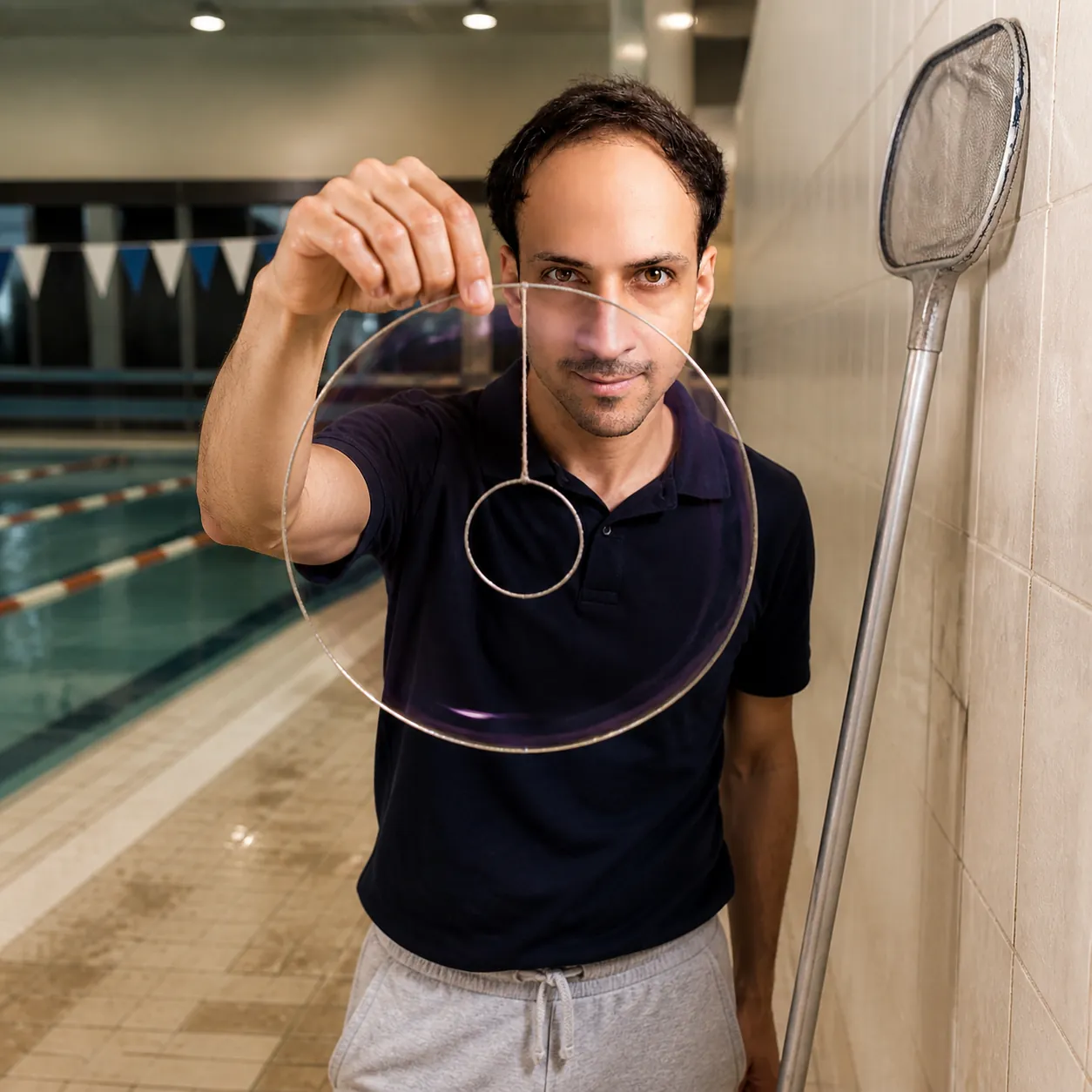
Water Bell at the Oasis Spring — AI Portrait Prompt
صورةAI Portraits

Turn your own photo into a portrait in a limestone spring pool in an oasis cleft, lit by early sky. Keeps your face unchanged.

من نص البرومبت

Use the attached reference photo as the identity reference: keep the same face, skin tone, hair and features as the person in that photo, without beautifying, aging or altering them. Create a square 1:1 museum-catalog frame with a strong first read and a slower second read at exactly 2880x2880 pixels. Location: a limestone spring pool in an oasis cleft, lit by early sky. Show the subject in an olive utility shirt tucked into rolled canvas trousers, clearing drifted leaves from the outflow lip. Make one rigorous physical condition the conceptual engine: a transparent bell of flowing water that flares from a jet striking a small disc and holds its curved shape utterly still gives a normally chaotic process one legible, patient, watchable form. Explore what discipline looks like in a material famous for taking any shape; direct expression and posture toward quiet astonishment, never melodrama or ad-like confidence. Use an eye-level 60mm medium-format viewpoint with honest perspective and gently limited depth of field. Make the composition rhyme the water's curve with the line of their shoulders. Render it as high-concept flow portraiture staged with real laminar apparatus, calibrated documentary lighting, optically true refraction, and quietly intelligent restraint, using early blue ambient light with one narrow beam threading the water and a palette of soft pewter, unglazed clay, and a cold aqua accent. Photorealistic: this must read as a real photograph from a physical camera, never an illustration, painting, or 3D render. Resolve real surface detail: the difference between a wiped surface and a clean one, faint tide marks on ceramic, and metal dulled unevenly by touch. Keep one identity-locked person, credible hands and fingers, natural fabric, and coherent scale, contact, reflections, shadows, airflow, deformation, and materials. Background people only when essential, always secondary and clearly different. Avoid splash crowns, suspended droplet sprays, chrome CGI liquid, neon glowing water, and fantasy water-bending gestures. No text, labels, logos, signatures, watermarks, random symbols, plastic skin, excessive bloom, or glossy AI finish.
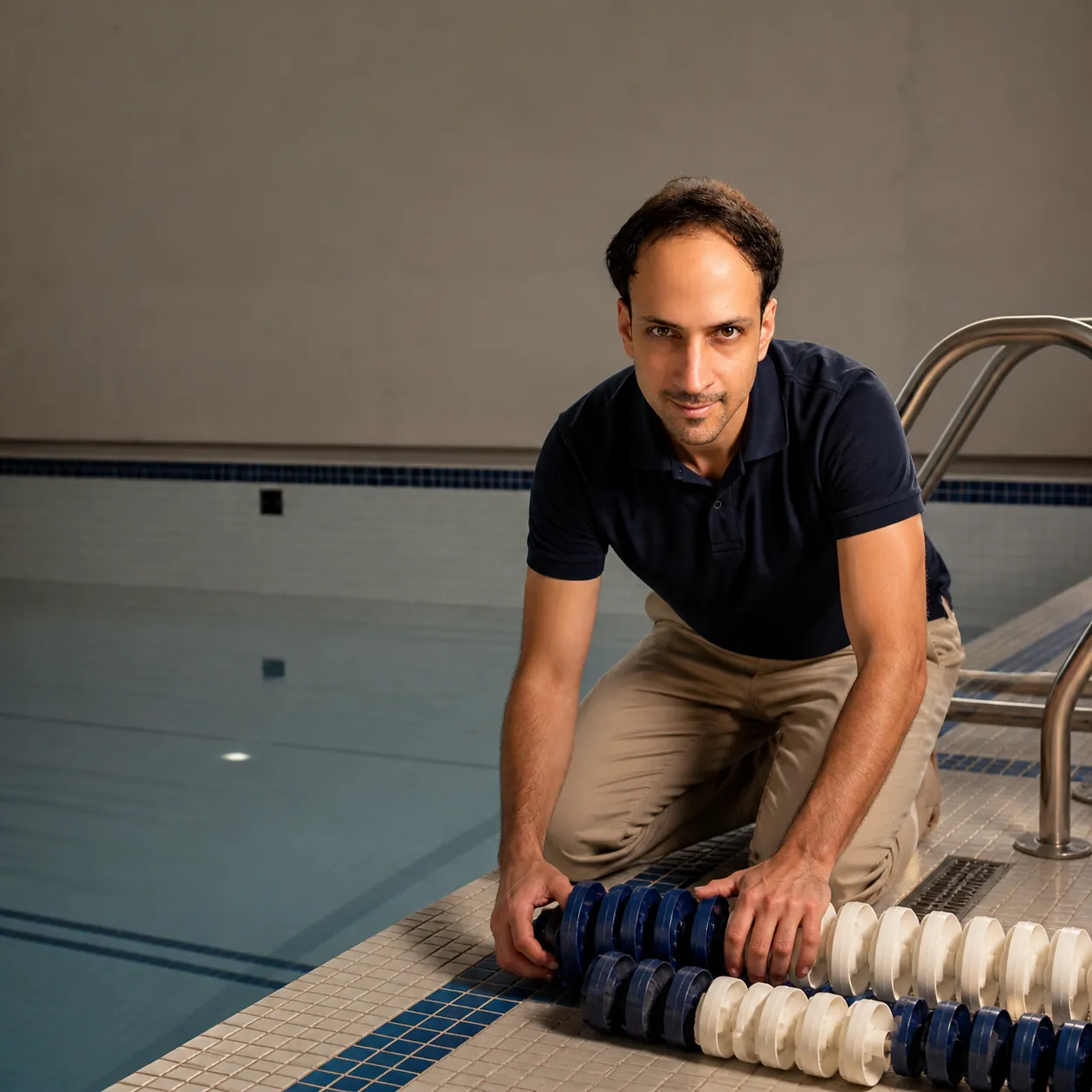
Brief Geometry: Tiled Surround of an Indoor Lap Pool — AI Portrait Prompt
صورةAI Portraits

Turn your own photo into a high-concept surface-tension portrait in the tiled surround of an indoor lap pool at rest. Keeps your face unchanged.

من نص البرومبت

Use the attached reference photo as the identity reference: keep the same face, skin tone, hair and features as the person in that photo, without beautifying, aging or altering them. Create a square 1:1 museum-catalog frame with a strong first read and a slower second read at exactly 2880x2880 pixels. Location: the tiled surround of an indoor lap pool at rest. Show them in a plain navy polo and light grey drawstring trousers, leaning a long-handled skimmer against the tile wall. Make one rigorous physical condition the conceptual engine: a flat soap film carrying a slack cotton loop that snaps the loop into a perfect circle when punctured inside it catches mathematics choosing the least surface right in front of them. Explore how much structure a surface with almost no substance can honestly carry; direct expression and posture toward measured delight, never melodrama or ad-like confidence. Use an eye-level 80mm medium-format viewpoint with gentle depth of field and no forced drama. Make the composition let the membrane's boundary draw a second frame inside the photograph. Render it as high-concept surface-tension portraiture built from real minimal-surface demonstrations, documentary realism, laboratory-grade wire craft, and emotionally restrained human composition, using quiet overhead bounce shaped so skin stays honest and reflections stay legible and a palette of pale limestone, dim pewter, and a single violet gleam. Photorealistic: this must read as a real photograph from a physical camera, never an illustration, painting, or 3D render. Resolve real surface detail: the difference between a wiped surface and a clean one, faint tide marks on ceramic, and metal dulled unevenly by touch. Keep one identity-locked person, credible hands and fingers, natural fabric, and coherent scale, contact, reflections, shadows, airflow, deformation, and materials. Background people only when essential, always secondary and clearly different. Avoid party-bubble clusters, rainbow oil-slick swirls, CGI-perfect spheres, sparkle overlays, and any child-with-wand whimsy. No text, labels, logos, signatures, watermarks, random symbols, plastic skin, excessive bloom, or glossy AI finish.
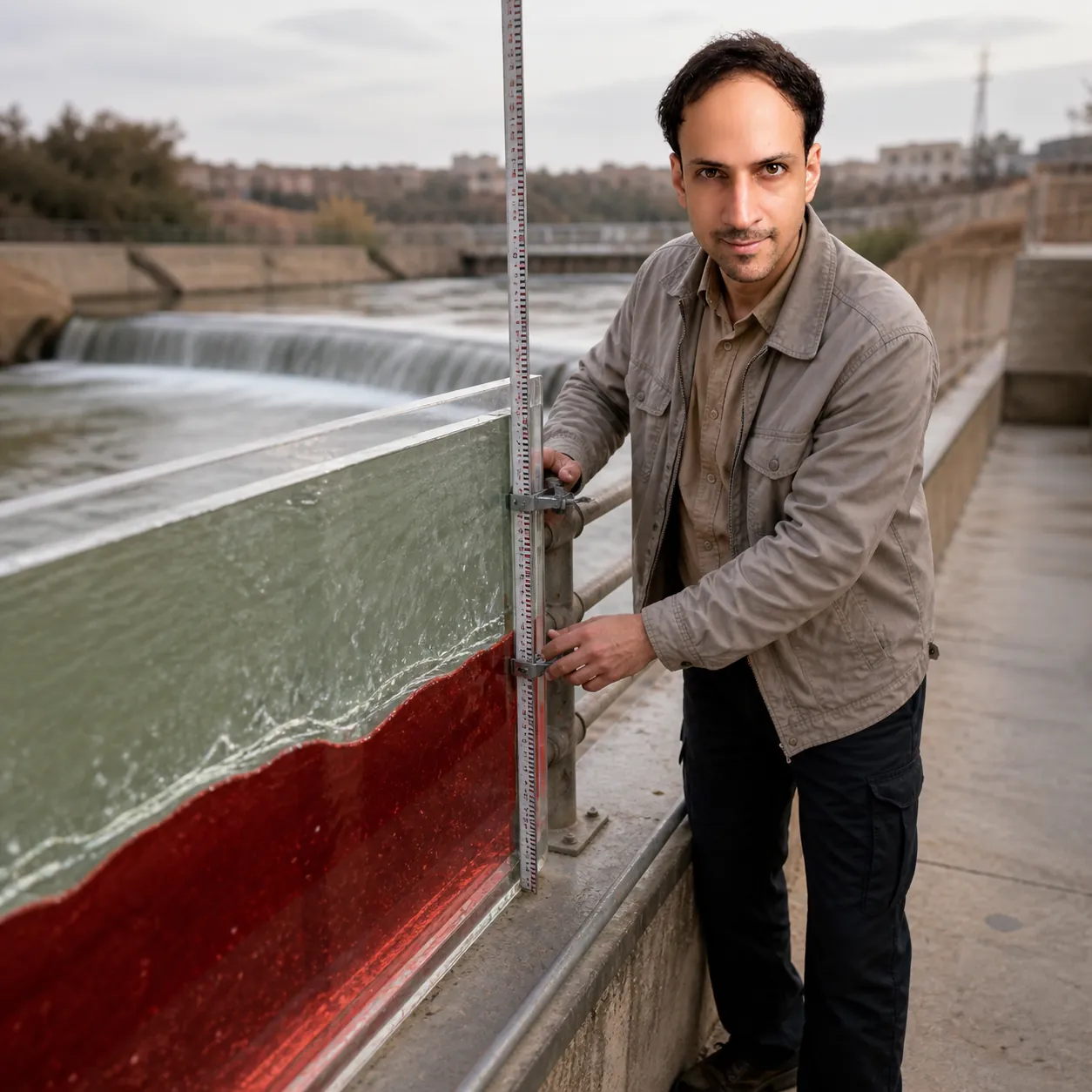
Motion Composed: Maintenance Walkway — AI Portrait Prompt
صورةAI Portraits

Turn your own photo into a portrait in a maintenance walkway beside a low Wadi Hanifah check weir. Keeps your face unchanged.

من نص البرومبت

Use the attached reference photo as the identity reference: keep the same face, skin tone, hair and features as the person in that photo, without beautifying, aging or altering them. Create a square 1:1 museum-catalog frame with a strong first read and a slower second read at exactly 2880x2880 pixels. Location: a maintenance walkway beside a low Wadi Hanifah check weir. Show the subject in a sand-grey field jacket over a tan shirt and dark workwear trousers, hooking a measuring staff onto the parapet rail. Use this advanced image-making device as the core logic: a pair of dyed currents that share one clear channel in full contact while keeping a knife-sharp boundary between them gives a normally chaotic process one legible, patient, watchable form. Explore whether calm is the absence of energy or its most complete control; direct expression and posture toward settled awe, never melodrama or ad-like confidence. Frame through the clear apparatus itself, refraction bending the background while their face stays undistorted and sharp. Make the composition hold clean empty space where turbulence would have been. Render it as high-concept flow portraiture staged with real laminar apparatus, calibrated documentary lighting, optically true refraction, and quietly intelligent restraint, using even overhead lab light shaped by baffles into calm directional zones and a palette of wet slate, glass green, and one crimson thread. Photorealistic: this must read as a real photograph from a physical camera, never an illustration, painting, or 3D render. Resolve real surface detail: wood grain read at honest scale, matte and gloss clearly separated, and no surface uniformly clean. Keep one identity-locked person, credible hands and fingers, natural fabric, and coherent scale, contact, reflections, shadows, airflow, deformation, and materials. Background people only when essential, always secondary and clearly different. Avoid splash crowns, suspended droplet sprays, chrome CGI liquid, neon glowing water, and fantasy water-bending gestures. No text, labels, logos, signatures, watermarks, random symbols, plastic skin, excessive bloom, or glossy AI finish.
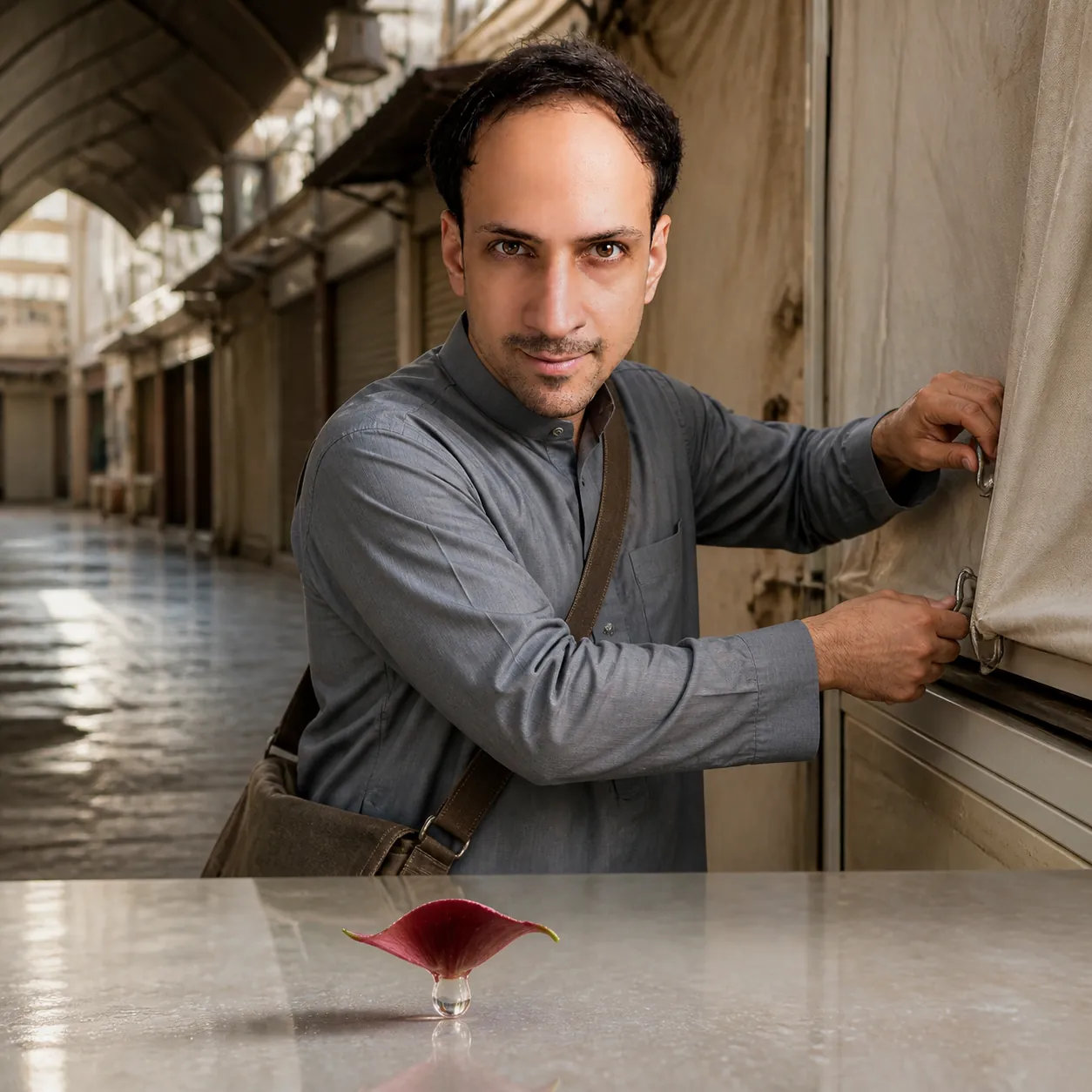
Pinned Droplet in the Souq — AI Portrait Prompt
صورةAI Portraits

Turn your own photo into a photorealistic portrait in a covered souq passage washed clean before its stalls open. Keeps your face unchanged.

من نص البرومبت

Use the attached reference photo as the identity reference: keep the same face, skin tone, hair and features as the person in that photo, without beautifying, aging or altering them. Create a square 1:1 museum-catalog frame with a strong first read and a slower second read at exactly 2880x2880 pixels. Location: a covered souq passage washed clean before its stalls open. Show the subject in an ash-grey traditional Gulf outfit with a canvas satchel worn across, hooking a stall's canvas flap back on its cleat. Treat this mechanism as the frame’s governing rule: a rose petal turned fully upside down, to whose face one spherical droplet stays pinned without wetting or falling proves that texture too small to see decides what water may touch. Explore what cleanliness means on a surface that cannot be made to stain; direct expression and posture toward gentle disbelief, never melodrama or ad-like confidence. Frame level with the work surface so the water's silhouette reads clean against the room. Make the composition give the water's edge the sharpest focus in the frame. Render it as conceptual materials-lab portraiture pairing believable coatings, true droplet behavior, restrained contemporary art direction, and warm human documentary presence, using clean side-window daylight that keeps every highlight on the water small and honest and a palette of slate grey, chalk white, and one madder-red note. Photorealistic: this must read as a real photograph from a physical camera, never an illustration, painting, or 3D render. Resolve real surface detail: floor finish worn along the walked line, skirting marked at shoe height, and corners darker than the open floor. Keep one identity-locked person, credible hands and fingers, natural fabric, and coherent scale, contact, reflections, shadows, airflow, deformation, and materials. Background people only when essential, always secondary and clearly different. Avoid cartoon dewdrop gloss, rainbow refraction overload, levitating water blobs, spiritual lotus kitsch, and hoses spraying dramatic mist. No text, labels, logos, signatures, watermarks, random symbols, plastic skin, excessive bloom, or glossy AI finish.
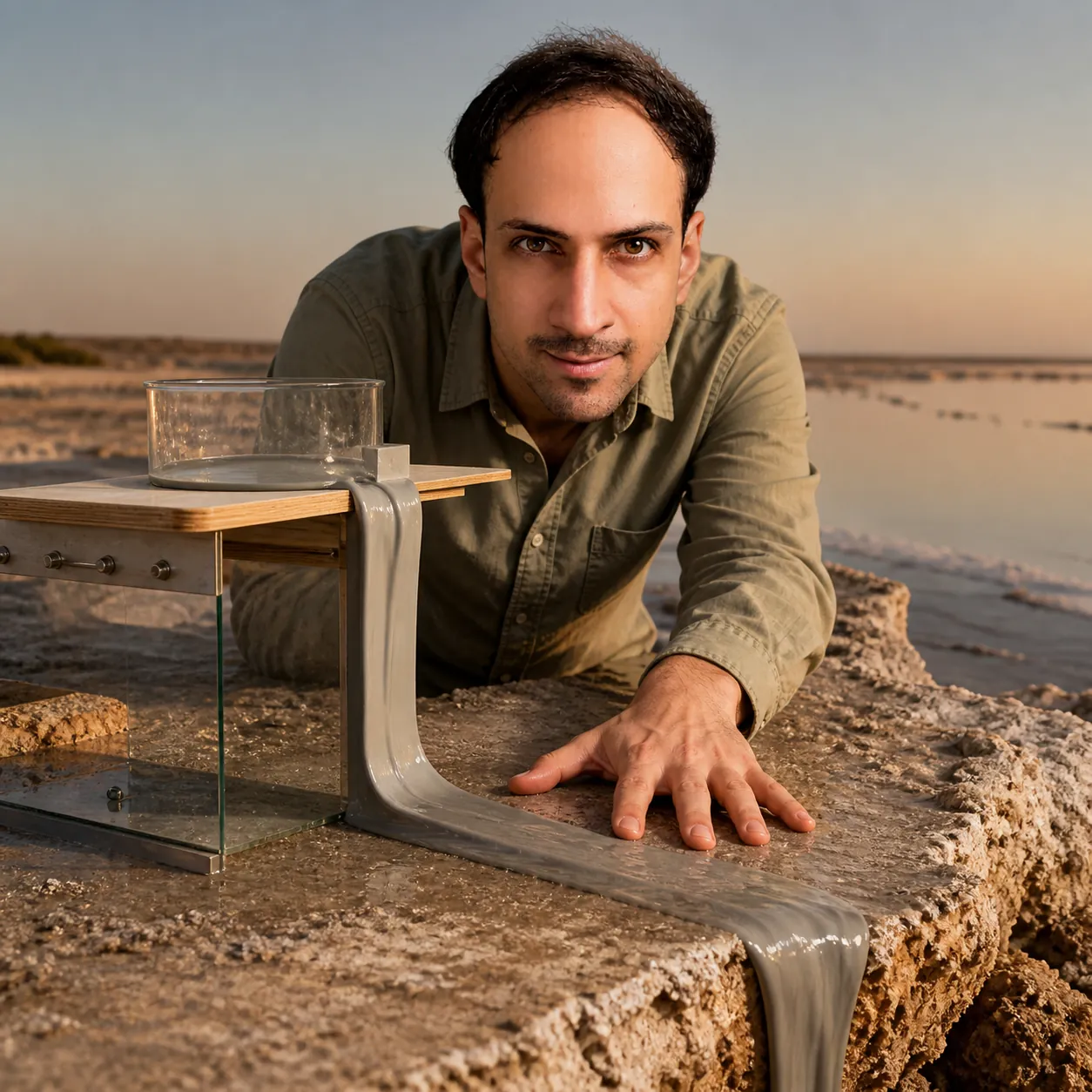
Creeping Putty on the Sabkha — AI Portrait Prompt
صورةAI Portraits

Turn your own photo into a museum-grade demonstration portrait in the firm crusted edge of a coastal sabkha flat at low sun. Keeps your face unchanged.

من نص البرومبت

Use the attached reference photo as the identity reference: keep the same face, skin tone, hair and features as the person in that photo, without beautifying, aging or altering them. Create a square 1:1 museum-catalog frame with a strong first read and a slower second read at exactly 2880x2880 pixels. Location: the firm crusted edge of a coastal sabkha flat at low sun. Show the subject in a pale olive field shirt buttoned at the wrists, spreading their fingers flat against the damp crust. Use this advanced image-making device as the core logic: a bar of silicone bounce putty that has crept overnight across the shelf edge in one smooth unbroken glacier tongue holds a small lawful contradiction still enough to be studied. Explore whether patience is a property of minds or simply of timescales; direct expression and posture toward steady curiosity, never melodrama or ad-like confidence. Frame past the apparatus at shoulder height, foreground glass and steel physical but never obscuring the face. Make the composition set one calm horizontal surface against their quiet vertical posture. Render it as museum-grade demonstration realism combining faithful fluid behavior, tactile material surfaces, patient observational portrait photography, and physically accurate weight and reflection, using late golden cross-light kept off the lens and low on the surfaces and a palette of putty grey, birch ply, and a single teal accent. Photorealistic: this must read as a real photograph from a physical camera, never an illustration, painting, or 3D render. Resolve real surface detail: thread ends and slight pilling on worn cloth, hairline chips at every hard corner, and stone that is porous rather than smooth. Keep one identity-locked person, credible hands and fingers, natural fabric, and coherent scale, contact, reflections, shadows, airflow, deformation, and materials. Background people only when essential, always secondary and clearly different. Avoid frozen splash crowns, CGI liquid-metal morphing, glowing sci-fi gels, food-fight mess on clothing, and impossible floating blobs. No text, labels, logos, signatures, watermarks, random symbols, plastic skin, excessive bloom, or glossy AI finish.
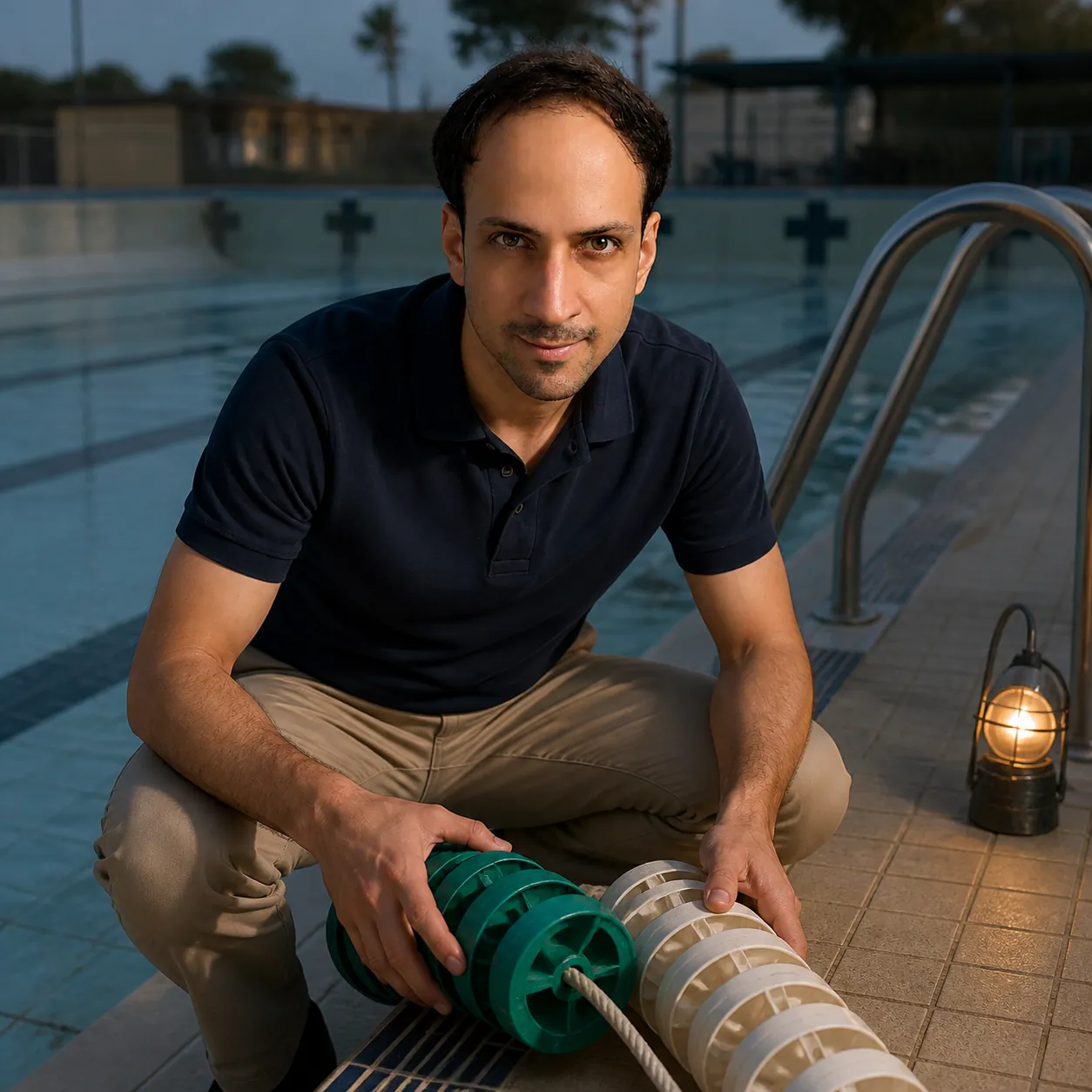
Lotus Droplets by the Empty Pool — AI Portrait Prompt
صورةAI Portraits

Turn your own photo into a photorealistic portrait in the tiled edge of a drained neighborhood pool at morning. Keeps your face unchanged.

من نص البرومبت

Use the attached reference photo as the identity reference: keep the same face, skin tone, hair and features as the person in that photo, without beautifying, aging or altering them. Create a square 1:1 museum-catalog frame with a strong first read and a slower second read at exactly 2880x2880 pixels. Location: the tiled edge of a drained neighborhood pool at morning. Show the subject in a navy polo shirt with pressed sand-colored trousers, stacking two lane-line floats beside the ladder. Treat this mechanism as the frame’s governing rule: a fresh lotus leaf on which dyed droplets stand as near-perfect spheres and gather dust as they roll proves that texture too small to see decides what water may touch. Explore why a surface's firmest refusal reads as courtesy rather than hostility; direct expression and posture toward measured curiosity, never melodrama or ad-like confidence. Frame level with the work surface so the water's silhouette reads clean against the room. Make the composition hold generous negative space above the water's smallest detail. Render it as conceptual materials-lab portraiture pairing believable coatings, true droplet behavior, restrained contemporary art direction, and warm human documentary presence, using one low raking lamp that gives the water a single small specular point and a palette of brushed aluminum, bone linen, and one line of indigo. Photorealistic: this must read as a real photograph from a physical camera, never an illustration, painting, or 3D render. Resolve real surface detail: paper fibre visible at cut edges, plastic that shows mould lines, and paint thicker where a brush turned. Keep one identity-locked person, credible hands and fingers, natural fabric, and coherent scale, contact, reflections, shadows, airflow, deformation, and materials. Background people only when essential, always secondary and clearly different. Avoid cartoon dewdrop gloss, rainbow refraction overload, levitating water blobs, spiritual lotus kitsch, and hoses spraying dramatic mist. No text, labels, logos, signatures, watermarks, random symbols, plastic skin, excessive bloom, or glossy AI finish.
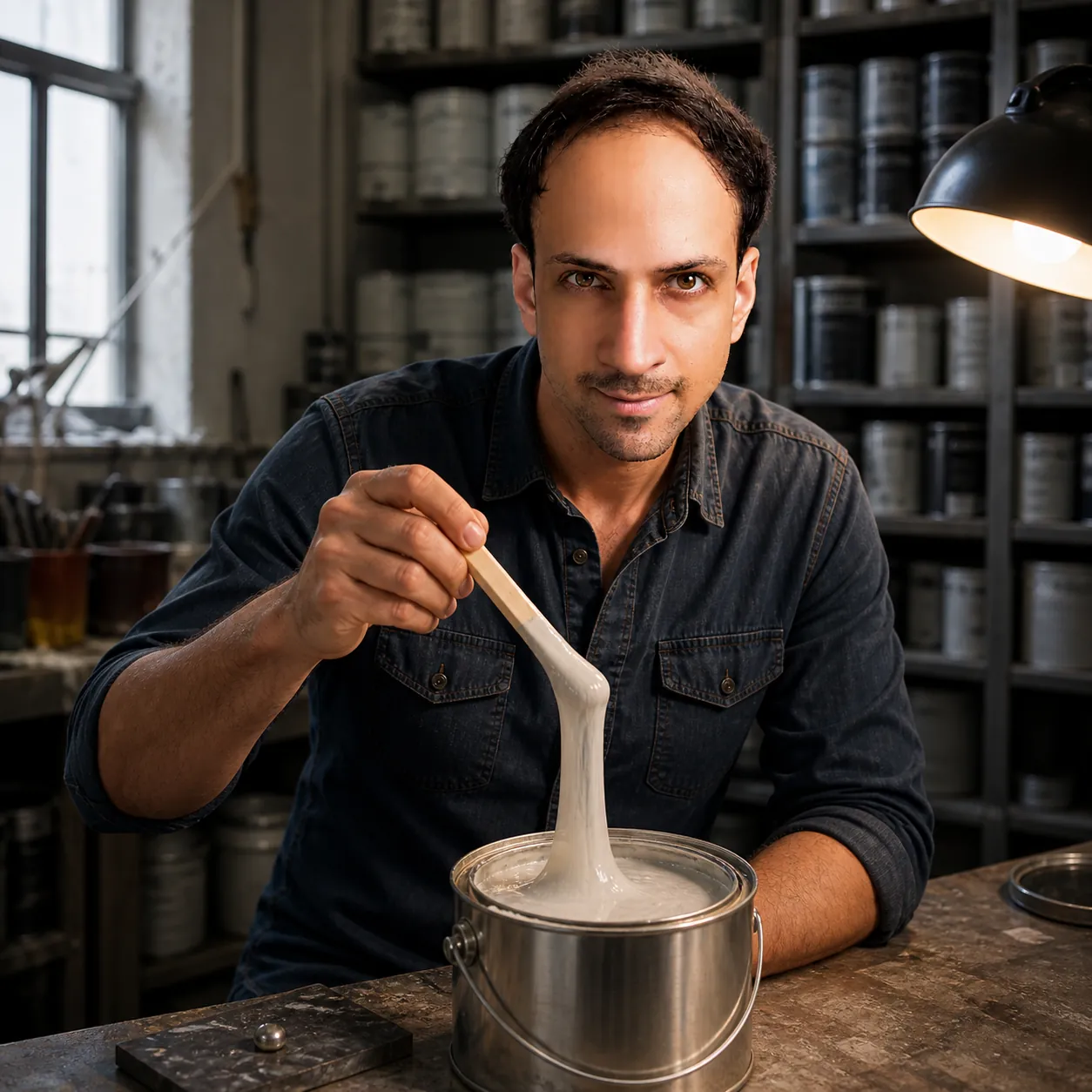
The Pad That Stops Steel — AI Portrait Prompt
صورةAI Portraits

Turn your own photo into a museum-grade demonstration portrait in a paint-tinting back room with sealed cans racked to the ceiling. Keeps your face unchanged.

من نص البرومبت

Use the attached reference photo as the identity reference: keep the same face, skin tone, hair and features as the person in that photo, without beautifying, aging or altering them. Create a square 1:1 museum-catalog frame with a strong first read and a slower second read at exactly 2880x2880 pixels. Location: a paint-tinting back room with sealed cans racked to the ceiling. Show the subject in a clean denim work shirt with a folded collar, drawing a stir stick up through settled gel. Treat this mechanism as the frame’s governing rule: a flexible white pad of engineered shear-thickening fluid that folds softly in their fingers yet stops a dropped steel slug outright holds a small lawful contradiction still enough to be studied. Explore how the same handful of matter can honestly hold two opposite verdicts; direct expression and posture toward restrained delight, never melodrama or ad-like confidence. Use a restrained 35mm view from bench height, their hands and the demonstration sharing honest scale. Make the composition leave generous still space where motion is expected and absent. Render it as museum-grade demonstration realism combining faithful fluid behavior, tactile material surfaces, patient observational portrait photography, and physically accurate weight and reflection, using cool window daylight from one side, balanced by a warm bench lamp and a palette of pitch black, pale plaster, and one amber glint. Photorealistic: this must read as a real photograph from a physical camera, never an illustration, painting, or 3D render. Resolve real surface detail: leather creased along the lines of use, stitching slightly irregular, and edges burnished from contact. Keep one identity-locked person, credible hands and fingers, natural fabric, and coherent scale, contact, reflections, shadows, airflow, deformation, and materials. Background people only when essential, always secondary and clearly different. Avoid frozen splash crowns, CGI liquid-metal morphing, glowing sci-fi gels, food-fight mess on clothing, and impossible floating blobs. No text, labels, logos, signatures, watermarks, random symbols, plastic skin, excessive bloom, or glossy AI finish.
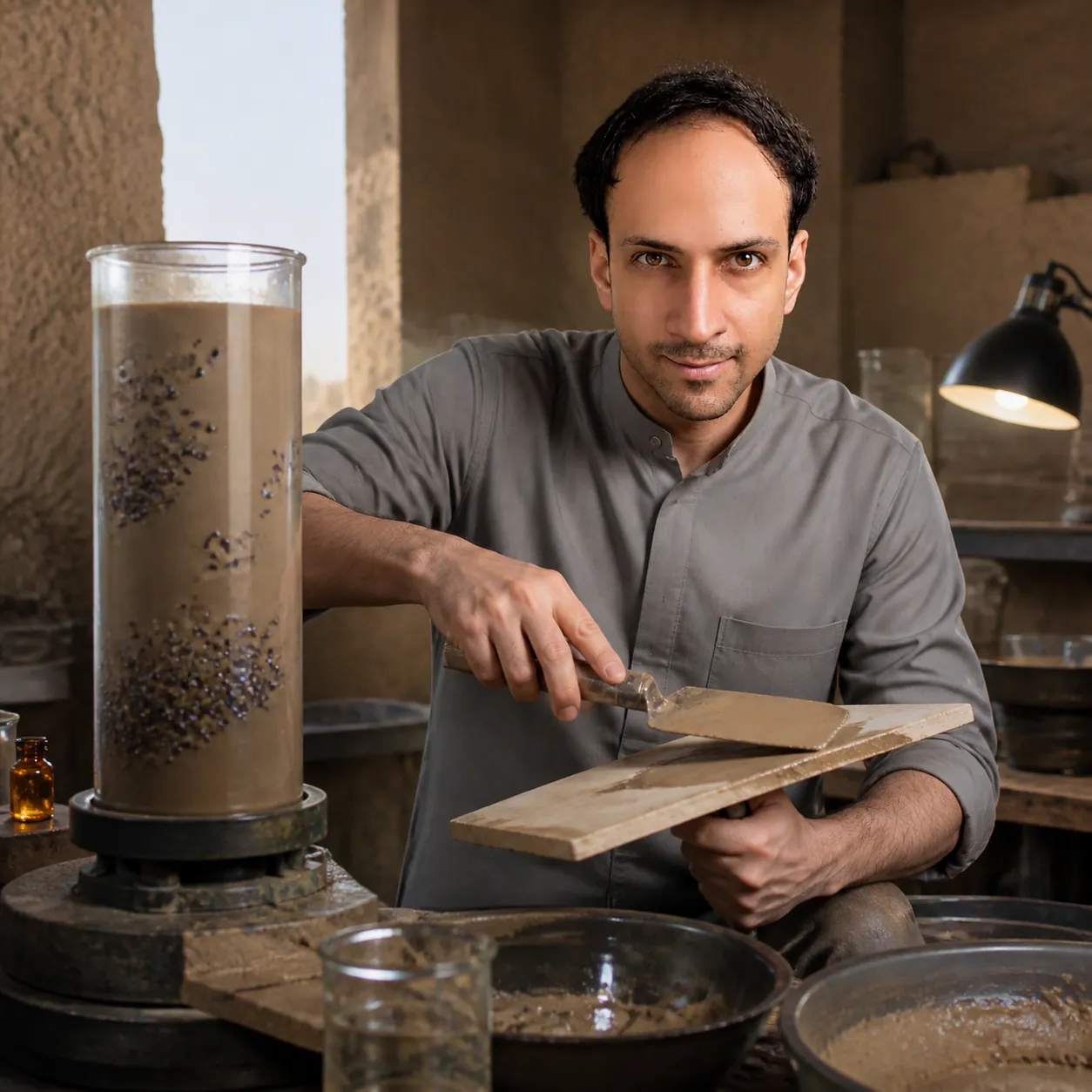
Suspended Shot in Diriyah Mud — AI Portrait Prompt
صورةAI Portraits

Turn your own photo into a portrait in a mud-brick restoration bay in Diriyah with troughs of resting plaster. Keeps your face unchanged.

من نص البرومبت

Use the attached reference photo as the identity reference: keep the same face, skin tone, hair and features as the person in that photo, without beautifying, aging or altering them. Create a square 1:1 museum-catalog frame with a strong first read and a slower second read at exactly 2880x2880 pixels. Location: a mud-brick restoration bay in Diriyah with troughs of resting plaster. Show the subject in a plain ash-grey traditional Gulf outfit with sleeves folded back twice, loading a hawk board with one clean trowel stroke. Use this advanced image-making device as the core logic: a tall column of drilling mud that gels within minutes of stillness, holding steel shot suspended until one slow stir holds a small lawful contradiction still enough to be studied. Explore what it costs an intuition to be corrected by a tabletop; direct expression and posture toward steady curiosity, never melodrama or ad-like confidence. Frame past the apparatus at shoulder height, foreground glass and steel physical but never obscuring the face. Make the composition leave generous still space where motion is expected and absent. Render it as conceptual materials-science portraiture combining working bench apparatus, truthful viscosity and yield behavior, restrained contemporary art direction, and human-centered editorial calm, using cool window daylight from one side, balanced by a warm bench lamp and a palette of pitch black, pale plaster, and one amber glint. Photorealistic: this must read as a real photograph from a physical camera, never an illustration, painting, or 3D render. Resolve real surface detail: rubber gone chalky with age, painted metal chipped to primer, and plastic yellowed only where light reaches it. Keep one identity-locked person, credible hands and fingers, natural fabric, and coherent scale, contact, reflections, shadows, airflow, deformation, and materials. Background people only when essential, always secondary and clearly different. Avoid frozen splash crowns, CGI liquid-metal morphing, glowing sci-fi gels, food-fight mess on clothing, and impossible floating blobs. No text, labels, logos, signatures, watermarks, random symbols, plastic skin, excessive bloom, or glossy AI finish.
Goniometer Sphere by the Pool — AI Portrait Prompt
صورةAI Portraits

Turn your own photo into a museum-grade demonstration portrait in the tiled edge of a drained neighborhood pool at morning. Keeps your face unchanged.

من نص البرومبت

Use the attached reference photo as the identity reference: keep the same face, skin tone, hair and features as the person in that photo, without beautifying, aging or altering them. Create a square 1:1 museum-catalog frame with a strong first read and a slower second read at exactly 2880x2880 pixels. Location: the tiled edge of a drained neighborhood pool at morning. Show the subject in a navy polo shirt with pressed sand-colored trousers, stacking two lane-line floats beside the ladder. Make one rigorous physical condition the conceptual engine: a bench goniometer that projects one resting droplet's silhouette, a nearly complete sphere touching its coated slide at one point turns refusal into something the eye can verify at arm's length. Explore how much of touching is really permission granted at invisible scales; direct expression and posture toward quiet astonishment, never melodrama or ad-like confidence. Use an eye-level 85mm portrait view with natural perspective and quiet, honest depth of field. Make the composition align their eye line with the border between wet and dry. Render it as museum-grade demonstration realism combining faithful contact-angle physics, tactile fabric and metal surfaces, honest water optics, and unhurried portrait photography, using cool dawn ambience warmed by one shaded tungsten practical close at hand and a palette of matte graphite, unglazed clay, and a quiet viridian accent. Photorealistic: this must read as a real photograph from a physical camera, never an illustration, painting, or 3D render. Resolve real surface detail: fine grit in the texture of concrete, efflorescence at damp edges, and hairline cracks that follow stress. Keep one identity-locked person, credible hands and fingers, natural fabric, and coherent scale, contact, reflections, shadows, airflow, deformation, and materials. Background people only when essential, always secondary and clearly different. Avoid CGI chrome water, crown-splash stock shots, glowing droplets, force-field ripples, and glycerin beads faked on every surface. No text, labels, logos, signatures, watermarks, random symbols, plastic skin, excessive bloom, or glossy AI finish.
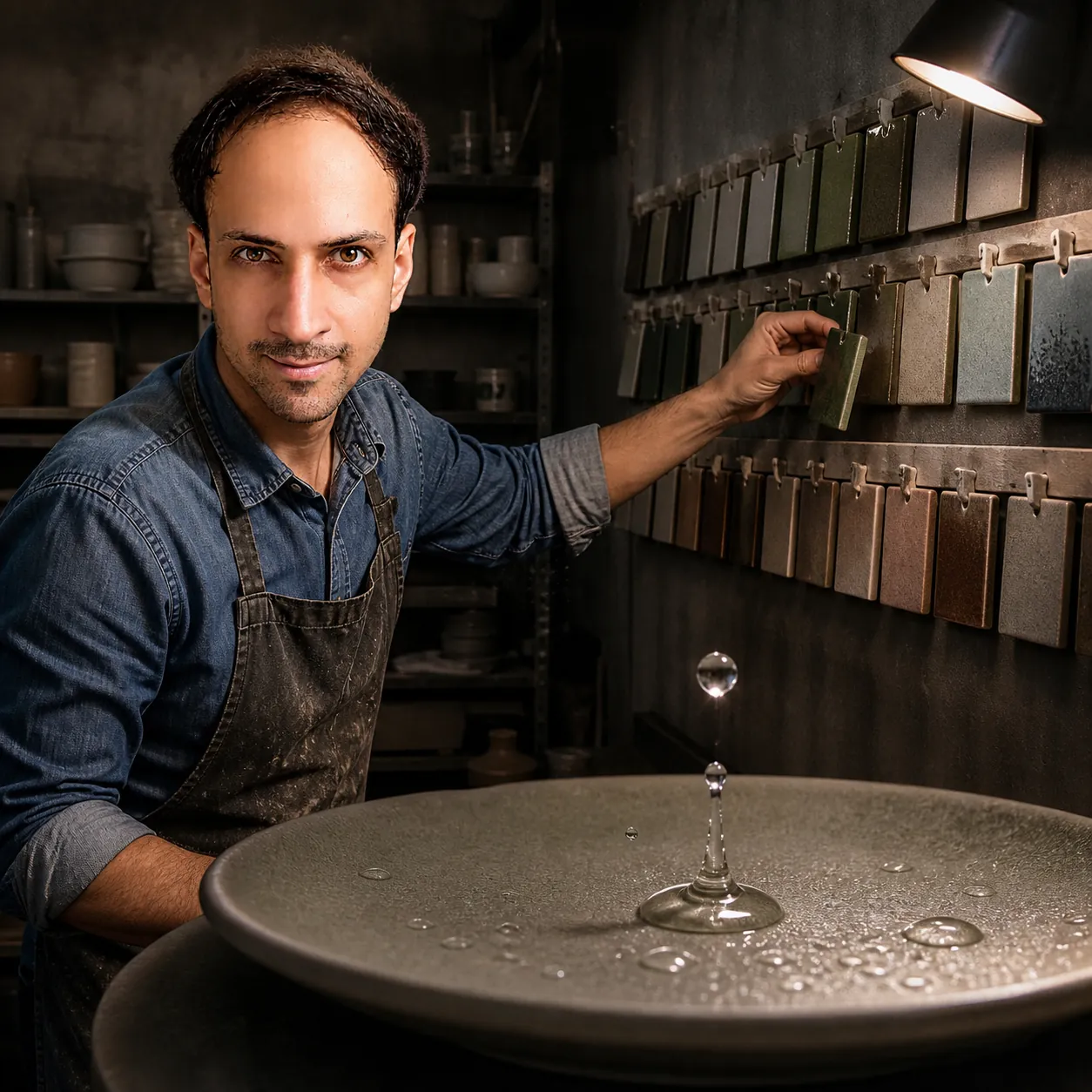
Self-Launching Dew in the Glaze Room — AI Portrait Prompt
صورةAI Portraits

Turn your own photo into a photorealistic portrait in a ceramics glaze room with test tiles pegged to one wall. Keeps your face unchanged.

من نص البرومبت

Use the attached reference photo as the identity reference: keep the same face, skin tone, hair and features as the person in that photo, without beautifying, aging or altering them. Create a square 1:1 museum-catalog frame with a strong first read and a slower second read at exactly 2880x2880 pixels. Location: a ceramics glaze room with test tiles pegged to one wall. Show the subject in a clay-dusted apron over a washed denim shirt, pegging one dipped test tile onto the wall rack. Build the artwork around this material rule: a chilled coated plate whose condensing dew droplets merge and fling themselves clear of the surface without any push proves that texture too small to see decides what water may touch. Explore how ordinary water earns the poise of a rarer, heavier liquid; direct expression and posture toward settled attention, never melodrama or ad-like confidence. Use a restrained 35mm environmental view with them at one third and the demonstration at the other. Make the composition keep the room austere so the water is the only event. Render it as conceptual materials-lab portraiture pairing believable coatings, true droplet behavior, restrained contemporary art direction, and warm human documentary presence, using one low raking lamp that gives the water a single small specular point and a palette of silvered air, deep charcoal, and muted moss green. Photorealistic: this must read as a real photograph from a physical camera, never an illustration, painting, or 3D render. Resolve real surface detail: hair with individual strands catching light, fine hairs of uneven length, and skin oil giving a low uneven sheen. Keep one identity-locked person, credible hands and fingers, natural fabric, and coherent scale, contact, reflections, shadows, airflow, deformation, and materials. Background people only when essential, always secondary and clearly different. Avoid cartoon dewdrop gloss, rainbow refraction overload, levitating water blobs, spiritual lotus kitsch, and hoses spraying dramatic mist. No text, labels, logos, signatures, watermarks, random symbols, plastic skin, excessive bloom, or glossy AI finish.
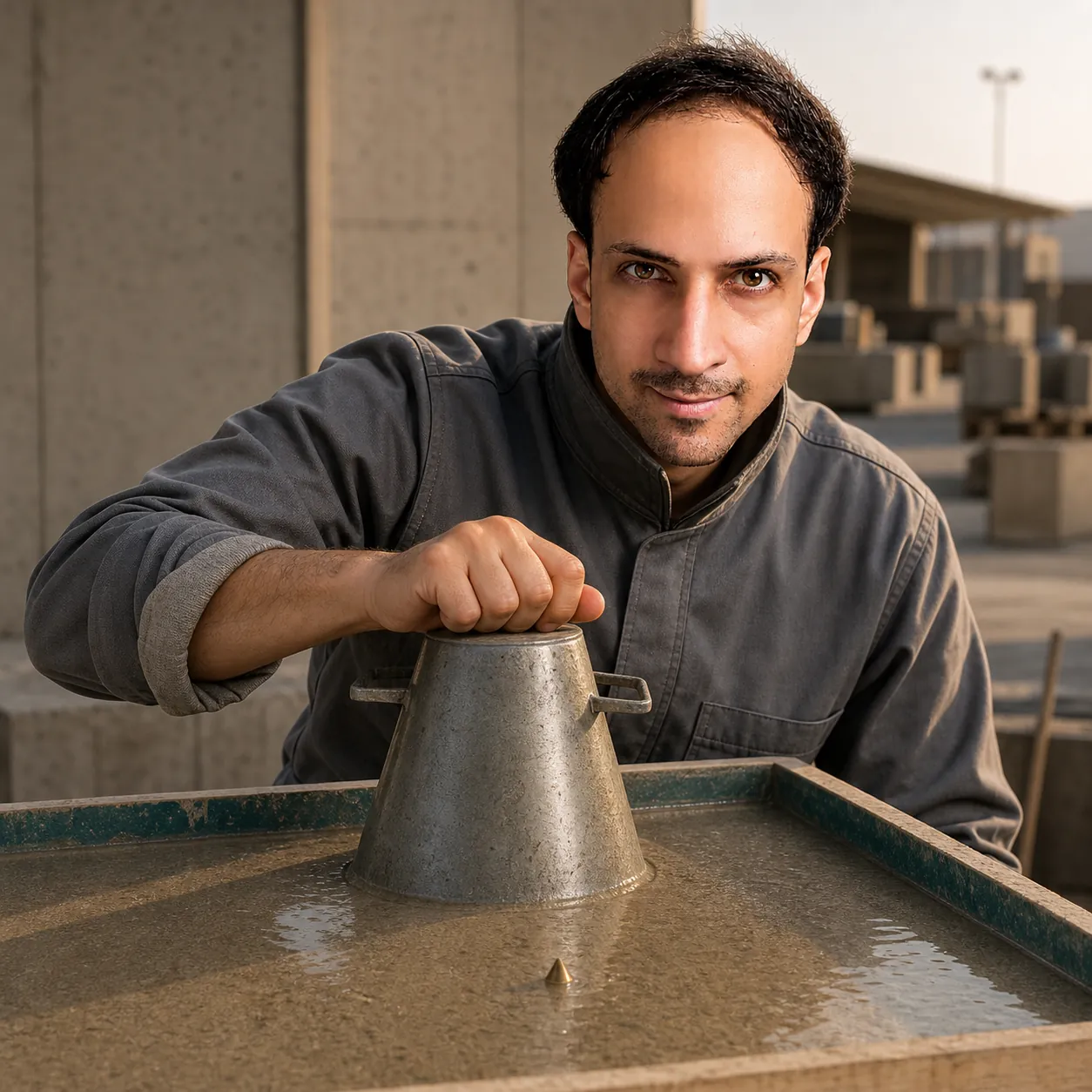
Quicksand Test at the Concrete Yard — AI Portrait Prompt
صورةAI Portraits

Turn your own photo into a portrait in a Riyadh concrete materials yard at early morning, slump boards hosed clean. Keeps your face unchanged.

من نص البرومبت

Use the attached reference photo as the identity reference: keep the same face, skin tone, hair and features as the person in that photo, without beautifying, aging or altering them. Create a square 1:1 museum-catalog frame with a strong first read and a slower second read at exactly 2880x2880 pixels. Location: a Riyadh concrete materials yard at early morning, slump boards hosed clean. Show the subject in a high-collared grey work jacket with rolled cuffs, tapping a steel slump cone free with one knuckle. The impossible-looking event must obey this clear system: a basin of water-saturated fine sand that bears a brass plumb bob until rhythmic taps let it sink from sight holds a small lawful contradiction still enough to be studied. Explore where the boundary sits between obeying a law and exploiting one; direct expression and posture toward patient scrutiny, never melodrama or ad-like confidence. Use a 90mm close-working lens: the fluid's response sharp near the frame's base and their attentive face readable above it. Make the composition set one calm horizontal surface against their quiet vertical posture. Render it as conceptual materials-science portraiture combining working bench apparatus, truthful viscosity and yield behavior, restrained contemporary art direction, and human-centered editorial calm, using late golden cross-light kept off the lens and low on the surfaces and a palette of putty grey, birch ply, and a single teal accent. Photorealistic: this must read as a real photograph from a physical camera, never an illustration, painting, or 3D render. Resolve real surface detail: skin that reddens slightly under pressure, nail beds with honest colour, and knuckle creases that fold rather than blur. Keep one identity-locked person, credible hands and fingers, natural fabric, and coherent scale, contact, reflections, shadows, airflow, deformation, and materials. Background people only when essential, always secondary and clearly different. Avoid frozen splash crowns, CGI liquid-metal morphing, glowing sci-fi gels, food-fight mess on clothing, and impossible floating blobs. No text, labels, logos, signatures, watermarks, random symbols, plastic skin, excessive bloom, or glossy AI finish.
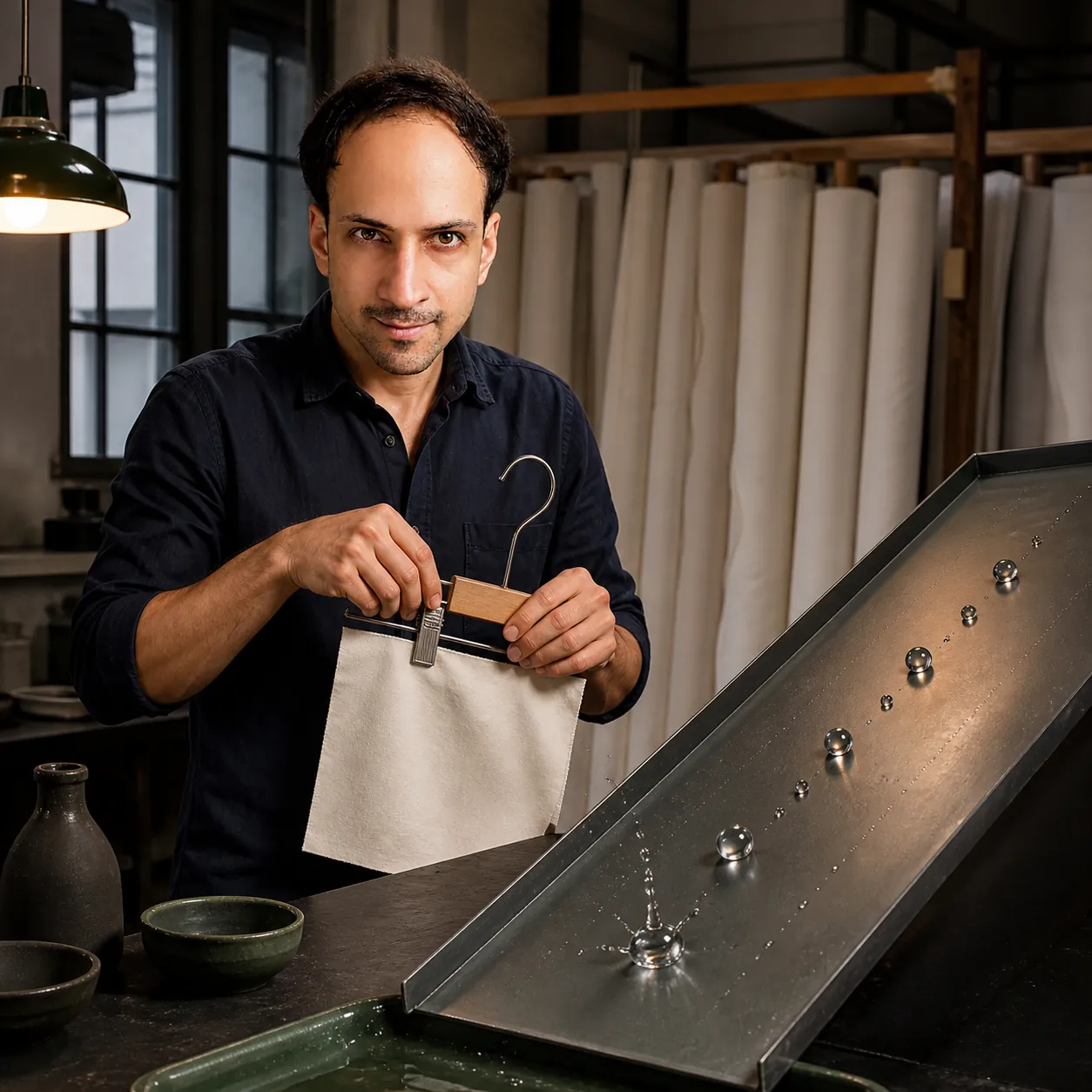
Bouncing Beads in the Textile Room — AI Portrait Prompt
صورةAI Portraits

Turn your own photo into a museum-grade demonstration portrait in a textile finishing room with bolts of white cloth racked. Keeps your face unchanged.

من نص البرومبت

Use the attached reference photo as the identity reference: keep the same face, skin tone, hair and features as the person in that photo, without beautifying, aging or altering them. Create a square 1:1 museum-catalog frame with a strong first read and a slower second read at exactly 2880x2880 pixels. Location: a textile finishing room with bolts of white cloth racked. Show the subject in a pressed indigo work shirt buttoned to one below the collar, clipping a cloth sample onto a wooden hanger. Build the artwork around this material rule: an inclined anodized tray down which dyed beads of water bounce and skip like dropped ball bearings proves that texture too small to see decides what water may touch. Explore why water that keeps its shape unsettles the eye more than spilled water; direct expression and posture toward settled attention, never melodrama or ad-like confidence. Use a restrained 35mm environmental view with them at one third and the demonstration at the other. Make the composition align their eye line with the border between wet and dry. Render it as museum-grade demonstration realism combining faithful contact-angle physics, tactile fabric and metal surfaces, honest water optics, and unhurried portrait photography, using cool dawn ambience warmed by one shaded tungsten practical close at hand and a palette of matte graphite, unglazed clay, and a quiet viridian accent. Photorealistic: this must read as a real photograph from a physical camera, never an illustration, painting, or 3D render. Resolve real surface detail: dust settled where nobody wipes, fingerprint haze on glass, and edges rubbed pale by handling. Keep one identity-locked person, credible hands and fingers, natural fabric, and coherent scale, contact, reflections, shadows, airflow, deformation, and materials. Background people only when essential, always secondary and clearly different. Avoid cartoon dewdrop gloss, rainbow refraction overload, levitating water blobs, spiritual lotus kitsch, and hoses spraying dramatic mist. No text, labels, logos, signatures, watermarks, random symbols, plastic skin, excessive bloom, or glossy AI finish.
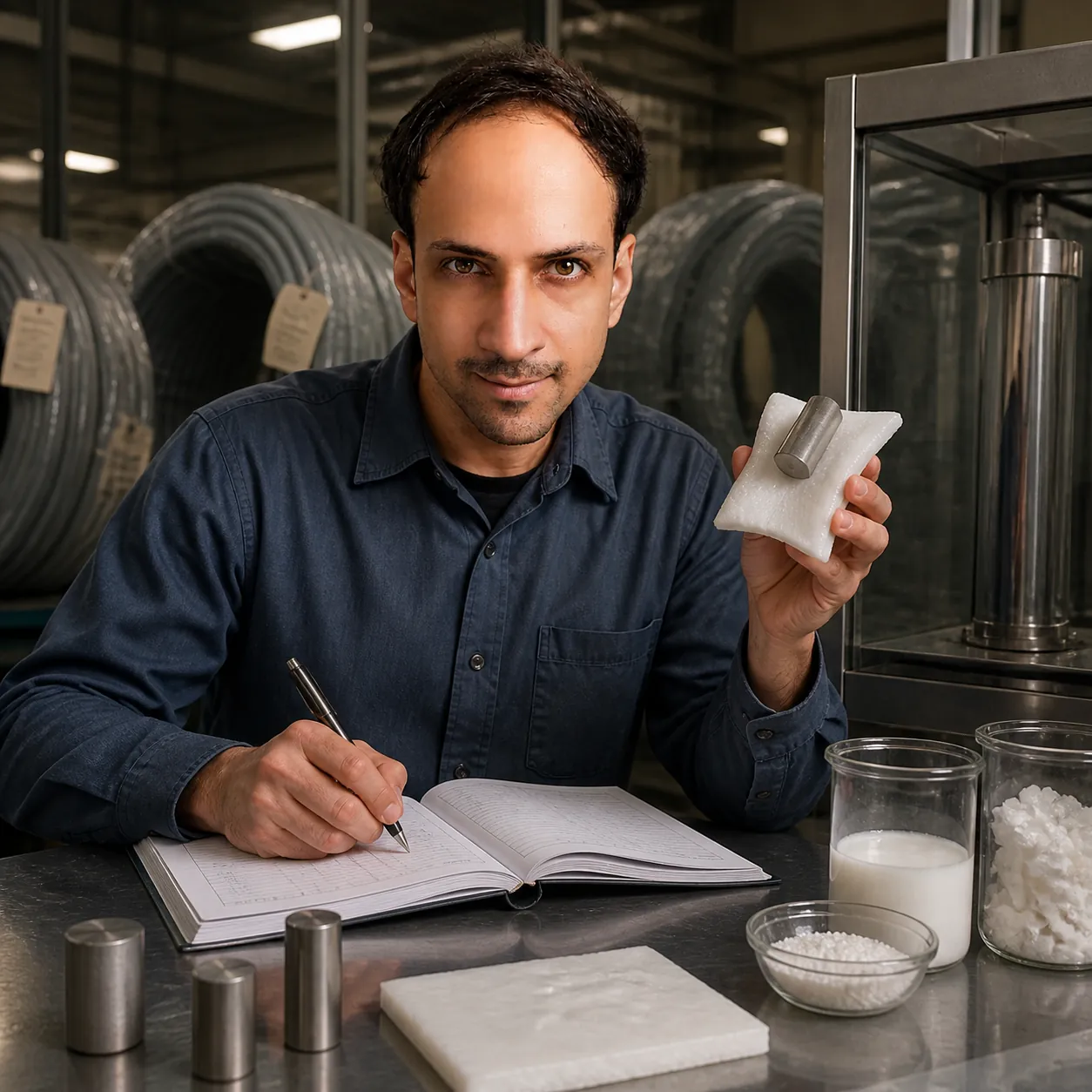
Soft Armor in Quality Control — AI Portrait Prompt
صورةAI Portraits

Turn your own photo into a quiet kinetic still-life portrait in a quality-control room in a polymer plant, extrudate coils tagged. Keeps your face unchanged.

من نص البرومبت

Use the attached reference photo as the identity reference: keep the same face, skin tone, hair and features as the person in that photo, without beautifying, aging or altering them. Create a square 1:1 museum-catalog frame with a strong first read and a slower second read at exactly 2880x2880 pixels. Location: a quality-control room in a polymer plant, extrudate coils tagged. Show the subject in a buttoned steel-blue overshirt with a flat chest pocket, logging one line in a bound record book. Use this advanced image-making device as the core logic: a flexible white pad of engineered shear-thickening fluid that folds softly in their fingers yet stops a dropped steel slug outright answers the manner of a force rather than its size. Explore how the same handful of matter can honestly hold two opposite verdicts; direct expression and posture toward quiet disbelief, never melodrama or ad-like confidence. Frame past the apparatus at shoulder height, foreground glass and steel physical but never obscuring the face. Make the composition set one calm horizontal surface against their quiet vertical posture. Render it as quiet kinetic still-life portraiture built from genuine non-Newtonian samples, honest studio texture, believable hand-scale staging, and patient documentary framing, using diffused overhead panels dimmed low enough to keep every reflection readable and a palette of mud brown, brushed steel, and muted glass green. Photorealistic: this must read as a real photograph from a physical camera, never an illustration, painting, or 3D render. Resolve real surface detail: visible weave in cloth, fine scratches on metal, and the faint unevenness of painted walls. Keep one identity-locked person, credible hands and fingers, natural fabric, and coherent scale, contact, reflections, shadows, airflow, deformation, and materials. Background people only when essential, always secondary and clearly different. Avoid rainbow slime aesthetics, splattered goo on skin, speaker-driven paint splashes, and ASMR dripping close-ups. No text, labels, logos, signatures, watermarks, random symbols, plastic skin, excessive bloom, or glossy AI finish.

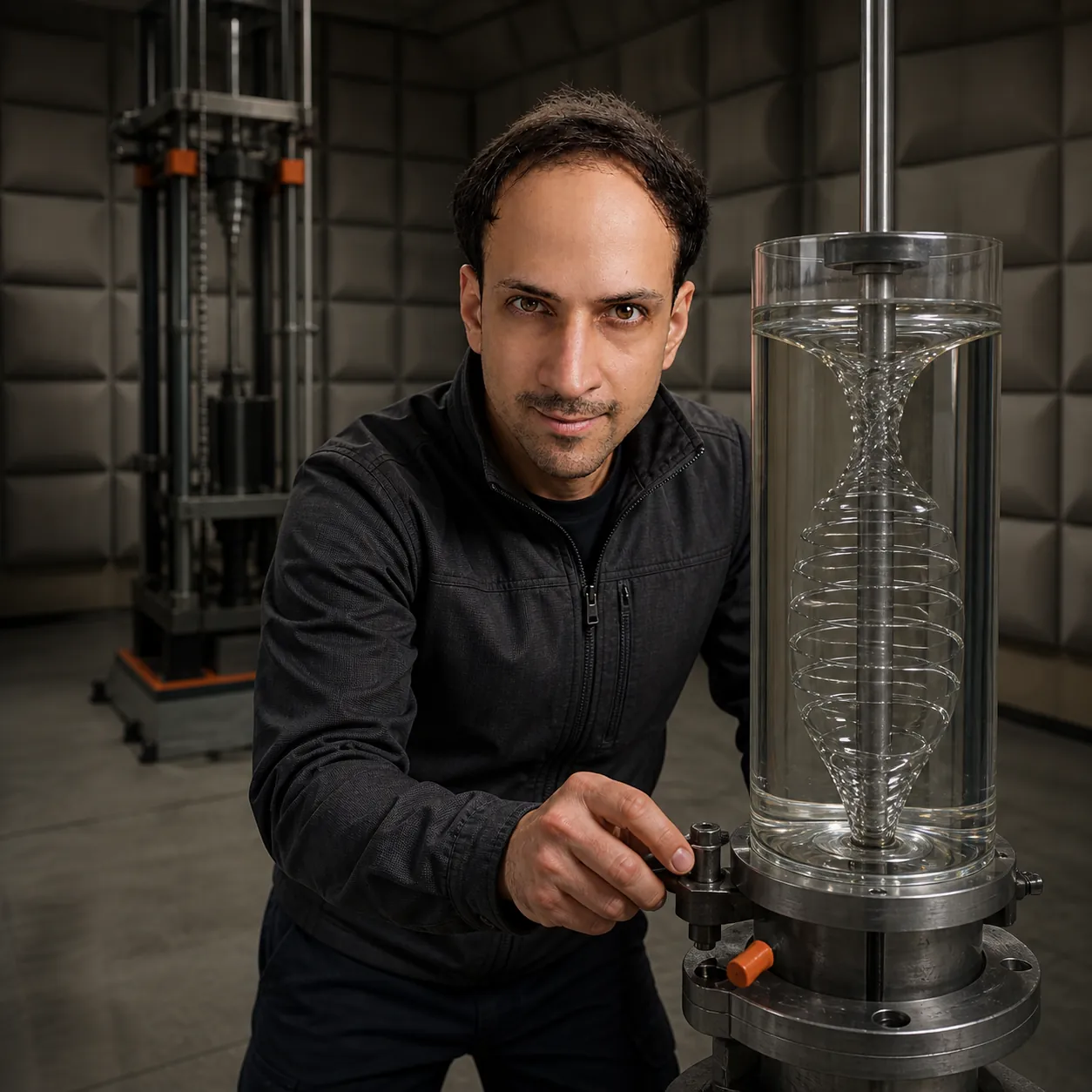
The Rod-Climbing Polymer — AI Portrait Prompt
صورةAI Portraits

Turn your own photo into a museum-grade demonstration portrait in a padded impact-test room with a guided drop rig standing idle. Keeps your face unchanged.

من نص البرومبت

Use the attached reference photo as the identity reference: keep the same face, skin tone, hair and features as the person in that photo, without beautifying, aging or altering them. Create a square 1:1 museum-catalog frame with a strong first read and a slower second read at exactly 2880x2880 pixels. Location: a padded impact-test room with a guided drop rig standing idle. Show the subject in a zipped charcoal technical jacket over dark work trousers, setting the release catch with one deliberate thumb. Make one rigorous physical condition the conceptual engine: a glass cylinder of clear polymer solution that climbs the spinning stir rod against every instinct a centrifuge ever taught answers the manner of a force rather than its size. Explore how memory can live in a substance with no fixed shape; direct expression and posture toward measured astonishment, never melodrama or ad-like confidence. Use an eye-level 80mm medium-format viewpoint with honest perspective and gentle depth of field. Make the composition keep every contour of the fluid sharper than the room behind. Render it as museum-grade demonstration realism combining faithful fluid behavior, tactile material surfaces, patient observational portrait photography, and physically accurate weight and reflection, using diffused overhead panels dimmed low enough to keep every reflection readable and a palette of wet cement, ivory, and one line of safety orange. Photorealistic: this must read as a real photograph from a physical camera, never an illustration, painting, or 3D render. Resolve real surface detail: fine grit in the texture of concrete, efflorescence at damp edges, and hairline cracks that follow stress. Keep one identity-locked person, credible hands and fingers, natural fabric, and coherent scale, contact, reflections, shadows, airflow, deformation, and materials. Background people only when essential, always secondary and clearly different. Avoid rainbow slime aesthetics, splattered goo on skin, speaker-driven paint splashes, and ASMR dripping close-ups. No text, labels, logos, signatures, watermarks, random symbols, plastic skin, excessive bloom, or glossy AI finish.
