
تخطَّ إلى المحتوى
f

faisal aziz

@alkhunizan

3150البرومبتات
0تصويتات مستلمة
0مساهمات
تاريخ الانضمام منذ 4 أشهر
3150 مساهمات في العام الماضي
نوفمبر
ديسمبر
يناير
فبراير
مارس
أبريل
مايو
يونيو
يوليو
أغسطس
سبتمبر
أكتوبر
ن
ر
ج
أقل
أكثر
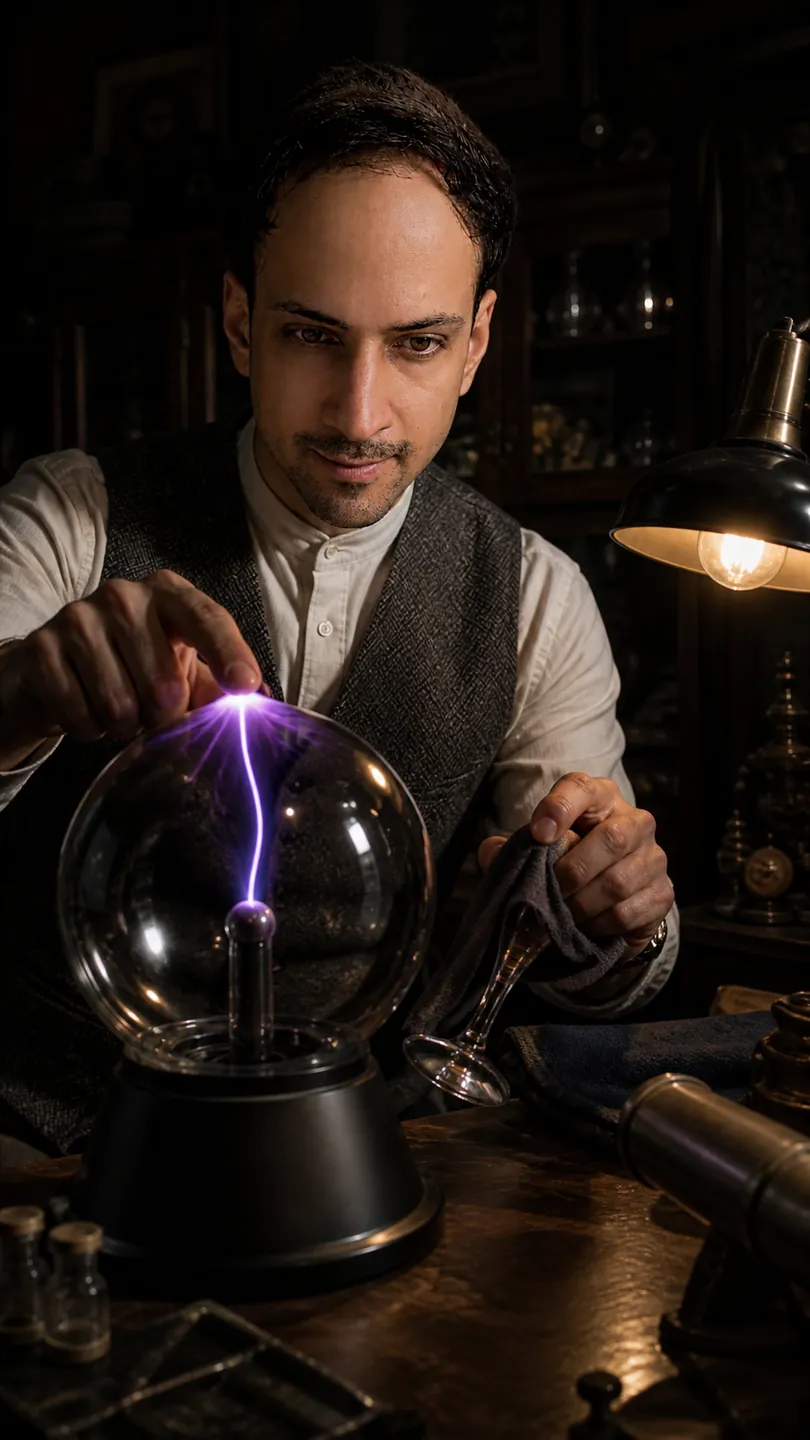
Branching Verdict: Restored Najdi Mud-Brick Room — AI Portrait Prompt
صورةAI Portraits

Turn your own photo into a high-voltage archival portrait in a restored Najdi mud-brick room lit by one low lantern. Keeps your face unchanged.

من نص البرومبت

Use the attached reference photo as the identity reference: keep the same face, skin tone, hair and features as the person in that photo, without beautifying, aging or altering them. Use a formal 3:4 environmental portrait with complete hands and meaningful objects inside frame at exactly 2480x3312 pixels. Location: a restored Najdi mud-brick room lit by one low lantern. Show the subject in a plain sand-colored traditional Gulf outfit, sleeves buttoned at the wrist, trimming a lantern wick to a lower flame. The impossible-looking event must obey this clear system: a sealed plasma globe whose slender violet filaments abandon their drift and gather beneath their fingertip resting on the cold glass reports what the current actually did, with nothing invented for drama. Explore how a discharge decides its path when every option looks identical; direct expression and posture toward quiet conviction, never melodrama or ad-like confidence. Frame past the near edge of the apparatus, foreground detail physical and their expression fully readable. Make the composition run one bright line toward their eyes without ever arriving. Render it as high-voltage archival portraiture built from sealed and lawful apparatus, deep-shadow documentary realism, physically true glass reflections, and museum-label restraint, using near-darkness held back by one small tungsten lamp at the bench and a palette of deep charcoal, gunmetal grey, and one violet whisper. Photorealistic: this must read as a real photograph from a physical camera, never an illustration, painting, or 3D render. Resolve real surface detail: hair with individual strands catching light, fine hairs of uneven length, and skin oil giving a low uneven sheen. Keep one identity-locked person, credible hands and fingers, natural fabric, and coherent scale, contact, reflections, shadows, airflow, deformation, and materials. Background people only when essential, always secondary and clearly different. Avoid sci-fi energy balls, fractal screen-saver overlays, sparks showering from hands, wizard-lightning fingertips, and ultraviolet glow gimmicks. No text, labels, logos, signatures, watermarks, random symbols, plastic skin, excessive bloom, or glossy AI finish.
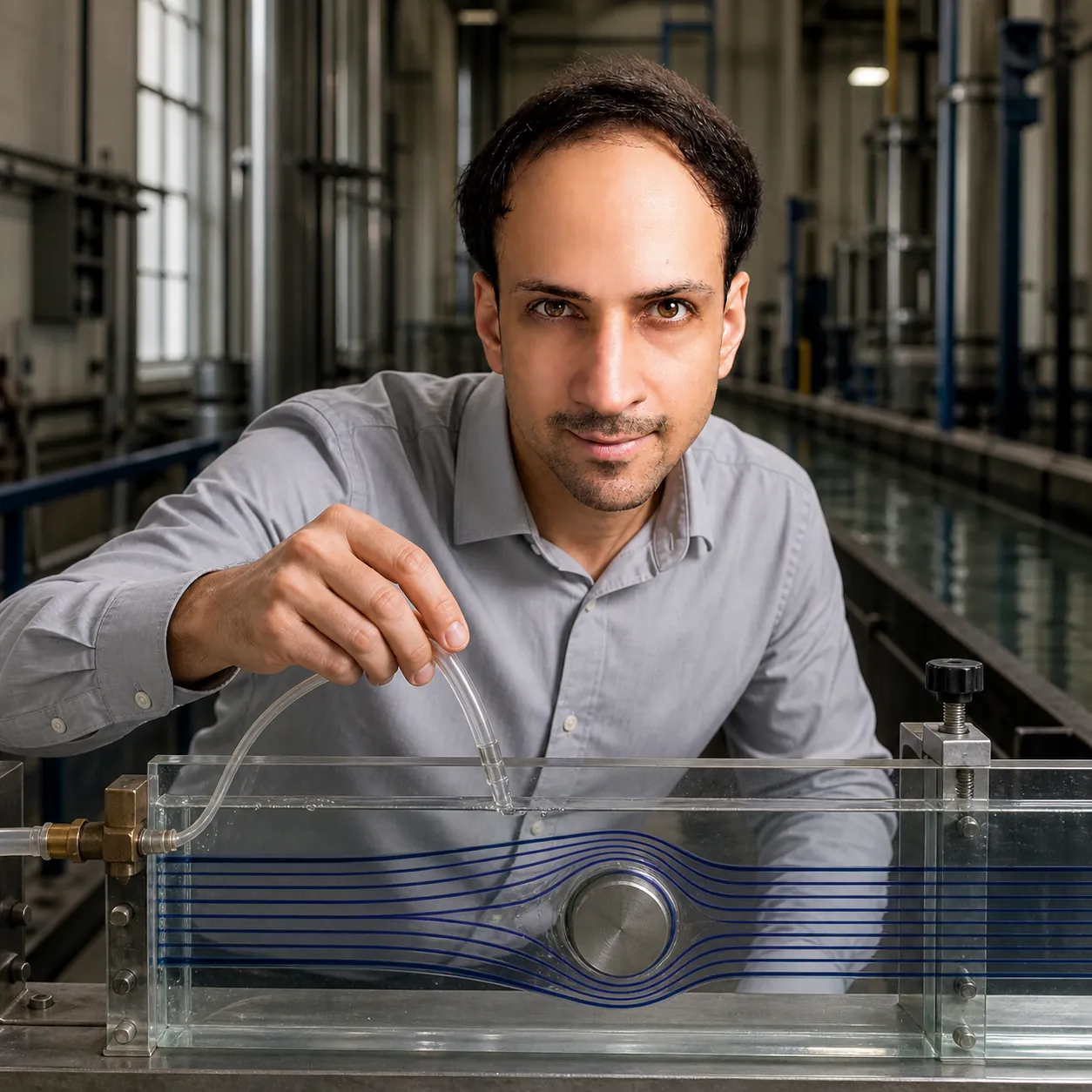
Dye Lines Parting Around a Disc — AI Portrait Prompt
صورةAI Portraits

Turn your own photo into a portrait in a university hydraulics hall of tall standpipes and long still channels. Keeps your face unchanged.

من نص البرومبت

Use the attached reference photo as the identity reference: keep the same face, skin tone, hair and features as the person in that photo, without beautifying, aging or altering them. Create a square 1:1 museum-catalog frame with a strong first read and a slower second read at exactly 2880x2880 pixels. Location: a university hydraulics hall of tall standpipes and long still channels. Show the subject in a pressed pale-grey shirt with sleeves buttoned at the wrist, bleeding one air bubble from a clear manifold line. Make one rigorous physical condition the conceptual engine: a fan of parallel dye lines between two close glass plates that parts around a steel disc and closes seamlessly behind it gives a normally chaotic process one legible, patient, watchable form. Explore why the eye trusts glass more readily than it trusts obedient water; direct expression and posture toward level wonder, never melodrama or ad-like confidence. Use an eye-level 60mm medium-format viewpoint with honest perspective and gently limited depth of field. Make the composition rhyme the water's curve with the line of their shoulders. Render it as museum-scale demonstration realism combining faithful portrait photography, glass-smooth water rendered without exaggeration, machined hydraulic hardware, and physically exact reflections, using even overhead lab light shaped by baffles into calm directional zones and a palette of bone white, clear-water celadon, and a line of indigo. Photorealistic: this must read as a real photograph from a physical camera, never an illustration, painting, or 3D render. Resolve real surface detail: fine grit in the texture of concrete, efflorescence at damp edges, and hairline cracks that follow stress. Keep one identity-locked person, credible hands and fingers, natural fabric, and coherent scale, contact, reflections, shadows, airflow, deformation, and materials. Background people only when essential, always secondary and clearly different. Avoid splash crowns, suspended droplet sprays, chrome CGI liquid, neon glowing water, and fantasy water-bending gestures. No text, labels, logos, signatures, watermarks, random symbols, plastic skin, excessive bloom, or glossy AI finish.
Branching Verdict: Back Room — AI Portrait Prompt
صورةAI Portraits

Turn your own photo into a photorealistic portrait in the back room of a scientific-antiques dealer, cabinets unlocked. Keeps your face unchanged.

من نص البرومبت

Use the attached reference photo as the identity reference: keep the same face, skin tone, hair and features as the person in that photo, without beautifying, aging or altering them. Design a full-height 9:16 cinematic artwork that reads on a phone and rewards gallery-scale inspection at exactly 2144x3808 pixels. Location: the back room of a scientific-antiques dealer, cabinets unlocked. Show the subject in a herringbone wool vest over a band-collar shirt, folding a felt square around a glass stem. Make one rigorous physical condition the conceptual engine: a sealed plasma globe whose slender violet filaments abandon their drift and gather beneath their fingertip resting on the cold glass lets the material answer the current in its own native dialect. Explore how a discharge decides its path when every option looks identical; direct expression and posture toward disciplined marvel, never melodrama or ad-like confidence. Frame from a low three-quarter angle so the demonstration sits between the lens and their attention. Make the composition surround the lit evidence with generous, honest darkness. Render it as gallery-caliber physics portraiture merging real electrical signatures, charcoal-dark tonal control, precise glass-and-char material rendering, and steady observational calm, using near-darkness held back by one small tungsten lamp at the bench and a palette of midnight blue-black, brushed nickel, and one phosphor-green line. Photorealistic: this must read as a real photograph from a physical camera, never an illustration, painting, or 3D render. Give the space honest scale: real distance between foreground, subject, and far wall. Resolve real surface detail: condensation beading at true size, liquid meniscus curving against glass, and wet surfaces darker than dry ones. Keep one identity-locked person, credible hands and fingers, natural fabric, and coherent scale, contact, reflections, shadows, airflow, deformation, and materials. Background people only when essential, always secondary and clearly different. Avoid sci-fi energy balls, fractal screen-saver overlays, sparks showering from hands, wizard-lightning fingertips, and ultraviolet glow gimmicks. No text, labels, logos, signatures, watermarks, random symbols, plastic skin, excessive bloom, or glossy AI finish.
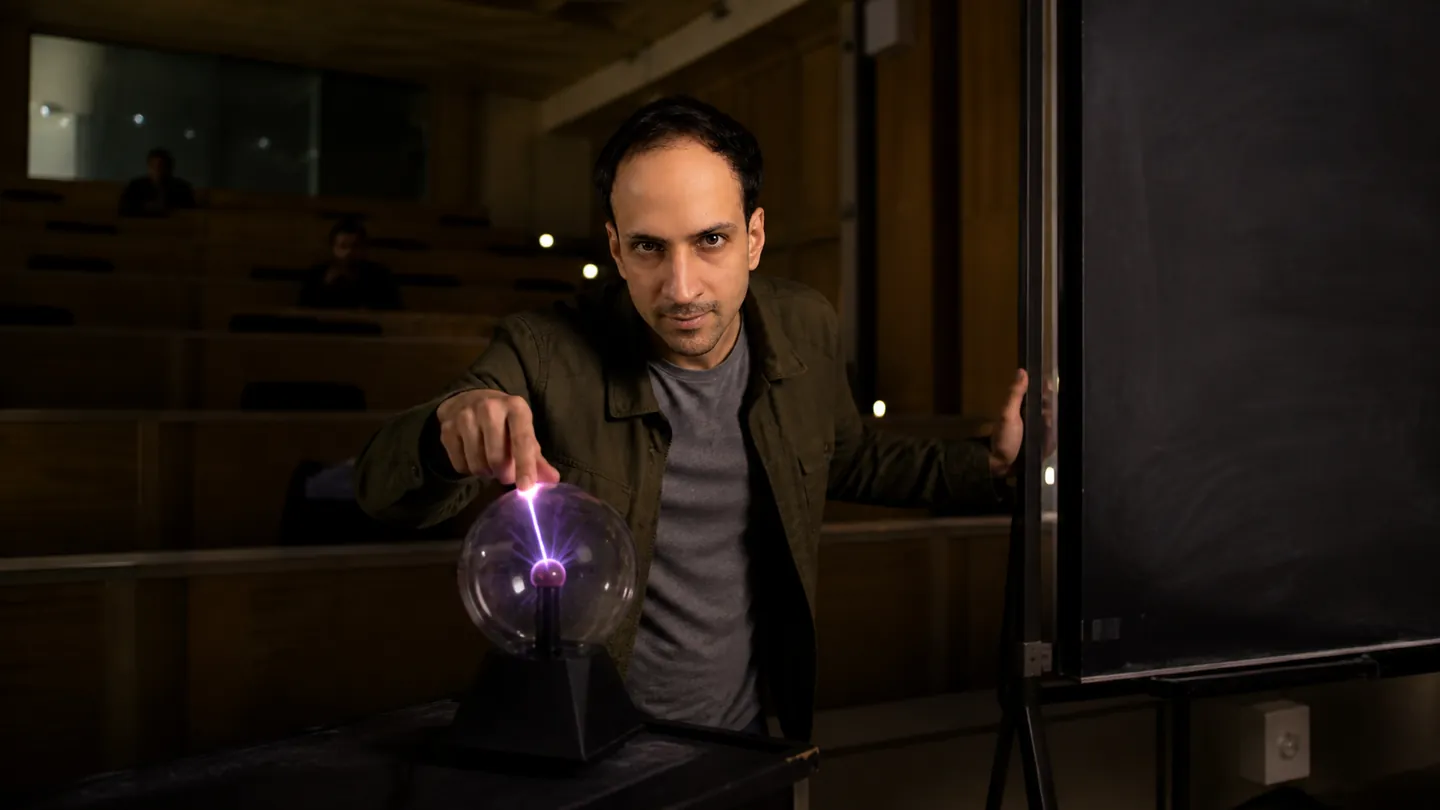
Branching Verdict: Raked Lecture Hall — AI Portrait Prompt
صورةAI Portraits

Turn your own photo into a photorealistic portrait in a raked lecture hall in a Riyadh university at night. Keeps your face unchanged.

من نص البرومبت

Use the attached reference photo as the identity reference: keep the same face, skin tone, hair and features as the person in that photo, without beautifying, aging or altering them. Compose a wide 16:9 narrative image where environment and subject carry equal meaning at exactly 3808x2144 pixels. Location: a raked lecture hall in a Riyadh university at night. Show the subject in an olive field jacket over a plain heather-grey tee, wheeling a rolling blackboard flush against the side wall. Build the artwork around this material rule: a sealed plasma globe whose slender violet filaments abandon their drift and gather beneath their fingertip resting on the cold glass gives a bench-scale object the quiet gravity of a monument. Explore how a discharge decides its path when every option looks identical; direct expression and posture toward steady curiosity, never melodrama or ad-like confidence. Use an eye-level 85mm portrait view with honest perspective and one plane of disciplined focus. Make the composition let the brightest point be the smallest thing in frame. Render it as evidence-grade scientific photography pairing honest discharge phenomena, calibrated near-darkness exposure, believable period instrumentation, and quiet, unhurried human-scale storytelling, using a single backlight through frosted glass, edges kept in soft shadow and a palette of charred oak, pale ivory, and one ember-orange thread. Photorealistic: this must read as a real photograph from a physical camera, never an illustration, painting, or 3D render. Give truthful depth cues: overlapping planes and shadows softening as they travel. Resolve real surface detail: rubber gone chalky with age, painted metal chipped to primer, and plastic yellowed only where light reaches it. Keep one identity-locked person, credible hands and fingers, natural fabric, and coherent scale, contact, reflections, shadows, airflow, deformation, and materials. Background people only when essential, always secondary and clearly different. Avoid sci-fi energy balls, fractal screen-saver overlays, sparks showering from hands, wizard-lightning fingertips, and ultraviolet glow gimmicks. No text, labels, logos, signatures, watermarks, random symbols, plastic skin, excessive bloom, or glossy AI finish.
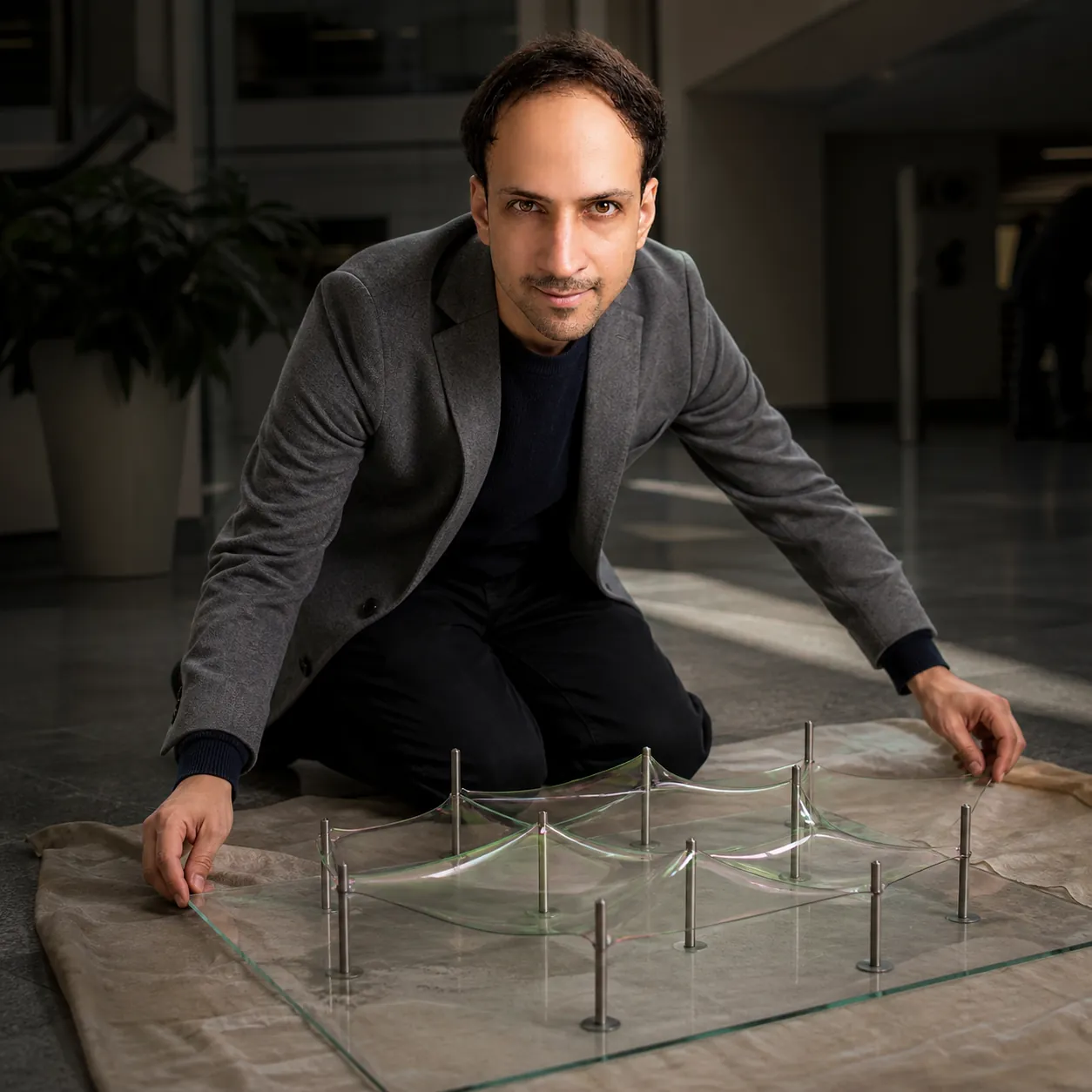
Iridescent Proof: Daylit Atrium — AI Portrait Prompt
صورةAI Portraits

Turn your own photo into a conceptual physics portrait in the daylit atrium of a quiet office building on a Friday. Keeps your face unchanged.

من نص البرومبت

Use the attached reference photo as the identity reference: keep the same face, skin tone, hair and features as the person in that photo, without beautifying, aging or altering them. Create a square 1:1 museum-catalog frame with a strong first read and a slower second read at exactly 2880x2880 pixels. Location: the daylit atrium of a quiet office building on a Friday. Show them in an unstructured stone-grey blazer over a fine navy knit, unfolding a drop cloth across the stone floor. Use this advanced image-making device as the core logic: a soap network between two clear plates and steel pins that links every pin with the shortest possible roads keeps its composure while thinning lawfully toward a collapse it cannot refuse. Explore whether watching a problem solve itself can count as understanding it; direct expression and posture toward unhurried attention, never melodrama or ad-like confidence. Use a 105mm near-macro portrait blend, one iridescent border sharp near the lens and their attentive face readable beyond. Make the composition hold their hands and the fragile surface in one patient plane. Render it as conceptual physics portraiture blending exact interference color, honest wet materiality, unhurried editorial framing, and quietly human-scale scientific staging, using a single softened practical raking the surface with the room falling dark and a palette of deep charcoal, unpolished tin, and one green interference stripe. Photorealistic: this must read as a real photograph from a physical camera, never an illustration, painting, or 3D render. Resolve real surface detail: rubber gone chalky with age, painted metal chipped to primer, and plastic yellowed only where light reaches it. Keep one identity-locked person, credible hands and fingers, natural fabric, and coherent scale, contact, reflections, shadows, airflow, deformation, and materials. Background people only when essential, always secondary and clearly different. Avoid psychedelic color grading, floating foam confetti, glassy chrome bubbles, dish-soap advertising gloss, and impossible unbroken membranes. No text, labels, logos, signatures, watermarks, random symbols, plastic skin, excessive bloom, or glossy AI finish.
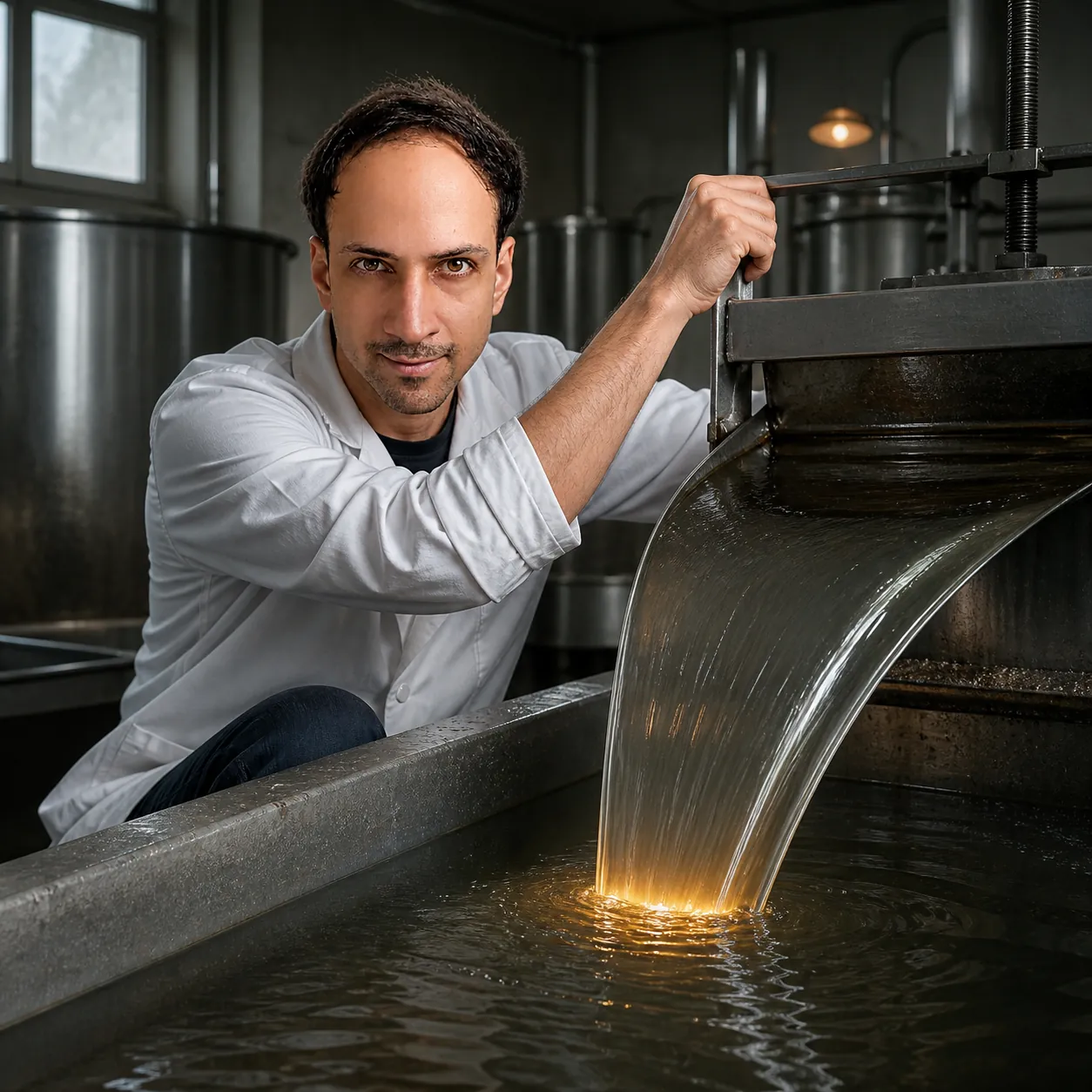
Light-Trapping Stream in the Honey House — AI Portrait Prompt
صورةAI Portraits

Turn your own photo into a portrait in a small honey-house of steel settling tanks and scrubbed concrete. Keeps your face unchanged.

من نص البرومبت

Use the attached reference photo as the identity reference: keep the same face, skin tone, hair and features as the person in that photo, without beautifying, aging or altering them. Create a square 1:1 museum-catalog frame with a strong first read and a slower second read at exactly 2880x2880 pixels. Location: a small honey-house of steel settling tanks and scrubbed concrete. Show the subject in a white food-grade smock over rolled dark chinos, raising a small steel gate above a settling tank. Build the artwork around this material rule: a smooth descending stream that traps lamplight inside itself by total internal reflection and glows only where it finally lands gives a normally chaotic process one legible, patient, watchable form. Explore what stillness means when real mass is passing through it every second; direct expression and posture toward settled awe, never melodrama or ad-like confidence. Frame along the water's surface at forearm height so the flow's edge and their gaze share one plane. Make the composition rhyme the water's curve with the line of their shoulders. Render it as large-format hydro-engineering portraiture built from real channel flows, precise wet-metal detailing, truthful surface optics, and patient documentary framing, using cool diffuse daylight with a single warm practical reflected in wet metal and a palette of wet slate, glass green, and one crimson thread. Photorealistic: this must read as a real photograph from a physical camera, never an illustration, painting, or 3D render. Resolve real surface detail: label-free packaging showing carton fibre, cardboard bruised at the corners, and tape lifting slightly at one end. Keep one identity-locked person, credible hands and fingers, natural fabric, and coherent scale, contact, reflections, shadows, airflow, deformation, and materials. Background people only when essential, always secondary and clearly different. Avoid splash crowns, suspended droplet sprays, chrome CGI liquid, neon glowing water, and fantasy water-bending gestures. No text, labels, logos, signatures, watermarks, random symbols, plastic skin, excessive bloom, or glossy AI finish.
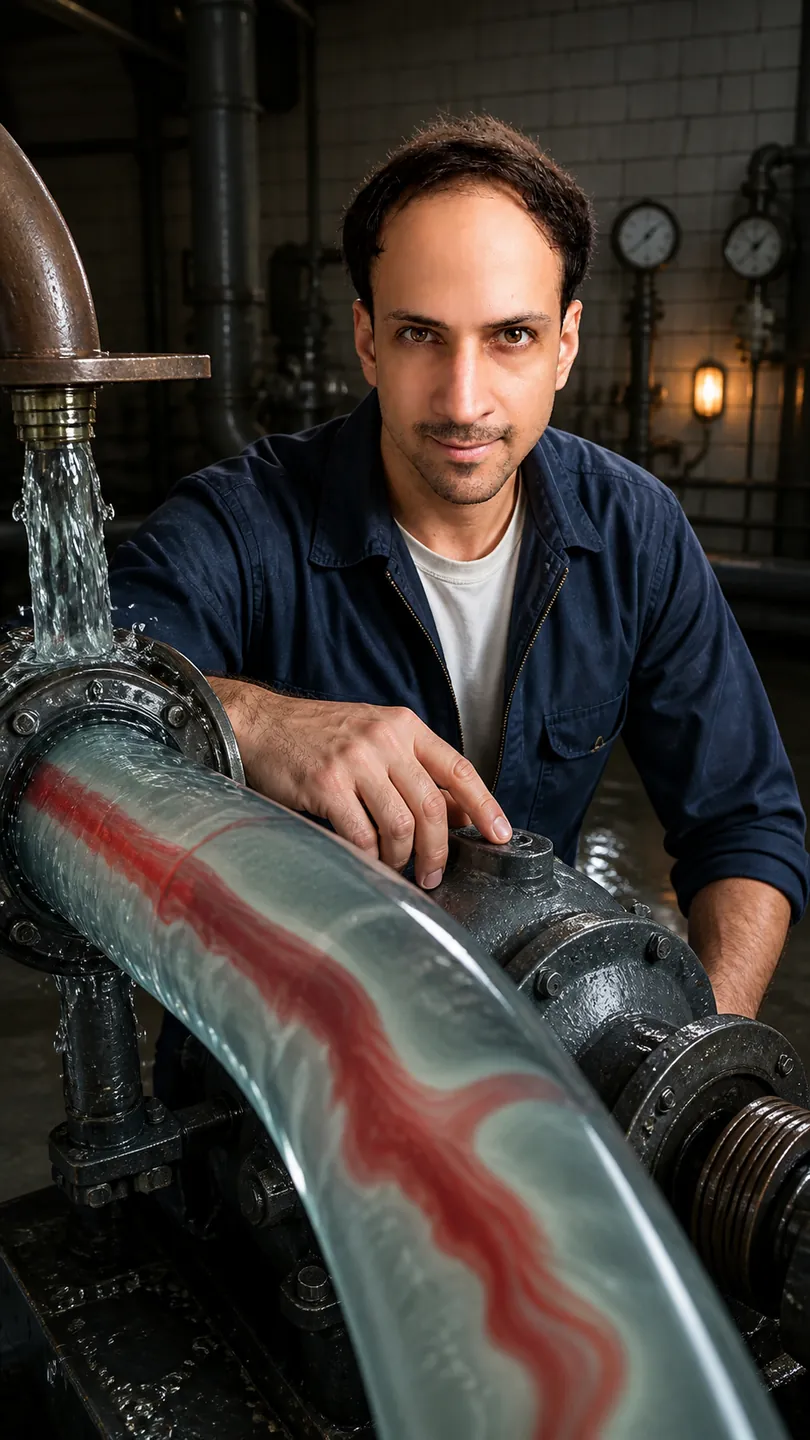
Dye Ring Beneath the Fountain — AI Portrait Prompt
صورةAI Portraits

Turn your own photo into a portrait in the tiled pump room beneath a public fountain, gauges faintly lit. Keeps your face unchanged.

من نص البرومبت

Use the attached reference photo as the identity reference: keep the same face, skin tone, hair and features as the person in that photo, without beautifying, aging or altering them. Design a full-height 9:16 cinematic artwork that reads on a phone and rewards gallery-scale inspection at exactly 2144x3808 pixels. Location: the tiled pump room beneath a public fountain, gauges faintly lit. Show the subject in a navy coverall unzipped over a clean white undershirt, resting two fingers on a humming pump casing. Treat this mechanism as the frame’s governing rule: a ring of dye in glycerin that is stirred into a full blur between clear cylinders and cranked back into a ring reveals what a liquid becomes when turbulence is lawfully withheld. Explore whether mixing truly destroys order or only hides it from impatient eyes; direct expression and posture toward clear-eyed patience, never melodrama or ad-like confidence. Use a 90mm close-portrait hybrid: one smooth stream sharp near the lens and their face readable beyond it. Make the composition give the dye's edge more acuity than any highlight. Render it as large-format hydro-engineering portraiture built from real channel flows, precise wet-metal detailing, truthful surface optics, and patient documentary framing, using cool diffuse daylight with a single warm practical reflected in wet metal and a palette of wet slate, glass green, and one crimson thread. Photorealistic: this must read as a real photograph from a physical camera, never an illustration, painting, or 3D render. Give the frame volume: faint density deepest in the room, contrast easing at the edges. Resolve real surface detail: dust settled where nobody wipes, fingerprint haze on glass, and edges rubbed pale by handling. Keep one identity-locked person, credible hands and fingers, natural fabric, and coherent scale, contact, reflections, shadows, airflow, deformation, and materials. Background people only when essential, always secondary and clearly different. Avoid stock waterfall mist, whirlpool vortices, ripple-covered surfaces, levitating water spheres, and dramatic slow-motion splash photography. No text, labels, logos, signatures, watermarks, random symbols, plastic skin, excessive bloom, or glossy AI finish.
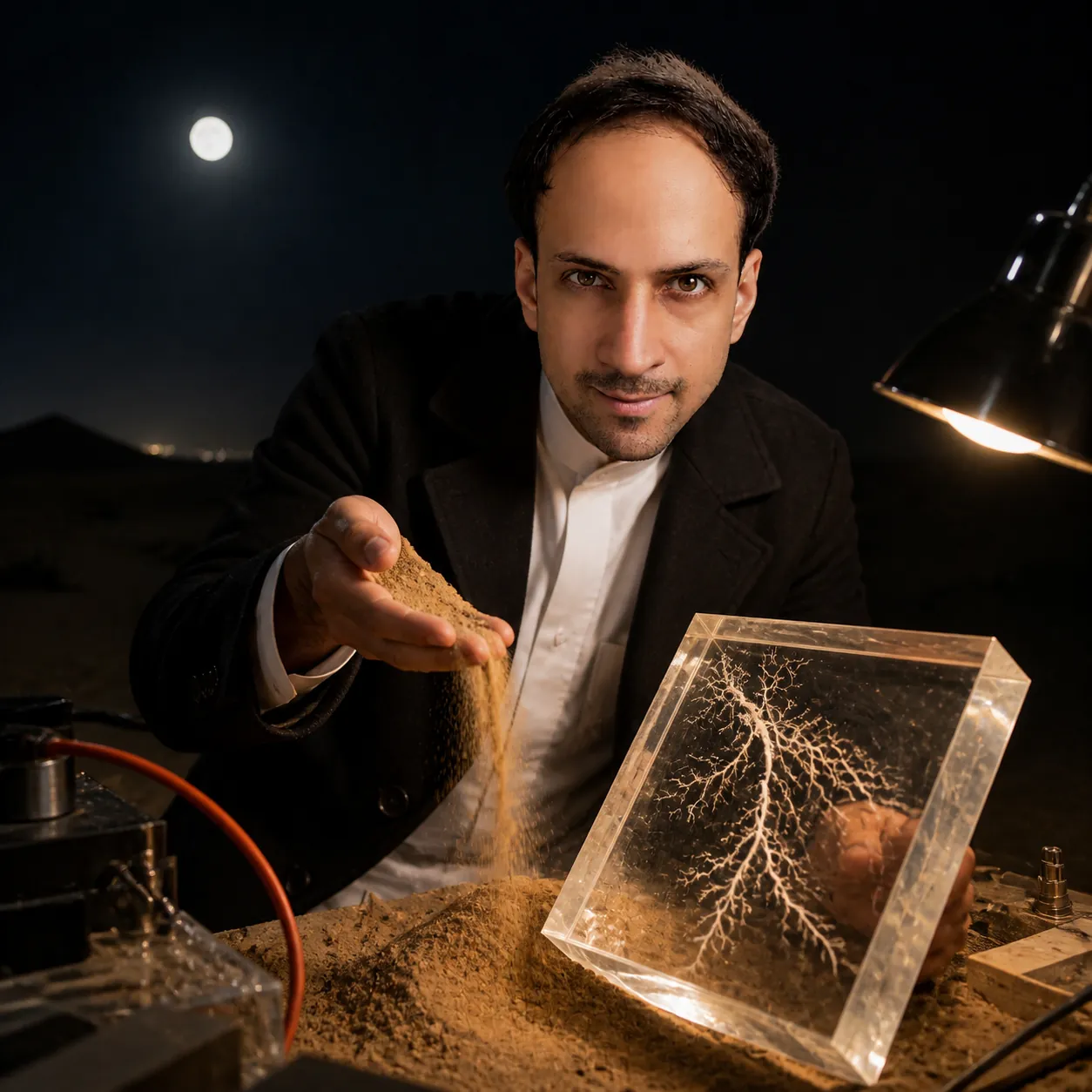
Lightning's Autograph: Moonlit Sand Rise — AI Portrait Prompt
صورةAI Portraits

Turn your own photo into a photorealistic portrait in a moonlit sand rise at the desert's edge outside Riyadh. Keeps your face unchanged.

من نص البرومبت

Use the attached reference photo as the identity reference: keep the same face, skin tone, hair and features as the person in that photo, without beautifying, aging or altering them. Create a square 1:1 museum-catalog frame with a strong first read and a slower second read at exactly 2880x2880 pixels. Location: a moonlit sand rise at the desert's edge outside Riyadh. Show them in a dark wool overcoat over a plain white traditional Gulf outfit, sifting a palmful of cool sand back onto the rise. Treat this mechanism as the frame’s governing rule: a clear acrylic block they tilt toward a lamp, holding a frozen white fern of fractures where a trapped charge once escaped brings a feared force close enough to study without any bravado. Explore why the fastest events in nature can leave the most patient evidence; direct expression and posture toward disciplined marvel, never melodrama or ad-like confidence. Frame past the near edge of the apparatus, foreground detail physical and their expression fully readable. Make the composition run one bright line toward their eyes without ever arriving. Render it as evidence-grade scientific photography pairing honest discharge phenomena, calibrated near-darkness exposure, believable period instrumentation, and quiet, unhurried human-scale storytelling, using one low practical lamp with the room allowed to fall away dark and a palette of charred oak, pale ivory, and one ember-orange thread. Photorealistic: this must read as a real photograph from a physical camera, never an illustration, painting, or 3D render. Resolve real surface detail: paper fibre visible at cut edges, plastic that shows mould lines, and paint thicker where a brush turned. Keep one identity-locked person, credible hands and fingers, natural fabric, and coherent scale, contact, reflections, shadows, airflow, deformation, and materials. Background people only when essential, always secondary and clearly different. Avoid sci-fi energy balls, fractal screen-saver overlays, sparks showering from hands, wizard-lightning fingertips, and ultraviolet glow gimmicks. No text, labels, logos, signatures, watermarks, random symbols, plastic skin, excessive bloom, or glossy AI finish.
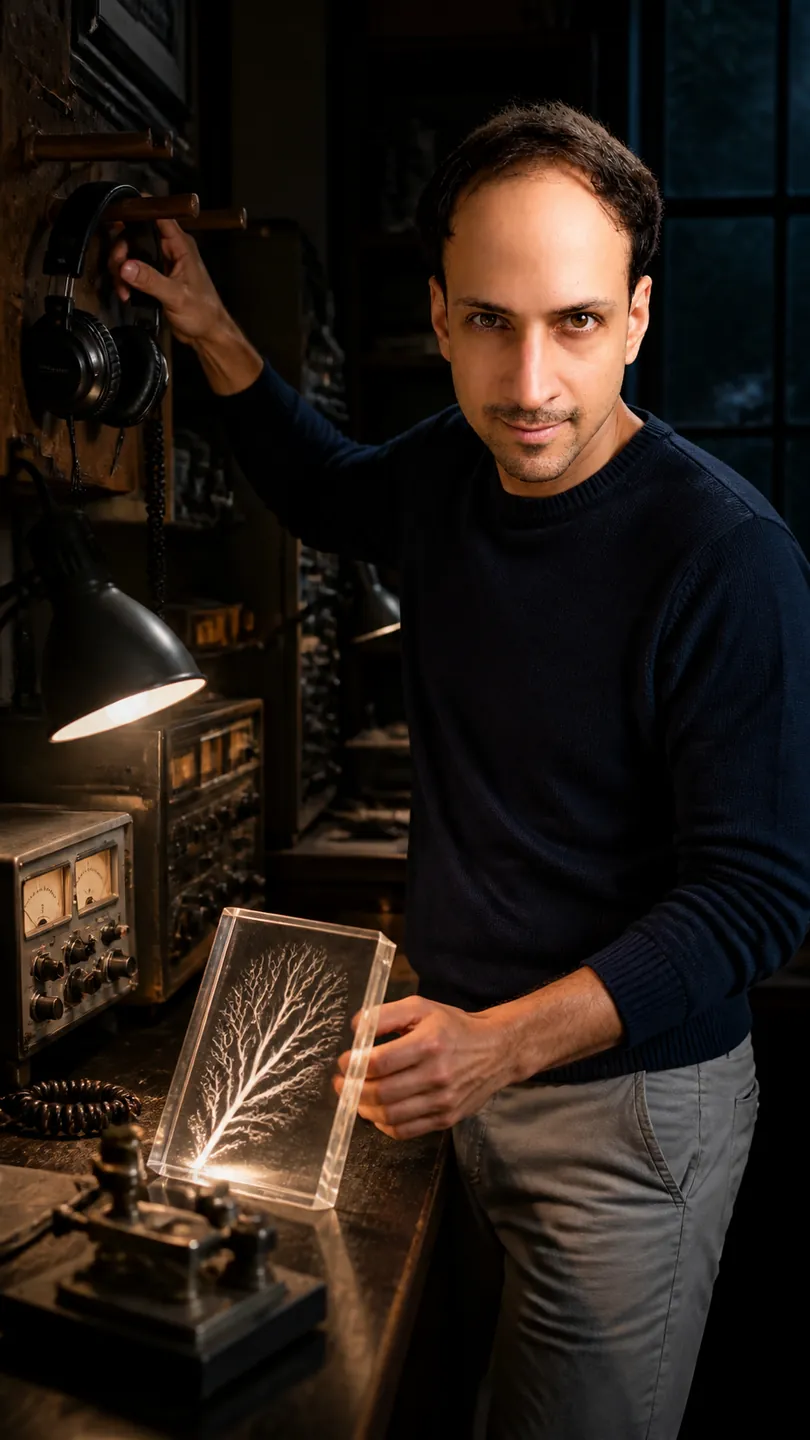
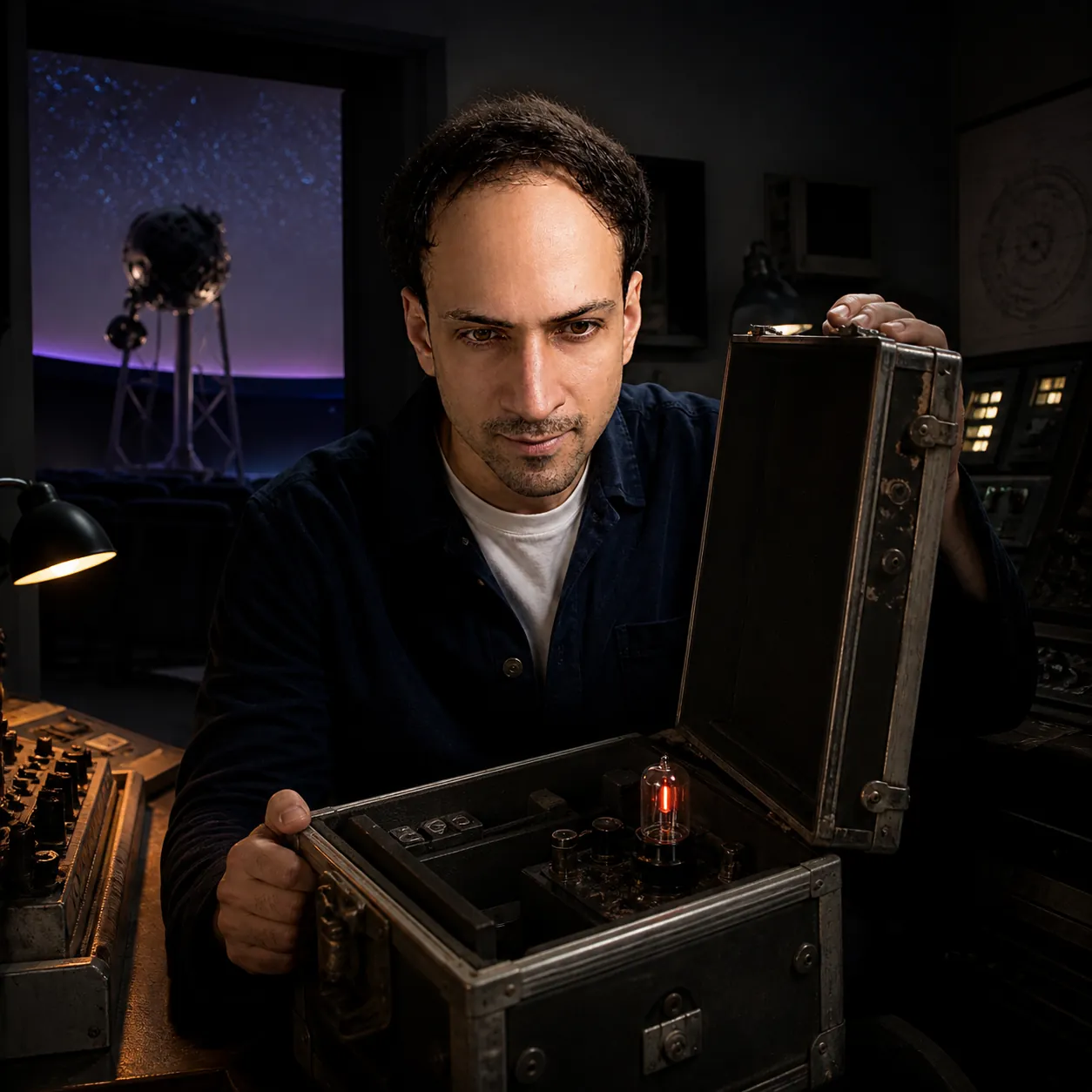
Lightning's Autograph: Tidy Amateur-Radio Room — AI Portrait Prompt
صورةAI Portraits

Turn your own photo into a photorealistic portrait in a tidy amateur-radio room at night, panel lamps glowing faintly. Keeps your face unchanged.

من نص البرومبت

Use the attached reference photo as the identity reference: keep the same face, skin tone, hair and features as the person in that photo, without beautifying, aging or altering them. Design a full-height 9:16 cinematic artwork that reads on a phone and rewards gallery-scale inspection at exactly 2144x3808 pixels. Location: a tidy amateur-radio room at night, panel lamps glowing faintly. Show the subject in a fine-gauge navy sweater and pressed pale-grey trousers, hanging a pair of headphones on a wooden peg. Build the artwork around this material rule: a clear acrylic block they tilt toward a lamp, holding a frozen white fern of fractures where a trapped charge once escaped lets the material answer the current in its own native dialect. Explore why the fastest events in nature can leave the most patient evidence; direct expression and posture toward unhurried scrutiny, never melodrama or ad-like confidence. Frame past the near edge of the apparatus, foreground detail physical and their expression fully readable. Make the composition run one bright line toward their eyes without ever arriving. Render it as gallery-caliber physics portraiture merging real electrical signatures, charcoal-dark tonal control, precise glass-and-char material rendering, and steady observational calm, using late blue window light mixed with one warm low-wattage source and a palette of soot black, aged bakelite brown, and dim neon amber. Photorealistic: this must read as a real photograph from a physical camera, never an illustration, painting, or 3D render. Give the air depth: falloff with distance and no artificial clarity far back. Resolve real surface detail: thread ends and slight pilling on worn cloth, hairline chips at every hard corner, and stone that is porous rather than smooth. Keep one identity-locked person, credible hands and fingers, natural fabric, and coherent scale, contact, reflections, shadows, airflow, deformation, and materials. Background people only when essential, always secondary and clearly different. Avoid sci-fi energy balls, fractal screen-saver overlays, sparks showering from hands, wizard-lightning fingertips, and ultraviolet glow gimmicks. No text, labels, logos, signatures, watermarks, random symbols, plastic skin, excessive bloom, or glossy AI finish.
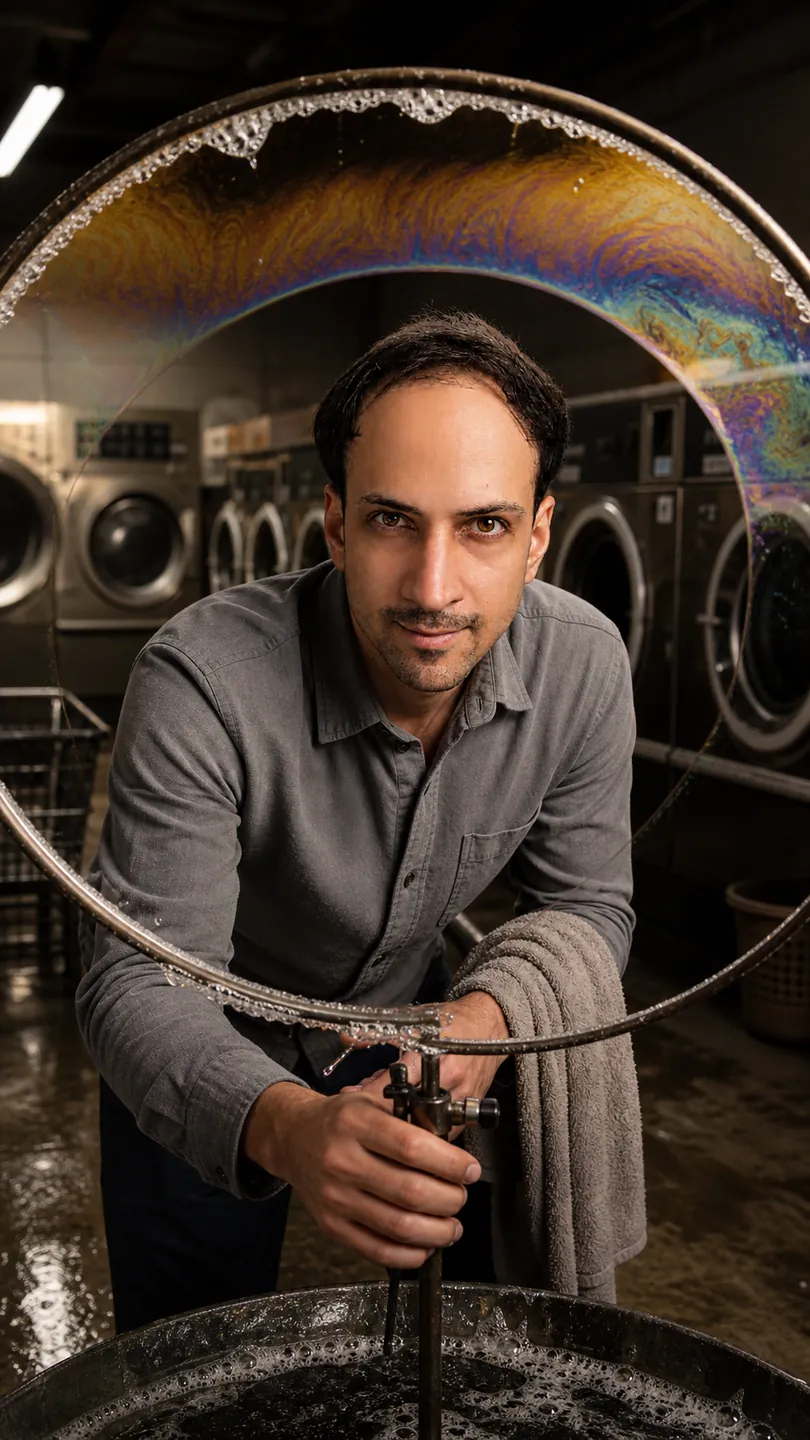
Lawful Color: Small Neighborhood Laundromat — AI Portrait Prompt
صورةAI Portraits

Turn your own photo into a large-format wet-lab portrait in a small neighborhood laundromat after closing, machines standing open. Keeps your face unchanged.

من نص البرومبت

Use the attached reference photo as the identity reference: keep the same face, skin tone, hair and features as the person in that photo, without beautifying, aging or altering them. Design a full-height 9:16 cinematic artwork that reads on a phone and rewards gallery-scale inspection at exactly 2144x3808 pixels. Location: a small neighborhood laundromat after closing, machines standing open. Show the subject in a soft grey overshirt with both cuffs buttoned at the wrist, draping a damp towel over one forearm. Make one rigorous physical condition the conceptual engine: a patch of common black film at a soap wall's top edge that has thinned until it reflects almost no light holds a rigorous result on a membrane a breath could erase. Explore how a liquid film outruns calculation while obeying it perfectly; direct expression and posture toward quiet astonishment, never melodrama or ad-like confidence. Use a 105mm near-macro portrait blend, one iridescent border sharp near the lens and their attentive face readable beyond. Make the composition keep one dark, quiet ground behind every iridescent passage. Render it as large-format wet-lab photography built from working soap-film apparatus, accurate reflection physics, restrained studio styling, and calm observational distance, using one broad diffused panel reflected in the film against a darkened room and a palette of warm concrete, soap-water grey, and a low gold shimmer. Photorealistic: this must read as a real photograph from a physical camera, never an illustration, painting, or 3D render. Give the space honest scale: real distance between foreground, subject, and far wall. Resolve real surface detail: condensation beading at true size, liquid meniscus curving against glass, and wet surfaces darker than dry ones. Keep one identity-locked person, credible hands and fingers, natural fabric, and coherent scale, contact, reflections, shadows, airflow, deformation, and materials. Background people only when essential, always secondary and clearly different. Avoid psychedelic color grading, floating foam confetti, glassy chrome bubbles, dish-soap advertising gloss, and impossible unbroken membranes. No text, labels, logos, signatures, watermarks, random symbols, plastic skin, excessive bloom, or glossy AI finish.
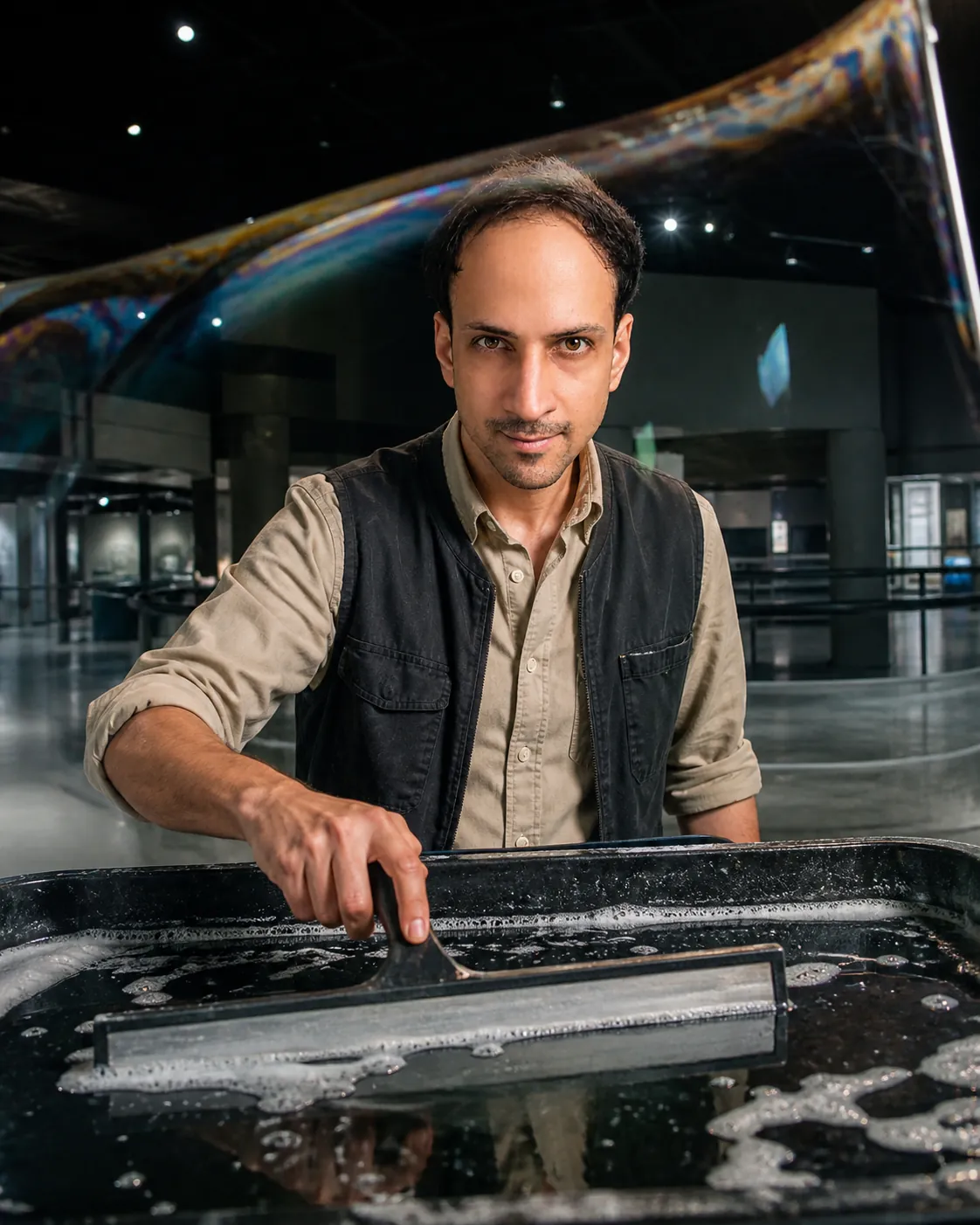
Lawful Color: Empty Demonstration Hall — AI Portrait Prompt
صورةAI Portraits

Turn your own photo into a gallery-hall demonstration portrait in the empty demonstration hall of a science center before opening. Keeps your face unchanged.

من نص البرومبت

Use the attached reference photo as the identity reference: keep the same face, skin tone, hair and features as the person in that photo, without beautifying, aging or altering them. Build a portrait 4:5 editorial artwork with protected negative space and a fully readable face at exactly 2560x3200 pixels. Location: the empty demonstration hall of a science center before opening. Show the subject in a pressed sand-beige shirt under a dark utility vest, skimming stray suds from a dip trough with a squeegee. Build the artwork around this material rule: a patch of common black film at a soap wall's top edge that has thinned until it reflects almost no light translates thickness the eye cannot see into order the eye can. Explore how a liquid film outruns calculation while obeying it perfectly; direct expression and posture toward patient reverence, never melodrama or ad-like confidence. Frame them partly through a soap membrane so the view and its faint colored reflection share one plane. Make the composition leave generous still air above the thinnest part of the surface. Render it as gallery-hall demonstration realism uniting true thin-film optics, believable soap chemistry, patient portrait photography, and quiet contemporary exhibit design, using cool morning ambience with one warm lamp held well away from the membrane and a palette of bone white, dark zinc, and one thin teal seam. Photorealistic: this must read as a real photograph from a physical camera, never an illustration, painting, or 3D render. Resolve real surface detail: cotton that hangs by its own weight, seams that pucker very slightly, and collars softened by washing. Keep one identity-locked person, credible hands and fingers, natural fabric, and coherent scale, contact, reflections, shadows, airflow, deformation, and materials. Background people only when essential, always secondary and clearly different. Avoid psychedelic color grading, floating foam confetti, glassy chrome bubbles, dish-soap advertising gloss, and impossible unbroken membranes. No text, labels, logos, signatures, watermarks, random symbols, plastic skin, excessive bloom, or glossy AI finish.
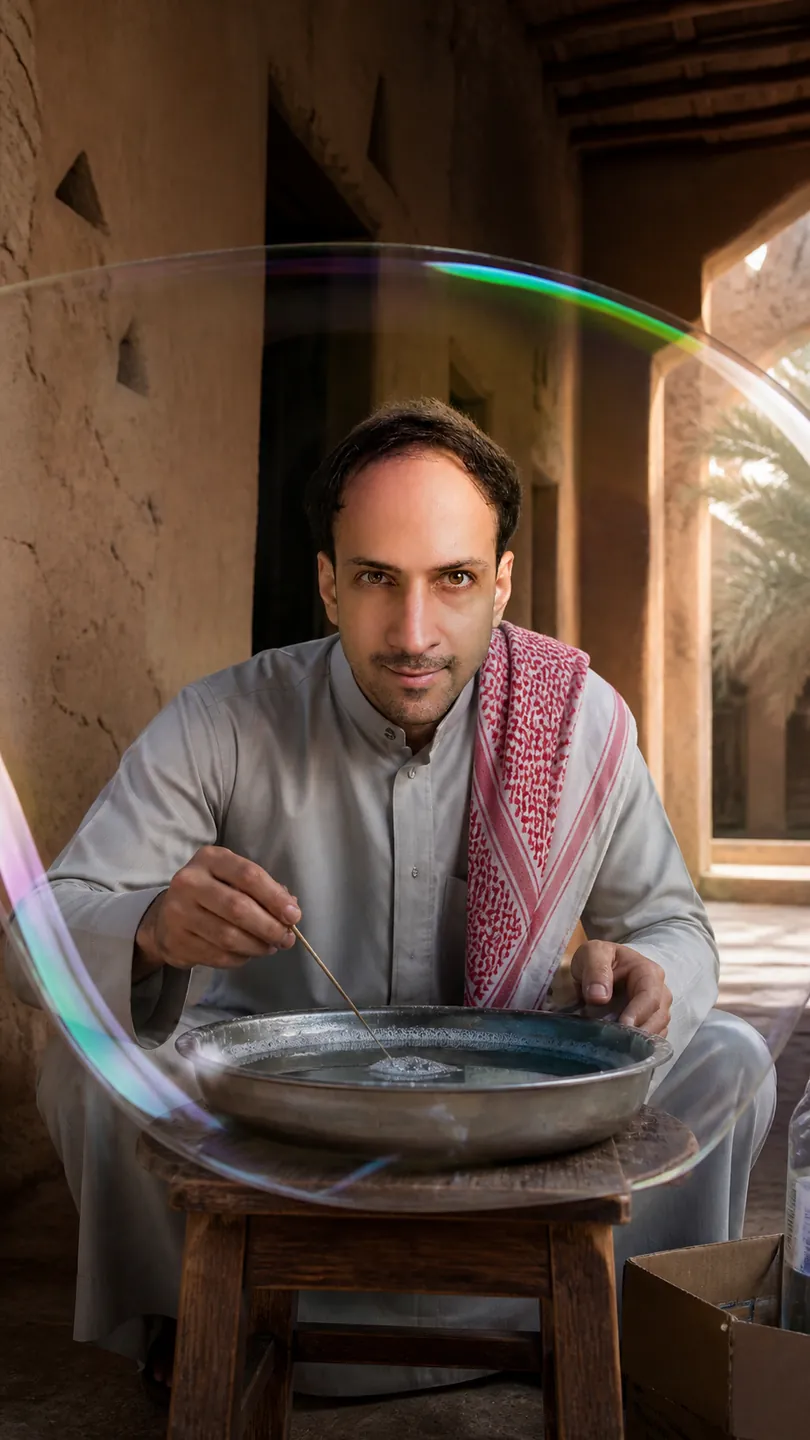
Lawful Color: Shaded Veranda — AI Portrait Prompt
صورةAI Portraits

Turn your own photo into a gallery-hall demonstration portrait in the shaded veranda of a Diriyah mud-brick house at midmorning. Keeps your face unchanged.

من نص البرومبت

Use the attached reference photo as the identity reference: keep the same face, skin tone, hair and features as the person in that photo, without beautifying, aging or altering them. Design a full-height 9:16 cinematic artwork that reads on a phone and rewards gallery-scale inspection at exactly 2144x3808 pixels. Location: the shaded veranda of a Diriyah mud-brick house at midmorning. Show the subject in a pale grey traditional Gulf outfit with a folded shemagh over one shoulder, centering a shallow basin on a low wooden stool. Treat this mechanism as the frame’s governing rule: a patch of common black film at a soap wall's top edge that has thinned until it reflects almost no light shows a surface obeying its boundary the way an answer obeys a question. Explore how a liquid film outruns calculation while obeying it perfectly; direct expression and posture toward hushed precision, never melodrama or ad-like confidence. Frame them partly through a soap membrane so the view and its faint colored reflection share one plane. Make the composition leave generous still air above the thinnest part of the surface. Render it as gallery-hall demonstration realism uniting true thin-film optics, believable soap chemistry, patient portrait photography, and quiet contemporary exhibit design, using low side daylight kept off the background so the colors read true and a palette of deep charcoal, unpolished tin, and one green interference stripe. Photorealistic: this must read as a real photograph from a physical camera, never an illustration, painting, or 3D render. Give the frame volume: faint density deepest in the room, contrast easing at the edges. Resolve real surface detail: label-free packaging showing carton fibre, cardboard bruised at the corners, and tape lifting slightly at one end. Keep one identity-locked person, credible hands and fingers, natural fabric, and coherent scale, contact, reflections, shadows, airflow, deformation, and materials. Background people only when essential, always secondary and clearly different. Avoid party-bubble clusters, rainbow oil-slick swirls, CGI-perfect spheres, sparkle overlays, and any child-with-wand whimsy. No text, labels, logos, signatures, watermarks, random symbols, plastic skin, excessive bloom, or glossy AI finish.
Lawful Glow: Control Alcove — AI Portrait Prompt
صورةAI Portraits

Turn your own photo into a photorealistic portrait in the control alcove of a small planetarium between shows. Keeps your face unchanged.

من نص البرومبت

Use the attached reference photo as the identity reference: keep the same face, skin tone, hair and features as the person in that photo, without beautifying, aging or altering them. Create a square 1:1 museum-catalog frame with a strong first read and a slower second read at exactly 2880x2880 pixels. Location: the control alcove of a small planetarium between shows. Show them in a midnight-blue overshirt buttoned once over a white tee, unlatching a flight case and lifting its lid upright. Treat this mechanism as the frame’s governing rule: a small sealed neon lamp in a bakelite holder whose orange glow clings to only one of its two electrodes brings a feared force close enough to study without any bravado. Explore where the boundary lies between an instrument's reading and a work of art; direct expression and posture toward settled astonishment, never melodrama or ad-like confidence. Frame past the near edge of the apparatus, foreground detail physical and their expression fully readable. Make the composition let the brightest point be the smallest thing in frame. Render it as evidence-grade scientific photography pairing honest discharge phenomena, calibrated near-darkness exposure, believable period instrumentation, and quiet, unhurried human-scale storytelling, using near-darkness held back by one small tungsten lamp at the bench and a palette of deep charcoal, gunmetal grey, and one violet whisper. Photorealistic: this must read as a real photograph from a physical camera, never an illustration, painting, or 3D render. Resolve real surface detail: floor finish worn along the walked line, skirting marked at shoe height, and corners darker than the open floor. Keep one identity-locked person, credible hands and fingers, natural fabric, and coherent scale, contact, reflections, shadows, airflow, deformation, and materials. Background people only when essential, always secondary and clearly different. Avoid sci-fi energy balls, fractal screen-saver overlays, sparks showering from hands, wizard-lightning fingertips, and ultraviolet glow gimmicks. No text, labels, logos, signatures, watermarks, random symbols, plastic skin, excessive bloom, or glossy AI finish.
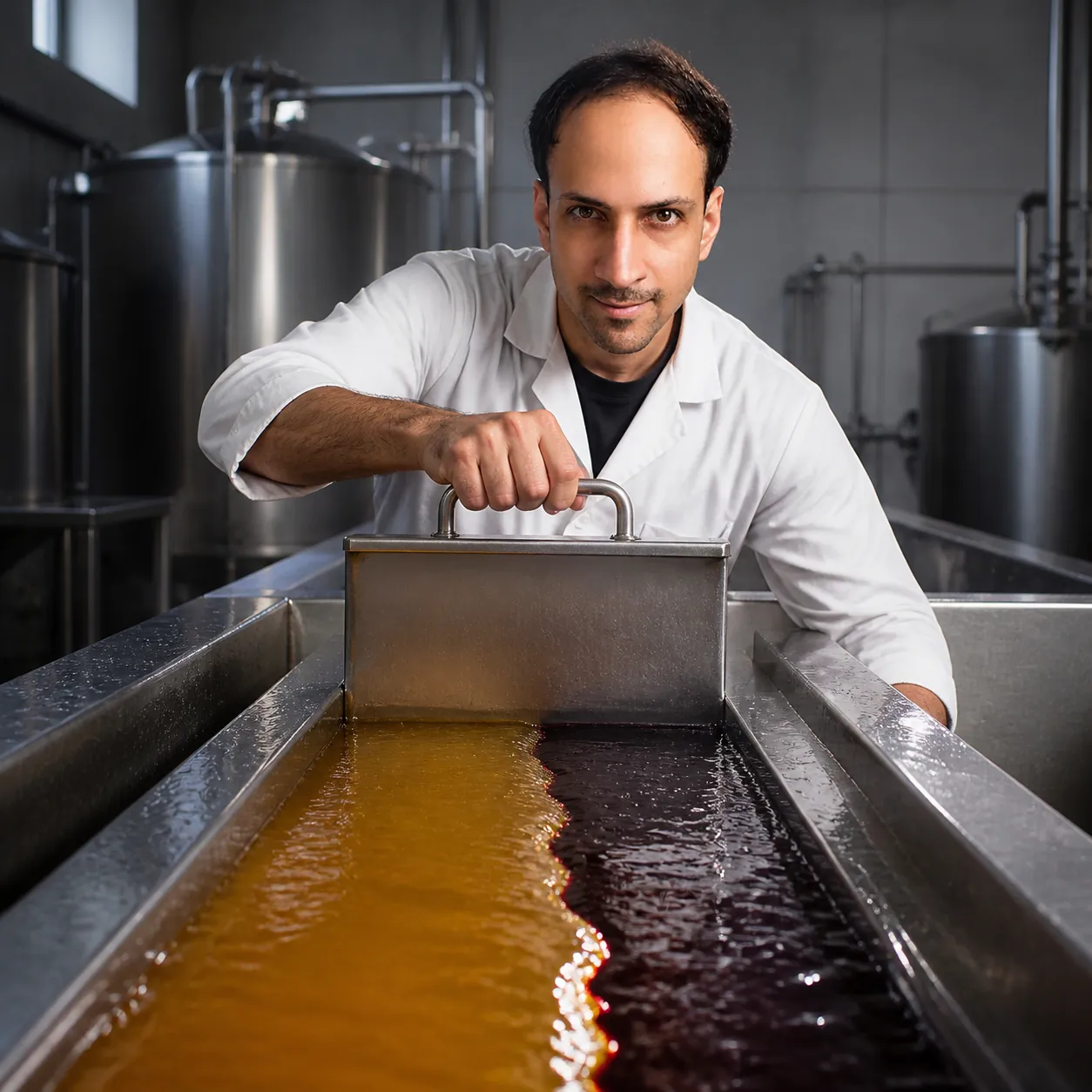
Motion Composed: Small Honey-House — AI Portrait Prompt
صورةAI Portraits

Turn your own photo into a quiet kinetic-art portrait in a small honey-house of steel settling tanks and scrubbed concrete. Keeps your face unchanged.

من نص البرومبت

Use the attached reference photo as the identity reference: keep the same face, skin tone, hair and features as the person in that photo, without beautifying, aging or altering them. Create a square 1:1 museum-catalog frame with a strong first read and a slower second read at exactly 2880x2880 pixels. Location: a small honey-house of steel settling tanks and scrubbed concrete. Show the subject in a white food-grade smock over rolled dark chinos, raising a small steel gate above a settling tank. The impossible-looking event must obey this clear system: a pair of dyed currents that share one clear channel in full contact while keeping a knife-sharp boundary between them puts continuous motion through a form that never once looks hurried. Explore whether calm is the absence of energy or its most complete control; direct expression and posture toward unhurried attention, never melodrama or ad-like confidence. Use a 90mm close-portrait hybrid: one smooth stream sharp near the lens and their face readable beyond it. Make the composition keep the flow's stillest passage sharpest and the room soft. Render it as quiet kinetic-art portraiture combining working flow sculpture, honest wet-surface materiality, calm controlled studio styling, and unforced human presence, using early blue ambient light with one narrow beam threading the water and a palette of brushed steel, water grey, and one amber gleam. Photorealistic: this must read as a real photograph from a physical camera, never an illustration, painting, or 3D render. Resolve real surface detail: skin that reddens slightly under pressure, nail beds with honest colour, and knuckle creases that fold rather than blur. Keep one identity-locked person, credible hands and fingers, natural fabric, and coherent scale, contact, reflections, shadows, airflow, deformation, and materials. Background people only when essential, always secondary and clearly different. Avoid stock waterfall mist, whirlpool vortices, ripple-covered surfaces, levitating water spheres, and dramatic slow-motion splash photography. No text, labels, logos, signatures, watermarks, random symbols, plastic skin, excessive bloom, or glossy AI finish.
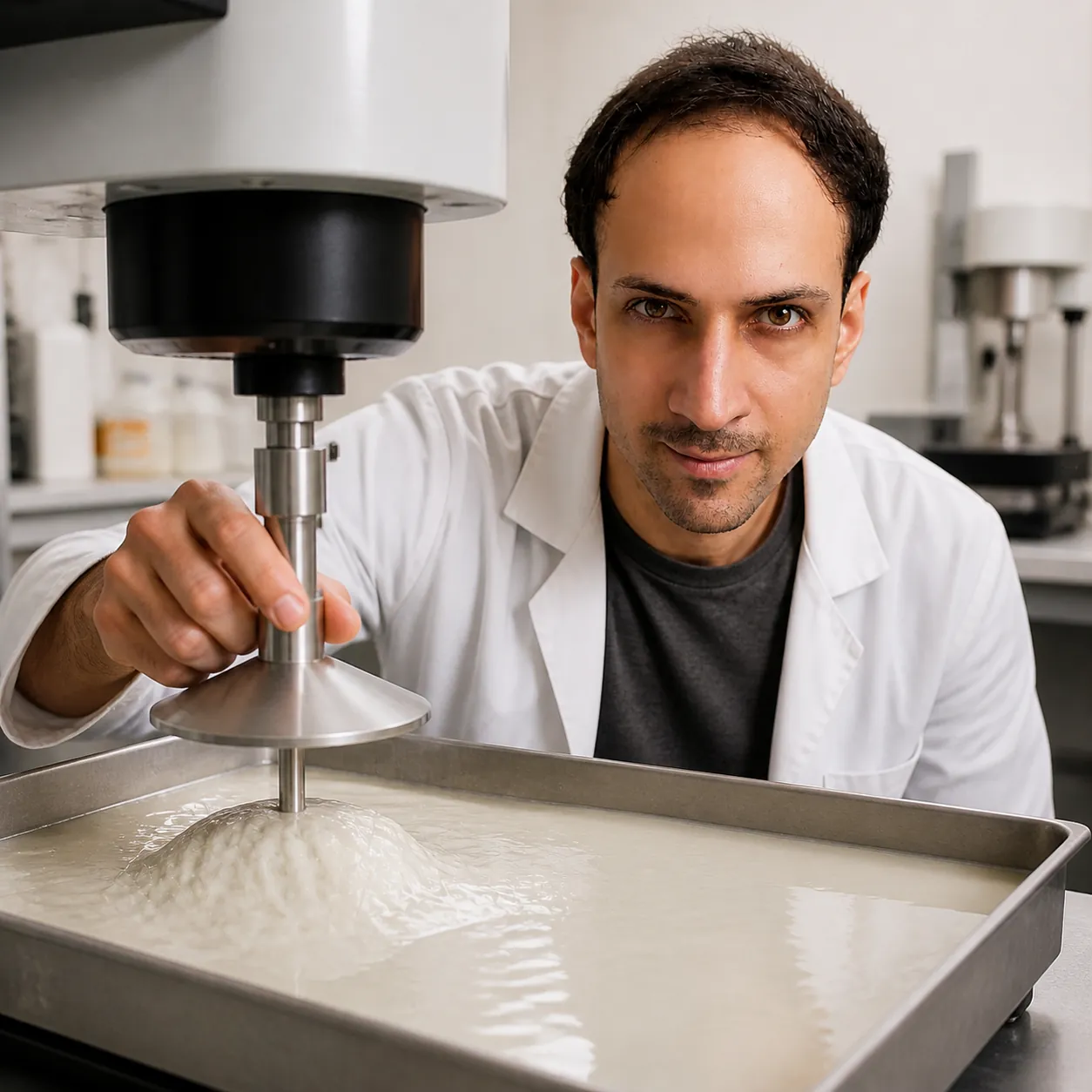
Cornstarch That Answers Back — AI Portrait Prompt
صورةAI Portraits

Turn your own photo into a portrait in a university rheology lab with a cone-and-plate instrument at rest. Keeps your face unchanged.

من نص البرومبت

Use the attached reference photo as the identity reference: keep the same face, skin tone, hair and features as the person in that photo, without beautifying, aging or altering them. Create a square 1:1 museum-catalog frame with a strong first read and a slower second read at exactly 2880x2880 pixels. Location: a university rheology lab with a cone-and-plate instrument at rest. Show the subject in a white lab coat open over a dark grey crew-neck, lowering the instrument's cone with two careful fingers. Make one rigorous physical condition the conceptual engine: a wide steel tray of dense cornstarch suspension that carries their struck knuckles like pavement yet swallows their resting hand answers the manner of a force rather than its size. Explore why a liquid is entitled to behave like stone when questioned rudely; direct expression and posture toward measured astonishment, never melodrama or ad-like confidence. Use an eye-level 80mm medium-format viewpoint with honest perspective and gentle depth of field. Make the composition give the substance's reply the same visual weight as their face. Render it as precise rheological portrait realism grounded in laboratory-true material response, calm documentary texture, instrument-grade staging, and quietly humane composition, using even skylit top light softened by white walls and honest shadow and a palette of chalk white, wet slate, and one seam of ochre. Photorealistic: this must read as a real photograph from a physical camera, never an illustration, painting, or 3D render. Resolve real surface detail: true skin texture with pores and fine hair at the hairline, and fabric that creases where it is actually stressed. Keep one identity-locked person, credible hands and fingers, natural fabric, and coherent scale, contact, reflections, shadows, airflow, deformation, and materials. Background people only when essential, always secondary and clearly different. Avoid rainbow slime aesthetics, splattered goo on skin, speaker-driven paint splashes, and ASMR dripping close-ups. No text, labels, logos, signatures, watermarks, random symbols, plastic skin, excessive bloom, or glossy AI finish.
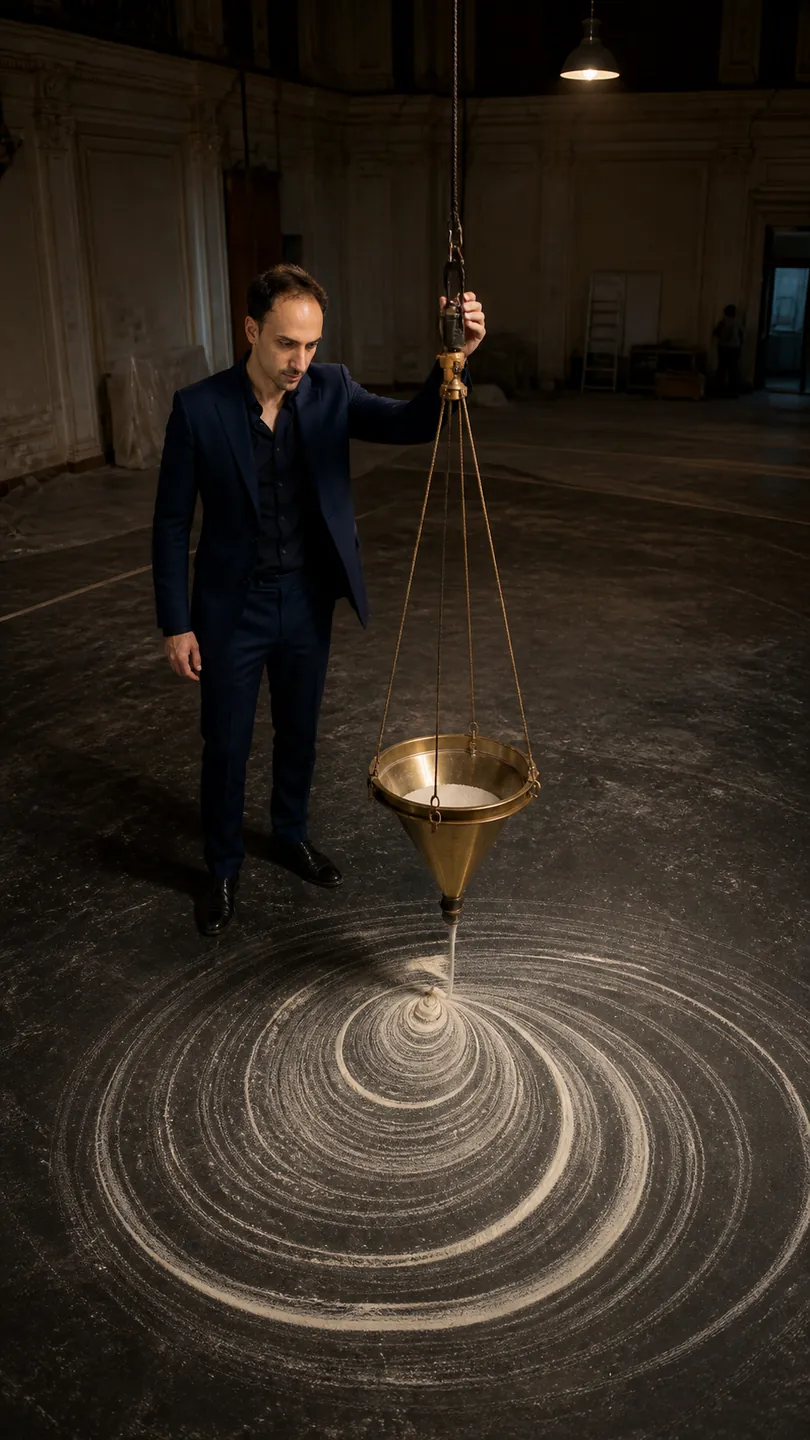
Sand Pendulum in the Ballroom Under Renovation — AI Portrait Prompt
صورةAI Portraits

Turn your own photo into a scientific-instrument portrait in a hotel ballroom mid-renovation, its chandelier lowered and gone. Keeps your face unchanged.

من نص البرومبت

Use the attached reference photo as the identity reference: keep the same face, skin tone, hair and features as the person in that photo, without beautifying, aging or altering them. Design a full-height 9:16 cinematic artwork that reads on a phone and rewards gallery-scale inspection at exactly 2144x3808 pixels. Location: a hotel ballroom mid-renovation, its chandelier lowered and gone. Show them in a midnight-blue suit worn without a tie, collar open, guiding the empty hoist hook to a dead stop. Treat this mechanism as the frame’s governing rule: a brass funnel of white sand that swings on long cords, pouring its own path onto a dark floor gives a universal law a pace calm enough to watch at work. Explore how much credit a person deserves for a drawing they only set in motion; direct expression and posture toward listening stillness, never melodrama or ad-like confidence. Use a raised three-quarter viewpoint so the whole record and their bowed attention share one frame. Make the composition align the stillest object with the fastest line. Render it as scientific-instrument realism combining believable weighted mechanisms, truthful decaying traces, hand-finished wood and brass, and patient observational portrait photography, using a single shaded bulb hung high, its cone stopping short of the walls and a palette of iron black, warm limewash, and a single indigo accent. Photorealistic: this must read as a real photograph from a physical camera, never an illustration, painting, or 3D render. Give the frame volume: faint density deepest in the room, contrast easing at the edges. Resolve real surface detail: label-free packaging showing carton fibre, cardboard bruised at the corners, and tape lifting slightly at one end. Keep one identity-locked person, credible hands and fingers, natural fabric, and coherent scale, contact, reflections, shadows, airflow, deformation, and materials. Background people only when essential, always secondary and clearly different. Avoid glowing neon spirograph swirls, levitating pens, CGI particle trails, sacred-geometry overlays, and face-smearing motion blur. No text, labels, logos, signatures, watermarks, random symbols, plastic skin, excessive bloom, or glossy AI finish.
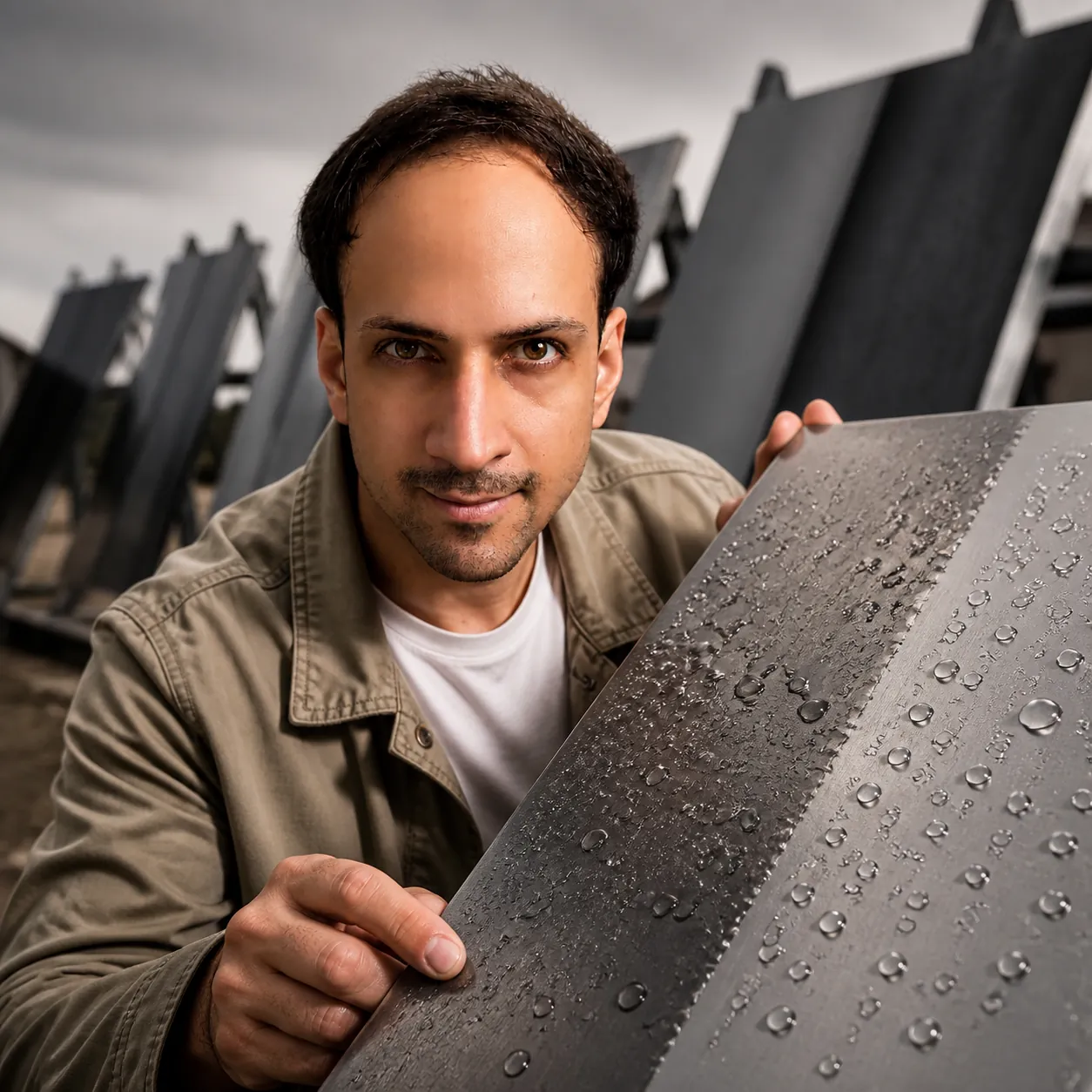
Half-Coated Plate in the Weathering Yard — AI Portrait Prompt
صورةAI Portraits

Turn your own photo into a portrait in an outdoor weathering yard with sample panels racked toward the sun. Keeps your face unchanged.

من نص البرومبت

Use the attached reference photo as the identity reference: keep the same face, skin tone, hair and features as the person in that photo, without beautifying, aging or altering them. Create a square 1:1 museum-catalog frame with a strong first read and a slower second read at exactly 2880x2880 pixels. Location: an outdoor weathering yard with sample panels racked toward the sun. Show the subject in a sand-washed field jacket over an unmarked white tee, angling one sample panel a few degrees steeper. The impossible-looking event must obey this clear system: a steel plate coated on one half only, where identical droplets sprawl flat or stand as spheres across one machined line proves that texture too small to see decides what water may touch. Explore whether a boundary kept perfectly is a wall or a kindness; direct expression and posture toward restrained delight, never melodrama or ad-like confidence. Use a 90mm macro-to-portrait hybrid: the water's nearest detail sharp by the lens, their face readable beyond it. Make the composition keep the room austere so the water is the only event. Render it as museum-grade demonstration realism combining faithful contact-angle physics, tactile fabric and metal surfaces, honest water optics, and unhurried portrait photography, using one low raking lamp that gives the water a single small specular point and a palette of silvered air, deep charcoal, and muted moss green. Photorealistic: this must read as a real photograph from a physical camera, never an illustration, painting, or 3D render. Resolve real surface detail: condensation beading at true size, liquid meniscus curving against glass, and wet surfaces darker than dry ones. Keep one identity-locked person, credible hands and fingers, natural fabric, and coherent scale, contact, reflections, shadows, airflow, deformation, and materials. Background people only when essential, always secondary and clearly different. Avoid cartoon dewdrop gloss, rainbow refraction overload, levitating water blobs, spiritual lotus kitsch, and hoses spraying dramatic mist. No text, labels, logos, signatures, watermarks, random symbols, plastic skin, excessive bloom, or glossy AI finish.
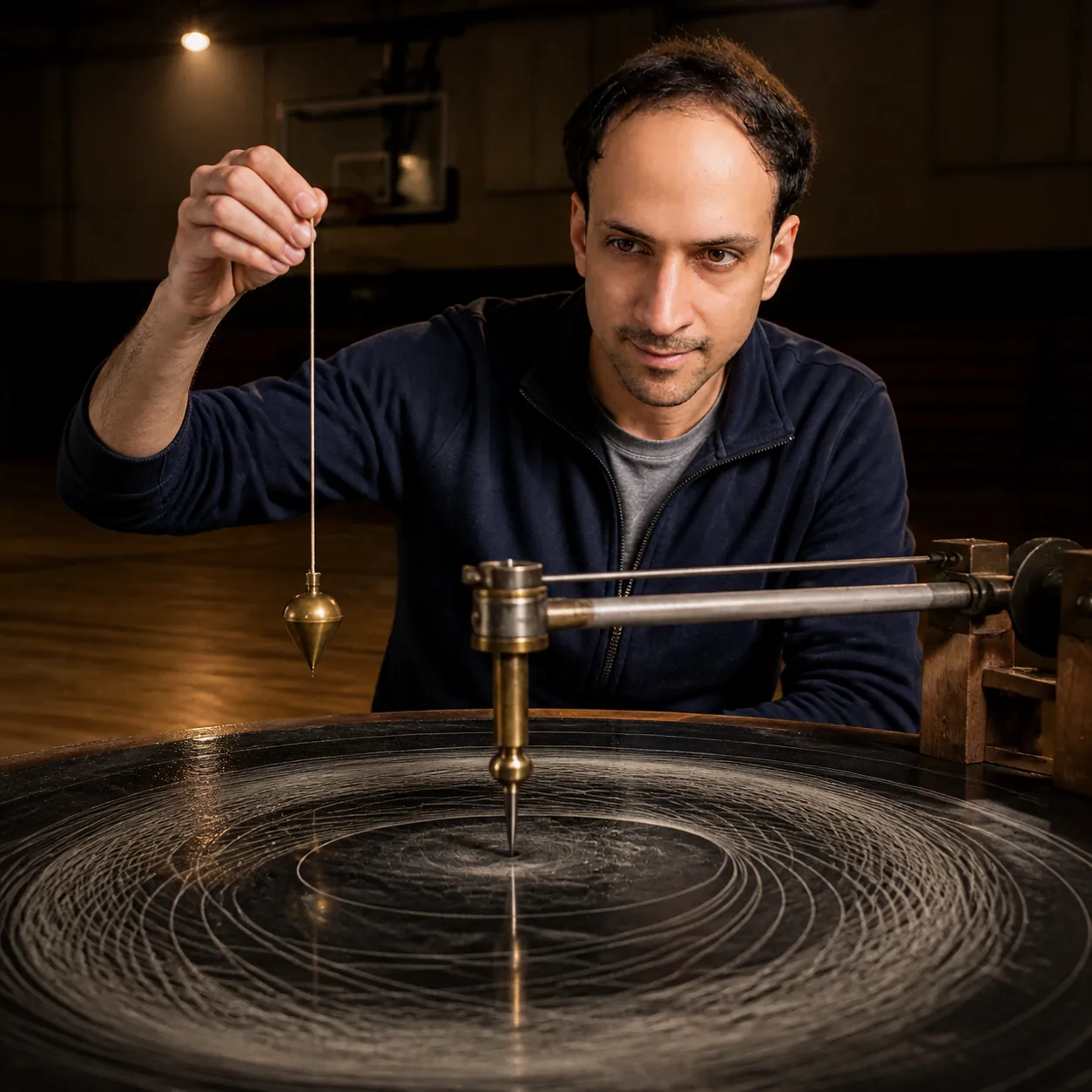
Stylus Through Lamp Soot — AI Portrait Prompt
صورةAI Portraits

Turn your own photo into a scientific-instrument portrait in a school gymnasium after hours, one court light left burning. Keeps your face unchanged.

من نص البرومبت

Use the attached reference photo as the identity reference: keep the same face, skin tone, hair and features as the person in that photo, without beautifying, aging or altering them. Create a square 1:1 museum-catalog frame with a strong first read and a slower second read at exactly 2880x2880 pixels. Location: a school gymnasium after hours, one court light left burning. Show the subject in a plain navy track jacket zipped over a grey tee, dropping a plumb line until the bob just clears the floor. Build the artwork around this material rule: a smoked-glass plate under a pendulum stylus that scribes bright clean lines through the even black lamp soot leaves authorship with gravity while the machine merely steadies the pen. Explore why watching a drawing finish itself feels like being trusted with a secret; direct expression and posture toward quiet astonishment, never melodrama or ad-like confidence. Use an 85mm portrait distance with the freshest line of the drawing sharp in the foreground. Make the composition grant the drawing more area than the person. Render it as scientific-instrument realism combining believable weighted mechanisms, truthful decaying traces, hand-finished wood and brass, and patient observational portrait photography, using dim ambient darkness held back by two small warm practicals and a palette of walnut brown, bone-dry plaster, and one glint of steel. Photorealistic: this must read as a real photograph from a physical camera, never an illustration, painting, or 3D render. Resolve real surface detail: dust settled where nobody wipes, fingerprint haze on glass, and edges rubbed pale by handling. Keep one identity-locked person, credible hands and fingers, natural fabric, and coherent scale, contact, reflections, shadows, airflow, deformation, and materials. Background people only when essential, always secondary and clearly different. Avoid hypnotist's watch iconography, perpetual-motion fantasy rigs, laser-perfect printed curves, cosmic nebula backdrops, and pendulums hung from nothing. No text, labels, logos, signatures, watermarks, random symbols, plastic skin, excessive bloom, or glossy AI finish.
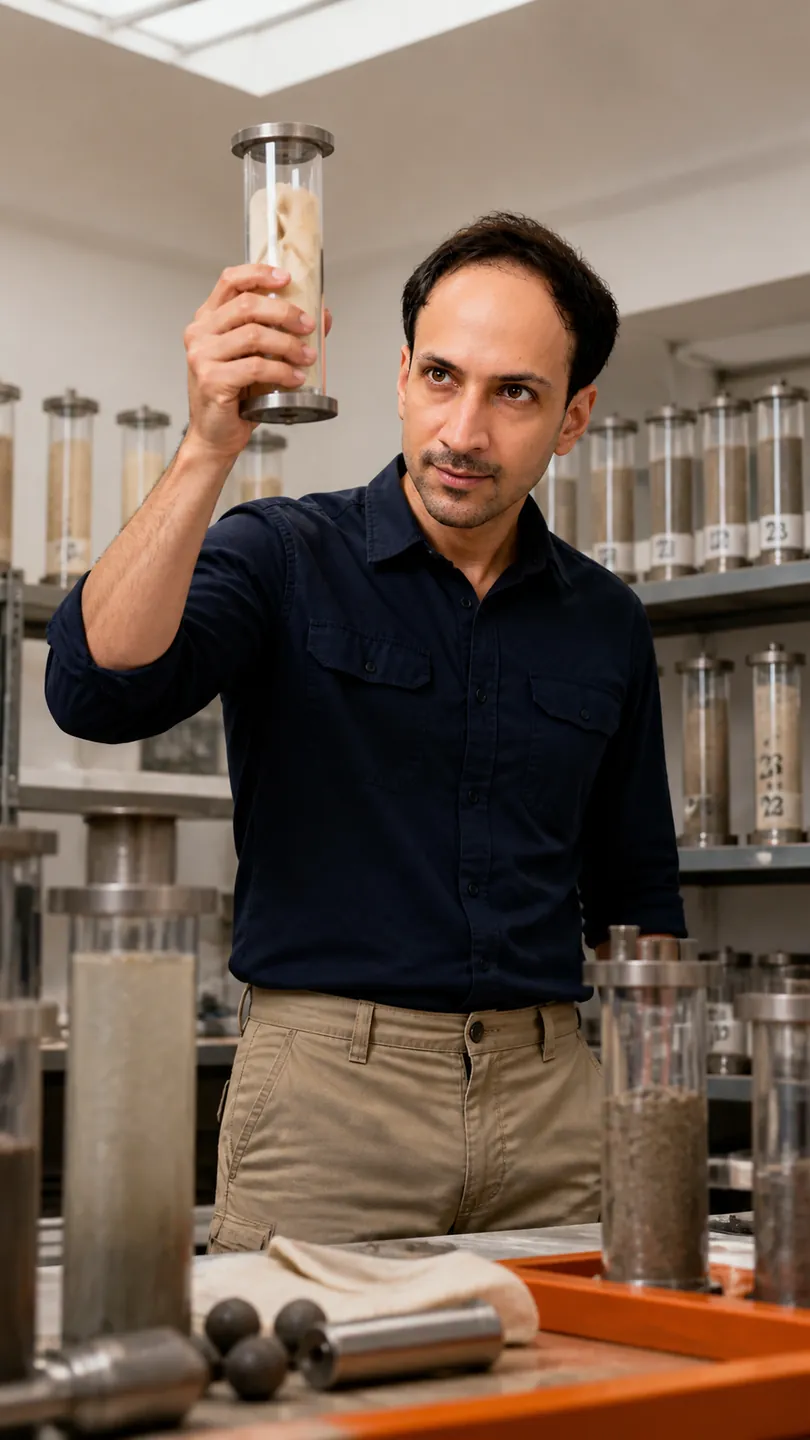
The Pad That Stops Steel — AI Portrait Prompt
صورةAI Portraits

Turn your own photo into a quiet kinetic still-life portrait in a drilling-fluids test room with numbered sample columns on shelves. Keeps your face unchanged.

من نص البرومبت

Use the attached reference photo as the identity reference: keep the same face, skin tone, hair and features as the person in that photo, without beautifying, aging or altering them. Design a full-height 9:16 cinematic artwork that reads on a phone and rewards gallery-scale inspection at exactly 2144x3808 pixels. Location: a drilling-fluids test room with numbered sample columns on shelves. Show the subject in pressed khaki field trousers and a navy technical shirt, holding one sample column up to the light. Make one rigorous physical condition the conceptual engine: a flexible white pad of engineered shear-thickening fluid that folds softly in their fingers yet stops a dropped steel slug outright turns viscosity from a fixed number into a reply with terms. Explore how the same handful of matter can honestly hold two opposite verdicts; direct expression and posture toward lucid patience, never melodrama or ad-like confidence. Frame past the apparatus at shoulder height, foreground glass and steel physical but never obscuring the face. Make the composition set one calm horizontal surface against their quiet vertical posture. Render it as quiet kinetic still-life portraiture built from genuine non-Newtonian samples, honest studio texture, believable hand-scale staging, and patient documentary framing, using even skylit top light softened by white walls and honest shadow and a palette of wet cement, ivory, and one line of safety orange. Photorealistic: this must read as a real photograph from a physical camera, never an illustration, painting, or 3D render. Give the space honest scale: real distance between foreground, subject, and far wall. Resolve real surface detail: condensation beading at true size, liquid meniscus curving against glass, and wet surfaces darker than dry ones. Keep one identity-locked person, credible hands and fingers, natural fabric, and coherent scale, contact, reflections, shadows, airflow, deformation, and materials. Background people only when essential, always secondary and clearly different. Avoid frozen splash crowns, CGI liquid-metal morphing, glowing sci-fi gels, food-fight mess on clothing, and impossible floating blobs. No text, labels, logos, signatures, watermarks, random symbols, plastic skin, excessive bloom, or glossy AI finish.
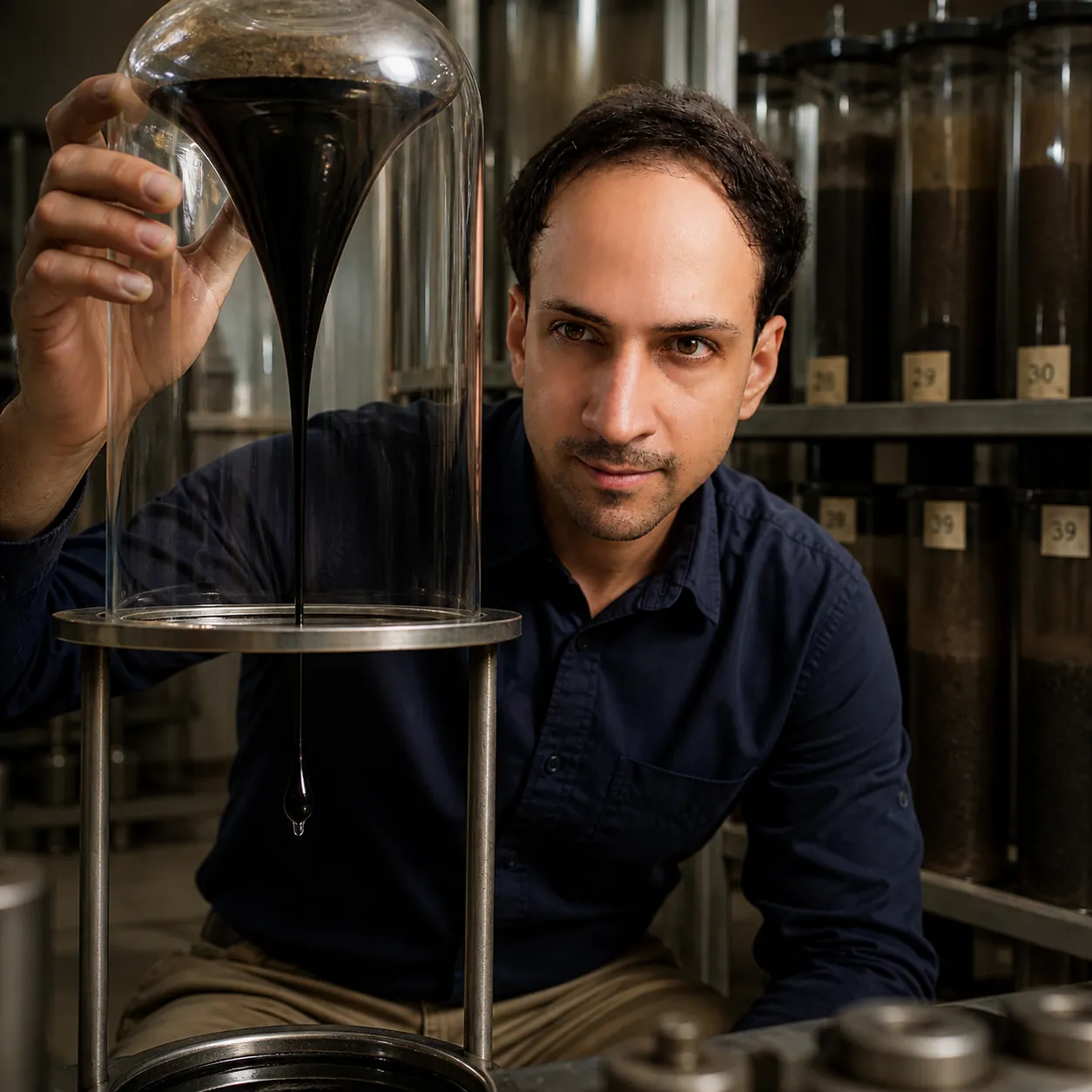
The Decade-Long Pitch Drop — AI Portrait Prompt
صورةAI Portraits

Turn your own photo into a portrait in a drilling-fluids test room with numbered sample columns on shelves. Keeps your face unchanged.

من نص البرومبت

Use the attached reference photo as the identity reference: keep the same face, skin tone, hair and features as the person in that photo, without beautifying, aging or altering them. Create a square 1:1 museum-catalog frame with a strong first read and a slower second read at exactly 2880x2880 pixels. Location: a drilling-fluids test room with numbered sample columns on shelves. Show the subject in pressed khaki field trousers and a navy technical shirt, holding one sample column up to the light. The impossible-looking event must obey this clear system: a bell-jarred funnel of black pitch whose single pendant drop has been lengthening for most of a decade holds a small lawful contradiction still enough to be studied. Explore what a material's refusal reveals about the question it was asked; direct expression and posture toward patient scrutiny, never melodrama or ad-like confidence. Use a 90mm close-working lens: the fluid's response sharp near the frame's base and their attentive face readable above it. Make the composition anchor the brightest highlight on the material, never on them. Render it as museum-grade demonstration realism combining faithful fluid behavior, tactile material surfaces, patient observational portrait photography, and physically accurate weight and reflection, using one low raking key across the fluid surface with soft neutral fill and a palette of mud brown, brushed steel, and muted glass green. Photorealistic: this must read as a real photograph from a physical camera, never an illustration, painting, or 3D render. Resolve real surface detail: condensation beading at true size, liquid meniscus curving against glass, and wet surfaces darker than dry ones. Keep one identity-locked person, credible hands and fingers, natural fabric, and coherent scale, contact, reflections, shadows, airflow, deformation, and materials. Background people only when essential, always secondary and clearly different. Avoid frozen splash crowns, CGI liquid-metal morphing, glowing sci-fi gels, food-fight mess on clothing, and impossible floating blobs. No text, labels, logos, signatures, watermarks, random symbols, plastic skin, excessive bloom, or glossy AI finish.
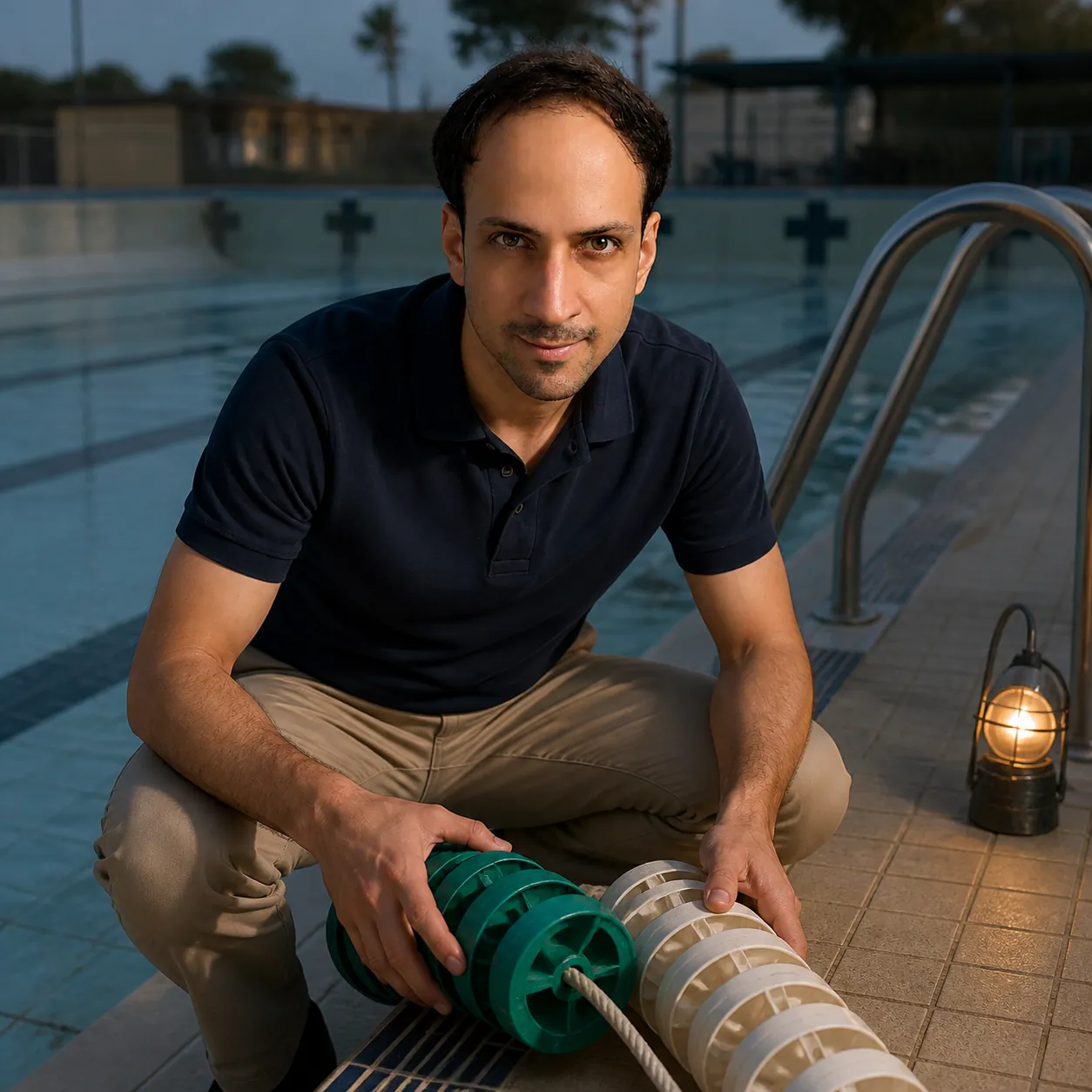
Goniometer Sphere by the Pool — AI Portrait Prompt
صورةAI Portraits

Turn your own photo into a museum-grade demonstration portrait in the tiled edge of a drained neighborhood pool at morning. Keeps your face unchanged.

من نص البرومبت

Use the attached reference photo as the identity reference: keep the same face, skin tone, hair and features as the person in that photo, without beautifying, aging or altering them. Create a square 1:1 museum-catalog frame with a strong first read and a slower second read at exactly 2880x2880 pixels. Location: the tiled edge of a drained neighborhood pool at morning. Show the subject in a navy polo shirt with pressed sand-colored trousers, stacking two lane-line floats beside the ladder. Make one rigorous physical condition the conceptual engine: a bench goniometer that projects one resting droplet's silhouette, a nearly complete sphere touching its coated slide at one point turns refusal into something the eye can verify at arm's length. Explore how much of touching is really permission granted at invisible scales; direct expression and posture toward quiet astonishment, never melodrama or ad-like confidence. Use an eye-level 85mm portrait view with natural perspective and quiet, honest depth of field. Make the composition align their eye line with the border between wet and dry. Render it as museum-grade demonstration realism combining faithful contact-angle physics, tactile fabric and metal surfaces, honest water optics, and unhurried portrait photography, using cool dawn ambience warmed by one shaded tungsten practical close at hand and a palette of matte graphite, unglazed clay, and a quiet viridian accent. Photorealistic: this must read as a real photograph from a physical camera, never an illustration, painting, or 3D render. Resolve real surface detail: fine grit in the texture of concrete, efflorescence at damp edges, and hairline cracks that follow stress. Keep one identity-locked person, credible hands and fingers, natural fabric, and coherent scale, contact, reflections, shadows, airflow, deformation, and materials. Background people only when essential, always secondary and clearly different. Avoid CGI chrome water, crown-splash stock shots, glowing droplets, force-field ripples, and glycerin beads faked on every surface. No text, labels, logos, signatures, watermarks, random symbols, plastic skin, excessive bloom, or glossy AI finish.
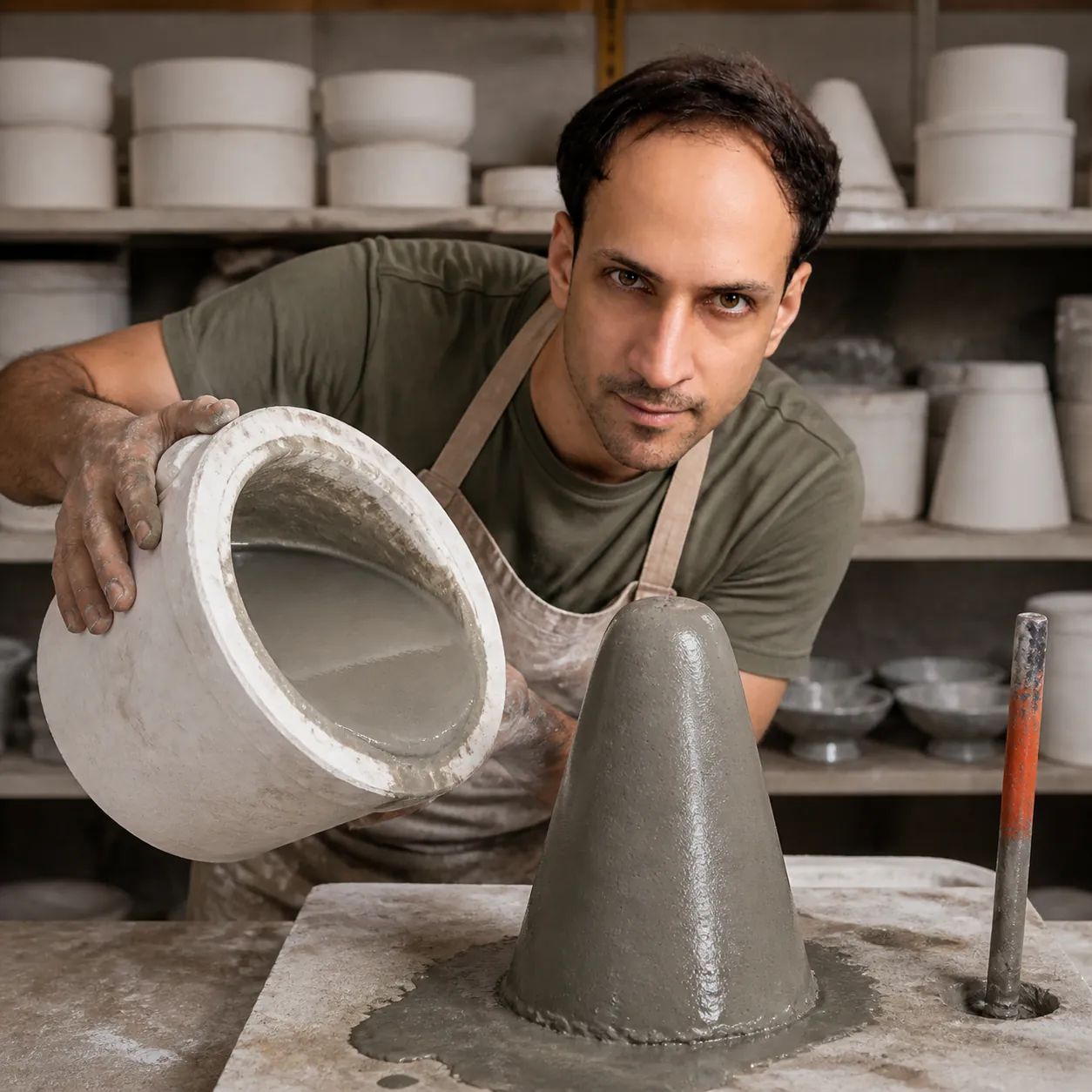
Concrete Cone at the Casting Bench — AI Portrait Prompt
صورةAI Portraits

Turn your own photo into a portrait in a ceramics slip-casting bench ringed with plaster molds drying white. Keeps your face unchanged.

من نص البرومبت

Use the attached reference photo as the identity reference: keep the same face, skin tone, hair and features as the person in that photo, without beautifying, aging or altering them. Create a square 1:1 museum-catalog frame with a strong first read and a slower second read at exactly 2880x2880 pixels. Location: a ceramics slip-casting bench ringed with plaster molds drying white. Show the subject in a clay-dusted canvas apron over a plain olive tee, tilting a filled mold to check the slip's level. Build the artwork around this material rule: a cone of fresh grey concrete that holds its molded shape on the board until a vibrating poker touches its base holds a small lawful contradiction still enough to be studied. Explore why more force can buy less motion when matter sets the terms; direct expression and posture toward earned respect, never melodrama or ad-like confidence. Frame from just above the work surface so the material's decision and their eyes sit in one plane of focus. Make the composition keep every contour of the fluid sharper than the room behind. Render it as museum-grade demonstration realism combining faithful fluid behavior, tactile material surfaces, patient observational portrait photography, and physically accurate weight and reflection, using diffused overhead panels dimmed low enough to keep every reflection readable and a palette of wet cement, ivory, and one line of safety orange. Photorealistic: this must read as a real photograph from a physical camera, never an illustration, painting, or 3D render. Resolve real surface detail: dust settled where nobody wipes, fingerprint haze on glass, and edges rubbed pale by handling. Keep one identity-locked person, credible hands and fingers, natural fabric, and coherent scale, contact, reflections, shadows, airflow, deformation, and materials. Background people only when essential, always secondary and clearly different. Avoid frozen splash crowns, CGI liquid-metal morphing, glowing sci-fi gels, food-fight mess on clothing, and impossible floating blobs. No text, labels, logos, signatures, watermarks, random symbols, plastic skin, excessive bloom, or glossy AI finish.
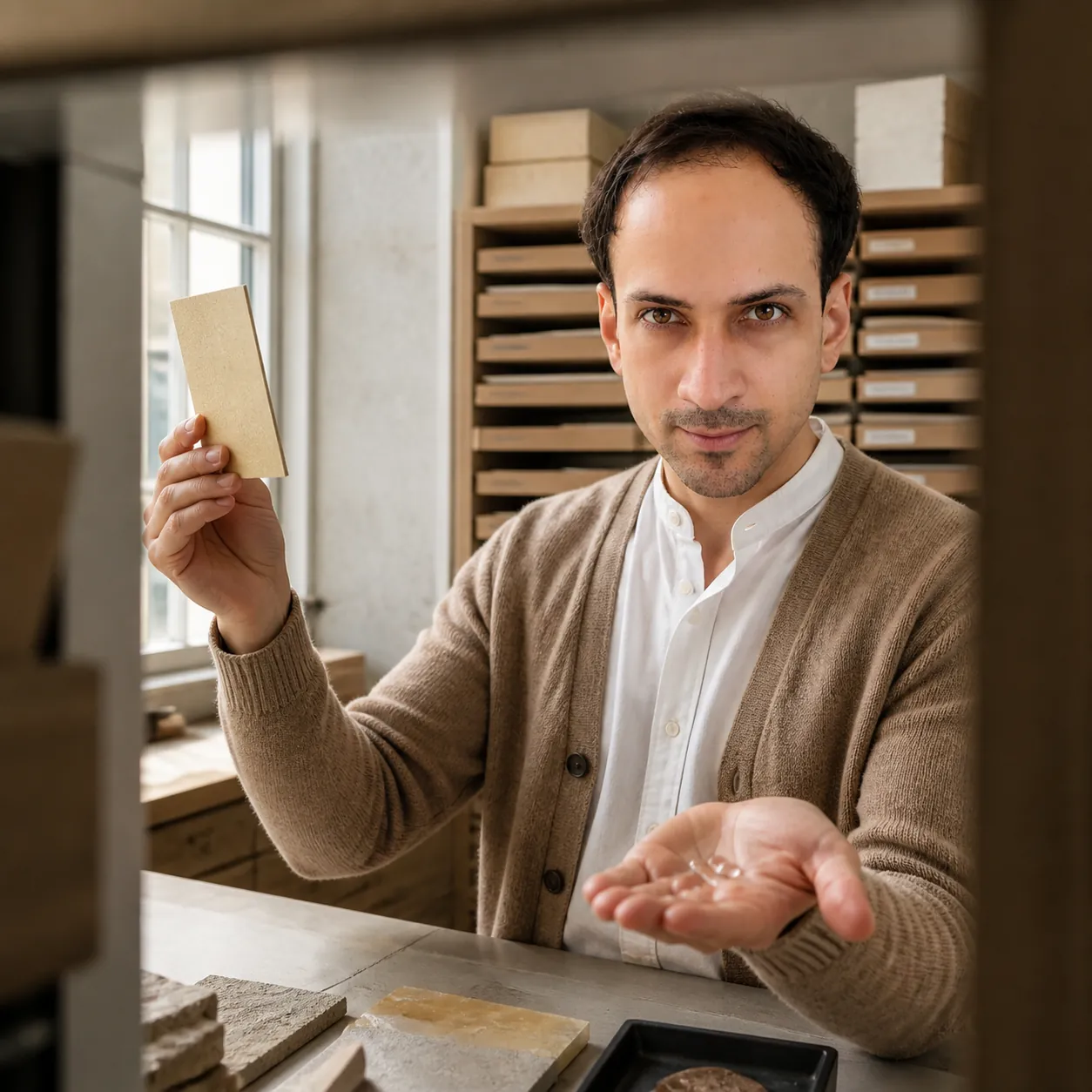
Liquid Marbles in the Materials Library — AI Portrait Prompt
صورةAI Portraits

Turn your own photo into a photorealistic portrait in a daylight materials library lined with labeled swatch drawers. Keeps your face unchanged.

من نص البرومبت

Use the attached reference photo as the identity reference: keep the same face, skin tone, hair and features as the person in that photo, without beautifying, aging or altering them. Create a square 1:1 museum-catalog frame with a strong first read and a slower second read at exactly 2880x2880 pixels. Location: a daylight materials library lined with labeled swatch drawers. Show the subject in a camel knit cardigan over a white band-collar shirt, matching one swatch card against the window light. Use this advanced image-making device as the core logic: a scatter of liquid marbles, water droplets whose jacket of fine hydrophobic powder lets them roll across their bare palm proves that texture too small to see decides what water may touch. Explore whether refusal, held long enough, becomes a form of care; direct expression and posture toward studied stillness, never melodrama or ad-like confidence. Frame through a real doorway or shelf edge, foreground soft, the person and the water both sharp. Make the composition hold generous negative space above the water's smallest detail. Render it as conceptual materials-lab portraiture pairing believable coatings, true droplet behavior, restrained contemporary art direction, and warm human documentary presence, using soft overcast skylight with shadows opened by one matte white bounce and a palette of pale cement, warm oat, and one measure of saffron. Photorealistic: this must read as a real photograph from a physical camera, never an illustration, painting, or 3D render. Resolve real surface detail: rubber gone chalky with age, painted metal chipped to primer, and plastic yellowed only where light reaches it. Keep one identity-locked person, credible hands and fingers, natural fabric, and coherent scale, contact, reflections, shadows, airflow, deformation, and materials. Background people only when essential, always secondary and clearly different. Avoid cartoon dewdrop gloss, rainbow refraction overload, levitating water blobs, spiritual lotus kitsch, and hoses spraying dramatic mist. No text, labels, logos, signatures, watermarks, random symbols, plastic skin, excessive bloom, or glossy AI finish.
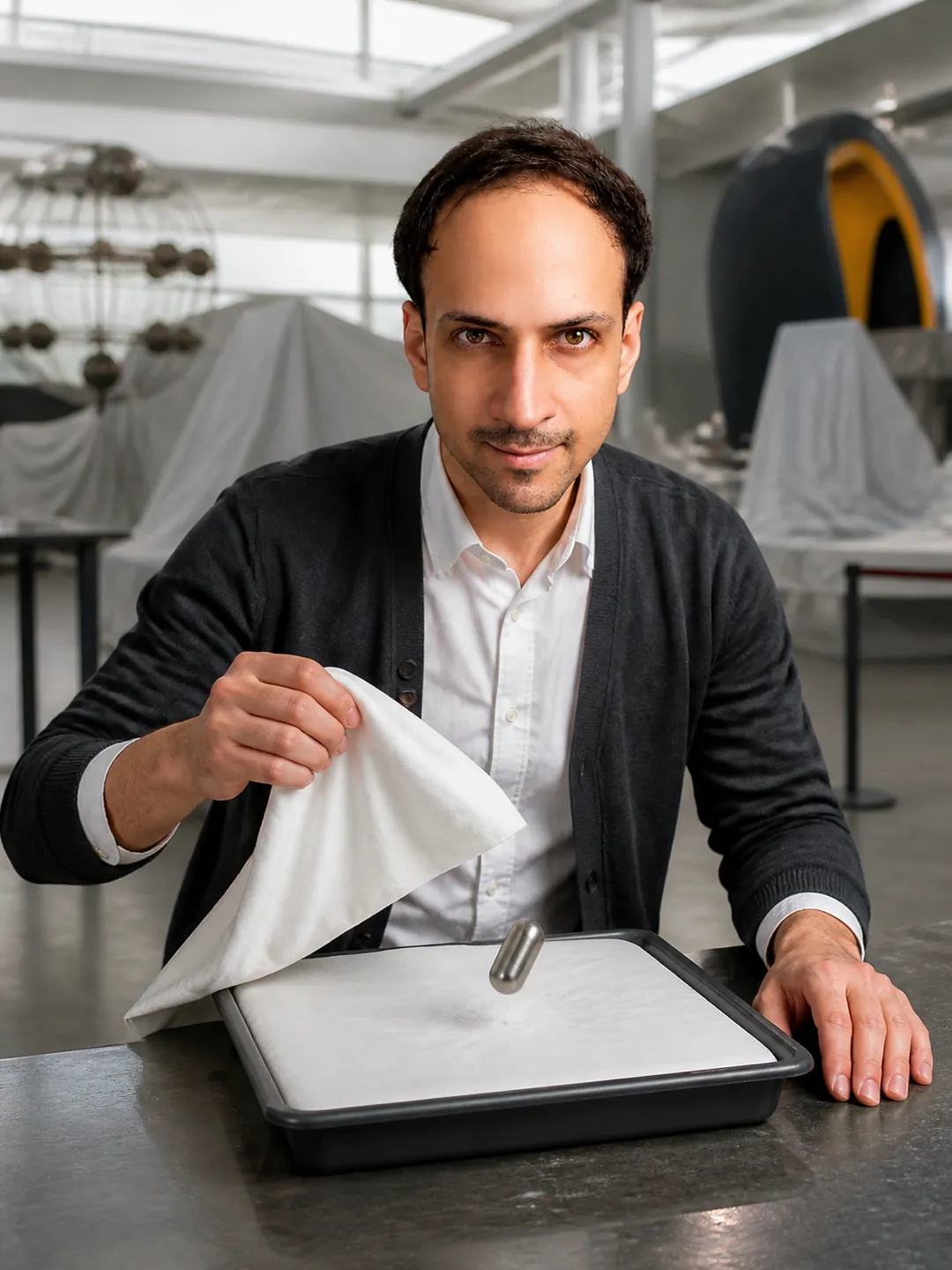
Two Verdicts in the Science Hall — AI Portrait Prompt
صورةAI Portraits

Turn your own photo into a portrait in a science-center demonstration hall before opening, its exhibits still sheeted. Keeps your face unchanged.

من نص البرومبت

Use the attached reference photo as the identity reference: keep the same face, skin tone, hair and features as the person in that photo, without beautifying, aging or altering them. Use a formal 3:4 environmental portrait with complete hands and meaningful objects inside frame at exactly 2480x3312 pixels. Location: a science-center demonstration hall before opening, its exhibits still sheeted. Show the subject in a slate cardigan over a pressed white shirt, folding one dust sheet back over their forearm. The impossible-looking event must obey this clear system: a flexible white pad of engineered shear-thickening fluid that folds softly in their fingers yet stops a dropped steel slug outright reads like disobedience until the underlying rule is finally seen. Explore how the same handful of matter can honestly hold two opposite verdicts; direct expression and posture toward steady curiosity, never melodrama or ad-like confidence. Use a restrained 35mm view from bench height, their hands and the demonstration sharing honest scale. Make the composition leave generous still space where motion is expected and absent. Render it as precise rheological portrait realism grounded in laboratory-true material response, calm documentary texture, instrument-grade staging, and quietly humane composition, using even skylit top light softened by white walls and honest shadow and a palette of chalk white, wet slate, and one seam of ochre. Photorealistic: this must read as a real photograph from a physical camera, never an illustration, painting, or 3D render. Resolve real surface detail: hair with individual strands catching light, short hairs of uneven length, and skin oil giving a low uneven sheen. Keep one identity-locked person, credible hands and fingers, natural fabric, and coherent scale, contact, reflections, shadows, airflow, deformation, and materials. Background people only when essential, always secondary and clearly different. Avoid frozen splash crowns, CGI liquid-metal morphing, glowing sci-fi gels, food-fight mess on clothing, and impossible floating blobs. No text, labels, logos, signatures, watermarks, random symbols, plastic skin, excessive bloom, or glossy AI finish.