تخطَّ إلى المحتوى
f

faisal aziz

@alkhunizan

3000البرومبتات
0تصويتات مستلمة
0مساهمات
تاريخ الانضمام منذ 4 أشهر
3000 مساهمات في العام الماضي
نوفمبر
ديسمبر
يناير
فبراير
مارس
أبريل
مايو
يونيو
يوليو
أغسطس
سبتمبر
أكتوبر
ن
ر
ج
أقل
أكثر
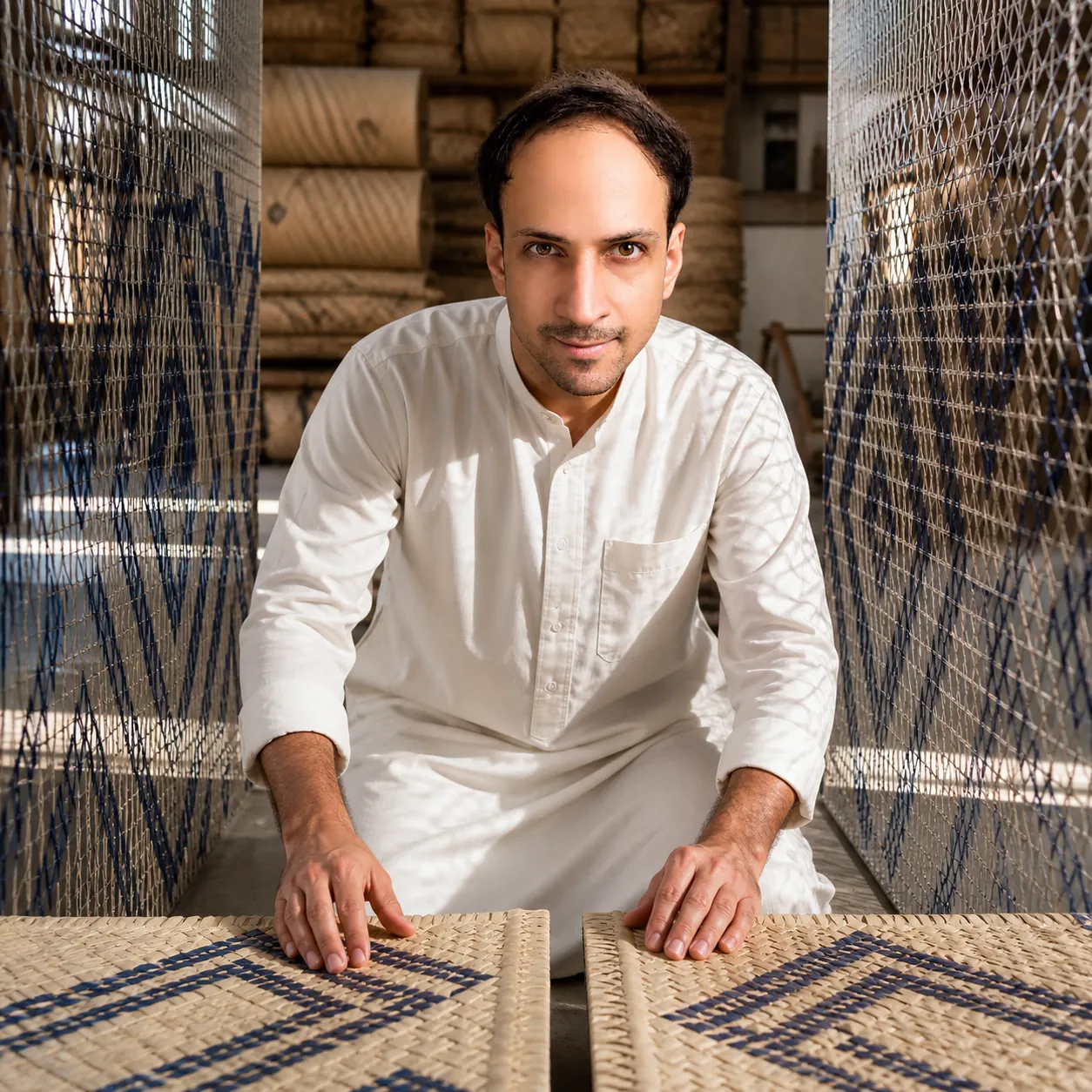
Woven Interference: Craft Cooperative Hall — AI Portrait Prompt
صورةAI Portraits

Turn your own photo into a quietly rigorous studio portrait in a craft cooperative hall stacked with woven palm-frond mats. Keeps your face unchanged.

من نص البرومبت

Use the attached reference photo as the identity reference: keep the same face, skin tone, hair and features as the person in that photo, without beautifying, aging or altering them. Treat that reference as the character anchor and change only the scene. Create a square 1:1 museum-catalog frame with a strong first read and a slower second read at exactly 2880x2880 pixels. Location: a craft cooperative hall stacked with woven palm-frond mats. Show the subject in an ivory cotton traditional Gulf outfit with both sleeves turned back once, matching two mat edges until their weaves sit square. The impossible-looking event must obey this clear system: a corridor of two woven wire fences one stride apart, through which giant slow bands roll at any shift of viewpoint summons a third pattern that belongs to neither layer alone. Explore whether motion the eye reports but the world denies still counts as real; direct expression and posture toward attentive calm, never melodrama or ad-like confidence. Use a 50mm standpoint set exactly where the bands read strongest, with their face just off that axis. Make the composition keep both source patterns readable at the edges as quiet evidence. Render it as quietly rigorous studio realism uniting layered handcrafted screens, physically exact interference behavior, restrained heritage styling, and dignified observational portraiture, using low raking sun that lets every layered shadow keep its true edge and a palette of washed white, cool steel mesh, and one indigo band. Photorealistic: this must read as a real photograph from a physical camera, never an illustration, painting, or 3D render. Resolve real surface detail: glass with real thickness at its edge, reflections that carry the room's actual colour, and dust visible only at grazing angles. Keep one identity-locked person, credible hands and fingers, natural fabric, and coherent scale, contact, reflections, shadows, airflow, deformation, and materials. Background people only when essential, always secondary and clearly different. Avoid op-art poster graphics, hypnotic spiral overlays, digital glitch scanlines, television static, and patterns projected across their face. No text, labels, logos, signatures, watermarks, random symbols, plastic skin, excessive bloom, or glossy AI finish.
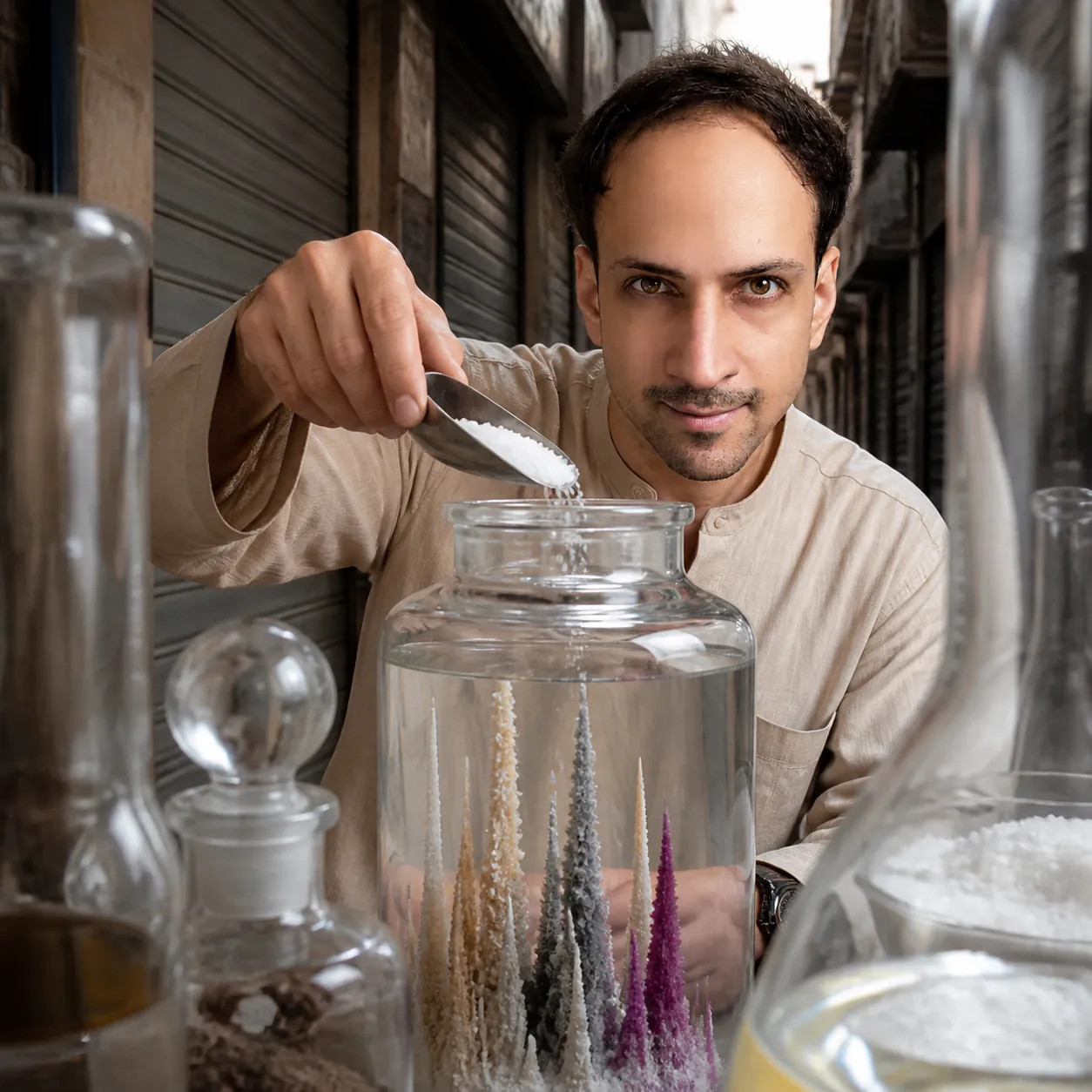
What Brine Knew: Salt Merchant's Stall — AI Portrait Prompt
صورةAI Portraits

Turn your own photo into a conceptual bench-science portrait in a salt merchant's stall in a shuttered souq lane, still cool. Keeps your face unchanged.

من نص البرومبت

Use the attached reference photo as the identity reference: keep the same face, skin tone, hair and features as the person in that photo, without beautifying, aging or altering them. Treat that reference as the character anchor and change only the scene. Create a square 1:1 museum-catalog frame with a strong first read and a slower second read at exactly 2880x2880 pixels. Location: a salt merchant's stall in a shuttered souq lane, still cool. Show the subject in a pale oat cotton traditional Gulf outfit with a dark wristwatch showing, cupping a scoop of coarse salt and tipping it back. Use this advanced image-making device as the core logic: a tall jar of sodium silicate in which dropped metal salts have raised slender mineral towers, each color naming its salt produces confident geometry in a place where nobody asked for any. Explore what a finished form can testify about the liquid that built it; direct expression and posture toward collected wonder, never melodrama or ad-like confidence. Frame through the nearest glassware so refraction bends the background while their face stays direct and sharp. Make the composition let ordinary glassware frame the geometry like museum casework. Render it as conceptual bench-science photography combining believable grown geometry, honest hand-and-glass interaction, precise material response, and quiet contemporary gallery restraint, using soft overcast daylight through high windows with shadows kept open and legible and a palette of putty, brushed steel, and one violet chrome-alum note. Photorealistic: this must read as a real photograph from a physical camera, never an illustration, painting, or 3D render. Resolve real surface detail: rubber gone chalky with age, painted metal chipped to primer, and plastic yellowed only where light reaches it. Keep one identity-locked person, credible hands and fingers, natural fabric, and coherent scale, contact, reflections, shadows, airflow, deformation, and materials. Background people only when essential, always secondary and clearly different. Avoid wizard-laboratory props, neon translucent minerals, floating crystal shards, motion-smeared growth trails, and jewelry-advert sparkle. No text, labels, logos, signatures, watermarks, random symbols, plastic skin, excessive bloom, or glossy AI finish.
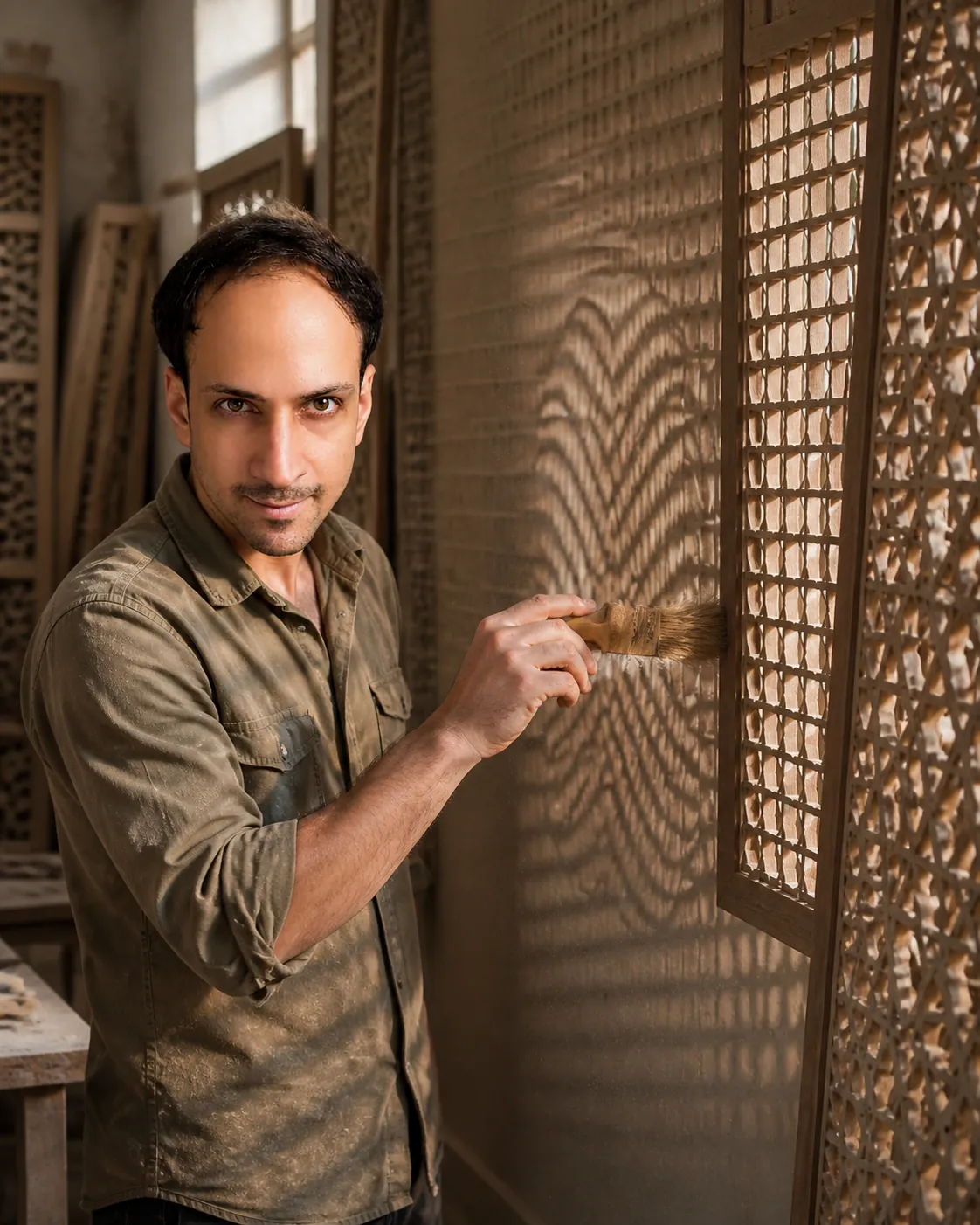
Standing Motion: Lattice Joinery Shop — AI Portrait Prompt
صورةAI Portraits

Turn your own photo into a portrait in a lattice joinery shop where carved cedar panels lean in ordered rows. Keeps your face unchanged.

من نص البرومبت

Use the attached reference photo as the identity reference: keep the same face, skin tone, hair and features as the person in that photo, without beautifying, aging or altering them. Treat that reference as the character anchor and change only the scene. Build a portrait 4:5 editorial artwork with protected negative space and a fully readable face at exactly 2560x3200 pixels. Location: a lattice joinery shop where carved cedar panels lean in ordered rows. Show them in a dust-flecked khaki work shirt with sleeves rolled twice, brushing sawdust from one carved opening with a soft brush. The impossible-looking event must obey this clear system: a pair of carved mashrabiya screens hung a hand span apart, whose overlapped shadows gather into broad bands drifting with the sun magnifies a difference too small to see into bands the eye cannot miss. Explore why two still patterns can conjure a third that plainly moves; direct expression and posture toward patient scrutiny, never melodrama or ad-like confidence. Use a restrained 35mm view with verticals kept true, the person at one-third and the patterned field beyond. Make the composition give the emergent pattern more visual weight than either honest layer. Render it as museum-grade optical demonstration realism combining true moiré geometry, tactile weave detail, faithful shadow behavior, and calm editorial framing, using one broad diffused window source held oblique so fine patterns stay resolvable and a palette of pale plaster, carbon grey, and a muted date-brown. Photorealistic: this must read as a real photograph from a physical camera, never an illustration, painting, or 3D render. Resolve real surface detail: dust settled where nobody wipes, fingerprint haze on glass, and edges rubbed pale by handling. Keep one identity-locked person, credible hands and fingers, natural fabric, and coherent scale, contact, reflections, shadows, airflow, deformation, and materials. Background people only when essential, always secondary and clearly different. Avoid kaleidoscope symmetry, fake motion blur, rainbow chromatic fringing, and funhouse distortion of their features. No text, labels, logos, signatures, watermarks, random symbols, plastic skin, excessive bloom, or glossy AI finish.
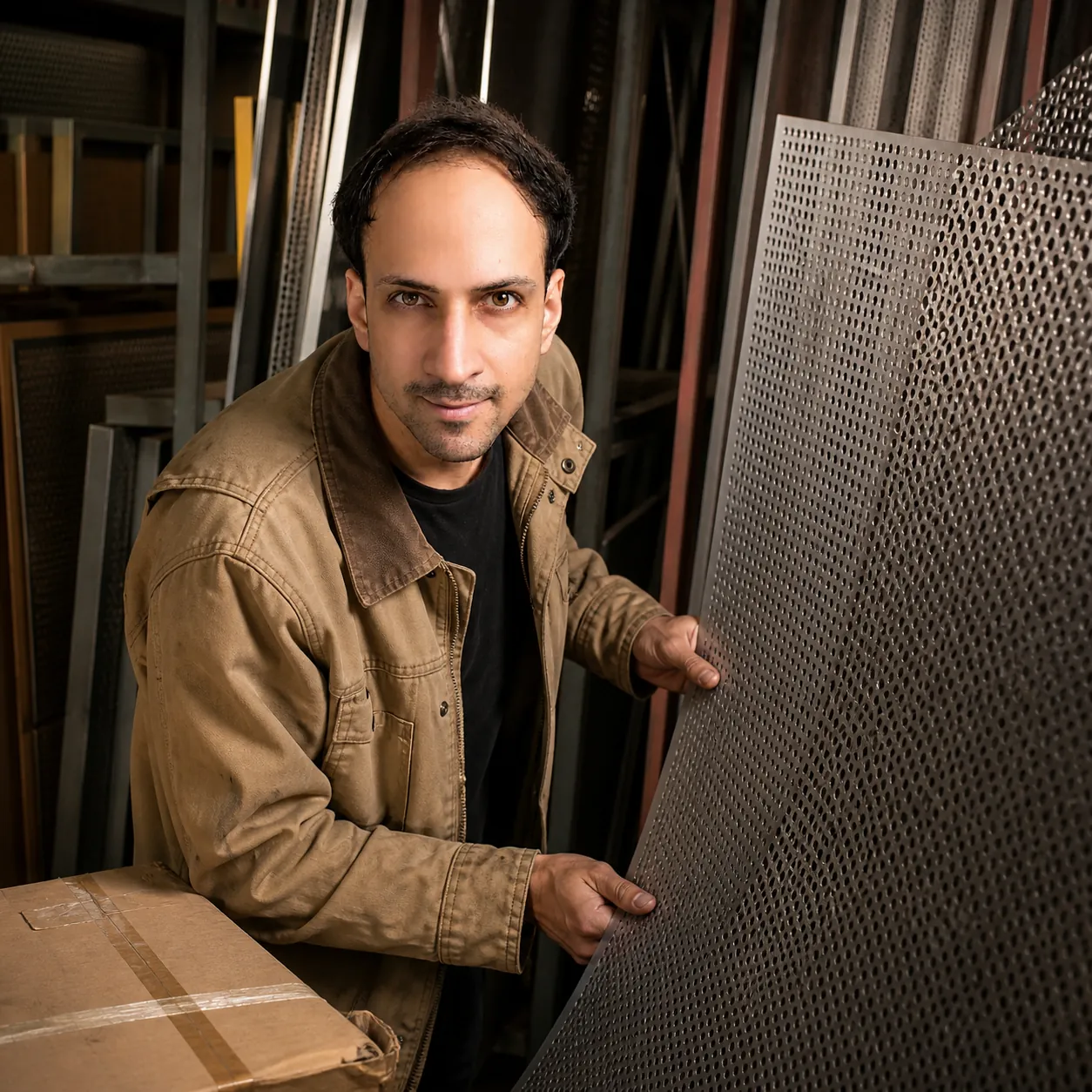
Layered Beat: Shaded Metal Supply Yard — AI Portrait Prompt
صورةAI Portraits

Turn your own photo into a quietly rigorous studio portrait in a shaded metal supply yard with perforated sheets racked on edge. Keeps your face unchanged.

من نص البرومبت

Use the attached reference photo as the identity reference: keep the same face, skin tone, hair and features as the person in that photo, without beautifying, aging or altering them. Treat that reference as the character anchor and change only the scene. Create a square 1:1 museum-catalog frame with a strong first read and a slower second read at exactly 2880x2880 pixels. Location: a shaded metal supply yard with perforated sheets racked on edge. Show the subject in a tan canvas work jacket over a dark crew-neck, tilting one thin sheet upright against the rack rail. Build the artwork around this material rule: a double layer of sheer silk stretched on one frame, whose riding weaves break into watered bands that gave moiré its name summons a third pattern that belongs to neither layer alone. Explore what it means that the boldest pattern present was authored by neither maker; direct expression and posture toward held fascination, never melodrama or ad-like confidence. Frame straight through the nearer pattern layer, its structure crisp while their eyes hold the true focus. Make the composition place their eyes in the one calm zone the fringes spare. Render it as quietly rigorous studio realism uniting layered handcrafted screens, physically exact interference behavior, restrained heritage styling, and dignified observational portraiture, using a single hard lamp placed to cast one clean, honest shadow and a palette of warm cedar, deep shadow, and one seam of saffron. Photorealistic: this must read as a real photograph from a physical camera, never an illustration, painting, or 3D render. Resolve real surface detail: label-free packaging showing carton fibre, cardboard bruised at the corners, and tape lifting slightly at one end. Keep one identity-locked person, credible hands and fingers, natural fabric, and coherent scale, contact, reflections, shadows, airflow, deformation, and materials. Background people only when essential, always secondary and clearly different. Avoid op-art poster graphics, hypnotic spiral overlays, digital glitch scanlines, television static, and patterns projected across their face. No text, labels, logos, signatures, watermarks, random symbols, plastic skin, excessive bloom, or glossy AI finish.
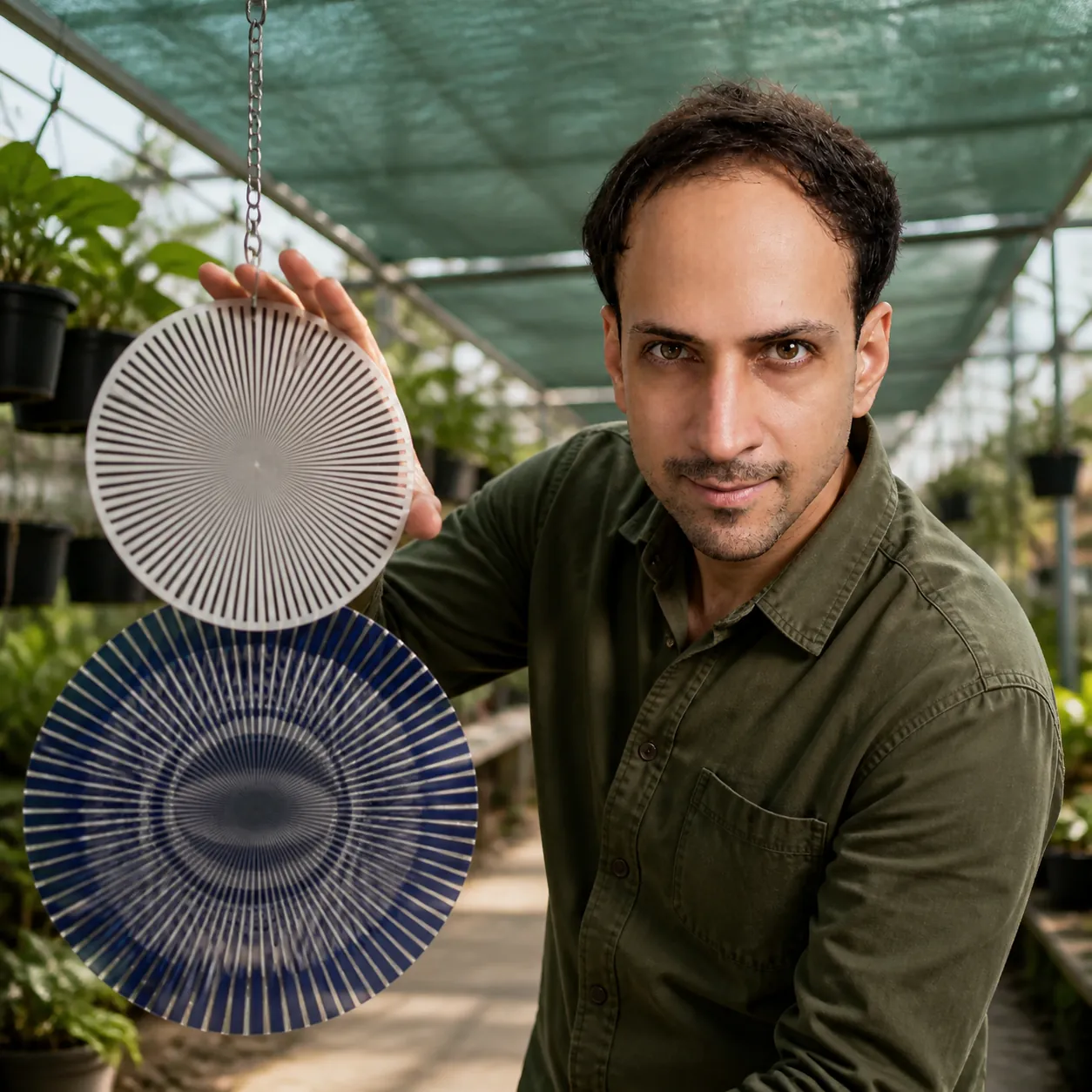
Almost Identical: Plant Nursery Aisle — AI Portrait Prompt
صورةAI Portraits

Turn your own photo into a portrait in a plant nursery aisle under doubled green shade netting at midmorning. Keeps your face unchanged.

من نص البرومبت

Use the attached reference photo as the identity reference: keep the same face, skin tone, hair and features as the person in that photo, without beautifying, aging or altering them. Treat that reference as the character anchor and change only the scene. Create a square 1:1 museum-catalog frame with a strong first read and a slower second read at exactly 2880x2880 pixels. Location: a plant nursery aisle under doubled green shade netting at midmorning. Show the subject in an olive utility overshirt with both cuffs buttoned closed, stilling a hanging pot's slow spin with one raised palm. Make one rigorous physical condition the conceptual engine: a face-to-face pair of radially ruled discs, whose fringe spokes wheel through many degrees for each single degree of the top disc summons a third pattern that belongs to neither layer alone. Explore why amplification built from spacing alone feels more trustworthy than machinery; direct expression and posture toward measured astonishment, never melodrama or ad-like confidence. Use an eye-level 85mm portrait view stopped down so both pattern layers stay equally sharp. Make the composition place their eyes in the one calm zone the fringes spare. Render it as museum-grade optical demonstration realism combining true moiré geometry, tactile weave detail, faithful shadow behavior, and calm editorial framing, using even mid-morning shade with just enough directionality to model their face and a palette of washed white, cool steel mesh, and one indigo band. Photorealistic: this must read as a real photograph from a physical camera, never an illustration, painting, or 3D render. Resolve real surface detail: fine grit in the texture of concrete, efflorescence at damp edges, and hairline cracks that follow stress. Keep one identity-locked person, credible hands and fingers, natural fabric, and coherent scale, contact, reflections, shadows, airflow, deformation, and materials. Background people only when essential, always secondary and clearly different. Avoid op-art poster graphics, hypnotic spiral overlays, digital glitch scanlines, television static, and patterns projected across their face. No text, labels, logos, signatures, watermarks, random symbols, plastic skin, excessive bloom, or glossy AI finish.
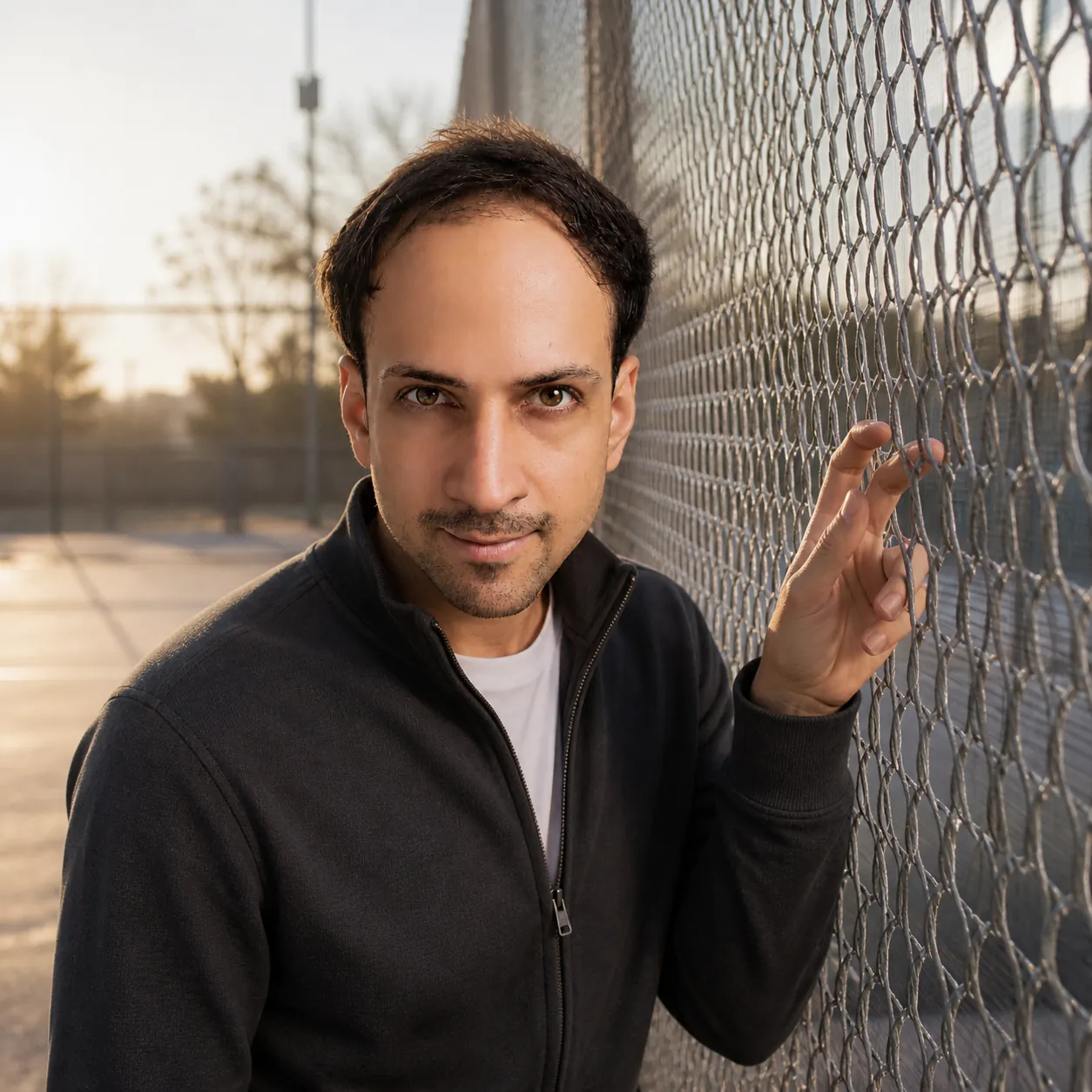
The Uninvited Third: Empty Neighborhood Sports Court — AI Portrait Prompt
صورةAI Portraits

Turn your own photo into a portrait in an empty neighborhood sports court at dawn beside its tall woven fence. Keeps your face unchanged.

من نص البرومبت

Use the attached reference photo as the identity reference: keep the same face, skin tone, hair and features as the person in that photo, without beautifying, aging or altering them. Treat that reference as the character anchor and change only the scene. Create a square 1:1 museum-catalog frame with a strong first read and a slower second read at exactly 2880x2880 pixels. Location: an empty neighborhood sports court at dawn beside its tall woven fence. Show the subject in a zipped charcoal track jacket over a plain white tee, hooking two fingers loosely through the cool wire mesh. Treat this mechanism as the frame’s governing rule: a printed line sheet laid over its identical twin on glass, where a fingertip of offset becomes one fringe sweeping the pane gives stillness a pulse the camera can record without any trick. Explore how a disagreement smaller than a thread becomes the loudest thing visible; direct expression and posture toward unhurried curiosity, never melodrama or ad-like confidence. Frame from low tripod height so the layered patterns rise behind their shoulders without crowding the face. Make the composition crop one giant fringe mid-sweep so its scale stays unproven. Render it as museum-grade optical demonstration realism combining true moiré geometry, tactile weave detail, faithful shadow behavior, and calm editorial framing, using a single hard lamp placed to cast one clean, honest shadow and a palette of pale plaster, carbon grey, and a muted date-brown. Photorealistic: this must read as a real photograph from a physical camera, never an illustration, painting, or 3D render. Resolve real surface detail: leather creased along the lines of use, stitching slightly irregular, and edges burnished from contact. Keep one identity-locked person, credible hands and fingers, natural fabric, and coherent scale, contact, reflections, shadows, airflow, deformation, and materials. Background people only when essential, always secondary and clearly different. Avoid kaleidoscope symmetry, fake motion blur, rainbow chromatic fringing, and funhouse distortion of their features. No text, labels, logos, signatures, watermarks, random symbols, plastic skin, excessive bloom, or glossy AI finish.
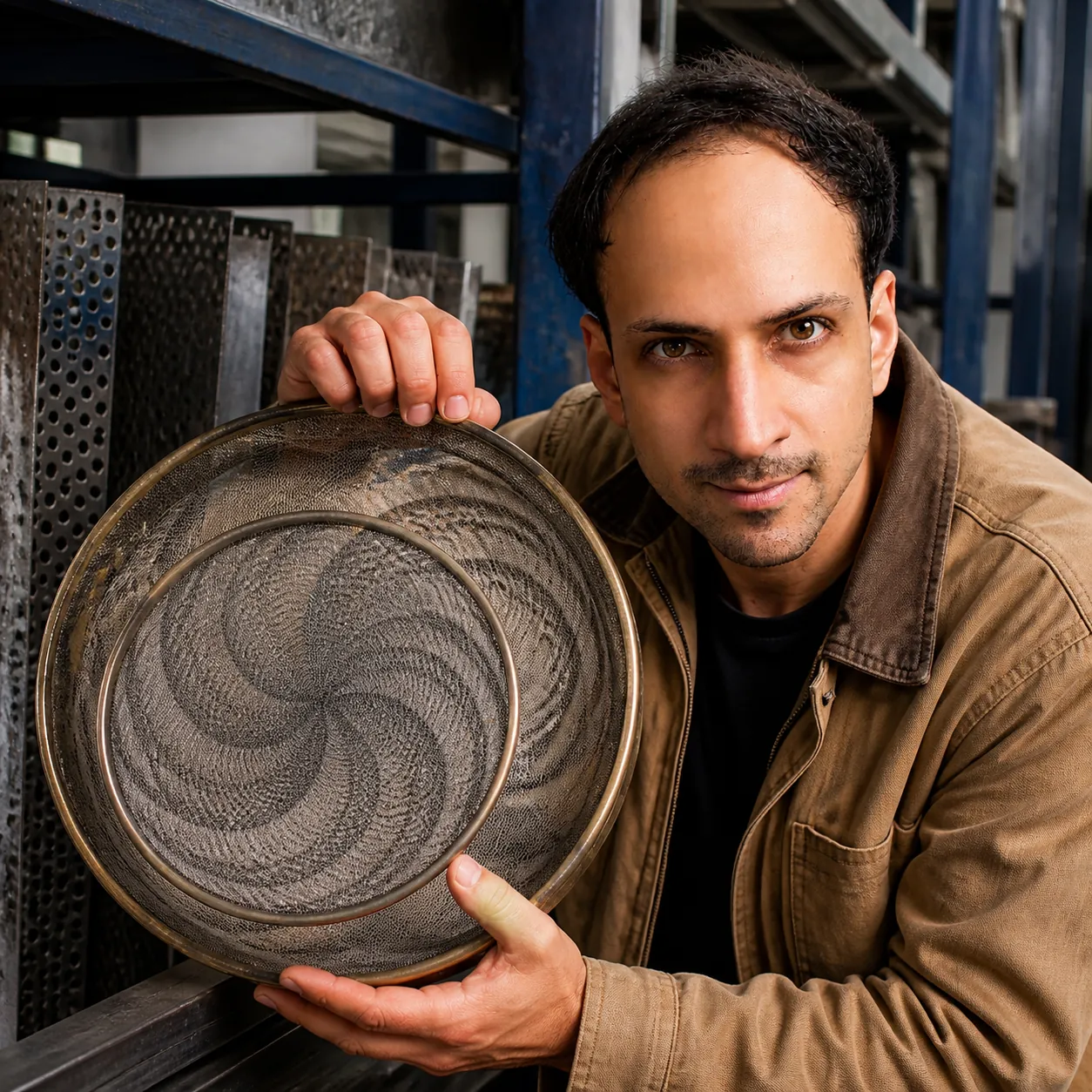
Lawful Shimmer: Shaded Metal Supply Yard — AI Portrait Prompt
صورةAI Portraits

Turn your own photo into a gallery-standard pattern portrait in a shaded metal supply yard with perforated sheets racked on edge. Keeps your face unchanged.

من نص البرومبت

Use the attached reference photo as the identity reference: keep the same face, skin tone, hair and features as the person in that photo, without beautifying, aging or altering them. Treat that reference as the character anchor and change only the scene. Create a square 1:1 museum-catalog frame with a strong first read and a slower second read at exactly 2880x2880 pixels. Location: a shaded metal supply yard with perforated sheets racked on edge. Show the subject in a tan canvas work jacket over a dark crew-neck, tilting one thin sheet upright against the rack rail. The impossible-looking event must obey this clear system: a nested pair of fine flour sieves that answers a slight relative turn with bold curved fringes swirling across both meshes gives stillness a pulse the camera can record without any trick. Explore whether the third pattern is discovered or invented at the moment of overlap; direct expression and posture toward patient scrutiny, never melodrama or ad-like confidence. Use a 50mm standpoint set exactly where the bands read strongest, with their face just off that axis. Make the composition give the emergent pattern more visual weight than either honest layer. Render it as gallery-standard pattern photography built on lawfully emergent fringes, honest textile texture, deep controlled focus, and unhurried human presence, using cool ambient daylight lifted by one warm bounce off nearby wood and a palette of bone linen, graphite line-work, and a low brass accent. Photorealistic: this must read as a real photograph from a physical camera, never an illustration, painting, or 3D render. Resolve real surface detail: skin that reddens slightly under pressure, nail beds with honest colour, and knuckle creases that fold rather than blur. Keep one identity-locked person, credible hands and fingers, natural fabric, and coherent scale, contact, reflections, shadows, airflow, deformation, and materials. Background people only when essential, always secondary and clearly different. Avoid kaleidoscope symmetry, fake motion blur, rainbow chromatic fringing, and funhouse distortion of their features. No text, labels, logos, signatures, watermarks, random symbols, plastic skin, excessive bloom, or glossy AI finish.
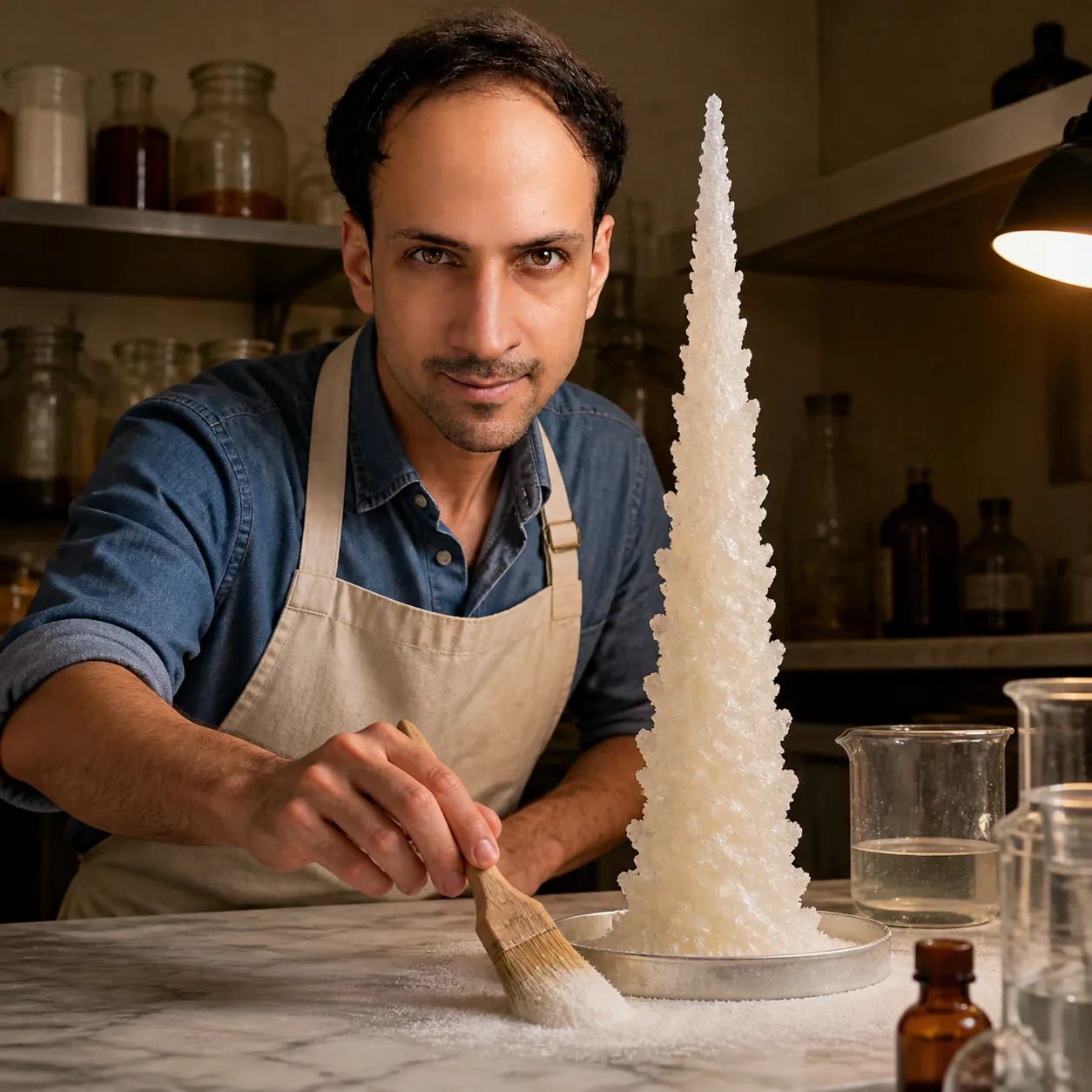
Stream to Stone: Marble Back Table — AI Portrait Prompt
صورةAI Portraits

Turn your own photo into a conceptual bench-science portrait in the marble back table of a small confectioner's workroom at closing. Keeps your face unchanged.

من نص البرومبت

Use the attached reference photo as the identity reference: keep the same face, skin tone, hair and features as the person in that photo, without beautifying, aging or altering them. Treat that reference as the character anchor and change only the scene. Create a square 1:1 museum-catalog frame with a strong first read and a slower second read at exactly 2880x2880 pixels. Location: the marble back table of a small confectioner's workroom at closing. Show the subject in a bib apron in undyed canvas over rolled chambray sleeves, dusting the marble slab clean with a soft brush. Treat this mechanism as the frame’s governing rule: a white column of sodium acetate that solidifies exactly where its own poured stream lands, stacking itself into a warm tower produces confident geometry in a place where nobody asked for any. Explore why a liquid can carry a cathedral's worth of order without showing it; direct expression and posture toward earned conviction, never melodrama or ad-like confidence. Frame slightly above their hands so vessel, hands, and face stack in one calm diagonal. Make the composition let ordinary glassware frame the geometry like museum casework. Render it as conceptual bench-science photography combining believable grown geometry, honest hand-and-glass interaction, precise material response, and quiet contemporary gallery restraint, using one raking bench lamp that turns every crystal edge into a drawn line and a palette of warm plaster, pale brine grey, and one date-brown accent. Photorealistic: this must read as a real photograph from a physical camera, never an illustration, painting, or 3D render. Resolve real surface detail: paper fibre visible at cut edges, plastic that shows mould lines, and paint thicker where a brush turned. Keep one identity-locked person, credible hands and fingers, natural fabric, and coherent scale, contact, reflections, shadows, airflow, deformation, and materials. Background people only when essential, always secondary and clearly different. Avoid wizard-laboratory props, neon translucent minerals, floating crystal shards, motion-smeared growth trails, and jewelry-advert sparkle. No text, labels, logos, signatures, watermarks, random symbols, plastic skin, excessive bloom, or glossy AI finish.
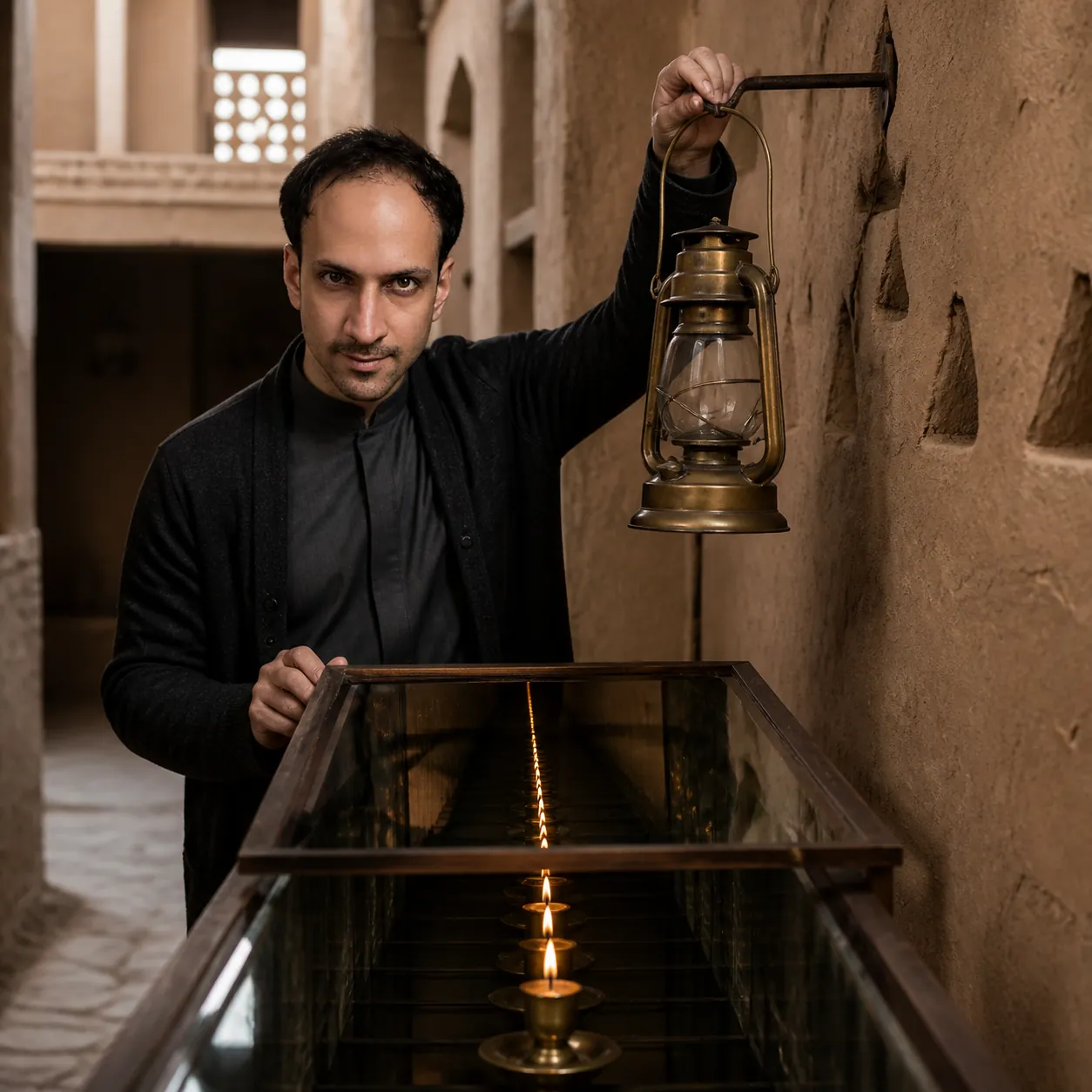
Honest Infinity: Restored Mud-Brick Passage — AI Portrait Prompt
صورةAI Portraits

Turn your own photo into a high-concept optical portrait in a restored mud-brick passage in old Diriyah, lanterns not yet lit. Keeps your face unchanged.

من نص البرومبت

Use the attached reference photo as the identity reference: keep the same face, skin tone, hair and features as the person in that photo, without beautifying, aging or altering them. Create a square 1:1 museum-catalog frame with a strong first read and a slower second read at exactly 2880x2880 pixels. Location: a restored mud-brick passage in old Diriyah, lanterns not yet lit. Show them in a winter-weight slate traditional Gulf outfit layered with a plain dark cardigan, lifting an unlit brass lantern down from its wall hook. Make one rigorous physical condition the conceptual engine: a narrow well of two horizontal mirrors, floor and lid, that repeats one candle flame into a colonnade sinking through the table turns one modest original into abundant company the eye can truly count. Explore why an honest repetition can astonish more than any invented spectacle; direct expression and posture toward level wonder, never melodrama or ad-like confidence. Use an eye-level 55mm medium-format viewpoint with natural perspective and quiet, honest depth of field. Make the composition let the recession deepen away from them, never toward their face. Render it as high-concept optical portraiture built from truthful mirror geometry, accurate reflection falloff, museum-demonstration staging, and calm documentary realism around one unrepeated person, using one small warm practical as key with deep protected shadow around it and a palette of deep black, aged silver, and one candleflame amber. Photorealistic: this must read as a real photograph from a physical camera, never an illustration, painting, or 3D render. Resolve real surface detail: true skin texture with pores and fine hair at the hairline, and fabric that creases where it is actually stressed. Keep one identity-locked person, credible hands and fingers, natural fabric, and coherent scale, contact, reflections, shadows, airflow, deformation, and materials. Background people only when essential, always secondary and clearly different. Avoid duplicated faces, funhouse warps, endless-clone selfies, glowing portal tunnels, and CGI mirror shards. No text, labels, logos, signatures, watermarks, random symbols, plastic skin, excessive bloom, or glossy AI finish.
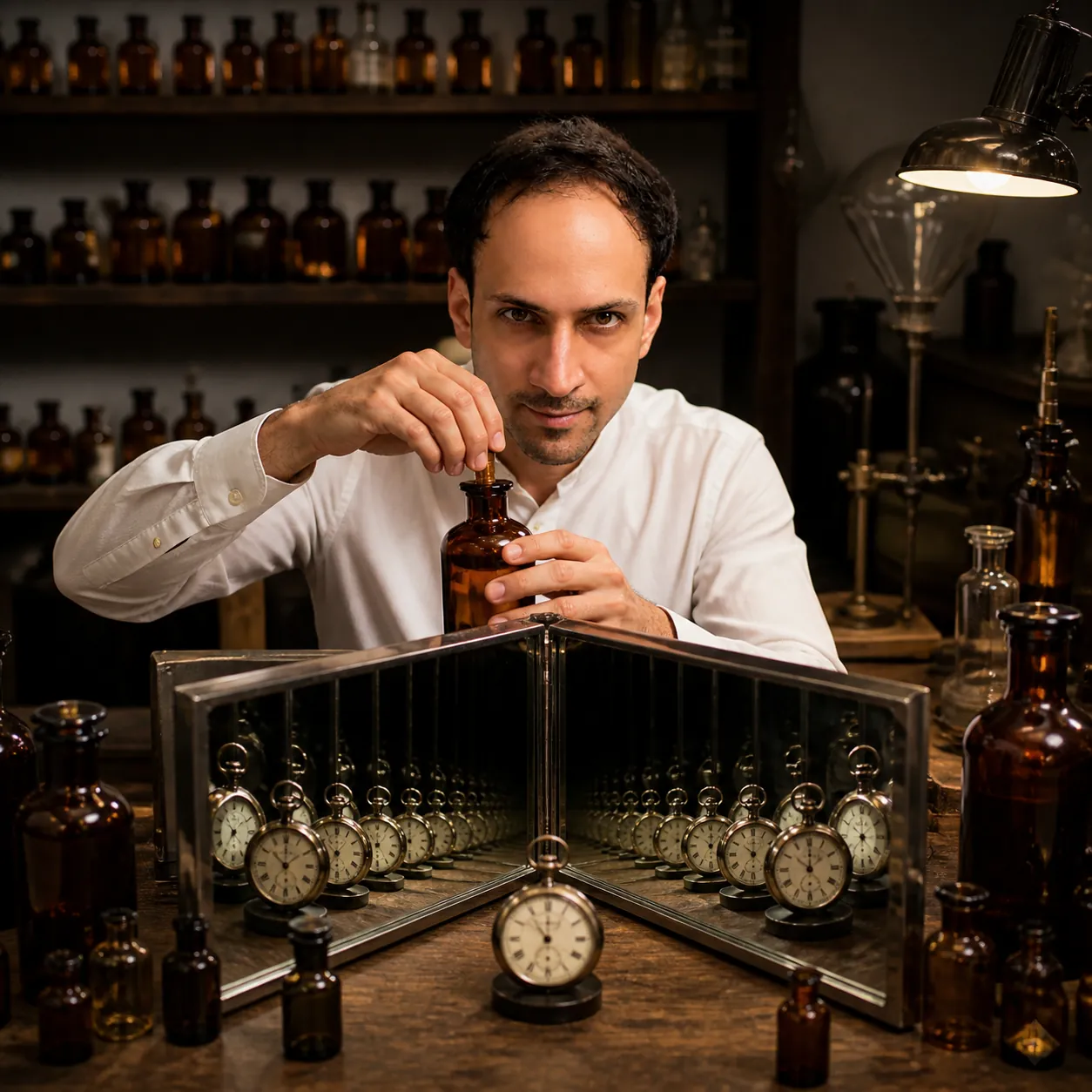
Depth on Loan: Perfumer's Compounding Room — AI Portrait Prompt
صورةAI Portraits

Turn your own photo into a conceptual instrument portrait in a perfumer's compounding room with amber bottles ranked by size. Keeps your face unchanged.

من نص البرومبت

Use the attached reference photo as the identity reference: keep the same face, skin tone, hair and features as the person in that photo, without beautifying, aging or altering them. Create a square 1:1 museum-catalog frame with a strong first read and a slower second read at exactly 2880x2880 pixels. Location: a perfumer's compounding room with amber bottles ranked by size. Show them in a collarless white shirt with both sleeves buttoned at the wrist, seating a ground-glass stopper home with one gentle twist. Make one rigorous physical condition the conceptual engine: a hinged pair of upright mirrors that arranges one pocket watch into a ring of copies counted by the opening angle turns one modest original into abundant company the eye can truly count. Explore why the eye keeps re-testing a spectacle it has already verified as lawful; direct expression and posture toward earned composure, never melodrama or ad-like confidence. Use an eye-level 55mm medium-format viewpoint with natural perspective and quiet, honest depth of field. Make the composition let the recession deepen away from them, never toward their face. Render it as conceptual instrument photography built from lawful recursion, accurate glass color and absorption, precise machined mounts, and quiet observational framing, using controlled darkness with a single shielded lamp placed to miss every mirror and a palette of graphite, chalk white, and one seam of oxide red. Photorealistic: this must read as a real photograph from a physical camera, never an illustration, painting, or 3D render. Resolve real surface detail: fine lint on dark fabric, water spotting on steel, and the soft rounding of edges that have been used for years. Keep one identity-locked person, credible hands and fingers, natural fabric, and coherent scale, contact, reflections, shadows, airflow, deformation, and materials. Background people only when essential, always secondary and clearly different. Avoid duplicated faces, funhouse warps, endless-clone selfies, glowing portal tunnels, and CGI mirror shards. No text, labels, logos, signatures, watermarks, random symbols, plastic skin, excessive bloom, or glossy AI finish.
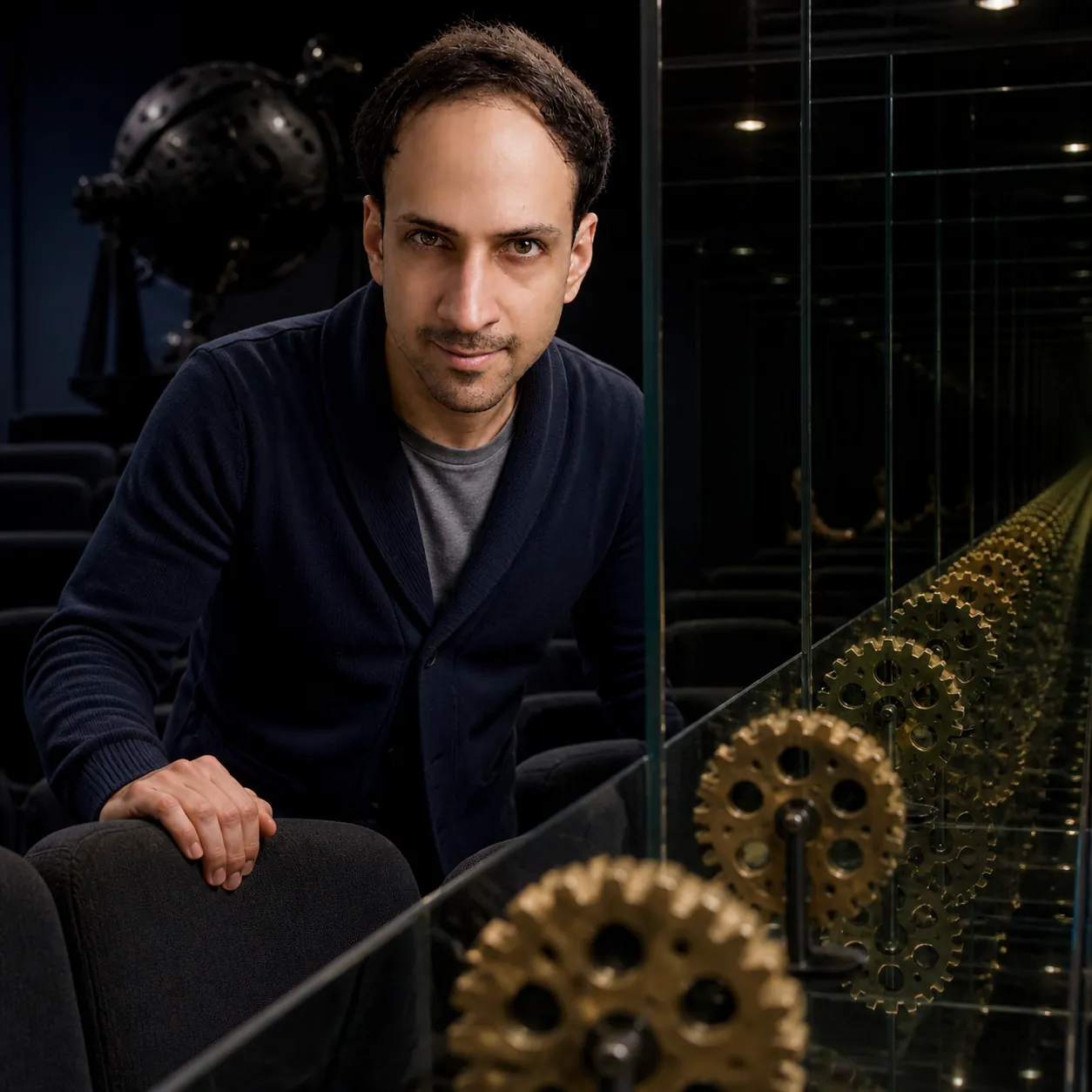
Geometry's Census: Small Planetarium — AI Portrait Prompt
صورةAI Portraits

Turn your own photo into a gallery-grade catoptric portrait in a small planetarium under low house lights, its star projector parked. Keeps your face unchanged.

من نص البرومبت

Use the attached reference photo as the identity reference: keep the same face, skin tone, hair and features as the person in that photo, without beautifying, aging or altering them. Create a square 1:1 museum-catalog frame with a strong first read and a slower second read at exactly 2880x2880 pixels. Location: a small planetarium under low house lights, its star projector parked. Show them in a midnight-blue shawl-collar cardigan over a heather-grey tee, folding one theater seat down with a quiet hand. The impossible-looking event must obey this clear system: a chamber of three long front-surface mirrors that multiplies one small brass gear into a mandala tiling outward in every direction proves repetition can multiply spectacle without inventing one new fact. Explore whether a person can stand beside abundance without being taken into it; direct expression and posture toward patient scrutiny, never melodrama or ad-like confidence. Use a 90mm macro-to-portrait hybrid: one repeated object near the lens, their face beyond it and outside every reflection. Make the composition weight the single real object more heavily than all its copies. Render it as gallery-grade catoptric photography combining correct virtual-image spacing, honest generation-by-generation dimming, restrained art direction, and unhurried human presence, using low house light dimmed until the repeated images become the brightest things and a palette of iron black, dim mercury silver, and pale flame gold. Photorealistic: this must read as a real photograph from a physical camera, never an illustration, painting, or 3D render. Resolve real surface detail: condensation beading at true size, liquid meniscus curving against glass, and wet surfaces darker than dry ones. Keep one identity-locked person, credible hands and fingers, natural fabric, and coherent scale, contact, reflections, shadows, airflow, deformation, and materials. Background people only when essential, always secondary and clearly different. Avoid neon infinity-room installations, floating disembodied reflections, cracked-mirror symbolism, and impossible seamless recursion without dimming. No text, labels, logos, signatures, watermarks, random symbols, plastic skin, excessive bloom, or glossy AI finish.
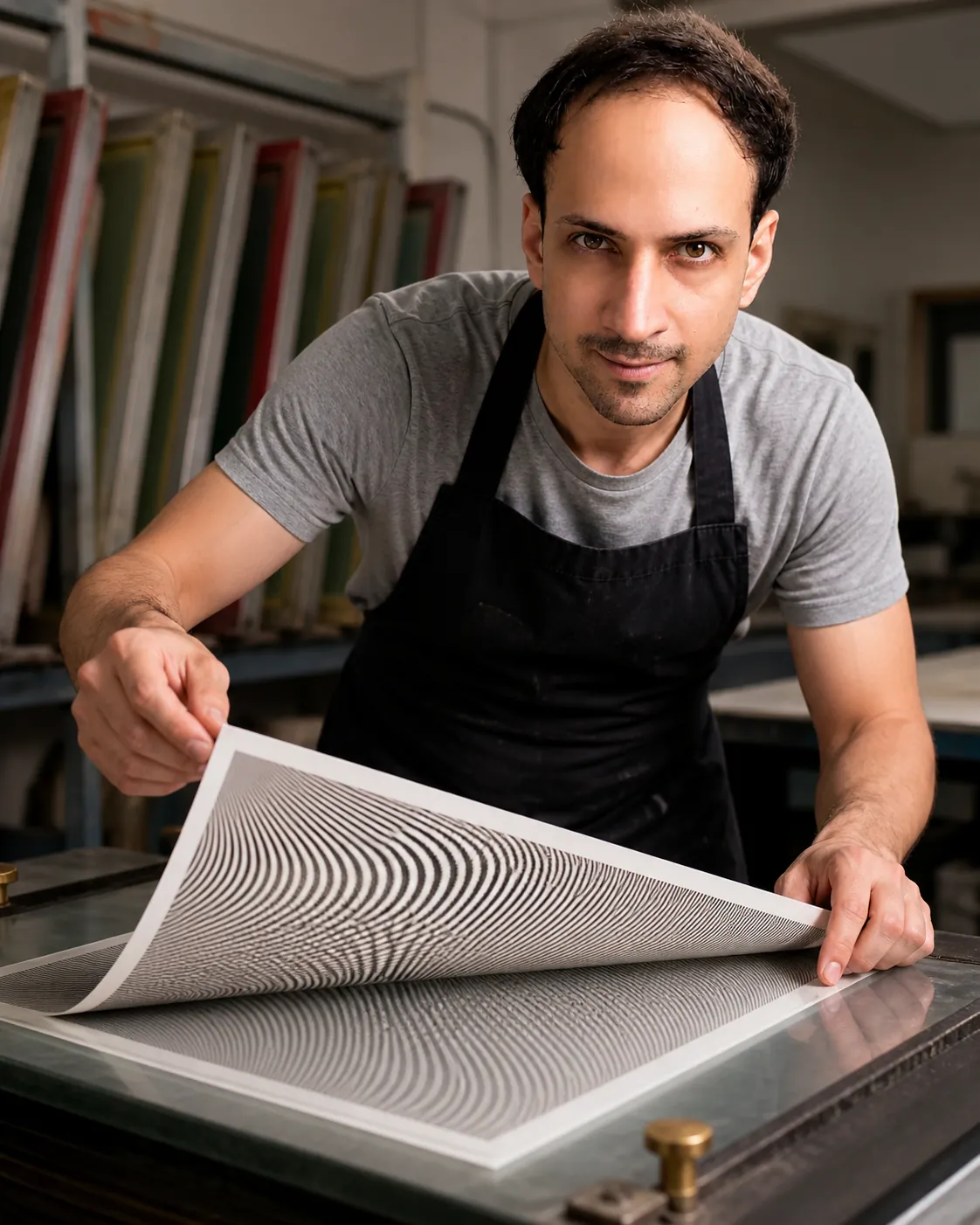
The Uninvited Third: Screen-Printing Workshop — AI Portrait Prompt
صورةAI Portraits

Turn your own photo into a portrait in a screen-printing workshop with taut mesh frames racked along one wall. Keeps your face unchanged.

من نص البرومبت

Use the attached reference photo as the identity reference: keep the same face, skin tone, hair and features as the person in that photo, without beautifying, aging or altering them. Treat that reference as the character anchor and change only the scene. Build a portrait 4:5 editorial artwork with protected negative space and a fully readable face at exactly 2560x3200 pixels. Location: a screen-printing workshop with taut mesh frames racked along one wall. Show them in a black canvas shop apron over a heather-grey tee, lowering one mesh frame flat onto the vacuum table. Build the artwork around this material rule: a printed line sheet laid over its identical twin on glass, where a fingertip of offset becomes one fringe sweeping the pane magnifies a difference too small to see into bands the eye cannot miss. Explore how a disagreement smaller than a thread becomes the loudest thing visible; direct expression and posture toward sober delight, never melodrama or ad-like confidence. Use a 50mm standpoint set exactly where the bands read strongest, with their face just off that axis. Make the composition keep both source patterns readable at the edges as quiet evidence. Render it as museum-grade optical demonstration realism combining true moiré geometry, tactile weave detail, faithful shadow behavior, and calm editorial framing, using even mid-morning shade with just enough directionality to model their face and a palette of bone linen, graphite line-work, and a low brass accent. Photorealistic: this must read as a real photograph from a physical camera, never an illustration, painting, or 3D render. Resolve real surface detail: cotton that hangs by its own weight, seams that pucker very slightly, and collars softened by washing. Keep one identity-locked person, credible hands and fingers, natural fabric, and coherent scale, contact, reflections, shadows, airflow, deformation, and materials. Background people only when essential, always secondary and clearly different. Avoid kaleidoscope symmetry, fake motion blur, rainbow chromatic fringing, and funhouse distortion of their features. No text, labels, logos, signatures, watermarks, random symbols, plastic skin, excessive bloom, or glossy AI finish.
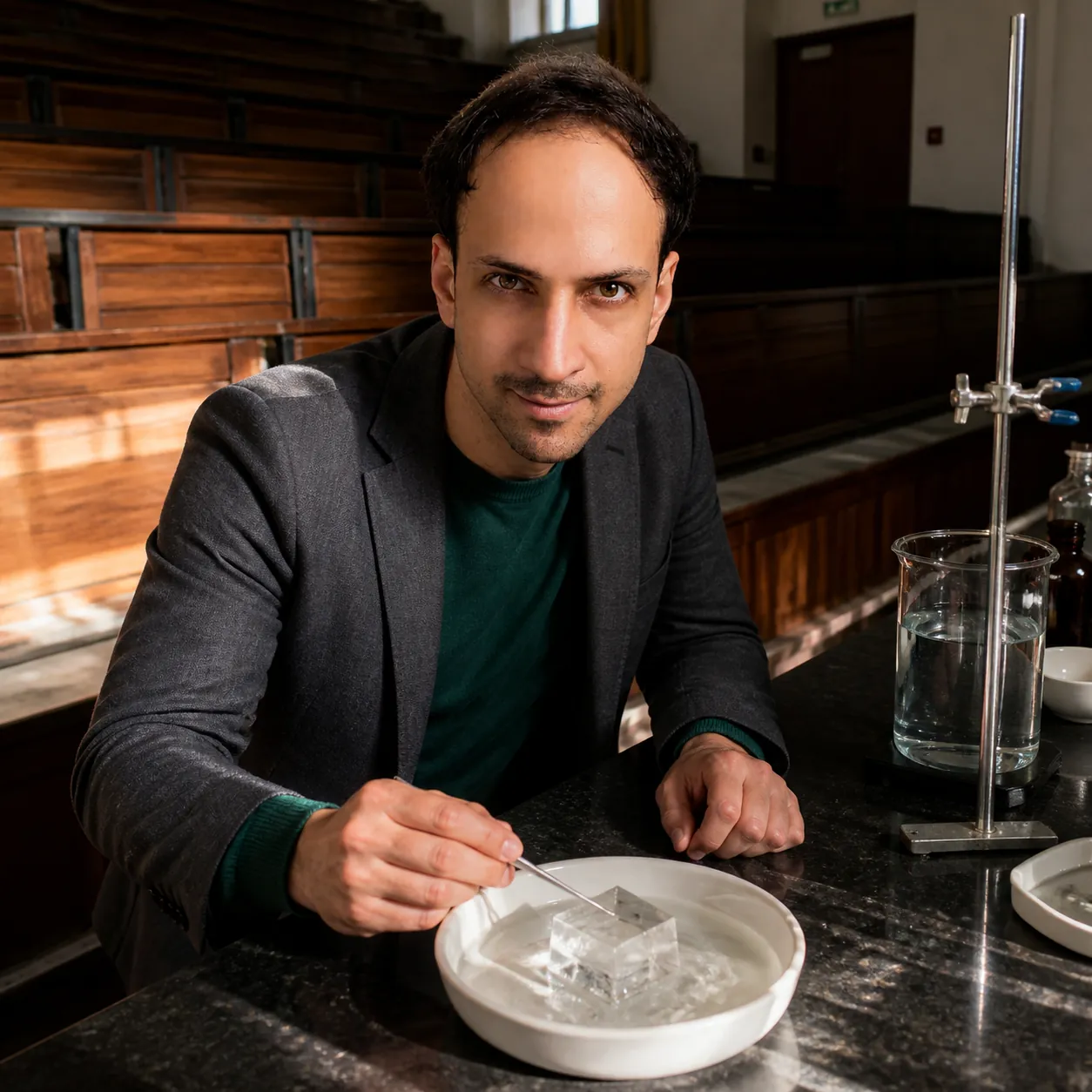
Geometry Unasked: Empty Raked Lecture Theatre — AI Portrait Prompt
صورةAI Portraits

Turn your own photo into a portrait in an empty raked lecture theatre with one long demonstration bench below. Keeps your face unchanged.

من نص البرومبت

Use the attached reference photo as the identity reference: keep the same face, skin tone, hair and features as the person in that photo, without beautifying, aging or altering them. Treat that reference as the character anchor and change only the scene. Create a square 1:1 museum-catalog frame with a strong first read and a slower second read at exactly 2880x2880 pixels. Location: an empty raked lecture theatre with one long demonstration bench below. Show the subject in a mid-grey blazer over a deep green crew-neck sweater, centering a white ceramic dish on the long bench. Treat this mechanism as the frame’s governing rule: a single alum crystal grown from a pinhead seed into a faceted block whose faces lie flat as instrument glass produces confident geometry in a place where nobody asked for any. Explore how one law repeated without exception becomes something the eye calls beauty; direct expression and posture toward watchful respect, never melodrama or ad-like confidence. Frame slightly above their hands so vessel, hands, and face stack in one calm diagonal. Make the composition give the newest crystal the frame's brightest square inch. Render it as conceptual bench-science photography combining believable grown geometry, honest hand-and-glass interaction, precise material response, and quiet contemporary gallery restraint, using hard low window sun refracted through glassware into small honest caustics and a palette of salt white, wet slate, and deep vitriol blue. Photorealistic: this must read as a real photograph from a physical camera, never an illustration, painting, or 3D render. Resolve real surface detail: floor finish worn along the walked line, skirting marked at shoe height, and corners darker than the open floor. Keep one identity-locked person, credible hands and fingers, natural fabric, and coherent scale, contact, reflections, shadows, airflow, deformation, and materials. Background people only when essential, always secondary and clearly different. Avoid wizard-laboratory props, neon translucent minerals, floating crystal shards, motion-smeared growth trails, and jewelry-advert sparkle. No text, labels, logos, signatures, watermarks, random symbols, plastic skin, excessive bloom, or glossy AI finish.
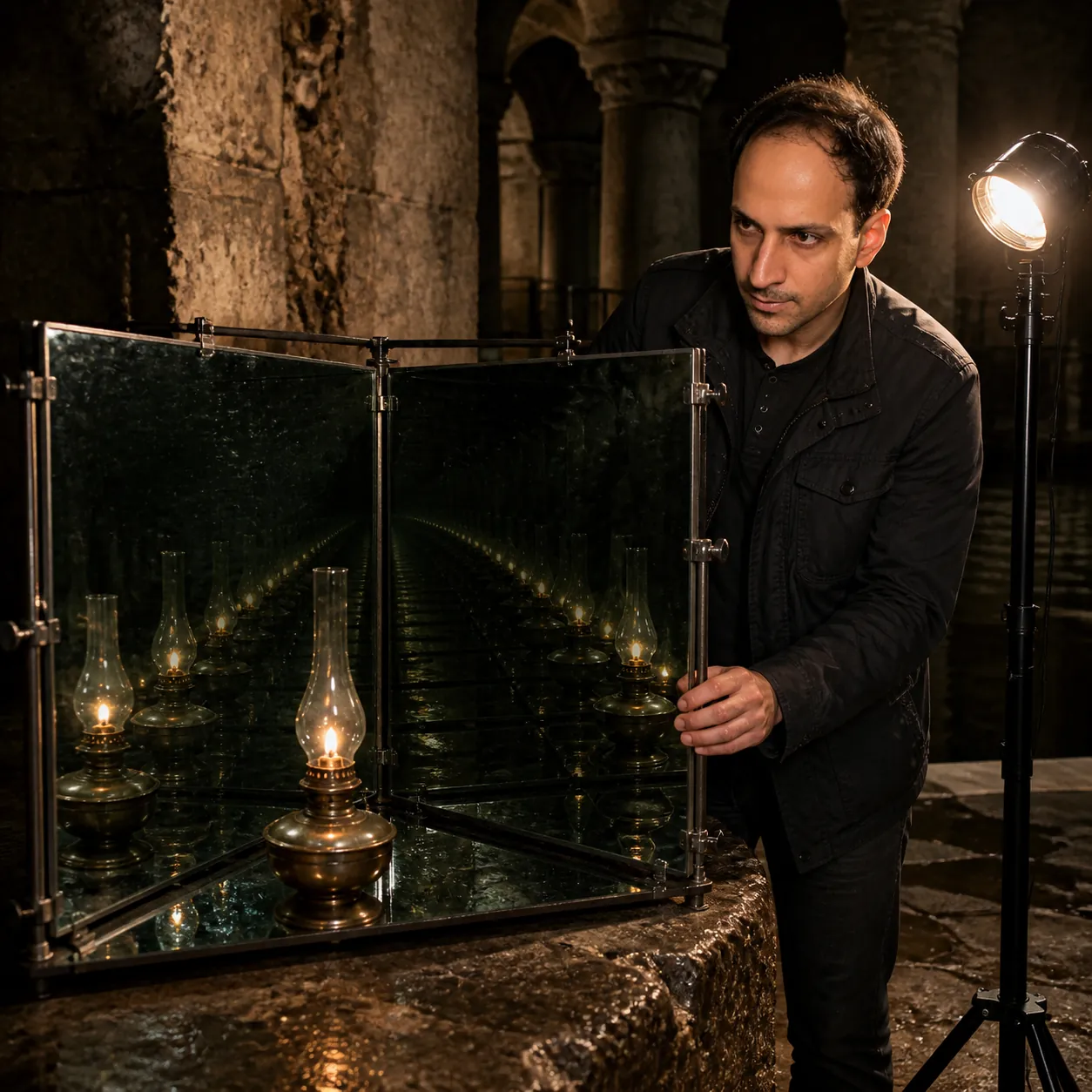
Exactly Once: Restored Underground Stone Cistern — AI Portrait Prompt
صورةAI Portraits

Turn your own photo into a conceptual instrument portrait in a restored underground stone cistern lit by one standing work lamp. Keeps your face unchanged.

من نص البرومبت

Use the attached reference photo as the identity reference: keep the same face, skin tone, hair and features as the person in that photo, without beautifying, aging or altering them. Create a square 1:1 museum-catalog frame with a strong first read and a slower second read at exactly 2880x2880 pixels. Location: a restored underground stone cistern lit by one standing work lamp. Show them in a charcoal field jacket closed over a dark waffle henley, planting the work lamp's tripod firm on the uneven floor. The impossible-looking event must obey this clear system: a pair of facing mirrors set one degree out of parallel, bending a lone brass oil lamp's reflected corridor into darkness turns one modest original into abundant company the eye can truly count. Explore what each new copy must surrender in brightness to be admitted; direct expression and posture toward grounded awe, never melodrama or ad-like confidence. Use a 90mm macro-to-portrait hybrid: one repeated object near the lens, their face beyond it and outside every reflection. Make the composition weight the single real object more heavily than all its copies. Render it as conceptual instrument photography built from lawful recursion, accurate glass color and absorption, precise machined mounts, and quiet observational framing, using one small warm practical as key with deep protected shadow around it and a palette of soot black, unpolished pewter, and one deep bottle green. Photorealistic: this must read as a real photograph from a physical camera, never an illustration, painting, or 3D render. Resolve real surface detail: glass with real thickness at its edge, reflections that carry the room's actual colour, and dust visible only at grazing angles. Keep one identity-locked person, credible hands and fingers, natural fabric, and coherent scale, contact, reflections, shadows, airflow, deformation, and materials. Background people only when essential, always secondary and clearly different. Avoid duplicated faces, funhouse warps, endless-clone selfies, glowing portal tunnels, and CGI mirror shards. No text, labels, logos, signatures, watermarks, random symbols, plastic skin, excessive bloom, or glossy AI finish.
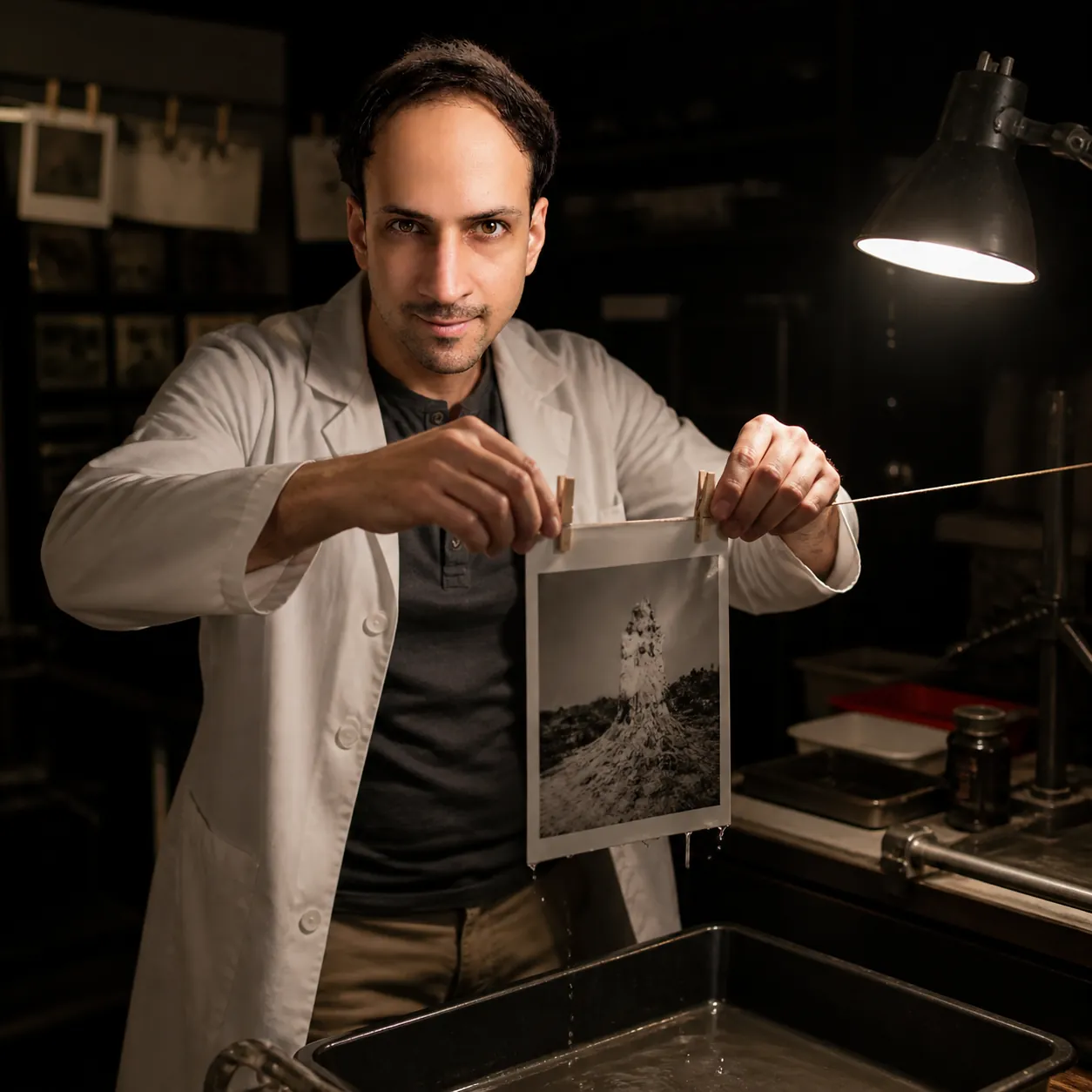
Still Voltage: Photographic Darkroom — AI Portrait Prompt
صورةAI Portraits

Turn your own photo into a photorealistic portrait in a photographic darkroom, safelight off and one work lamp on. Keeps your face unchanged.

من نص البرومبت

Use the attached reference photo as the identity reference: keep the same face, skin tone, hair and features as the person in that photo, without beautifying, aging or altering them. Create a square 1:1 museum-catalog frame with a strong first read and a slower second read at exactly 2880x2880 pixels. Location: a photographic darkroom, safelight off and one work lamp on. Show them in a lab coat left open over a slate henley and chinos, pegging a dripping print to a taut line. The impossible-looking event must obey this clear system: a hollow branching fulgurite lifted from desert sand, glass fused along the exact path one lightning stroke took underground brings a feared force close enough to study without any bravado. Explore what it costs to make an invisible force testify in public; direct expression and posture toward steady curiosity, never melodrama or ad-like confidence. Use a 50mm view at bench height so apparatus and face carry equal optical weight. Make the composition surround the lit evidence with generous, honest darkness. Render it as evidence-grade scientific photography pairing honest discharge phenomena, calibrated near-darkness exposure, believable period instrumentation, and quiet, unhurried human-scale storytelling, using deep dusk ambience shaped by one hooded lamp aimed at the work and a palette of charred oak, pale ivory, and one ember-orange thread. Photorealistic: this must read as a real photograph from a physical camera, never an illustration, painting, or 3D render. Resolve real surface detail: skin that reddens slightly under pressure, nail beds with honest colour, and knuckle creases that fold rather than blur. Keep one identity-locked person, credible hands and fingers, natural fabric, and coherent scale, contact, reflections, shadows, airflow, deformation, and materials. Background people only when essential, always secondary and clearly different. Avoid sci-fi energy balls, fractal screen-saver overlays, sparks showering from hands, wizard-lightning fingertips, and ultraviolet glow gimmicks. No text, labels, logos, signatures, watermarks, random symbols, plastic skin, excessive bloom, or glossy AI finish.
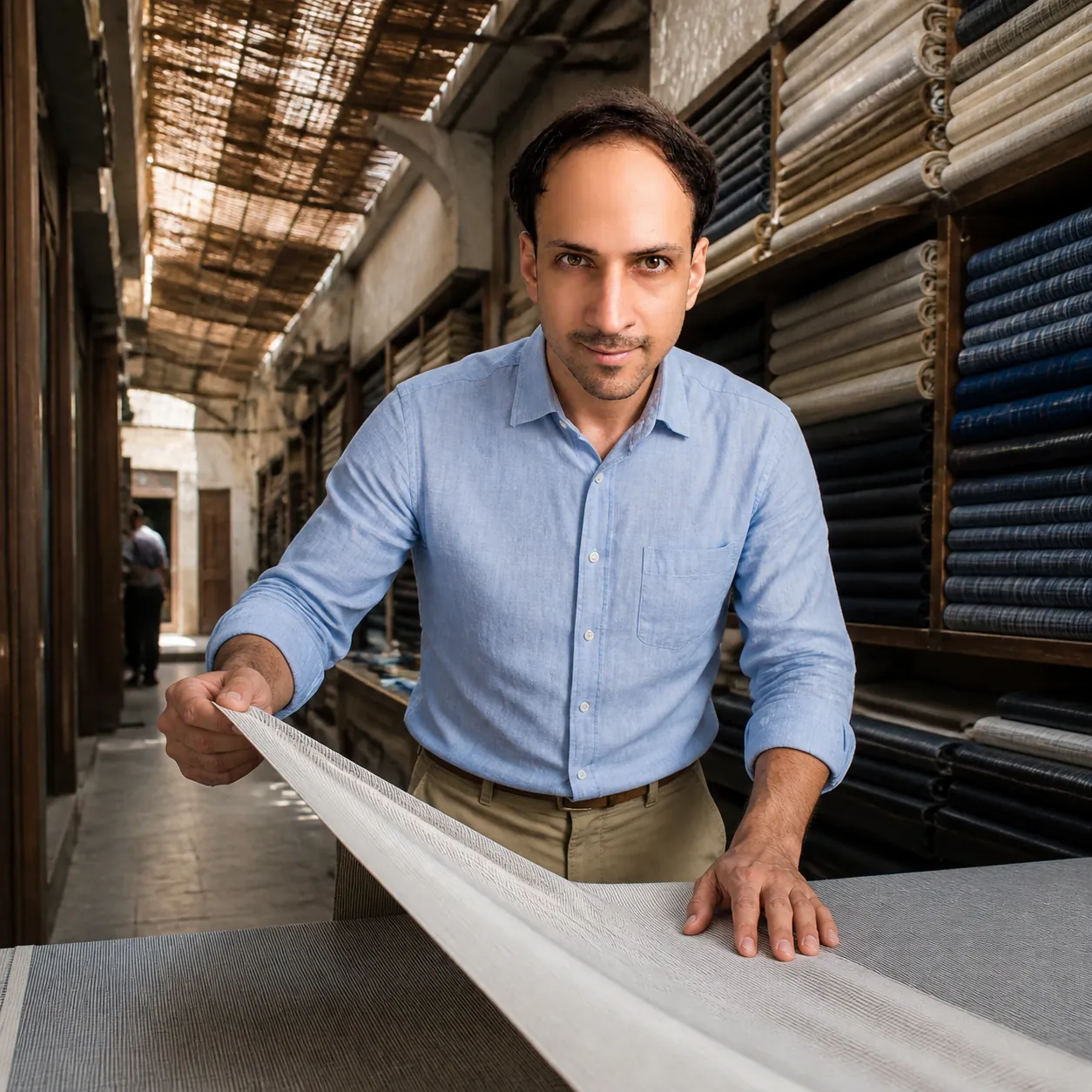
Slow Giant Bands: Covered Textile Souq Aisle — AI Portrait Prompt
صورةAI Portraits

Turn your own photo into a high-concept interference portrait in a covered textile souq aisle before opening, bolts shelved high. Keeps your face unchanged.

من نص البرومبت

Use the attached reference photo as the identity reference: keep the same face, skin tone, hair and features as the person in that photo, without beautifying, aging or altering them. Treat that reference as the character anchor and change only the scene. Create a square 1:1 museum-catalog frame with a strong first read and a slower second read at exactly 2880x2880 pixels. Location: a covered textile souq aisle before opening, bolts shelved high. Show the subject in a light-blue casual shirt tucked into pressed sand chinos, unrolling a forearm's length of cloth across the counter. Treat this mechanism as the frame’s governing rule: a clamped pair of perforated steel sheets whose hole pitches differ by a hairsbreadth, blooming into one cloudy pattern of beats summons a third pattern that belongs to neither layer alone. Explore what stillness is worth once it learns to carry a visible rhythm; direct expression and posture toward attentive calm, never melodrama or ad-like confidence. Frame from low tripod height so the layered patterns rise behind their shoulders without crowding the face. Make the composition run the interference bands diagonally while every real edge stays level. Render it as high-concept interference portraiture built from genuinely overlapping physical patterns, large-format documentary clarity, hand-made material honesty, and patient architectural observation, using one broad diffused window source held oblique so fine patterns stay resolvable and a palette of washed white, cool steel mesh, and one indigo band. Photorealistic: this must read as a real photograph from a physical camera, never an illustration, painting, or 3D render. Resolve real surface detail: grout darker than tile, sealant slightly yellowed, and every joint showing a real tolerance gap. Keep one identity-locked person, credible hands and fingers, natural fabric, and coherent scale, contact, reflections, shadows, airflow, deformation, and materials. Background people only when essential, always secondary and clearly different. Avoid op-art poster graphics, hypnotic spiral overlays, digital glitch scanlines, television static, and patterns projected across their face. No text, labels, logos, signatures, watermarks, random symbols, plastic skin, excessive bloom, or glossy AI finish.
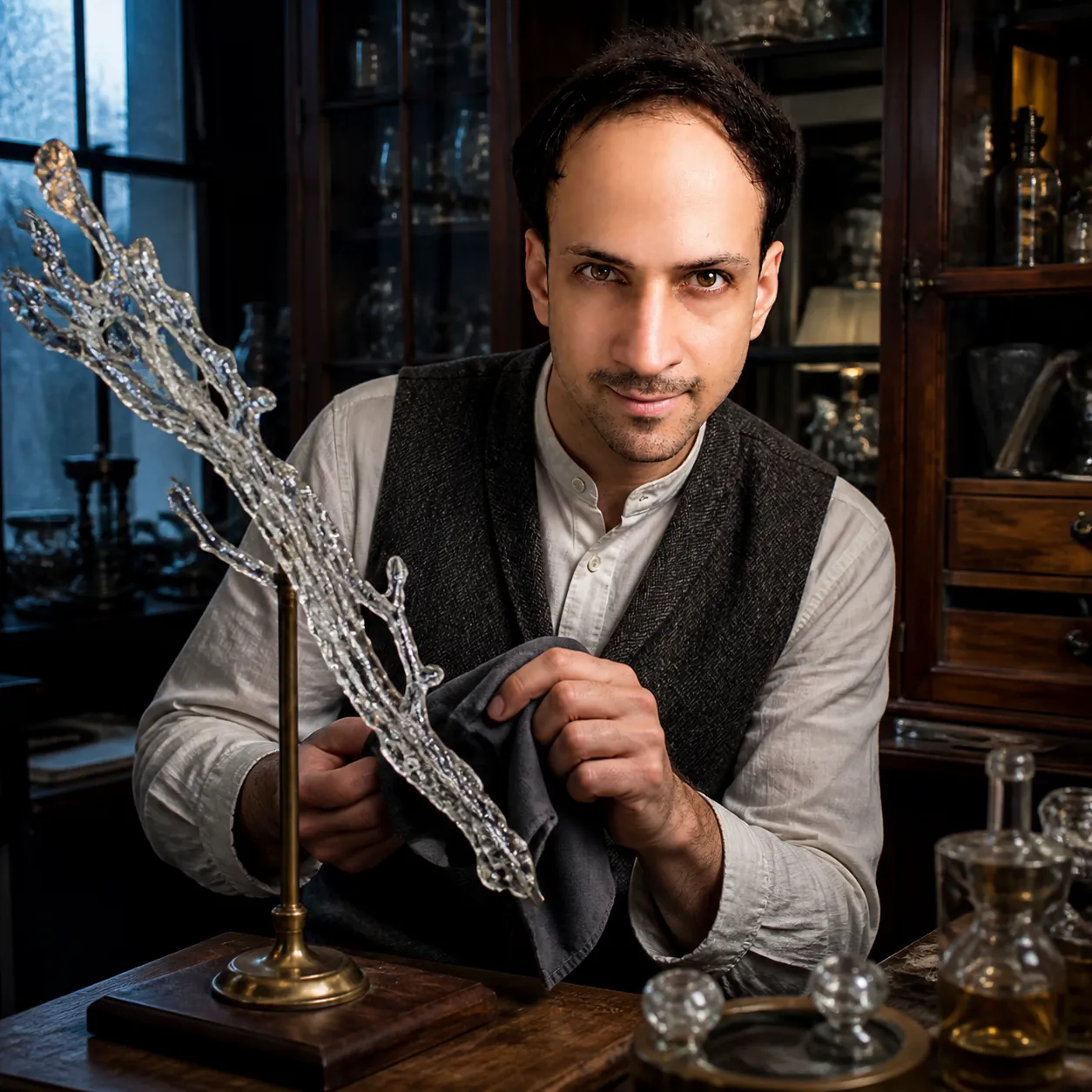
Still Voltage: Back Room — AI Portrait Prompt
صورةAI Portraits

Turn your own photo into a high-voltage archival portrait in the back room of a scientific-antiques dealer, cabinets unlocked. Keeps your face unchanged.

من نص البرومبت

Use the attached reference photo as the identity reference: keep the same face, skin tone, hair and features as the person in that photo, without beautifying, aging or altering them. Create a square 1:1 museum-catalog frame with a strong first read and a slower second read at exactly 2880x2880 pixels. Location: the back room of a scientific-antiques dealer, cabinets unlocked. Show them in a herringbone wool vest over a band-collar shirt, folding a felt square around a glass stem. Use this advanced image-making device as the core logic: a hollow branching fulgurite lifted from desert sand, glass fused along the exact path one lightning stroke took underground turns activity far too fast to witness into a form calm enough to study. Explore what it costs to make an invisible force testify in public; direct expression and posture toward reverent precision, never melodrama or ad-like confidence. Frame from a low three-quarter angle so the demonstration sits between the lens and their attention. Make the composition run one bright line toward their eyes without ever arriving. Render it as high-voltage archival portraiture built from sealed and lawful apparatus, deep-shadow documentary realism, physically true glass reflections, and museum-label restraint, using late blue window light mixed with one warm low-wattage source and a palette of deep charcoal, gunmetal grey, and one violet whisper. Photorealistic: this must read as a real photograph from a physical camera, never an illustration, painting, or 3D render. Resolve real surface detail: wood grain read at honest scale, matte and gloss clearly separated, and no surface uniformly clean. Keep one identity-locked person, credible hands and fingers, natural fabric, and coherent scale, contact, reflections, shadows, airflow, deformation, and materials. Background people only when essential, always secondary and clearly different. Avoid Tesla-coil showmanship, storm lightning skies, arcs crawling on skin, glowing superhero eyes, and cyberpunk neon haze. No text, labels, logos, signatures, watermarks, random symbols, plastic skin, excessive bloom, or glossy AI finish.

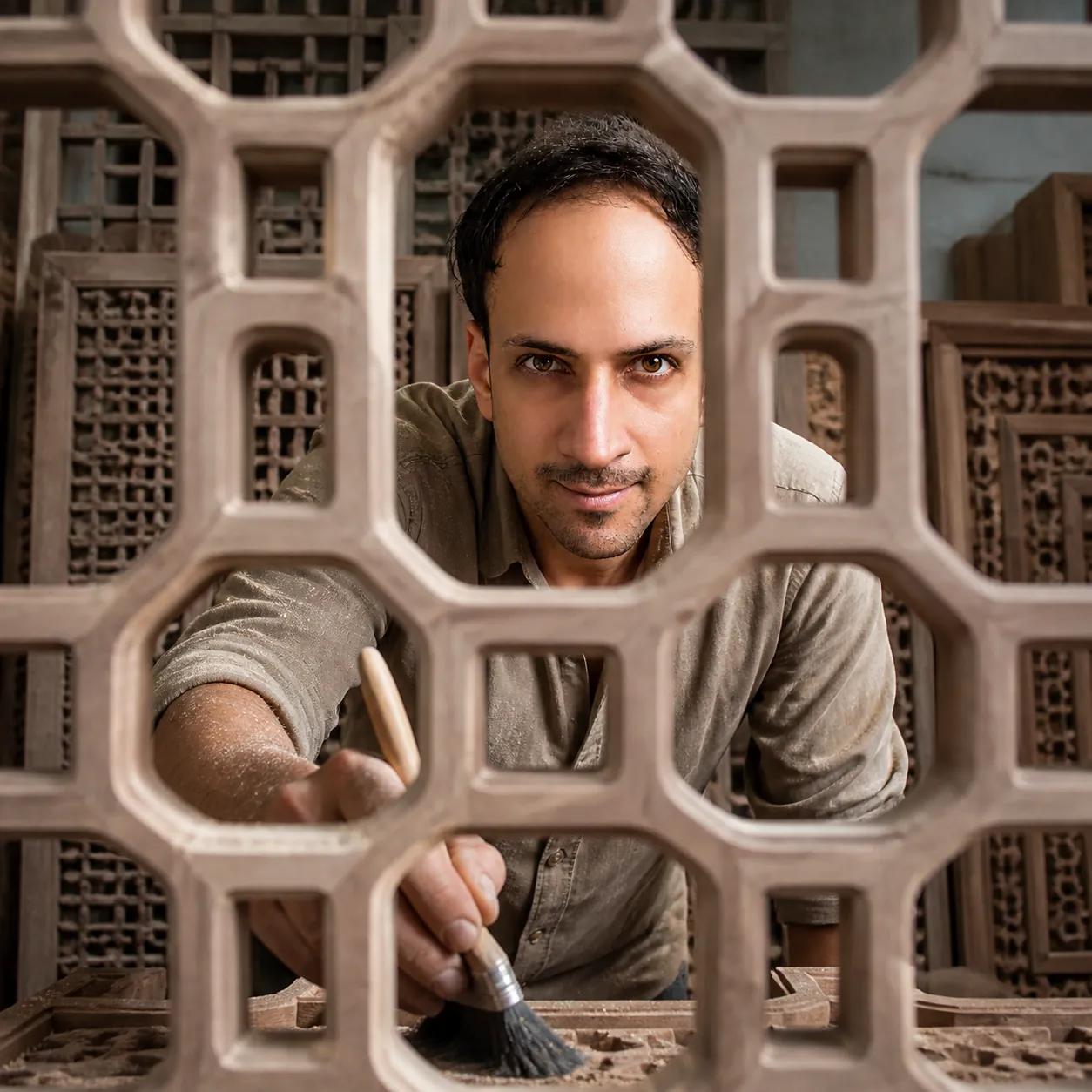
Quiet Leverage: Lattice Joinery Shop — AI Portrait Prompt
صورةAI Portraits

Turn your own photo into a portrait in a lattice joinery shop where carved cedar panels lean in ordered rows. Keeps your face unchanged.

من نص البرومبت

Use the attached reference photo as the identity reference: keep the same face, skin tone, hair and features as the person in that photo, without beautifying, aging or altering them. Treat that reference as the character anchor and change only the scene. Create a square 1:1 museum-catalog frame with a strong first read and a slower second read at exactly 2880x2880 pixels. Location: a lattice joinery shop where carved cedar panels lean in ordered rows. Show the subject in a dust-flecked khaki work shirt with sleeves rolled twice, brushing sawdust from one carved opening with a soft brush. Build the artwork around this material rule: a bench vernier of two printed scales, on which one dark fringe marches boldly for movements finer than a hair gives stillness a pulse the camera can record without any trick. Explore where a pattern lives when it exists only between two others; direct expression and posture toward sober delight, never melodrama or ad-like confidence. Frame straight through the nearer pattern layer, its structure crisp while their eyes hold the true focus. Make the composition place their eyes in the one calm zone the fringes spare. Render it as museum-grade optical demonstration realism combining true moiré geometry, tactile weave detail, faithful shadow behavior, and calm editorial framing, using even mid-morning shade with just enough directionality to model their face and a palette of washed white, cool steel mesh, and one indigo band. Photorealistic: this must read as a real photograph from a physical camera, never an illustration, painting, or 3D render. Resolve real surface detail: dust settled where nobody wipes, fingerprint haze on glass, and edges rubbed pale by handling. Keep one identity-locked person, credible hands and fingers, natural fabric, and coherent scale, contact, reflections, shadows, airflow, deformation, and materials. Background people only when essential, always secondary and clearly different. Avoid kaleidoscope symmetry, fake motion blur, rainbow chromatic fringing, and funhouse distortion of their features. No text, labels, logos, signatures, watermarks, random symbols, plastic skin, excessive bloom, or glossy AI finish.
The Waiting Solid: Deep Majlis Windowsill Catching — AI Portrait Prompt
صورةAI Portraits

Turn your own photo into a museum-demonstration portrait in a deep majlis windowsill catching the first clean light of morning. Keeps your face unchanged.

من نص البرومبت

Use the attached reference photo as the identity reference: keep the same face, skin tone, hair and features as the person in that photo, without beautifying, aging or altering them. Treat that reference as the character anchor and change only the scene. Create a square 1:1 museum-catalog frame with a strong first read and a slower second read at exactly 2880x2880 pixels. Location: a deep majlis windowsill catching the first clean light of morning. Show the subject in a plain ash-grey traditional Gulf outfit pressed for the morning, setting a clear jar down onto a folded cloth. The impossible-looking event must obey this clear system: a cotton thread lifted dripping from a blue jar, strung with copper-sulfate crystals whose flat faces meet at identical angles produces confident geometry in a place where nobody asked for any. Explore whether a solution held past its limit is patient or merely undecided; direct expression and posture toward patient scrutiny, never melodrama or ad-like confidence. Use a 90mm framing that holds the grown geometry and their face in one plane of focus. Make the composition hold one large calm emptiness against the crowded crystalline detail. Render it as museum-demonstration realism combining faithful crystal optics, accurate refraction and caustics, patient editorial portrait craft, and unstyled working-room authenticity, using one raking bench lamp that turns every crystal edge into a drawn line and a palette of raw cotton, dim pewter, and clear sugar amber. Photorealistic: this must read as a real photograph from a physical camera, never an illustration, painting, or 3D render. Resolve real surface detail: condensation beading at true size, liquid meniscus curving against glass, and wet surfaces darker than dry ones. Keep one identity-locked person, credible hands and fingers, natural fabric, and coherent scale, contact, reflections, shadows, airflow, deformation, and materials. Background people only when essential, always secondary and clearly different. Avoid wizard-laboratory props, neon translucent minerals, floating crystal shards, motion-smeared growth trails, and jewelry-advert sparkle. No text, labels, logos, signatures, watermarks, random symbols, plastic skin, excessive bloom, or glossy AI finish.
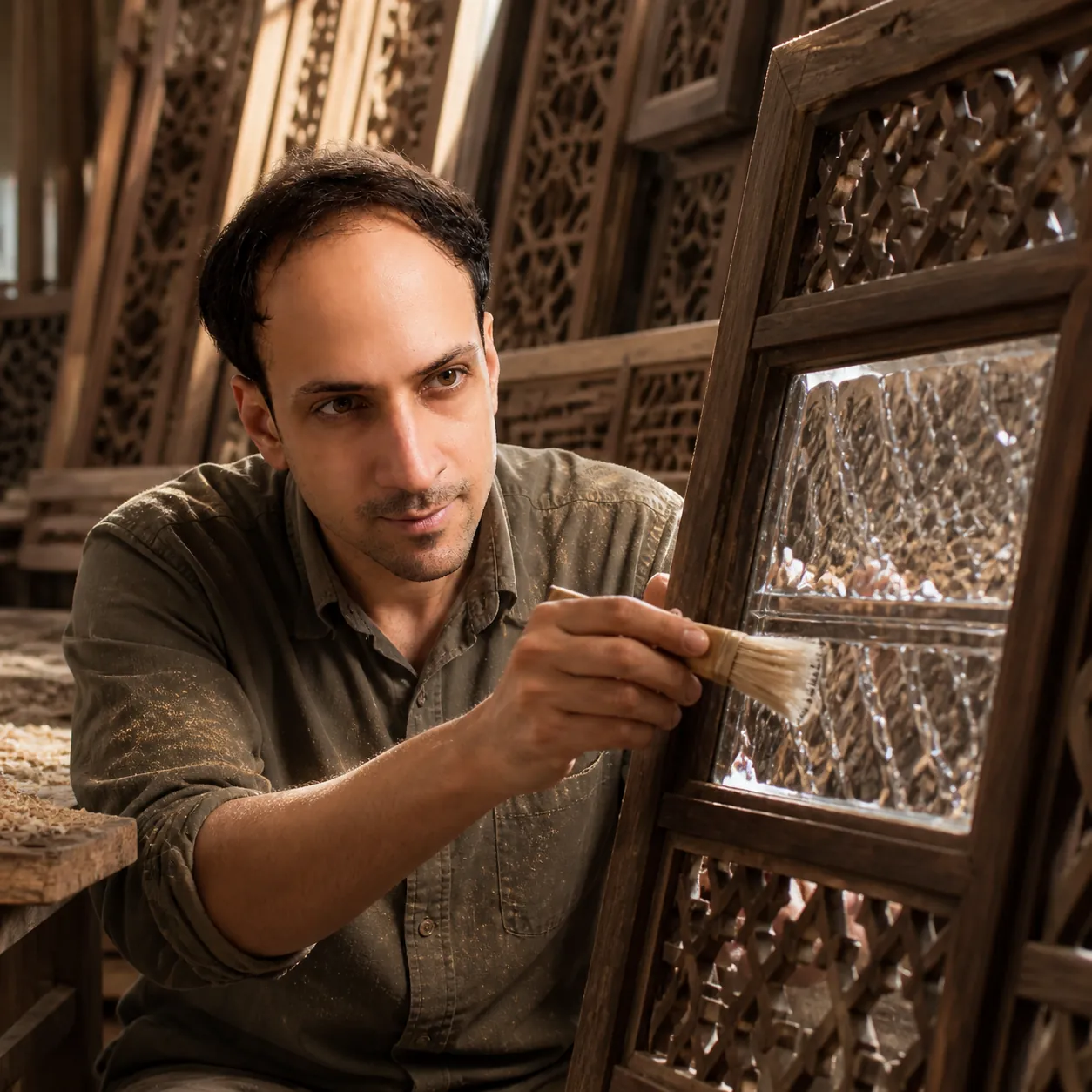
Difference Made Visible: Lattice Joinery Shop — AI Portrait Prompt
صورةAI Portraits

Turn your own photo into a portrait in a lattice joinery shop where carved cedar panels lean in ordered rows. Keeps your face unchanged.

من نص البرومبت

Use the attached reference photo as the identity reference: keep the same face, skin tone, hair and features as the person in that photo, without beautifying, aging or altering them. Treat that reference as the character anchor and change only the scene. Create a square 1:1 museum-catalog frame with a strong first read and a slower second read at exactly 2880x2880 pixels. Location: a lattice joinery shop where carved cedar panels lean in ordered rows. Show the subject in a dust-flecked khaki work shirt with sleeves rolled twice, brushing sawdust from one carved opening with a soft brush. The impossible-looking event must obey this clear system: a straight-lined sheet read through a panel of old hand-blown glass, whose frozen ripples fold the lines into standing waves summons a third pattern that belongs to neither layer alone. Explore how much of what we call motion is only comparison happening quickly; direct expression and posture toward grounded awe, never melodrama or ad-like confidence. Use a 50mm standpoint set exactly where the bands read strongest, with their face just off that axis. Make the composition give the emergent pattern more visual weight than either honest layer. Render it as high-concept interference portraiture built from genuinely overlapping physical patterns, large-format documentary clarity, hand-made material honesty, and patient architectural observation, using low raking sun that lets every layered shadow keep its true edge and a palette of pale plaster, carbon grey, and a muted date-brown. Photorealistic: this must read as a real photograph from a physical camera, never an illustration, painting, or 3D render. Resolve real surface detail: brass darkened in the recesses and bright where thumbs land, and lacquer crazed rather than perfect. Keep one identity-locked person, credible hands and fingers, natural fabric, and coherent scale, contact, reflections, shadows, airflow, deformation, and materials. Background people only when essential, always secondary and clearly different. Avoid op-art poster graphics, hypnotic spiral overlays, digital glitch scanlines, television static, and patterns projected across their face. No text, labels, logos, signatures, watermarks, random symbols, plastic skin, excessive bloom, or glossy AI finish.
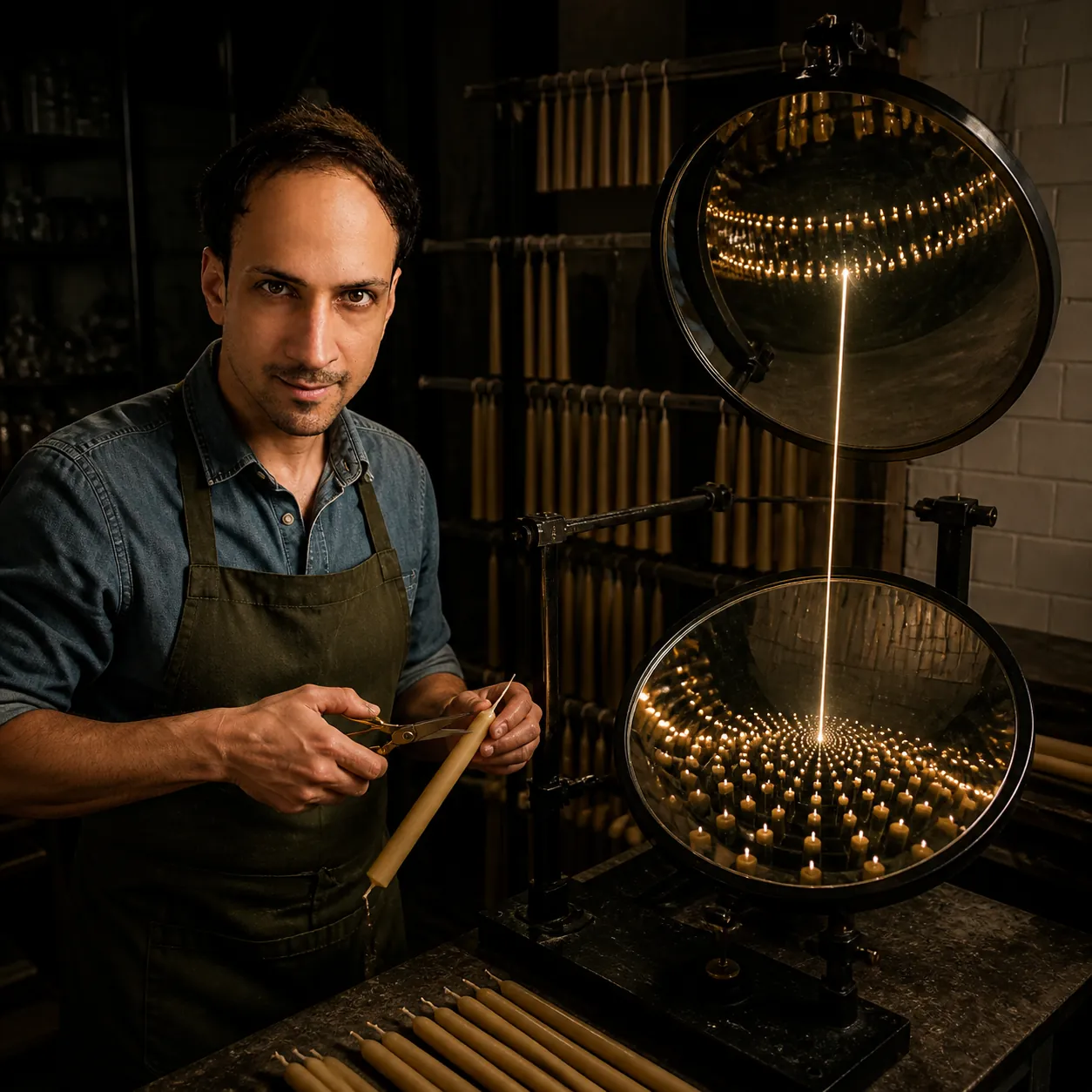
Lawful Recursion: Candle Maker's Back Room — AI Portrait Prompt
صورةAI Portraits

Turn your own photo into a high-concept optical portrait in a candle maker's back room with racked tapers cooling on rails. Keeps your face unchanged.

من نص البرومبت

Use the attached reference photo as the identity reference: keep the same face, skin tone, hair and features as the person in that photo, without beautifying, aging or altering them. Treat that reference as the character anchor and change only the scene. Create a square 1:1 museum-catalog frame with a strong first read and a slower second read at exactly 2880x2880 pixels. Location: a candle maker's back room with racked tapers cooling on rails. Show the subject in a waxed canvas apron over a rolled-sleeve chambray shirt, trimming one cooled wick square with small brass shears. Treat this mechanism as the frame’s governing rule: a pair of concave laboratory mirrors that folds one thin laser beam into an oval constellation of glowing spots turns one modest original into abundant company the eye can truly count. Explore where repetition actually ends, and what decides the final visible copy; direct expression and posture toward grounded awe, never melodrama or ad-like confidence. Frame from just off the mirror axis so the recession stays deep while their face appears exactly once. Make the composition let the recession deepen away from them, never toward their face. Render it as high-concept optical portraiture built from truthful mirror geometry, accurate reflection falloff, museum-demonstration staging, and calm documentary realism around one unrepeated person, using low house light dimmed until the repeated images become the brightest things and a palette of soot black, unpolished pewter, and one deep bottle green. Photorealistic: this must read as a real photograph from a physical camera, never an illustration, painting, or 3D render. Resolve real surface detail: grout darker than tile, sealant slightly yellowed, and every joint showing a real tolerance gap. Keep one identity-locked person, credible hands and fingers, natural fabric, and coherent scale, contact, reflections, shadows, airflow, deformation, and materials. Background people only when essential, always secondary and clearly different. Avoid duplicated faces, funhouse warps, endless-clone selfies, glowing portal tunnels, and CGI mirror shards. No text, labels, logos, signatures, watermarks, random symbols, plastic skin, excessive bloom, or glossy AI finish.
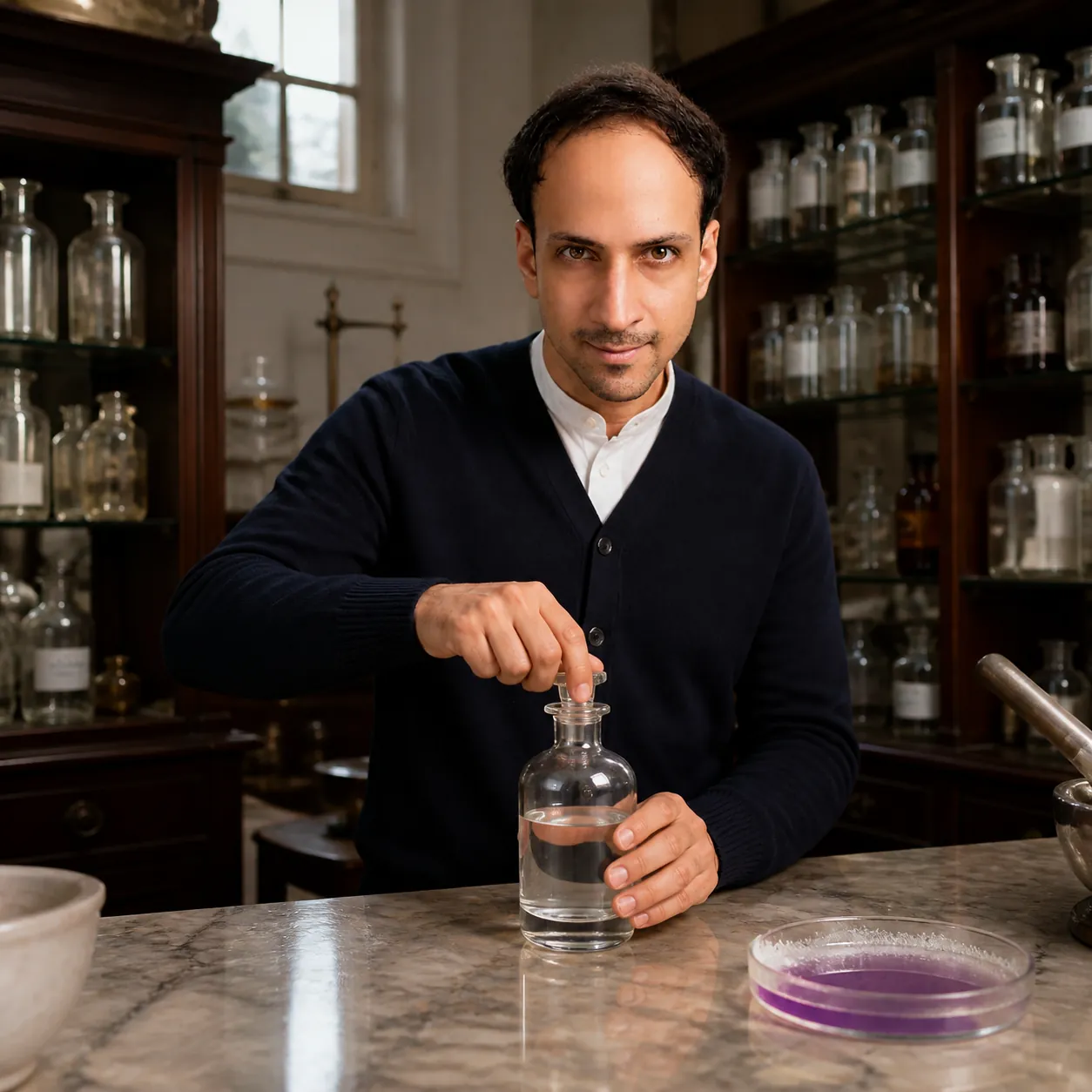
The Rush Back: Back Compounding Room — AI Portrait Prompt
صورةAI Portraits

Turn your own photo into a museum-demonstration portrait in the back compounding room of an old pharmacy, marble counter cleared. Keeps your face unchanged.

من نص البرومبت

Use the attached reference photo as the identity reference: keep the same face, skin tone, hair and features as the person in that photo, without beautifying, aging or altering them. Treat that reference as the character anchor and change only the scene. Create a square 1:1 museum-catalog frame with a strong first read and a slower second read at exactly 2880x2880 pixels. Location: the back compounding room of an old pharmacy, marble counter cleared. Show the subject in a fine navy cardigan buttoned over a white band-collar shirt, twisting a glass stopper into a reagent bottle's neck. Treat this mechanism as the frame’s governing rule: a shallow dish of supersaturated solution that a single touched seed has half converted, feathered white behind a moving front produces confident geometry in a place where nobody asked for any. Explore how one invisible instruction chooses the shape of everything that follows; direct expression and posture toward watchful respect, never melodrama or ad-like confidence. Frame slightly above their hands so vessel, hands, and face stack in one calm diagonal. Make the composition let ordinary glassware frame the geometry like museum casework. Render it as museum-demonstration realism combining faithful crystal optics, accurate refraction and caustics, patient editorial portrait craft, and unstyled working-room authenticity, using soft overcast daylight through high windows with shadows kept open and legible and a palette of putty, brushed steel, and one violet chrome-alum note. Photorealistic: this must read as a real photograph from a physical camera, never an illustration, painting, or 3D render. Resolve real surface detail: leather creased along the lines of use, stitching slightly irregular, and edges burnished from contact. Keep one identity-locked person, credible hands and fingers, natural fabric, and coherent scale, contact, reflections, shadows, airflow, deformation, and materials. Background people only when essential, always secondary and clearly different. Avoid wizard-laboratory props, neon translucent minerals, floating crystal shards, motion-smeared growth trails, and jewelry-advert sparkle. No text, labels, logos, signatures, watermarks, random symbols, plastic skin, excessive bloom, or glossy AI finish.
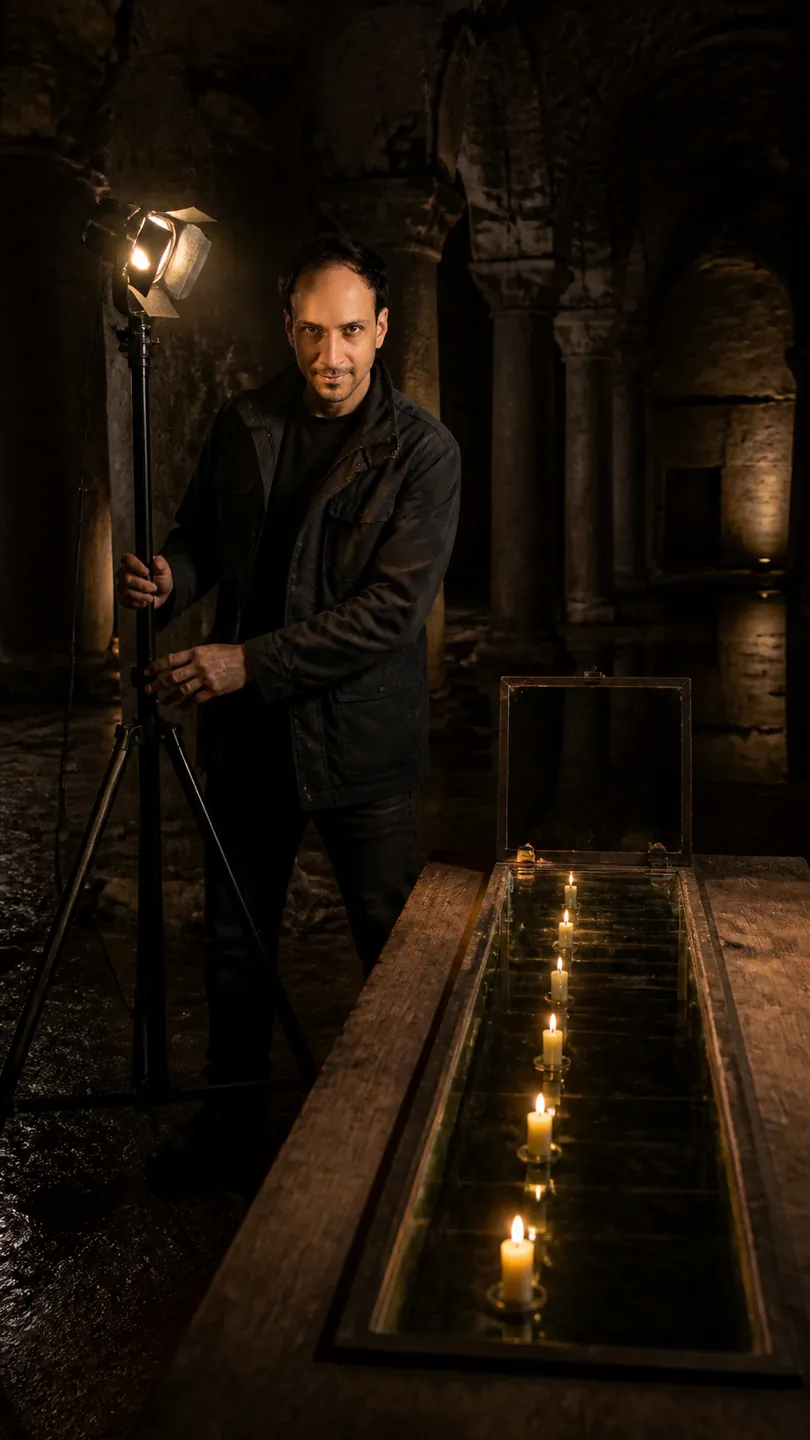
Honest Infinity: Restored Underground Stone Cistern — AI Portrait Prompt
صورةAI Portraits

Turn your own photo into a gallery-grade catoptric portrait in a restored underground stone cistern lit by one standing work lamp. Keeps your face unchanged.

من نص البرومبت

Use the attached reference photo as the identity reference: keep the same face, skin tone, hair and features as the person in that photo, without beautifying, aging or altering them. Design a full-height 9:16 cinematic artwork that reads on a phone and rewards gallery-scale inspection at exactly 2144x3808 pixels. Location: a restored underground stone cistern lit by one standing work lamp. Show the subject in a charcoal field jacket closed over a dark waffle henley, planting the work lamp's tripod firm on the uneven floor. Make one rigorous physical condition the conceptual engine: a narrow well of two horizontal mirrors, floor and lid, that repeats one candle flame into a colonnade sinking through the table leaves them beside the multiplication as its single, unduplicated human witness. Explore why an honest repetition can astonish more than any invented spectacle; direct expression and posture toward earned composure, never melodrama or ad-like confidence. Use a measured 32mm wide view with them at one-third and the apparatus honest, unstretched, and fully in frame. Make the composition keep them fully outside every reflective sightline, present exactly once. Render it as gallery-grade catoptric photography combining correct virtual-image spacing, honest generation-by-generation dimming, restrained art direction, and unhurried human presence, using controlled darkness with a single shielded lamp placed to miss every mirror and a palette of deep black, aged silver, and one candleflame amber. Photorealistic: this must read as a real photograph from a physical camera, never an illustration, painting, or 3D render. Give the space honest scale: real distance between foreground, subject, and far wall. Resolve real surface detail: glass with real thickness at its edge, reflections that carry the room's actual colour, and dust visible only at grazing angles. Keep one identity-locked person, credible hands and fingers, natural fabric, and coherent scale, contact, reflections, shadows, airflow, deformation, and materials. Background people only when essential, always secondary and clearly different. Avoid duplicated faces, funhouse warps, endless-clone selfies, glowing portal tunnels, and CGI mirror shards. No text, labels, logos, signatures, watermarks, random symbols, plastic skin, excessive bloom, or glossy AI finish.

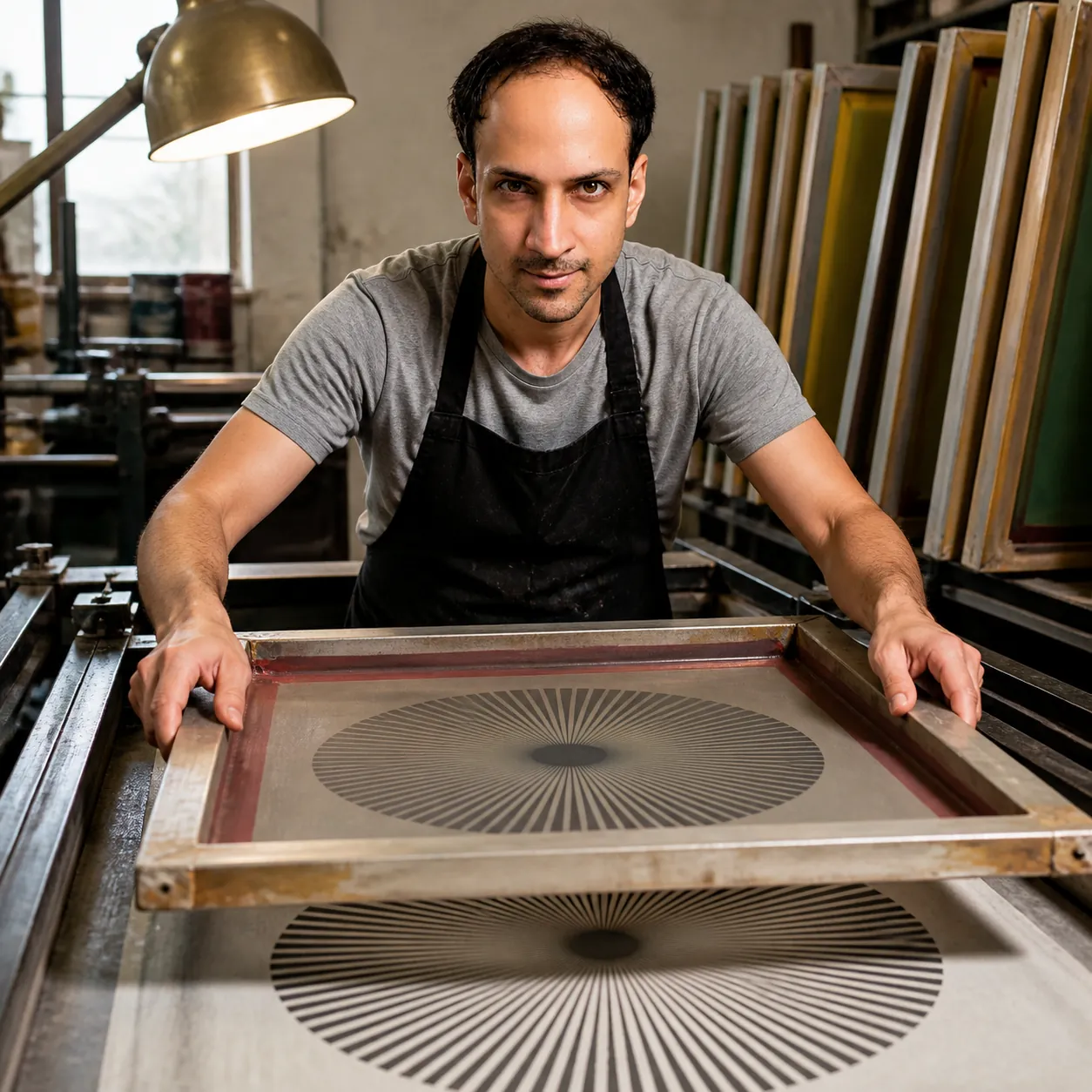
Almost Identical: Screen-Printing Workshop — AI Portrait Prompt
صورةAI Portraits

Turn your own photo into a portrait in a screen-printing workshop with taut mesh frames racked along one wall. Keeps your face unchanged.

من نص البرومبت

Use the attached reference photo as the identity reference: keep the same face, skin tone, hair and features as the person in that photo, without beautifying, aging or altering them. Treat that reference as the character anchor and change only the scene. Create a square 1:1 museum-catalog frame with a strong first read and a slower second read at exactly 2880x2880 pixels. Location: a screen-printing workshop with taut mesh frames racked along one wall. Show the subject in a black canvas shop apron over a heather-grey tee, lowering one mesh frame flat onto the vacuum table. Build the artwork around this material rule: a face-to-face pair of radially ruled discs, whose fringe spokes wheel through many degrees for each single degree of the top disc gives stillness a pulse the camera can record without any trick. Explore why amplification built from spacing alone feels more trustworthy than machinery; direct expression and posture toward quiet reckoning, never melodrama or ad-like confidence. Frame straight through the nearer pattern layer, its structure crisp while their eyes hold the true focus. Make the composition keep both source patterns readable at the edges as quiet evidence. Render it as quietly rigorous studio realism uniting layered handcrafted screens, physically exact interference behavior, restrained heritage styling, and dignified observational portraiture, using a single hard lamp placed to cast one clean, honest shadow and a palette of bone linen, graphite line-work, and a low brass accent. Photorealistic: this must read as a real photograph from a physical camera, never an illustration, painting, or 3D render. Resolve real surface detail: cotton that hangs by its own weight, seams that pucker very slightly, and collars softened by washing. Keep one identity-locked person, credible hands and fingers, natural fabric, and coherent scale, contact, reflections, shadows, airflow, deformation, and materials. Background people only when essential, always secondary and clearly different. Avoid kaleidoscope symmetry, fake motion blur, rainbow chromatic fringing, and funhouse distortion of their features. No text, labels, logos, signatures, watermarks, random symbols, plastic skin, excessive bloom, or glossy AI finish.