تخطَّ إلى المحتوى
f

faisal aziz

@alkhunizan

3000البرومبتات
0تصويتات مستلمة
0مساهمات
تاريخ الانضمام منذ 4 أشهر
3000 مساهمات في العام الماضي
نوفمبر
ديسمبر
يناير
فبراير
مارس
أبريل
مايو
يونيو
يوليو
أغسطس
سبتمبر
أكتوبر
ن
ر
ج
أقل
أكثر
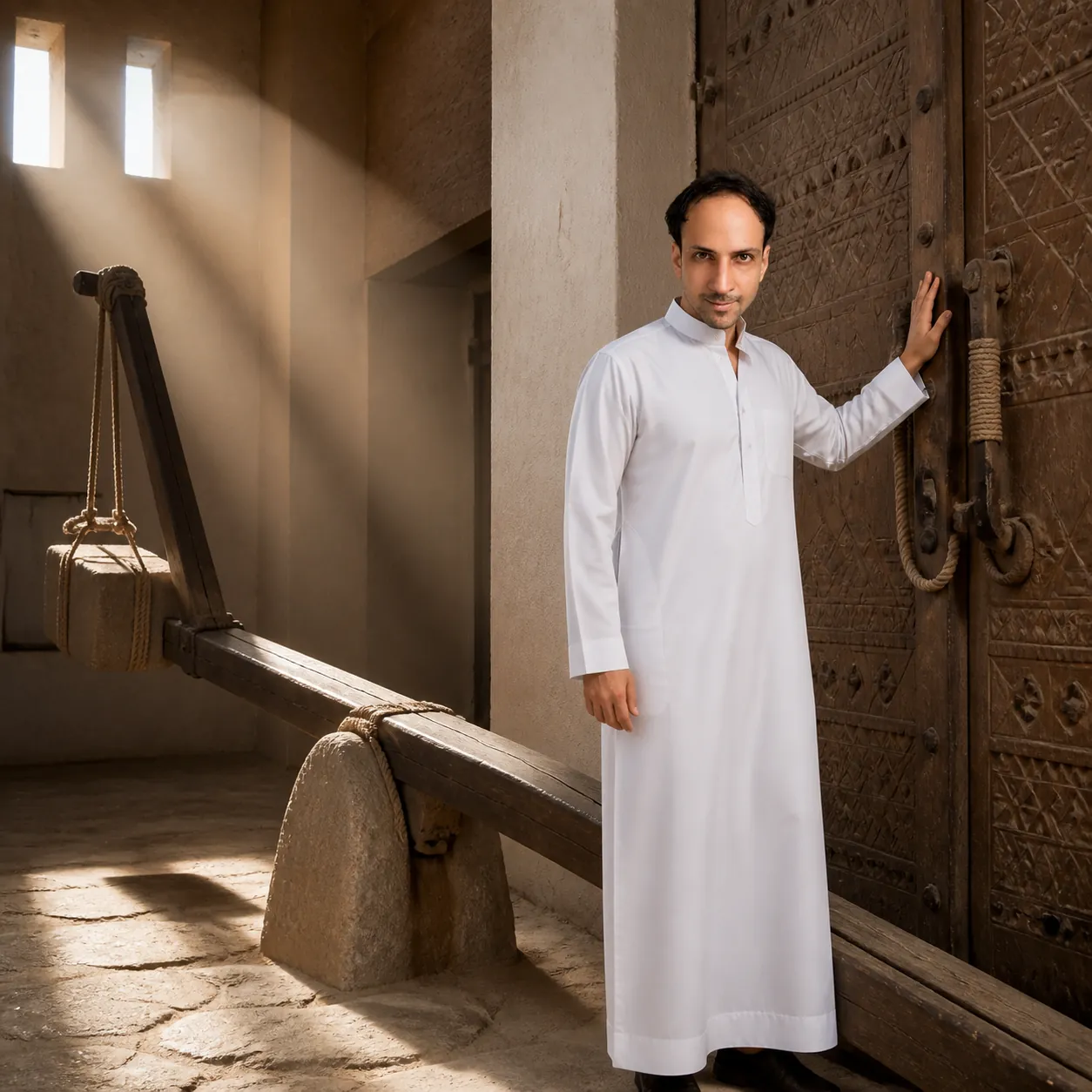
Deep Reserve: Najdi Gatehouse Passage — AI Portrait Prompt
صورةAI Portraits

Turn your own photo into a conceptual labor portrait in a Najdi gatehouse passage before tall carved timber doors. Keeps your face unchanged.

من نص البرومبت

Use the attached reference photo as the identity reference: keep the same face, skin tone, hair and features as the person in that photo, without beautifying, aging or altering them. Create a square 1:1 museum-catalog frame with a strong first read and a slower second read at exactly 2880x2880 pixels. Location: a Najdi gatehouse passage before tall carved timber doors. Show the subject in a crisp white everyday traditional Gulf outfit with an open collar, resting four fingertips against one door's carved edge. Use this advanced image-making device as the core logic: a long squared timber lever over a stone fulcrum, at whose far end one calm downward hand balances a dressed block turns a small, steady effort into the equal of crushing weight. Explore how strength stored in design differs from strength spent in strain; direct expression and posture toward quiet competence, never melodrama or ad-like confidence. Frame from a few steps back with the full rig visible, their figure honest against its scale. Make the composition keep every working line and bearing point sharp and traceable. Render it as conceptual labor portraiture uniting real counterweight physics, timber-and-rope craft authenticity, measured cinematic stillness, and quietly dignified working-portrait realism, using dusty shafts of high window light cut into slow diagonal beams and a palette of dust grey, dark rope tan, and muted olive. Photorealistic: this must read as a real photograph from a physical camera, never an illustration, painting, or 3D render. Resolve real surface detail: visible weave in cloth, fine scratches on metal, and the faint unevenness of painted walls. Keep one identity-locked person, credible hands and fingers, natural fabric, and coherent scale, contact, reflections, shadows, airflow, deformation, and materials. Background people only when essential, always secondary and clearly different. Avoid gym equipment, heroic strongman poses, bulging-vein close-ups, snapped-rope drama, and impossibly floating boulders. No text, labels, logos, signatures, watermarks, random symbols, plastic skin, excessive bloom, or glossy AI finish.
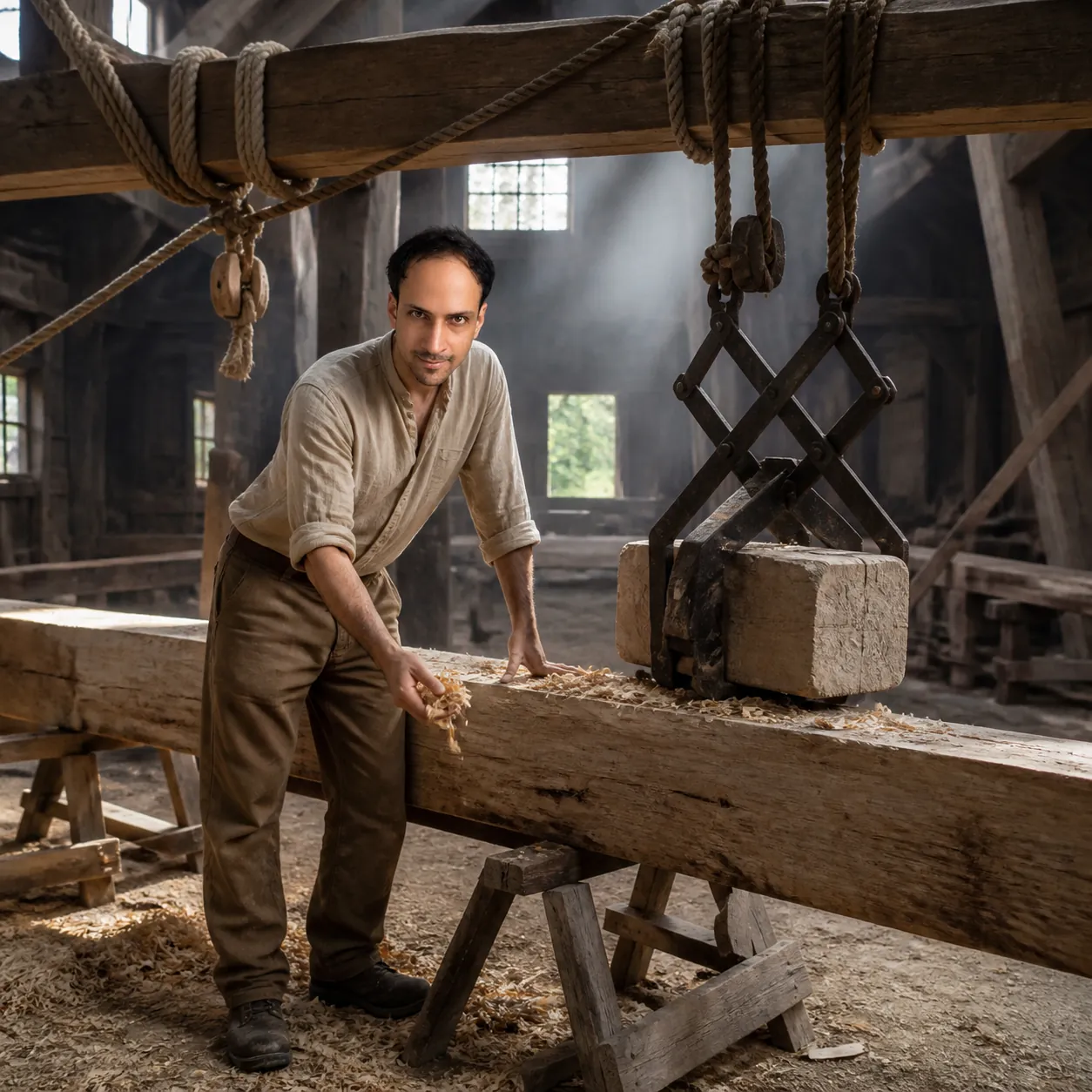
Force Deferred: Timber-Framing Hall — AI Portrait Prompt
صورةAI Portraits

Turn your own photo into a quiet working-rigging portrait in a timber-framing hall with fresh-sawn beams laid across paired trestles. Keeps your face unchanged.

من نص البرومبت

Use the attached reference photo as the identity reference: keep the same face, skin tone, hair and features as the person in that photo, without beautifying, aging or altering them. Create a square 1:1 museum-catalog frame with a strong first read and a slower second read at exactly 2880x2880 pixels. Location: a timber-framing hall with fresh-sawn beams laid across paired trestles. Show the subject in a wheat-colored linen shirt tucked into heavy cotton work trousers, clearing curled shavings off a beam with one cupped hand. Use this advanced image-making device as the core logic: a pair of scissor-jawed lifting tongs whose grip on a rough block tightens exactly as hard as its weight pulls down turns a small, steady effort into the equal of crushing weight. Explore why stored advantage is quietest at the exact moment it is greatest; direct expression and posture toward attentive ease, never melodrama or ad-like confidence. Frame from a few steps back with the full rig visible, their figure honest against its scale. Make the composition place the balance point exactly on a third line. Render it as quiet working-rigging portraiture built from lawful mechanical advantage, heavy documentary realism, hand-worn rope-and-timber materiality, and patient large-format editorial composition, using dusty shafts of high window light cut into slow diagonal beams and a palette of raw hemp, limestone grey, and one oxide-red band. Photorealistic: this must read as a real photograph from a physical camera, never an illustration, painting, or 3D render. Resolve real surface detail: wood grain read at honest scale, matte and gloss clearly separated, and no surface uniformly clean. Keep one identity-locked person, credible hands and fingers, natural fabric, and coherent scale, contact, reflections, shadows, airflow, deformation, and materials. Background people only when essential, always secondary and clearly different. Avoid gym equipment, heroic strongman poses, bulging-vein close-ups, snapped-rope drama, and impossibly floating boulders. No text, labels, logos, signatures, watermarks, random symbols, plastic skin, excessive bloom, or glossy AI finish.
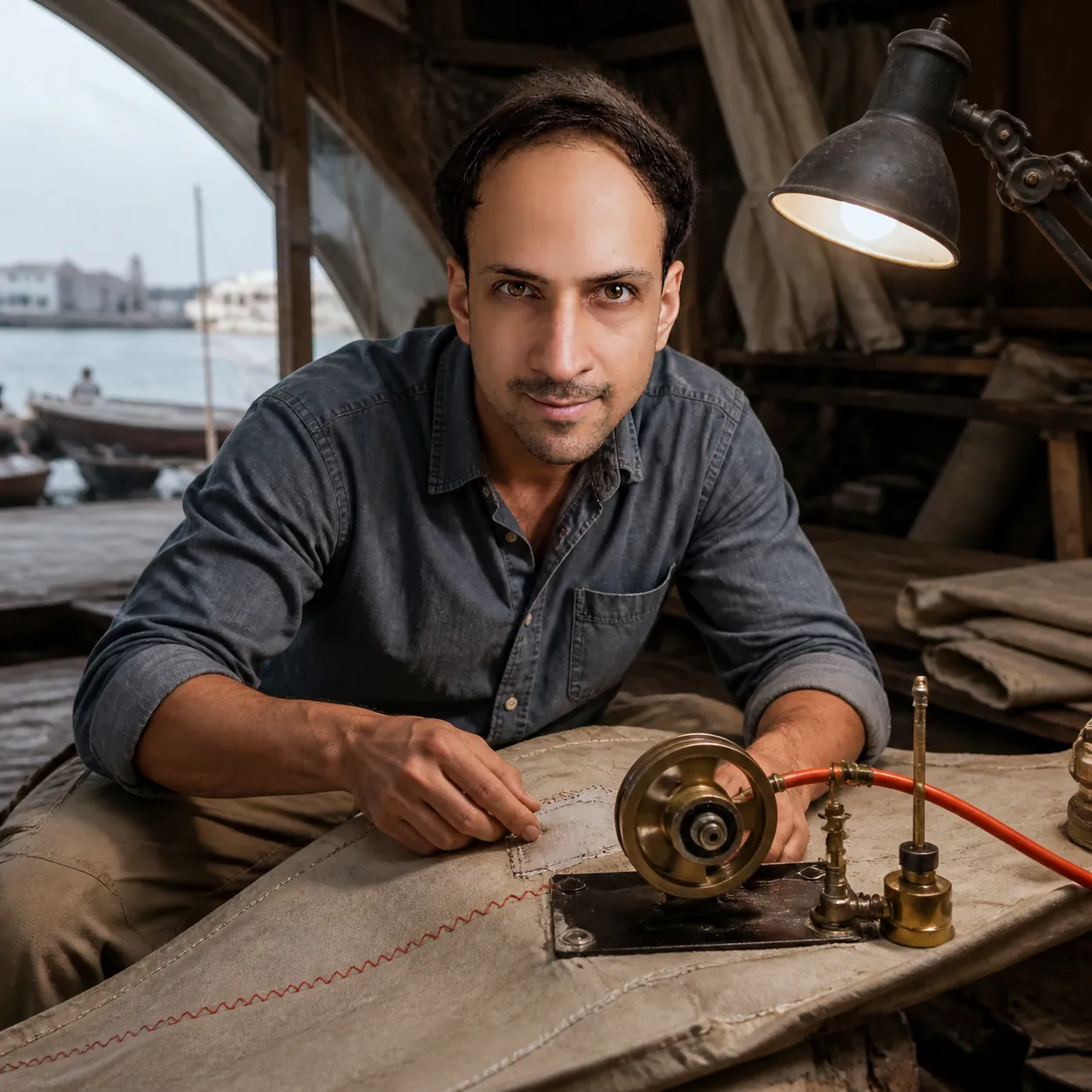
The Long Exhale: Sail-Repair Loft — AI Portrait Prompt
صورةAI Portraits

Turn your own photo into a workshop-instrument portrait in a sail-repair loft above a Jeddah boat shed, canvas rolled aside. Keeps your face unchanged.

من نص البرومبت

Use the attached reference photo as the identity reference: keep the same face, skin tone, hair and features as the person in that photo, without beautifying, aging or altering them. Create a square 1:1 museum-catalog frame with a strong first read and a slower second read at exactly 2880x2880 pixels. Location: a sail-repair loft above a Jeddah boat shed, canvas rolled aside. Show the subject in a faded chambray shirt rolled past the forearms over canvas trousers, pressing a patch seam flat with one slow thumbstroke. Treat this mechanism as the frame’s governing rule: a palm-sized brass turbine wheel that one smooth exhale spins up and leaves coasting on its jeweled bearing turns the body's most invisible act into a mechanism the eye can audit. Explore whether slowing the breath genuinely slows anything else worth naming; direct expression and posture toward steadied wonder, never melodrama or ad-like confidence. Frame at the instrument's working height so its smallest motion and their eyes read together. Make the composition center the instrument's stillest point and set them gently off-axis. Render it as workshop-instrument portraiture built from real pneumatic mechanisms, warm handcrafted materiality, patient documentary observation, and calibration marks rendered exactly legible, using a single hooded bench lamp pooling light around hands and instrument and a palette of slate grey, clear glass, and a madder-red thread. Photorealistic: this must read as a real photograph from a physical camera, never an illustration, painting, or 3D render. Resolve real surface detail: grout darker than tile, sealant slightly yellowed, and every joint showing a real tolerance gap. Keep one identity-locked person, credible hands and fingers, natural fabric, and coherent scale, contact, reflections, shadows, airflow, deformation, and materials. Background people only when essential, always secondary and clearly different. Avoid glowing breath vapor, swirling CGI air streaks, meditation-pose serenity, and dust motes in god rays. No text, labels, logos, signatures, watermarks, random symbols, plastic skin, excessive bloom, or glossy AI finish.
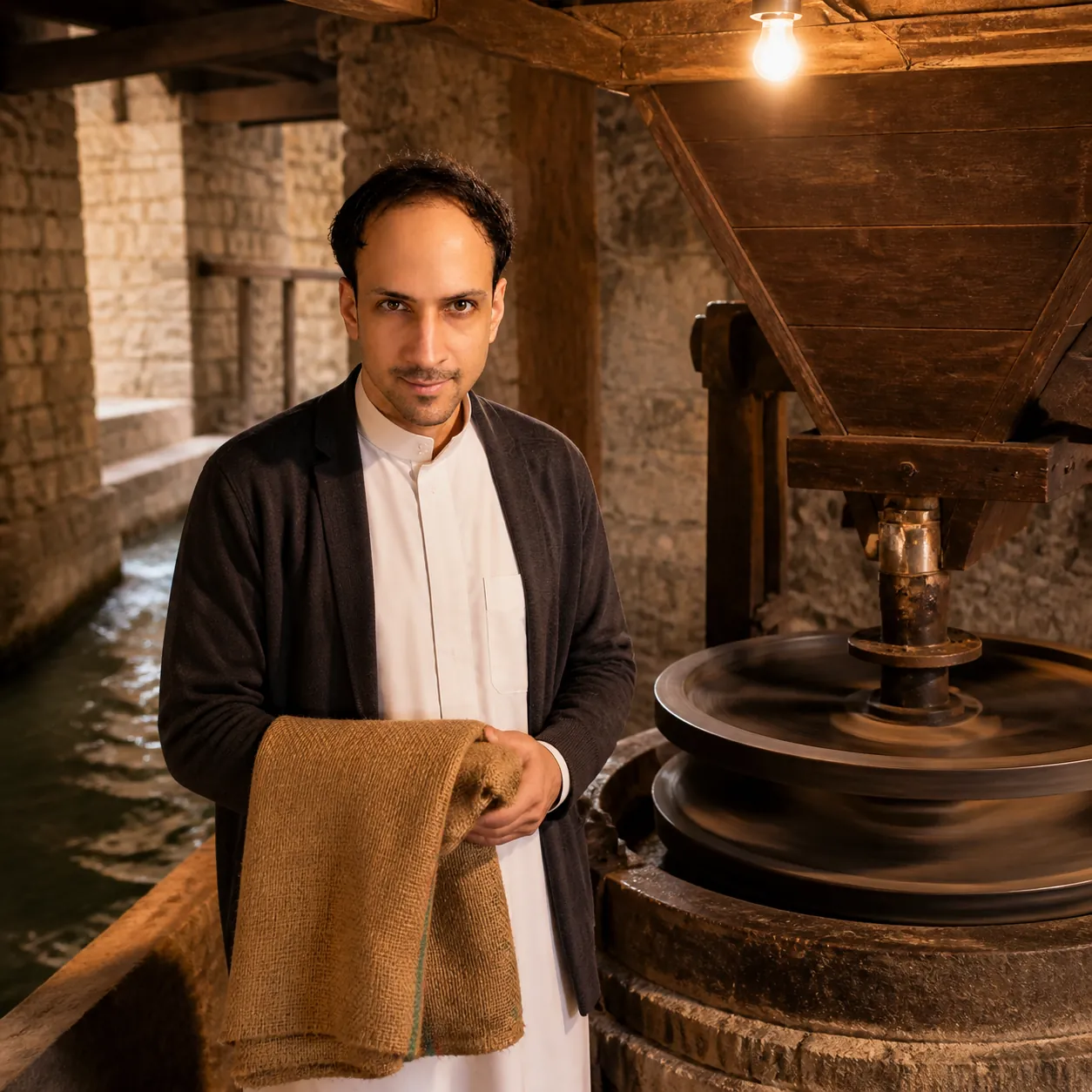
Banked Effort: Restored Stone Gristmill — AI Portrait Prompt
صورةAI Portraits

Turn your own photo into a museum-demonstration portrait in a restored stone gristmill in Al-Ahsa beside its quiet channel. Keeps your face unchanged.

من نص البرومبت

Use the attached reference photo as the identity reference: keep the same face, skin tone, hair and features as the person in that photo, without beautifying, aging or altering them. Create a square 1:1 museum-catalog frame with a strong first read and a slower second read at exactly 2880x2880 pixels. Location: a restored stone gristmill in Al-Ahsa beside its quiet channel. Show the subject in a crisp white traditional Gulf outfit under an open charcoal cardigan, folding an empty jute sack squarely over one forearm. Build the artwork around this material rule: a waist-high cast flywheel brought to speed by many light palm pushes, now coasting on its own banked momentum pays out only what was honestly deposited, yet the timing feels generous. Explore why small efforts stop feeling small the moment something visibly keeps them; direct expression and posture toward steady anticipation, never melodrama or ad-like confidence. Use a restrained 35mm view placing them beside the machine, neither dominating the other. Make the composition give the smallest moving part more presence than anything still. Render it as museum-demonstration realism combining truthful mechanical detail, high-fidelity portrait photography, audible-seeming moments of metal contact, and quietly restrained editorial art direction, using a single practical bulb above the mechanism with gentle ambient spill and a palette of raw pine, graphite, and a narrow copper gleam. Photorealistic: this must read as a real photograph from a physical camera, never an illustration, painting, or 3D render. Resolve real surface detail: dust settled where nobody wipes, fingerprint haze on glass, and edges rubbed pale by handling. Keep one identity-locked person, credible hands and fingers, natural fabric, and coherent scale, contact, reflections, shadows, airflow, deformation, and materials. Background people only when essential, always secondary and clearly different. Avoid Rube Goldberg clutter, floating holographic interfaces, trophy-shelf staging, neon motivational glow, and impossibly frictionless chrome machinery. No text, labels, logos, signatures, watermarks, random symbols, plastic skin, excessive bloom, or glossy AI finish.
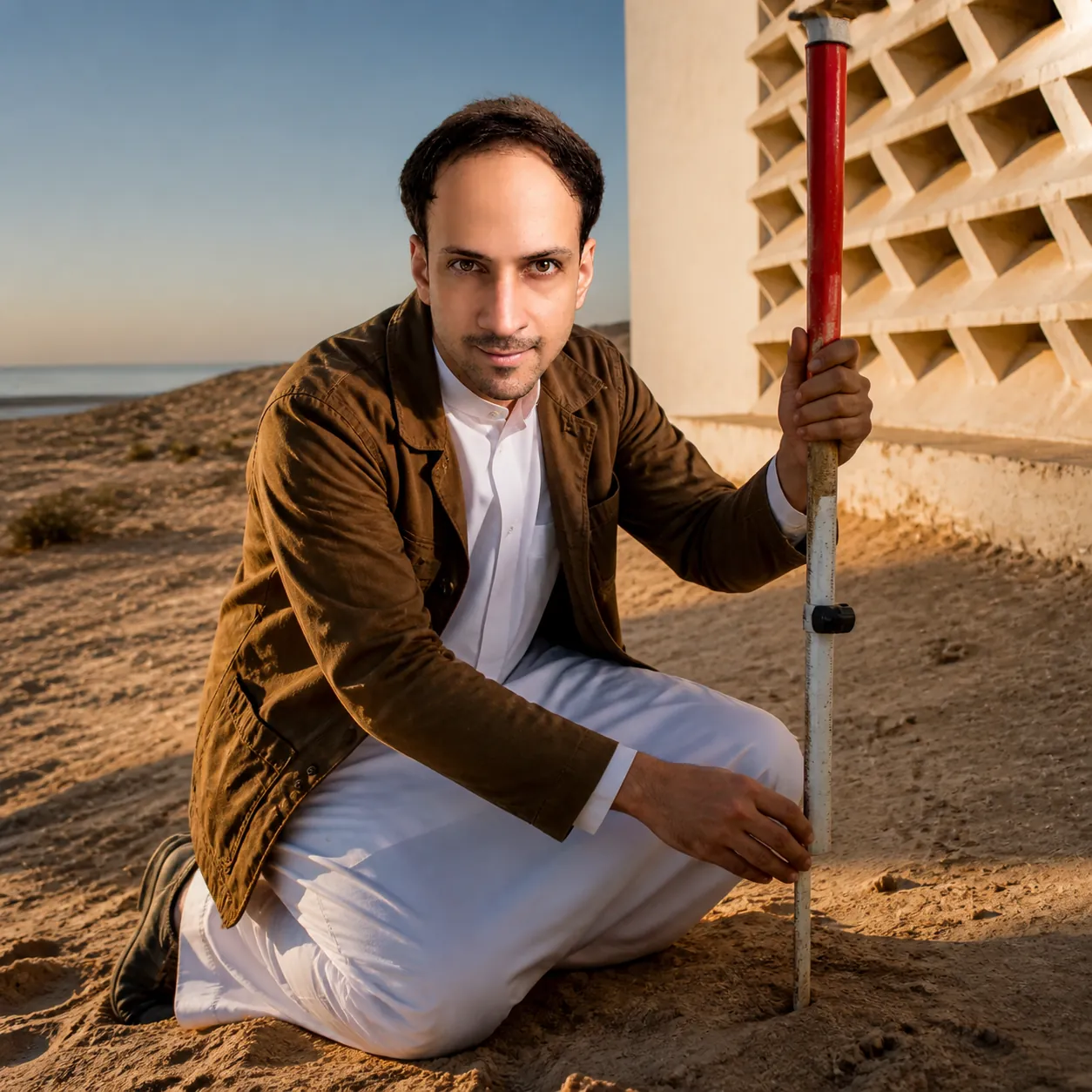
Lawful Brightness: Eastern Shoulder — AI Portrait Prompt
صورةAI Portraits

Turn your own photo into a conceptual daylight portrait in the eastern shoulder of a low dune minutes after clean sunrise. Keeps your face unchanged.

من نص البرومبت

Use the attached reference photo as the identity reference: keep the same face, skin tone, hair and features as the person in that photo, without beautifying, aging or altering them. Create a square 1:1 museum-catalog frame with a strong first read and a slower second read at exactly 2880x2880 pixels. Location: the eastern shoulder of a low dune minutes after clean sunrise. Show the subject in a warm brown chore coat over a plain white traditional Gulf outfit, planting a slender survey stake upright in the sand. Use this advanced image-making device as the core logic: a bank of degree-indexed louvres whose every notch admits a known geometric fraction of the full unfiltered beam makes the dose visible to the naked eye from across the room. Explore whether stone and plaster can hold a duty of care better than machinery; direct expression and posture toward modest certainty, never melodrama or ad-like confidence. Frame along the light's travel so its entry, its path, and its landing all stay legible in one view. Make the composition align one architectural line with the sun's incoming angle. Render it as conceptual daylight portraiture combining measured light apertures, honest shadow depth, warm mineral textures, and restrained editorial composition without artificial glow, using a single crisp-edged patch of daylight surrounded by deep readable shadow and a palette of dove grey, bleached canvas, and one warm ochre accent. Photorealistic: this must read as a real photograph from a physical camera, never an illustration, painting, or 3D render. Resolve real surface detail: rubber gone chalky with age, painted metal chipped to primer, and plastic yellowed only where light reaches it. Keep one identity-locked person, credible hands and fingers, natural fabric, and coherent scale, contact, reflections, shadows, airflow, deformation, and materials. Background people only when essential, always secondary and clearly different. Avoid tanning-salon imagery, golden-hour social-media grading, sunburst clock motifs, glowing skin retouching, and beams bending like spotlights. No text, labels, logos, signatures, watermarks, random symbols, plastic skin, excessive bloom, or glossy AI finish.
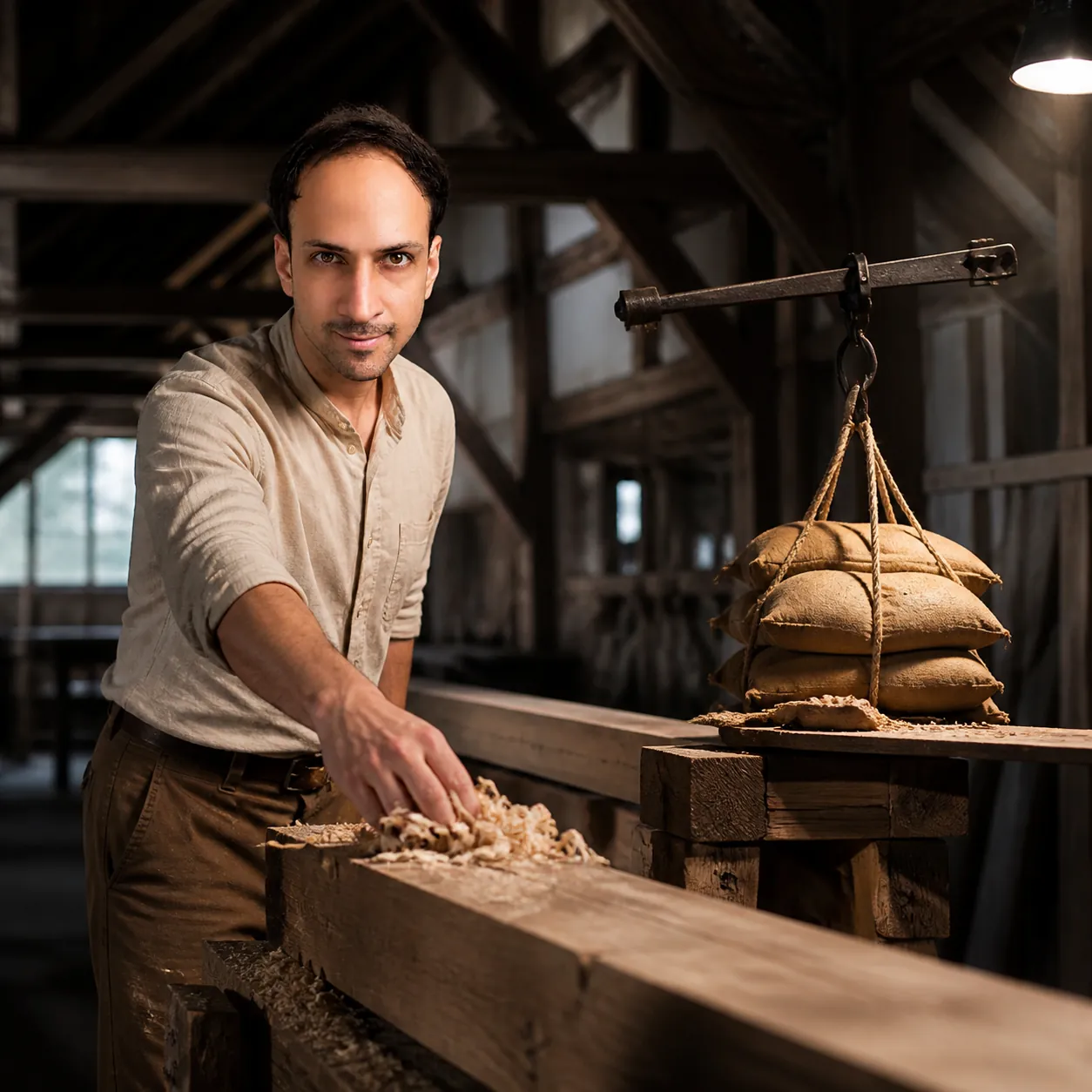
The Long Arm: Timber-Framing Hall — AI Portrait Prompt
صورةAI Portraits

Turn your own photo into a portrait in a timber-framing hall with fresh-sawn beams laid across paired trestles. Keeps your face unchanged.

من نص البرومبت

Use the attached reference photo as the identity reference: keep the same face, skin tone, hair and features as the person in that photo, without beautifying, aging or altering them. Create a square 1:1 museum-catalog frame with a strong first read and a slower second read at exactly 2880x2880 pixels. Location: a timber-framing hall with fresh-sawn beams laid across paired trestles. Show the subject in a wheat-colored linen shirt tucked into heavy cotton work trousers, clearing curled shavings off a beam with one cupped hand. The impossible-looking event must obey this clear system: an iron steelyard whose small sliding poise, nudged a hand-width outward along the arm, levels a hook of heavy sandbags makes mechanical advantage visible enough to be read at a glance. Explore whether ease that was engineered years ago still counts as their own strength; direct expression and posture toward unhurried resolve, never melodrama or ad-like confidence. Use an 85mm portrait lens focused on their hands, with the balanced load readable just beyond them. Make the composition run one unbroken structural line from hand to load. Render it as museum-grade demonstration photography combining true static balance, believable rigging detail, honest load-bearing structure, and restrained human-scale art direction, using one high work lamp shaded so the load sits in sculptural half-light and a palette of dust grey, dark rope tan, and muted olive. Photorealistic: this must read as a real photograph from a physical camera, never an illustration, painting, or 3D render. Resolve real surface detail: condensation beading at true size, liquid meniscus curving against glass, and wet surfaces darker than dry ones. Keep one identity-locked person, credible hands and fingers, natural fabric, and coherent scale, contact, reflections, shadows, airflow, deformation, and materials. Background people only when essential, always secondary and clearly different. Avoid neon fitness styling, sweat-spray action shots, cartoon oversized pulleys, crumbling CGI stone, and triumphant summit gestures. No text, labels, logos, signatures, watermarks, random symbols, plastic skin, excessive bloom, or glossy AI finish.
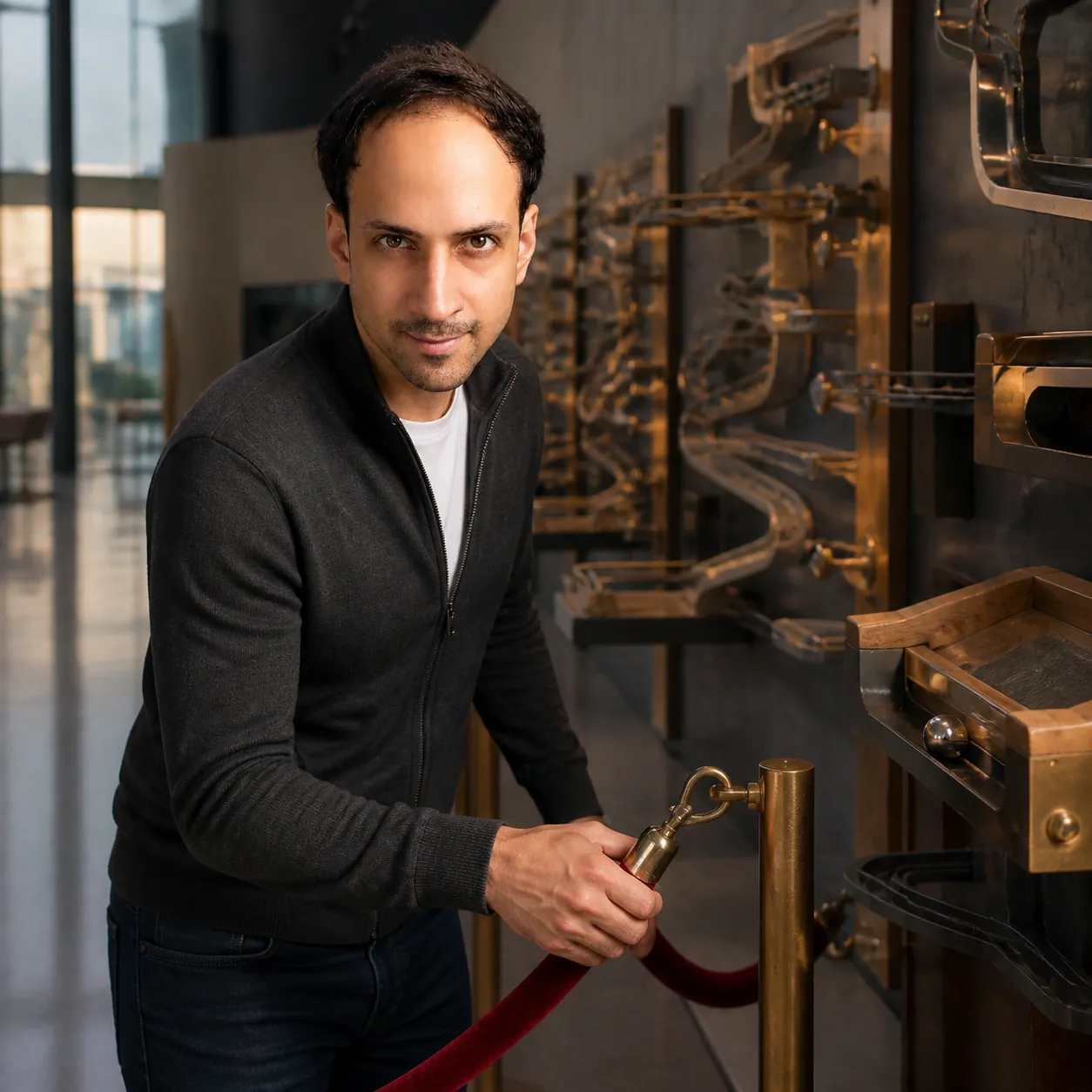
Earned Click: Hands-On Science Centre Hall — AI Portrait Prompt
صورةAI Portraits

Turn your own photo into a kinetic-mechanism portrait in a hands-on science centre hall in Riyadh, empty after closing. Keeps your face unchanged.

من نص البرومبت

Use the attached reference photo as the identity reference: keep the same face, skin tone, hair and features as the person in that photo, without beautifying, aging or altering them. Create a square 1:1 museum-catalog frame with a strong first read and a slower second read at exactly 2880x2880 pixels. Location: a hands-on science centre hall in Riyadh, empty after closing. Show the subject in a graphite zip cardigan over a white crew-neck and dark jeans, lifting a velvet rope hook to let themselves through. Make one rigorous physical condition the conceptual engine: a wall-length marble run whose brass gates open one per finished task, each release sending one steel ball farther down the course turns effort already spent into motion the body can plainly feel. Explore why a click the hand has earned satisfies more deeply than any praise; direct expression and posture toward earned satisfaction, never melodrama or ad-like confidence. Use an eye-level 50mm perspective that keeps both the mechanism and their hands honestly proportioned. Make the composition read left to right along the machine's direction of progress. Render it as kinetic-mechanism portraiture built from real working machines, documentary patience, warm workshop materiality, and composition that honors cause before effect, using late-afternoon window light raking across moving parts with soft bounced fill and a palette of worn oak, gunmetal grey, and one brass accent. Photorealistic: this must read as a real photograph from a physical camera, never an illustration, painting, or 3D render. Resolve real surface detail: true skin texture with pores and fine hair at the hairline, and fabric that creases where it is actually stressed. Keep one identity-locked person, credible hands and fingers, natural fabric, and coherent scale, contact, reflections, shadows, airflow, deformation, and materials. Background people only when essential, always secondary and clearly different. Avoid slot-machine iconography, glowing progress bars, cascading gold coins, cartoon gear mandalas, and confetti-burst celebration effects. No text, labels, logos, signatures, watermarks, random symbols, plastic skin, excessive bloom, or glossy AI finish.
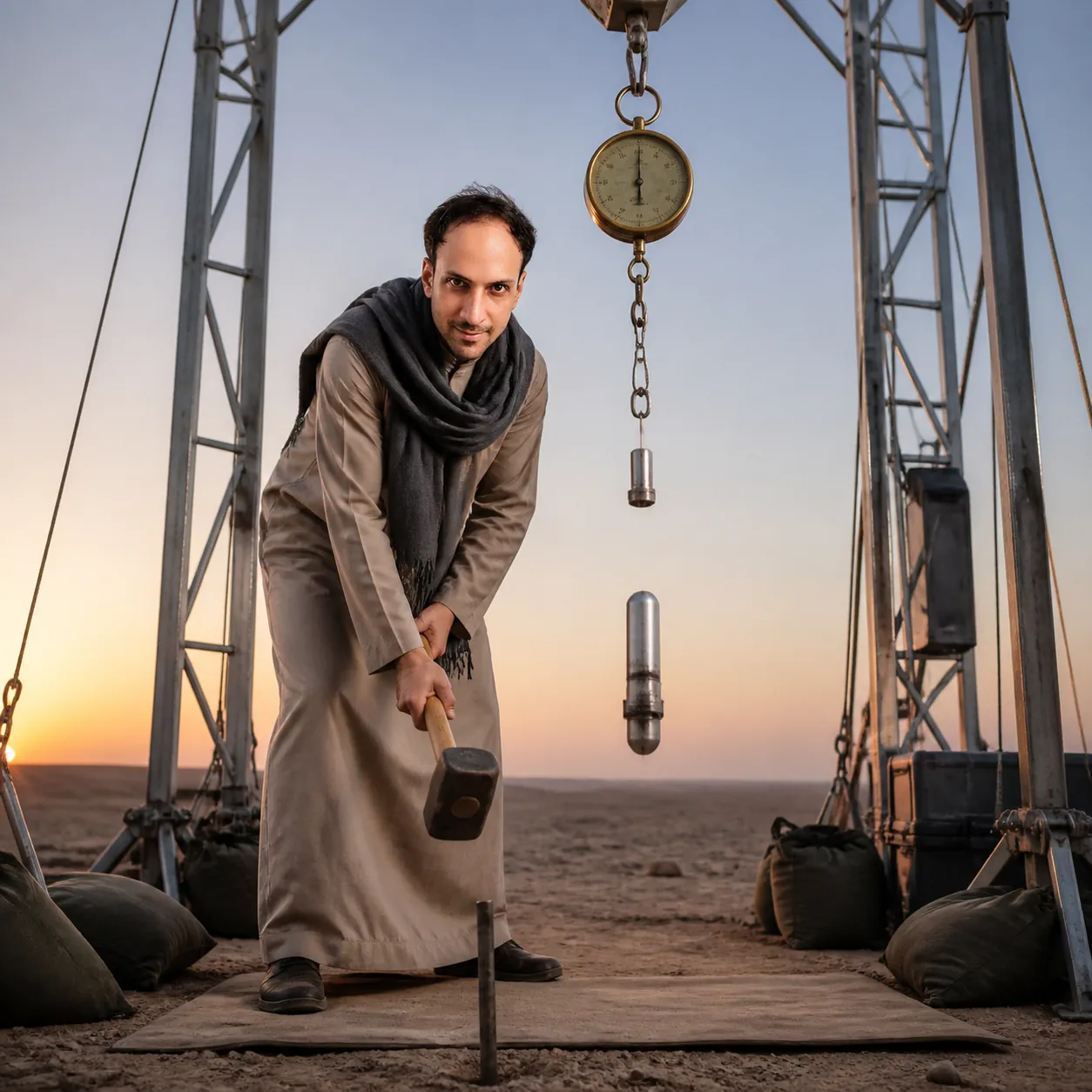
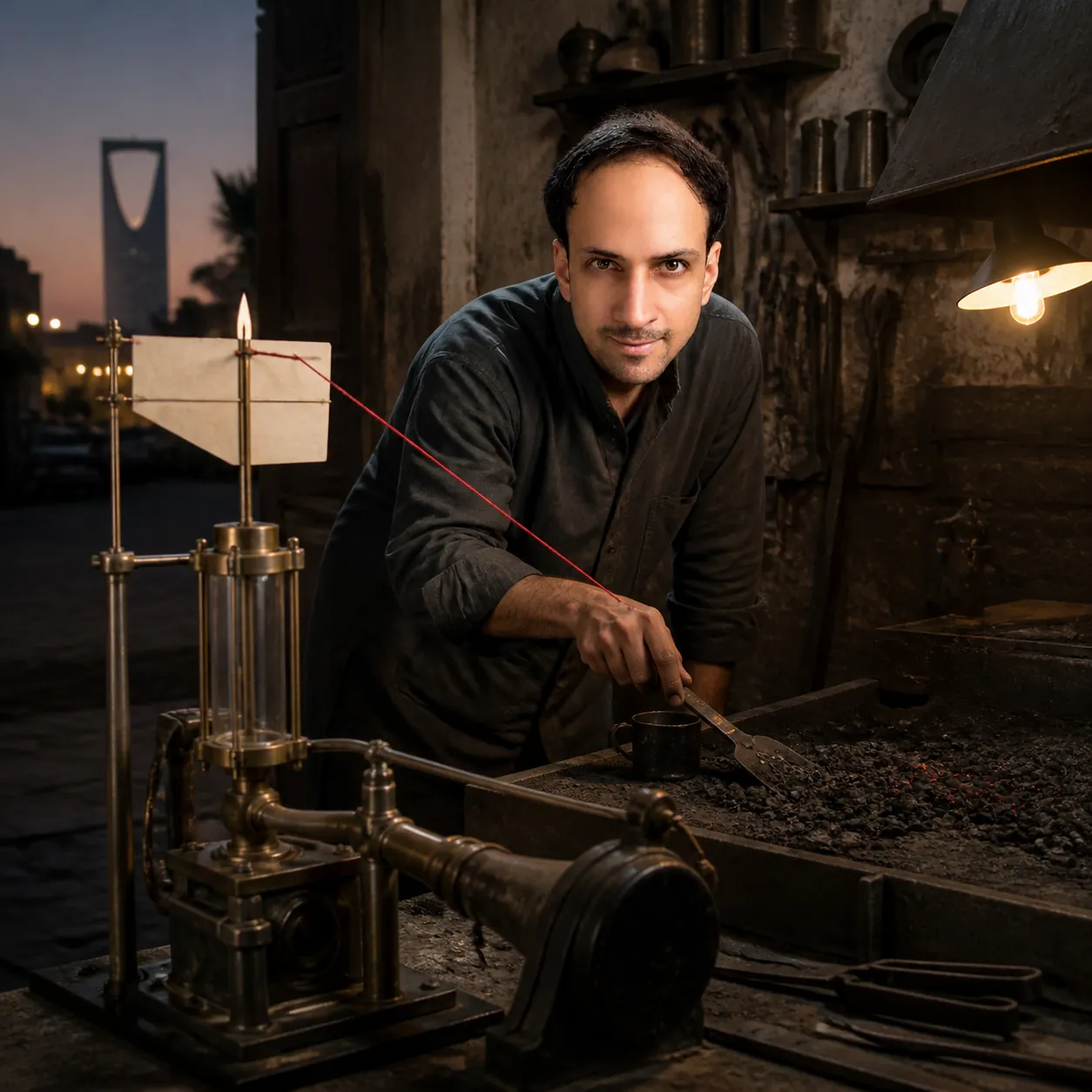
Slow Instrument: Small Riyadh Smithy — AI Portrait Prompt
صورةAI Portraits

Turn your own photo into a museum-demonstration portrait in a small Riyadh smithy at dusk, its forge banked low and quiet. Keeps your face unchanged.

من نص البرومبت

Use the attached reference photo as the identity reference: keep the same face, skin tone, hair and features as the person in that photo, without beautifying, aging or altering them. Create a square 1:1 museum-catalog frame with a strong first read and a slower second read at exactly 2880x2880 pixels. Location: a small Riyadh smithy at dusk, its forge banked low and quiet. Show the subject in a heavy cotton smock in iron grey over dark work trousers, banking the coals level with a flat iron blade. Build the artwork around this material rule: a counterweighted paper vane on a polished needle pivot that swings a marked arc and returns with every measured breath trains the breather as surely as the breather drives the machine. Explore why a steady small force outworks a strong unsteady one; direct expression and posture toward level patience, never melodrama or ad-like confidence. Frame from a few steps back through soft foreground objects, keeping their face and the mechanism sharp. Make the composition trace the air's path from source to reading in one line. Render it as museum-demonstration realism combining true fluid and pressure physics, brass-and-glass instrument finish, quiet editorial portrait light, and unexaggerated human presence, using quiet dusk ambience lifted by one warm tungsten practical near the work and a palette of slate grey, clear glass, and a madder-red thread. Photorealistic: this must read as a real photograph from a physical camera, never an illustration, painting, or 3D render. Resolve real surface detail: dust settled where nobody wipes, fingerprint haze on glass, and edges rubbed pale by handling. Keep one identity-locked person, credible hands and fingers, natural fabric, and coherent scale, contact, reflections, shadows, airflow, deformation, and materials. Background people only when essential, always secondary and clearly different. Avoid spa-candle arrangements, incense smoke spirals, neon waveform overlays, and saxophone music-video haze. No text, labels, logos, signatures, watermarks, random symbols, plastic skin, excessive bloom, or glossy AI finish.
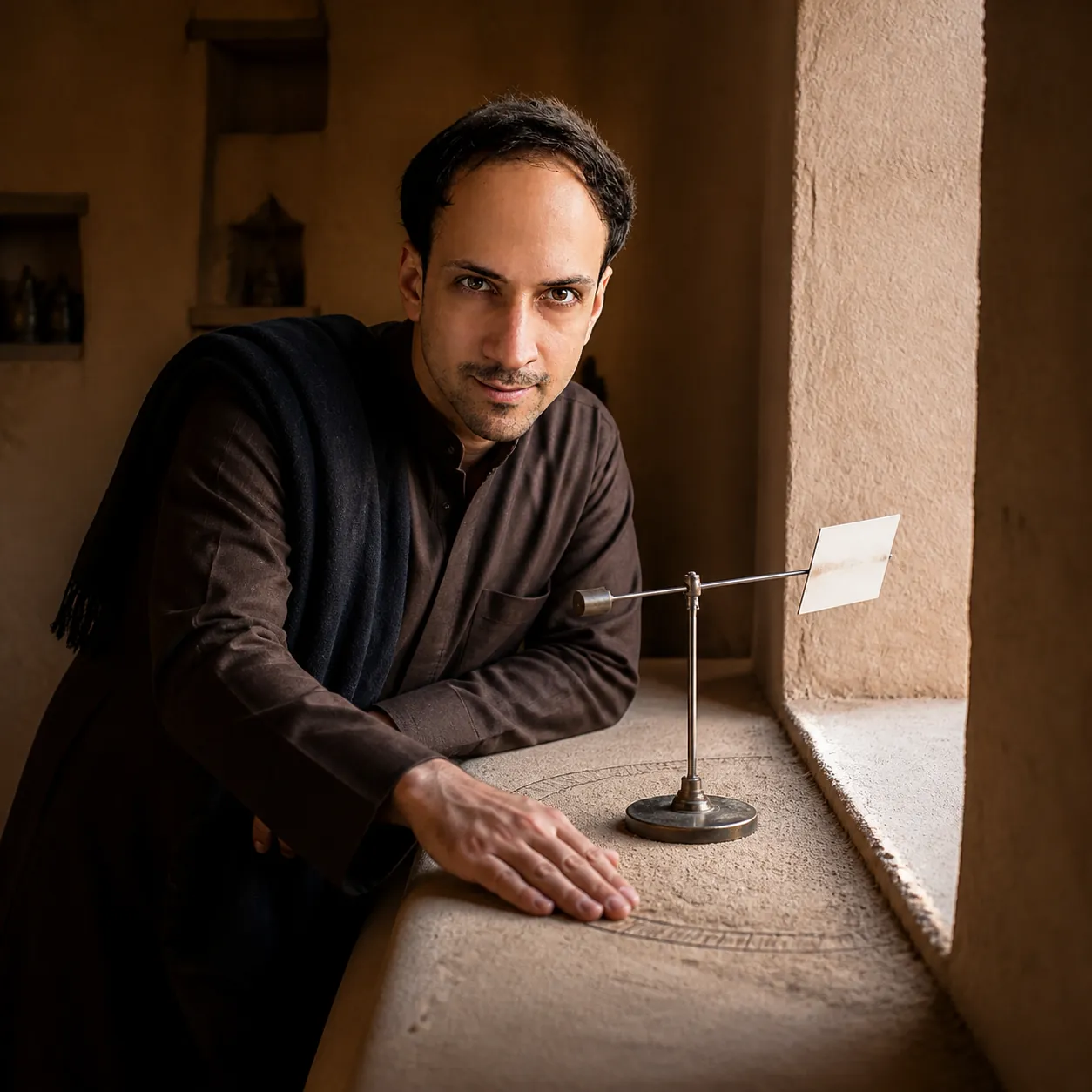
Weight Unwritten: Portable Drop-Test Gantry — AI Portrait Prompt
صورةAI Portraits

Turn your own photo into a photorealistic portrait in a portable drop-test gantry staked at the desert edge before sunrise. Keeps your face unchanged.

من نص البرومبت

Use the attached reference photo as the identity reference: keep the same face, skin tone, hair and features as the person in that photo, without beautifying, aging or altering them. Create a square 1:1 museum-catalog frame with a strong first read and a slower second read at exactly 2880x2880 pixels. Location: a portable drop-test gantry staked at the desert edge before sunrise. Show the subject in a plain beige traditional Gulf outfit under a charcoal shawl folded once, driving a stake flush with two mallet taps. Make one rigorous physical condition the conceptual engine: a brass spring scale carrying a full kilogram whose needle sinks to zero as the capsule drops away turns one honestly borrowed second into proof that weight is circumstance, not essence. Explore why buying one honest second can require a tower ten stories tall; direct expression and posture toward disciplined awe, never melodrama or ad-like confidence. Use an eye-level 55mm viewpoint with natural perspective, their planted stance sharing the frame with the floating demonstration. Make the composition stack one floating object directly above their planted feet. Render it as conceptual physics portraiture pairing genuine microgravity evidence, a falling-camera perspective, restrained contemporary art direction, and grounded human dignity, using low bounced tungsten off padded surfaces, holding gentle contrast on their face and a palette of desert dawn sand, steel grey, and muted teal. Photorealistic: this must read as a real photograph from a physical camera, never an illustration, painting, or 3D render. Resolve real surface detail: fine lint on dark fabric, water spotting on steel, and the soft rounding of edges that have been used for years. Keep one identity-locked person, credible hands and fingers, natural fabric, and coherent scale, contact, reflections, shadows, airflow, deformation, and materials. Background people only when essential, always secondary and clearly different. Avoid floating-hair astronaut poses, levitating people, swirling CGI water tentacles, and sci-fi antigravity glow. No text, labels, logos, signatures, watermarks, random symbols, plastic skin, excessive bloom, or glossy AI finish.
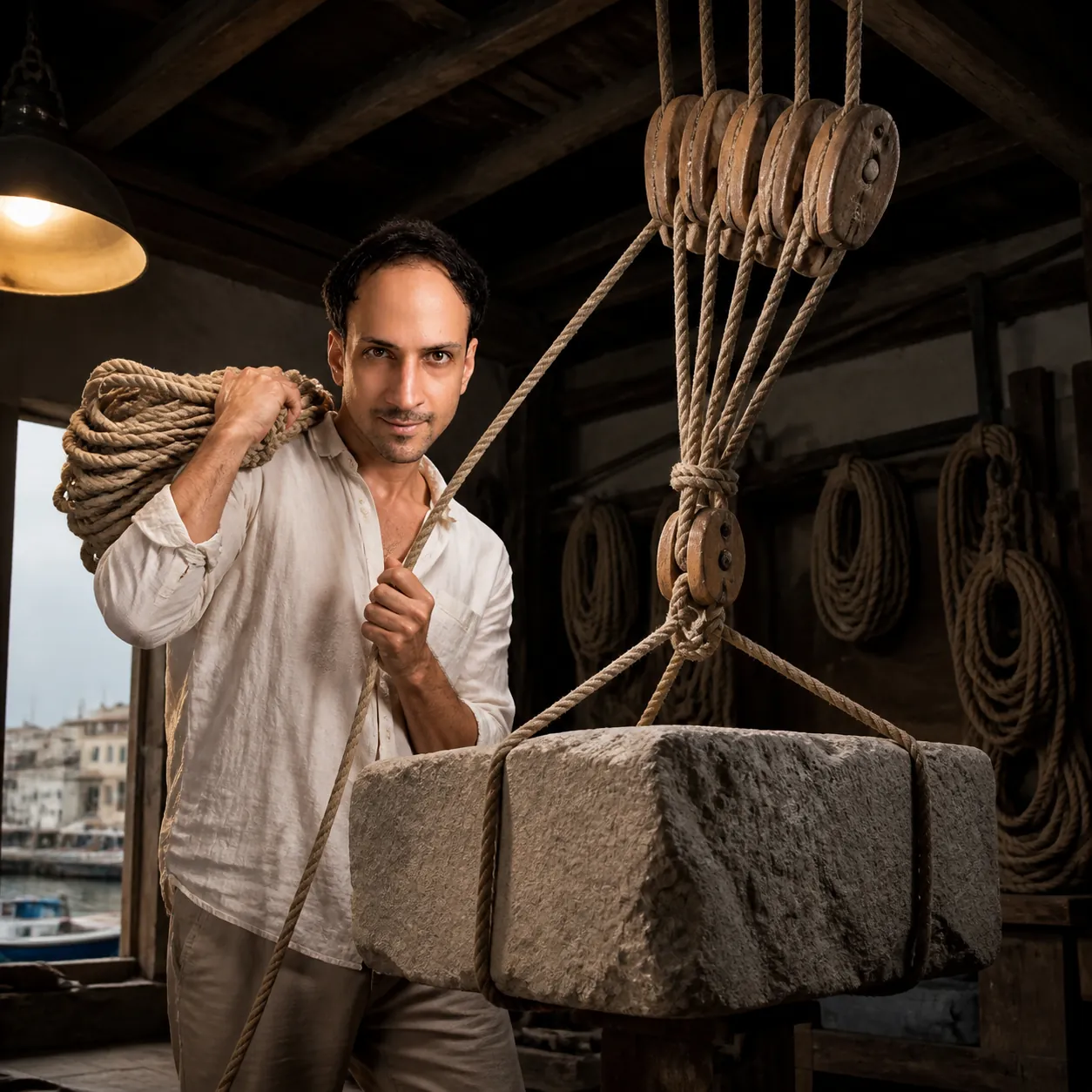
Slow Instrument: Restored Mud-Brick Room — AI Portrait Prompt
صورةAI Portraits

Turn your own photo into a photorealistic portrait in a restored mud-brick room in old Diriyah with one deep window. Keeps your face unchanged.

من نص البرومبت

Use the attached reference photo as the identity reference: keep the same face, skin tone, hair and features as the person in that photo, without beautifying, aging or altering them. Create a square 1:1 museum-catalog frame with a strong first read and a slower second read at exactly 2880x2880 pixels. Location: a restored mud-brick room in old Diriyah with one deep window. Show the subject in a winter-weight brown traditional Gulf outfit with a dark shawl folded on one shoulder, sweeping the deep windowsill clear with the side of one hand. Make one rigorous physical condition the conceptual engine: a counterweighted paper vane on a polished needle pivot that swings a marked arc and returns with every measured breath turns the body's most invisible act into a mechanism the eye can audit. Explore why a steady small force outworks a strong unsteady one; direct expression and posture toward attentive ease, never melodrama or ad-like confidence. Use a patient 85mm eye-level view with true perspective and a narrow, deliberate plane of focus. Make the composition center the instrument's stillest point and set them gently off-axis. Render it as gallery-grade mechanical still life extended to portraiture, lawful aerodynamic behavior, measured tonal restraint, and fine engraved-scale detail held sharp, using even indirect skylight softened further by high pale walls and a palette of warm oak, dull pewter, and muted bellows-leather tan. Photorealistic: this must read as a real photograph from a physical camera, never an illustration, painting, or 3D render. Resolve real surface detail: fine lint on dark fabric, water spotting on steel, and the soft rounding of edges that have been used for years. Keep one identity-locked person, credible hands and fingers, natural fabric, and coherent scale, contact, reflections, shadows, airflow, deformation, and materials. Background people only when essential, always secondary and clearly different. Avoid glowing breath vapor, swirling CGI air streaks, meditation-pose serenity, and dust motes in god rays. No text, labels, logos, signatures, watermarks, random symbols, plastic skin, excessive bloom, or glossy AI finish.
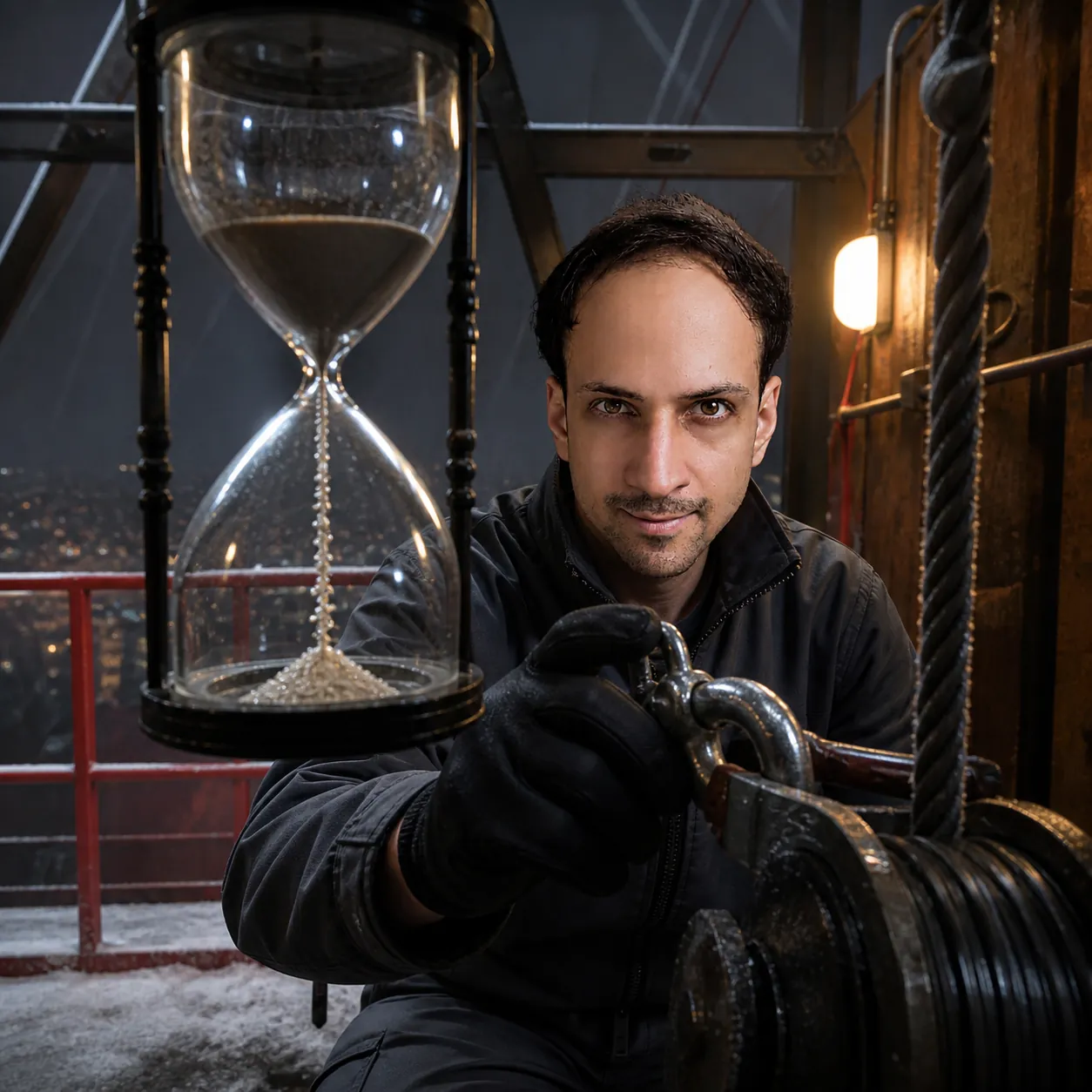
Quiet Leverage: Sail-Rigging Loft — AI Portrait Prompt
صورةAI Portraits

Turn your own photo into a heritage-engineering portrait in a sail-rigging loft above a Jeddah boatyard, coiled lines on pegs. Keeps your face unchanged.

من نص البرومبت

Use the attached reference photo as the identity reference: keep the same face, skin tone, hair and features as the person in that photo, without beautifying, aging or altering them. Create a square 1:1 museum-catalog frame with a strong first read and a slower second read at exactly 2880x2880 pixels. Location: a sail-rigging loft above a Jeddah boatyard, coiled lines on pegs. Show the subject in an open-weave cream shirt with both cuffs left unbuttoned, lifting a heavy coil of line onto one shoulder. Treat this mechanism as the frame’s governing rule: a five-sheave timber block-and-tackle through which their own seated bodyweight, applied to the fall rope, holds a quarried stone block level makes mechanical advantage visible enough to be read at a glance. Explore why a patient person with simple rigging outlifts a hurried, stronger one; direct expression and posture toward sober confidence, never melodrama or ad-like confidence. Use a low 35mm view from beside the load so its true scale presses against the frame. Make the composition place the balance point exactly on a third line. Render it as heritage-engineering realism built on accurate simple machines, tactile stone and hemp surfaces, deep architectural shadow, and slow considered framing, using one high work lamp shaded so the load sits in sculptural half-light and a palette of aged timber brown, chalk white, and deep tar black. Photorealistic: this must read as a real photograph from a physical camera, never an illustration, painting, or 3D render. Resolve real surface detail: paper fibre visible at cut edges, plastic that shows mould lines, and paint thicker where a brush turned. Keep one identity-locked person, credible hands and fingers, natural fabric, and coherent scale, contact, reflections, shadows, airflow, deformation, and materials. Background people only when essential, always secondary and clearly different. Avoid neon fitness styling, sweat-spray action shots, cartoon oversized pulleys, crumbling CGI stone, and triumphant summit gestures. No text, labels, logos, signatures, watermarks, random symbols, plastic skin, excessive bloom, or glossy AI finish.
Shared Fall: Winch Deck — AI Portrait Prompt
صورةAI Portraits

Turn your own photo into a working research-facility portrait in the winch deck at the tower's top, cables dropping into darkness. Keeps your face unchanged.

من نص البرومبت

Use the attached reference photo as the identity reference: keep the same face, skin tone, hair and features as the person in that photo, without beautifying, aging or altering them. Create a square 1:1 museum-catalog frame with a strong first read and a slower second read at exactly 2880x2880 pixels. Location: the winch deck at the tower's top, cables dropping into darkness. Show the subject in a slate softshell jacket zipped to mid-chest over grey trousers, checking a shackle pin with one gloved thumb. The impossible-looking event must obey this clear system: a large glass hourglass whose sand stops pouring mid-drop, the falling grains hanging in a paused column below the neck holds steady in frame only because the witness is falling too. Explore whether weight belongs to objects or to the situation holding them up; direct expression and posture toward steady astonishment, never melodrama or ad-like confidence. Use a 90mm near-far pairing: one suspended detail sharp near the lens and the person in the reference photo's grounded face readable beyond it. Make the composition hold every floating edge sharper than any grounded surface. Render it as working research-facility realism combining true free-fall fluid behavior, engineered-safety texture, unglamorous industrial surfaces, and quietly composed editorial portrait photography, using one warm console practical against cool ambient spill from high service lamps and a palette of charcoal, unpainted plywood, and one band of safety red. Photorealistic: this must read as a real photograph from a physical camera, never an illustration, painting, or 3D render. Resolve real surface detail: condensation beading at true size, liquid meniscus curving against glass, and wet surfaces darker than dry ones. Keep one identity-locked person, credible hands and fingers, natural fabric, and coherent scale, contact, reflections, shadows, airflow, deformation, and materials. Background people only when essential, always secondary and clearly different. Avoid space-station porthole backdrops, cartoon up-arrows, magically hovering furniture, dramatic slow-motion glass shatters, and superhero mid-air heroics. No text, labels, logos, signatures, watermarks, random symbols, plastic skin, excessive bloom, or glossy AI finish.
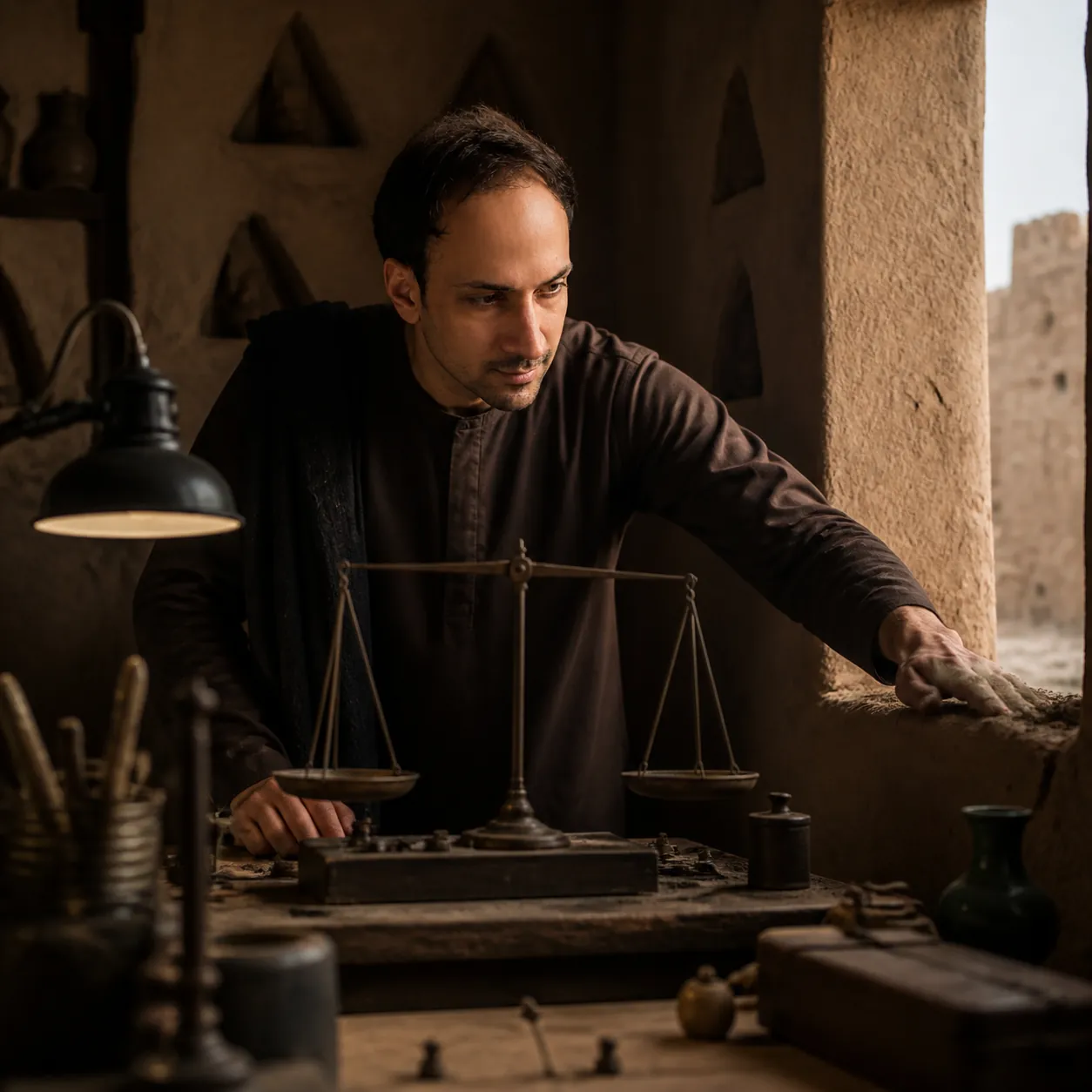
Kept Rhythm: Restored Mud-Brick Room — AI Portrait Prompt
صورةAI Portraits

Turn your own photo into a photorealistic portrait in a restored mud-brick room in old Diriyah with one deep window. Keeps your face unchanged.

من نص البرومبت

Use the attached reference photo as the identity reference: keep the same face, skin tone, hair and features as the person in that photo, without beautifying, aging or altering them. Create a square 1:1 museum-catalog frame with a strong first read and a slower second read at exactly 2880x2880 pixels. Location: a restored mud-brick room in old Diriyah with one deep window. Show the subject in a winter-weight brown traditional Gulf outfit with a dark shawl folded on one shoulder, sweeping the deep windowsill clear with the side of one hand. Build the artwork around this material rule: a knife-edge beam balance so delicate that a single directed breath presses one pan down a legible degree trains the breather as surely as the breather drives the machine. Explore how patience acquired at a bench travels home in the chest; direct expression and posture toward level patience, never melodrama or ad-like confidence. Frame from a few steps back through soft foreground objects, keeping their face and the mechanism sharp. Make the composition weight the frame low and steady, horizonless, like held breath. Render it as slow craft cinematography in a single still frame, honest air-driven motion, tactile bench-worn surfaces, and restrained heritage-modern art direction, using a single hooded bench lamp pooling light around hands and instrument and a palette of chalk white, deep umber, and one touch of verdigris. Photorealistic: this must read as a real photograph from a physical camera, never an illustration, painting, or 3D render. Resolve real surface detail: hair with individual strands catching light, short hairs of uneven length, and skin oil giving a low uneven sheen. Keep one identity-locked person, credible hands and fingers, natural fabric, and coherent scale, contact, reflections, shadows, airflow, deformation, and materials. Background people only when essential, always secondary and clearly different. Avoid spa-candle arrangements, incense smoke spirals, neon waveform overlays, and saxophone music-video haze. No text, labels, logos, signatures, watermarks, random symbols, plastic skin, excessive bloom, or glossy AI finish.
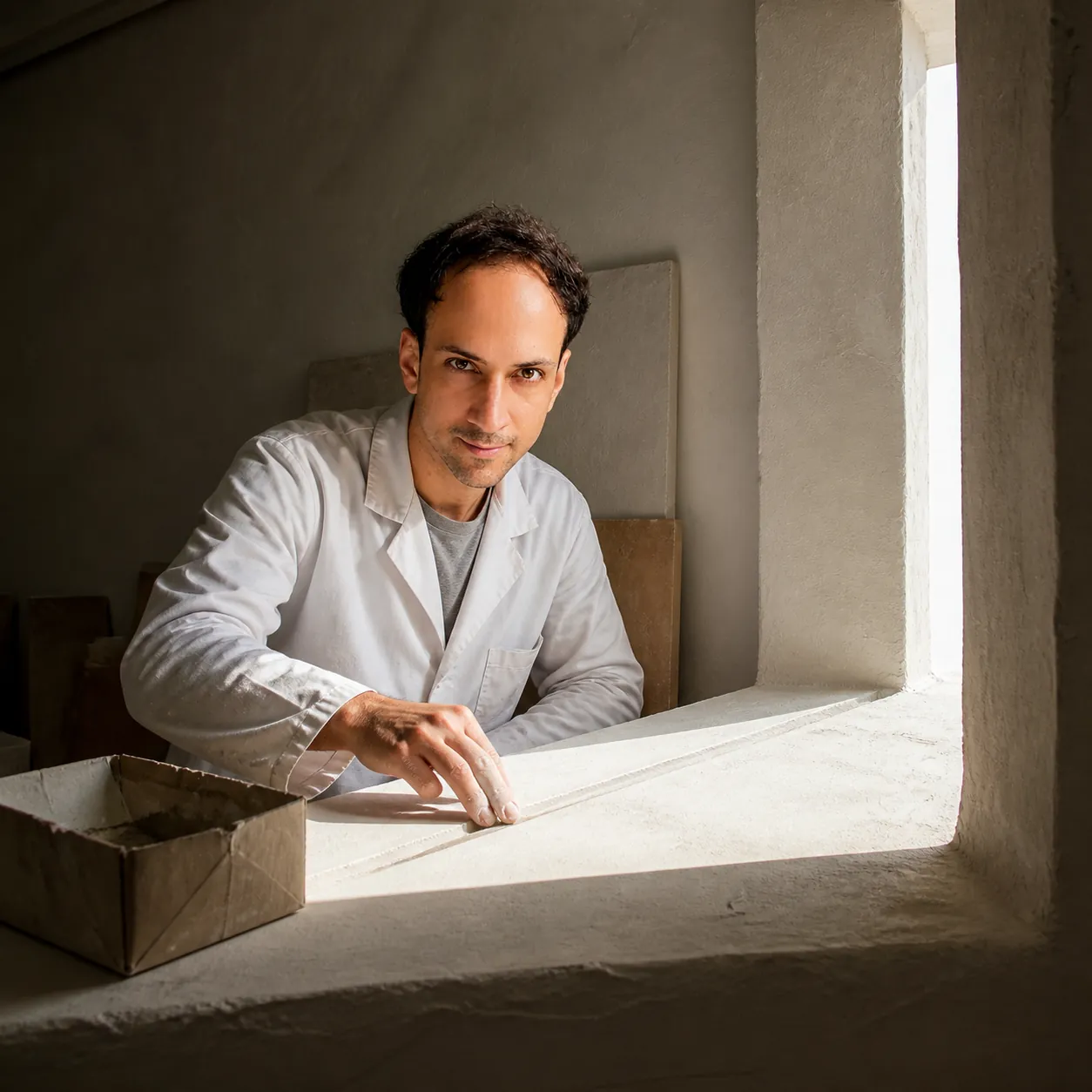
Sun Indoors: Plasterer's Studio — AI Portrait Prompt
صورةAI Portraits

Turn your own photo into a gallery-grade sun-study portrait in a plasterer's studio with sample walls raked by one tall window. Keeps your face unchanged.

من نص البرومبت

Use the attached reference photo as the identity reference: keep the same face, skin tone, hair and features as the person in that photo, without beautifying, aging or altering them. Create a square 1:1 museum-catalog frame with a strong first read and a slower second read at exactly 2880x2880 pixels. Location: a plasterer's studio with sample walls raked by one tall window. Show the subject in a white work smock over a grey tee, cuffs buttoned, brushing dust from an incised line with two fingers. Build the artwork around this material rule: a plaster alcove whose splayed window reveals are cut so the entering beam fills its floor completely and spills nowhere treats morning light as a nutrient with a dose, not a mood. Explore what it means to take the sun the way others take a remedy; direct expression and posture toward sober clarity, never melodrama or ad-like confidence. Use a 90mm portrait length with the beam's near edge crossing the foreground in believable sharpness. Make the composition keep the light's source small and its consequence large. Render it as gallery-grade sun-study photography built from lawful optics, physically exact beam edges, calm architectural framing, and patient observational realism, using a single crisp-edged patch of daylight surrounded by deep readable shadow and a palette of limewash white, raw plaster, and one honeyed bar. Photorealistic: this must read as a real photograph from a physical camera, never an illustration, painting, or 3D render. Resolve real surface detail: label-free packaging showing carton fibre, cardboard bruised at the corners, and tape lifting slightly at one end. Keep one identity-locked person, credible hands and fingers, natural fabric, and coherent scale, contact, reflections, shadows, airflow, deformation, and materials. Background people only when essential, always secondary and clearly different. Avoid god-ray haze shafts, lens-flare starbursts, glowing dust volumetrics, stained-glass rainbows, and any halo behind their head. No text, labels, logos, signatures, watermarks, random symbols, plastic skin, excessive bloom, or glossy AI finish.
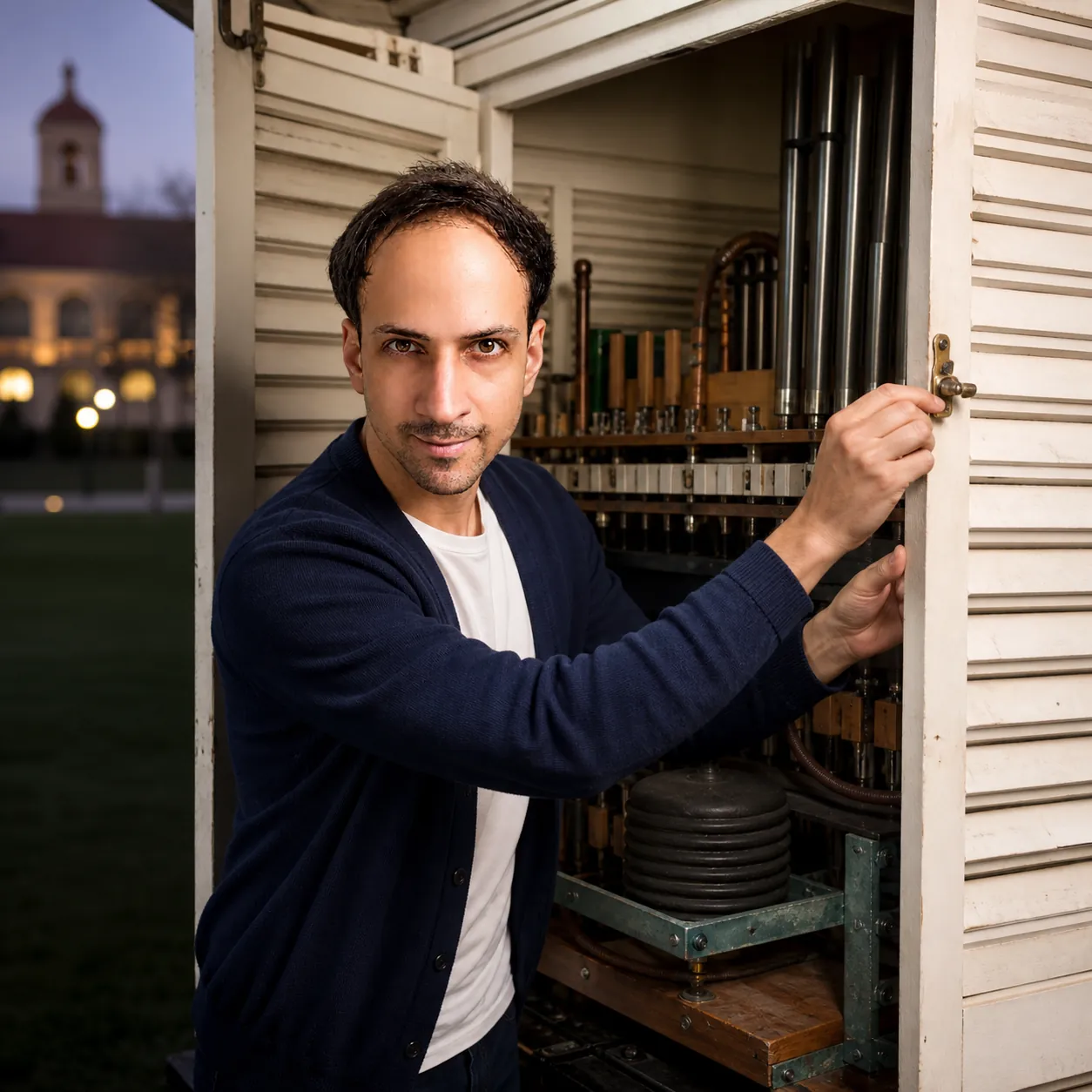
Tuned Patience: Louvered Instrument Shelter — AI Portrait Prompt
صورةAI Portraits

Turn your own photo into a workshop-instrument portrait in a louvered instrument shelter on a university lawn in still evening air. Keeps your face unchanged.

من نص البرومبت

Use the attached reference photo as the identity reference: keep the same face, skin tone, hair and features as the person in that photo, without beautifying, aging or altering them. Create a square 1:1 museum-catalog frame with a strong first read and a slower second read at exactly 2880x2880 pixels. Location: a louvered instrument shelter on a university lawn in still evening air. Show the subject in a fine-gauge navy cardigan over a white crew-neck tee, latching the shelter's louvered door back on its brass hook. Make one rigorous physical condition the conceptual engine: a ribbed reservoir bellows under a cast-iron weight that keeps one organ pipe speaking evenly between their strokes turns the body's most invisible act into a mechanism the eye can audit. Explore where the line runs between operating an instrument and being one; direct expression and posture toward quiet exactness, never melodrama or ad-like confidence. Use a patient 85mm eye-level view with true perspective and a narrow, deliberate plane of focus. Make the composition trace the air's path from source to reading in one line. Render it as workshop-instrument portraiture built from real pneumatic mechanisms, warm handcrafted materiality, patient documentary observation, and calibration marks rendered exactly legible, using even indirect skylight softened further by high pale walls and a palette of chalk white, deep umber, and one touch of verdigris. Photorealistic: this must read as a real photograph from a physical camera, never an illustration, painting, or 3D render. Resolve real surface detail: the difference between a wiped surface and a clean one, faint tide marks on ceramic, and metal dulled unevenly by touch. Keep one identity-locked person, credible hands and fingers, natural fabric, and coherent scale, contact, reflections, shadows, airflow, deformation, and materials. Background people only when essential, always secondary and clearly different. Avoid glowing breath vapor, swirling CGI air streaks, meditation-pose serenity, and dust motes in god rays. No text, labels, logos, signatures, watermarks, random symbols, plastic skin, excessive bloom, or glossy AI finish.
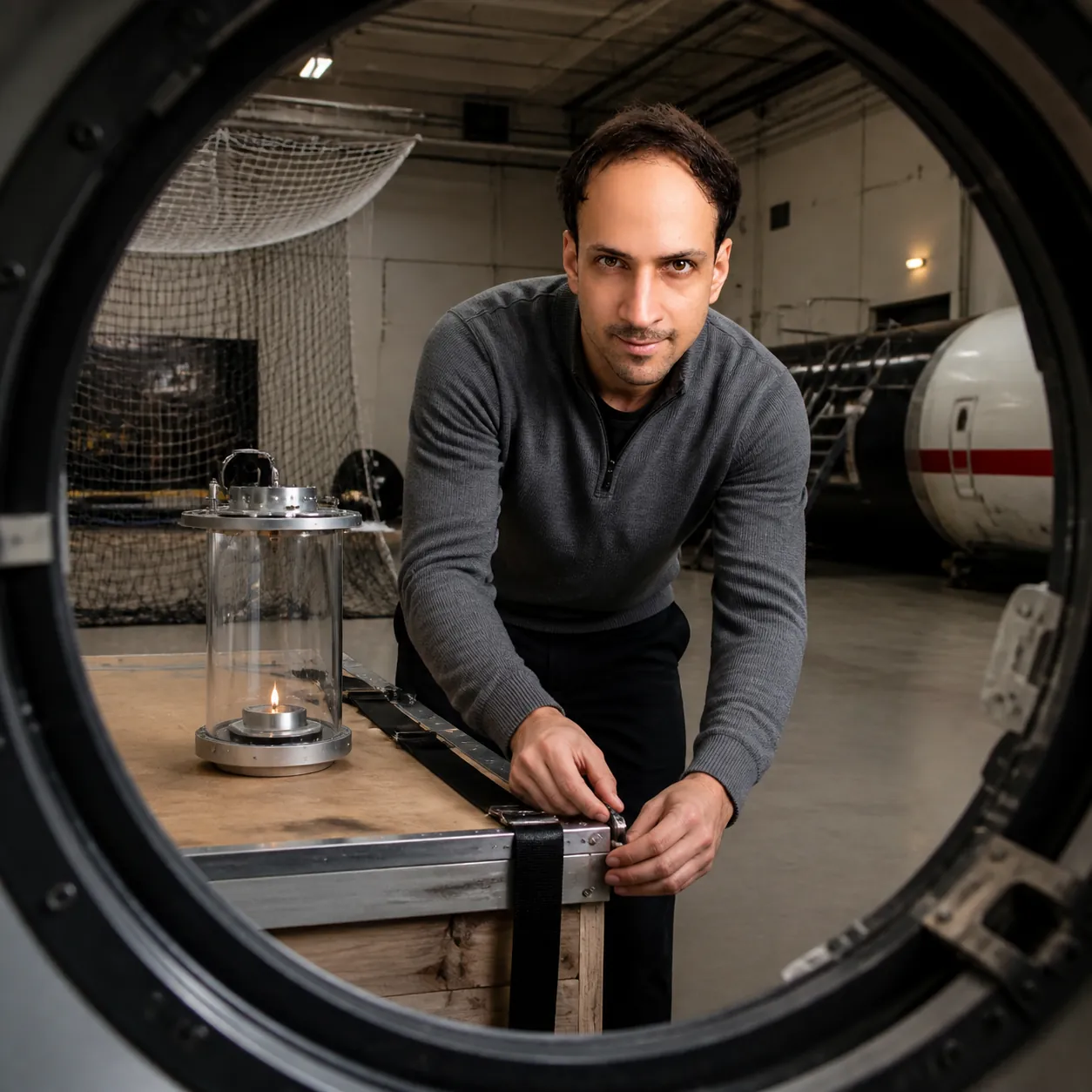
Borrowed Second: Quiet Hangar Corner — AI Portrait Prompt
صورةAI Portraits

Turn your own photo into a photorealistic portrait in a quiet hangar corner where a parabolic-flight prep table stands ready. Keeps your face unchanged.

من نص البرومبت

Use the attached reference photo as the identity reference: keep the same face, skin tone, hair and features as the person in that photo, without beautifying, aging or altering them. Create a square 1:1 museum-catalog frame with a strong first read and a slower second read at exactly 2880x2880 pixels. Location: a quiet hangar corner where a parabolic-flight prep table stands ready. Show the subject in a mid-grey flight-crew sweater over pressed dark trousers, buckling a loose strap flat against the table edge. Use this advanced image-making device as the core logic: a small candle flame inside the falling capsule that loses its teardrop and settles into a dim blue hemisphere turns one honestly borrowed second into proof that weight is circumstance, not essence. Explore how stillness and free fall can be the same event described twice; direct expression and posture toward watchful calm, never melodrama or ad-like confidence. Frame through the capsule's open hatch ring, its rim softly defocused and never crossing their face. Make the composition keep the catch nets visible without ever letting them dominate. Render it as conceptual physics portraiture pairing genuine microgravity evidence, a falling-camera perspective, restrained contemporary art direction, and grounded human dignity, using even technical illumination shaped by the capsule's own interior fixtures, shadows kept readable and a palette of charcoal, unpainted plywood, and one band of safety red. Photorealistic: this must read as a real photograph from a physical camera, never an illustration, painting, or 3D render. Resolve real surface detail: visible weave in cloth, fine scratches on metal, and the faint unevenness of painted walls. Keep one identity-locked person, credible hands and fingers, natural fabric, and coherent scale, contact, reflections, shadows, airflow, deformation, and materials. Background people only when essential, always secondary and clearly different. Avoid floating-hair astronaut poses, levitating people, swirling CGI water tentacles, and sci-fi antigravity glow. No text, labels, logos, signatures, watermarks, random symbols, plastic skin, excessive bloom, or glossy AI finish.
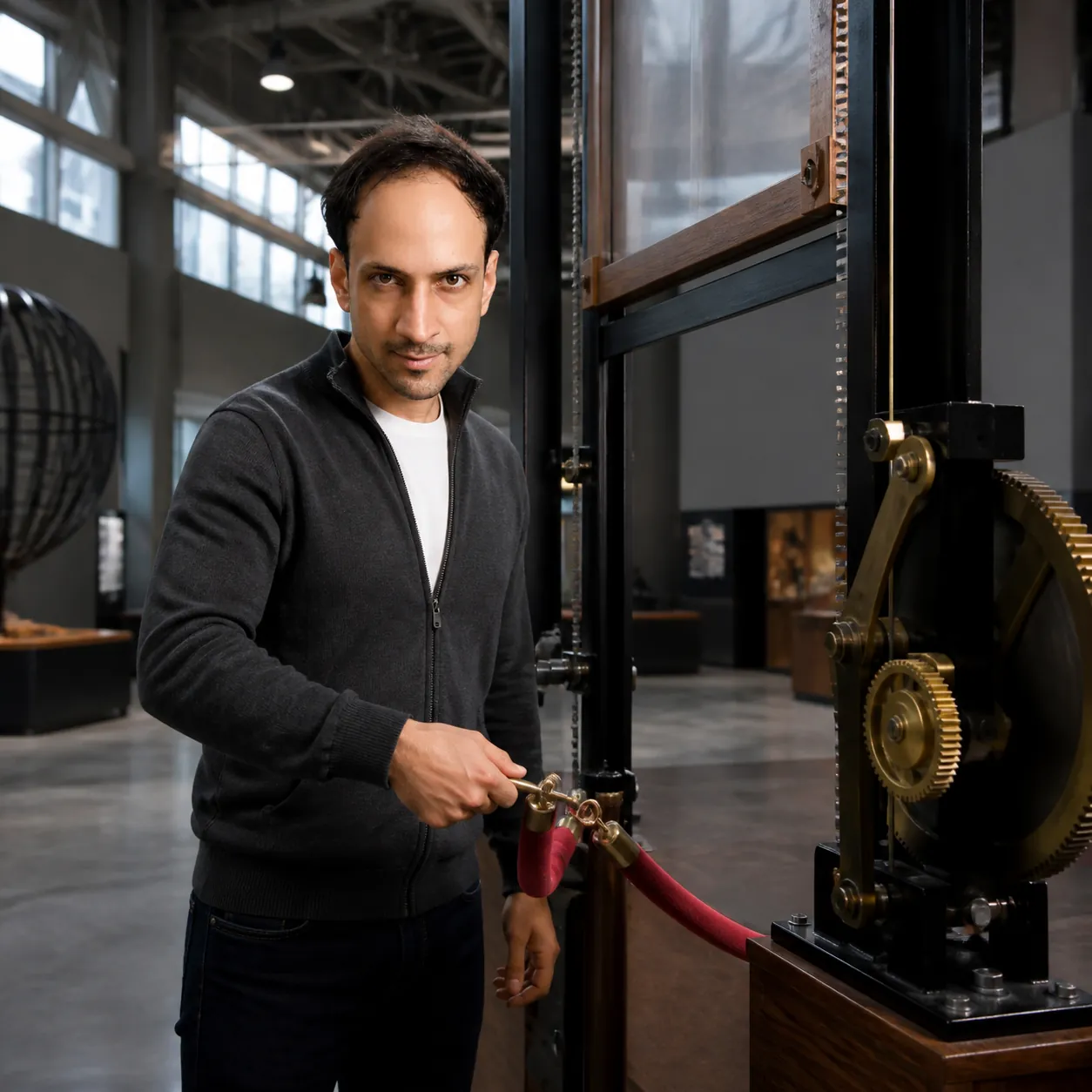
Lawful Payoff: Hands-On Science Centre Hall — AI Portrait Prompt
صورةAI Portraits

Turn your own photo into a conceptual workshop portrait in a hands-on science centre hall in Riyadh, empty after closing. Keeps your face unchanged.

من نص البرومبت

Use the attached reference photo as the identity reference: keep the same face, skin tone, hair and features as the person in that photo, without beautifying, aging or altering them. Create a square 1:1 museum-catalog frame with a strong first read and a slower second read at exactly 2880x2880 pixels. Location: a hands-on science centre hall in Riyadh, empty after closing. Show the subject in a graphite zip cardigan over a white crew-neck and dark jeans, lifting a velvet rope hook to let themselves through. Build the artwork around this material rule: a tall workshop sash so exactly counterweighted that its full heavy frame rises smoothly under the pressure of one finger pays out only what was honestly deposited, yet the timing feels generous. Explore how stored energy can look so much like patience from the outside; direct expression and posture toward collected readiness, never melodrama or ad-like confidence. Use a restrained 35mm view placing them beside the machine, neither dominating the other. Make the composition balance their stillness against one element caught mid-advance. Render it as conceptual workshop portraiture combining engineered anticipation, tactile brass and timber apparatus, believable mechanical motion, and emotionally intelligent documentary framing, using cool even skylight softened by dust in the air, contrast restrained and a palette of chalk white, cast iron, and one lacquered red accent. Photorealistic: this must read as a real photograph from a physical camera, never an illustration, painting, or 3D render. Resolve real surface detail: cotton that hangs by its own weight, seams that pucker very slightly, and collars softened by washing. Keep one identity-locked person, credible hands and fingers, natural fabric, and coherent scale, contact, reflections, shadows, airflow, deformation, and materials. Background people only when essential, always secondary and clearly different. Avoid Rube Goldberg clutter, floating holographic interfaces, trophy-shelf staging, neon motivational glow, and impossibly frictionless chrome machinery. No text, labels, logos, signatures, watermarks, random symbols, plastic skin, excessive bloom, or glossy AI finish.
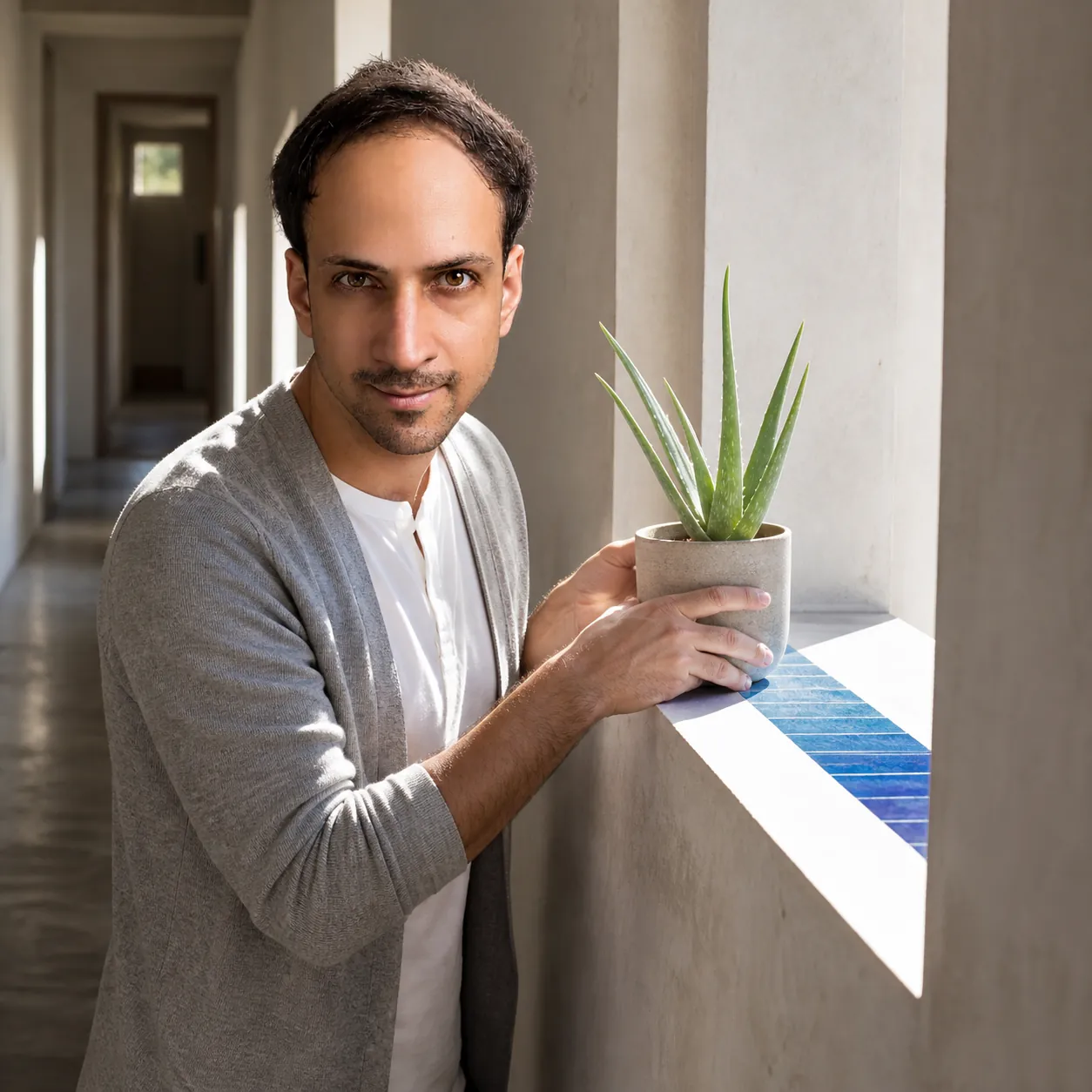
Borrowed Beam: Daylit Recovery Corridor Whose Deep — AI Portrait Prompt
صورةAI Portraits

Turn your own photo into a solar-architecture portrait in a daylit recovery corridor whose deep sills hold no equipment yet. Keeps your face unchanged.

من نص البرومبت

Use the attached reference photo as the identity reference: keep the same face, skin tone, hair and features as the person in that photo, without beautifying, aging or altering them. Create a square 1:1 museum-catalog frame with a strong first read and a slower second read at exactly 2880x2880 pixels. Location: a daylit recovery corridor whose deep sills hold no equipment yet. Show the subject in a soft grey cardigan over a white collarless shirt, lifting a potted aloe into the sill's bright band. Make one rigorous physical condition the conceptual engine: a graduated strip of blueprint paper that deepens toward Prussian blue one step for each measured interval of sun treats morning light as a nutrient with a dose, not a mood. Explore how much intention a beam must carry before it counts as care; direct expression and posture toward quiet receipt, never melodrama or ad-like confidence. Use an eye-level 80mm medium-format viewpoint that renders beam edges and skin texture equally truthfully. Make the composition keep the light's source small and its consequence large. Render it as solar-architecture portraiture built from real beam geometry, documentary daylight realism, hand-finished plaster materiality, and quietly clinical art direction, using true solar illumination metered by architecture, with no electric source anywhere visible and a palette of sand, whitewash, and a narrow Prussian-blue band. Photorealistic: this must read as a real photograph from a physical camera, never an illustration, painting, or 3D render. Resolve real surface detail: the difference between a wiped surface and a clean one, faint tide marks on ceramic, and metal dulled unevenly by touch. Keep one identity-locked person, credible hands and fingers, natural fabric, and coherent scale, contact, reflections, shadows, airflow, deformation, and materials. Background people only when essential, always secondary and clearly different. Avoid god-ray haze shafts, lens-flare starbursts, glowing dust volumetrics, stained-glass rainbows, and any halo behind their head. No text, labels, logos, signatures, watermarks, random symbols, plastic skin, excessive bloom, or glossy AI finish.
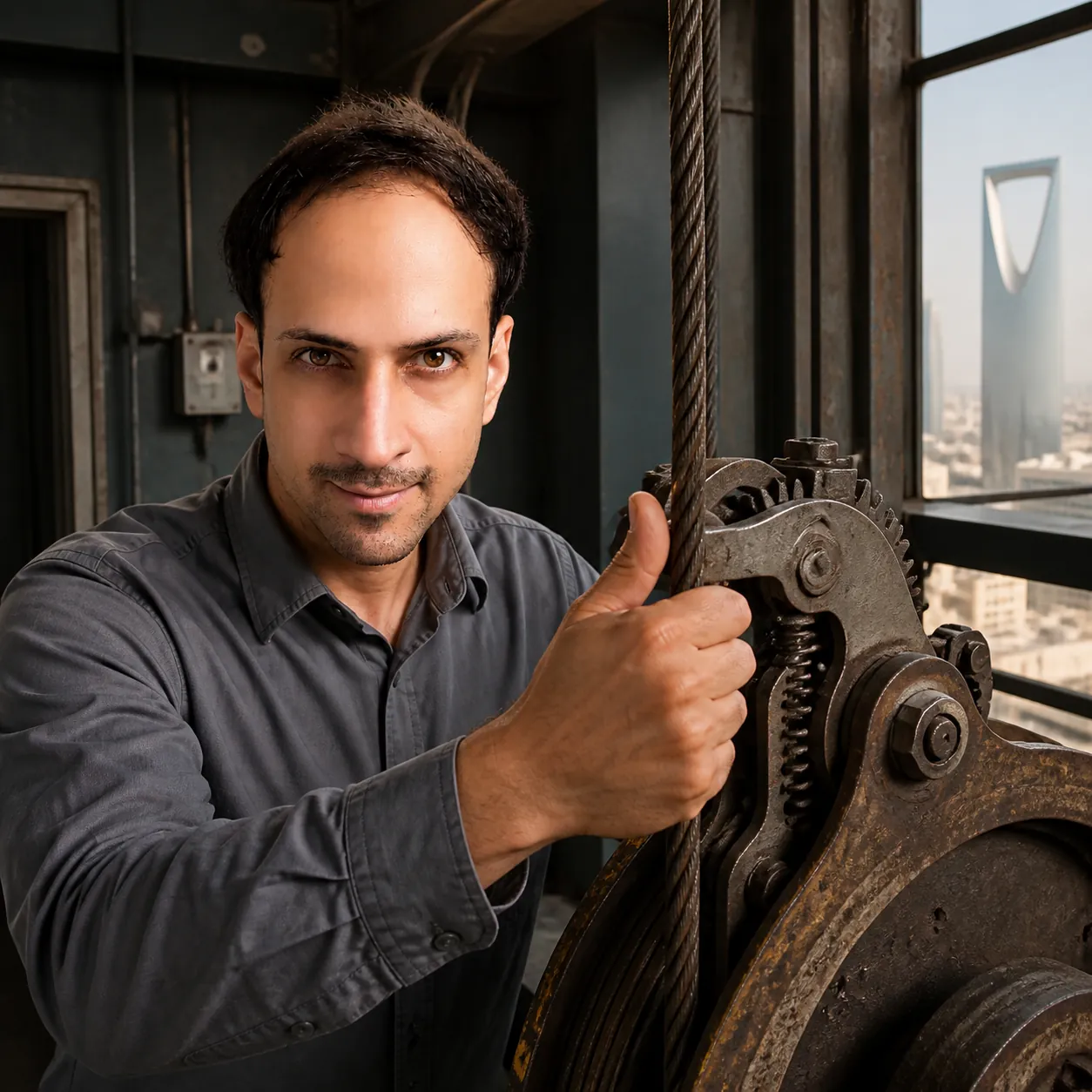
Forward Only: Freight Elevator Machine Room — AI Portrait Prompt
صورةAI Portraits

Turn your own photo into a museum-demonstration portrait in a freight elevator machine room at the top of a Riyadh tower. Keeps your face unchanged.

من نص البرومبت

Use the attached reference photo as the identity reference: keep the same face, skin tone, hair and features as the person in that photo, without beautifying, aging or altering them. Create a square 1:1 museum-catalog frame with a strong first read and a slower second read at exactly 2880x2880 pixels. Location: a freight elevator machine room at the top of a Riyadh tower. Show the subject in a steel-grey work shirt buttoned to the second button, testing a taut hoist rope with one careful thumb. Treat this mechanism as the frame’s governing rule: a workshop ratchet whose pawl drops into every fresh tooth with a bright click, holding its lifted iron weight against sliding back pays out only what was honestly deposited, yet the timing feels generous. Explore how a machine that cannot move backward changes what starting feels like; direct expression and posture toward grounded confidence, never melodrama or ad-like confidence. Frame from across the mechanism at hand height so the device and their face share one plane of focus. Make the composition leave visible headroom where the mechanism has yet to arrive. Render it as museum-demonstration realism combining truthful mechanical detail, high-fidelity portrait photography, audible-seeming moments of metal contact, and quietly restrained editorial art direction, using cool even skylight softened by dust in the air, contrast restrained and a palette of warm dust, deep umber, and one polished steel highlight. Photorealistic: this must read as a real photograph from a physical camera, never an illustration, painting, or 3D render. Resolve real surface detail: leather creased along the lines of use, stitching slightly irregular, and edges burnished from contact. Keep one identity-locked person, credible hands and fingers, natural fabric, and coherent scale, contact, reflections, shadows, airflow, deformation, and materials. Background people only when essential, always secondary and clearly different. Avoid Rube Goldberg clutter, floating holographic interfaces, trophy-shelf staging, neon motivational glow, and impossibly frictionless chrome machinery. No text, labels, logos, signatures, watermarks, random symbols, plastic skin, excessive bloom, or glossy AI finish.
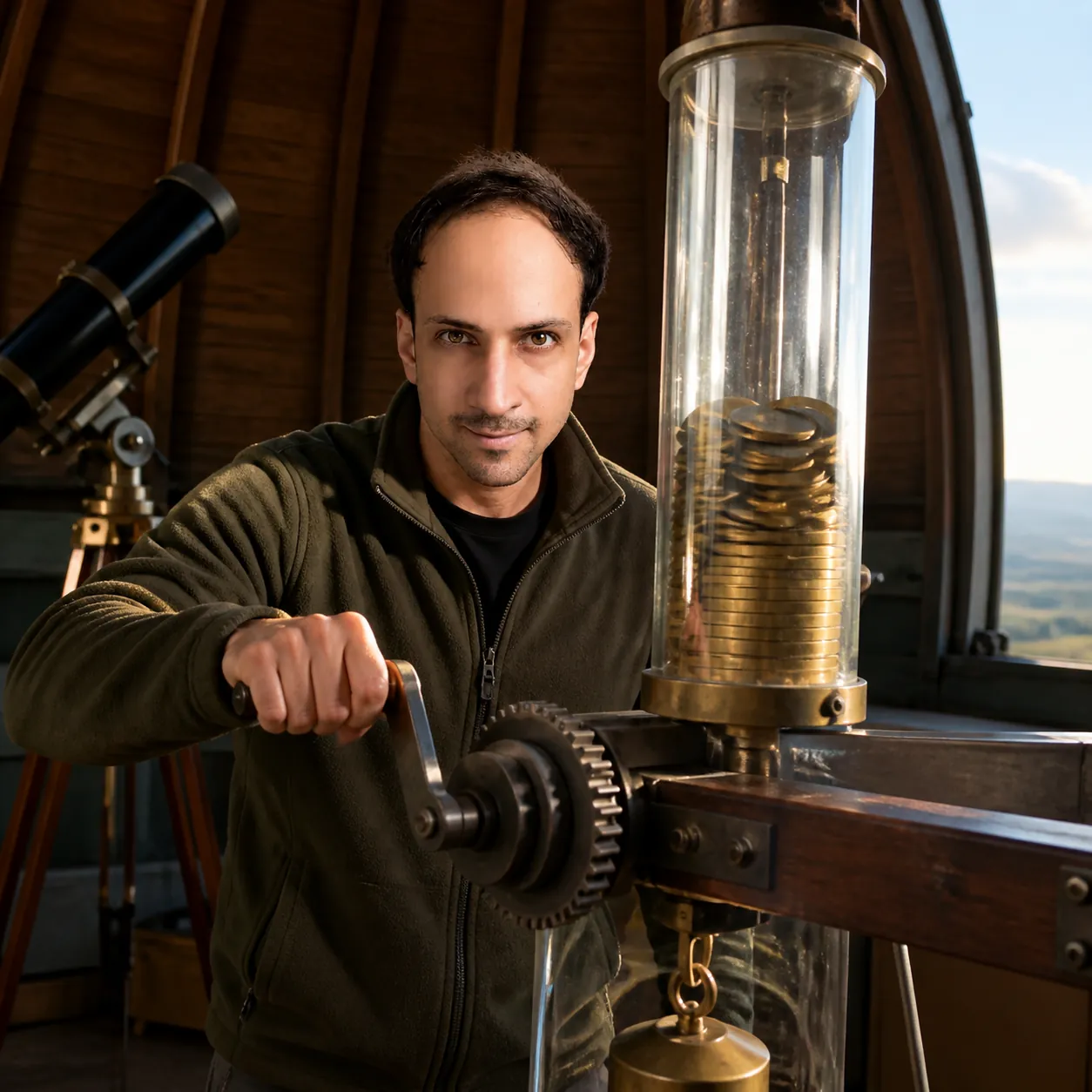
Stored Momentum: Hilltop Observatory Dome — AI Portrait Prompt
صورةAI Portraits

Turn your own photo into a conceptual workshop portrait in a hilltop observatory dome with its shutter cranked half open. Keeps your face unchanged.

من نص البرومبت

Use the attached reference photo as the identity reference: keep the same face, skin tone, hair and features as the person in that photo, without beautifying, aging or altering them. Create a square 1:1 museum-catalog frame with a strong first read and a slower second read at exactly 2880x2880 pixels. Location: a hilltop observatory dome with its shutter cranked half open. Show the subject in a dark olive fleece jacket zipped to mid-chest, cranking the dome shutter one steady half turn. The impossible-looking event must obey this clear system: a glass column filling with brass tokens, one per finished unit, mounted on a beam balanced to tip at a known count turns effort already spent into motion the body can plainly feel. Explore whether anticipation held in steel is a kinder teacher than anticipation held in nerves; direct expression and posture toward sober delight, never melodrama or ad-like confidence. Use an 85mm portrait view with the machine's nearest moving part softly large in the foreground. Make the composition balance their stillness against one element caught mid-advance. Render it as conceptual workshop portraiture combining engineered anticipation, tactile brass and timber apparatus, believable mechanical motion, and emotionally intelligent documentary framing, using late-afternoon window light raking across moving parts with soft bounced fill and a palette of raw pine, graphite, and a narrow copper gleam. Photorealistic: this must read as a real photograph from a physical camera, never an illustration, painting, or 3D render. Resolve real surface detail: glass with real thickness at its edge, reflections that carry the room's actual colour, and dust visible only at grazing angles. Keep one identity-locked person, credible hands and fingers, natural fabric, and coherent scale, contact, reflections, shadows, airflow, deformation, and materials. Background people only when essential, always secondary and clearly different. Avoid slot-machine iconography, glowing progress bars, cascading gold coins, cartoon gear mandalas, and confetti-burst celebration effects. No text, labels, logos, signatures, watermarks, random symbols, plastic skin, excessive bloom, or glossy AI finish.
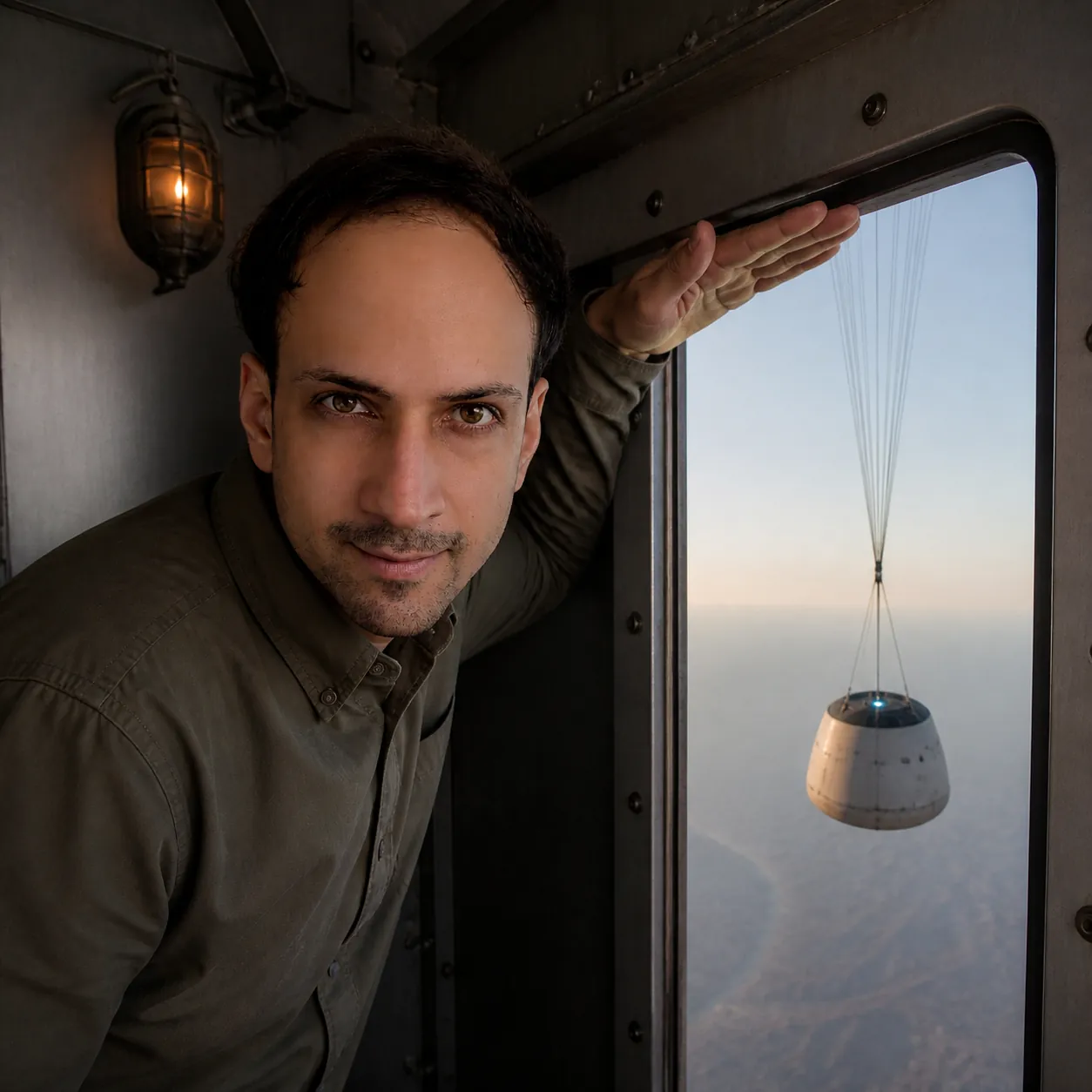
Borrowed Second: Mid-Tower Observation Gallery — AI Portrait Prompt
صورةAI Portraits

Turn your own photo into a portrait in a mid-tower observation gallery with one narrow armored viewing window. Keeps your face unchanged.

من نص البرومبت

Use the attached reference photo as the identity reference: keep the same face, skin tone, hair and features as the person in that photo, without beautifying, aging or altering them. Create a square 1:1 museum-catalog frame with a strong first read and a slower second read at exactly 2880x2880 pixels. Location: a mid-tower observation gallery with one narrow armored viewing window. Show the subject in an olive field shirt buttoned to the collar, sleeves left down, shading the glass with one flat hand to kill reflections. Treat this mechanism as the frame’s governing rule: a small candle flame inside the falling capsule that loses its teardrop and settles into a dim blue hemisphere holds steady in frame only because the witness is falling too. Explore how stillness and free fall can be the same event described twice; direct expression and posture toward unhurried marvel, never melodrama or ad-like confidence. Use a restrained wide 24mm from inside the capsule doorway, verticals true and their figure never stretched. Make the composition let empty vertical shaft space press in from above. Render it as working research-facility realism combining true free-fall fluid behavior, engineered-safety texture, unglamorous industrial surfaces, and quietly composed editorial portrait photography, using flat pre-dawn sky light with a single battery work lamp for warmth and a palette of desert dawn sand, steel grey, and muted teal. Photorealistic: this must read as a real photograph from a physical camera, never an illustration, painting, or 3D render. Resolve real surface detail: leather creased along the lines of use, stitching slightly irregular, and edges burnished from contact. Keep one identity-locked person, credible hands and fingers, natural fabric, and coherent scale, contact, reflections, shadows, airflow, deformation, and materials. Background people only when essential, always secondary and clearly different. Avoid space-station porthole backdrops, cartoon up-arrows, magically hovering furniture, dramatic slow-motion glass shatters, and superhero mid-air heroics. No text, labels, logos, signatures, watermarks, random symbols, plastic skin, excessive bloom, or glossy AI finish.
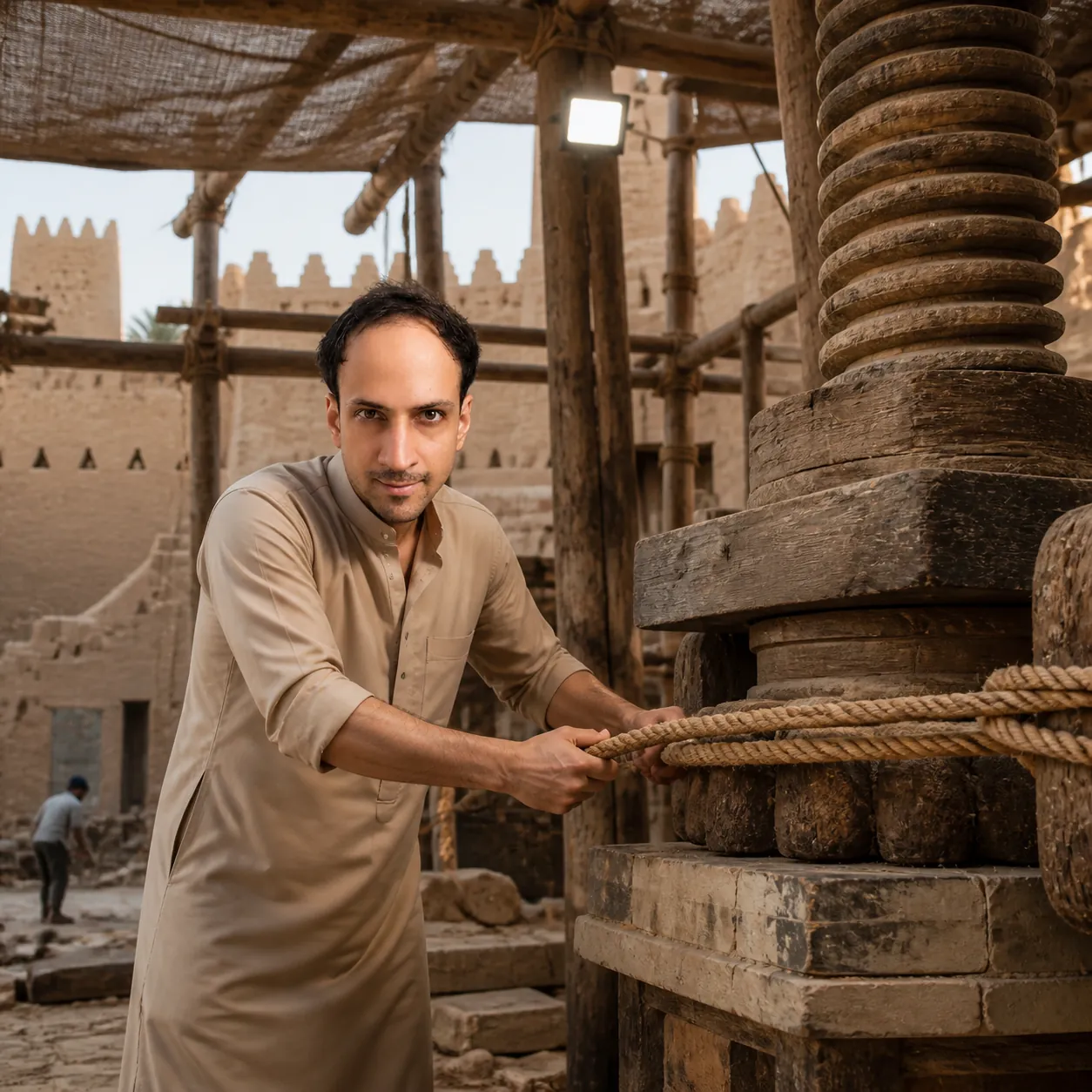
Slow Capital: Mud-Brick Restoration Terrace — AI Portrait Prompt
صورةAI Portraits

Turn your own photo into a portrait in a mud-brick restoration terrace in Diriyah, palm-trunk scaffolds in morning shade. Keeps your face unchanged.

من نص البرومبت

Use the attached reference photo as the identity reference: keep the same face, skin tone, hair and features as the person in that photo, without beautifying, aging or altering them. Create a square 1:1 museum-catalog frame with a strong first read and a slower second read at exactly 2880x2880 pixels. Location: a mud-brick restoration terrace in Diriyah, palm-trunk scaffolds in morning shade. Show the subject in a plain sand-toned traditional Gulf outfit with both sleeves folded back once, checking a scaffold lashing with one slow, deliberate pull. Treat this mechanism as the frame’s governing rule: a great timber screw press whose long bar, walked slowly through half a turn, sinks the platen with irresistible pressure turns a small, steady effort into the equal of crushing weight. Explore whether advantage borrowed from geometry must ever be paid back in strain; direct expression and posture toward grounded calm, never melodrama or ad-like confidence. Use a low 35mm view from beside the load so its true scale presses against the frame. Make the composition weigh the huge load against their small, calm effort. Render it as quiet working-rigging portraiture built from lawful mechanical advantage, heavy documentary realism, hand-worn rope-and-timber materiality, and patient large-format editorial composition, using one high work lamp shaded so the load sits in sculptural half-light and a palette of sandstone buff, rope-shadow grey, and a single indigo accent. Photorealistic: this must read as a real photograph from a physical camera, never an illustration, painting, or 3D render. Resolve real surface detail: grout darker than tile, sealant slightly yellowed, and every joint showing a real tolerance gap. Keep one identity-locked person, credible hands and fingers, natural fabric, and coherent scale, contact, reflections, shadows, airflow, deformation, and materials. Background people only when essential, always secondary and clearly different. Avoid gym equipment, heroic strongman poses, bulging-vein close-ups, snapped-rope drama, and impossibly floating boulders. No text, labels, logos, signatures, watermarks, random symbols, plastic skin, excessive bloom, or glossy AI finish.
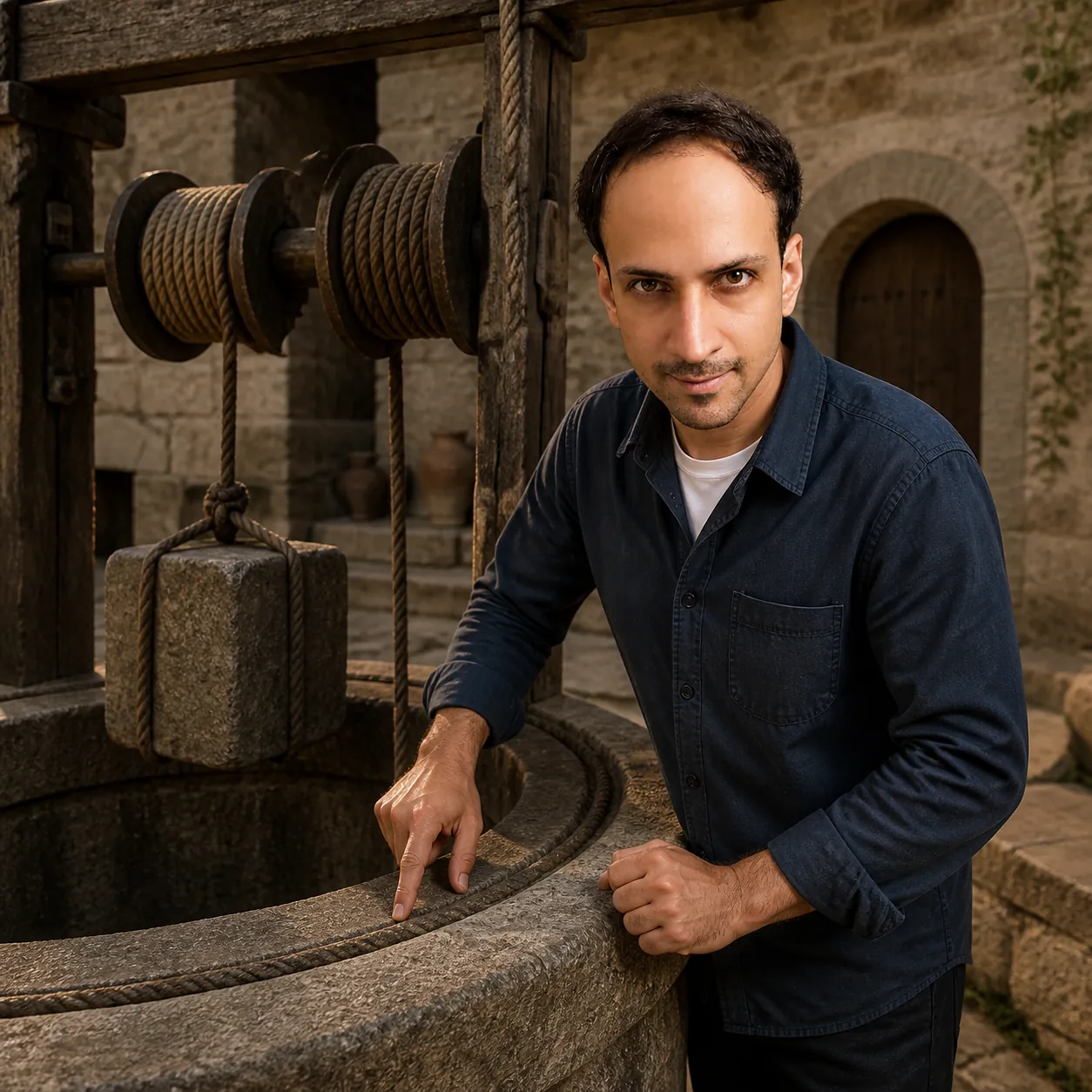
Earned Ease: Old Stone Well Court — AI Portrait Prompt
صورةAI Portraits

Turn your own photo into a quiet working-rigging portrait in an old stone well court at dusk, rope grooves worn into coping. Keeps your face unchanged.

من نص البرومبت

Use the attached reference photo as the identity reference: keep the same face, skin tone, hair and features as the person in that photo, without beautifying, aging or altering them. Create a square 1:1 museum-catalog frame with a strong first read and a slower second read at exactly 2880x2880 pixels. Location: an old stone well court at dusk, rope grooves worn into coping. Show the subject in a slate-blue overshirt buttoned over a white cotton undershirt, tracing one worn rope groove with a fingertip. Make one rigorous physical condition the conceptual engine: a differential windlass of two unequal drums whose rope, winding on one and off the other, inches a granite block upward turns a small, steady effort into the equal of crushing weight. Explore where the effort actually goes when a great weight rises gently; direct expression and posture toward quiet competence, never melodrama or ad-like confidence. Use an eye-level 50mm viewpoint that keeps mechanism, load, and face in one honest perspective. Make the composition give the load more frame and give them the light. Render it as quiet working-rigging portraiture built from lawful mechanical advantage, heavy documentary realism, hand-worn rope-and-timber materiality, and patient large-format editorial composition, using warm late-afternoon side light held back by deep architectural shadow and a palette of dust grey, dark rope tan, and muted olive. Photorealistic: this must read as a real photograph from a physical camera, never an illustration, painting, or 3D render. Resolve real surface detail: the difference between a wiped surface and a clean one, faint tide marks on ceramic, and metal dulled unevenly by touch. Keep one identity-locked person, credible hands and fingers, natural fabric, and coherent scale, contact, reflections, shadows, airflow, deformation, and materials. Background people only when essential, always secondary and clearly different. Avoid gym equipment, heroic strongman poses, bulging-vein close-ups, snapped-rope drama, and impossibly floating boulders. No text, labels, logos, signatures, watermarks, random symbols, plastic skin, excessive bloom, or glossy AI finish.
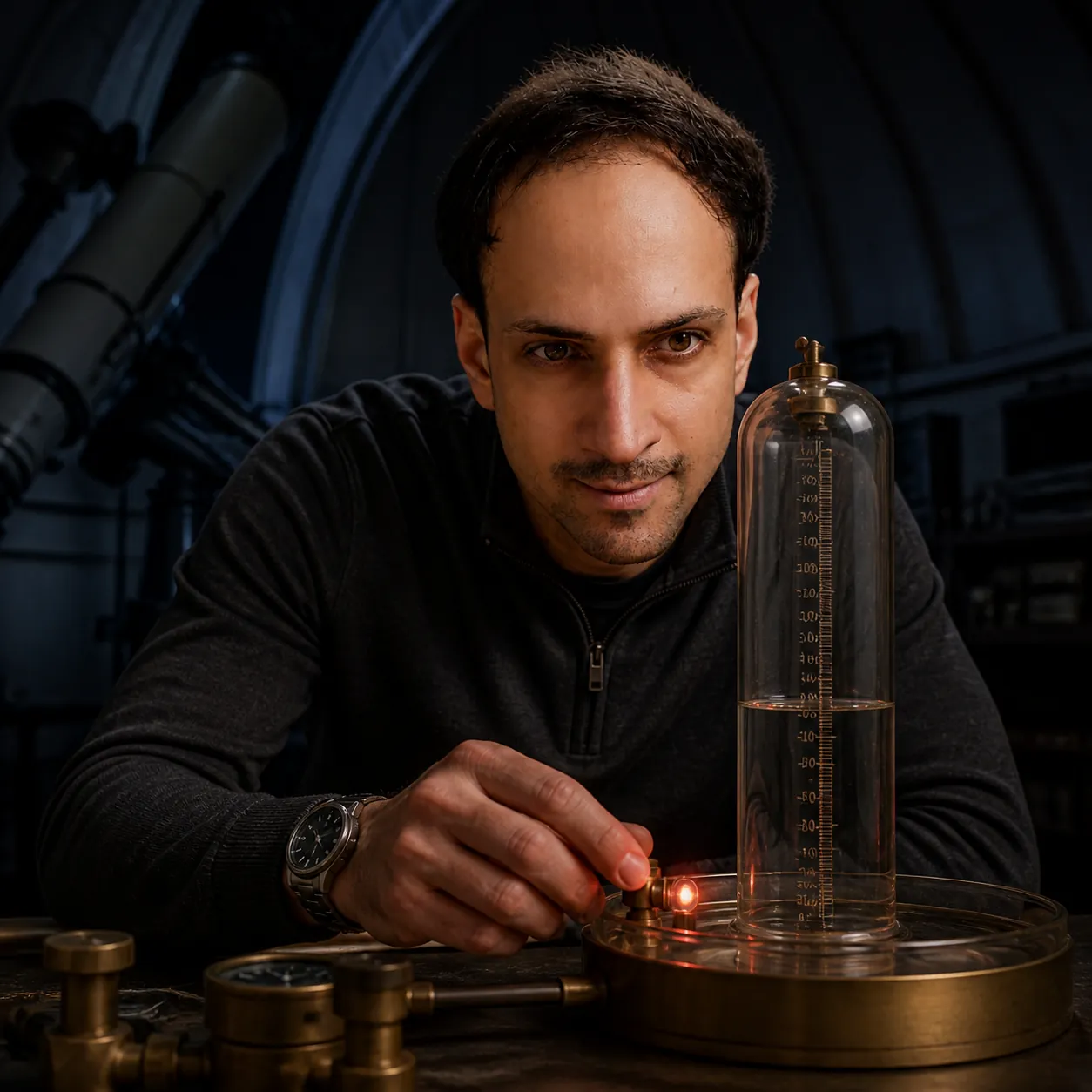
Practiced Quiet: Small University Observatory — AI Portrait Prompt
صورةAI Portraits

Turn your own photo into a photorealistic portrait in a small university observatory under its closed dome late at night. Keeps your face unchanged.

من نص البرومبت

Use the attached reference photo as the identity reference: keep the same face, skin tone, hair and features as the person in that photo, without beautifying, aging or altering them. Create a square 1:1 museum-catalog frame with a strong first read and a slower second read at exactly 2880x2880 pixels. Location: a small university observatory under its closed dome late at night. Show the subject in a charcoal quarter-zip pullover with a flat steel wristwatch, dimming the red work lamp to its lowest mark. The impossible-looking event must obey this clear system: a brass spirometer bell over a water seal that climbs its etched scale in true millimeters under one long breath turns the body's most invisible act into a mechanism the eye can audit. Explore whether calm is a temperament they were given or a mechanism they can build; direct expression and posture toward steadied wonder, never melodrama or ad-like confidence. Use a 50mm view from just above the work surface so instrument and face share one honest space. Make the composition weight the frame low and steady, horizonless, like held breath. Render it as gallery-grade mechanical still life extended to portraiture, lawful aerodynamic behavior, measured tonal restraint, and fine engraved-scale detail held sharp, using one warm practical low beside the instrument answered by cool side ambient and a palette of slate grey, clear glass, and a madder-red thread. Photorealistic: this must read as a real photograph from a physical camera, never an illustration, painting, or 3D render. Resolve real surface detail: glass with real thickness at its edge, reflections that carry the room's actual colour, and dust visible only at grazing angles. Keep one identity-locked person, credible hands and fingers, natural fabric, and coherent scale, contact, reflections, shadows, airflow, deformation, and materials. Background people only when essential, always secondary and clearly different. Avoid glowing breath vapor, swirling CGI air streaks, meditation-pose serenity, and dust motes in god rays. No text, labels, logos, signatures, watermarks, random symbols, plastic skin, excessive bloom, or glossy AI finish.