تخطَّ إلى المحتوى
f

faisal aziz

@alkhunizan

3000البرومبتات
0تصويتات مستلمة
0مساهمات
تاريخ الانضمام منذ 4 أشهر
3000 مساهمات في العام الماضي
نوفمبر
ديسمبر
يناير
فبراير
مارس
أبريل
مايو
يونيو
يوليو
أغسطس
سبتمبر
أكتوبر
ن
ر
ج
أقل
أكثر
Wringing the Cloth at Arm's Length — AI Portrait Prompt
صورةAI Portraits

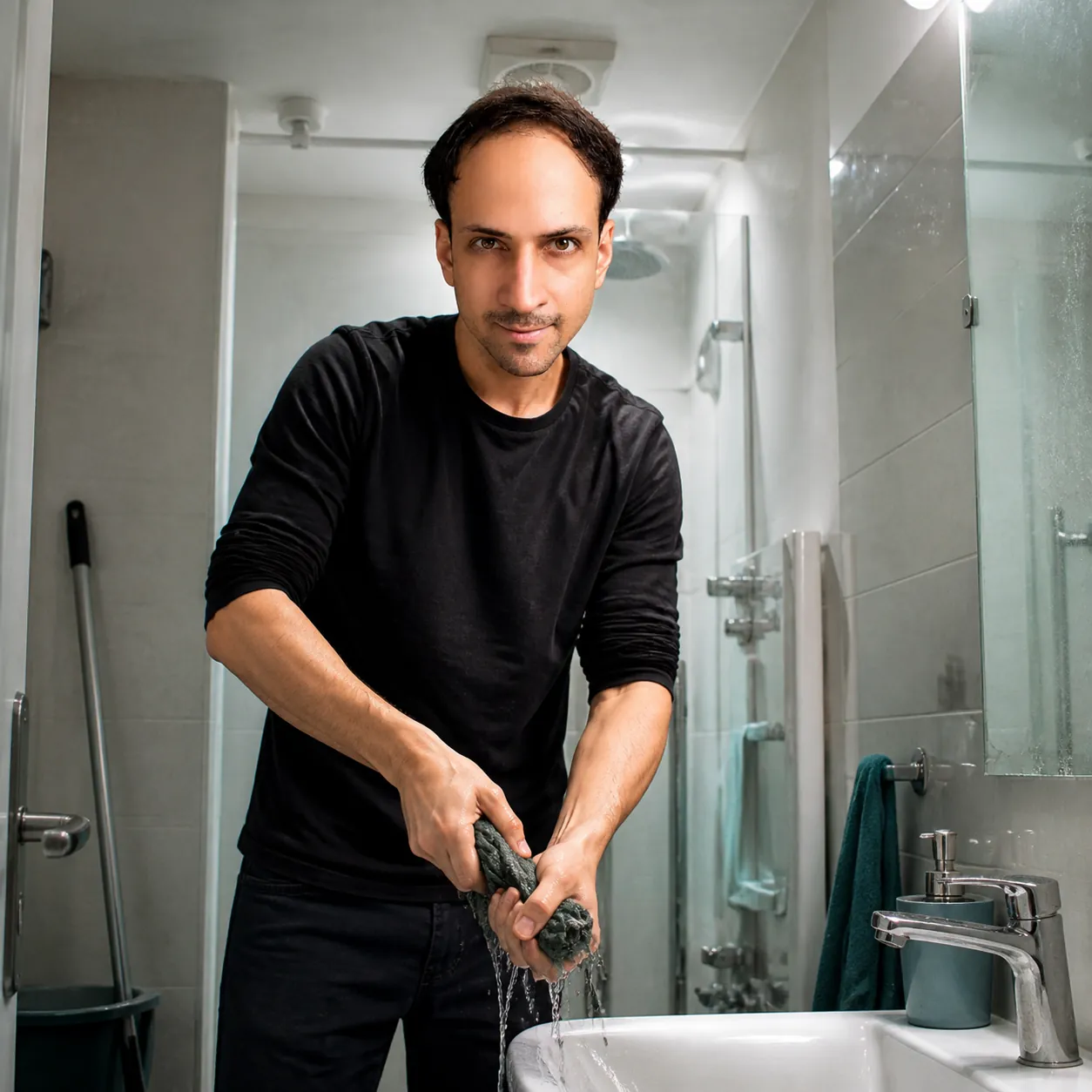
Turn your own photo into a contemporary reportage portrait in an apartment bathroom mid-clean with the extractor fan still running. Keeps your face unchanged.

من نص البرومبت

Use the attached reference photo as the identity reference: keep the same face, skin tone, hair and features as the person in that photo, without beautifying, aging or altering them. Create a square 1:1 museum-catalog frame with a strong first read and a slower second read at exactly 2880x2880 pixels. Location: an apartment bathroom mid-clean with the extractor fan still running. Show the subject in a plain black tee with sleeves pushed above the elbow, wringing a cloth out over the running tap. Make this piece of unglamorous evidence the whole argument: a long-handled implement gripped at its very end so wet waste never reaches skin, the job finished at that distance shows competence and difficulty occupying the same square metre of floor. Explore why the cheapest fix is often a thirty-second adjustment made before starting; expression occupied, not expressive, carrying matter-of-fact resolve, difficulty stated without inviting sympathy. Use an 85mm portrait length with the room compressed just enough to feel enclosed. Make the composition give the accommodation more acuity than any face-adjacent surface. Render it as contemporary reportage realism combining plain civic interiors, physically accurate material response, working household equipment, and calm documentary distance, using flat retail fluorescent with a cool cast and unflattering falloff and a palette of cool white, pale concrete, and one muted teal. Photorealistic: this must read as a real photograph from a physical camera, never an illustration, painting, or 3D render. Resolve real surface detail: floor finish worn along the walked line, skirting marked at shoe height, and corners darker than the open floor. Keep one identity-locked person, credible hands and fingers, natural fabric, and coherent scale, contact, reflections, shadows, airflow, deformation, and materials. Background people only when essential, always secondary and clearly different. Avoid glowing sound waves, sensory-overload blur effects, and mood portraits without labour. No text, labels, logos, signatures, watermarks, random symbols, plastic skin, excessive bloom, or glossy AI finish.
Last Quarter Turn — AI Portrait Prompt
صورةAI Portraits

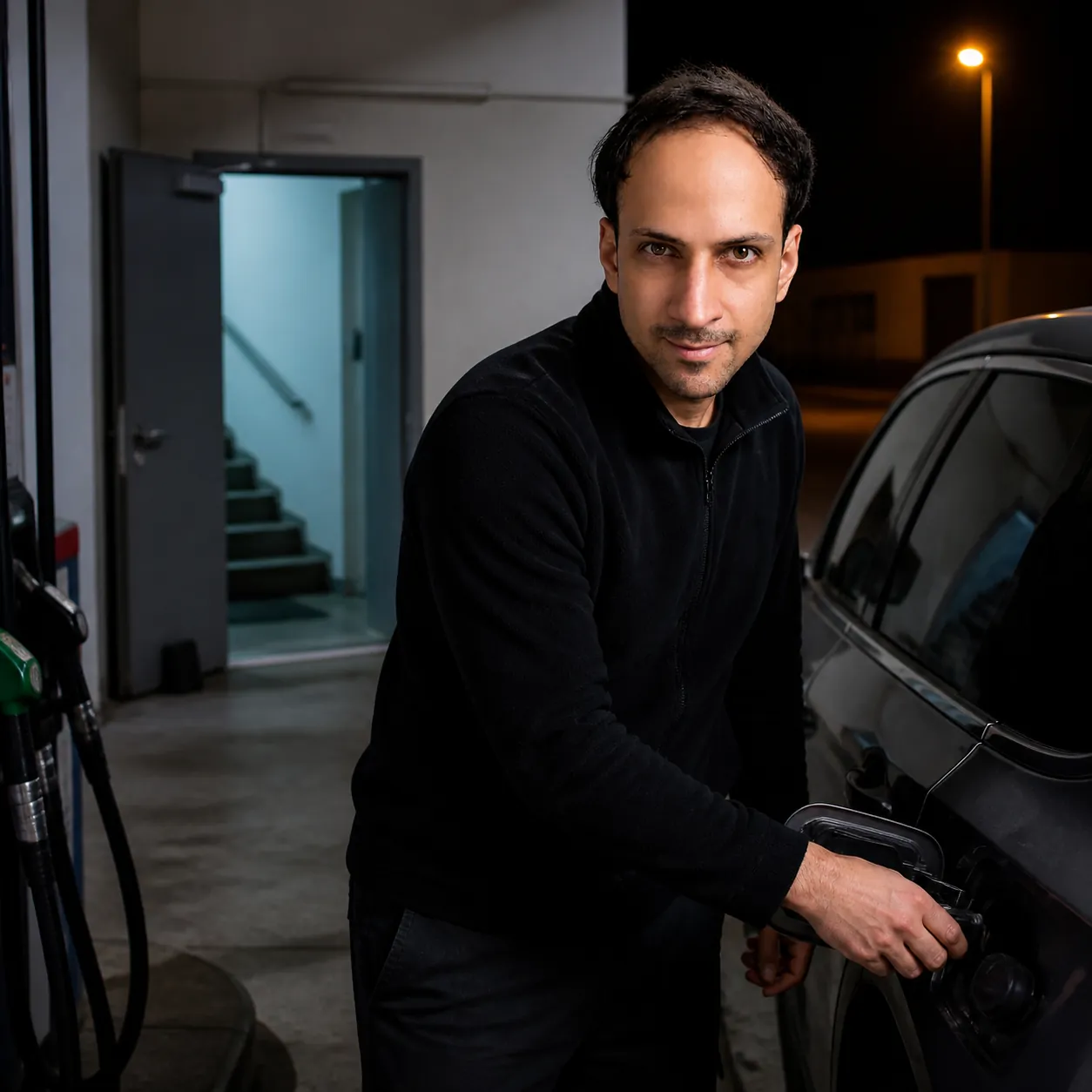
Turn your own photo into a reportage-grade threshold portrait in a quiet petrol station forecourt in the slack hour before dawn. Keeps your face unchanged.

من نص البرومبت

Use the attached reference photo as the identity reference: keep the same face, skin tone, hair and features as the person in that photo, without beautifying, aging or altering them. Create a square 1:1 museum-catalog frame with a strong first read and a slower second read at exactly 2880x2880 pixels. Location: a quiet petrol station forecourt in the slack hour before dawn. Show the subject in a black fleece half-zip over plain dark trousers, twisting a fuel cap closed a final quarter turn. Make this piece of unglamorous evidence the whole argument: a stairwell fire door that is held open a hand's width by a folded cloth, the lift's call button passed unpressed spends a whole morning's calculation on something a neighbour does absently. Explore what an ordinary threshold weighs once it has been measured this carefully; expression occupied, not expressive, carrying practical wariness, difficulty stated with the flatness of routine. Use an 85mm view from just off their shoulder, keeping the face readable in three-quarter turn. Make the composition give the object they are handling more acuity than the room. Render it as reportage-grade threshold photography built from ordinary retail surfaces, credible packaging materials, physically correct shadow behaviour, and patient non-theatrical staging, using one sodium streetlight reaching a doorway with cool interior spill behind them and a palette of concrete grey, cold white, and one sodium-orange accent. Photorealistic: this must read as a real photograph from a physical camera, never an illustration, painting, or 3D render. Resolve real surface detail: floor finish worn along the walked line, skirting marked at shoe height, and corners darker than the open floor. Keep one identity-locked person, credible hands and fingers, natural fabric, and coherent scale, contact, reflections, shadows, airflow, deformation, and materials. Background people only when essential, always secondary and clearly different. Avoid rain-streaked window sorrow, huddled foetal poses, blurred crowd chaos, and curtain-peeking paranoia. No text, labels, logos, signatures, watermarks, random symbols, plastic skin, excessive bloom, or glossy AI finish.
The Sealed Bag in the Boot — AI Portrait Prompt
صورةAI Portraits

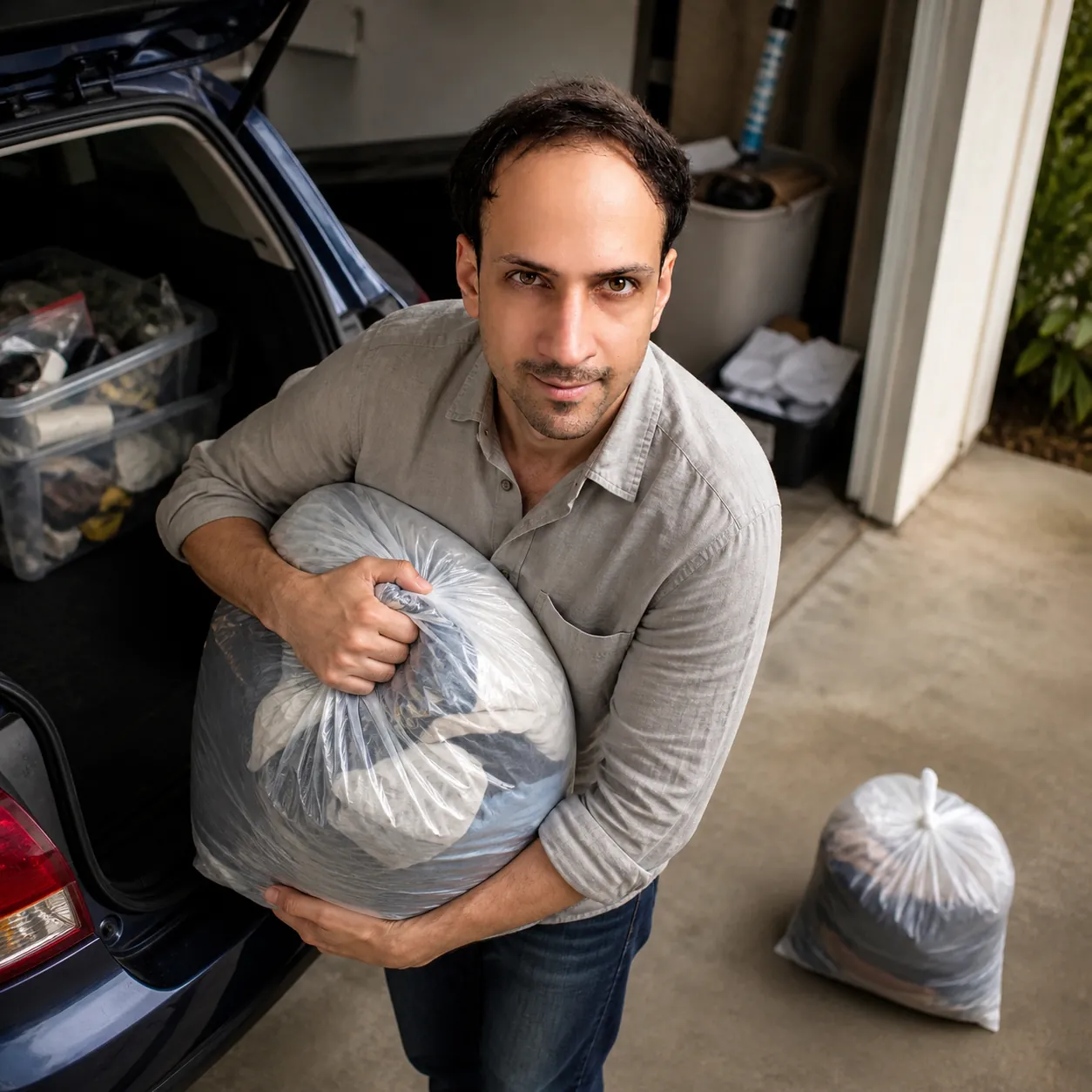
Turn your own photo into an archival still-life portrait in the open boot of a car in a residents' garage. Keeps your face unchanged.

من نص البرومبت

Use the attached reference photo as the identity reference: keep the same face, skin tone, hair and features as the person in that photo, without beautifying, aging or altering them. Create a square 1:1 museum-catalog frame with a strong first read and a slower second read at exactly 2880x2880 pixels. Location: the open boot of a car in a residents' garage. Show the subject in a stone-coloured linen shirt with the cuffs turned twice, pressing a full carrier bag square against the side. Build the image around this small, exact tableau: a sealed bag set apart on the floor from the rest, the only one of them not to be reopened shows care and accumulation arriving from exactly the same impulse. Explore what one genuinely emptied space costs compared with an afternoon of tidying; expression occupied, not expressive, carrying unhurried resolve, difficulty stated as household fact. Frame from slightly above the work so its real depth reads without exaggeration. Make the composition let one emptied gap sit at the frame's quietest point. Render it as archival still-life portraiture combining catalogue-clear object rendering, believable domestic wear, controlled neutral colour, and patient unstyled editorial realism, using unglamorous garage strip lighting balanced by pale daylight at the entrance and a palette of warm cardboard tan, cool grey, and dulled brass. Photorealistic: this must read as a real photograph from a physical camera, never an illustration, painting, or 3D render. Resolve real surface detail: skin that reddens slightly under pressure, nail beds with honest colour, and knuckle creases that fold rather than blur. Keep one identity-locked person, credible hands and fingers, natural fabric, and coherent scale, contact, reflections, shadows, airflow, deformation, and materials. Background people only when essential, always secondary and clearly different. Avoid clear-out crews, shame poses, posing at camera, teetering junk towers, and melancholy without labour. No text, labels, logos, signatures, watermarks, random symbols, plastic skin, excessive bloom, or glossy AI finish.
The Basket and the Back Door — AI Portrait Prompt
صورةAI Portraits

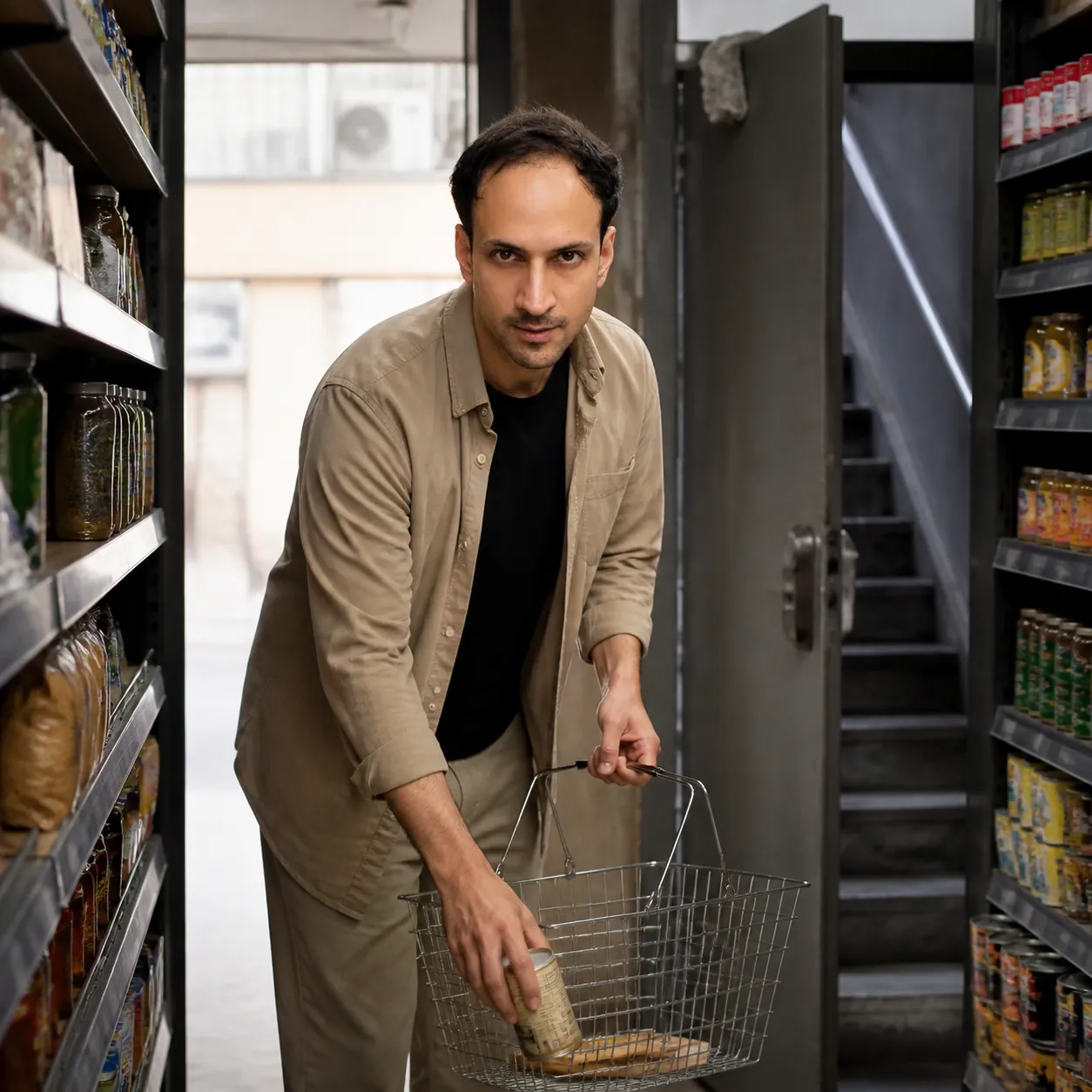
Turn your own photo into a portrait in a corner grocery's narrow aisle twenty minutes before its evening rush. Keeps your face unchanged.

من نص البرومبت

Use the attached reference photo as the identity reference: keep the same face, skin tone, hair and features as the person in that photo, without beautifying, aging or altering them. Create a square 1:1 museum-catalog frame with a strong first read and a slower second read at exactly 2880x2880 pixels. Location: a corner grocery's narrow aisle twenty minutes before its evening rush. Show the subject in a sand-coloured overshirt over a dark tee and canvas trousers, lowering one item into a wire hand basket. Let one honest object carry what the face will not: a stairwell fire door that is held open a hand's width by a folded cloth, the lift's call button passed unpressed turns an ordinary errand into the day's largest piece of engineering. Explore what an ordinary threshold weighs once it has been measured this carefully; expression occupied, not expressive, carrying rehearsed steadiness, difficulty stated as logistics rather than lament. Use a 50mm eye-level view from inside the room with the doorway kept at the edge. Make the composition hold measurable distance between their hands and the open air. Render it as quiet civic-documentary portraiture built from real errand logistics, contemporary Saudi street texture, honest domestic materials, and unhurried observational framing, using even overcast daylight entering a shopfront with no warm colour push and a palette of sand beige, iron grey, and one fluorescent blue-white. Photorealistic: this must read as a real photograph from a physical camera, never an illustration, painting, or 3D render. Resolve real surface detail: the difference between a wiped surface and a clean one, faint tide marks on ceramic, and metal dulled unevenly by touch. Keep one identity-locked person, credible hands and fingers, natural fabric, and coherent scale, contact, reflections, shadows, airflow, deformation, and materials. Background people only when essential, always secondary and clearly different. Avoid hero-poster stances, golden-hour wellness glow, posing at camera, and chest-clutching gestures. No text, labels, logos, signatures, watermarks, random symbols, plastic skin, excessive bloom, or glossy AI finish.
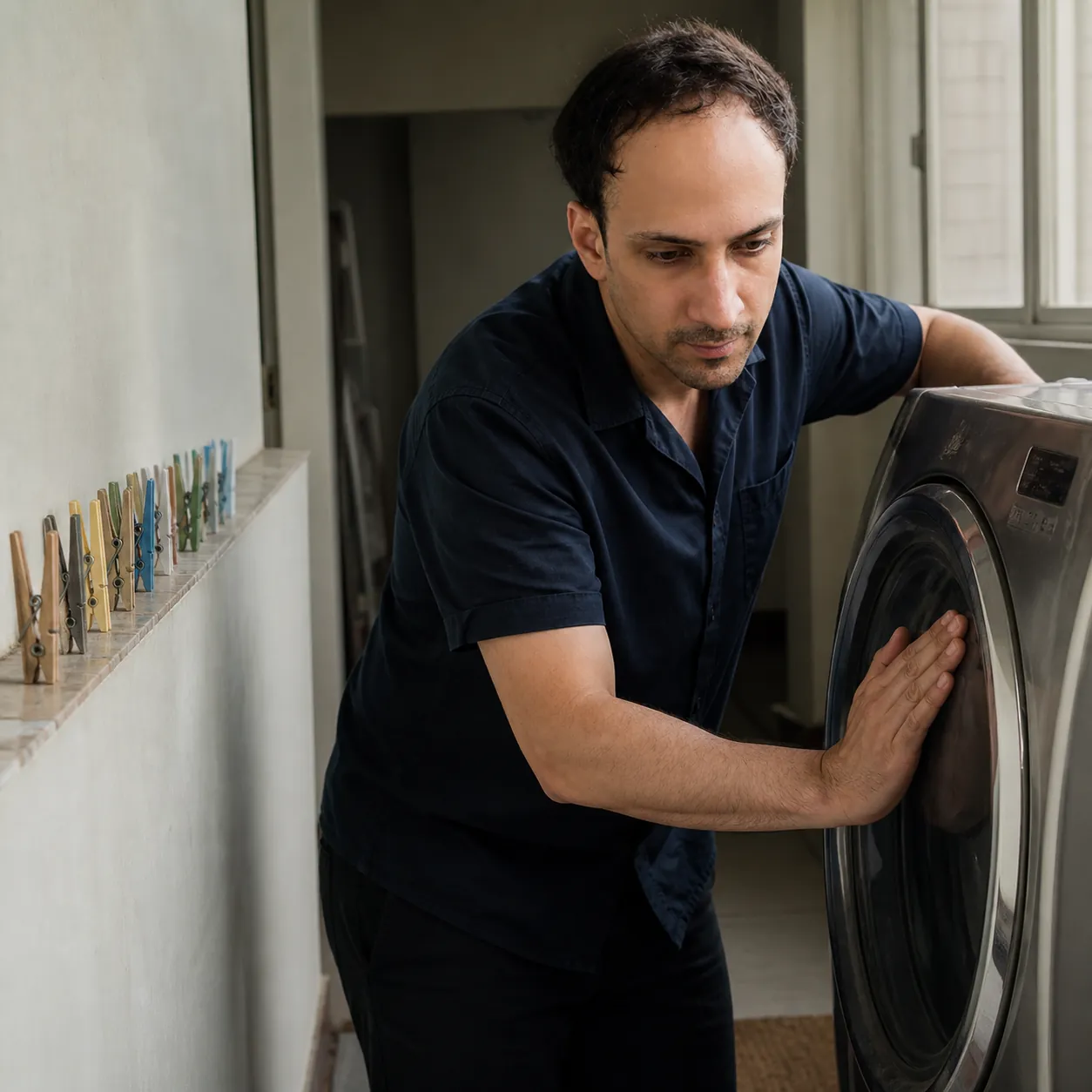
Pegs That Mark the Steps — AI Portrait Prompt
صورةAI Portraits

Turn your own photo into a quiet domestic documentary portrait in a small utility room off a Jeddah apartment hallway. Keeps your face unchanged.

من نص البرومبت

Use the attached reference photo as the identity reference: keep the same face, skin tone, hair and features as the person in that photo, without beautifying, aging or altering them. Create a square 1:1 museum-catalog frame with a strong first read and a slower second read at exactly 2880x2880 pixels. Location: a small utility room off a Jeddah apartment hallway. Show the subject in a short-sleeved navy shirt worn loose over dark cotton trousers, pressing a machine door shut with one palm. Build the image around this small, exact tableau: a line of clothes pegs along a ledge that mark the steps they have had to work out from scratch turns a five-minute job into an hour of starting the order again. Explore whether a rebuilt routine can ever feel as cheap as the original; expression occupied, not expressive, carrying steady insistence, difficulty stated quietly, in the objects alone. Frame at chest height so the object and their working hands share one plane. Make the composition keep the changed object sharp and everything habitual soft. Render it as quiet domestic documentary realism built from unposed observation, honest household materials, accurate skin rendering, and restrained contemporary art direction, using flat overcast daylight through one window, no shaped highlights and a palette of muted olive, chalk white, and dulled brushed steel. Photorealistic: this must read as a real photograph from a physical camera, never an illustration, painting, or 3D render. Resolve real surface detail: brass darkened in the recesses and bright where thumbs land, and lacquer crazed rather than perfect. Keep one identity-locked person, credible hands and fingers, natural fabric, and coherent scale, contact, reflections, shadows, airflow, deformation, and materials. Background people only when essential, always secondary and clearly different. Avoid hero poses, golden-hour wellness glow, eye contact with the lens, minimalist styling, and puzzle-piece symbolism. No text, labels, logos, signatures, watermarks, random symbols, plastic skin, excessive bloom, or glossy AI finish.
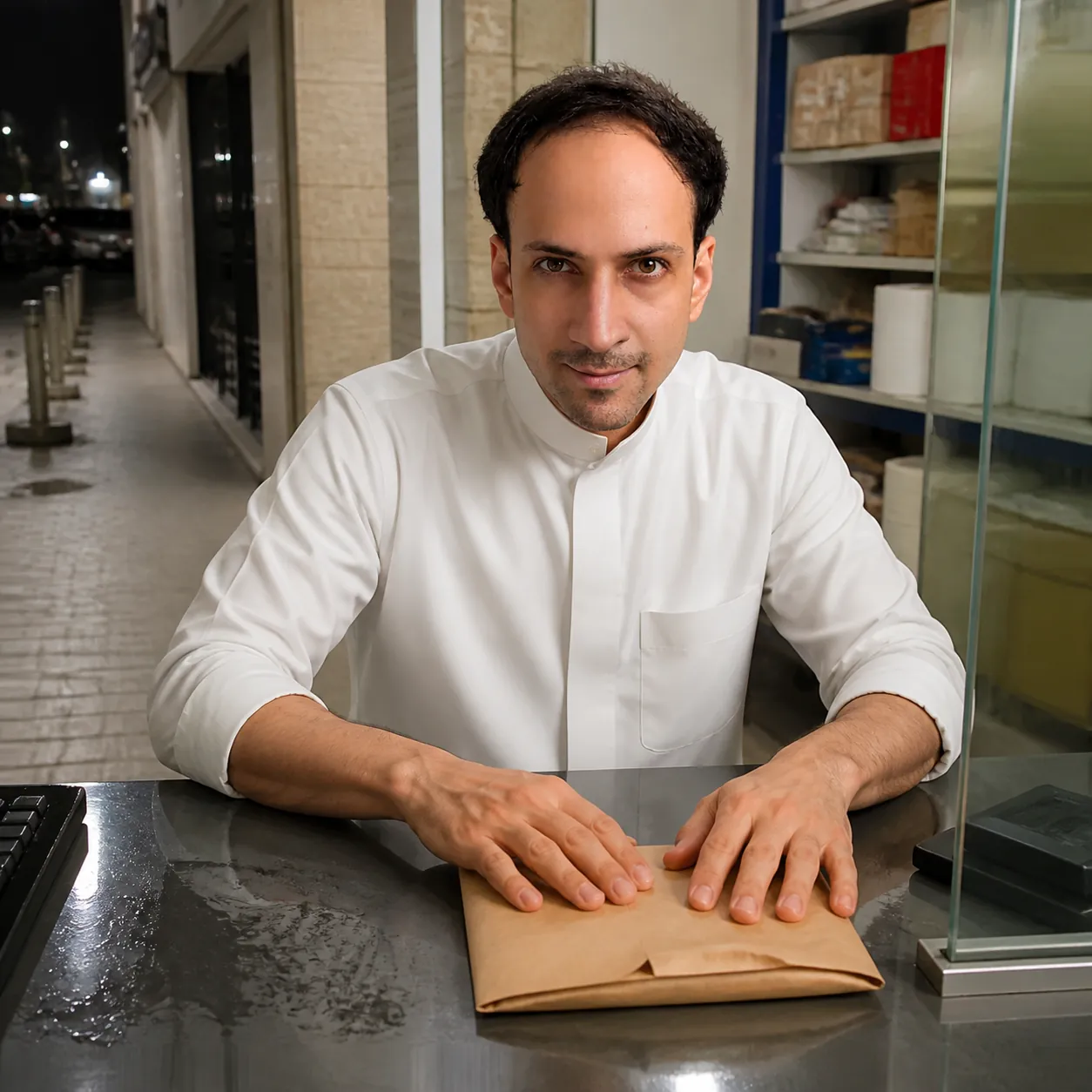
Where the Pavement Lights End — AI Portrait Prompt
صورةAI Portraits

Turn your own photo into a museum-grade domestic portrait in the street kerb outside your building where the pavement lights end. Keeps your face unchanged.

من نص البرومبت

Use the attached reference photo as the identity reference: keep the same face, skin tone, hair and features as the person in that photo, without beautifying, aging or altering them. Create a square 1:1 museum-catalog frame with a strong first read and a slower second read at exactly 2880x2880 pixels. Location: the street kerb outside their building where the pavement lights end. Show the subject in a plain white traditional Gulf outfit with the sleeves pushed back once, folding a shopping bag into a tight square. Build the image around this small, exact tableau: a taped parcel that finally reaches the post counter, its eleven days of hallway dust wiped from one corner spends a whole morning's calculation on something a neighbour does absently. Explore whether a rehearsed route counts as avoidance or as competent, expensive preparation; expression occupied, not expressive, carrying worn competence, difficulty stated with the flatness of routine. Frame at chest height so their hands and their eyes sit on one focal plane. Make the composition treat the threshold itself as the picture's structural spine. Render it as museum-grade domestic realism combining high-fidelity portrait photography, plain hardware detail, accurate low-light response, and restrained editorial art direction, using flat overhead fluorescent light from a shop ceiling with restrained contrast and a palette of sand beige, iron grey, and one fluorescent blue-white. Photorealistic: this must read as a real photograph from a physical camera, never an illustration, painting, or 3D render. Resolve real surface detail: condensation beading at true size, liquid meniscus curving against glass, and wet surfaces darker than dry ones. Keep one identity-locked person, credible hands and fingers, natural fabric, and coherent scale, contact, reflections, shadows, airflow, deformation, and materials. Background people only when essential, always secondary and clearly different. Avoid rain-streaked window sorrow, huddled foetal poses, blurred crowd chaos, and curtain-peeking paranoia. No text, labels, logos, signatures, watermarks, random symbols, plastic skin, excessive bloom, or glossy AI finish.
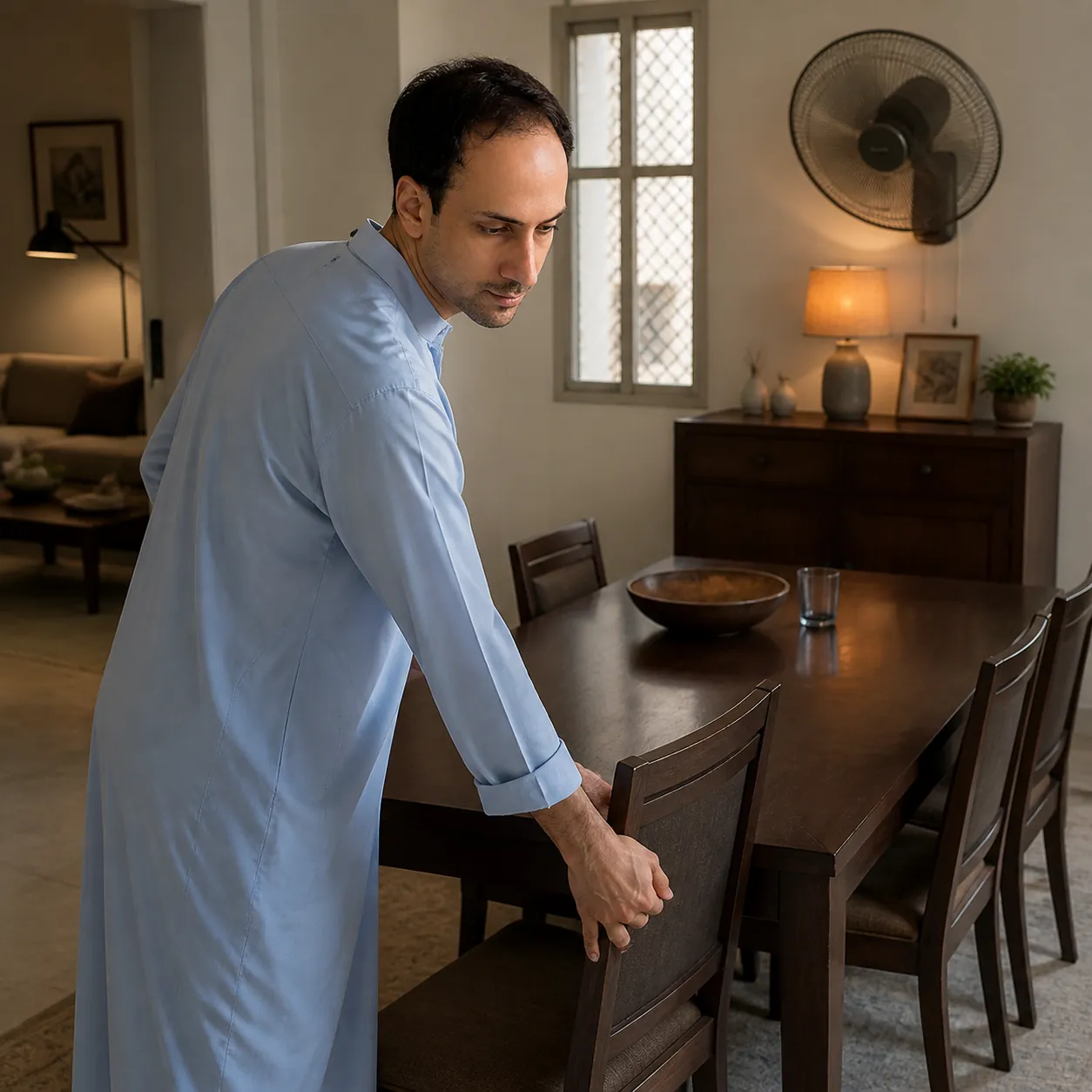
The Last Chair Pushed In — AI Portrait Prompt
صورةAI Portraits

Turn your own photo into an observational domestic portrait in a dining corner of the main room with four chairs pushed in. Keeps your face unchanged.

من نص البرومبت

Use the attached reference photo as the identity reference: keep the same face, skin tone, hair and features as the person in that photo, without beautifying, aging or altering them. Create a square 1:1 museum-catalog frame with a strong first read and a slower second read at exactly 2880x2880 pixels. Location: a dining corner of the main room with four chairs pushed in. Show them in a pale blue traditional Gulf outfit with the sleeves folded back once, pushing the last chair in against the table edge. Build the image around this small, exact tableau: a fan left off for weeks, switched on at last, its noise finally allowed to cover the hall turns an ordinary chore into a problem of position and sound. Explore what a room costs when every sound in it must first be named; expression occupied, not expressive, carrying steady alertness, difficulty stated as arrangement rather than distress. Frame them three-quarters from behind with both their hands and the far end readable. Make the composition show the extra distance their arrangement adds. Render it as observational domestic portraiture built from truthful chore staging, exact material texture, ordinary architectural geometry, and quietly unsentimental framing, using flat mid-afternoon daylight through a screened window with no direct sun and a palette of chalk cream, dark walnut, and low amber lamplight. Photorealistic: this must read as a real photograph from a physical camera, never an illustration, painting, or 3D render. Resolve real surface detail: glass with real thickness at its edge, reflections that carry the room's actual colour, and dust visible only at grazing angles. Keep one identity-locked person, credible hands and fingers, natural fabric, and coherent scale, contact, reflections, shadows, airflow, deformation, and materials. Background people only when essential, always secondary and clearly different. Avoid hero poses, golden-hour wellness glow, eye contact with the lens, and tear-streaked faces. No text, labels, logos, signatures, watermarks, random symbols, plastic skin, excessive bloom, or glossy AI finish.
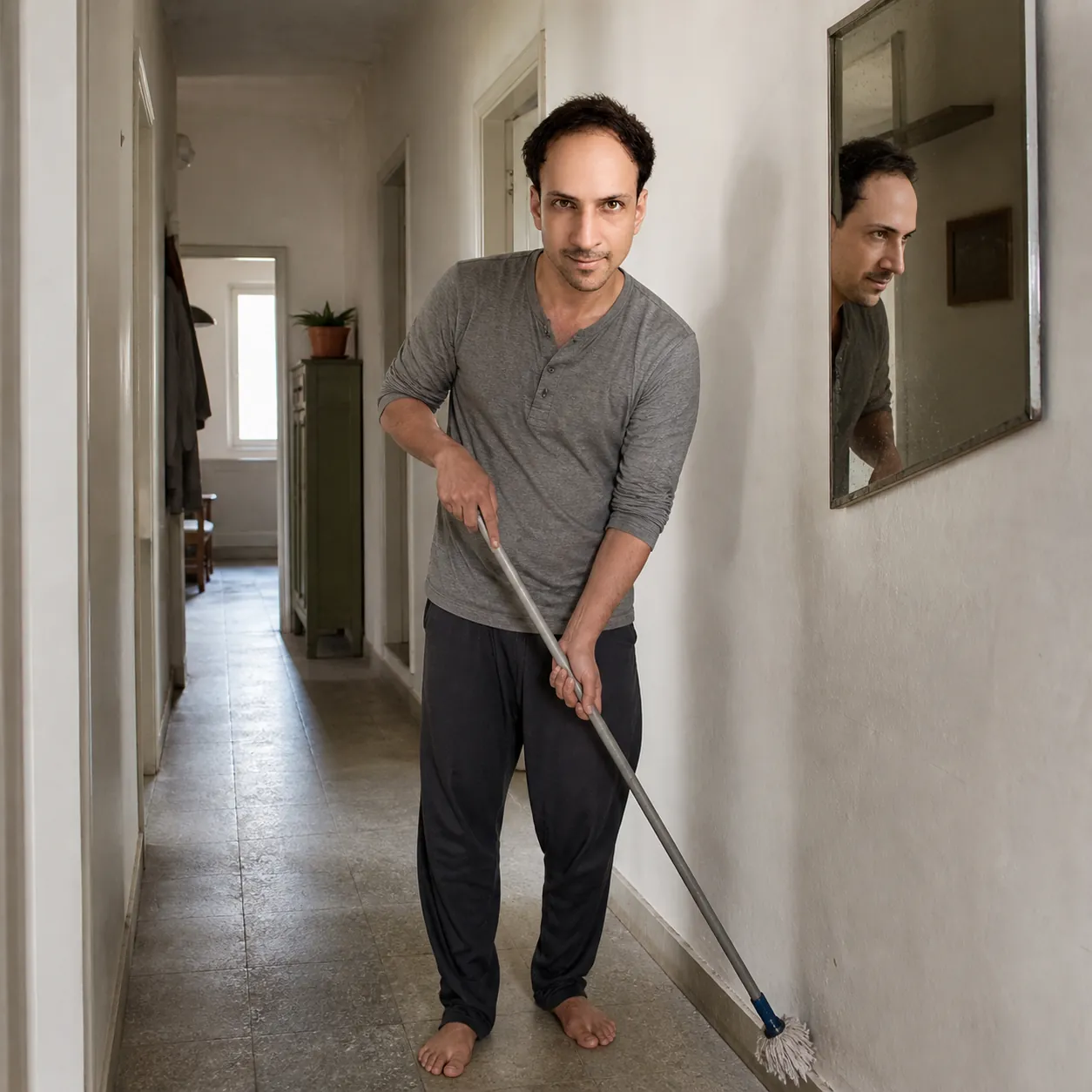
Accounting for the Whole Flat — AI Portrait Prompt
صورةAI Portraits

Turn your own photo into a gallery-scale everyday portrait in a long inner corridor of the flat with doors along one side. Keeps your face unchanged.

من نص البرومبت

Use the attached reference photo as the identity reference: keep the same face, skin tone, hair and features as the person in that photo, without beautifying, aging or altering them. Create a square 1:1 museum-catalog frame with a strong first read and a slower second read at exactly 2880x2880 pixels. Location: a long inner corridor of the flat with doors along one side. Show them in a heather-grey henley with the sleeves shoved to the elbow, trailing a dust mop along the base of the wall. Make this piece of unglamorous evidence the whole argument: a shaving mirror turned off-square to the wall so the open door stays in the glass beside their jaw holds an ordinary task open a moment longer than the task requires. Explore what it costs to keep a whole flat accounted for while working; expression occupied, not expressive, carrying dry persistence, difficulty stated as a bill quietly paid. Use a 40mm chest-height viewpoint that includes the room's depth without dramatizing it. Make the composition give the room's emptiest part the sharpest detail. Render it as gallery-scale everyday realism combining high-fidelity portrait photography, working household objects, and physically accurate shadow and reflection, using flat mid-afternoon daylight through a screened window with no direct sun and a palette of plaster white, worn grey tile, and one olive accent. Photorealistic: this must read as a real photograph from a physical camera, never an illustration, painting, or 3D render. Resolve real surface detail: floor finish worn along the walked line, skirting marked at shoe height, and corners darker than the open floor. Keep one identity-locked person, credible hands and fingers, natural fabric, and coherent scale, contact, reflections, shadows, airflow, deformation, and materials. Background people only when essential, always secondary and clearly different. Avoid thriller shadows, keyhole peering, weapons or uniforms, and staged startle reactions. No text, labels, logos, signatures, watermarks, random symbols, plastic skin, excessive bloom, or glossy AI finish.
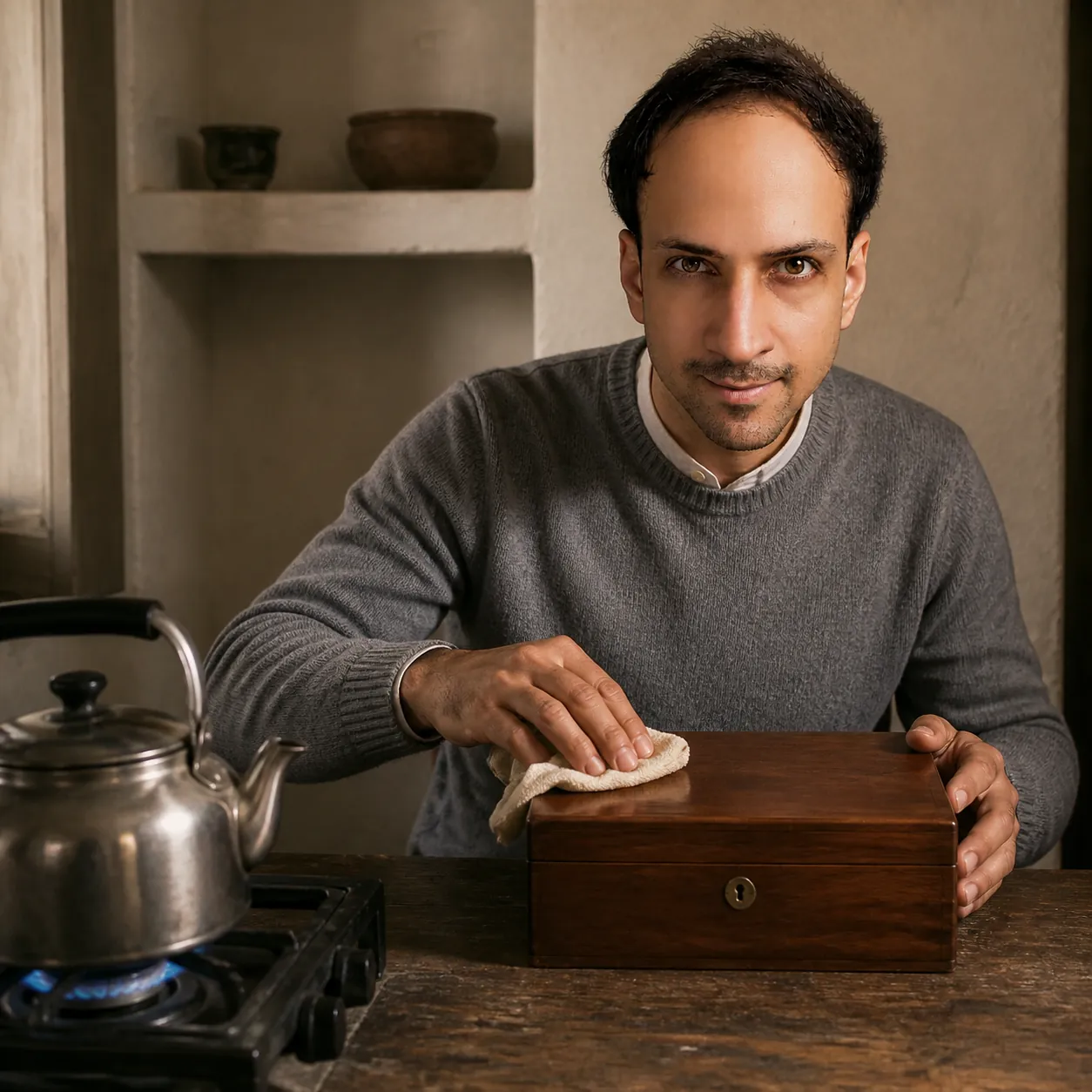
The Quiet Hours: Wall Niche — AI Portrait Prompt
صورةAI Portraits

Turn your own photo into a portrait in a wall niche holding one closed walnut case between bare plaster shelves. Keeps your face unchanged.

من نص البرومبت

Use the attached reference photo as the identity reference: keep the same face, skin tone, hair and features as the person in that photo, without beautifying, aging or altering them. Create a square 1:1 museum-catalog frame with a strong first read and a slower second read at exactly 2880x2880 pixels. Location: a wall niche holding one closed walnut case between bare plaster shelves. Show the subject in a heather-grey sweater with a band-collar shirt beneath it, buffing the case's lid along its grain with a soft cloth. Treat this mechanism as the frame’s governing rule: a stovetop kettle at its loud murmuring stage, when collapsing steam bubbles ring the water hardest just before the boil trades spectacle for a fascination that deepens by the third look. Explore why an evening feels longer when everything in it moves at hand speed; direct expression and posture toward attentive ease, never melodrama or ad-like confidence. Frame from the empty chair opposite them, the lens at a seated guest's eye height. Make the composition keep every working surface honest, worn, and unstyled. Render it as contemporary interior portraiture combining honest low-light photography, physically accurate flame behavior, lived-in Saudi domestic detail, and unhurried editorial composure, using the last grey-gold daylight from one window, failing believably across the room and a palette of soft olive, bone plaster, and a low flame-orange note. Photorealistic: this must read as a real photograph from a physical camera, never an illustration, painting, or 3D render. Resolve real surface detail: leather creased along the lines of use, stitching slightly irregular, and edges burnished from contact. Keep one identity-locked person, credible hands and fingers, natural fabric, and coherent scale, contact, reflections, shadows, airflow, deformation, and materials. Background people only when essential, always secondary and clearly different. Avoid orientalist lantern fantasies, floating dust-mote sunbeam overload, plastic-perfect wax flames, museum-diorama stiffness, and greeting-card coziness. No text, labels, logos, signatures, watermarks, random symbols, plastic skin, excessive bloom, or glossy AI finish.
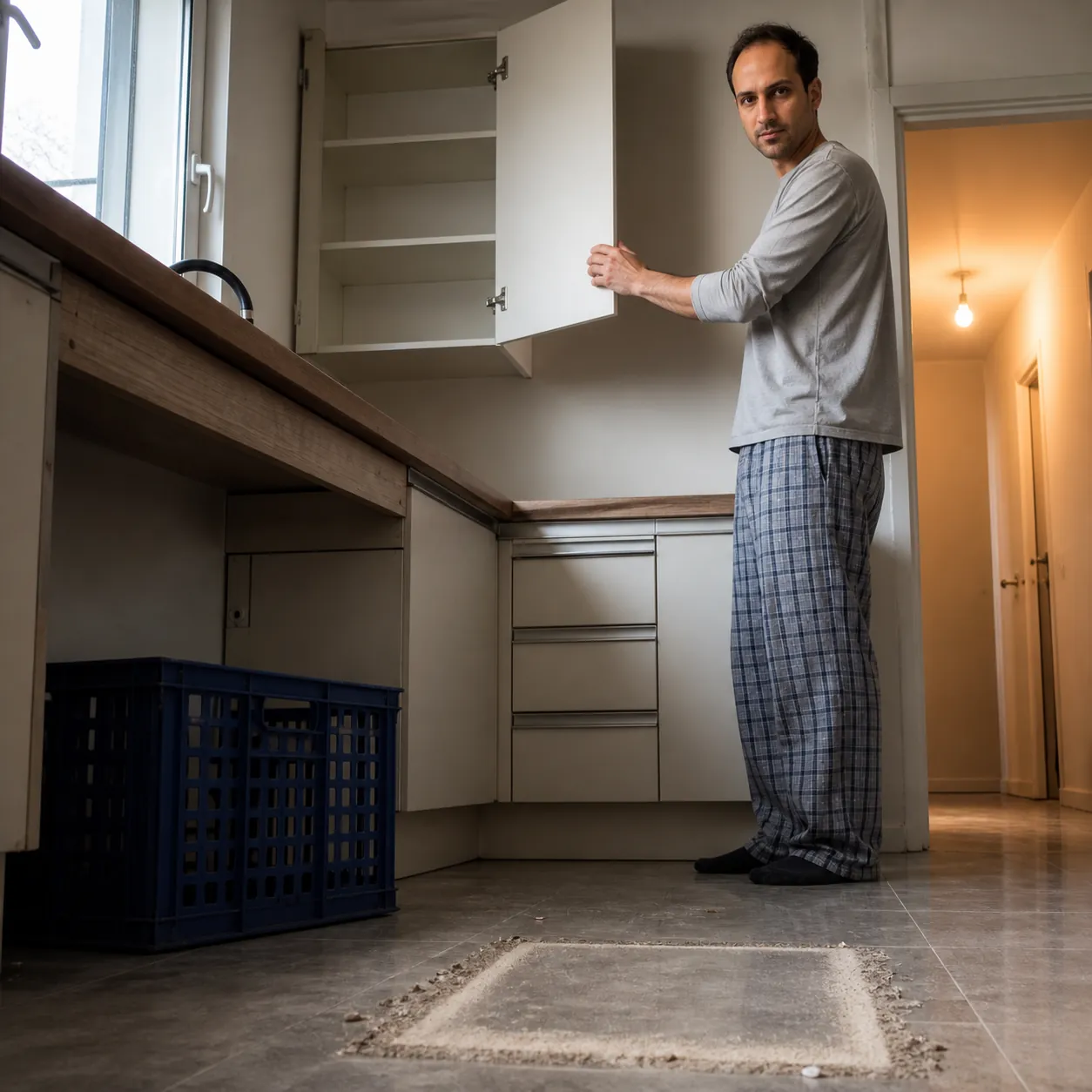
A Clean Rectangle in the Dust — AI Portrait Prompt
صورةAI Portraits

Turn your own photo into a photorealistic portrait in a flat's kitchen where two upper cupboards stand emptied and open. Keeps your face unchanged.

من نص البرومبت

Use the attached reference photo as the identity reference: keep the same face, skin tone, hair and features as the person in that photo, without beautifying, aging or altering them. Create a square 1:1 museum-catalog frame with a strong first read and a slower second read at exactly 2880x2880 pixels. Location: a flat's kitchen where two upper cupboards stand emptied and open. Show them in a soft grey long-sleeve tee and loose cotton pyjama trousers, easing a cupboard door closed until it latches. Anchor the frame to this piece of ordinary evidence: a plastic crate returned empty to its corner, where the floor keeps a clean rectangle in three weeks of dust carries the date of its own beginning better than memory does. Explore what a room remembers that a person cannot; expression occupied, not expressive, carrying practical acceptance, difficulty stated with the flatness of ordinary fact. Place the camera low beside the floor work so the room rises unemphasised. Make the composition treat the floor as the honest record of the fortnight. Render it as understated contemporary realism drawn from ordinary maintenance labour, precise everyday objects, believable dust, and sober editorial restraint, using overcast window light with one warm bulb left on next door and a palette of cool grey tile, unbleached cotton, and a single crate blue. Photorealistic: this must read as a real photograph from a physical camera, never an illustration, painting, or 3D render. Resolve real surface detail: cotton that hangs by its own weight, seams that pucker very slightly, and collars softened by washing. Keep one identity-locked person, credible hands and fingers, natural fabric, and coherent scale, contact, reflections, shadows, airflow, deformation, and materials. Background people only when essential, always secondary and clearly different. Avoid mood without labour, styled hoarder chaos, golden-hour comfort, and bedside sorrow. No text, labels, logos, signatures, watermarks, random symbols, plastic skin, excessive bloom, or glossy AI finish.
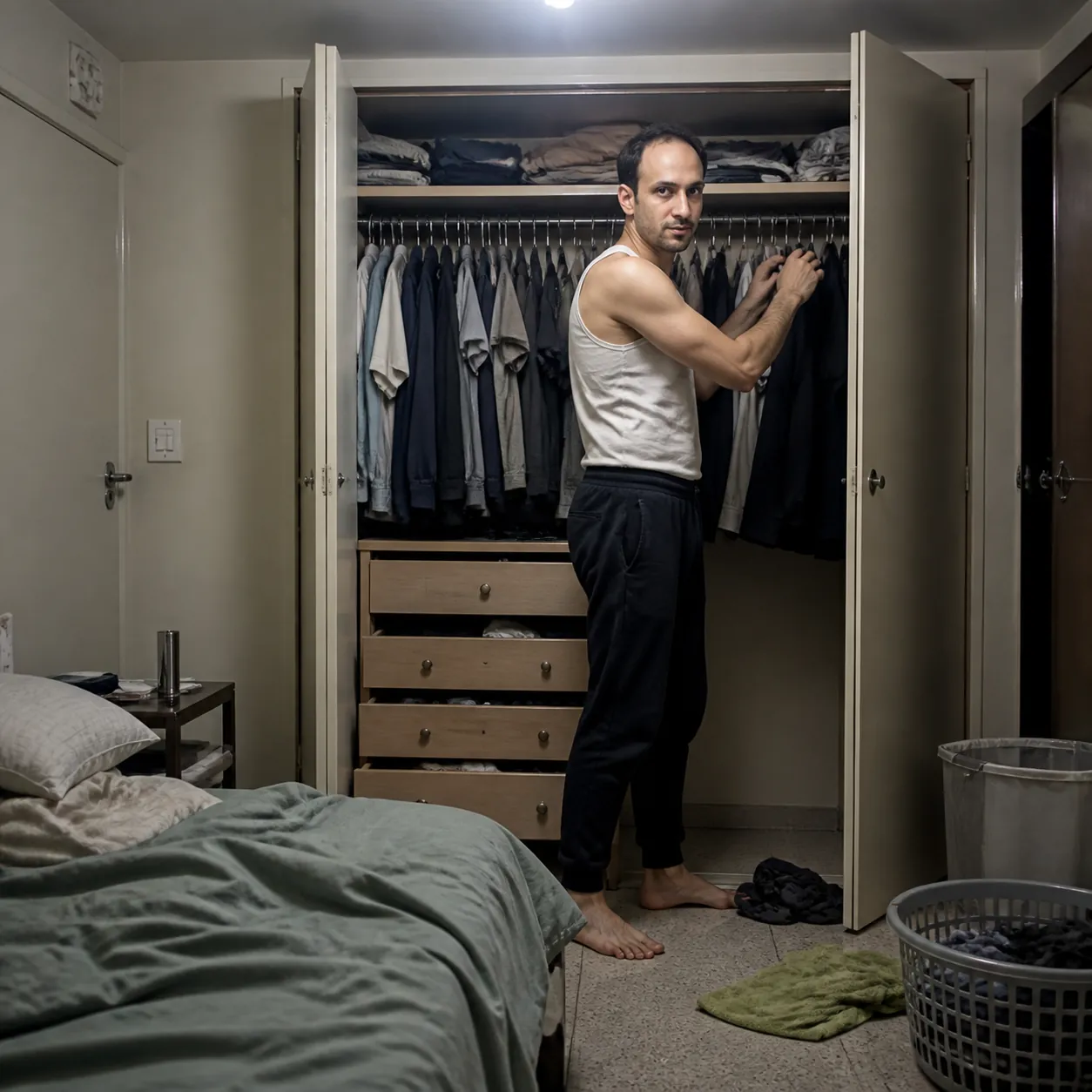
Eleven Days of Open Doors — AI Portrait Prompt
صورةAI Portraits

Turn your own photo into a gallery-grade domestic portrait in a bedroom whose wardrobe doors have stood open for eleven days. Keeps your face unchanged.

من نص البرومبت

Use the attached reference photo as the identity reference: keep the same face, skin tone, hair and features as the person in that photo, without beautifying, aging or altering them. Create a square 1:1 museum-catalog frame with a strong first read and a slower second read at exactly 2880x2880 pixels. Location: a bedroom whose wardrobe doors have stood open for eleven days. Show them in a plain white undershirt and dark drawstring trousers, feet bare, sliding a bank of hangers along the rail. Anchor the frame to this piece of ordinary evidence: a drawer bank whose first three hold dividers cut exactly to fit and whose remaining six hold loose contents carries the date of its own beginning better than memory does. Explore how much fuel an ordinary tidy requires when there is little spare; expression occupied, not expressive, carrying worn steadiness, difficulty stated with the flatness of ordinary fact. Place the camera low beside the floor work so the room rises unemphasised. Make the composition keep the untouched half in frame, never in the way. Render it as gallery-grade domestic realism combining unposed reportage photography, honest interior materials, accurate weight, and unhurried human-scale composition, using cool fluorescent tube light from a utility fitting, honest and undramatic and a palette of soft sand beige, worn steel, and one green cleaning-cloth accent. Photorealistic: this must read as a real photograph from a physical camera, never an illustration, painting, or 3D render. Resolve real surface detail: dust settled where nobody wipes, fingerprint haze on glass, and edges rubbed pale by handling. Keep one identity-locked person, credible hands and fingers, natural fabric, and coherent scale, contact, reflections, shadows, airflow, deformation, and materials. Background people only when essential, always secondary and clearly different. Avoid mood without labour, styled hoarder chaos, golden-hour comfort, and bedside sorrow. No text, labels, logos, signatures, watermarks, random symbols, plastic skin, excessive bloom, or glossy AI finish.
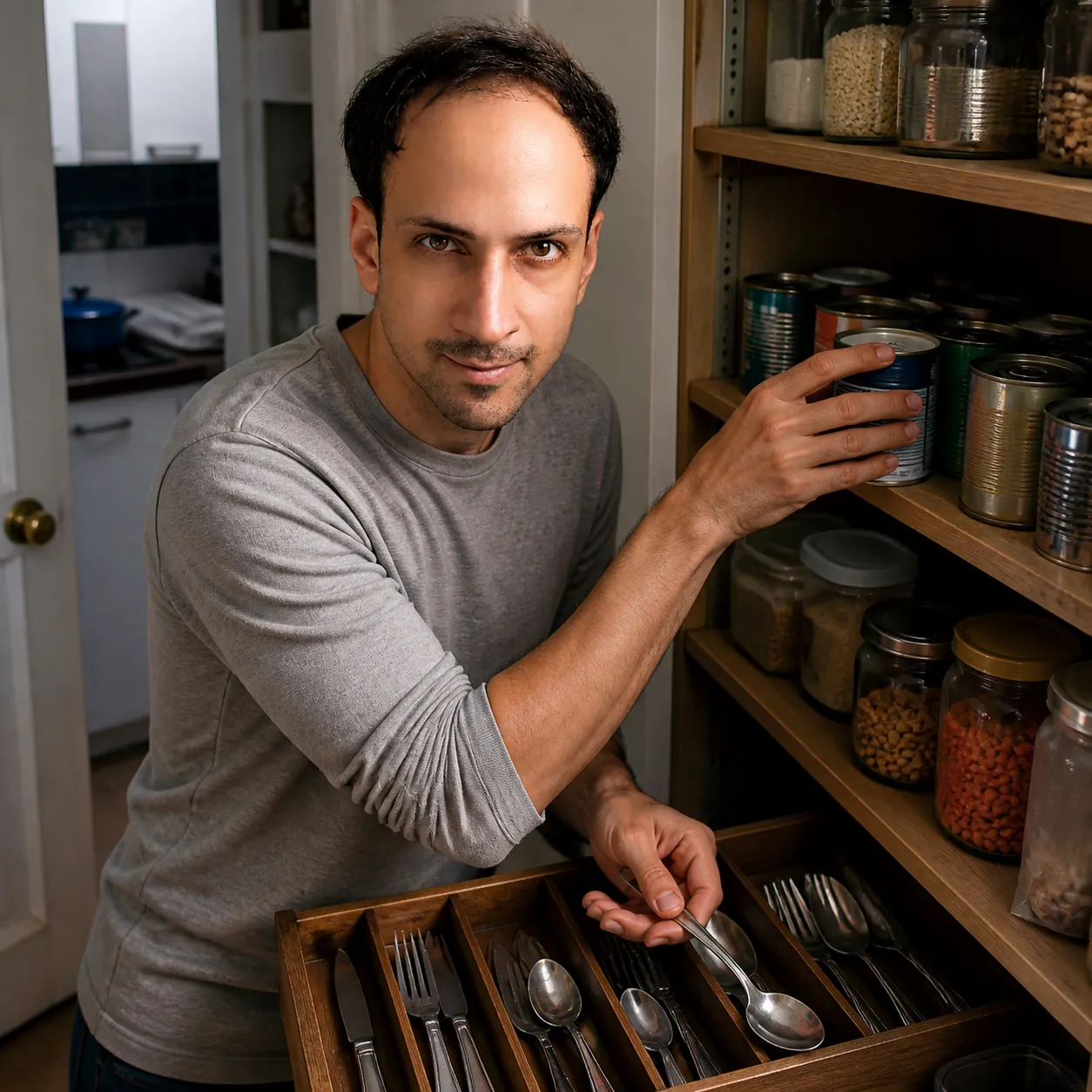
A Private Rule: Larder Cupboard — AI Portrait Prompt
صورةAI Portraits

Turn your own photo into a photorealistic portrait in a larder cupboard beside the kitchen door, lower shelves half filled. Keeps your face unchanged.

من نص البرومبت

Use the attached reference photo as the identity reference: keep the same face, skin tone, hair and features as the person in that photo, without beautifying, aging or altering them. Create a square 1:1 museum-catalog frame with a strong first read and a slower second read at exactly 2880x2880 pixels. Location: a larder cupboard beside the kitchen door, lower shelves half filled. Show the subject in a plain grey crew-neck with sleeves pushed above the wrist, sliding a tin into the gap left for it. Anchor the frame to this piece of ordinary evidence: a cutlery tray sorted by a rule that only they can feel, one spoon lifted out again for breaking it shows care and compulsion using exactly the same pair of hands. Explore what the hands know about a rule the mouth cannot explain; expression occupied, not expressive, carrying unhurried insistence, difficulty stated in hours rather than in feeling. Frame slightly above the work so the judged row reads as one line. Make the composition let one hand rest just short of the object. Render it as gallery-scale everyday realism made from documentary portrait photography, exact household props, physically correct wear, and composed stillness, using one shaded ceiling fitting throwing even, slightly tired light and a palette of unbleached cotton, dark walnut, and an enamel-blue accent. Photorealistic: this must read as a real photograph from a physical camera, never an illustration, painting, or 3D render. Resolve real surface detail: cotton that hangs by its own weight, seams that pucker very slightly, and collars softened by washing. Keep one identity-locked person, credible hands and fingers, natural fabric, and coherent scale, contact, reflections, shadows, airflow, deformation, and materials. Background people only when essential, always secondary and clearly different. Avoid decorative symmetry, tidiness memes, gleaming surfaces, anguished faces, and pinned clinical checklists. No text, labels, logos, signatures, watermarks, random symbols, plastic skin, excessive bloom, or glossy AI finish.
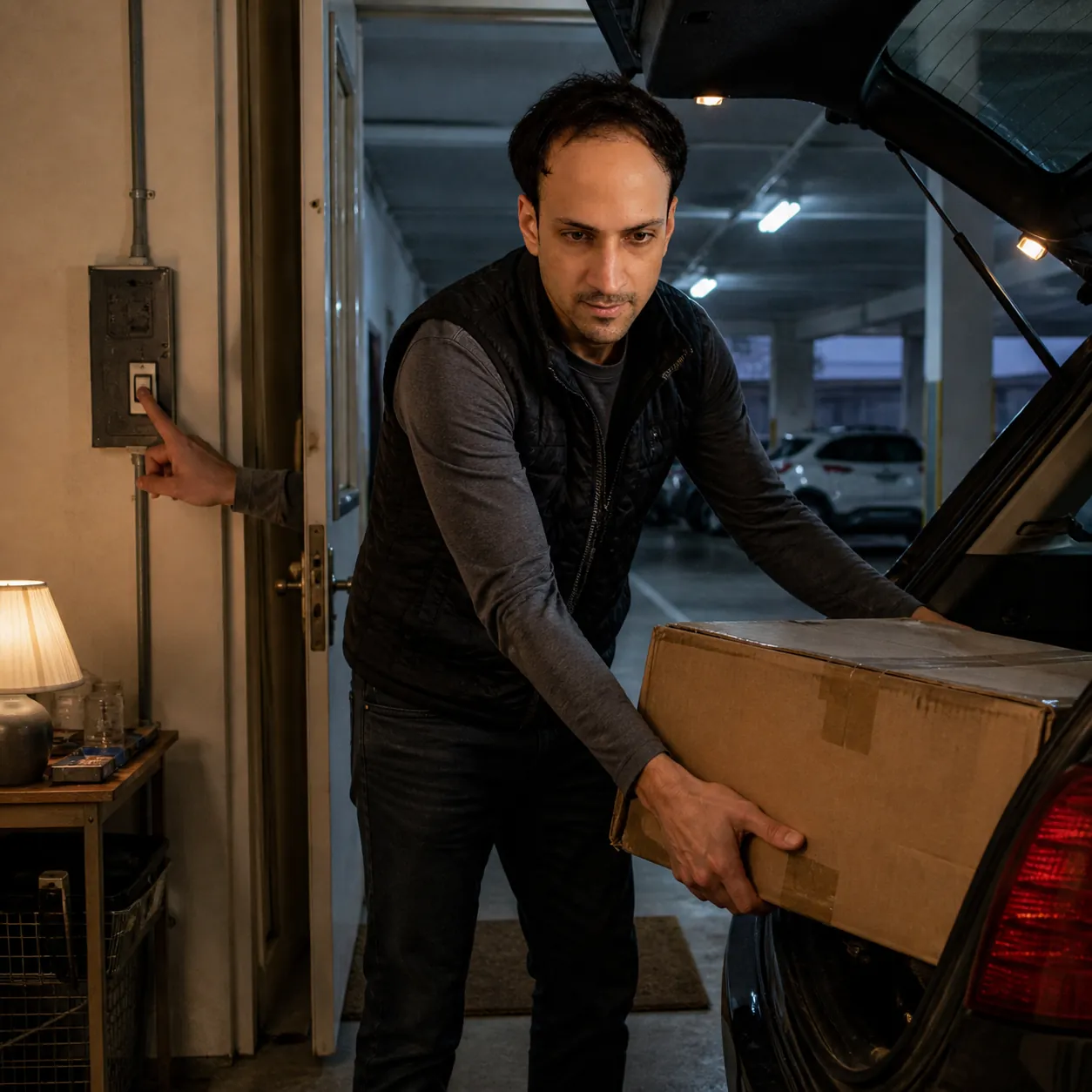
Already Off: Covered Residential Parking Level — AI Portrait Prompt
صورةAI Portraits

Turn your own photo into a portrait in a covered residential parking level under long ceiling tubes. Keeps your face unchanged.

من نص البرومبت

Use the attached reference photo as the identity reference: keep the same face, skin tone, hair and features as the person in that photo, without beautifying, aging or altering them. Create a square 1:1 museum-catalog frame with a strong first read and a slower second read at exactly 2880x2880 pixels. Location: a covered residential parking level under long ceiling tubes. Show the subject in a dark quilted gilet over a long-sleeved grey tee, sliding a heavy carton across the car's boot lip. The difficulty must be visible in this, not in their expression: a switch already down that one finger presses again in passing, the room behind it staying exactly as dark spends real labour on a doubt that looking cannot settle. Explore where the labour sits when nothing in the room needs fixing; expression occupied, not expressive, carrying workmanlike restraint, difficulty stated in the object alone. Hold a static wide view from just inside the room they are leaving. Make the composition keep one hand fully visible and unambiguous throughout. Render it as gallery-grade domestic documentation built from truthful skin rendering, worn everyday objects, credible household architecture, and framing that refuses drama, using late blue window light thinned by one low interior lamp and a palette of smoke grey, pale sand, and one dulled copper. Photorealistic: this must read as a real photograph from a physical camera, never an illustration, painting, or 3D render. Resolve real surface detail: rubber gone chalky with age, painted metal chipped to primer, and plastic yellowed only where light reaches it. Keep one identity-locked person, credible hands and fingers, natural fabric, and coherent scale, contact, reflections, shadows, airflow, deformation, and materials. Background people only when essential, always secondary and clearly different. Avoid clock close-ups, head-in-hands melancholy, mystical counting, inspirational calm, and beauty portraits without labour. No text, labels, logos, signatures, watermarks, random symbols, plastic skin, excessive bloom, or glossy AI finish.
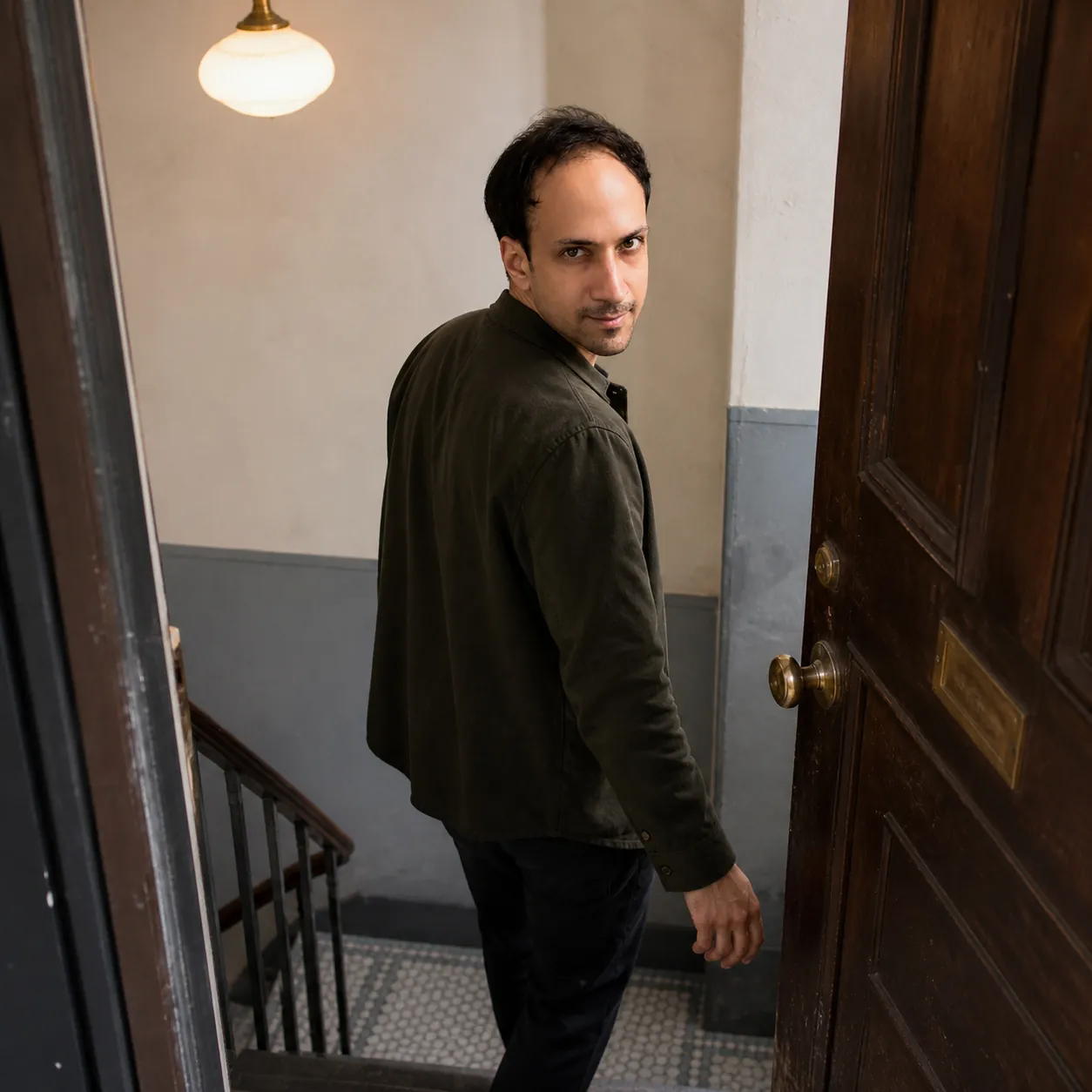
Leaving Once: Half-Landing Between Two Floors — AI Portrait Prompt
صورةAI Portraits

Turn your own photo into an unsentimental domestic portrait in the half-landing between two floors of a walk-up block. Keeps your face unchanged.

من نص البرومبت

Use the attached reference photo as the identity reference: keep the same face, skin tone, hair and features as the person in that photo, without beautifying, aging or altering them. Create a square 1:1 museum-catalog frame with a strong first read and a slower second read at exactly 2880x2880 pixels. Location: the half-landing between two floors of a walk-up block. Show the subject in a dark olive overshirt over a plain crew-neck, turning back down two steps toward the door. The difficulty must be visible in this, not in their expression: a doorway crossed and left behind by a person whose keys are already deep in a pocket, not the lock weighs a two-minute job against everything it can quietly become. Explore how closing-up chores acquire a second, longer version of themselves; expression occupied, not expressive, carrying steady attention, difficulty stated as a chore, not a confession. Hold a static wide view from just inside the room they are leaving. Make the composition keep one hand fully visible and unambiguous throughout. Render it as unsentimental domestic realism built from documentary portrait photography, honest household materials, restrained art direction, and patient observational timing, using an overhead fitting diffused by its plain glass shade and a palette of cool grey tile, bone plaster, and one brass accent. Photorealistic: this must read as a real photograph from a physical camera, never an illustration, painting, or 3D render. Resolve real surface detail: wood grain read at honest scale, matte and gloss clearly separated, and no surface uniformly clean. Keep one identity-locked person, credible hands and fingers, natural fabric, and coherent scale, contact, reflections, shadows, airflow, deformation, and materials. Background people only when essential, always secondary and clearly different. Avoid hand-washing imagery, tally marks, symmetrical object grids, hero poses at camera, and wellness glow. No text, labels, logos, signatures, watermarks, random symbols, plastic skin, excessive bloom, or glossy AI finish.
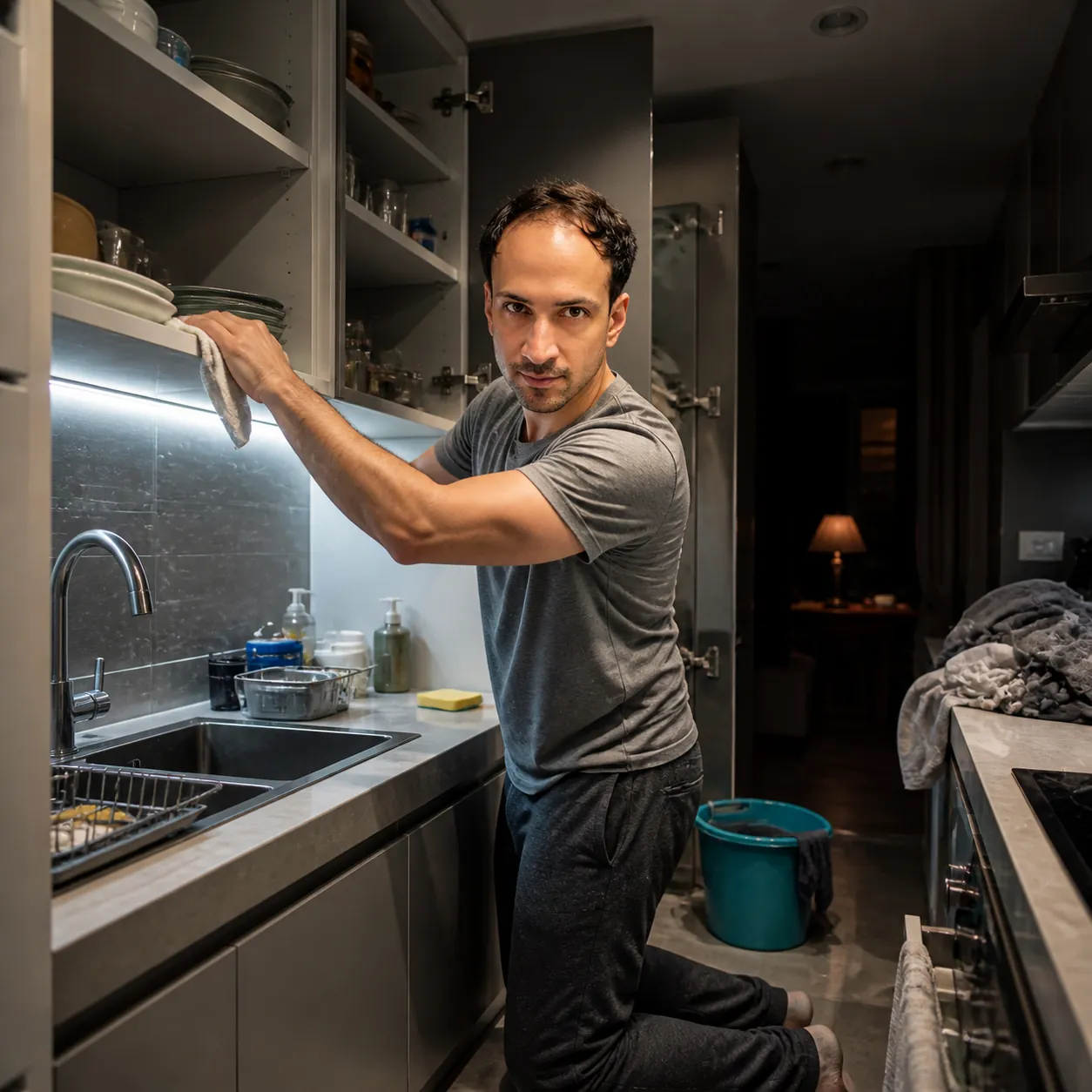
Real Progress: Galley Kitchen — AI Portrait Prompt
صورةAI Portraits

Turn your own photo into a portrait in a galley kitchen with every upper cupboard standing open at three. Keeps your face unchanged.

من نص البرومبت

Use the attached reference photo as the identity reference: keep the same face, skin tone, hair and features as the person in that photo, without beautifying, aging or altering them. Create a square 1:1 museum-catalog frame with a strong first read and a slower second read at exactly 2880x2880 pixels. Location: a galley kitchen with every upper cupboard standing open at three. Show the subject in a grey cotton tee, drawstring trousers, and bare working forearms, kneeling to wipe the last shelf edge dry. Anchor the frame to this piece of ordinary evidence: a room where four separate jobs stand half-done at once with none of them anywhere near finished keeps the labour honest while quietly naming what it is costing. Explore how a household benefits from labour its owner cannot quite stop giving; expression occupied, not expressive, carrying task-bound calm, difficulty stated in the plainest terms available. Frame slightly above the tableau so their forearms and the surface share focus. Make the composition leave the room beyond the lamp completely unlit. Render it as museum-scale portraiture of household work built from truthful low-light colour, tactile everyday objects, and unglamorised interiors, using a cold strip fitting bouncing evenly off wet tile and damp cloth and a palette of grey concrete, unbleached cotton, and a single teal bucket. Photorealistic: this must read as a real photograph from a physical camera, never an illustration, painting, or 3D render. Resolve real surface detail: cotton that hangs by its own weight, seams that pucker very slightly, and collars softened by washing. Keep one identity-locked person, credible hands and fingers, natural fabric, and coherent scale, contact, reflections, shadows, airflow, deformation, and materials. Background people only when essential, always secondary and clearly different. Avoid manic-eyed expressions, mess staged as spectacle, triumphant before-and-after framing, and golden window haze. No text, labels, logos, signatures, watermarks, random symbols, plastic skin, excessive bloom, or glossy AI finish.
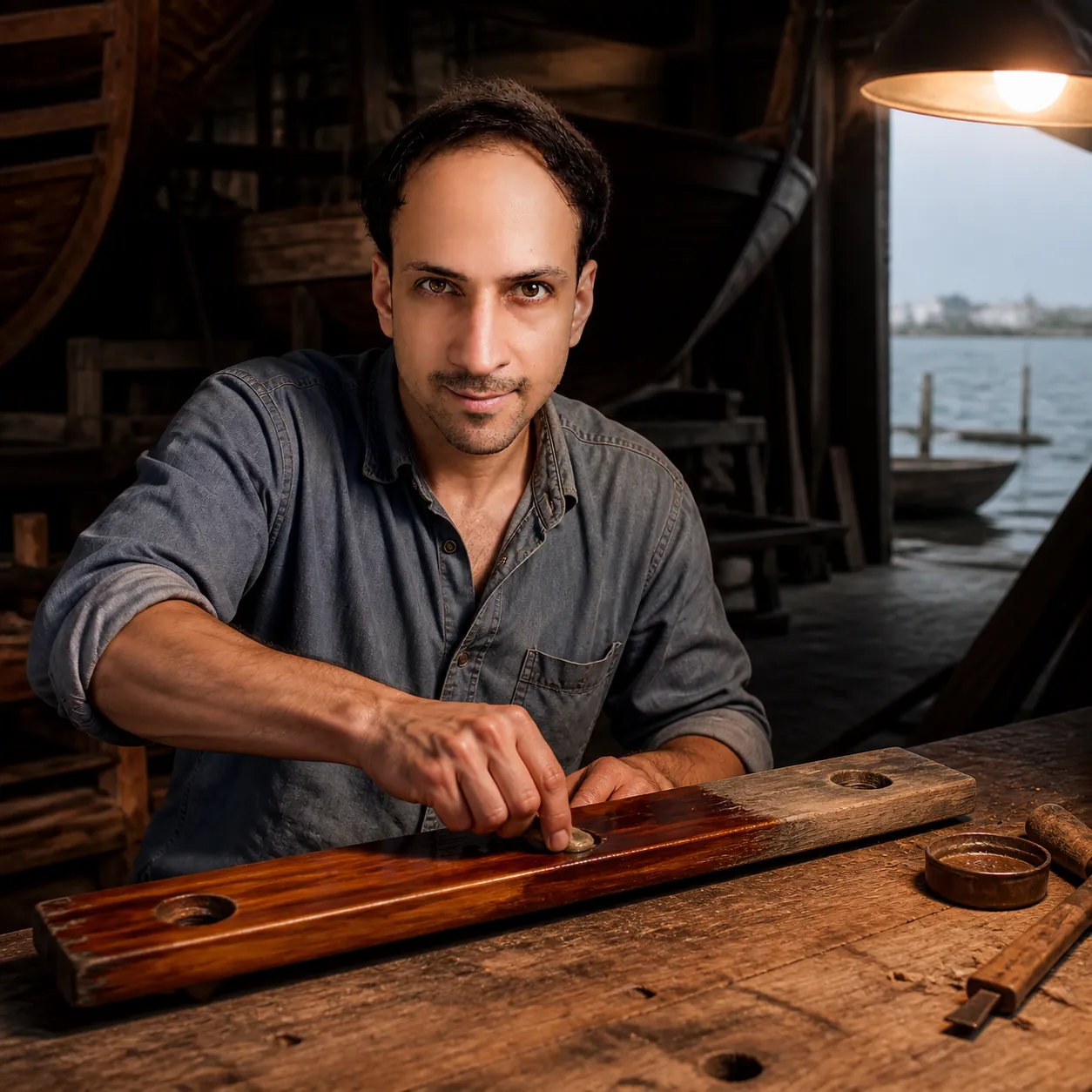
Quiet Longevity: Dim Dhow-Repair Shed — AI Portrait Prompt
صورةAI Portraits

Turn your own photo into a material-culture documentary portrait in a dim dhow-repair shed on the Gulf shore, tide sounding outside. Keeps your face unchanged.

من نص البرومبت

Use the attached reference photo as the identity reference: keep the same face, skin tone, hair and features as the person in that photo, without beautifying, aging or altering them. Create a square 1:1 museum-catalog frame with a strong first read and a slower second read at exactly 2880x2880 pixels. Location: a dim dhow-repair shed on the Gulf shore, tide sounding outside. Show the subject in a salt-faded blue overshirt with sleeves rolled past the elbow, pressing warmed wax into a seam with one thumb. Build the artwork around this material rule: a mahogany spirit level whose freshly oiled half glows with deep ribbon figure while its dry half stays dusty grey argues that upkeep, not replacement, is the true form of inheritance. Explore why time improves some surfaces and ruins all the rest; direct expression and posture toward sober gratitude, never melodrama or ad-like confidence. Use a restrained 35mm environmental view, the subject at one-third and the workspace honest around them. Make the composition hold empty bench space where a finished tool will rest. Render it as material-culture documentary photography combining believable century-old tools, honest maintenance evidence, restrained contemporary art direction, and calm human-scale observational framing, using a single warm workbench lamp pooled tight, the room falling to umber and a palette of seasoned black, beeswax cream, and a gleam of pewter. Photorealistic: this must read as a real photograph from a physical camera, never an illustration, painting, or 3D render. Resolve real surface detail: hair with individual strands catching light, fine hairs of uneven length, and skin oil giving a low uneven sheen. Keep one identity-locked person, credible hands and fingers, natural fabric, and coherent scale, contact, reflections, shadows, airflow, deformation, and materials. Background people only when essential, always secondary and clearly different. Avoid glowing forge montages, artificially weathered wood grain, hipster workshop styling, floating tool arrangements, and varnish-shiny fake patina. No text, labels, logos, signatures, watermarks, random symbols, plastic skin, excessive bloom, or glossy AI finish.
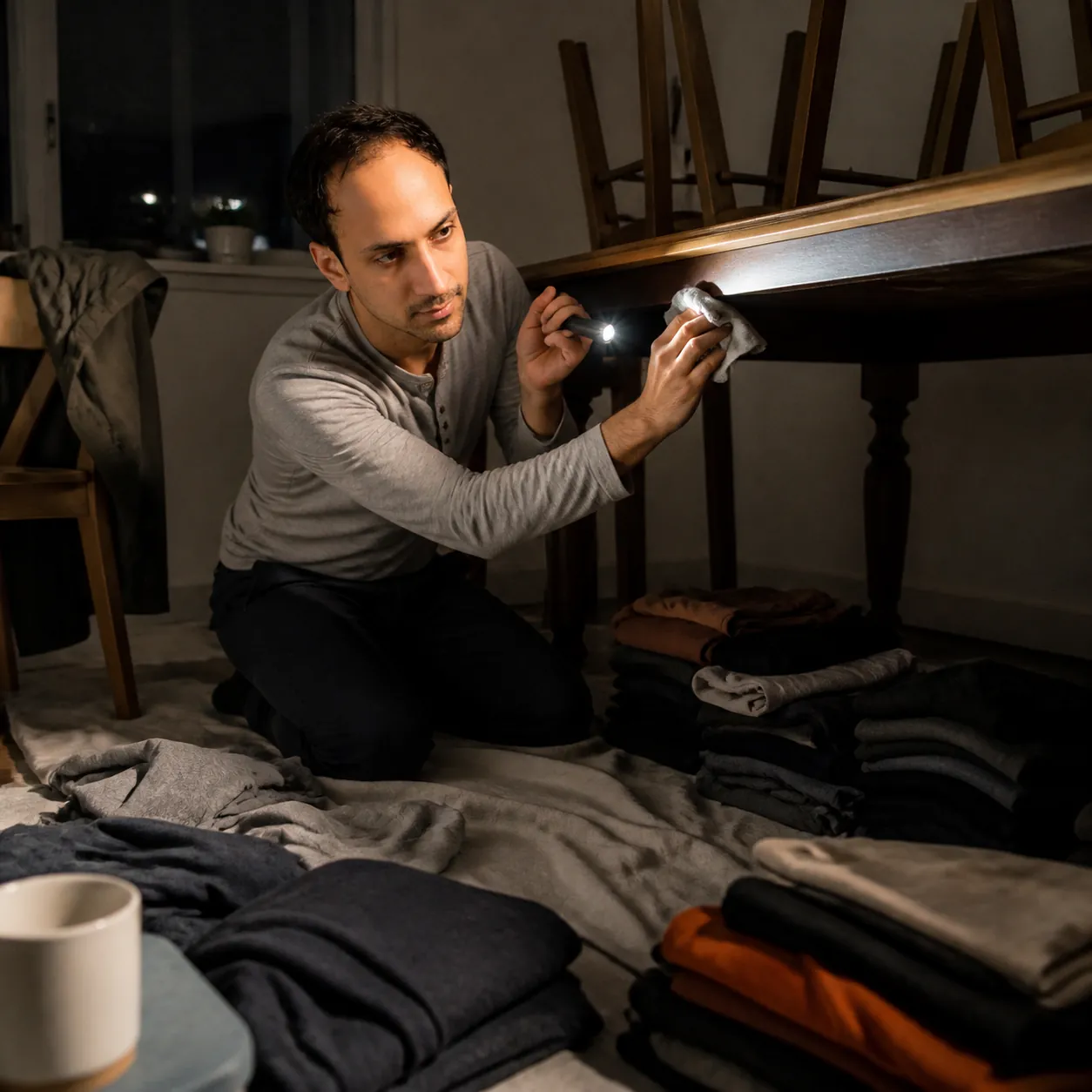
Sleeves Up: Dining Nook — AI Portrait Prompt
صورةAI Portraits

Turn your own photo into a portrait in a dining nook with its table cleared and its chairs upended. Keeps your face unchanged.

من نص البرومبت

Use the attached reference photo as the identity reference: keep the same face, skin tone, hair and features as the person in that photo, without beautifying, aging or altering them. Create a square 1:1 museum-catalog frame with a strong first read and a slower second read at exactly 2880x2880 pixels. Location: a dining nook with its table cleared and its chairs upended. Show the subject in a soft grey henley and plain dark cotton trousers, running a cloth along the underside of the table. The difficulty must be visible in this, not in their expression: a rail of clothing emptied onto a spread blanket and re-sorted into piles that agree on sleeve length and colour makes the scale of the night's work impossible to mistake for tidying. Explore how much real work one elevated night can absorb before its size shows; expression occupied, not expressive, carrying brisk composure, difficulty stated in the plainest terms available. Use a 35mm three-quarter view with one near object kept physically convincing. Make the composition let the untouched object rest quietly at one edge. Render it as museum-scale portraiture of household work built from truthful low-light colour, tactile everyday objects, and unglamorised interiors, using a hand torch plus weak ambient, both sources clearly accounted for and a palette of graphite shadow, oatmeal linen, and low sodium orange. Photorealistic: this must read as a real photograph from a physical camera, never an illustration, painting, or 3D render. Resolve real surface detail: visible weave in cloth, fine scratches on metal, and the faint unevenness of painted walls. Keep one identity-locked person, credible hands and fingers, natural fabric, and coherent scale, contact, reflections, shadows, airflow, deformation, and materials. Background people only when essential, always secondary and clearly different. Avoid heroic poster poses, glowing wellness interiors, and staring into the lens. No text, labels, logos, signatures, watermarks, random symbols, plastic skin, excessive bloom, or glossy AI finish.
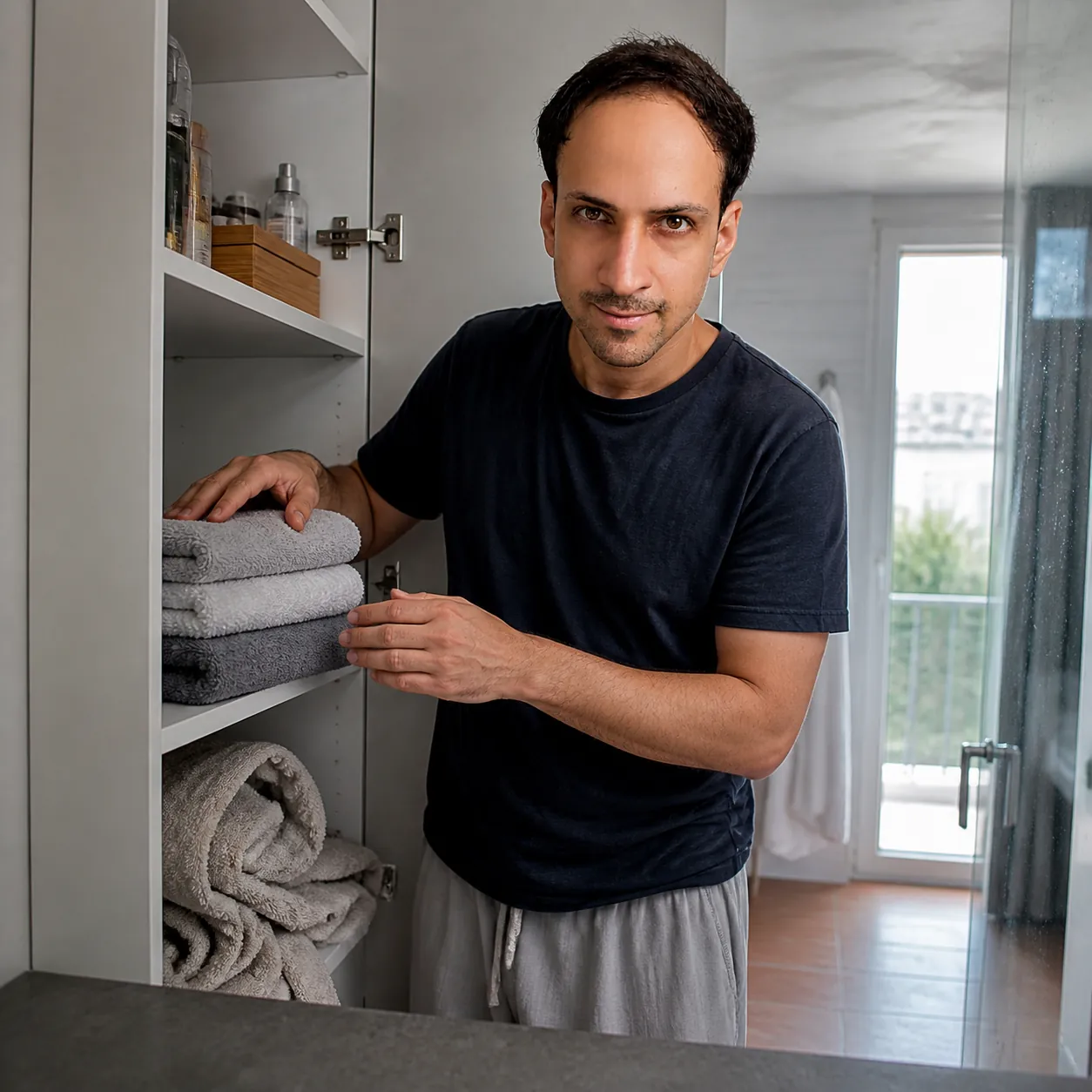
Until They Agree: Bathroom Linen Cupboard — AI Portrait Prompt
صورةAI Portraits

Turn your own photo into a museum-grade domestic portrait in a bathroom linen cupboard opened onto stacked towels at chest height. Keeps your face unchanged.

من نص البرومبت

Use the attached reference photo as the identity reference: keep the same face, skin tone, hair and features as the person in that photo, without beautifying, aging or altering them. Create a square 1:1 museum-catalog frame with a strong first read and a slower second read at exactly 2880x2880 pixels. Location: a bathroom linen cupboard opened onto stacked towels at chest height. Show the subject in a faded navy t-shirt and loose cotton house trousers, stacking three folded towels edge to edge. Build the image around this small, exact tableau: a stack of towels whose folded edges have been made to agree, two rejected ones still open on the rail shows care and compulsion using exactly the same pair of hands. Explore whether stopping and finishing feel the same from inside the work; expression occupied, not expressive, carrying flat competence, difficulty stated quietly enough to be missed once. Frame from low counter height so the aligned edge crosses the picture level. Make the composition let one hand rest just short of the object. Render it as museum-grade domestic realism built from unposed reportage technique, accurate fabric response, plain room architecture, and patient framing, using flat overcast daylight through a balcony door, no direct sun and a palette of laundered white, graphite, and one strip of terracotta floor. Photorealistic: this must read as a real photograph from a physical camera, never an illustration, painting, or 3D render. Resolve real surface detail: condensation beading at true size, liquid meniscus curving against glass, and wet surfaces darker than dry ones. Keep one identity-locked person, credible hands and fingers, natural fabric, and coherent scale, contact, reflections, shadows, airflow, deformation, and materials. Background people only when essential, always secondary and clearly different. Avoid decorative symmetry, tidiness memes, gleaming surfaces, anguished faces, and pinned clinical checklists. No text, labels, logos, signatures, watermarks, random symbols, plastic skin, excessive bloom, or glossy AI finish.
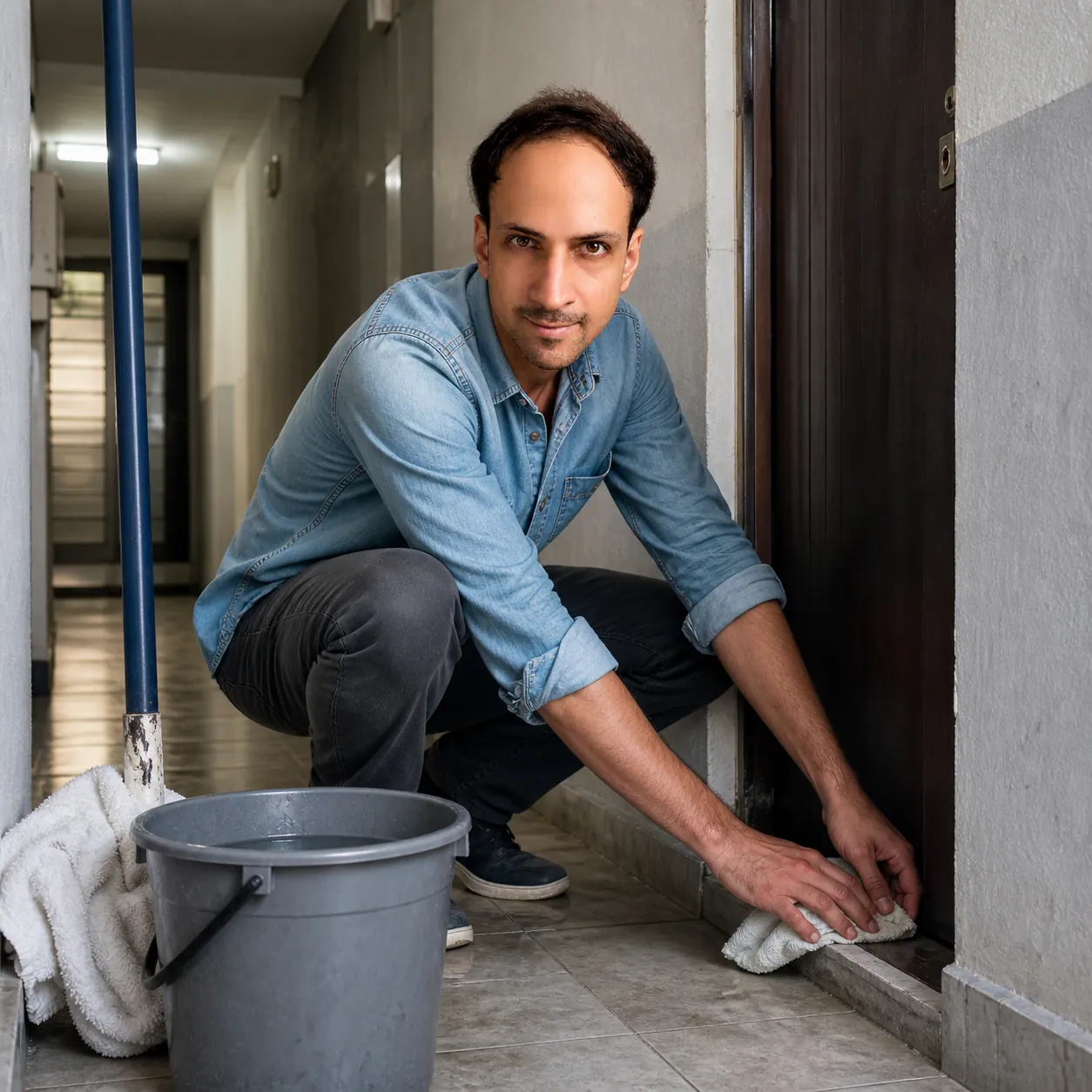
Landing Swept Bare At Night — AI Portrait Prompt
صورةAI Portraits

Turn your own photo into a photorealistic portrait in the shared landing outside your own flat door, swept bare. Keeps your face unchanged.

من نص البرومبت

Use the attached reference photo as the identity reference: keep the same face, skin tone, hair and features as the person in that photo, without beautifying, aging or altering them. Create a square 1:1 museum-catalog frame with a strong first read and a slower second read at exactly 2880x2880 pixels. Location: the shared landing outside their own flat door, swept bare. Show the subject in a light denim shirt buttoned once with the cuffs turned back, sliding a folded mat flush to the doorframe. The difficulty must be visible in this, not in their expression: a bucket of grey water that has been carried out and refilled clean four times in one ordinary job keeps the labour honest while quietly naming what it is costing. Explore why starting matters more than finishing when capacity feels briefly unlimited; expression occupied, not expressive, carrying practical resolve, difficulty stated in the plainest terms available. Use a 35mm three-quarter view with one near object kept physically convincing. Make the composition keep their hands and one clean surface brightest. Render it as gallery-grade domestic realism assembled from ordinary cleaning apparatus, precise fabric and tile response, and natural skin rendering, using a cold strip fitting bouncing evenly off wet tile and damp cloth and a palette of sand-grey wall, bone-white towelling, and one strip of blue. Photorealistic: this must read as a real photograph from a physical camera, never an illustration, painting, or 3D render. Resolve real surface detail: rubber gone chalky with age, painted metal chipped to primer, and plastic yellowed only where light reaches it. Keep one identity-locked person, credible hands and fingers, natural fabric, and coherent scale, contact, reflections, shadows, airflow, deformation, and materials. Background people only when essential, always secondary and clearly different. Avoid manic-eyed expressions, mess staged as spectacle, triumphant before-and-after framing, and golden window haze. No text, labels, logos, signatures, watermarks, random symbols, plastic skin, excessive bloom, or glossy AI finish.
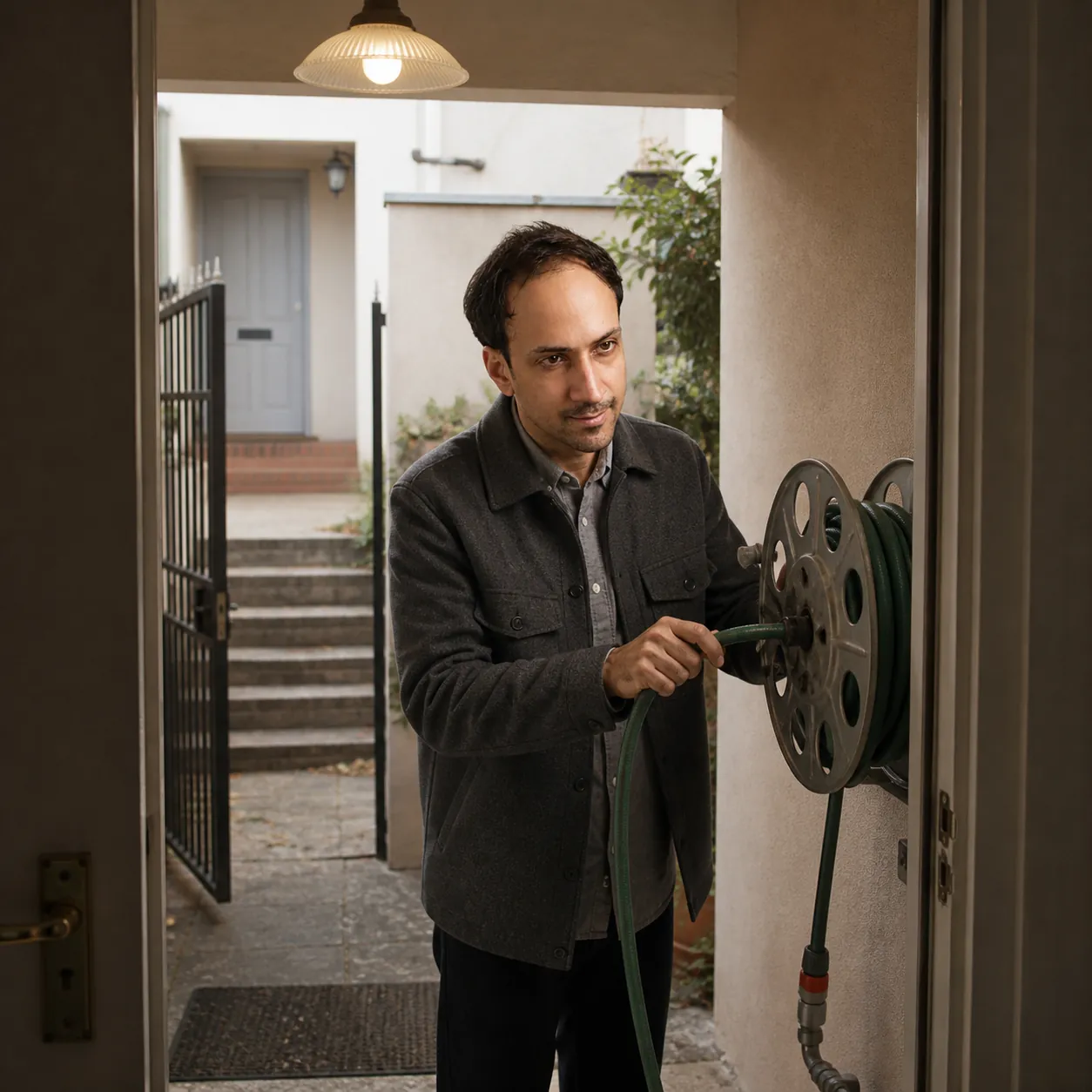
Third Return: Walled Front Yard — AI Portrait Prompt
صورةAI Portraits

Turn your own photo into a museum-catalog portrait in a walled front yard with a metal gate standing open. Keeps your face unchanged.

من نص البرومبت

Use the attached reference photo as the identity reference: keep the same face, skin tone, hair and features as the person in that photo, without beautifying, aging or altering them. Create a square 1:1 museum-catalog frame with a strong first read and a slower second read at exactly 2880x2880 pixels. Location: a walled front yard with a metal gate standing open. Show the subject in a mid-grey wool overshirt over a plain buttoned shirt, coiling a garden hose onto its wall reel. The difficulty must be visible in this, not in their expression: a flat door already locked that they have climbed one flight back to try again, their coat still buttoned weighs a two-minute job against everything it can quietly become. Explore how many minutes an ordinary leaving can quietly take from a day; expression occupied, not expressive, carrying worn method, difficulty stated in the object alone. Hold a static wide view from just inside the room they are leaving. Make the composition leave the route they already walked open behind them. Render it as museum-catalog realism combining editorial portrait craft, accurate metal and plastic surfaces, ordinary interior finishes, and emotionally literate restraint, using an overhead fitting diffused by its plain glass shade and a palette of unbleached linen, charcoal, and a low ember orange. Photorealistic: this must read as a real photograph from a physical camera, never an illustration, painting, or 3D render. Resolve real surface detail: visible weave in cloth, fine scratches on metal, and the faint unevenness of painted walls. Keep one identity-locked person, credible hands and fingers, natural fabric, and coherent scale, contact, reflections, shadows, airflow, deformation, and materials. Background people only when essential, always secondary and clearly different. Avoid hand-washing imagery, tally marks, symmetrical object grids, hero poses at camera, and wellness glow. No text, labels, logos, signatures, watermarks, random symbols, plastic skin, excessive bloom, or glossy AI finish.
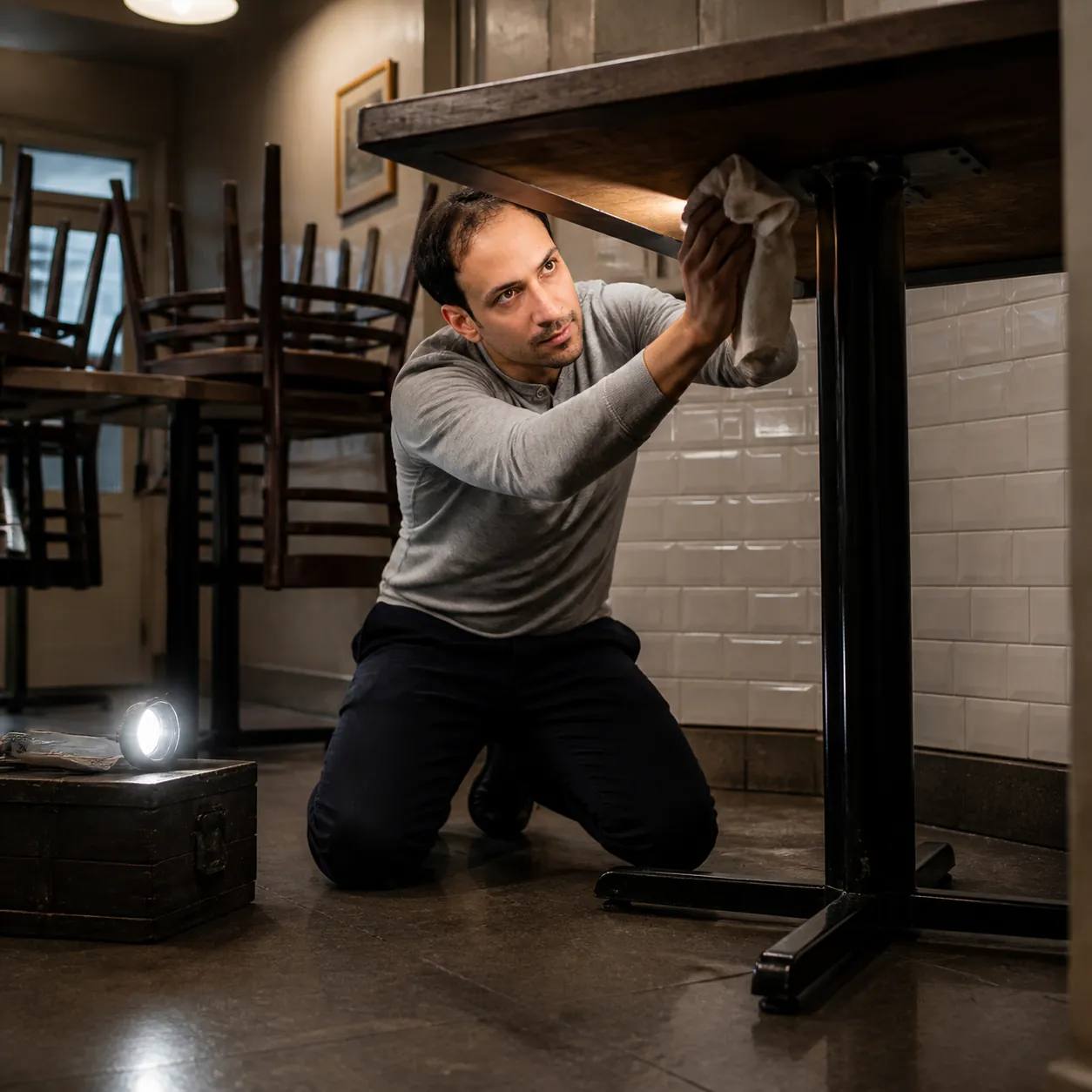
Dining Nook By Torchlight — AI Portrait Prompt
صورةAI Portraits

Turn your own photo into a photorealistic portrait in a dining nook with its table cleared and its chairs upended. Keeps your face unchanged.

من نص البرومبت

Use the attached reference photo as the identity reference: keep the same face, skin tone, hair and features as the person in that photo, without beautifying, aging or altering them. Create a square 1:1 museum-catalog frame with a strong first read and a slower second read at exactly 2880x2880 pixels. Location: a dining nook with its table cleared and its chairs upended. Show the subject in a soft grey henley and plain dark cotton trousers, running a cloth along the underside of the table. Make this piece of unglamorous evidence the whole argument: a torch propped on a crate so that both hands stay free for an inventory count nobody has requested keeps the labour honest while quietly naming what it is costing. Explore what a room looks like when energy arrives before any task needs it; expression occupied, not expressive, carrying sustained readiness, difficulty stated through the work alone. Use an 85mm from the room's threshold, compressing the scattered work behind them. Make the composition give the finished portion more sharpness than the rest. Render it as gallery-grade domestic realism assembled from ordinary cleaning apparatus, precise fabric and tile response, and natural skin rendering, using one ceiling panel doing all the work, with soft spill beneath and a palette of cool white tile, warm plaster, and one amber lamp. Photorealistic: this must read as a real photograph from a physical camera, never an illustration, painting, or 3D render. Resolve real surface detail: floor finish worn along the walked line, skirting marked at shoe height, and corners darker than the open floor. Keep one identity-locked person, credible hands and fingers, natural fabric, and coherent scale, contact, reflections, shadows, airflow, deformation, and materials. Background people only when essential, always secondary and clearly different. Avoid manic-eyed expressions, mess staged as spectacle, triumphant before-and-after framing, and golden window haze. No text, labels, logos, signatures, watermarks, random symbols, plastic skin, excessive bloom, or glossy AI finish.
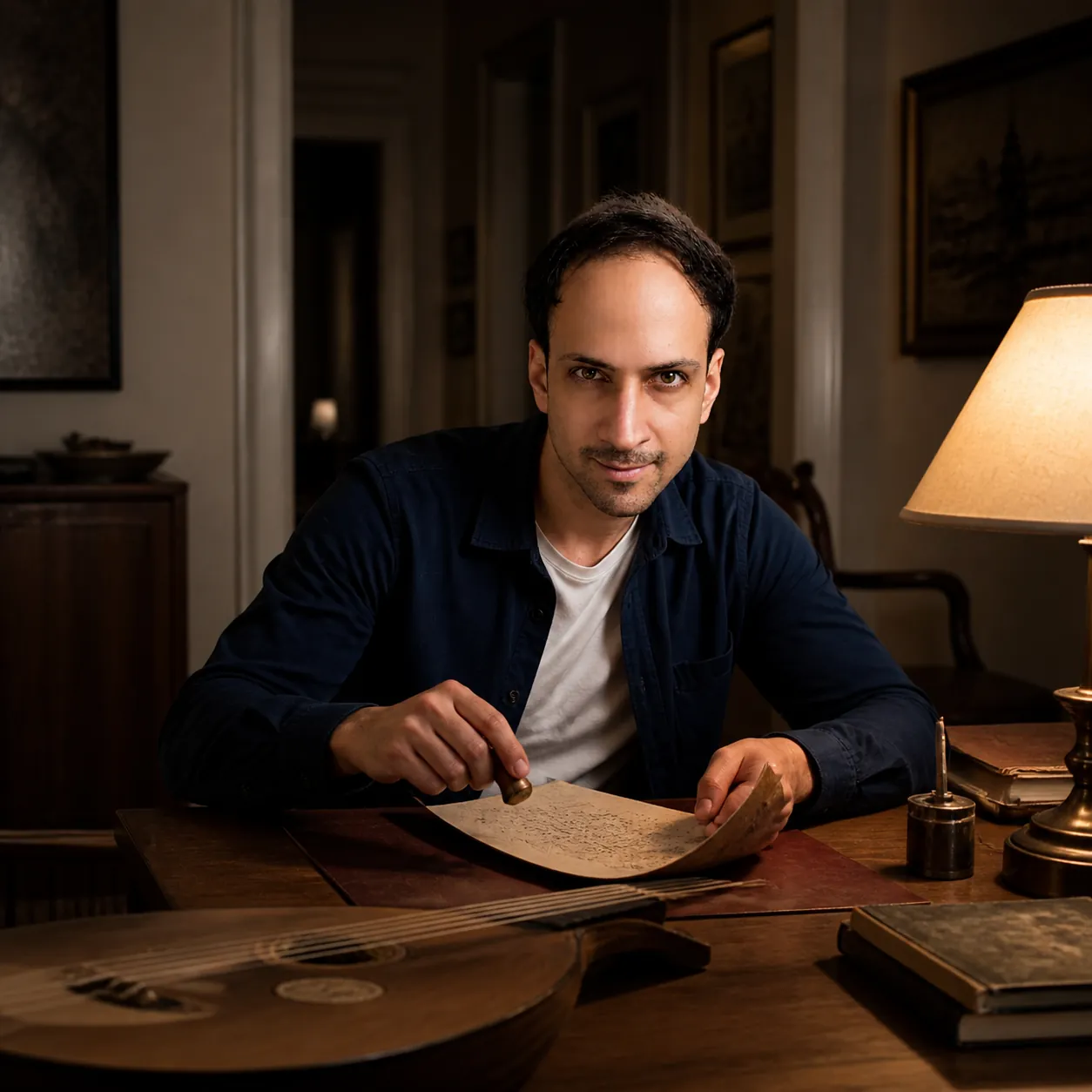
Kept Company: Walnut Writing Desk — AI Portrait Prompt
صورةAI Portraits

Turn your own photo into a quiet domestic portrait in a walnut writing desk in a widened hallway, lit by one lamp. Keeps your face unchanged.

من نص البرومبت

Use the attached reference photo as the identity reference: keep the same face, skin tone, hair and features as the person in that photo, without beautifying, aging or altering them. Create a square 1:1 museum-catalog frame with a strong first read and a slower second read at exactly 2880x2880 pixels. Location: a walnut writing desk in a widened hallway, lit by one lamp. Show the subject in a midnight-blue overshirt buttoned over a plain white tee, rocking a curved blotter once across the drying line. Treat this mechanism as the frame’s governing rule: an oud at rest whose untouched high string hums audibly when its matching octave is plucked on the string below rewards the kind of attention that cannot be paid in passing. Explore where fascination goes when spectacle is subtracted from a family's evening; direct expression and posture toward patient relish, never melodrama or ad-like confidence. Frame from the empty chair opposite them, the lens at a seated guest's eye height. Make the composition let lamplight falloff decide what the frame may keep. Render it as quiet domestic realism built from believable flame-lit exposure, tactile wood and wool surfaces, documentary patience, and museum-grade portrait restraint, using low tungsten-warm practicals kept below the eye line, shadows left generous and a palette of charcoal, aged brass, and one band of brick red. Photorealistic: this must read as a real photograph from a physical camera, never an illustration, painting, or 3D render. Resolve real surface detail: grout darker than tile, sealant slightly yellowed, and every joint showing a real tolerance gap. Keep one identity-locked person, credible hands and fingers, natural fabric, and coherent scale, contact, reflections, shadows, airflow, deformation, and materials. Background people only when essential, always secondary and clearly different. Avoid sepia nostalgia filters, costume-drama props, candlelit romance styling, and staged rustic clutter. No text, labels, logos, signatures, watermarks, random symbols, plastic skin, excessive bloom, or glossy AI finish.
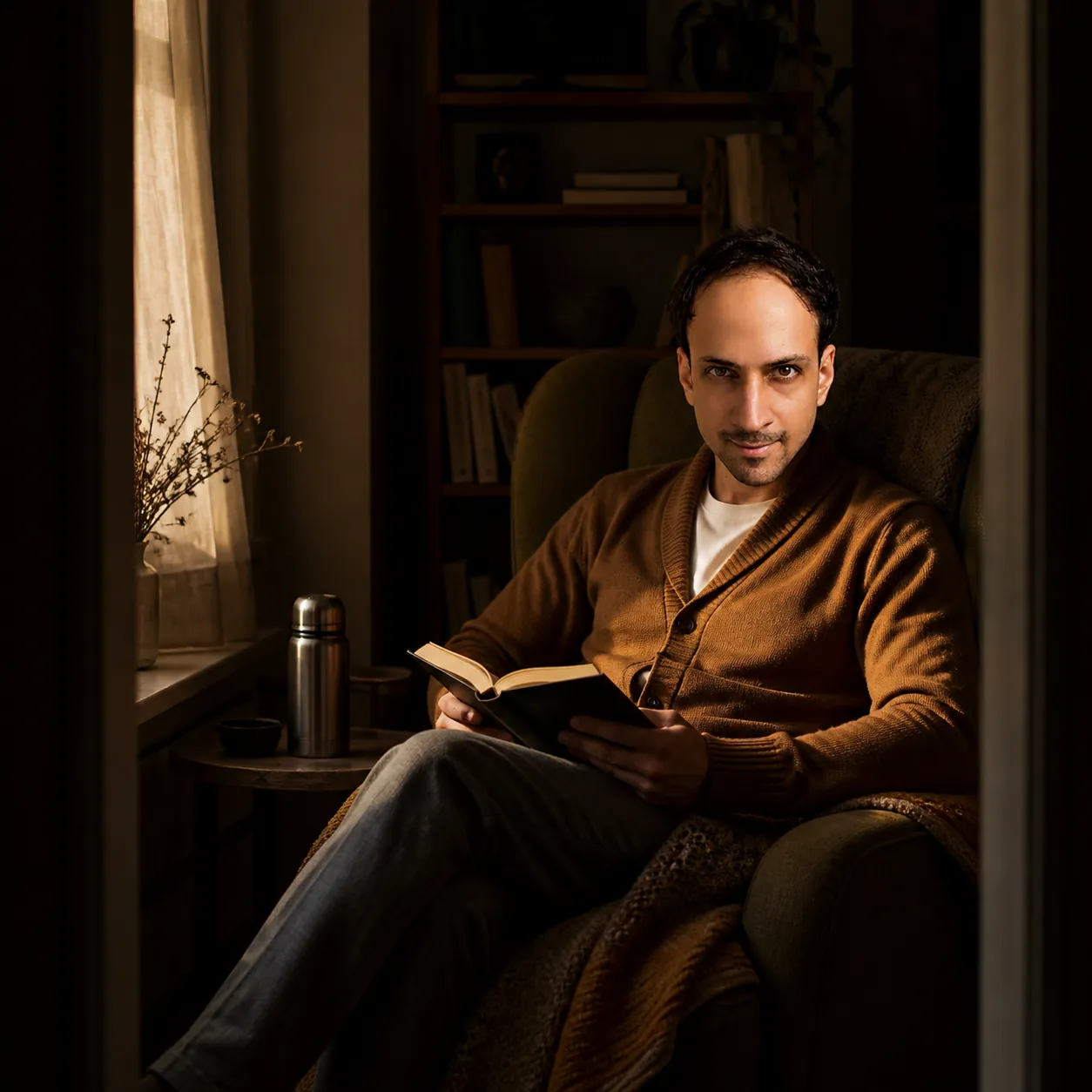
The Slow Center: Reading Nook — AI Portrait Prompt
صورةAI Portraits

Turn your own photo into a portrait in a reading nook with one armchair angled to the window's last light. Keeps your face unchanged.

من نص البرومبت

Use the attached reference photo as the identity reference: keep the same face, skin tone, hair and features as the person in that photo, without beautifying, aging or altering them. Create a square 1:1 museum-catalog frame with a strong first read and a slower second read at exactly 2880x2880 pixels. Location: a reading nook with one armchair angled to the window's last light. Show the subject in a camel-brown cardigan over a white crew-neck and grey wool trousers, drawing the armchair a hand-width closer to the window. Build the artwork around this material rule: a steel vacuum flask that keeps the evening's tea hot behind a double wall enclosing almost nothing at all trades spectacle for a fascination that deepens by the third look. Explore what full attention costs, and what it quietly buys back; direct expression and posture toward gathered calm, never melodrama or ad-like confidence. Use a 35mm doorway view with the room's single pool of light placed off-center and their figure inside it. Make the composition surround the action with generous, untroubled evening shadow. Render it as gallery-grade domestic still photography built from truthful household physics, restrained art direction, deep readable shadow, and companionable observational framing, using the last grey-gold daylight from one window, failing believably across the room and a palette of tea brown, raw linen, and one saffron thread. Photorealistic: this must read as a real photograph from a physical camera, never an illustration, painting, or 3D render. Resolve real surface detail: cotton that hangs by its own weight, seams that pucker very slightly, and collars softened by washing. Keep one identity-locked person, credible hands and fingers, natural fabric, and coherent scale, contact, reflections, shadows, airflow, deformation, and materials. Background people only when essential, always secondary and clearly different. Avoid orientalist lantern fantasies, floating dust-mote sunbeam overload, plastic-perfect wax flames, museum-diorama stiffness, and greeting-card coziness. No text, labels, logos, signatures, watermarks, random symbols, plastic skin, excessive bloom, or glossy AI finish.

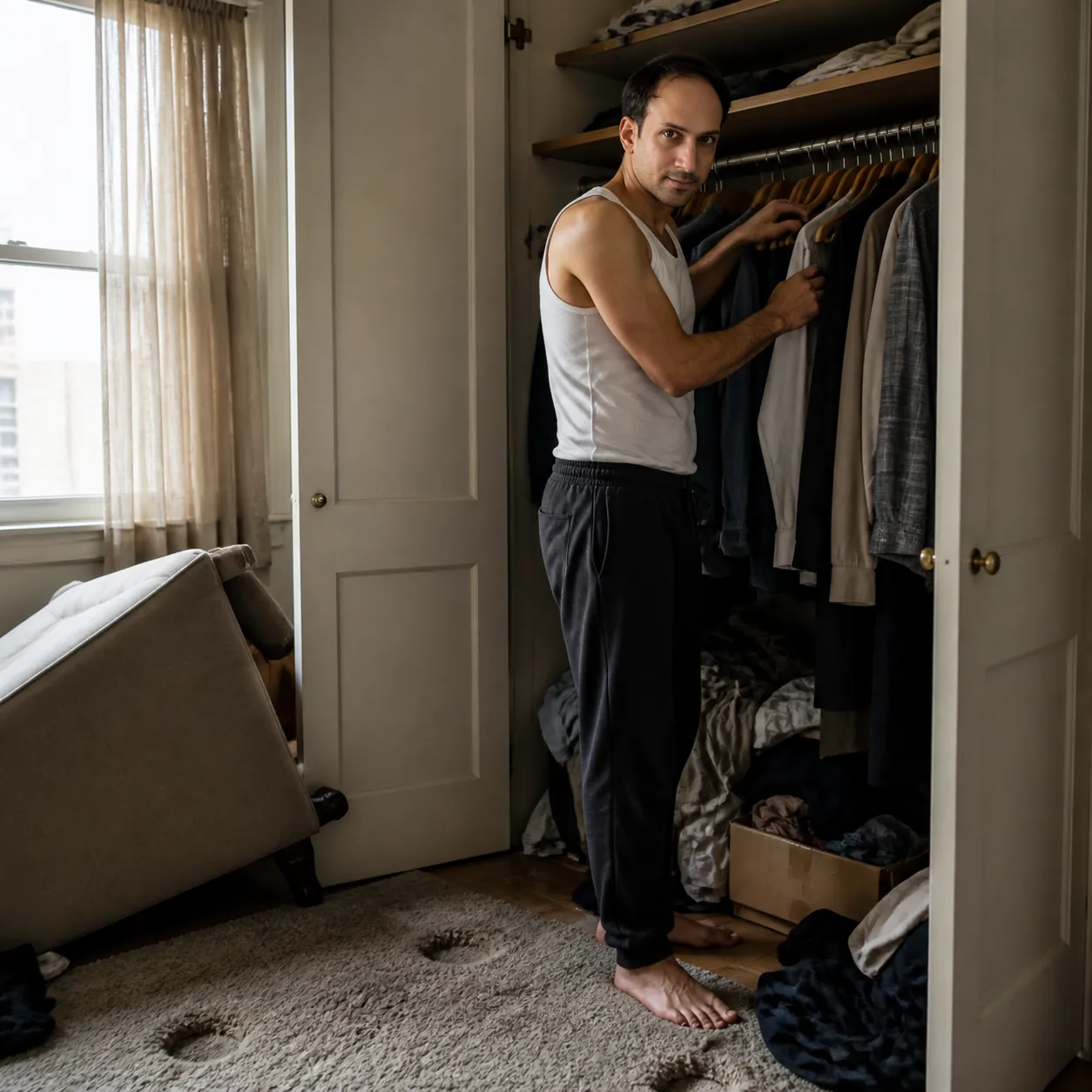
The Sofa's Old Footprints — AI Portrait Prompt
صورةAI Portraits

Turn your own photo into a quiet domestic documentary portrait in a bedroom whose wardrobe doors have stood open for eleven days. Keeps your face unchanged.

من نص البرومبت

Use the attached reference photo as the identity reference: keep the same face, skin tone, hair and features as the person in that photo, without beautifying, aging or altering them. Create a square 1:1 museum-catalog frame with a strong first read and a slower second read at exactly 2880x2880 pixels. Location: a bedroom whose wardrobe doors have stood open for eleven days. Show them in a plain white undershirt and dark drawstring trousers, feet bare, sliding a bank of hangers along the rail. Build the image around this small, exact tableau: a sofa standing at the angle it was pushed to one night, its old feet printed deep in the rug puts one week's ambition and this week's fuel in one frame. Explore what dignity looks like when the work undoes your own good intentions; expression occupied, not expressive, carrying plain persistence, difficulty stated without inviting anyone to comfort them. Frame at chest height so their hands and the waiting object share one plane. Make the composition give the one completed object more sharpness than the room. Render it as quiet domestic documentary portraiture built from unstyled household reality, restrained framing, truthful material wear, and patient observational timing, using flat mid-afternoon daylight through a half-curtained window with low, even contrast and a palette of dust white, olive shadow, and a band of cardboard brown. Photorealistic: this must read as a real photograph from a physical camera, never an illustration, painting, or 3D render. Resolve real surface detail: brass darkened in the recesses and bright where thumbs land, and lacquer crazed rather than perfect. Keep one identity-locked person, credible hands and fingers, natural fabric, and coherent scale, contact, reflections, shadows, airflow, deformation, and materials. Background people only when essential, always secondary and clearly different. Avoid hero poses, wellness-catalogue serenity, head-in-hands despair, meaningful gazes at camera, and before-and-after staging. No text, labels, logos, signatures, watermarks, random symbols, plastic skin, excessive bloom, or glossy AI finish.