تخطَّ إلى المحتوى
f

faisal aziz

@alkhunizan

2700البرومبتات
0تصويتات مستلمة
0مساهمات
تاريخ الانضمام منذ 4 أشهر
2700 مساهمات في العام الماضي
نوفمبر
ديسمبر
يناير
فبراير
مارس
أبريل
مايو
يونيو
يوليو
أغسطس
سبتمبر
أكتوبر
ن
ر
ج
أقل
أكثر
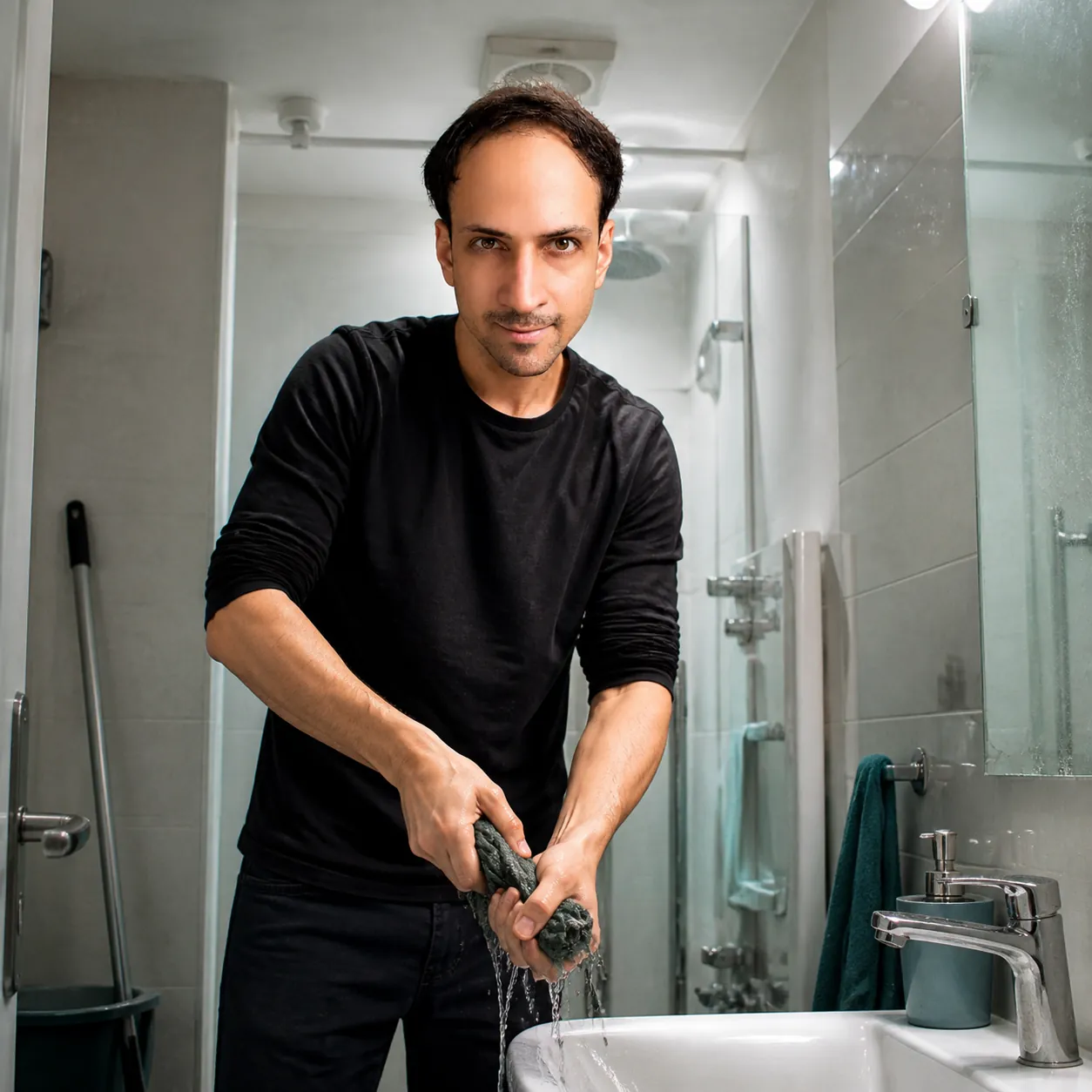
Wringing the Cloth at Arm's Length — AI Portrait Prompt
صورةAI Portraits

Turn your own photo into a contemporary reportage portrait in an apartment bathroom mid-clean with the extractor fan still running. Keeps your face unchanged.

من نص البرومبت

Use the attached reference photo as the identity reference: keep the same face, skin tone, hair and features as the person in that photo, without beautifying, aging or altering them. Create a square 1:1 museum-catalog frame with a strong first read and a slower second read at exactly 2880x2880 pixels. Location: an apartment bathroom mid-clean with the extractor fan still running. Show the subject in a plain black tee with sleeves pushed above the elbow, wringing a cloth out over the running tap. Make this piece of unglamorous evidence the whole argument: a long-handled implement gripped at its very end so wet waste never reaches skin, the job finished at that distance shows competence and difficulty occupying the same square metre of floor. Explore why the cheapest fix is often a thirty-second adjustment made before starting; expression occupied, not expressive, carrying matter-of-fact resolve, difficulty stated without inviting sympathy. Use an 85mm portrait length with the room compressed just enough to feel enclosed. Make the composition give the accommodation more acuity than any face-adjacent surface. Render it as contemporary reportage realism combining plain civic interiors, physically accurate material response, working household equipment, and calm documentary distance, using flat retail fluorescent with a cool cast and unflattering falloff and a palette of cool white, pale concrete, and one muted teal. Photorealistic: this must read as a real photograph from a physical camera, never an illustration, painting, or 3D render. Resolve real surface detail: floor finish worn along the walked line, skirting marked at shoe height, and corners darker than the open floor. Keep one identity-locked person, credible hands and fingers, natural fabric, and coherent scale, contact, reflections, shadows, airflow, deformation, and materials. Background people only when essential, always secondary and clearly different. Avoid glowing sound waves, sensory-overload blur effects, and mood portraits without labour. No text, labels, logos, signatures, watermarks, random symbols, plastic skin, excessive bloom, or glossy AI finish.
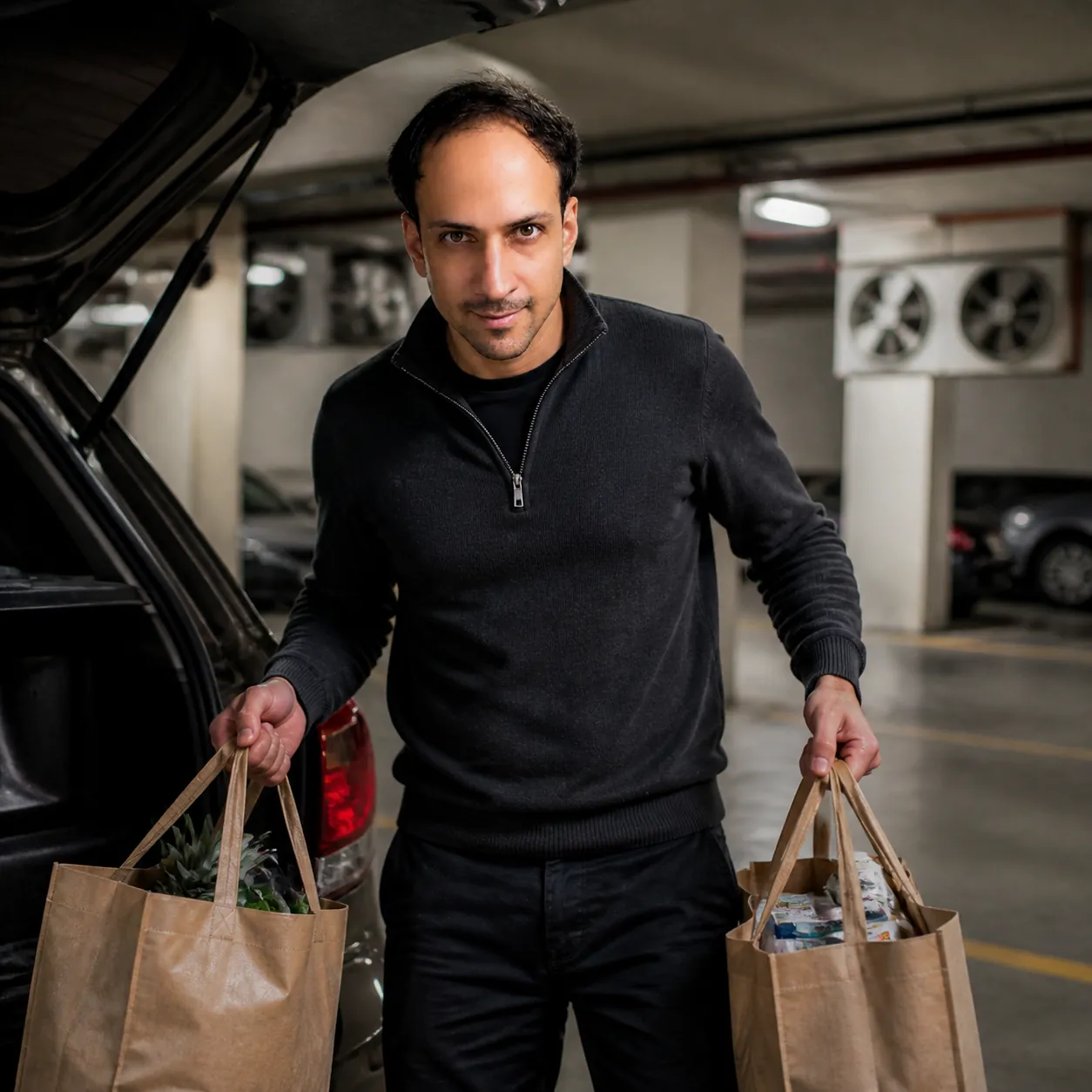
Bags From the Open Boot — AI Portrait Prompt
صورةAI Portraits

Turn your own photo into a restrained editorial portrait in a basement parking level where the ventilation fans never stop. Keeps your face unchanged.

من نص البرومبت

Use the attached reference photo as the identity reference: keep the same face, skin tone, hair and features as the person in that photo, without beautifying, aging or altering them. Create a square 1:1 museum-catalog frame with a strong first read and a slower second read at exactly 2880x2880 pixels. Location: a basement parking level where the ventilation fans never stop. Show them in a charcoal quarter-zip over a plain tee and work trousers, lifting two shopping bags clear of the open boot. Let one honest object carry what the face will not: a room running three sounds at once with one switch already chosen, the least necessary source picked to stop first makes the cost of an ordinary chore visible without making it a complaint. Explore where the difficulty actually sits when the finished result looks entirely unremarkable; expression occupied, not expressive, carrying quiet efficiency, difficulty stated as one more logistical fact. Use a 50mm eye-level view at working distance, the nearest object rendered as plainly as their hands. Make the composition give the accommodation more acuity than any face-adjacent surface. Render it as restrained editorial realism built from real chore apparatus, believable domestic wear, exact fabric and metal texture, and unsentimental framing, using even overcast light with accurate skin tone and no bloom and a palette of washed beige, slate grey, and worn brass. Photorealistic: this must read as a real photograph from a physical camera, never an illustration, painting, or 3D render. Resolve real surface detail: fine lint on dark fabric, water spotting on steel, and the soft rounding of edges that have been used for years. Keep one identity-locked person, credible hands and fingers, natural fabric, and coherent scale, contact, reflections, shadows, airflow, deformation, and materials. Background people only when essential, always secondary and clearly different. Avoid hands clamped over ears, meltdown theatrics, and hero poses at camera. No text, labels, logos, signatures, watermarks, random symbols, plastic skin, excessive bloom, or glossy AI finish.
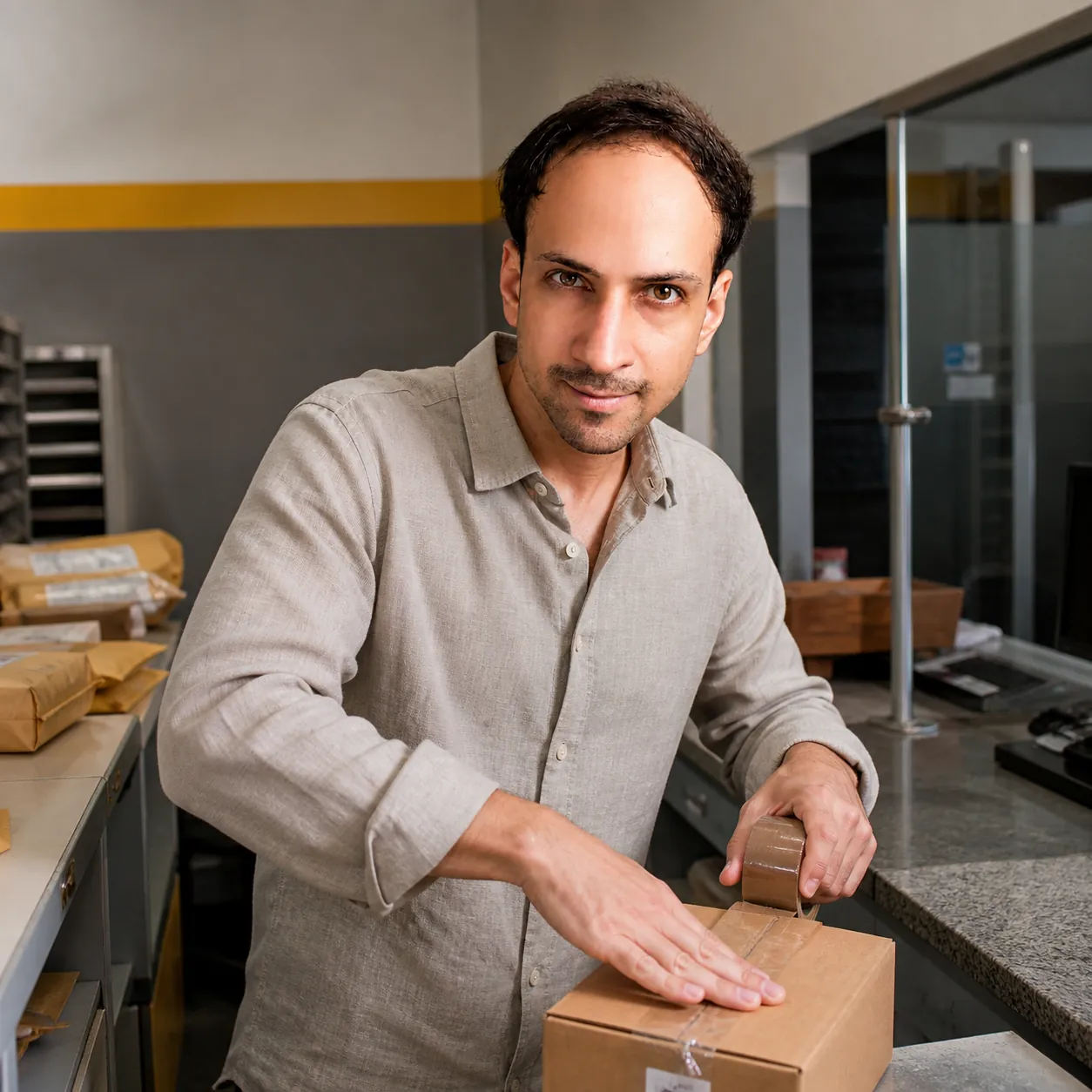
Taping the Parcel After the Queue — AI Portrait Prompt
صورةAI Portraits

Turn your own photo into a contemporary reportage portrait in a small post office's parcel counter after the queue has gone. Keeps your face unchanged.

من نص البرومبت

Use the attached reference photo as the identity reference: keep the same face, skin tone, hair and features as the person in that photo, without beautifying, aging or altering them. Create a square 1:1 museum-catalog frame with a strong first read and a slower second read at exactly 2880x2880 pixels. Location: a small post office's parcel counter after the queue has gone. Show the subject in a stone-coloured linen shirt with cuffs turned back twice, smoothing tape flat across a small parcel's open seam. Build the image around this small, exact tableau: a sleeve pulled down over the palm before a cold metal handle is taken, cotton standing in for bare skin shows competence and difficulty occupying the same square metre of floor. Explore whether the work should be measured by its result or by its price; expression occupied, not expressive, carrying level concentration, difficulty stated as ordinary upkeep. Frame at chest height so the accommodation and their occupied face share one honest plane. Make the composition keep the finished part of the chore visible at one edge. Render it as contemporary reportage realism combining plain civic interiors, physically accurate material response, working household equipment, and calm documentary distance, using even overcast light with accurate skin tone and no bloom and a palette of soap grey, warm plaster, and one ochre band. Photorealistic: this must read as a real photograph from a physical camera, never an illustration, painting, or 3D render. Resolve real surface detail: skin that reddens slightly under pressure, nail beds with honest colour, and knuckle creases that fold rather than blur. Keep one identity-locked person, credible hands and fingers, natural fabric, and coherent scale, contact, reflections, shadows, airflow, deformation, and materials. Background people only when essential, always secondary and clearly different. Avoid glowing sound waves, sensory-overload blur effects, and mood portraits without labour. No text, labels, logos, signatures, watermarks, random symbols, plastic skin, excessive bloom, or glossy AI finish.
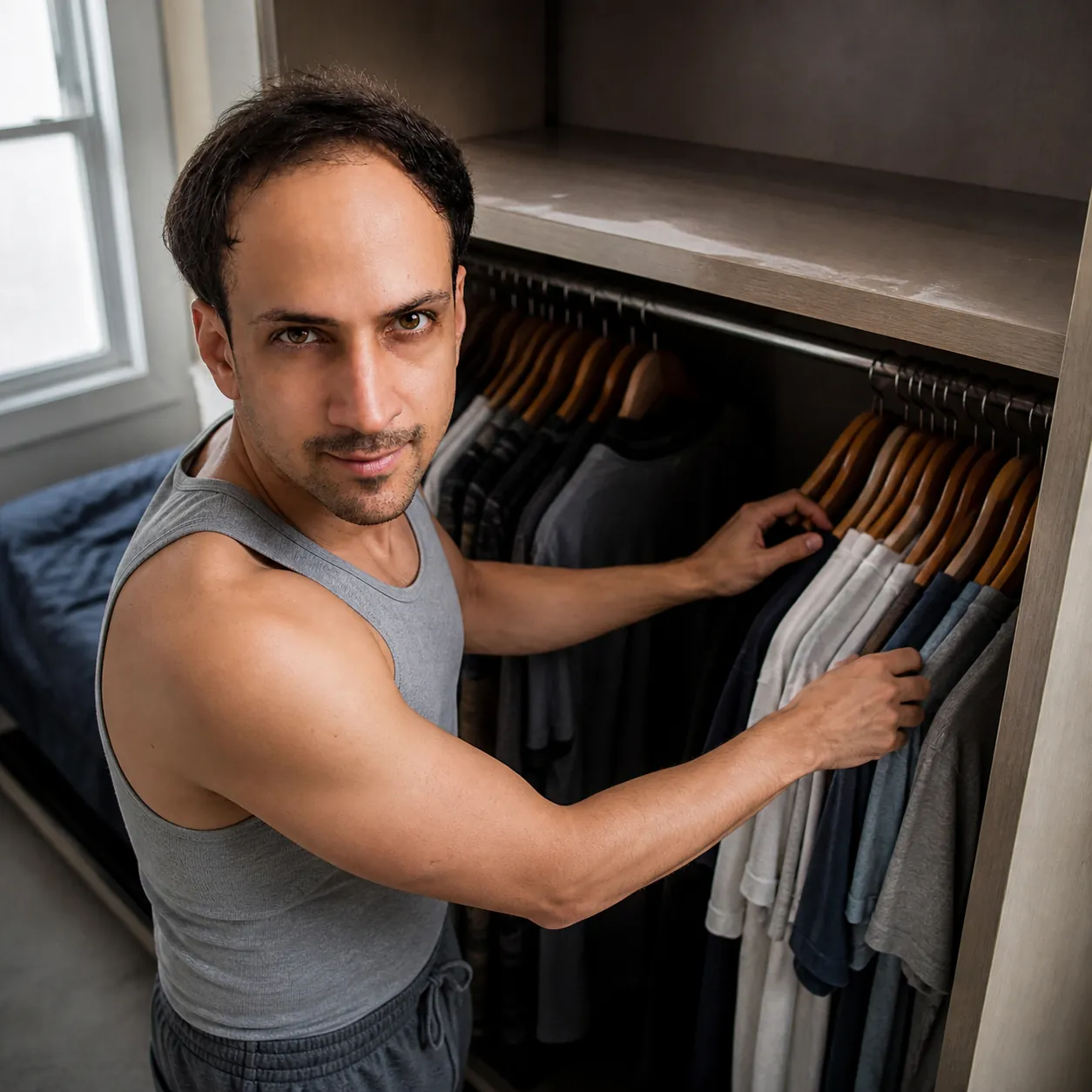
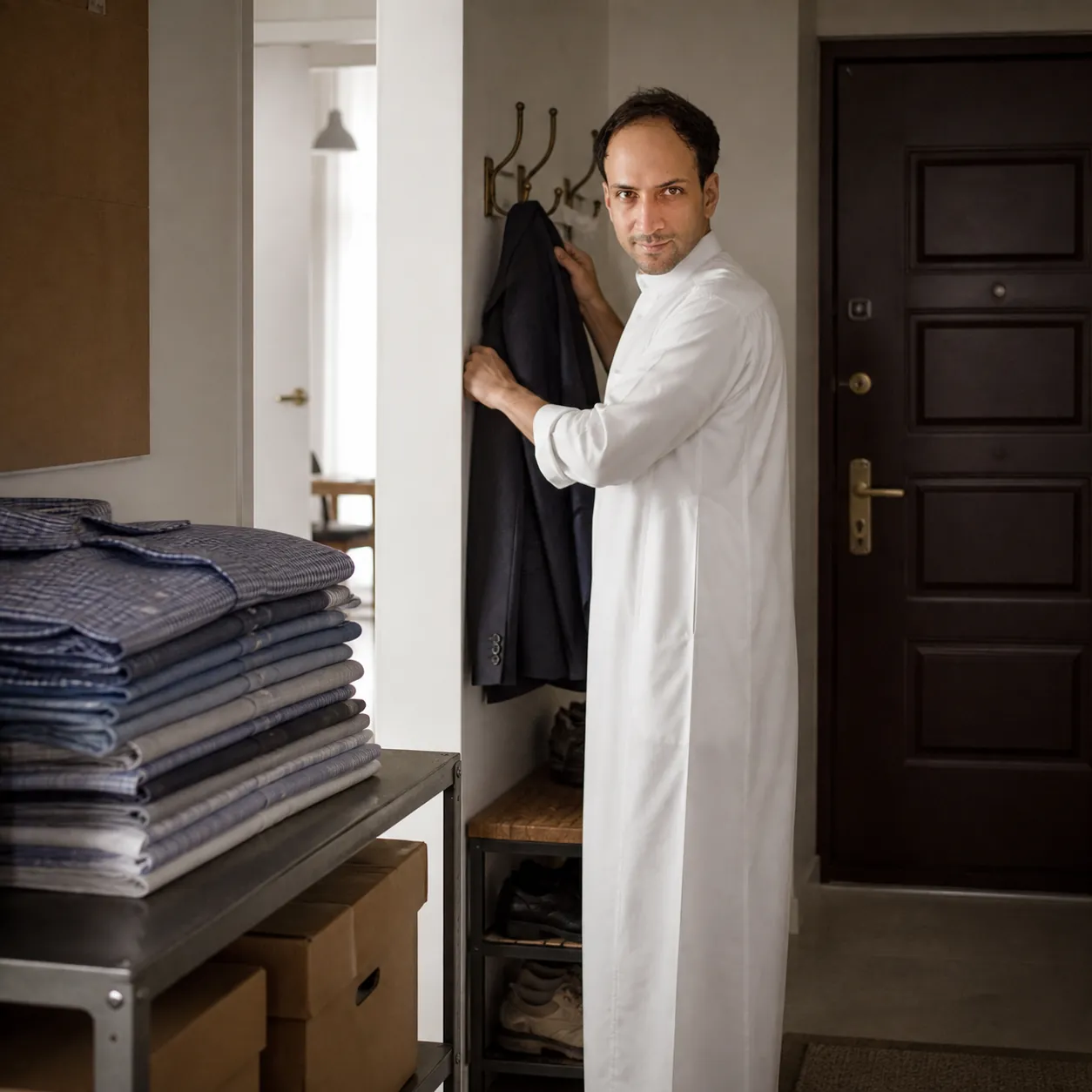
Pressed Shirts Kept for Later — AI Portrait Prompt
صورةAI Portraits

Turn your own photo into a photorealistic portrait in a flat's entry hall with the front door shut again. Keeps your face unchanged.

من نص البرومبت

Use the attached reference photo as the identity reference: keep the same face, skin tone, hair and features as the person in that photo, without beautifying, aging or altering them. Create a square 1:1 museum-catalog frame with a strong first read and a slower second read at exactly 2880x2880 pixels. Location: a flat's entry hall with the front door shut again. Show the subject in a plain white traditional Gulf outfit with one sleeve folded back, hanging a folded coat back on the hall hook. Anchor the frame to this piece of ordinary evidence: a folded stack of pressed shirts kept in a size that will come back, squared and faced one way shows care and accumulation arriving from exactly the same impulse. Explore what a room owes to the future it has been furnished for; expression occupied, not expressive, carrying level judgement, difficulty stated without any note of shame. Place the camera at shelf height so held objects meet the lens squarely. Make the composition weight the frame toward what stays rather than what leaves. Render it as level-headed household realism assembled from working-storage photography, truthful stacking physics, matte everyday surfaces, and dignified full-length human presence, using cool morning ambience from an open door, warmed slightly by interior walls and a palette of warm cardboard tan, cool grey, and dulled brass. Photorealistic: this must read as a real photograph from a physical camera, never an illustration, painting, or 3D render. Resolve real surface detail: cotton that hangs by its own weight, seams that pucker very slightly, and collars softened by washing. Keep one identity-locked person, credible hands and fingers, natural fabric, and coherent scale, contact, reflections, shadows, airflow, deformation, and materials. Background people only when essential, always secondary and clearly different. Avoid clear-out crews, shame poses, posing at camera, teetering junk towers, and melancholy without labour. No text, labels, logos, signatures, watermarks, random symbols, plastic skin, excessive bloom, or glossy AI finish.
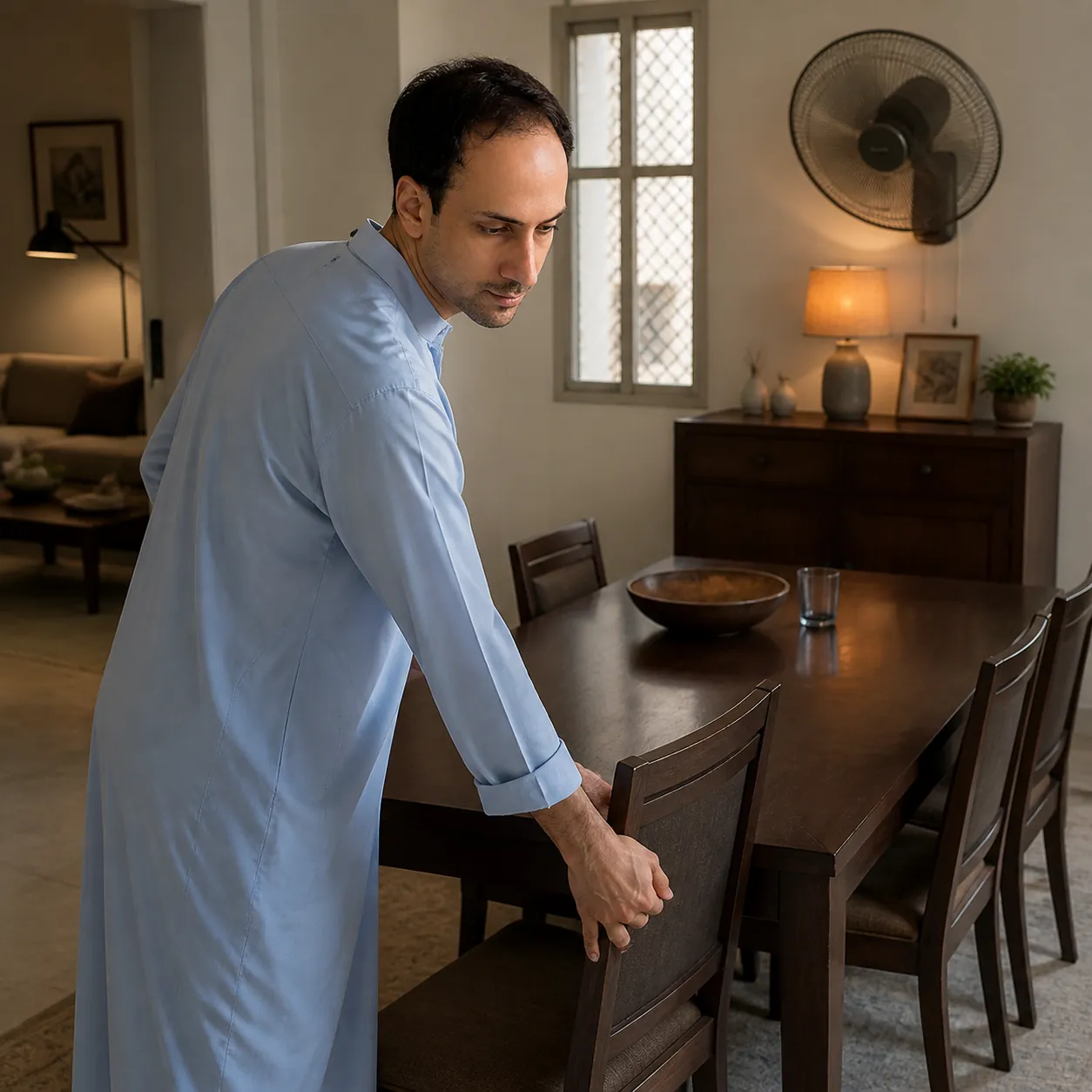
The Cleared Shelf's Dust Line — AI Portrait Prompt
صورةAI Portraits

Turn your own photo into a quiet domestic documentary portrait in a bedroom wardrobe standing open on its two hanging rails. Keeps your face unchanged.

من نص البرومبت

Use the attached reference photo as the identity reference: keep the same face, skin tone, hair and features as the person in that photo, without beautifying, aging or altering them. Create a square 1:1 museum-catalog frame with a strong first read and a slower second read at exactly 2880x2880 pixels. Location: a bedroom wardrobe standing open on its two hanging rails. Show the subject in a grey cotton undershirt and loose drawstring house trousers, sliding hangers apart to reach the shelf behind. Build the image around this small, exact tableau: a single cleared shelf whose pale dust line still shows the footprint of everything just carried out of the room turns a small errand into the longest decision of the week. Explore where the work actually happens when nothing in the room appears to move; expression occupied, not expressive, carrying occupied deliberation, difficulty stated in the register of ordinary work. Frame from slightly above the work so its real depth reads without exaggeration. Make the composition let one emptied gap sit at the frame's quietest point. Render it as quiet domestic documentary realism combining unstyled interior photography, honest household materials, precise object description, and unhurried observational framing, using flat overcast daylight through a dusty window with soft, even falloff and a palette of dust beige, cold steel, and one worn indigo note. Photorealistic: this must read as a real photograph from a physical camera, never an illustration, painting, or 3D render. Resolve real surface detail: brass darkened in the recesses and bright where thumbs land, and lacquer crazed rather than perfect. Keep one identity-locked person, credible hands and fingers, natural fabric, and coherent scale, contact, reflections, shadows, airflow, deformation, and materials. Background people only when essential, always secondary and clearly different. Avoid squalor, vermin, rotting food, hero-poster staging, and any wellness-aesthetic glow that replaces visible work. No text, labels, logos, signatures, watermarks, random symbols, plastic skin, excessive bloom, or glossy AI finish.
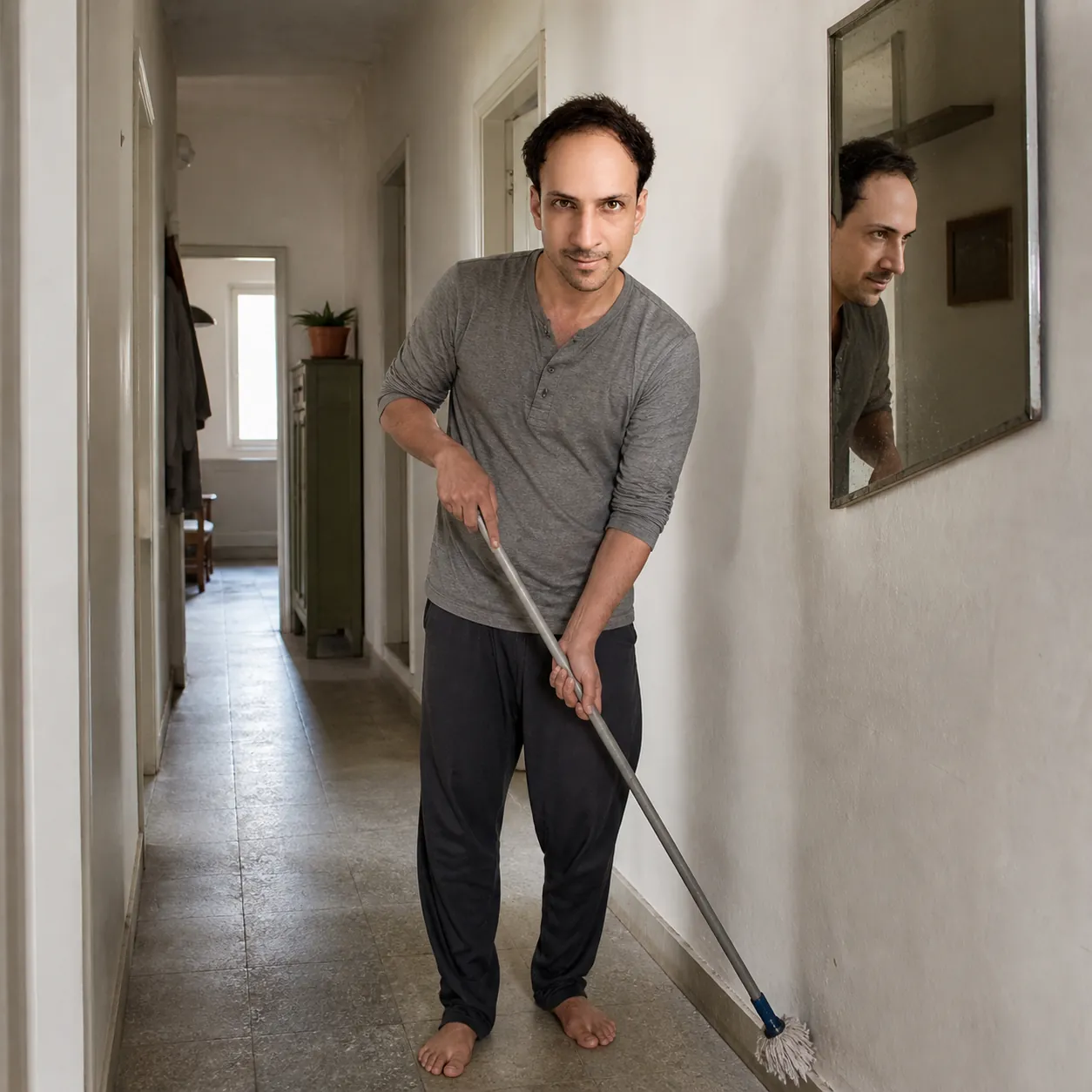
The Last Chair Pushed In — AI Portrait Prompt
صورةAI Portraits

Turn your own photo into an observational domestic portrait in a dining corner of the main room with four chairs pushed in. Keeps your face unchanged.

من نص البرومبت

Use the attached reference photo as the identity reference: keep the same face, skin tone, hair and features as the person in that photo, without beautifying, aging or altering them. Create a square 1:1 museum-catalog frame with a strong first read and a slower second read at exactly 2880x2880 pixels. Location: a dining corner of the main room with four chairs pushed in. Show them in a pale blue traditional Gulf outfit with the sleeves folded back once, pushing the last chair in against the table edge. Build the image around this small, exact tableau: a fan left off for weeks, switched on at last, its noise finally allowed to cover the hall turns an ordinary chore into a problem of position and sound. Explore what a room costs when every sound in it must first be named; expression occupied, not expressive, carrying steady alertness, difficulty stated as arrangement rather than distress. Frame them three-quarters from behind with both their hands and the far end readable. Make the composition show the extra distance their arrangement adds. Render it as observational domestic portraiture built from truthful chore staging, exact material texture, ordinary architectural geometry, and quietly unsentimental framing, using flat mid-afternoon daylight through a screened window with no direct sun and a palette of chalk cream, dark walnut, and low amber lamplight. Photorealistic: this must read as a real photograph from a physical camera, never an illustration, painting, or 3D render. Resolve real surface detail: glass with real thickness at its edge, reflections that carry the room's actual colour, and dust visible only at grazing angles. Keep one identity-locked person, credible hands and fingers, natural fabric, and coherent scale, contact, reflections, shadows, airflow, deformation, and materials. Background people only when essential, always secondary and clearly different. Avoid hero poses, golden-hour wellness glow, eye contact with the lens, and tear-streaked faces. No text, labels, logos, signatures, watermarks, random symbols, plastic skin, excessive bloom, or glossy AI finish.
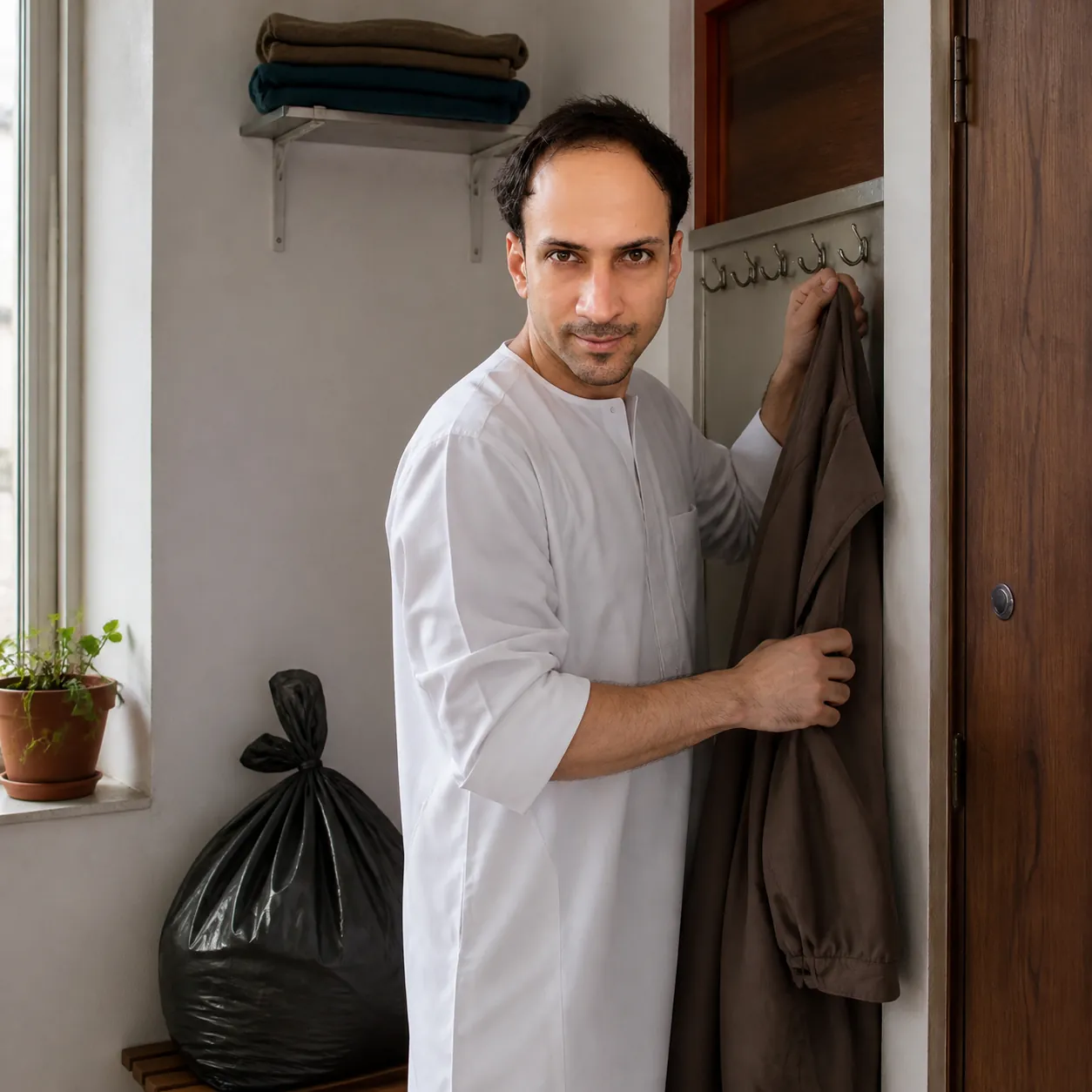
Accounting for the Whole Flat — AI Portrait Prompt
صورةAI Portraits

Turn your own photo into a gallery-scale everyday portrait in a long inner corridor of the flat with doors along one side. Keeps your face unchanged.

من نص البرومبت

Use the attached reference photo as the identity reference: keep the same face, skin tone, hair and features as the person in that photo, without beautifying, aging or altering them. Create a square 1:1 museum-catalog frame with a strong first read and a slower second read at exactly 2880x2880 pixels. Location: a long inner corridor of the flat with doors along one side. Show them in a heather-grey henley with the sleeves shoved to the elbow, trailing a dust mop along the base of the wall. Make this piece of unglamorous evidence the whole argument: a shaving mirror turned off-square to the wall so the open door stays in the glass beside their jaw holds an ordinary task open a moment longer than the task requires. Explore what it costs to keep a whole flat accounted for while working; expression occupied, not expressive, carrying dry persistence, difficulty stated as a bill quietly paid. Use a 40mm chest-height viewpoint that includes the room's depth without dramatizing it. Make the composition give the room's emptiest part the sharpest detail. Render it as gallery-scale everyday realism combining high-fidelity portrait photography, working household objects, and physically accurate shadow and reflection, using flat mid-afternoon daylight through a screened window with no direct sun and a palette of plaster white, worn grey tile, and one olive accent. Photorealistic: this must read as a real photograph from a physical camera, never an illustration, painting, or 3D render. Resolve real surface detail: floor finish worn along the walked line, skirting marked at shoe height, and corners darker than the open floor. Keep one identity-locked person, credible hands and fingers, natural fabric, and coherent scale, contact, reflections, shadows, airflow, deformation, and materials. Background people only when essential, always secondary and clearly different. Avoid thriller shadows, keyhole peering, weapons or uniforms, and staged startle reactions. No text, labels, logos, signatures, watermarks, random symbols, plastic skin, excessive bloom, or glossy AI finish.
The Donation Bag by the Door — AI Portrait Prompt
صورةAI Portraits

Turn your own photo into a quiet domestic documentary portrait in a flat's entry hall with the front door shut again. Keeps your face unchanged.

من نص البرومبت

Use the attached reference photo as the identity reference: keep the same face, skin tone, hair and features as the person in that photo, without beautifying, aging or altering them. Create a square 1:1 museum-catalog frame with a strong first read and a slower second read at exactly 2880x2880 pixels. Location: a flat's entry hall with the front door shut again. Show the subject in a plain white traditional Gulf outfit with one sleeve folded back, hanging a folded coat back on the hall hook. Let one honest object carry what the face will not: a tied donation bag whose top two jumpers have already been lifted back onto the shelf above the door turns a small errand into the longest decision of the week. Explore why the hardest part of a small clearing job is the deciding; expression occupied, not expressive, carrying steady thrift, difficulty stated as household fact. Use an eye-level 50mm view with kept objects and hands on one plane. Make the composition give the kept object more definition than the surrounding room. Render it as quiet domestic documentary realism combining unstyled interior photography, honest household materials, precise object description, and unhurried observational framing, using flat overcast daylight through a dusty window with soft, even falloff and a palette of kraft brown, plaster white, and one faded teal. Photorealistic: this must read as a real photograph from a physical camera, never an illustration, painting, or 3D render. Resolve real surface detail: true skin texture with pores and fine hair at the hairline, and fabric that creases where it is actually stressed. Keep one identity-locked person, credible hands and fingers, natural fabric, and coherent scale, contact, reflections, shadows, airflow, deformation, and materials. Background people only when essential, always secondary and clearly different. Avoid squalor, vermin, rotting food, hero-poster staging, and any wellness-aesthetic glow that replaces visible work. No text, labels, logos, signatures, watermarks, random symbols, plastic skin, excessive bloom, or glossy AI finish.
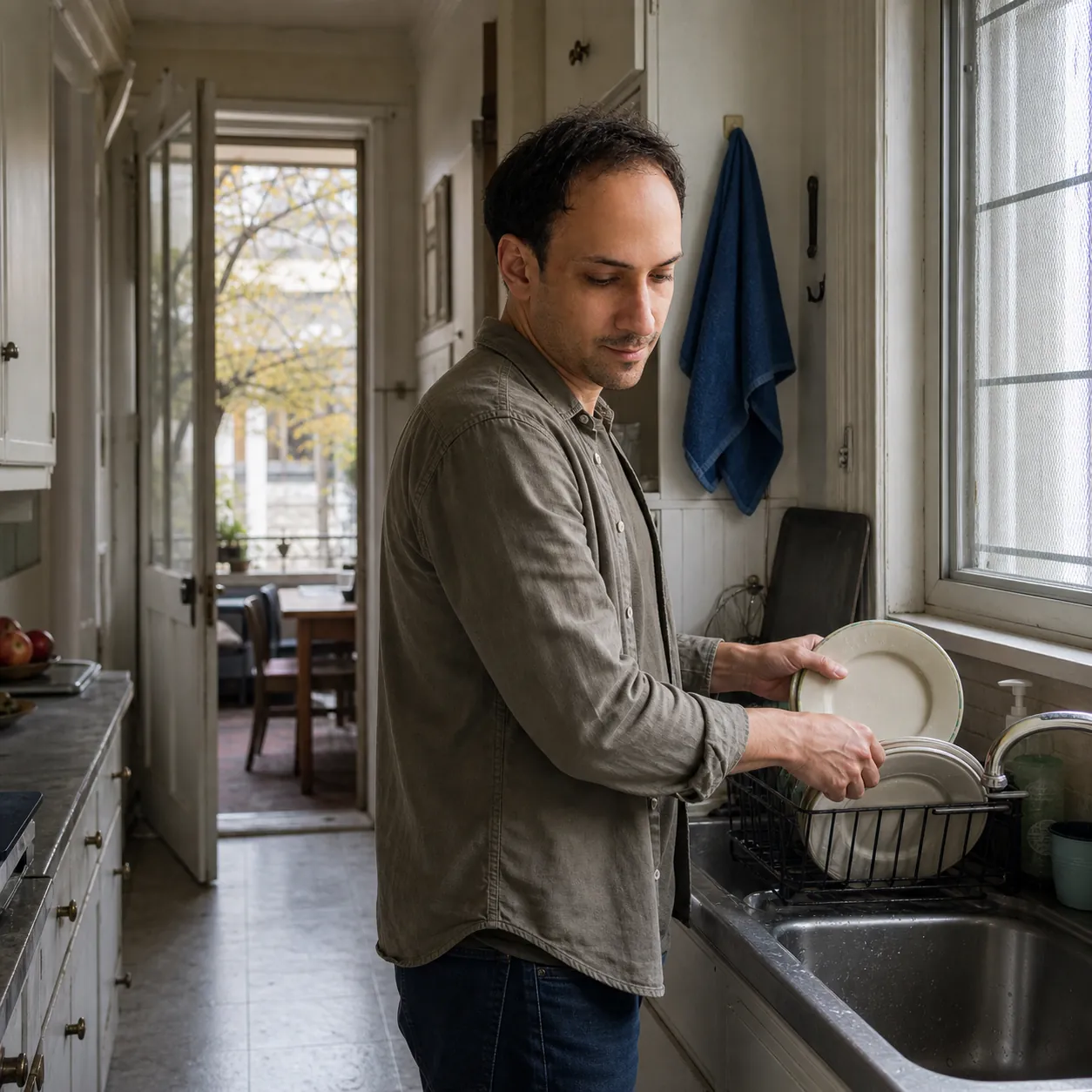
A Door Propped Wide — AI Portrait Prompt
صورةAI Portraits

Turn your own photo into a quiet domestic documentary portrait in a narrow galley kitchen open at both ends to the flat. Keeps your face unchanged.

من نص البرومبت

Use the attached reference photo as the identity reference: keep the same face, skin tone, hair and features as the person in that photo, without beautifying, aging or altering them. Create a square 1:1 museum-catalog frame with a strong first read and a slower second read at exactly 2880x2880 pixels. Location: a narrow galley kitchen open at both ends to the flat. Show them in a soft olive t-shirt under an unbuttoned cotton overshirt, stacking rinsed plates into the draining rack. Build the image around this small, exact tableau: an outer door propped wide in cold weather so the rooms behind them are never shut out turns an ordinary chore into a problem of position and sound. Explore how one small allowance can cost more than the whole precaution; expression occupied, not expressive, carrying borrowed calm, difficulty stated as a bill quietly paid. Frame them three-quarters from behind with both their hands and the far end readable. Make the composition let their standing position read before the chore does. Render it as quiet domestic documentary realism combining unposed portrait photography, honest interior materials, accurate household light, and unhurried observational framing, using flat mid-afternoon daylight through a screened window with no direct sun and a palette of pale limestone, iron grey, and one faded indigo cloth. Photorealistic: this must read as a real photograph from a physical camera, never an illustration, painting, or 3D render. Resolve real surface detail: brass darkened in the recesses and bright where thumbs land, and lacquer crazed rather than perfect. Keep one identity-locked person, credible hands and fingers, natural fabric, and coherent scale, contact, reflections, shadows, airflow, deformation, and materials. Background people only when essential, always secondary and clearly different. Avoid hero poses, golden-hour wellness glow, eye contact with the lens, and tear-streaked faces. No text, labels, logos, signatures, watermarks, random symbols, plastic skin, excessive bloom, or glossy AI finish.
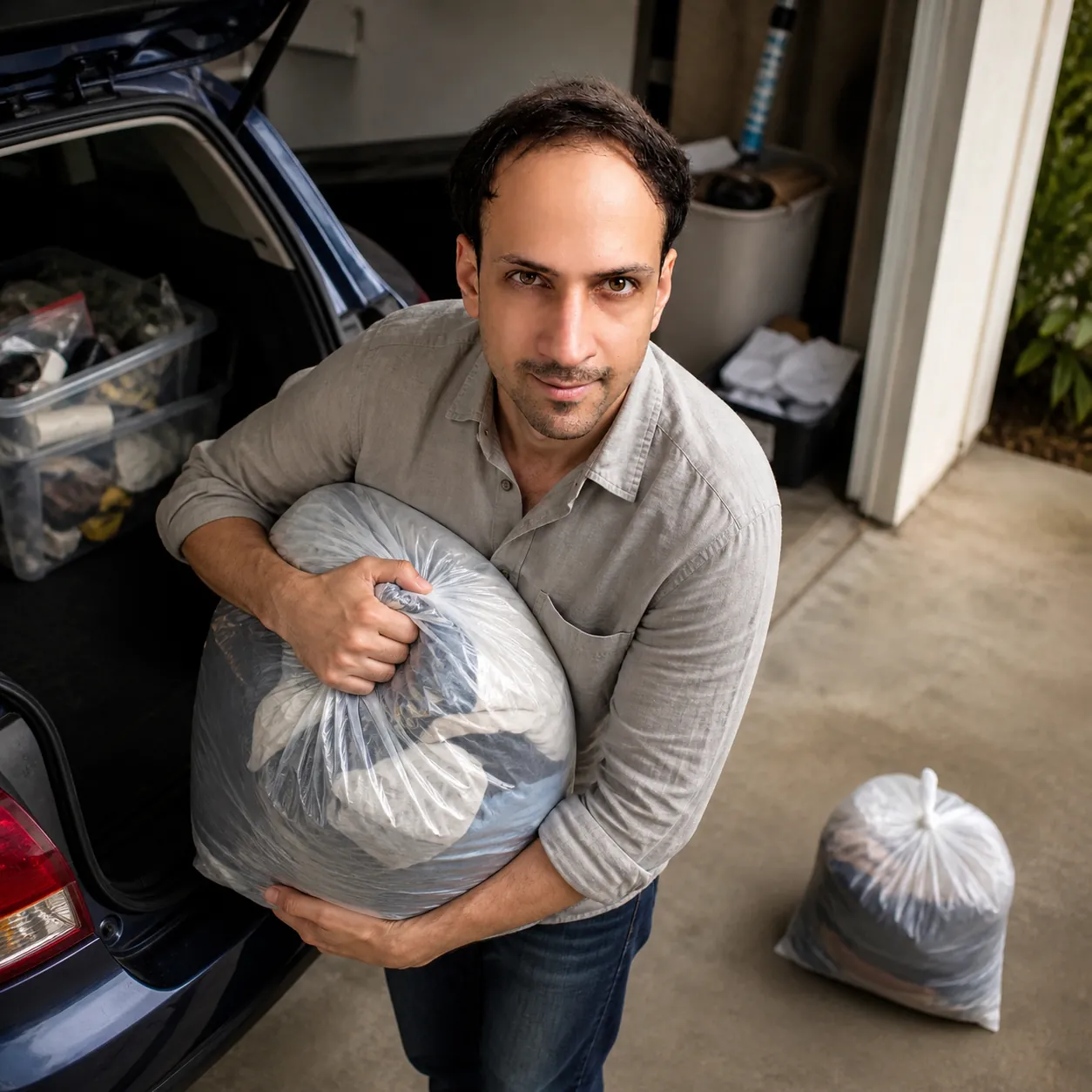
The Sealed Bag in the Boot — AI Portrait Prompt
صورةAI Portraits

Turn your own photo into an archival still-life portrait in the open boot of a car in a residents' garage. Keeps your face unchanged.

من نص البرومبت

Use the attached reference photo as the identity reference: keep the same face, skin tone, hair and features as the person in that photo, without beautifying, aging or altering them. Create a square 1:1 museum-catalog frame with a strong first read and a slower second read at exactly 2880x2880 pixels. Location: the open boot of a car in a residents' garage. Show the subject in a stone-coloured linen shirt with the cuffs turned twice, pressing a full carrier bag square against the side. Build the image around this small, exact tableau: a sealed bag set apart on the floor from the rest, the only one of them not to be reopened shows care and accumulation arriving from exactly the same impulse. Explore what one genuinely emptied space costs compared with an afternoon of tidying; expression occupied, not expressive, carrying unhurried resolve, difficulty stated as household fact. Frame from slightly above the work so its real depth reads without exaggeration. Make the composition let one emptied gap sit at the frame's quietest point. Render it as archival still-life portraiture combining catalogue-clear object rendering, believable domestic wear, controlled neutral colour, and patient unstyled editorial realism, using unglamorous garage strip lighting balanced by pale daylight at the entrance and a palette of warm cardboard tan, cool grey, and dulled brass. Photorealistic: this must read as a real photograph from a physical camera, never an illustration, painting, or 3D render. Resolve real surface detail: skin that reddens slightly under pressure, nail beds with honest colour, and knuckle creases that fold rather than blur. Keep one identity-locked person, credible hands and fingers, natural fabric, and coherent scale, contact, reflections, shadows, airflow, deformation, and materials. Background people only when essential, always secondary and clearly different. Avoid clear-out crews, shame poses, posing at camera, teetering junk towers, and melancholy without labour. No text, labels, logos, signatures, watermarks, random symbols, plastic skin, excessive bloom, or glossy AI finish.
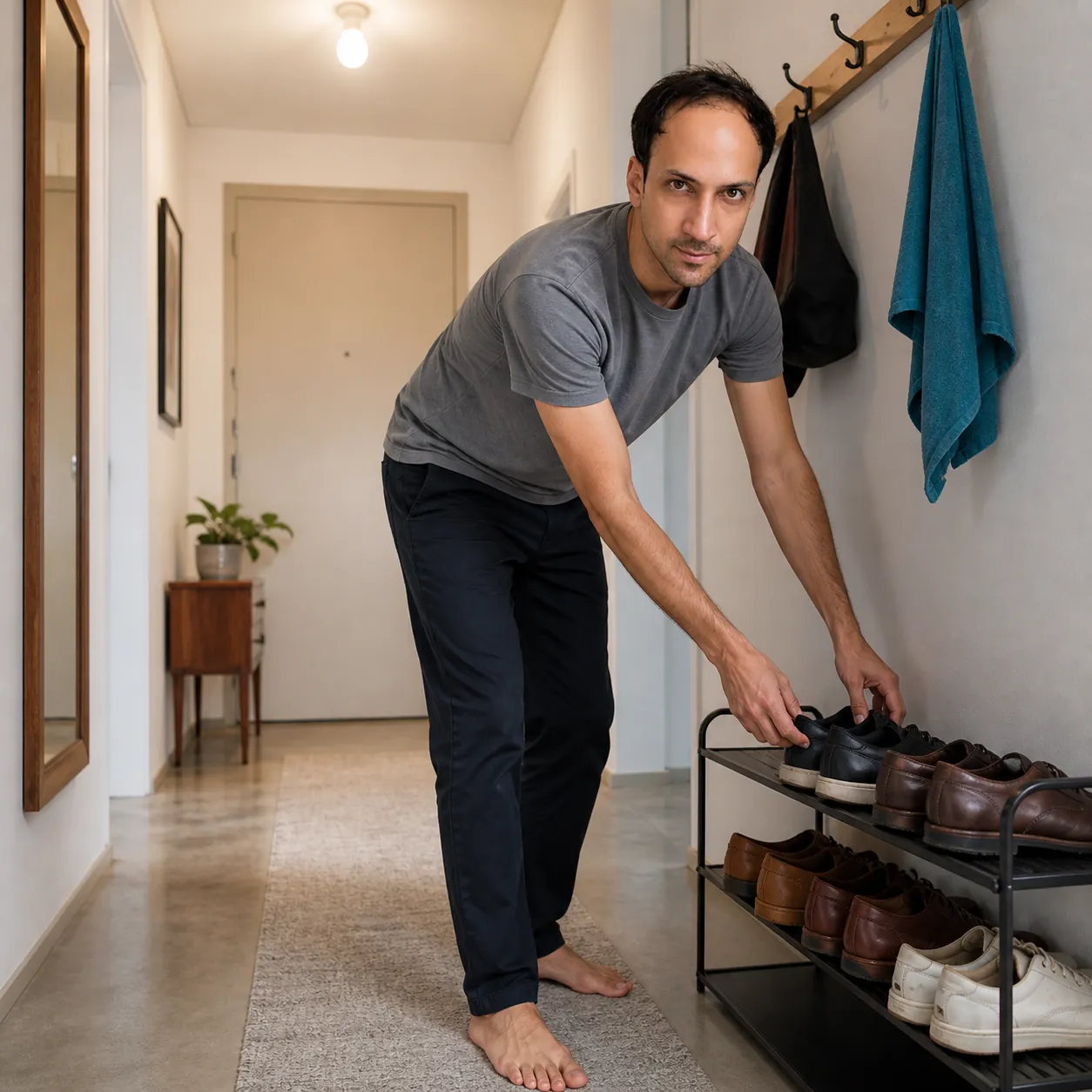
A Bulb Left Burning — AI Portrait Prompt
صورةAI Portraits

Turn your own photo into an observational domestic portrait in a flat's entrance hall with a shoe rack and a hook rail. Keeps your face unchanged.

من نص البرومبت

Use the attached reference photo as the identity reference: keep the same face, skin tone, hair and features as the person in that photo, without beautifying, aging or altering them. Create a square 1:1 museum-catalog frame with a strong first read and a slower second read at exactly 2880x2880 pixels. Location: a flat's entrance hall with a shoe rack and a hook rail. Show them in a plain grey crew-neck, dark cotton trousers, and bare feet, straightening a row of shoes along the rack. Anchor the frame to this piece of ordinary evidence: a corridor bulb left burning all through a bright afternoon, its switch passed again and again and never touched holds an ordinary task open a moment longer than the task requires. Explore how a private precaution turns into ordinary housekeeping without anyone noticing; expression occupied, not expressive, carrying unhurried caution, difficulty stated in the geometry alone. Place the lens beside the task at working height with the far wall sharp. Make the composition show the extra distance their arrangement adds. Render it as observational domestic portraiture built from truthful chore staging, exact material texture, ordinary architectural geometry, and quietly unsentimental framing, using even ceiling light with a second lamp filling the far end and a palette of sand beige, concrete grey, and one teal towel. Photorealistic: this must read as a real photograph from a physical camera, never an illustration, painting, or 3D render. Resolve real surface detail: cotton that hangs by its own weight, seams that pucker very slightly, and collars softened by washing. Keep one identity-locked person, credible hands and fingers, natural fabric, and coherent scale, contact, reflections, shadows, airflow, deformation, and materials. Background people only when essential, always secondary and clearly different. Avoid thriller shadows, keyhole peering, weapons or uniforms, and staged startle reactions. No text, labels, logos, signatures, watermarks, random symbols, plastic skin, excessive bloom, or glossy AI finish.
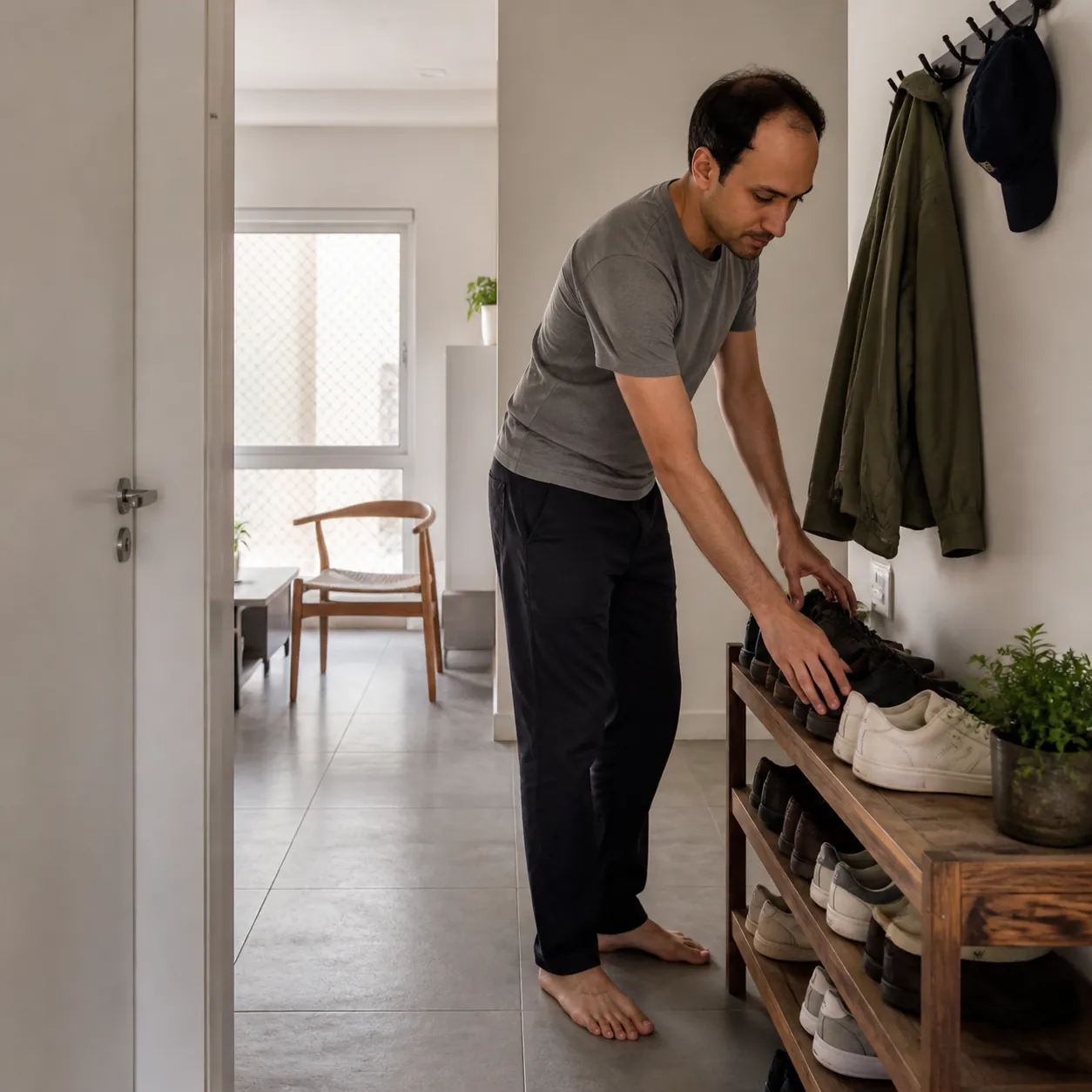
Shoes Lined Up, Door in View — AI Portrait Prompt
صورةAI Portraits

Turn your own photo into a quiet domestic documentary portrait in a flat's entrance hall with a shoe rack and a hook rail. Keeps your face unchanged.

من نص البرومبت

Use the attached reference photo as the identity reference: keep the same face, skin tone, hair and features as the person in that photo, without beautifying, aging or altering them. Create a square 1:1 museum-catalog frame with a strong first read and a slower second read at exactly 2880x2880 pixels. Location: a flat's entrance hall with a shoe rack and a hook rail. Show them in a plain grey crew-neck, dark cotton trousers, and bare feet, straightening a row of shoes along the rack. Let one honest object carry what the face will not: a chair carried the long way round the table so the room's one way in never falls behind them turns an ordinary chore into a problem of position and sound. Explore why an ordinary chore has to be solved as a geometry problem first; expression occupied, not expressive, carrying flat competence, difficulty stated as arrangement rather than distress. Use a 50mm eye-level view from the side of the room they left open. Make the composition give the room's emptiest part the sharpest detail. Render it as quiet domestic documentary realism combining unposed portrait photography, honest interior materials, accurate household light, and unhurried observational framing, using flat mid-afternoon daylight through a screened window with no direct sun and a palette of plaster white, worn grey tile, and one olive accent. Photorealistic: this must read as a real photograph from a physical camera, never an illustration, painting, or 3D render. Resolve real surface detail: true skin texture with pores and fine hair at the hairline, and fabric that creases where it is actually stressed. Keep one identity-locked person, credible hands and fingers, natural fabric, and coherent scale, contact, reflections, shadows, airflow, deformation, and materials. Background people only when essential, always secondary and clearly different. Avoid hero poses, golden-hour wellness glow, eye contact with the lens, and tear-streaked faces. No text, labels, logos, signatures, watermarks, random symbols, plastic skin, excessive bloom, or glossy AI finish.
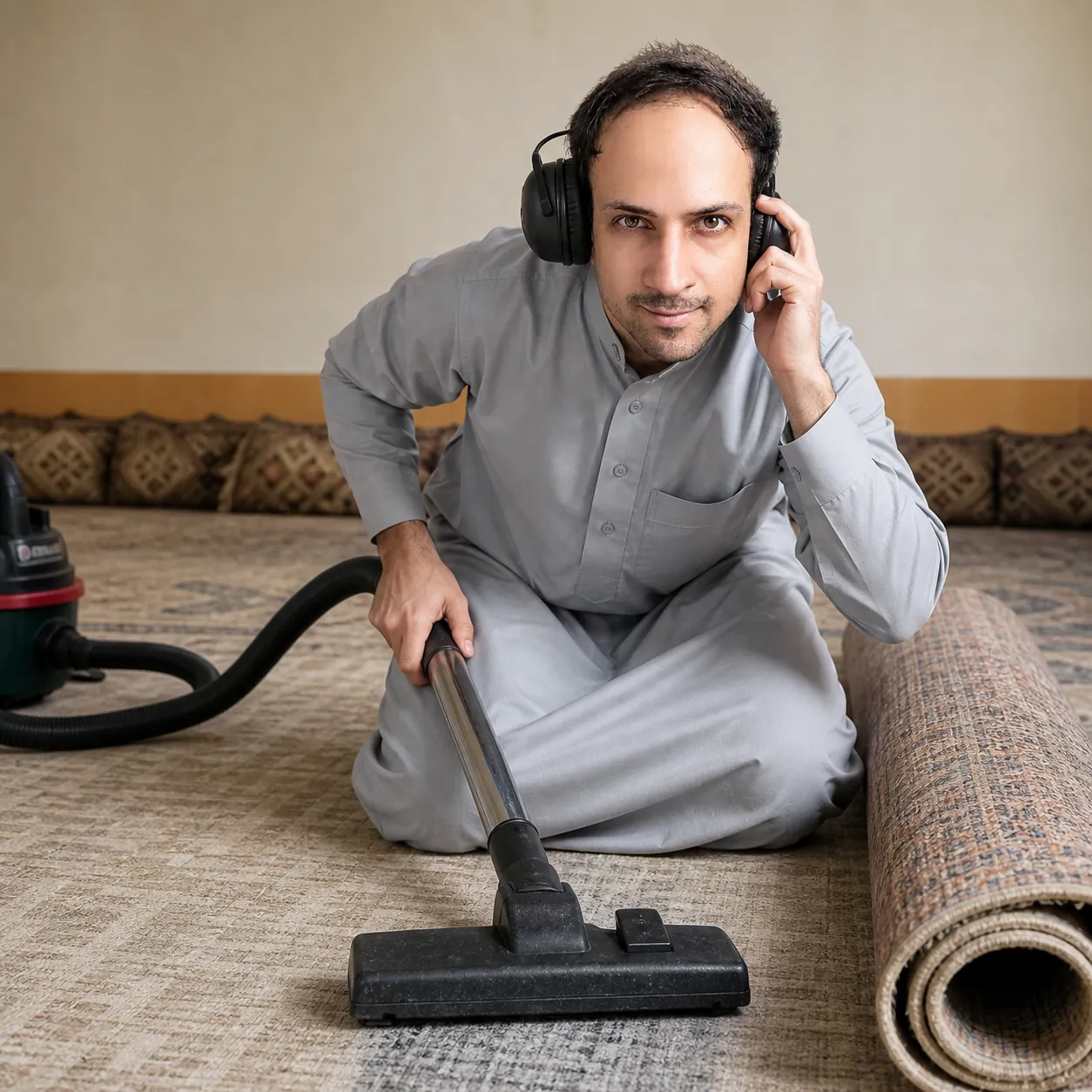
Vacuuming the Majlis Rug — AI Portrait Prompt
صورةAI Portraits

Turn your own photo into a contemporary reportage portrait in a majlis floor mid-clean with its long rug rolled back. Keeps your face unchanged.

من نص البرومبت

Use the attached reference photo as the identity reference: keep the same face, skin tone, hair and features as the person in that photo, without beautifying, aging or altering them. Create a square 1:1 museum-catalog frame with a strong first read and a slower second read at exactly 2880x2880 pixels. Location: a majlis floor mid-clean with its long rug rolled back. Show them in a light grey traditional Gulf outfit with the hem gathered clear, guiding a vacuum head along one rolled-back rug edge. Make this piece of unglamorous evidence the whole argument: a pair of over-ear defenders worn as plainly as work gloves, pushed back off one ear only to check a machine's note shows competence and difficulty occupying the same square metre of floor. Explore why a ten-item errand can cost more than the hour it takes; expression occupied, not expressive, carrying plain diligence, difficulty stated without inviting sympathy. Use an 85mm portrait length with the room compressed just enough to feel enclosed. Make the composition weight the near object heavier than the room behind it. Render it as contemporary reportage realism combining plain civic interiors, physically accurate material response, working household equipment, and calm documentary distance, using one ceiling fitting doing all the work, shadows short and plain and a palette of soap grey, warm plaster, and one ochre band. Photorealistic: this must read as a real photograph from a physical camera, never an illustration, painting, or 3D render. Resolve real surface detail: paper fibre visible at cut edges, plastic that shows mould lines, and paint thicker where a brush turned. Keep one identity-locked person, credible hands and fingers, natural fabric, and coherent scale, contact, reflections, shadows, airflow, deformation, and materials. Background people only when essential, always secondary and clearly different. Avoid glowing sound waves, sensory-overload blur effects, and mood portraits without labour. No text, labels, logos, signatures, watermarks, random symbols, plastic skin, excessive bloom, or glossy AI finish.
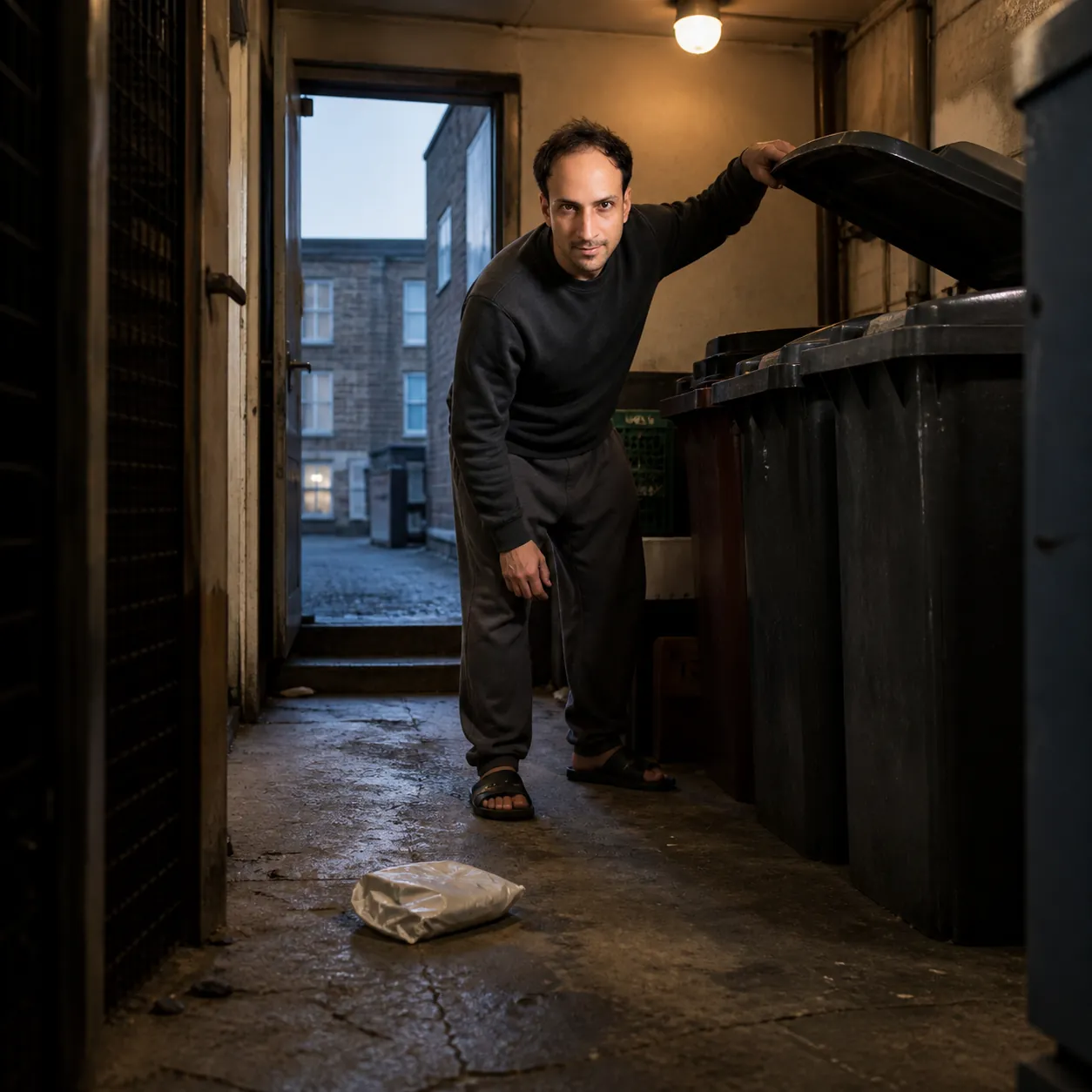
The Bin Store Under One Bulb — AI Portrait Prompt
صورةAI Portraits

Turn your own photo into a museum-grade domestic portrait in a building's ground-floor bin store lit by one bare fitting. Keeps your face unchanged.

من نص البرومبت

Use the attached reference photo as the identity reference: keep the same face, skin tone, hair and features as the person in that photo, without beautifying, aging or altering them. Create a square 1:1 museum-catalog frame with a strong first read and a slower second read at exactly 2880x2880 pixels. Location: a building's ground-floor bin store lit by one bare fitting. Show the subject in a dark grey sweatshirt over loose cotton trousers and slip-on sandals, tipping a lid open with the back of one wrist. Anchor the frame to this piece of ordinary evidence: a single bought item in a bag folded small, carried from a shop that was entered and left inside its quietest minutes spends a whole morning's calculation on something a neighbour does absently. Explore why an exit has to be located before an errand can begin; expression occupied, not expressive, carrying flat determination, difficulty stated in plain working terms. Place the camera low at bag height so the floor and the threshold dominate. Make the composition hold measurable distance between their hands and the open air. Render it as museum-grade domestic realism combining high-fidelity portrait photography, plain hardware detail, accurate low-light response, and restrained editorial art direction, using pale pre-dawn daylight through a doorway, balanced by one weak interior lamp and a palette of matte navy, unbleached paper, and a single tile green. Photorealistic: this must read as a real photograph from a physical camera, never an illustration, painting, or 3D render. Resolve real surface detail: dust settled where nobody wipes, fingerprint haze on glass, and edges rubbed pale by handling. Keep one identity-locked person, credible hands and fingers, natural fabric, and coherent scale, contact, reflections, shadows, airflow, deformation, and materials. Background people only when essential, always secondary and clearly different. Avoid rain-streaked window sorrow, huddled foetal poses, blurred crowd chaos, and curtain-peeking paranoia. No text, labels, logos, signatures, watermarks, random symbols, plastic skin, excessive bloom, or glossy AI finish.
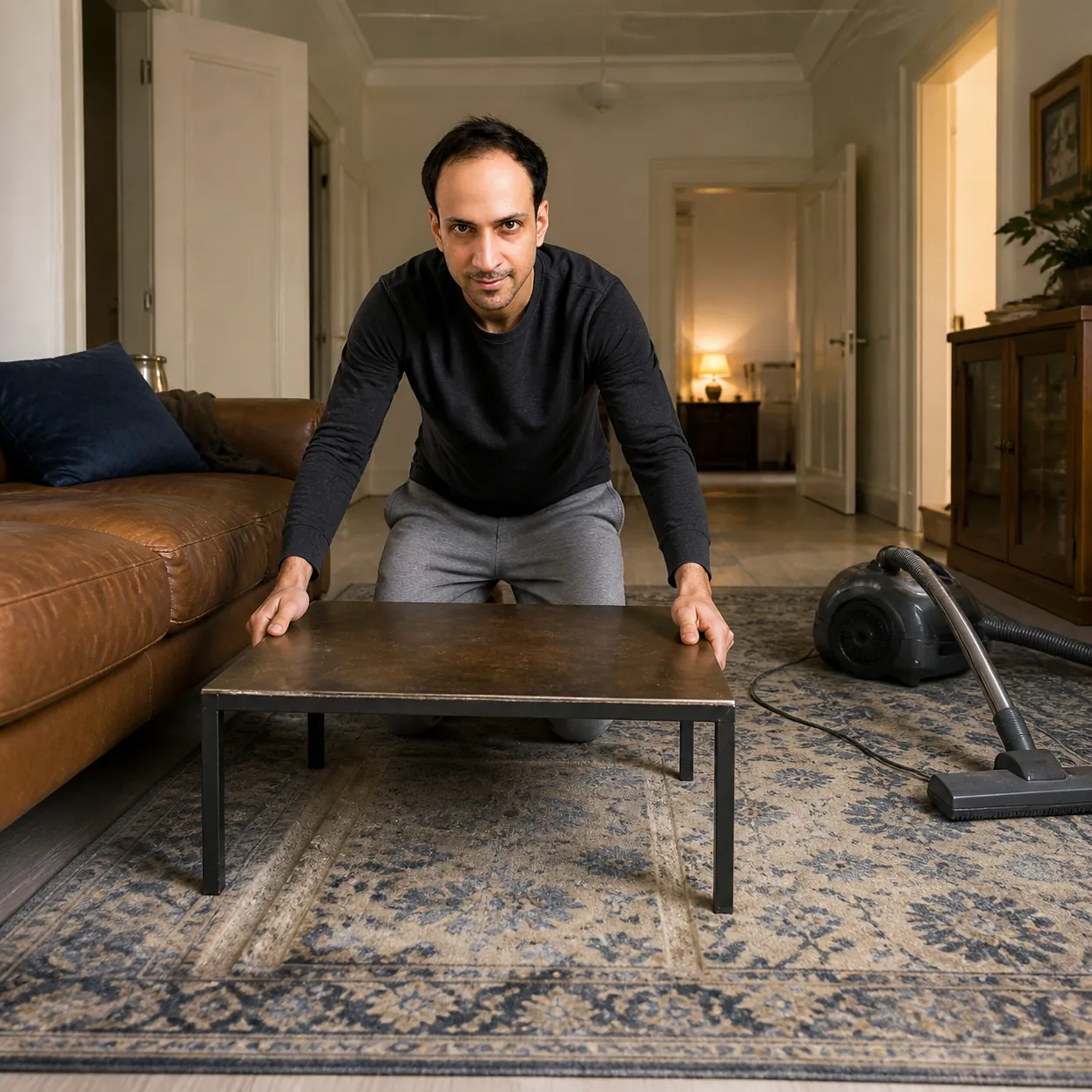
Between Two Doorways — AI Portrait Prompt
صورةAI Portraits

Turn your own photo into a museum-grade domestic portrait in a sitting room where two doorways face each other across the rug. Keeps your face unchanged.

من نص البرومبت

Use the attached reference photo as the identity reference: keep the same face, skin tone, hair and features as the person in that photo, without beautifying, aging or altering them. Create a square 1:1 museum-catalog frame with a strong first read and a slower second read at exactly 2880x2880 pixels. Location: a sitting room where two doorways face each other across the rug. Show them in a charcoal long-sleeve tee and soft grey lounge trousers, nudging a low table back onto its floor marks. Make this piece of unglamorous evidence the whole argument: a vacuum cleaner switched off mid-strip while they identify a sound that turned out to be the building itself holds an ordinary task open a moment longer than the task requires. Explore how much extra walking one unbroken sightline is worth to them; expression occupied, not expressive, carrying dry persistence, difficulty stated the way furniture states itself. Use a 40mm chest-height viewpoint that includes the room's depth without dramatizing it. Make the composition place the one opening off-center without letting it dominate. Render it as museum-grade domestic realism built from reportage portraiture, true material response, plain interior architecture, and restrained contemporary art direction, using even ceiling light with a second lamp filling the far end and a palette of pale limestone, iron grey, and one faded indigo cloth. Photorealistic: this must read as a real photograph from a physical camera, never an illustration, painting, or 3D render. Resolve real surface detail: leather creased along the lines of use, stitching slightly irregular, and edges burnished from contact. Keep one identity-locked person, credible hands and fingers, natural fabric, and coherent scale, contact, reflections, shadows, airflow, deformation, and materials. Background people only when essential, always secondary and clearly different. Avoid thriller shadows, keyhole peering, weapons or uniforms, and staged startle reactions. No text, labels, logos, signatures, watermarks, random symbols, plastic skin, excessive bloom, or glossy AI finish.
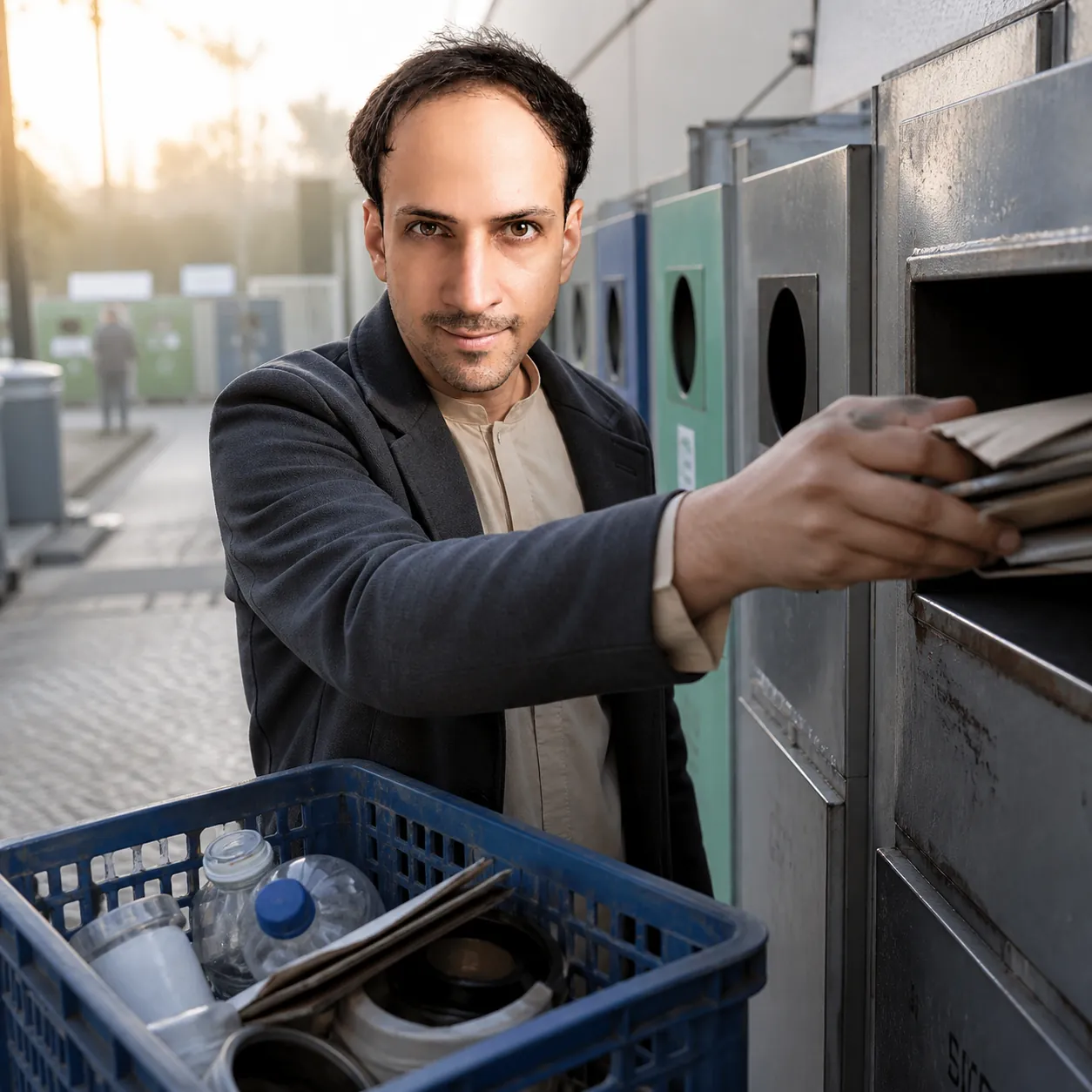
The Bag Not to Be Reopened — AI Portrait Prompt
صورةAI Portraits

Turn your own photo into an archival still-life portrait in a neighbourhood recycling bay at early morning, bins in line. Keeps your face unchanged.

من نص البرومبت

Use the attached reference photo as the identity reference: keep the same face, skin tone, hair and features as the person in that photo, without beautifying, aging or altering them. Create a square 1:1 museum-catalog frame with a strong first read and a slower second read at exactly 2880x2880 pixels. Location: a neighbourhood recycling bay at early morning, bins in line. Show the subject in a plain beige traditional Gulf outfit under a thin dark overcoat, posting a folded bundle through a steel hatch. The difficulty must be visible in this, not in their expression: a plastic crate of things still to be sorted, its handles worn smooth from being carried into a fourth room shows care and accumulation arriving from exactly the same impulse. Explore how order can grow steadily heavier without ever becoming any kind of mess; expression occupied, not expressive, carrying plain persistence, difficulty stated without any note of shame. Hold a static 40mm frame at standing height with their working hand visible. Make the composition put their working hand nearer the lens than their face. Render it as archival still-life portraiture combining catalogue-clear object rendering, believable domestic wear, controlled neutral colour, and patient unstyled editorial realism, using cool morning ambience from an open door, warmed slightly by interior walls and a palette of dust beige, cold steel, and one worn indigo note. Photorealistic: this must read as a real photograph from a physical camera, never an illustration, painting, or 3D render. Resolve real surface detail: rubber gone chalky with age, painted metal chipped to primer, and plastic yellowed only where light reaches it. Keep one identity-locked person, credible hands and fingers, natural fabric, and coherent scale, contact, reflections, shadows, airflow, deformation, and materials. Background people only when essential, always secondary and clearly different. Avoid clear-out crews, shame poses, posing at camera, teetering junk towers, and melancholy without labour. No text, labels, logos, signatures, watermarks, random symbols, plastic skin, excessive bloom, or glossy AI finish.
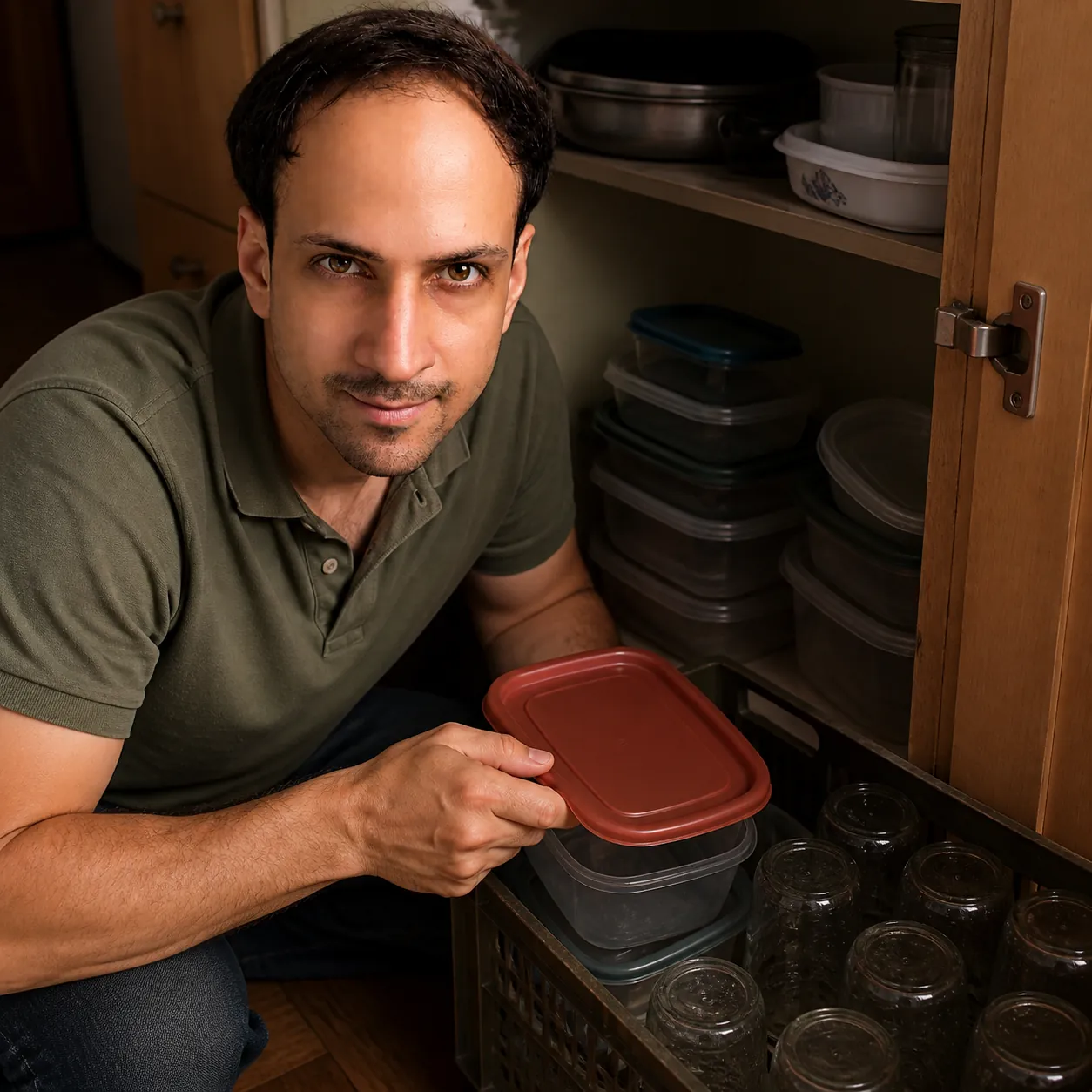
Jars Kept for a Nameless Season — AI Portrait Prompt
صورةAI Portraits

Turn your own photo into a museum-grade domestic portrait in a kitchen cupboard opened on stacked plastic food containers. Keeps your face unchanged.

من نص البرومبت

Use the attached reference photo as the identity reference: keep the same face, skin tone, hair and features as the person in that photo, without beautifying, aging or altering them. Create a square 1:1 museum-catalog frame with a strong first read and a slower second read at exactly 2880x2880 pixels. Location: a kitchen cupboard opened on stacked plastic food containers. Show the subject in a faded olive polo shirt with the collar left open, matching one lid to its container by sight. Build the image around this small, exact tableau: a stack of clean glass jars nested in a crate, each rinsed, dried, and turned mouth-down for a nameless season shows care and accumulation arriving from exactly the same impulse. Explore whether keeping a useful thing is thrift, foresight, or a quiet tax; expression occupied, not expressive, carrying unhurried resolve, difficulty stated in the register of ordinary work. Frame from slightly above the work so its real depth reads without exaggeration. Make the composition weight the frame toward what stays rather than what leaves. Render it as museum-grade domestic portraiture built from plain-room reportage, accurate cardboard and glass materiality, restrained art direction, and unsentimental observation, using one bare ceiling fitting doing all the work, shadows short and honest and a palette of pale gypsum, tea-stained paper, and a narrow rust accent. Photorealistic: this must read as a real photograph from a physical camera, never an illustration, painting, or 3D render. Resolve real surface detail: condensation beading at true size, liquid meniscus curving against glass, and wet surfaces darker than dry ones. Keep one identity-locked person, credible hands and fingers, natural fabric, and coherent scale, contact, reflections, shadows, airflow, deformation, and materials. Background people only when essential, always secondary and clearly different. Avoid clear-out crews, shame poses, posing at camera, teetering junk towers, and melancholy without labour. No text, labels, logos, signatures, watermarks, random symbols, plastic skin, excessive bloom, or glossy AI finish.
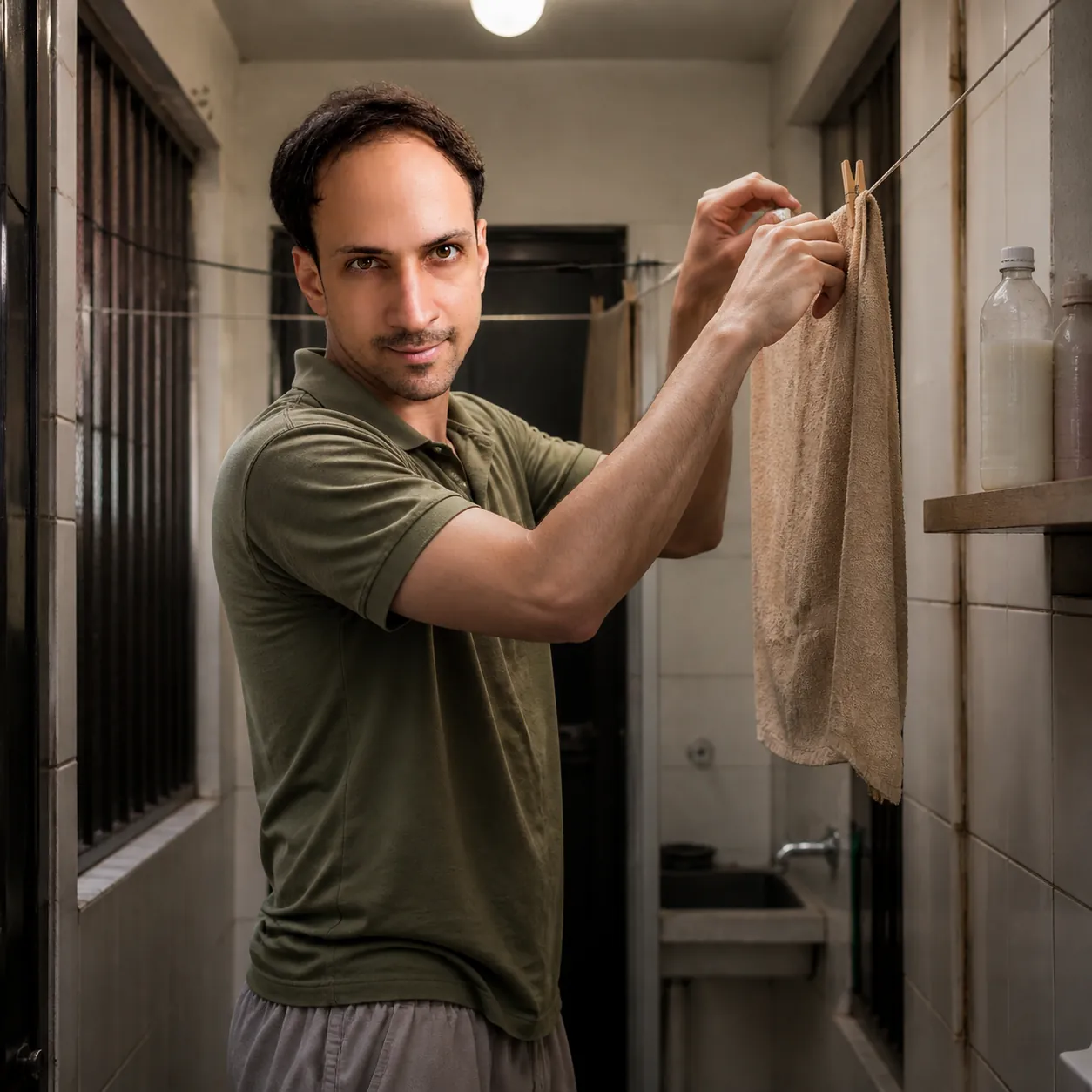
The Unscented Bottle on the Balcony — AI Portrait Prompt
صورةAI Portraits

Turn your own photo into a portrait in an enclosed service balcony where a washing line crosses at head height. Keeps your face unchanged.

من نص البرومبت

Use the attached reference photo as the identity reference: keep the same face, skin tone, hair and features as the person in that photo, without beautifying, aging or altering them. Create a square 1:1 museum-catalog frame with a strong first read and a slower second read at exactly 2880x2880 pixels. Location: an enclosed service balcony where a washing line crosses at head height. Show the subject in a faded olive polo shirt and loose cotton trousers, pegging one heavy towel along the line's near end. Make this piece of unglamorous evidence the whole argument: an unperfumed cleaning bottle kept at the front of the shelf while the scented one stands unopened behind it makes the cost of an ordinary chore visible without making it a complaint. Explore what it costs to keep an ordinary evening's maintenance running on schedule; expression occupied, not expressive, carrying steady economy, difficulty stated quietly enough to be missed. Use an 85mm portrait length with the room compressed just enough to feel enclosed. Make the composition give the accommodation more acuity than any face-adjacent surface. Render it as quiet domestic documentary realism combining unstyled interior photography, tactile household materials, honest working light, and unhurried observational framing, using one ceiling fitting doing all the work, shadows short and plain and a palette of unbleached cotton, dull steel, and one olive note. Photorealistic: this must read as a real photograph from a physical camera, never an illustration, painting, or 3D render. Resolve real surface detail: grout darker than tile, sealant slightly yellowed, and every joint showing a real tolerance gap. Keep one identity-locked person, credible hands and fingers, natural fabric, and coherent scale, contact, reflections, shadows, airflow, deformation, and materials. Background people only when essential, always secondary and clearly different. Avoid hands clamped over ears, meltdown theatrics, and hero poses at camera. No text, labels, logos, signatures, watermarks, random symbols, plastic skin, excessive bloom, or glossy AI finish.
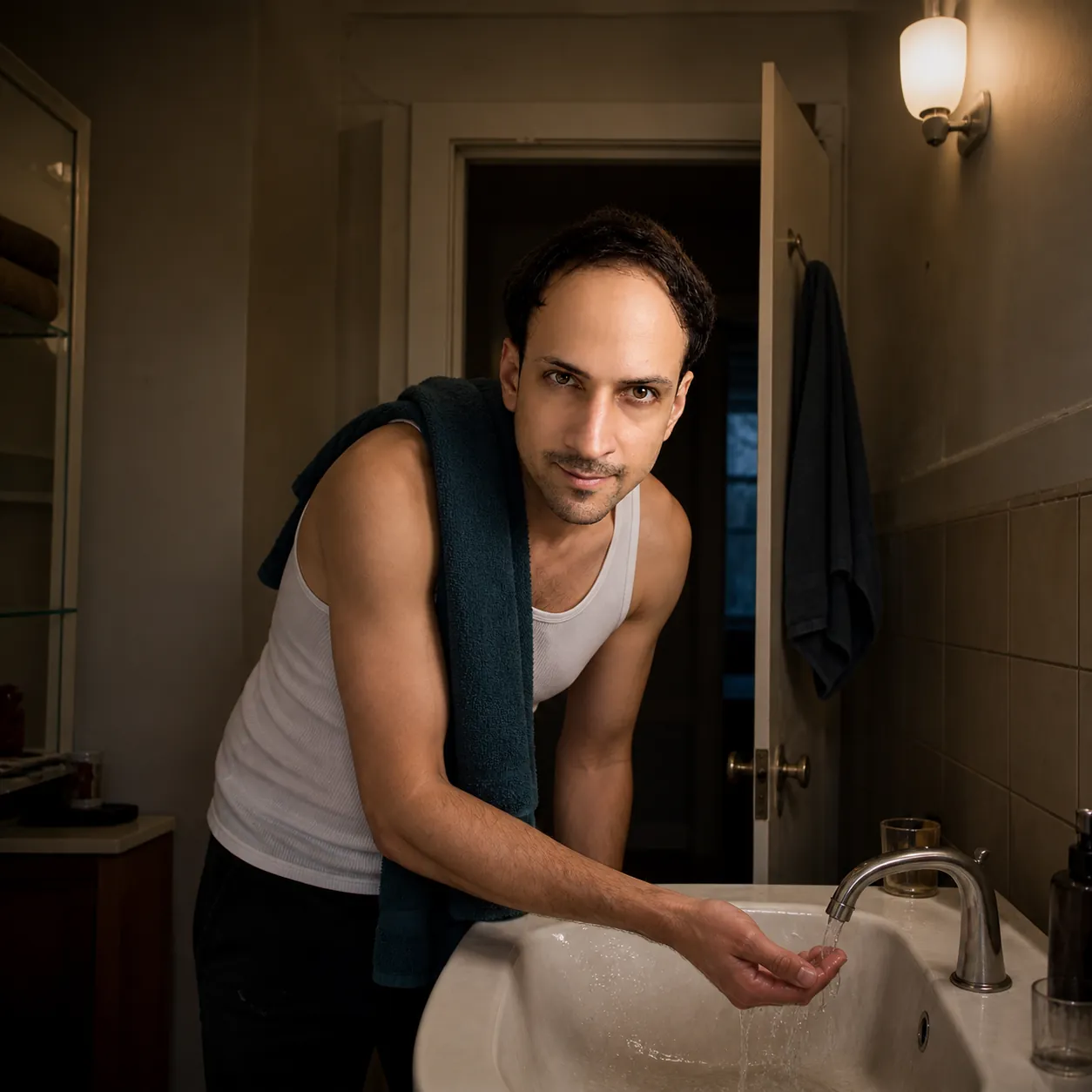
Rinsing the Basin, Door Hooked Open — AI Portrait Prompt
صورةAI Portraits

Turn your own photo into a museum-grade domestic portrait in a bathroom lit by one wall lamp, its door hooked open. Keeps your face unchanged.

من نص البرومبت

Use the attached reference photo as the identity reference: keep the same face, skin tone, hair and features as the person in that photo, without beautifying, aging or altering them. Create a square 1:1 museum-catalog frame with a strong first read and a slower second read at exactly 2880x2880 pixels. Location: a bathroom lit by one wall lamp, its door hooked open. Show them in a plain white undershirt with a towel across one shoulder, rinsing the basin down with one cupped hand. The difficulty must be visible in this, not in their expression: a fan left off for weeks, switched on at last, its noise finally allowed to cover the hall holds an ordinary task open a moment longer than the task requires. Explore what a room costs when every sound in it must first be named; expression occupied, not expressive, carrying level attention, difficulty stated without ever naming a reason. Frame from the near corner at standing height with their hands closest to camera. Make the composition let their standing position read before the chore does. Render it as museum-grade domestic realism built from reportage portraiture, true material response, plain interior architecture, and restrained contemporary art direction, using low evening interior light with the far rooms left dimmer and a palette of sand beige, concrete grey, and one teal towel. Photorealistic: this must read as a real photograph from a physical camera, never an illustration, painting, or 3D render. Resolve real surface detail: thread ends and slight pilling on worn cloth, hairline chips at every hard corner, and stone that is porous rather than smooth. Keep one identity-locked person, credible hands and fingers, natural fabric, and coherent scale, contact, reflections, shadows, airflow, deformation, and materials. Background people only when essential, always secondary and clearly different. Avoid thriller shadows, keyhole peering, weapons or uniforms, and staged startle reactions. No text, labels, logos, signatures, watermarks, random symbols, plastic skin, excessive bloom, or glossy AI finish.
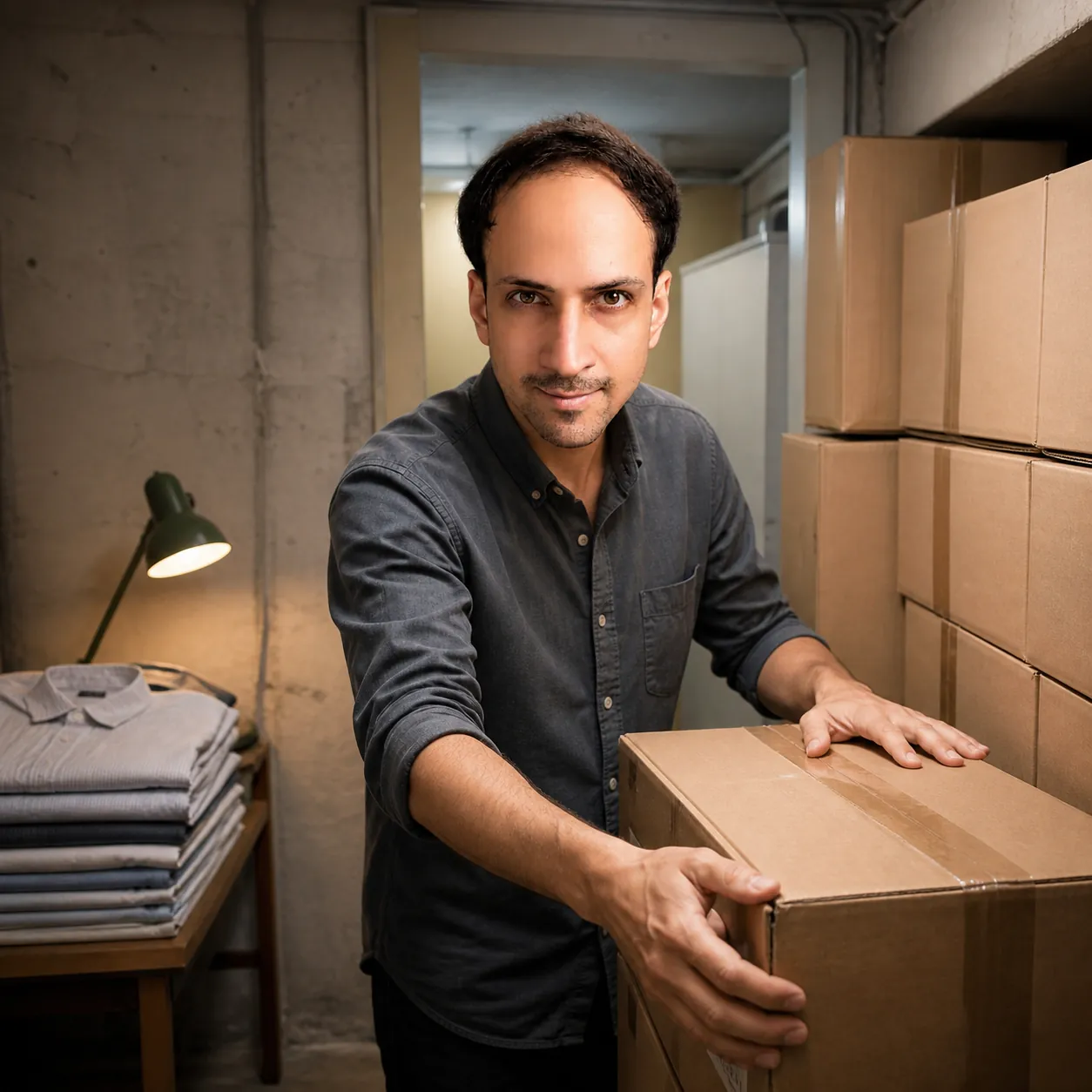
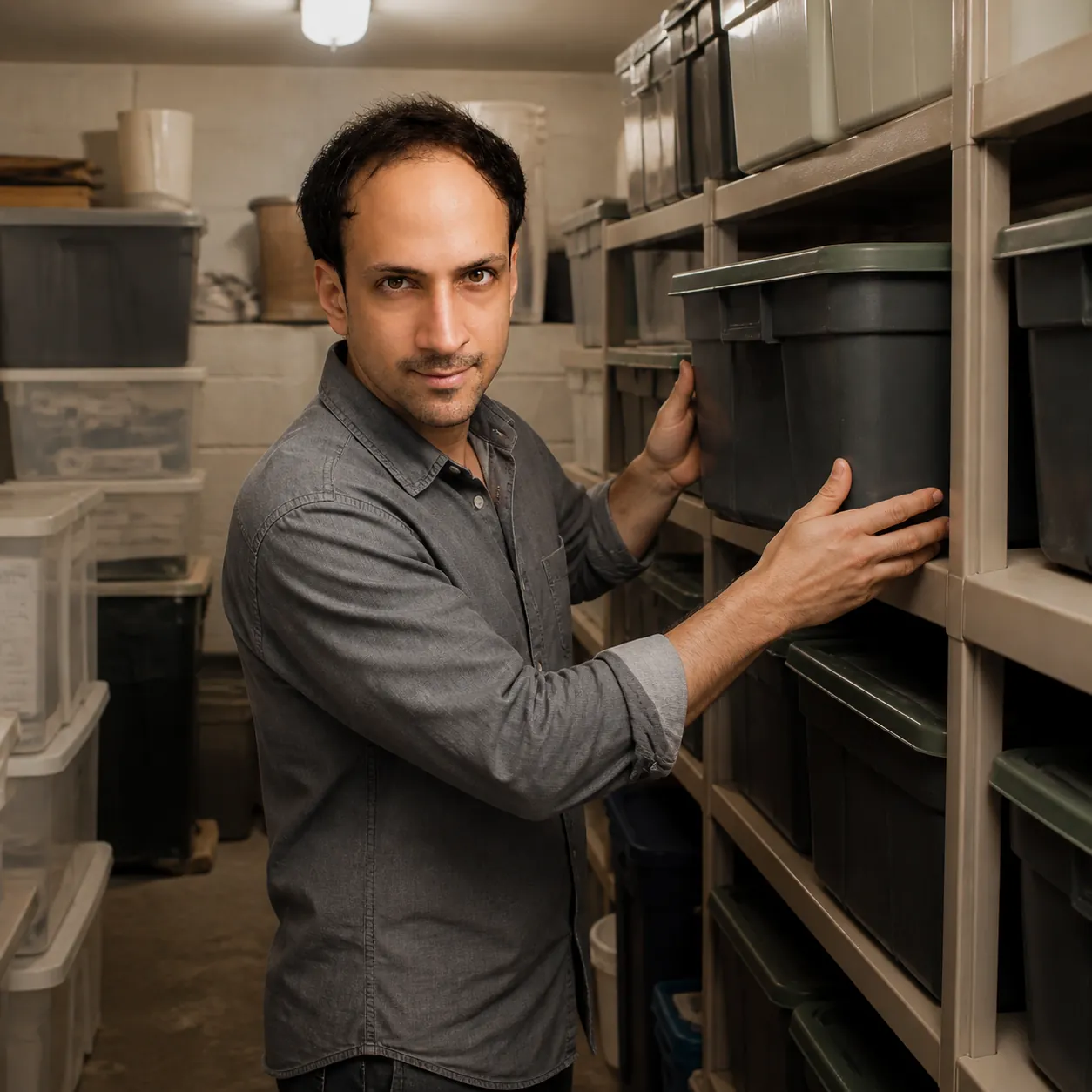
One Tub Out of Place — AI Portrait Prompt
صورةAI Portraits

Turn your own photo into an observational still-life portrait in a windowless storage room lined with plastic tubs and shelving. Keeps your face unchanged.

من نص البرومبت

Use the attached reference photo as the identity reference: keep the same face, skin tone, hair and features as the person in that photo, without beautifying, aging or altering them. Create a square 1:1 museum-catalog frame with a strong first read and a slower second read at exactly 2880x2880 pixels. Location: a windowless storage room lined with plastic tubs and shelving. Show the subject in an untucked grey button-down with the cuffs turned back once, sliding a stacked tub back into its slot. Make this piece of unglamorous evidence the whole argument: a pair of near-identical boxes side by side, the newer a replacement that is wrong in one load-bearing way carries a whole routine on one part that nobody outside would notice. Explore why one substituted item can cost an entire afternoon of rebuilding; expression occupied, not expressive, carrying practical stubbornness, difficulty stated quietly, in the objects alone. Use a slightly high 40mm angle that shows the whole interrupted arrangement at once. Make the composition let the routine's line visibly break at one point. Render it as observational still-life portraiture built from real household objects, matter-of-fact framing, accurate fabric behavior, and gallery-scale detail without polish, using one ceiling fitting doing all the work, shadows soft and low and a palette of pale sand, soft charcoal, and faded plastic green. Photorealistic: this must read as a real photograph from a physical camera, never an illustration, painting, or 3D render. Resolve real surface detail: paper fibre visible at cut edges, plastic that shows mould lines, and paint thicker where a brush turned. Keep one identity-locked person, credible hands and fingers, natural fabric, and coherent scale, contact, reflections, shadows, airflow, deformation, and materials. Background people only when essential, always secondary and clearly different. Avoid melancholy posed at windows, showroom kitchens, hands clutching the head, inspirational lighting, and clockwork-brain imagery. No text, labels, logos, signatures, watermarks, random symbols, plastic skin, excessive bloom, or glossy AI finish.
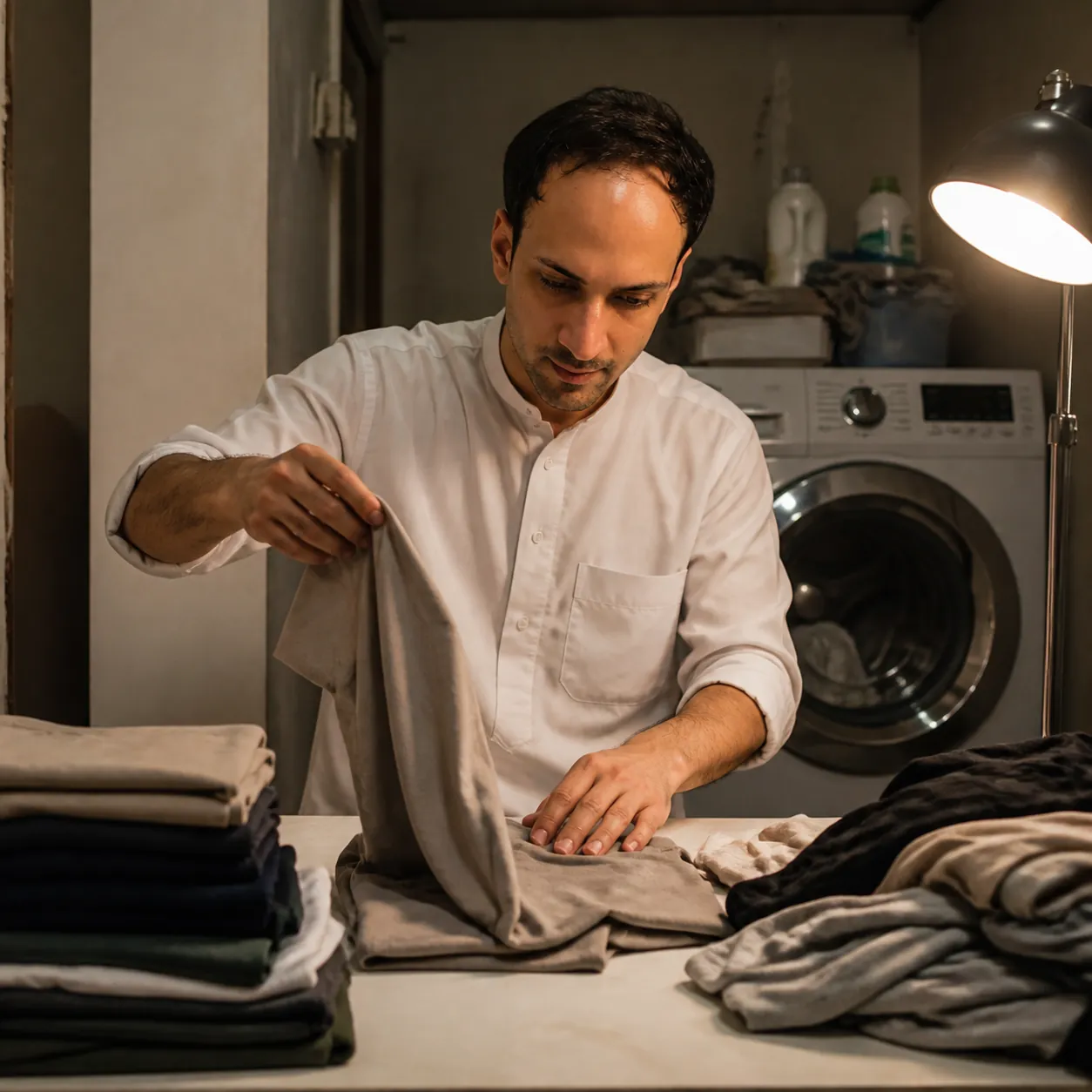
Three Identical Screwdrivers — AI Portrait Prompt
صورةAI Portraits

Turn your own photo into a museum-grade domestic portrait in a small back room stacked shoulder-high with taped cardboard boxes. Keeps your face unchanged.

من نص البرومبت

Use the attached reference photo as the identity reference: keep the same face, skin tone, hair and features as the person in that photo, without beautifying, aging or altering them. Create a square 1:1 museum-catalog frame with a strong first read and a slower second read at exactly 2880x2880 pixels. Location: a small back room stacked shoulder-high with taped cardboard boxes. Show the subject in a charcoal work shirt buttoned to the second button, sliding one taped box forward on the stack. Let one honest object carry what the face will not: a folded stack of pressed shirts kept in a size that will come back, squared and faced one way turns a small errand into the longest decision of the week. Explore what a room owes to the future it has been furnished for; expression occupied, not expressive, carrying steady thrift, difficulty stated quietly enough to be missed once. Use an eye-level 50mm view with kept objects and hands on one plane. Make the composition keep every stacked edge parallel and every surface visibly clean. Render it as museum-grade domestic portraiture built from plain-room reportage, accurate cardboard and glass materiality, restrained art direction, and unsentimental observation, using a low domestic lamp plus spill from the corridor, both plainly motivated and a palette of bleached linen, concrete grey, and a single olive accent. Photorealistic: this must read as a real photograph from a physical camera, never an illustration, painting, or 3D render. Resolve real surface detail: fine grit in the texture of concrete, efflorescence at damp edges, and hairline cracks that follow stress. Keep one identity-locked person, credible hands and fingers, natural fabric, and coherent scale, contact, reflections, shadows, airflow, deformation, and materials. Background people only when essential, always secondary and clearly different. Avoid squalor, vermin, rotting food, hero-poster staging, and any wellness-aesthetic glow that replaces visible work. No text, labels, logos, signatures, watermarks, random symbols, plastic skin, excessive bloom, or glossy AI finish.
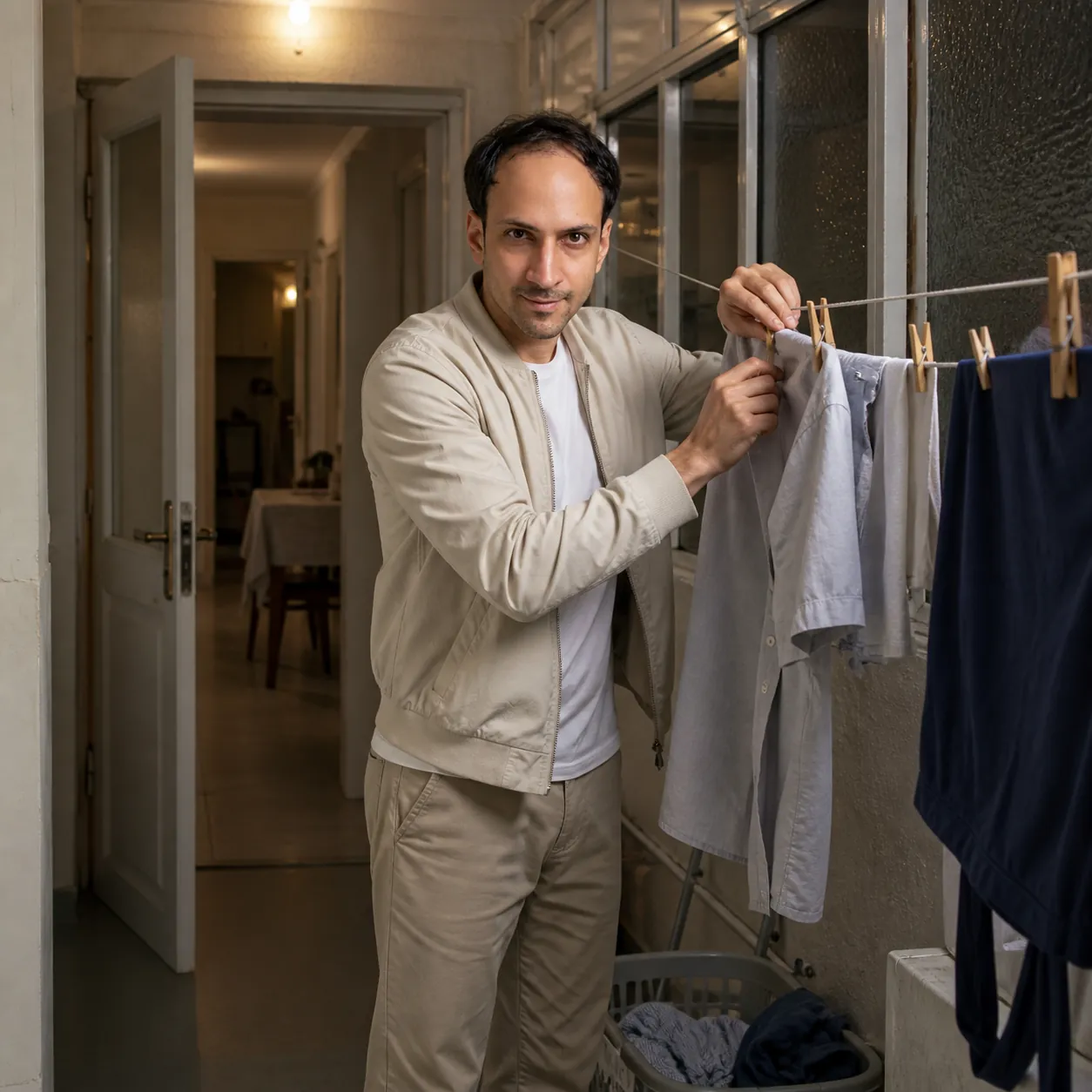
Sorting Laundry by Feel — AI Portrait Prompt
صورةAI Portraits

Turn your own photo into a museum-grade observational portrait in a utility alcove off the hallway with a front-loading machine. Keeps your face unchanged.

من نص البرومبت

Use the attached reference photo as the identity reference: keep the same face, skin tone, hair and features as the person in that photo, without beautifying, aging or altering them. Create a square 1:1 museum-catalog frame with a strong first read and a slower second read at exactly 2880x2880 pixels. Location: a utility alcove off the hallway with a front-loading machine. Show them in a plain white traditional Gulf outfit with both sleeves folded once, dividing a laundry pile into two stacks by feel. Anchor the frame to this piece of ordinary evidence: a room running three sounds at once with one switch already chosen, the least necessary source picked to stop first shows competence and difficulty occupying the same square metre of floor. Explore where the difficulty actually sits when the finished result looks entirely unremarkable; expression occupied, not expressive, carrying unhurried method, difficulty stated in the flattest possible voice. Frame slightly above the work surface so the task, not the person, occupies the centre. Make the composition let one unfinished half of the task stay honestly in frame. Render it as museum-grade observational portraiture built from ordinary domestic labour, accurate surface texture, plain interior architecture, and restrained contemporary art direction, using a single low lamp against an otherwise dim room and a palette of unbleached cotton, dull steel, and one olive note. Photorealistic: this must read as a real photograph from a physical camera, never an illustration, painting, or 3D render. Resolve real surface detail: dust settled where nobody wipes, fingerprint haze on glass, and edges rubbed pale by handling. Keep one identity-locked person, credible hands and fingers, natural fabric, and coherent scale, contact, reflections, shadows, airflow, deformation, and materials. Background people only when essential, always secondary and clearly different. Avoid glowing sound waves, sensory-overload blur effects, and mood portraits without labour. No text, labels, logos, signatures, watermarks, random symbols, plastic skin, excessive bloom, or glossy AI finish.
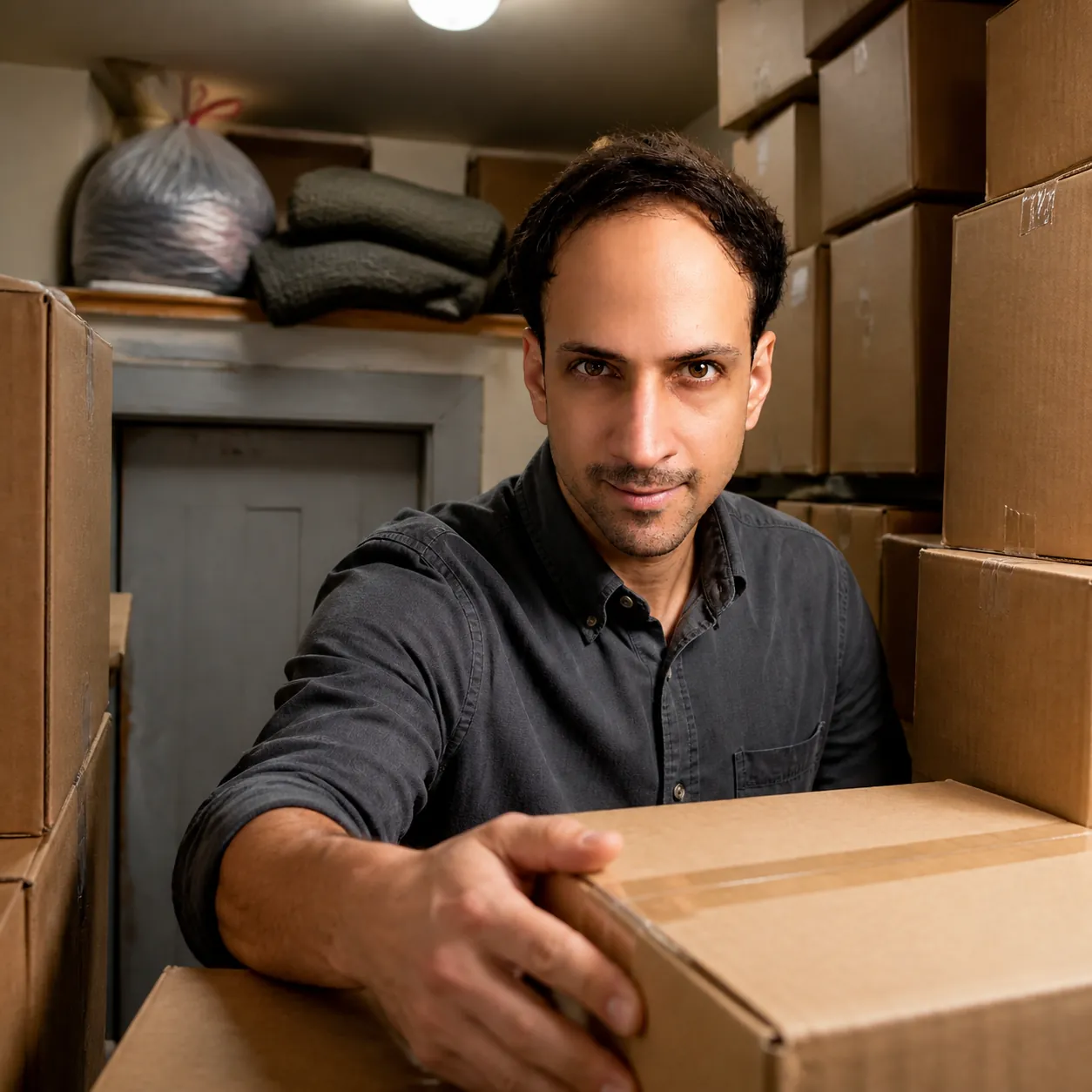
Laundry With the Rooms Behind — AI Portrait Prompt
صورةAI Portraits

Turn your own photo into a gallery-scale everyday portrait in an enclosed balcony with a washing line and the flat behind. Keeps your face unchanged.

من نص البرومبت

Use the attached reference photo as the identity reference: keep the same face, skin tone, hair and features as the person in that photo, without beautifying, aging or altering them. Create a square 1:1 museum-catalog frame with a strong first read and a slower second read at exactly 2880x2880 pixels. Location: an enclosed balcony with a washing line and the flat behind. Show them in a light zip-up jacket over a plain tee and canvas trousers, pegging a shirt to the line one corner at a time. Anchor the frame to this piece of ordinary evidence: an outer door propped wide in cold weather so the rooms behind them are never shut out holds an ordinary task open a moment longer than the task requires. Explore how one small allowance can cost more than the whole precaution; expression occupied, not expressive, carrying worn resolve, difficulty stated the way furniture states itself. Place the lens beside the task at working height with the far wall sharp. Make the composition show the extra distance their arrangement adds. Render it as gallery-scale everyday realism combining high-fidelity portrait photography, working household objects, and physically accurate shadow and reflection, using one corridor bulb doing most of the work with soft ambient spill and a palette of off-white paint, brushed steel, and dull brass fittings. Photorealistic: this must read as a real photograph from a physical camera, never an illustration, painting, or 3D render. Resolve real surface detail: hair with individual strands catching light, short facial hair of uneven length, and skin oil giving a low uneven sheen. Keep one identity-locked person, credible hands and fingers, natural fabric, and coherent scale, contact, reflections, shadows, airflow, deformation, and materials. Background people only when essential, always secondary and clearly different. Avoid thriller shadows, keyhole peering, weapons or uniforms, and staged startle reactions. No text, labels, logos, signatures, watermarks, random symbols, plastic skin, excessive bloom, or glossy AI finish.

Boxes Stacked Shoulder-High — AI Portrait Prompt
صورةAI Portraits

Turn your own photo into an archival still-life portrait in a small back room stacked shoulder-high with taped cardboard boxes. Keeps your face unchanged.

من نص البرومبت

Use the attached reference photo as the identity reference: keep the same face, skin tone, hair and features as the person in that photo, without beautifying, aging or altering them. Create a square 1:1 museum-catalog frame with a strong first read and a slower second read at exactly 2880x2880 pixels. Location: a small back room stacked shoulder-high with taped cardboard boxes. Show the subject in a charcoal work shirt buttoned to the second button, sliding one taped box forward on the stack. Make this piece of unglamorous evidence the whole argument: a tied donation bag whose top two jumpers have already been lifted back onto the shelf above the door shows care and accumulation arriving from exactly the same impulse. Explore why the hardest part of a small clearing job is the deciding; expression occupied, not expressive, carrying level judgement, difficulty stated in the register of ordinary work. Use an 85mm portrait length compressing the kept things gently behind their shoulder. Make the composition put their working hand nearer the lens than their face. Render it as archival still-life portraiture combining catalogue-clear object rendering, believable domestic wear, controlled neutral colour, and patient unstyled editorial realism, using one bare ceiling fitting doing all the work, shadows short and honest and a palette of warm cardboard tan, cool grey, and dulled brass. Photorealistic: this must read as a real photograph from a physical camera, never an illustration, painting, or 3D render. Resolve real surface detail: paper fibre visible at cut edges, plastic that shows mould lines, and paint thicker where a brush turned. Keep one identity-locked person, credible hands and fingers, natural fabric, and coherent scale, contact, reflections, shadows, airflow, deformation, and materials. Background people only when essential, always secondary and clearly different. Avoid clear-out crews, shame poses, posing at camera, teetering junk towers, and melancholy without labour. No text, labels, logos, signatures, watermarks, random symbols, plastic skin, excessive bloom, or glossy AI finish.