تخطَّ إلى المحتوى
f

faisal aziz

@alkhunizan

3150البرومبتات
0تصويتات مستلمة
0مساهمات
تاريخ الانضمام منذ 4 أشهر
3150 مساهمات في العام الماضي
نوفمبر
ديسمبر
يناير
فبراير
مارس
أبريل
مايو
يونيو
يوليو
أغسطس
سبتمبر
أكتوبر
ن
ر
ج
أقل
أكثر
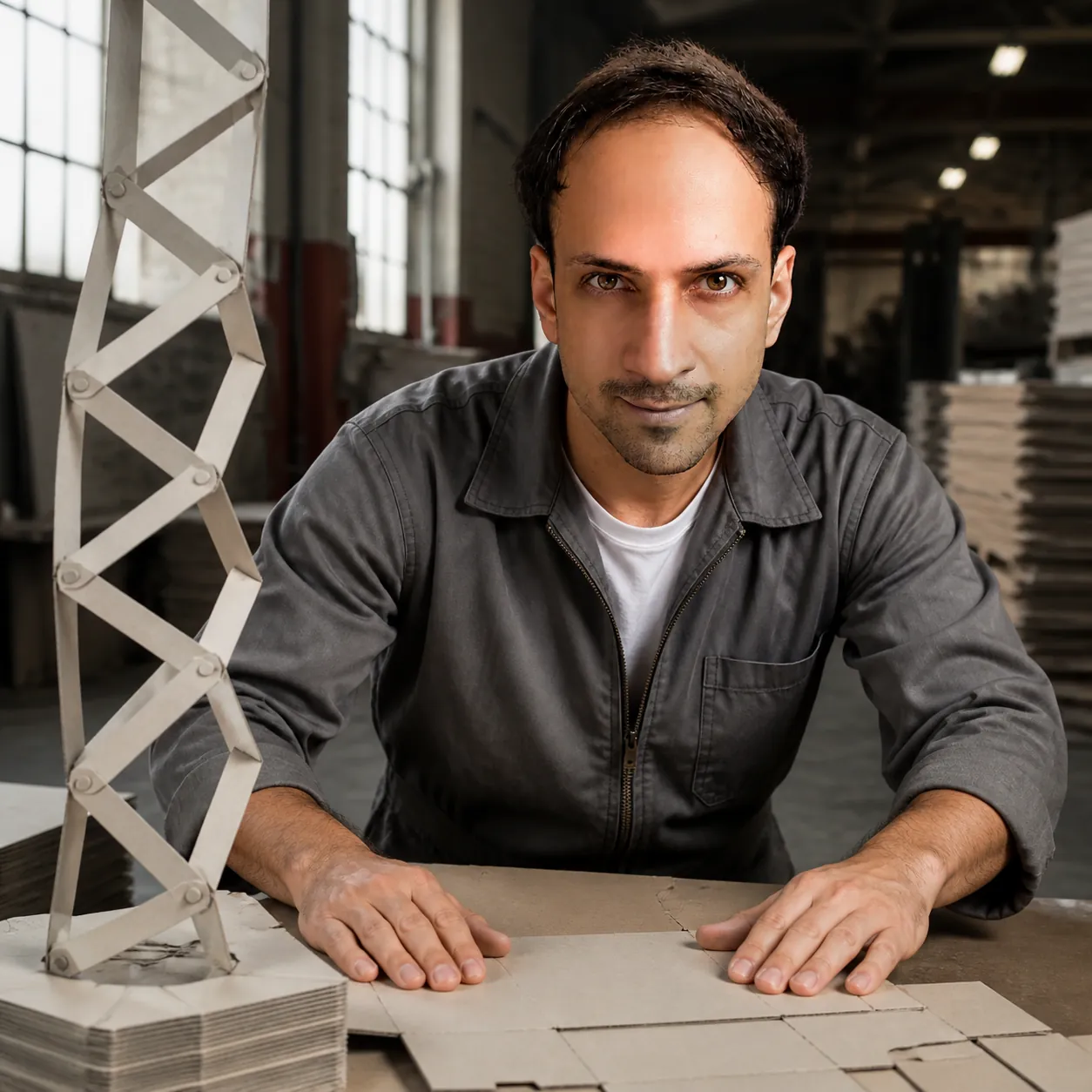
Scissor Tower from a Flat Bundle — AI Portrait Prompt
صورةAI Portraits

Turn your own photo into a high-concept paper-engineering portrait in the quiet end of a carton factory floor between shifts. Keeps your face unchanged.

من نص البرومبت

Use the attached reference photo as the identity reference: keep the same face, skin tone, hair and features as the person in that photo, without beautifying, aging or altering them. Create a square 1:1 museum-catalog frame with a strong first read and a slower second read at exactly 2880x2880 pixels. Location: the quiet end of a carton factory floor between shifts. Show them in a plain grey coverall half-zipped over a clean white tee, flattening one carton blank with a slow two-handed press. The impossible-looking event must obey this clear system: a tower of card struts joined by paper rivets that scissors upward from a flat bundle when its base is squeezed puts work the eye reserves for steel onto material sold by the ream. Explore how one careful score line can teach a sheet to refuse bending; direct expression and posture toward gentle rigor, never melodrama or ad-like confidence. Use a 90mm close-portrait hybrid: one crease edge razor sharp near the lens, their face readable beyond it. Make the composition keep every cut edge sharp while the room softens behind. Render it as high-concept paper-engineering portraiture built from working cut-and-fold structures, documentary realism, gallery-grade craft styling, and physically truthful load behavior, using flat north window light that keeps every crease edge legible and a palette of pale card, graphite, and a narrow band of brick. Photorealistic: this must read as a real photograph from a physical camera, never an illustration, painting, or 3D render. Resolve real surface detail: brass darkened in the recesses and bright where thumbs land, and lacquer crazed rather than perfect. Keep one identity-locked person, credible hands and fingers, natural fabric, and coherent scale, contact, reflections, shadows, airflow, deformation, and materials. Background people only when essential, always secondary and clearly different. Avoid origami cranes, glowing magical paper, floating confetti, printed lettering on sheets, and weightless CGI folds. No text, labels, logos, signatures, watermarks, random symbols, plastic skin, excessive bloom, or glossy AI finish.
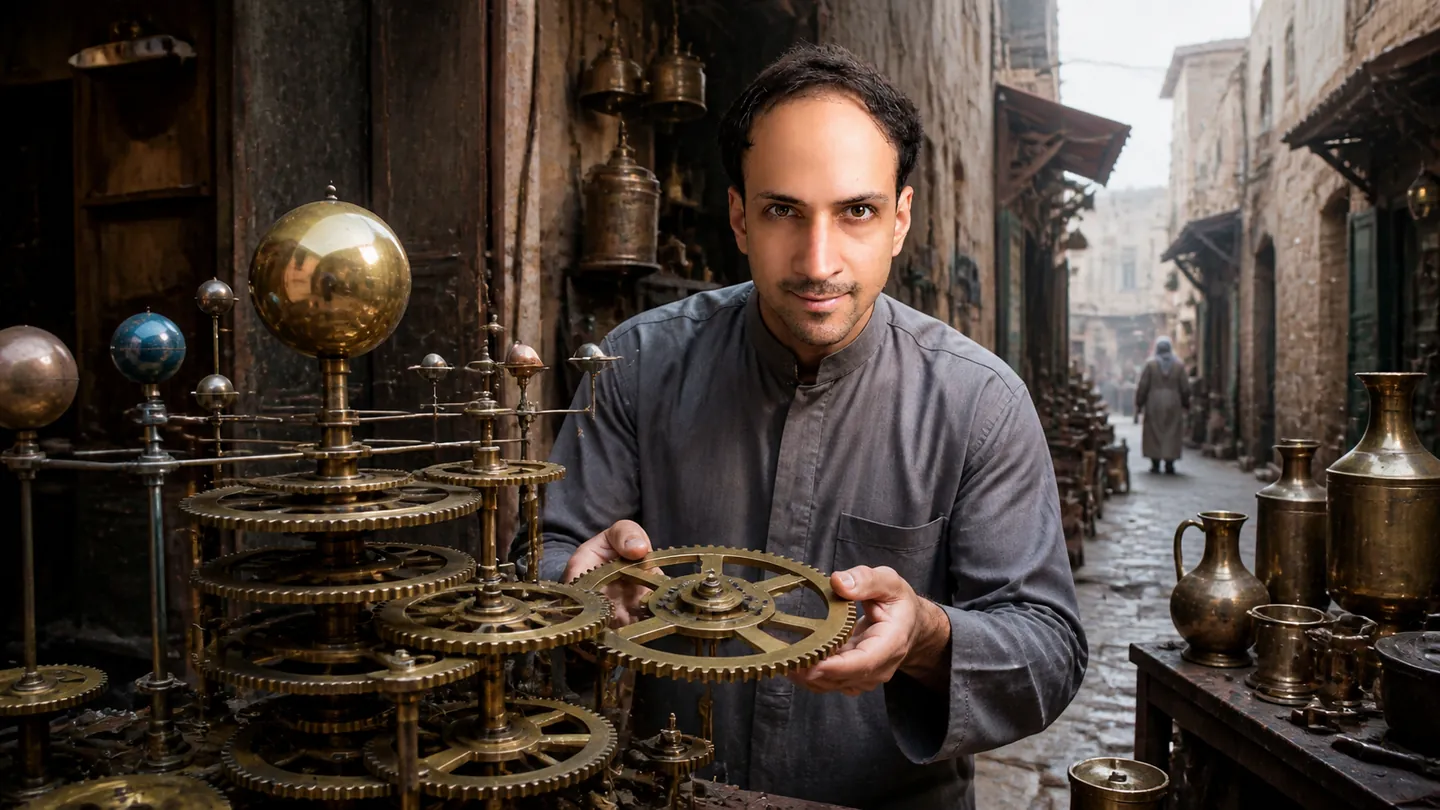
Brass Gear in the Old Souq — AI Portrait Prompt
صورةAI Portraits

Turn your own photo into a museum-grade mechanism portrait in a brass-spinners' lane in an old Riyadh souq at early morning. Keeps your face unchanged.

من نص البرومبت

Use the attached reference photo as the identity reference: keep the same face, skin tone, hair and features as the person in that photo, without beautifying, aging or altering them. Compose a wide 16:9 narrative image where environment and subject carry equal meaning at exactly 3808x2144 pixels. Location: a brass-spinners' lane in an old Riyadh souq at early morning. Show the subject in a plain ash-grey winter traditional Gulf outfit, cuffs turned back once, hefting a heavy gear wheel in both open palms. Use this advanced image-making device as the core logic: a benchtop brass orrery whose stacked gear train holds every planet at tonight's true heliocentric position around a polished central sun runs on a hand's effort alone, no current invited anywhere. Explore why a machine with no memory chips can still remember mathematics perfectly; direct expression and posture toward quiet verification, never melodrama or ad-like confidence. Use a 90mm hybrid view: one machined detail near the lens, their readable face beyond. Make the composition keep every moving part inside the frame except one. Render it as museum-grade mechanism portraiture built from historically accurate analog computers, brushed-brass materiality, honest documentary realism, and quiet patient editorial composition, using diffuse overcast daylight held to gentle contrast so engravings stay legible and a palette of dark slate, oiled bronze, and one chalk-white line. Photorealistic: this must read as a real photograph from a physical camera, never an illustration, painting, or 3D render. Give the space honest scale: real distance between foreground, subject, and far wall. Resolve real surface detail: the difference between a wiped surface and a clean one, faint tide marks on ceramic, and metal dulled unevenly by touch. Keep one identity-locked person, credible hands and fingers, natural fabric, and coherent scale, contact, reflections, shadows, airflow, deformation, and materials. Background people only when essential, always secondary and clearly different. Avoid steampunk goggles, glued-on decorative cogs, glowing holographic overlays, impossible gear meshes, and clock faces. No text, labels, logos, signatures, watermarks, random symbols, plastic skin, excessive bloom, or glossy AI finish.
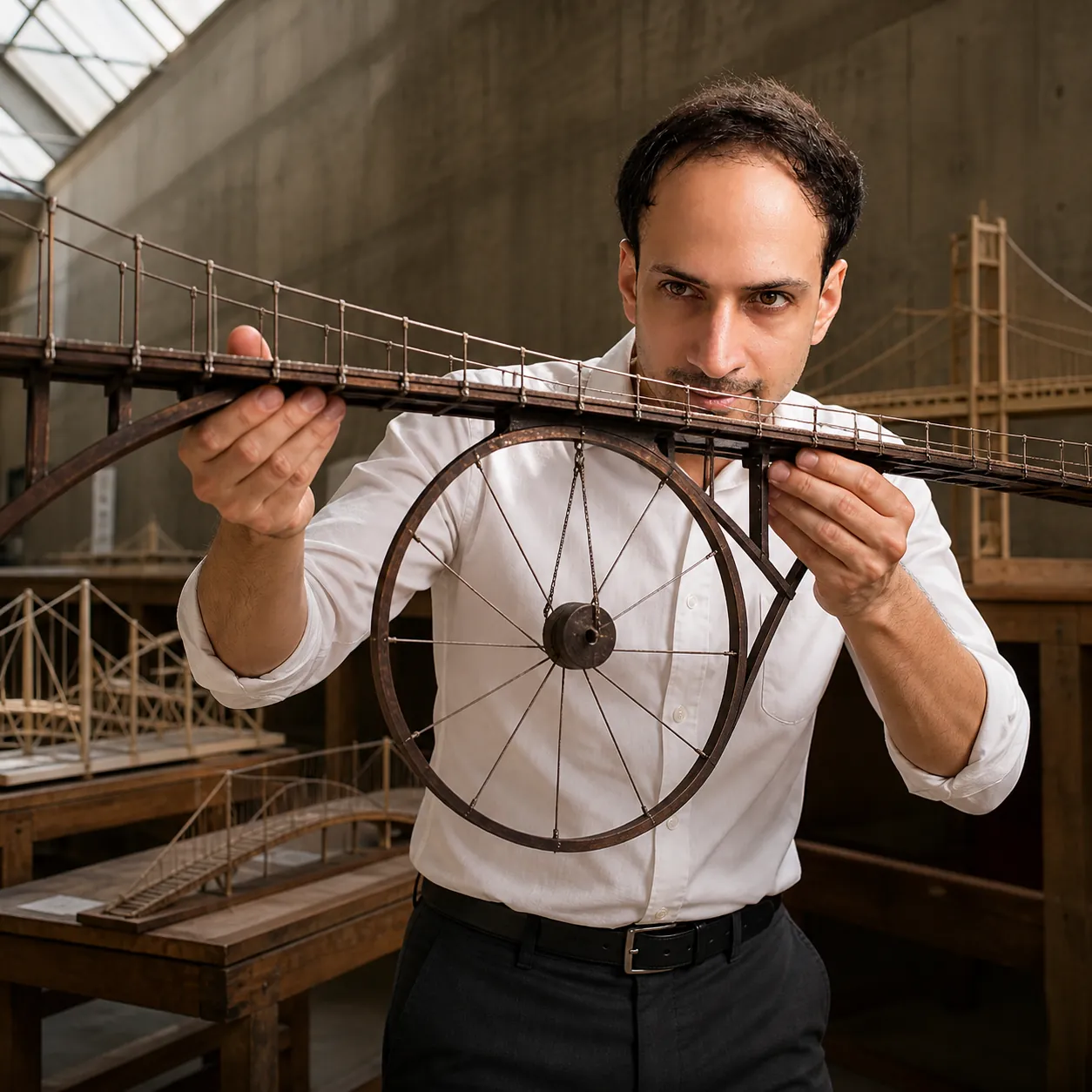
Spokes Among Student Bridges — AI Portrait Prompt
صورةAI Portraits

Turn your own photo into a quiet museum-demonstration portrait in a university engineering hall lined with student bridge models. Keeps your face unchanged.

من نص البرومبت

Use the attached reference photo as the identity reference: keep the same face, skin tone, hair and features as the person in that photo, without beautifying, aging or altering them. Create a square 1:1 museum-catalog frame with a strong first read and a slower second read at exactly 2880x2880 pixels. Location: a university engineering hall lined with student bridge models. Show them in a white dress shirt tucked into charcoal trousers, collar open, tilting one model bridge to sight along its deck. Make one rigorous physical condition the conceptual engine: a spoked wheel under a hung load whose hub hangs from its upper spokes instead of standing on the lower ones replaces the eye's first guess about what holds it with a stranger truth. Explore why a taut line feels more trustworthy than a solid post once understood; direct expression and posture toward steady wonder, never melodrama or ad-like confidence. Use an eye-level 50mm view with honest perspective so every cable angle stays measurably true. Make the composition let one taut line lead the eye to their hands. Render it as quiet museum-demonstration photography combining engineering-model exactness, visible fastener detail, true-to-load cable sag and straightness, and restrained human-scale staging, using diffused skylight from above that leaves thin cables bright against deeper shadow and a palette of warm concrete, dark walnut, and thin steel-cable silver. Photorealistic: this must read as a real photograph from a physical camera, never an illustration, painting, or 3D render. Resolve real surface detail: fine grit in the texture of concrete, efflorescence at damp edges, and hairline cracks that follow stress. Keep one identity-locked person, credible hands and fingers, natural fabric, and coherent scale, contact, reflections, shadows, airflow, deformation, and materials. Background people only when essential, always secondary and clearly different. Avoid floating objects with no visible cables, glowing wires, rubber-looking bent bars, and impossible knots. No text, labels, logos, signatures, watermarks, random symbols, plastic skin, excessive bloom, or glossy AI finish.
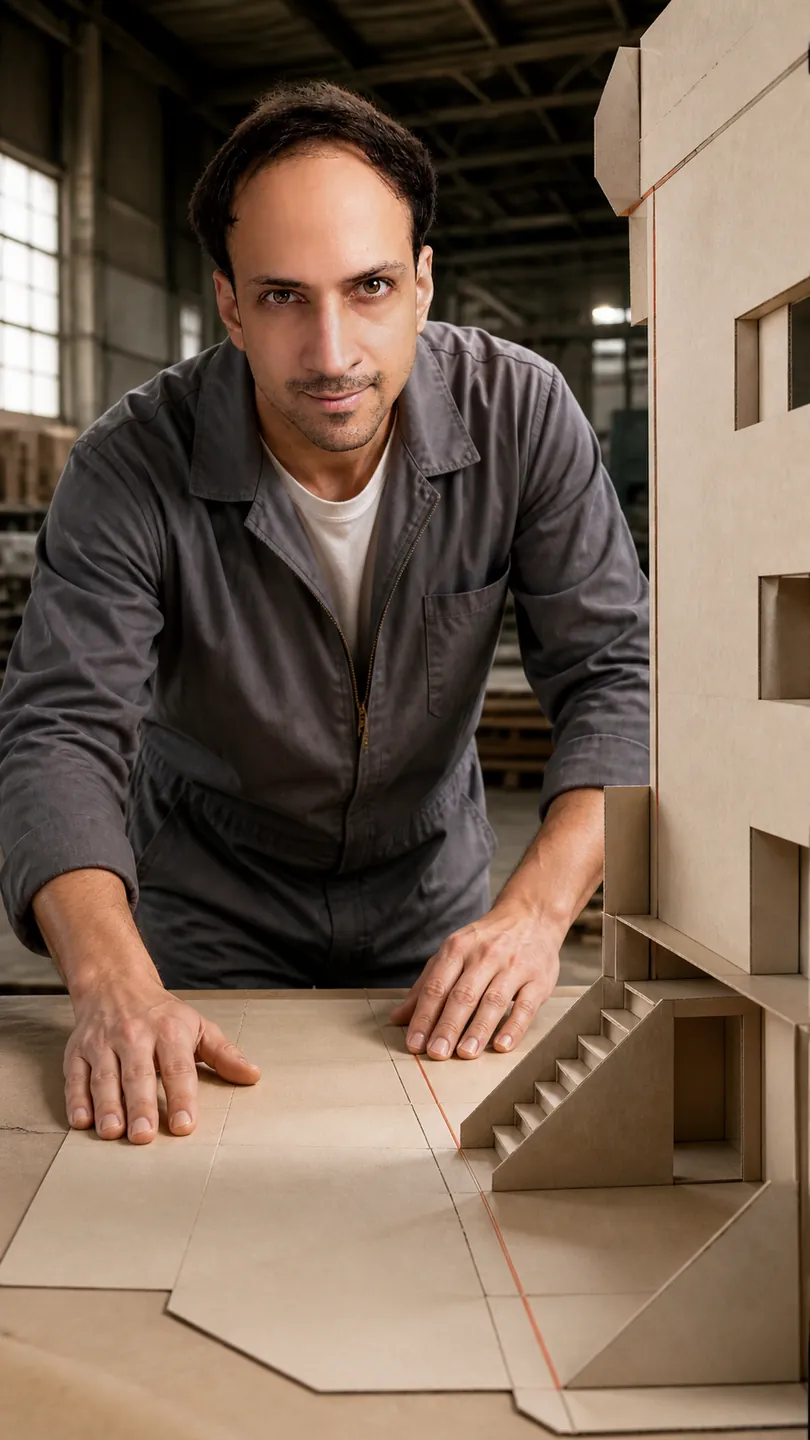
Facade Rising from the Fold — AI Portrait Prompt
صورةAI Portraits

Turn your own photo into a gallery-grade structural still-life portrait in the quiet end of a carton factory floor between shifts. Keeps your face unchanged.

من نص البرومبت

Use the attached reference photo as the identity reference: keep the same face, skin tone, hair and features as the person in that photo, without beautifying, aging or altering them. Design a full-height 9:16 cinematic artwork that reads on a phone and rewards gallery-scale inspection at exactly 2144x3808 pixels. Location: the quiet end of a carton factory floor between shifts. Show the subject in a plain grey coverall half-zipped over a clean white tee, flattening one carton blank with a slow two-handed press. Treat this mechanism as the frame’s governing rule: a courtyard facade that rises fully formed, walls and stair together, as its folded base sheet opens to ninety degrees turns the marks of its making into working structural parts. Explore what it means that an entire building can wait inside a flat sheet; direct expression and posture toward studied wonder, never melodrama or ad-like confidence. Use a 90mm close-portrait hybrid: one crease edge razor sharp near the lens, their face readable beyond it. Make the composition place their hand near the structure without ever touching the load. Render it as gallery-grade structural still-life portraiture built from real folded spans, matte paper materiality, unexaggerated shadow logic, and patient architectural composition, using soft bounced daylight with one deeper shadow pocket beneath the structure and a palette of unbleached kraft, bone white, and one line of vermilion. Photorealistic: this must read as a real photograph from a physical camera, never an illustration, painting, or 3D render. Give the frame volume: faint density deepest in the room, contrast easing at the edges. Resolve real surface detail: dust settled where nobody wipes, fingerprint haze on glass, and edges rubbed pale by handling. Keep one identity-locked person, credible hands and fingers, natural fabric, and coherent scale, contact, reflections, shadows, airflow, deformation, and materials. Background people only when essential, always secondary and clearly different. Avoid greeting-card kitsch, torn-edge scrapbook collage, cartoon pop-up books, and burning paper drama. No text, labels, logos, signatures, watermarks, random symbols, plastic skin, excessive bloom, or glossy AI finish.
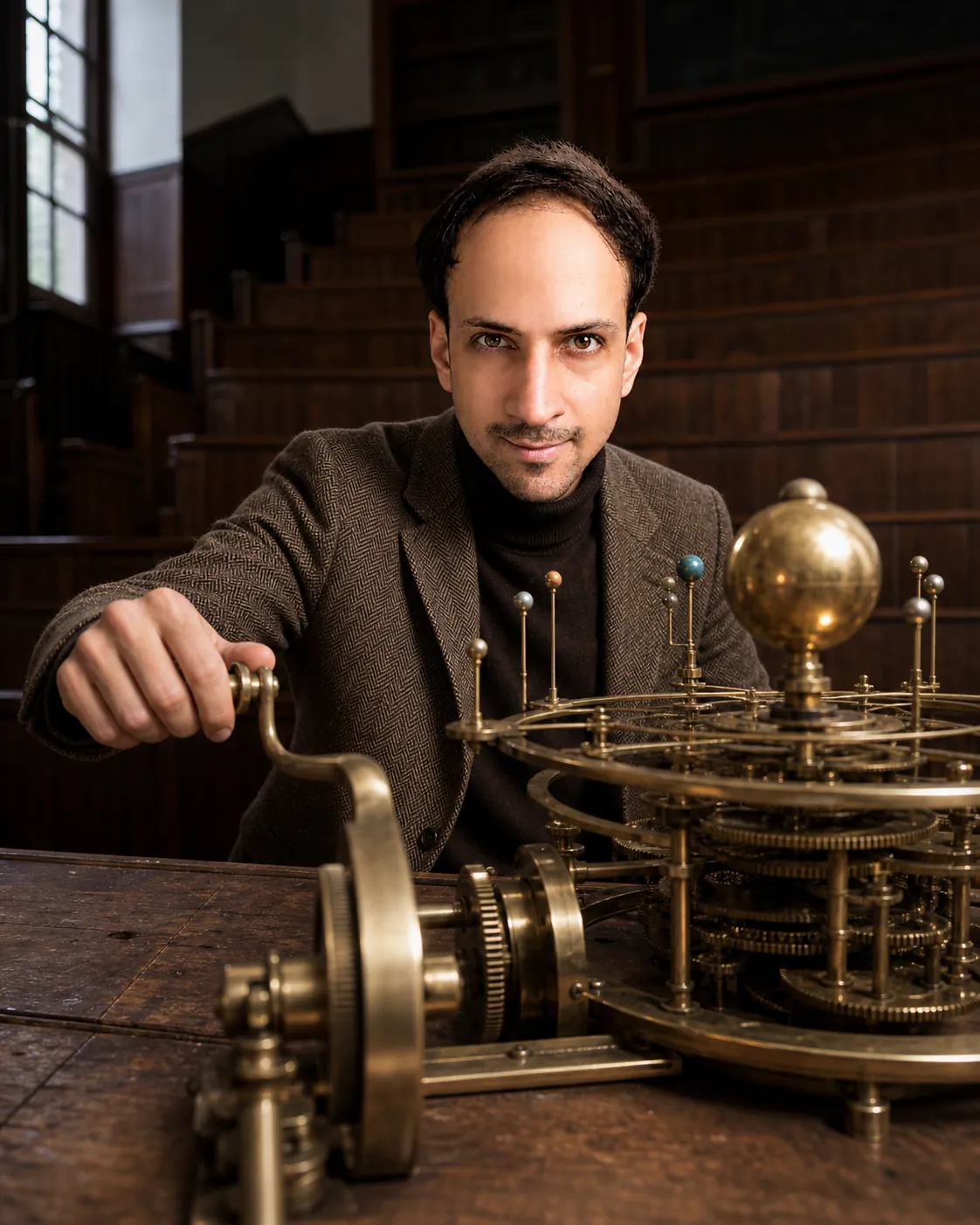
One Slow Revolution — AI Portrait Prompt
صورةAI Portraits

Turn your own photo into a portrait in an old lecture theatre with steep wooden seating and a demonstration bench. Keeps your face unchanged.

من نص البرومبت

Use the attached reference photo as the identity reference: keep the same face, skin tone, hair and features as the person in that photo, without beautifying, aging or altering them. Build a portrait 4:5 editorial artwork with protected negative space and a fully readable face at exactly 2560x3200 pixels. Location: an old lecture theatre with steep wooden seating and a demonstration bench. Show the subject in a brown herringbone jacket over a fine merino roll-neck, turning a demonstration handle one slow full revolution. Build the artwork around this material rule: a benchtop brass orrery whose stacked gear train holds every planet at tonight's true heliocentric position around a polished central sun shows how much of the world reduces to ratio and constrained motion. Explore why a machine with no memory chips can still remember mathematics perfectly; direct expression and posture toward attentive humility, never melodrama or ad-like confidence. Use a 90mm hybrid view: one machined detail near the lens, their readable face beyond. Make the composition keep every moving part inside the frame except one. Render it as gallery-grade technical realism built on lawful mechanism kinematics, precise engraved detail, tactile wood-and-metal textures, and emotionally intelligent portrait lighting, using cool north skylight fill with soft falloff into wood-paneled shadow and a palette of warm umber, pale vellum, and one muted teal accent. Photorealistic: this must read as a real photograph from a physical camera, never an illustration, painting, or 3D render. Resolve real surface detail: fine lint on dark fabric, water spotting on steel, and the soft rounding of edges that have been used for years. Keep one identity-locked person, credible hands and fingers, natural fabric, and coherent scale, contact, reflections, shadows, airflow, deformation, and materials. Background people only when essential, always secondary and clearly different. Avoid steampunk goggles, glued-on decorative cogs, glowing holographic overlays, impossible gear meshes, and clock faces. No text, labels, logos, signatures, watermarks, random symbols, plastic skin, excessive bloom, or glossy AI finish.
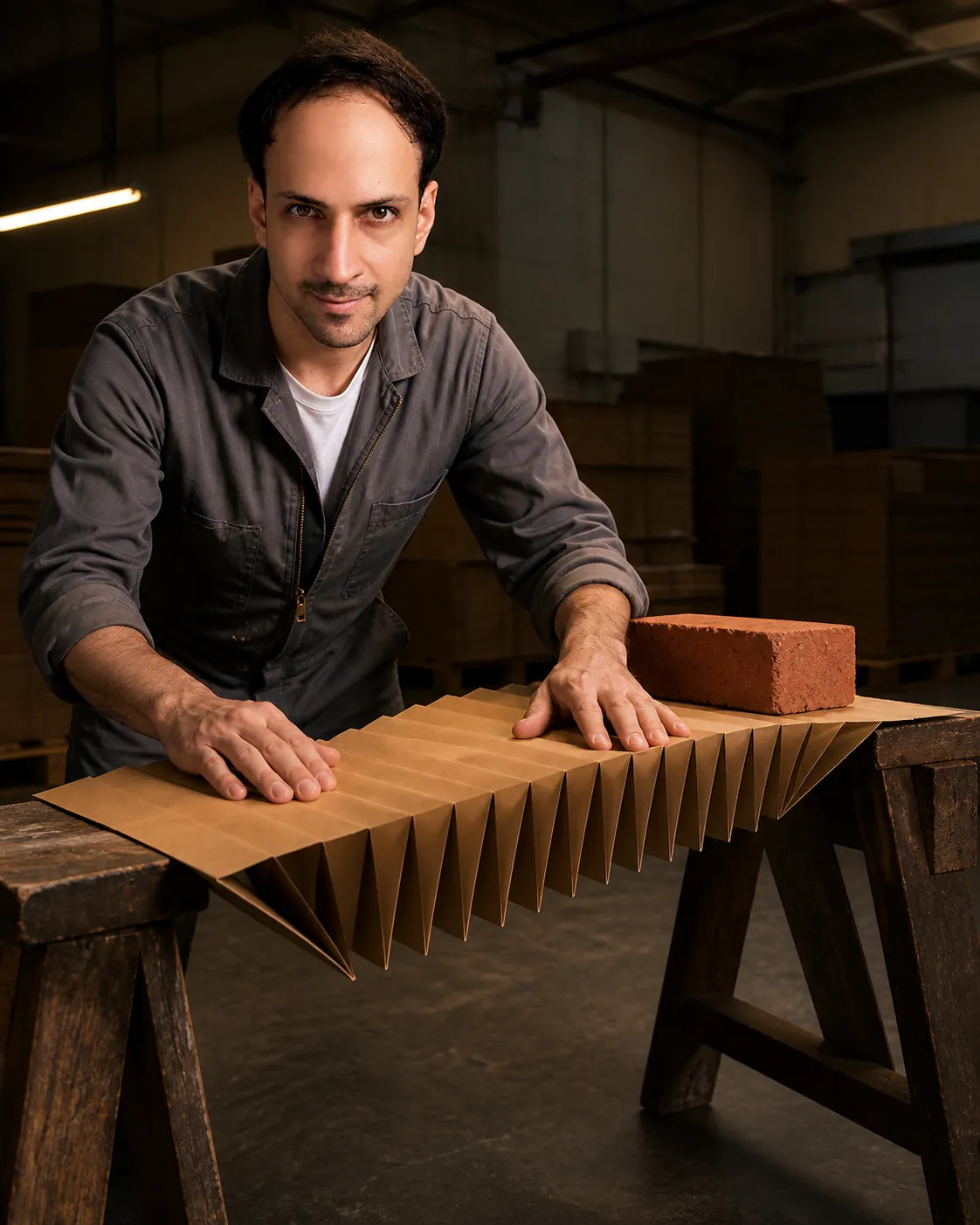
Paper Bridge, Fired Brick — AI Portrait Prompt
صورةAI Portraits

Turn your own photo into a museum-workshop portrait in the quiet end of a carton factory floor between shifts. Keeps your face unchanged.

من نص البرومبت

Use the attached reference photo as the identity reference: keep the same face, skin tone, hair and features as the person in that photo, without beautifying, aging or altering them. Build a portrait 4:5 editorial artwork with protected negative space and a fully readable face at exactly 2560x3200 pixels. Location: the quiet end of a carton factory floor between shifts. Show the subject in a plain grey coverall half-zipped over a clean white tee, flattening one carton blank with a slow two-handed press. The impossible-looking event must obey this clear system: a bridge pleated from one kraft sheet whose deep accordion corrugations span two trestles beneath a single fired brick shows shape doing quietly what the eye expects heavy material to do. Explore why a material that tears between two fingers can be trusted with real weight; direct expression and posture toward sober delight, never melodrama or ad-like confidence. Frame from a low three-quarter angle so the paper structure gains quiet monumentality while their posture stays true. Make the composition keep every cut edge sharp while the room softens behind. Render it as museum-workshop realism combining honest fiber texture, accurate crease shadows, believable deflection under real weight, and restrained editorial lighting, using one low raking lamp that turns each fold into a drawn line and a palette of pale card, graphite, and a narrow band of brick. Photorealistic: this must read as a real photograph from a physical camera, never an illustration, painting, or 3D render. Resolve real surface detail: dust settled where nobody wipes, fingerprint haze on glass, and edges rubbed pale by handling. Keep one identity-locked person, credible hands and fingers, natural fabric, and coherent scale, contact, reflections, shadows, airflow, deformation, and materials. Background people only when essential, always secondary and clearly different. Avoid greeting-card kitsch, torn-edge scrapbook collage, cartoon pop-up books, and burning paper drama. No text, labels, logos, signatures, watermarks, random symbols, plastic skin, excessive bloom, or glossy AI finish.
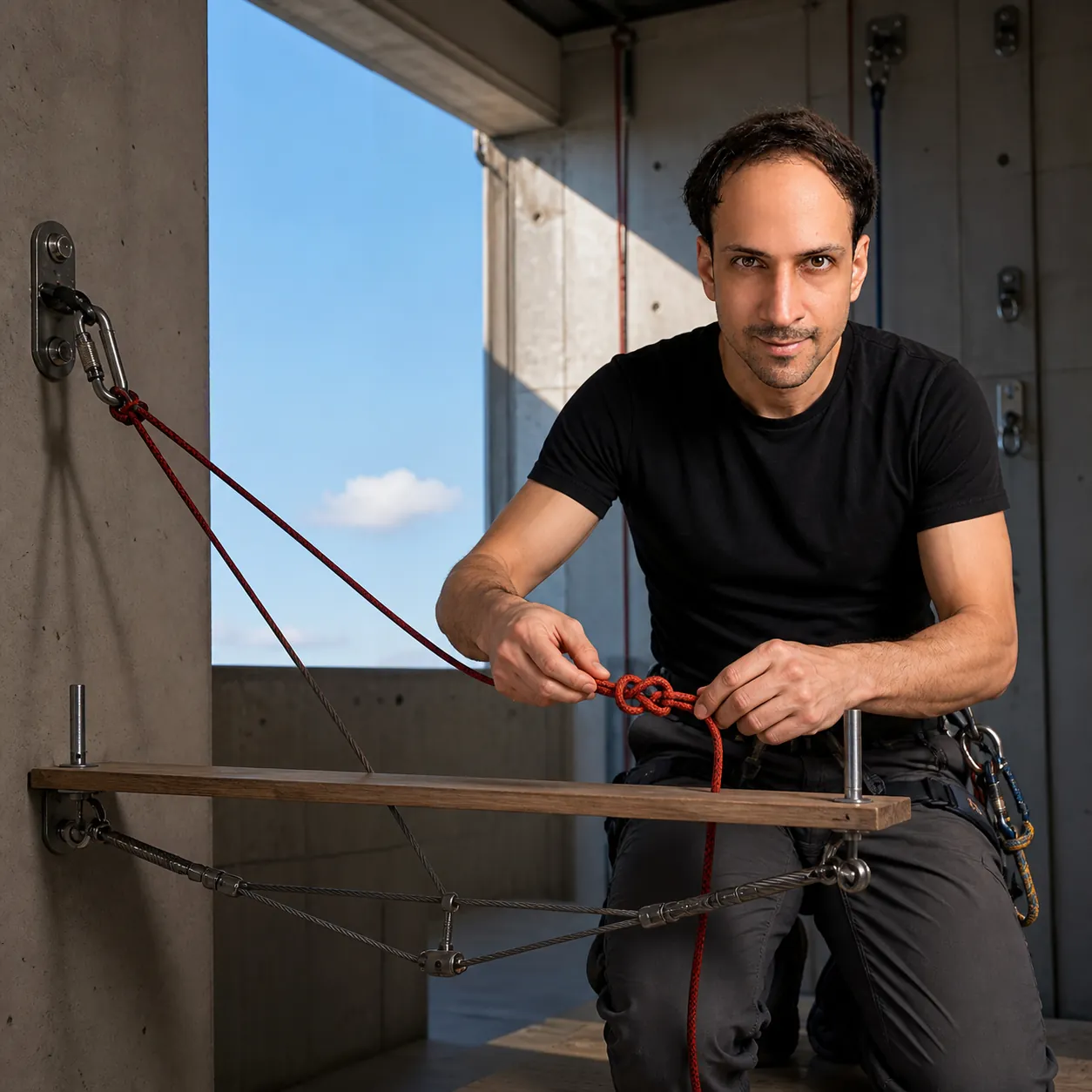
A Shelf Held by Tension — AI Portrait Prompt
صورةAI Portraits

Turn your own photo into an exhibition-grade statics portrait in a rope-access training bay with anchors bolted to a practice wall. Keeps your face unchanged.

من نص البرومبت

Use the attached reference photo as the identity reference: keep the same face, skin tone, hair and features as the person in that photo, without beautifying, aging or altering them. Create a square 1:1 museum-catalog frame with a strong first read and a slower second read at exactly 2880x2880 pixels. Location: a rope-access training bay with anchors bolted to a practice wall. Show them in a fitted black training shirt and grey climbing trousers, dressing a figure-eight knot flat with both thumbs. Build the artwork around this material rule: a thin shelf board that spans far beyond its own strength, kept dead flat by a shallow cable truss beneath replaces the eye's first guess about what holds it with a stranger truth. Explore whether stillness achieved by balanced opposition counts as rest or as work; direct expression and posture toward unhurried scrutiny, never melodrama or ad-like confidence. Frame level with the widest gap in the structure so clear daylight through it sits beside their face. Make the composition let one taut line lead the eye to their hands. Render it as exhibition-grade statics portraiture combining precise rigging detail, physically consistent shadows through open gaps, matte natural materials, and disciplined contemporary art direction, using first blue daylight with one warm tungsten pool held on the work and a palette of gallery white, ash wood, and one taut red cord. Photorealistic: this must read as a real photograph from a physical camera, never an illustration, painting, or 3D render. Resolve real surface detail: label-free packaging showing carton fibre, cardboard bruised at the corners, and tape lifting slightly at one end. Keep one identity-locked person, credible hands and fingers, natural fabric, and coherent scale, contact, reflections, shadows, airflow, deformation, and materials. Background people only when essential, always secondary and clearly different. Avoid floating objects with no visible cables, glowing wires, rubber-looking bent bars, and impossible knots. No text, labels, logos, signatures, watermarks, random symbols, plastic skin, excessive bloom, or glossy AI finish.
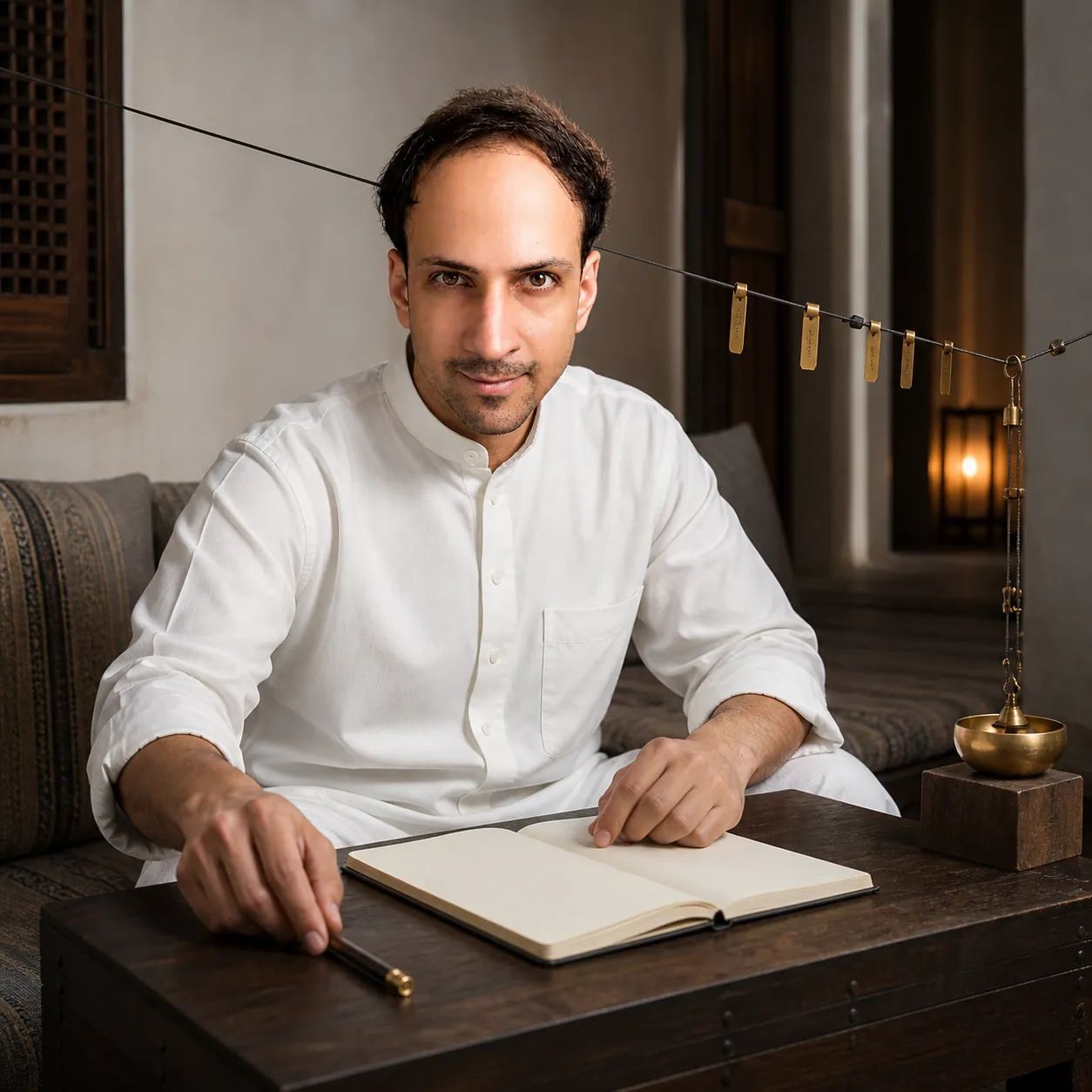
The Finish Bell: Majlis Corner — AI Portrait Prompt
صورةAI Portraits

Turn your own photo into a museum-scale focus portrait in a majlis corner with a low table cleared to one open notebook. Keeps your face unchanged.

من نص البرومبت

Use the attached reference photo as the identity reference: keep the same face, skin tone, hair and features as the person in that photo, without beautifying, aging or altering them. Create a square 1:1 museum-catalog frame with a strong first read and a slower second read. Location: a majlis corner with a low table cleared to one open notebook. Show the subject in a plain white summer traditional Gulf outfit with sleeves folded once, capping a pen and setting it parallel to the notebook. Make one rigorous physical condition the conceptual engine: a taut wire crossing the room on which brass task tags slide down and ring a small bowl bell at the far end makes the backlog merciful by refusing to show it all at once. Explore why endings deserve a sound and what accumulates when they get one; direct expression and posture toward relieved presence, never melodrama or ad-like confidence. Use an eye-level 65mm medium-format viewpoint with natural perspective and restrained depth of field. Make the composition show the retired temptation present but visibly out of reach. Render it as museum-scale focus realism combining high-fidelity portrait photography, truthful single-source light, honest joinery and wiring, and physically accurate mechanisms, using cool early-morning ambient light balanced by one warm practical source and a palette of graphite, unbleached paper, and one brass accent. Keep one identity-locked person, credible hands and fingers, natural fabric, and coherent scale, contact, reflections, shadows, airflow, deformation, and materials. Background people only when essential, always secondary and clearly different. Avoid scattered-papers chaos clichés, head-in-hands despair, wall-of-sticky-notes mania, spiraling doodle overlays, and racing-thought visual metaphors. No text, labels, logos, signatures, watermarks, random symbols, plastic skin, excessive bloom, or glossy AI finish.
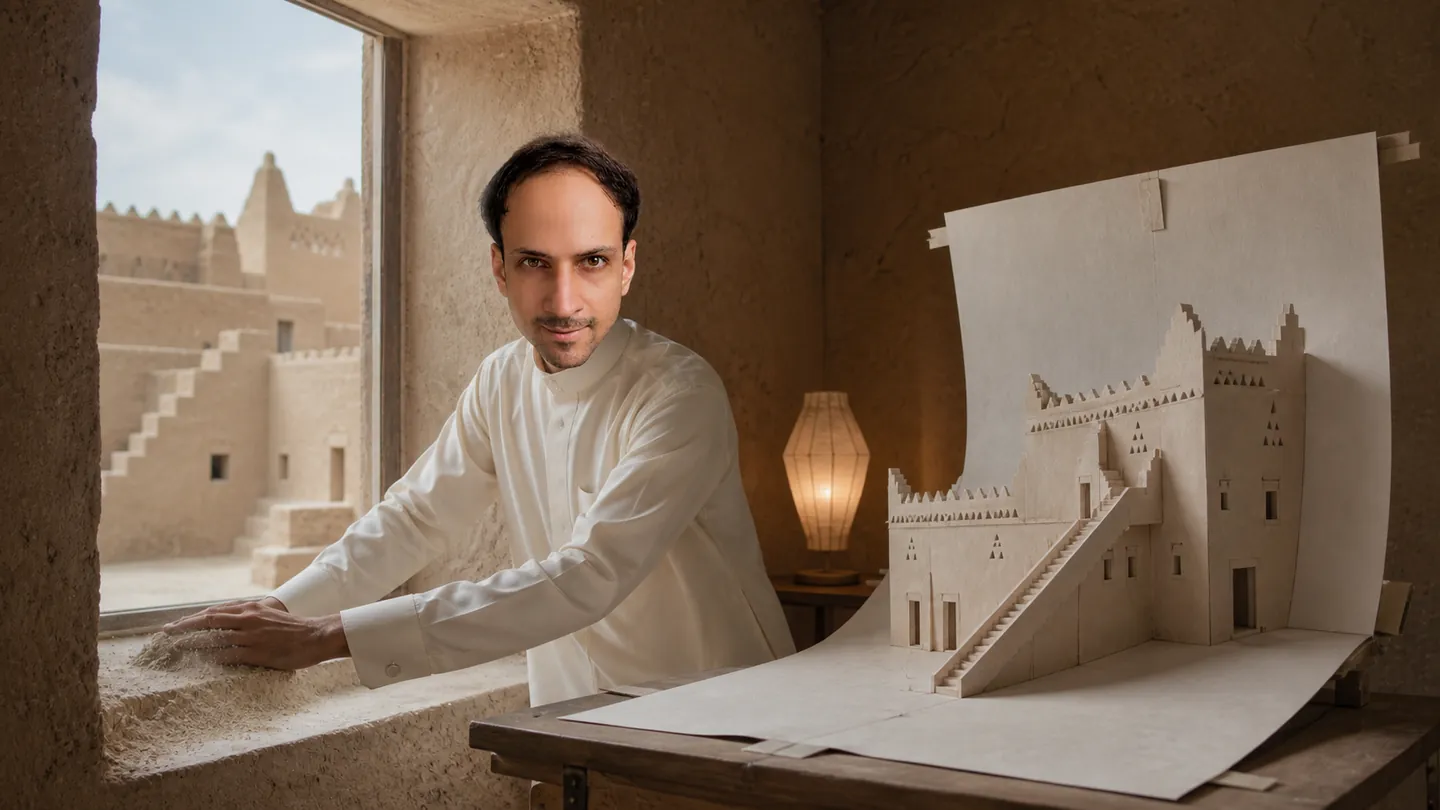
Pop-Up Courtyard in Diriyah — AI Portrait Prompt
صورةAI Portraits

Turn your own photo into a high-concept paper-engineering portrait in a restored mud-brick room in Diriyah with one deep window sill. Keeps your face unchanged.

من نص البرومبت

Use the attached reference photo as the identity reference: keep the same face, skin tone, hair and features as the person in that photo, without beautifying, aging or altering them. Compose a wide 16:9 narrative image where environment and subject carry equal meaning at exactly 3808x2144 pixels. Location: a restored mud-brick room in Diriyah with one deep window sill. Show the subject in a plain ivory traditional Gulf outfit worn without a headdress, cuffs buttoned, sweeping fine dust from the sill with one cupped hand. Build the artwork around this material rule: a courtyard facade that rises fully formed, walls and stair together, as its folded base sheet opens to ninety degrees stands up to demands that look plainly unfair to paper. Explore what it means that an entire building can wait inside a flat sheet; direct expression and posture toward gentle rigor, never melodrama or ad-like confidence. Use an eye-level 58mm medium-format viewpoint with natural perspective and honest paper texture. Make the composition give the load path one clean diagonal from burden to bearing. Render it as high-concept paper-engineering portraiture built from working cut-and-fold structures, documentary realism, gallery-grade craft styling, and physically truthful load behavior, using cool ambient morning light warmed by a single paper-shaded practical and a palette of pale card, graphite, and a narrow band of brick. Photorealistic: this must read as a real photograph from a physical camera, never an illustration, painting, or 3D render. Give truthful depth cues: overlapping planes and shadows softening as they travel. Resolve real surface detail: wood grain read at honest scale, matte and gloss clearly separated, and no surface uniformly clean. Keep one identity-locked person, credible hands and fingers, natural fabric, and coherent scale, contact, reflections, shadows, airflow, deformation, and materials. Background people only when essential, always secondary and clearly different. Avoid origami cranes, glowing magical paper, floating confetti, printed lettering on sheets, and weightless CGI folds. No text, labels, logos, signatures, watermarks, random symbols, plastic skin, excessive bloom, or glossy AI finish.
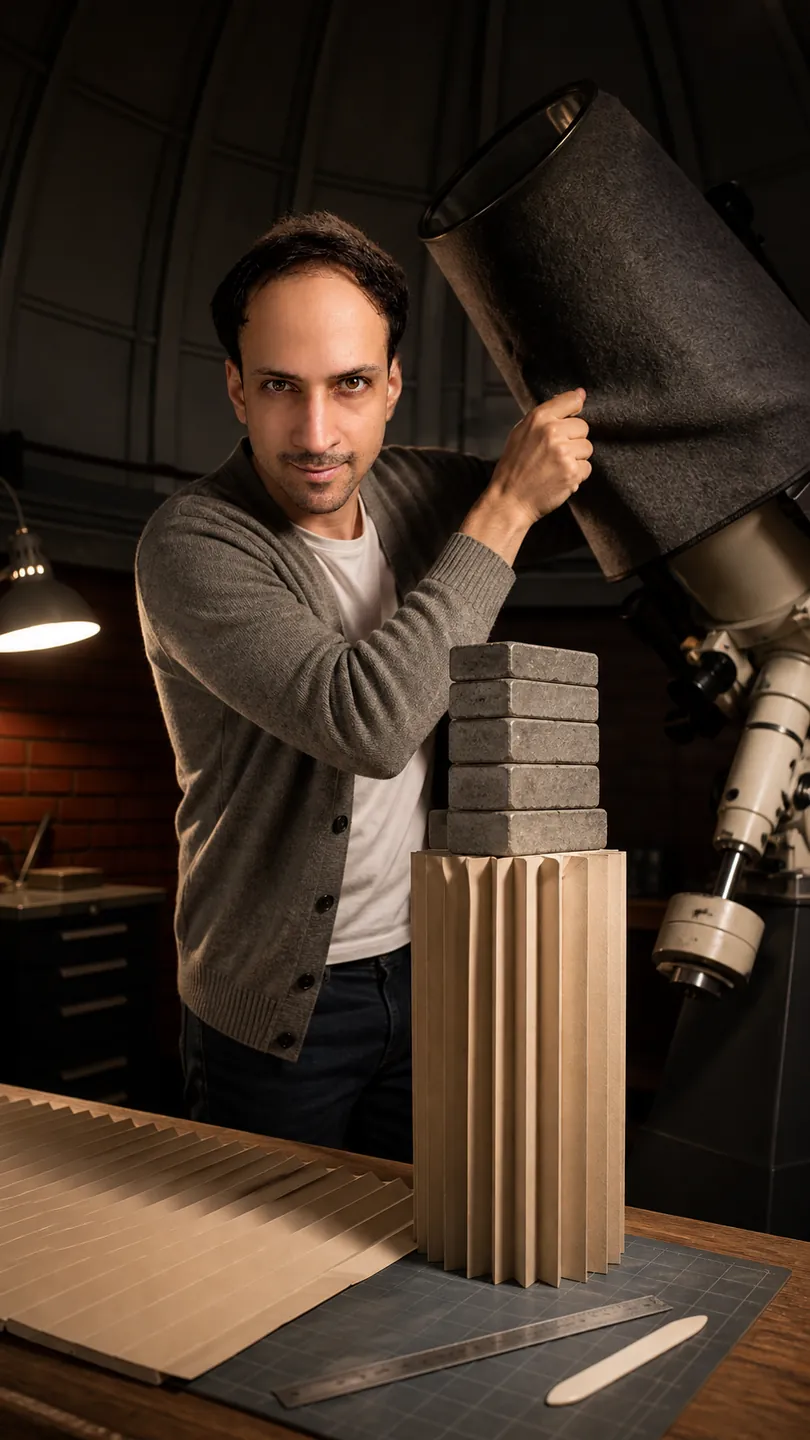
Paper Column Under the Dome — AI Portrait Prompt
صورةAI Portraits

Turn your own photo into a museum-workshop portrait in a small university observatory with its dome slit closed for daylight. Keeps your face unchanged.

من نص البرومبت

Use the attached reference photo as the identity reference: keep the same face, skin tone, hair and features as the person in that photo, without beautifying, aging or altering them. Design a full-height 9:16 cinematic artwork that reads on a phone and rewards gallery-scale inspection at exactly 2144x3808 pixels. Location: a small university observatory with its dome slit closed for daylight. Show the subject in a heather-grey cardigan over a white crew-neck and dark denim, fitting the felt-lined cover over the telescope tube. Treat this mechanism as the frame’s governing rule: a slender kraft column pleated into crisp vertical flutes that carries a knee-high stack of concrete blocks without flexing lets a straightedge and a bone folder stand in for a foundry. Explore how a fold multiplies strength without adding a single gram of material; direct expression and posture toward patient exactness, never melodrama or ad-like confidence. Use a 90mm close-portrait hybrid: one crease edge razor sharp near the lens, their face readable beyond it. Make the composition place their hand near the structure without ever touching the load. Render it as museum-workshop realism combining honest fiber texture, accurate crease shadows, believable deflection under real weight, and restrained editorial lighting, using one low raking lamp that turns each fold into a drawn line and a palette of pale card, graphite, and a narrow band of brick. Photorealistic: this must read as a real photograph from a physical camera, never an illustration, painting, or 3D render. Give the frame volume: faint density deepest in the room, contrast easing at the edges. Resolve real surface detail: label-free packaging showing carton fibre, cardboard bruised at the corners, and tape lifting slightly at one end. Keep one identity-locked person, credible hands and fingers, natural fabric, and coherent scale, contact, reflections, shadows, airflow, deformation, and materials. Background people only when essential, always secondary and clearly different. Avoid origami cranes, glowing magical paper, floating confetti, printed lettering on sheets, and weightless CGI folds. No text, labels, logos, signatures, watermarks, random symbols, plastic skin, excessive bloom, or glossy AI finish.
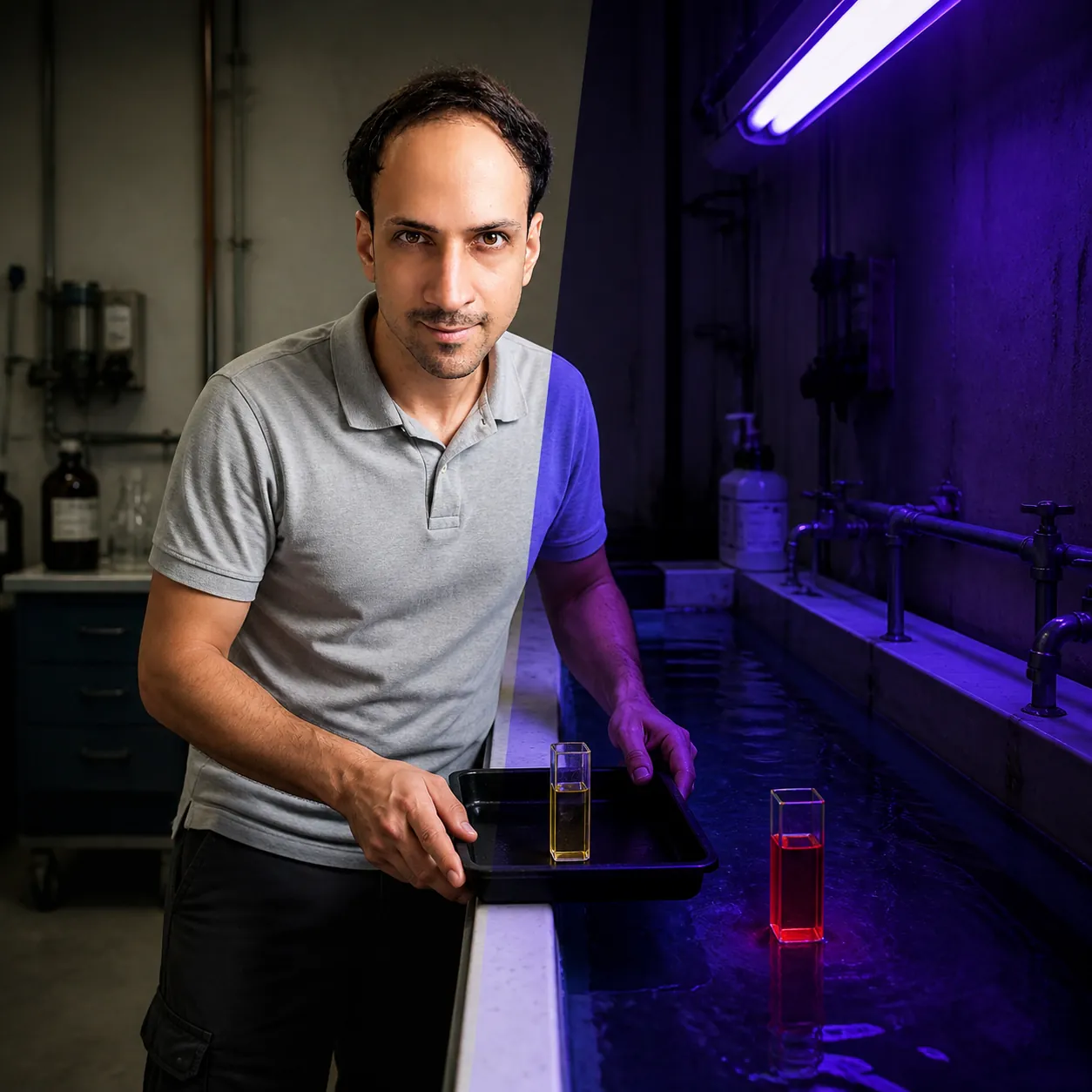
Olive Oil Turns Red — AI Portrait Prompt
صورةAI Portraits

Turn your own photo into a portrait in a municipal water-testing station with one long white sampling sink. Keeps your face unchanged.

من نص البرومبت

Use the attached reference photo as the identity reference: keep the same face, skin tone, hair and features as the person in that photo, without beautifying, aging or altering them. Create a square 1:1 museum-catalog frame with a strong first read and a slower second read at exactly 2880x2880 pixels. Location: a municipal water-testing station with one long white sampling sink. Show them in a pale grey polo shirt and dark utility trousers, setting a black tray square to the sink rim. Make one rigorous physical condition the conceptual engine: a thin glass cell of fresh-pressed olive oil whose chlorophyll answers ultraviolet with deep red light instead of the green it looks divides one honest frame into an ordinary half and a luminous half. Explore why the eye's narrow window has always felt like the whole world; direct expression and posture toward sober delight, never melodrama or ad-like confidence. Use an eye-level 55mm viewpoint with natural perspective and shadows kept open enough to read their face. Make the composition give the ordinary half as much space as the luminous half. Render it as high-fidelity fluorescence portraiture built from real emission behavior, documentary color accuracy, museum specimen staging, and emotionally restrained composition, using cool ultraviolet from above the frame with enough bounce to keep faces readable and a palette of charcoal, bone grey, and one band of mineral orange. Photorealistic: this must read as a real photograph from a physical camera, never an illustration, painting, or 3D render. Resolve real surface detail: the difference between a wiped surface and a clean one, faint tide marks on ceramic, and metal dulled unevenly by touch. Keep one identity-locked person, credible hands and fingers, natural fabric, and coherent scale, contact, reflections, shadows, airflow, deformation, and materials. Background people only when essential, always secondary and clearly different. Avoid blacklight-party glow, neon signage, glowing body paint, radioactive-green fog, and cartoon toxic-waste barrels. No text, labels, logos, signatures, watermarks, random symbols, plastic skin, excessive bloom, or glossy AI finish.
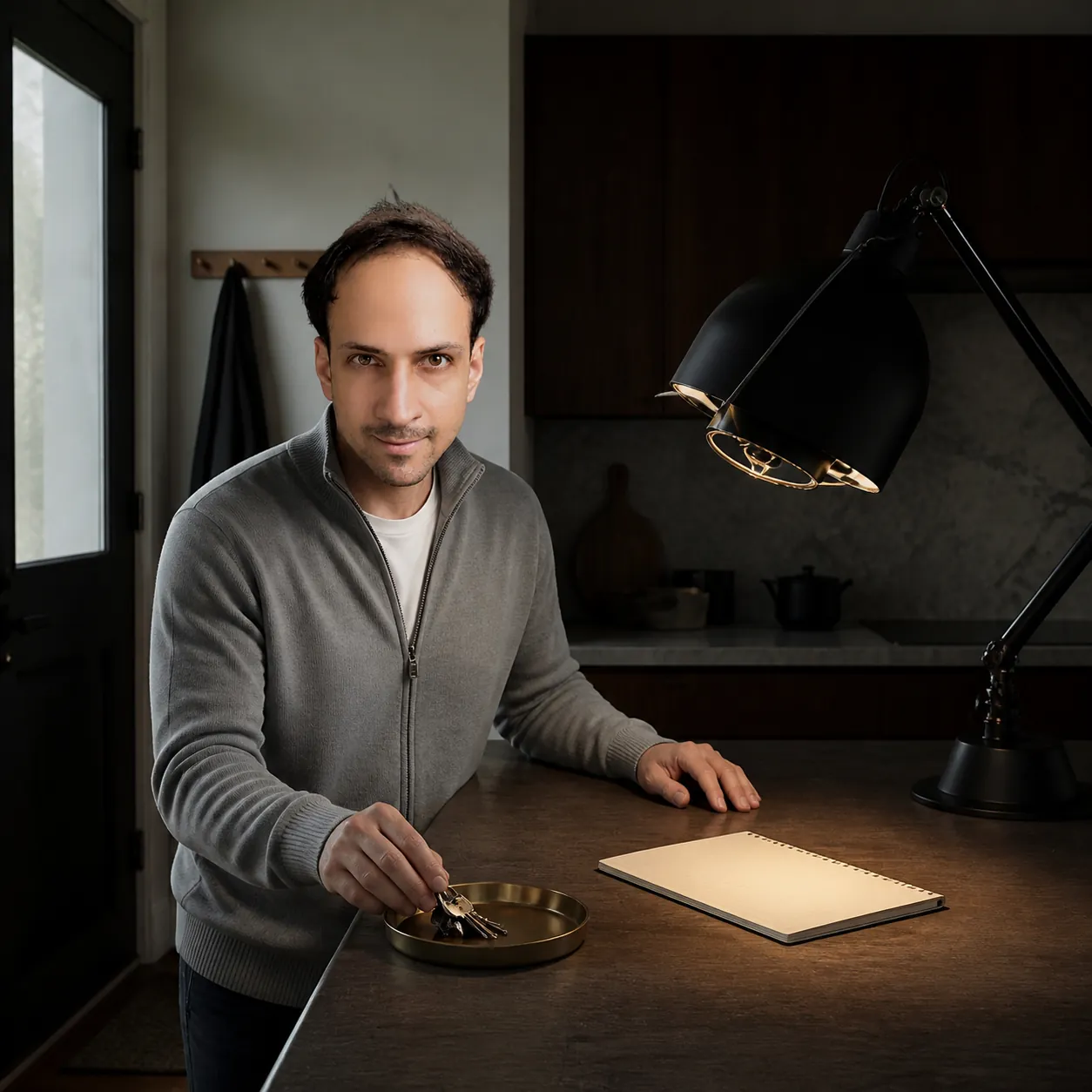
Attention's Architecture: Kitchen Counter Arranged — AI Portrait Prompt
صورةAI Portraits

Turn your own photo into a conceptual attention portrait in a kitchen counter arranged as tomorrow's launchpad by the door. Keeps your face unchanged.

من نص البرومبت

Use the attached reference photo as the identity reference: keep the same face, skin tone, hair and features as the person in that photo, without beautifying, aging or altering them. Create a square 1:1 museum-catalog frame with a strong first read and a slower second read. Location: a kitchen counter arranged as tomorrow's launchpad by the door. Show the subject in a soft grey zip cardigan over a white crew-neck, placing keys into a shallow brass tray. Build the artwork around this material rule: a desk lamp fitted with a physical iris diaphragm narrowed until light falls on one page and nothing else grants every ending a small, physical arrival instead of silence. Explore how much world one page needs when the rest goes unlit; direct expression and posture toward steady self-possession, never melodrama or ad-like confidence. Use a measured wide 28mm view with the subject near one-third of the frame and no stretched limbs. Make the composition hold generous empty space where the clutter used to live. Render it as conceptual attention portraiture combining tactile time-keeping architecture, restrained contemporary art direction, believable devices, and human-centered editorial realism, using soft north-facing daylight with restrained contrast and visible skin texture and a palette of walnut, slate, and one small field of lamp amber. Keep one identity-locked person, credible hands and fingers, natural fabric, and coherent scale, contact, reflections, shadows, airflow, deformation, and materials. Background people only when essential, always secondary and clearly different. Avoid productivity-app screens, pomodoro-branded props, motivational posters, bullet-journal styling spreads, and pill-bottle imagery. No text, labels, logos, signatures, watermarks, random symbols, plastic skin, excessive bloom, or glossy AI finish.
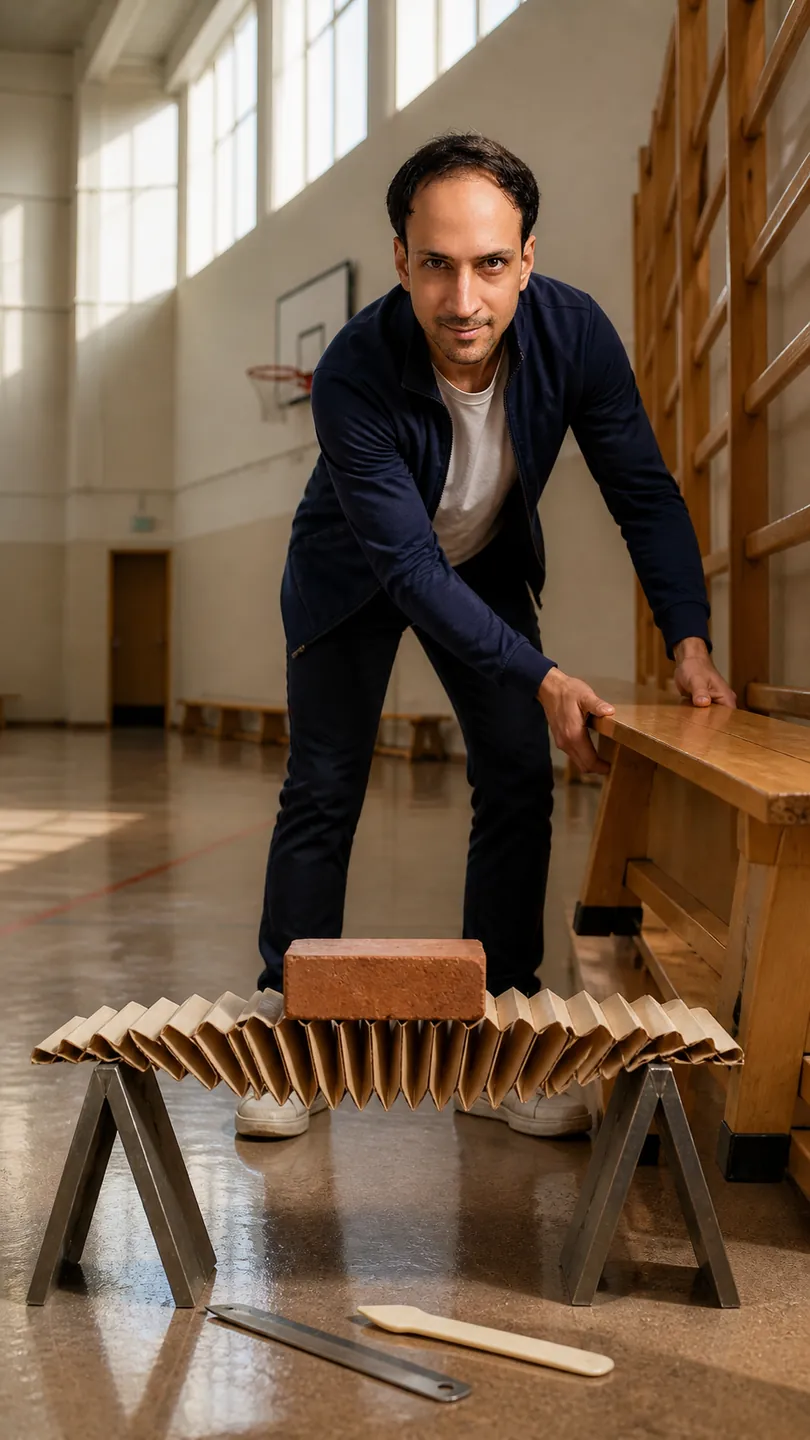
Morning in the Empty Hall — AI Portrait Prompt
صورةAI Portraits

Turn your own photo into a museum-workshop portrait in an empty school sports hall under high morning windows. Keeps your face unchanged.

من نص البرومبت

Use the attached reference photo as the identity reference: keep the same face, skin tone, hair and features as the person in that photo, without beautifying, aging or altering them. Design a full-height 9:16 cinematic artwork that reads on a phone and rewards gallery-scale inspection at exactly 2144x3808 pixels. Location: an empty school sports hall under high morning windows. Show the subject in a zip-through navy track jacket over a plain white shirt, unstacking one low bench from the wall line. Make one rigorous physical condition the conceptual engine: a bridge pleated from one kraft sheet whose deep accordion corrugations span two trestles beneath a single fired brick lets a straightedge and a bone folder stand in for a foundry. Explore why a material that tears between two fingers can be trusted with real weight; direct expression and posture toward gentle rigor, never melodrama or ad-like confidence. Frame from a low three-quarter angle so the paper structure gains quiet monumentality while their posture stays true. Make the composition keep every cut edge sharp while the room softens behind. Render it as museum-workshop realism combining honest fiber texture, accurate crease shadows, believable deflection under real weight, and restrained editorial lighting, using even overhead workroom light shaped so white surfaces hold visible tone steps and a palette of unbleached kraft, bone white, and one line of vermilion. Photorealistic: this must read as a real photograph from a physical camera, never an illustration, painting, or 3D render. Give the space honest scale: real distance between foreground, subject, and far wall. Resolve real surface detail: glass with real thickness at its edge, reflections that carry the room's actual colour, and dust visible only at grazing angles. Keep one identity-locked person, credible hands and fingers, natural fabric, and coherent scale, contact, reflections, shadows, airflow, deformation, and materials. Background people only when essential, always secondary and clearly different. Avoid origami cranes, glowing magical paper, floating confetti, printed lettering on sheets, and weightless CGI folds. No text, labels, logos, signatures, watermarks, random symbols, plastic skin, excessive bloom, or glossy AI finish.
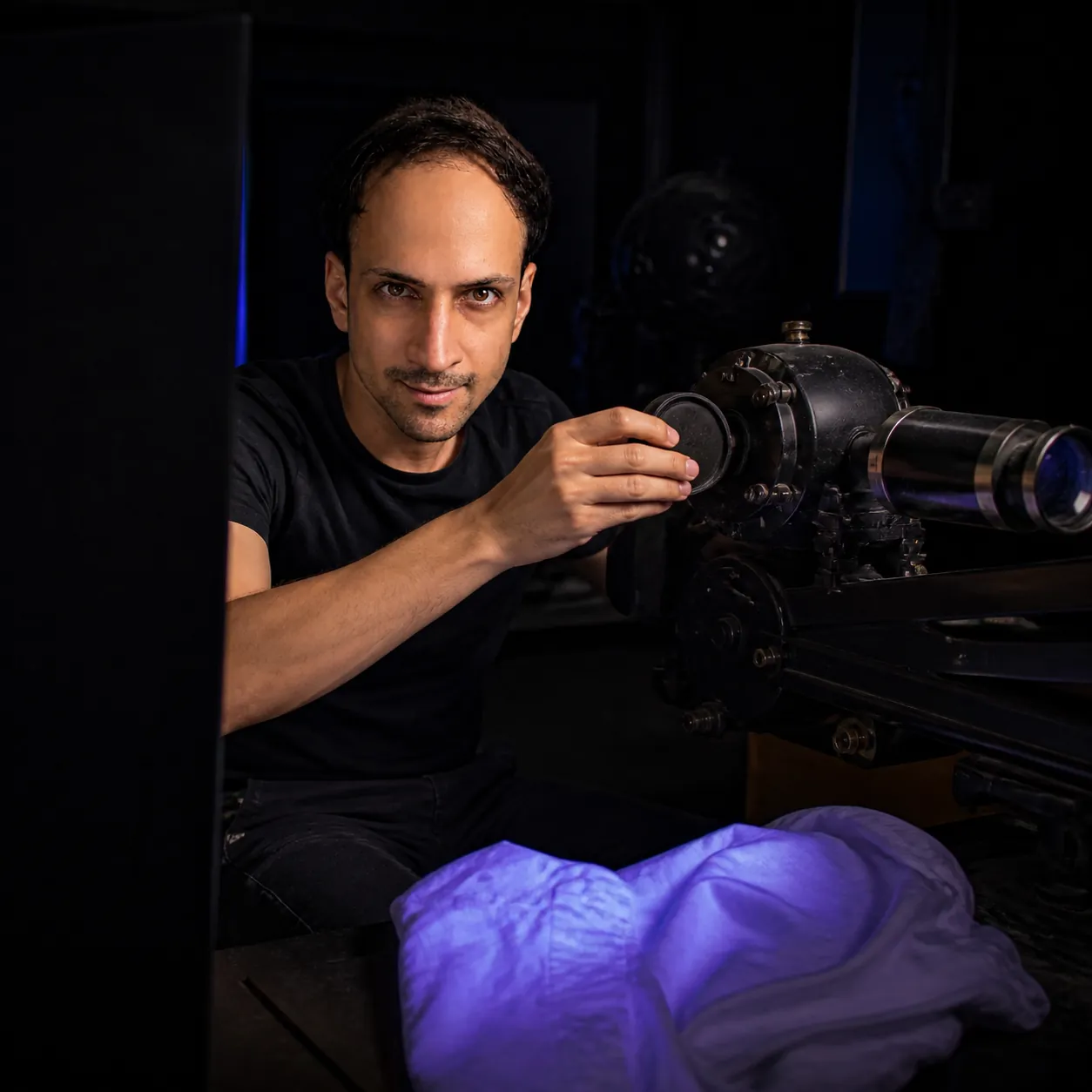
A Shirt That Glows Violet — AI Portrait Prompt
صورةAI Portraits

Turn your own photo into a museum demonstration portrait in the back workshop of a small planetarium with the dome lights doused. Keeps your face unchanged.

من نص البرومبت

Use the attached reference photo as the identity reference: keep the same face, skin tone, hair and features as the person in that photo, without beautifying, aging or altering them. Create a square 1:1 museum-catalog frame with a strong first read and a slower second read at exactly 2880x2880 pixels. Location: the back workshop of a small planetarium with the dome lights doused. Show them in a black cotton crew-neck and dark straight-leg work trousers, seating a lens cap onto a parked projector arm. Use this advanced image-making device as the core logic: a folded white shirt whose fibers flare cold violet under ultraviolet, since the dye that makes cotton read as white also glows takes its second color from light nobody in the room can see. Explore what honesty requires when one object has two equally true appearances; direct expression and posture toward cool fascination, never melodrama or ad-like confidence. Frame past a matte black card at the frame's edge, physical but never crossing their face. Make the composition keep the emitting detail sharpest while the room stays quietly dim. Render it as museum demonstration realism combining honest low-light photography, spectrally plausible glow, plain material texture, and unhurried human presence in frame, using cool ultraviolet from above the frame with enough bounce to keep faces readable and a palette of unbleached linen, umber, and one stripe of quinine blue. Photorealistic: this must read as a real photograph from a physical camera, never an illustration, painting, or 3D render. Resolve real surface detail: thread ends and slight pilling on worn cloth, hairline chips at every hard corner, and stone that is porous rather than smooth. Keep one identity-locked person, credible hands and fingers, natural fabric, and coherent scale, contact, reflections, shadows, airflow, deformation, and materials. Background people only when essential, always secondary and clearly different. Avoid rave lighting rigs, uniform purple haze, CGI bioluminescent forests, and glowing eyes. No text, labels, logos, signatures, watermarks, random symbols, plastic skin, excessive bloom, or glossy AI finish.
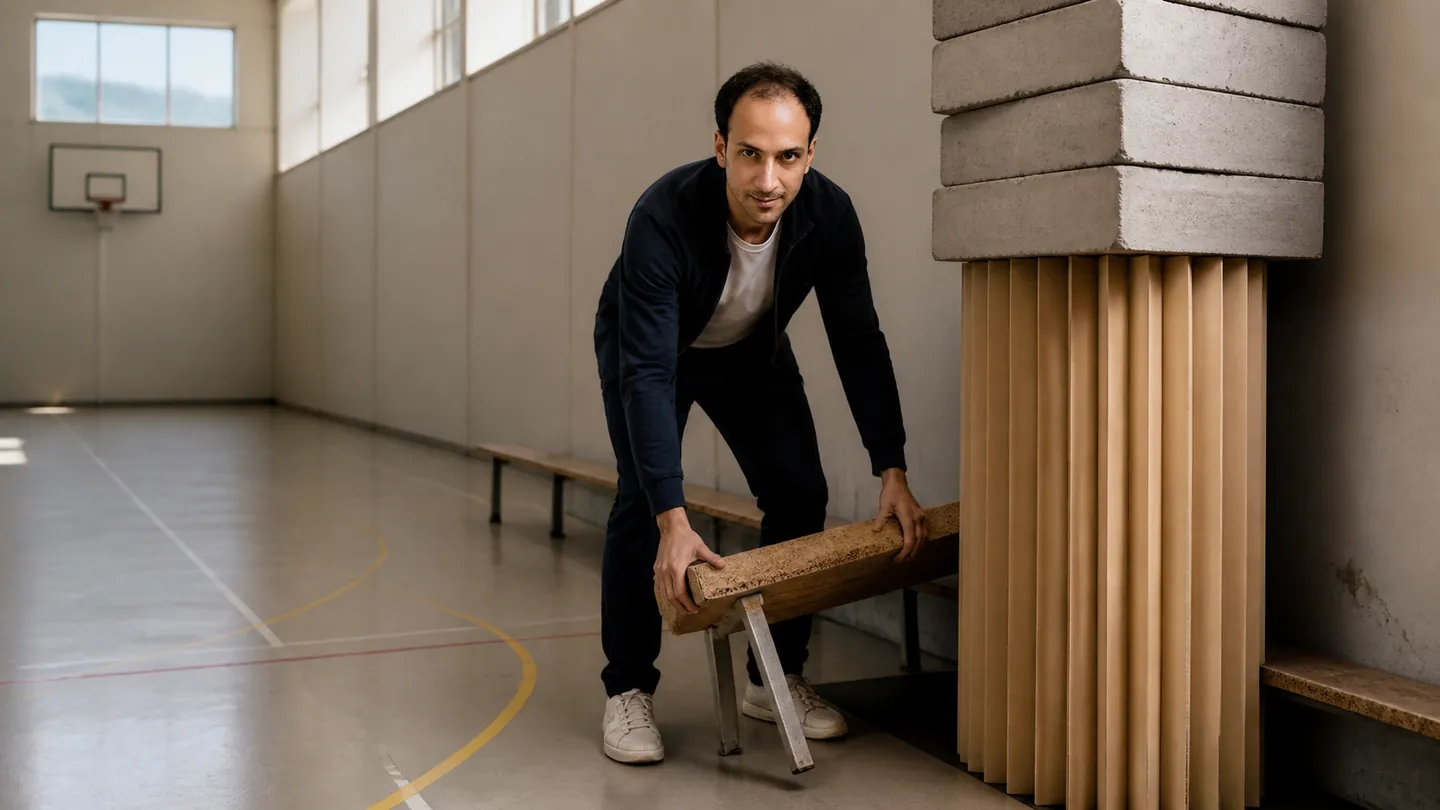
Fluted Paper in the Sports Hall — AI Portrait Prompt
صورةAI Portraits

Turn your own photo into a conceptual maker-bench portrait in an empty school sports hall under high morning windows. Keeps your face unchanged.

من نص البرومبت

Use the attached reference photo as the identity reference: keep the same face, skin tone, hair and features as the person in that photo, without beautifying, aging or altering them. Compose a wide 16:9 narrative image where environment and subject carry equal meaning at exactly 3808x2144 pixels. Location: an empty school sports hall under high morning windows. Show the subject in a zip-through navy track jacket over a plain white shirt, unstacking one low bench from the wall line. Build the artwork around this material rule: a slender kraft column pleated into crisp vertical flutes that carries a knee-high stack of concrete blocks without flexing makes its whole working structure legible, every member thin enough to read. Explore how a fold multiplies strength without adding a single gram of material; direct expression and posture toward sober delight, never melodrama or ad-like confidence. Use an eye-level 58mm medium-format viewpoint with natural perspective and honest paper texture. Make the composition give the load path one clean diagonal from burden to bearing. Render it as conceptual maker-bench photography uniting tactile card mechanisms, precise score-line detail, quiet contemporary art direction, and human-centered observational framing, using soft bounced daylight with one deeper shadow pocket beneath the structure and a palette of museum-board grey, soft ivory, and a single ochre accent. Photorealistic: this must read as a real photograph from a physical camera, never an illustration, painting, or 3D render. Give truthful depth cues: overlapping planes and shadows softening as they travel. Resolve real surface detail: rubber gone chalky with age, painted metal chipped to primer, and plastic yellowed only where light reaches it. Keep one identity-locked person, credible hands and fingers, natural fabric, and coherent scale, contact, reflections, shadows, airflow, deformation, and materials. Background people only when essential, always secondary and clearly different. Avoid greeting-card kitsch, torn-edge scrapbook collage, cartoon pop-up books, and burning paper drama. No text, labels, logos, signatures, watermarks, random symbols, plastic skin, excessive bloom, or glossy AI finish.
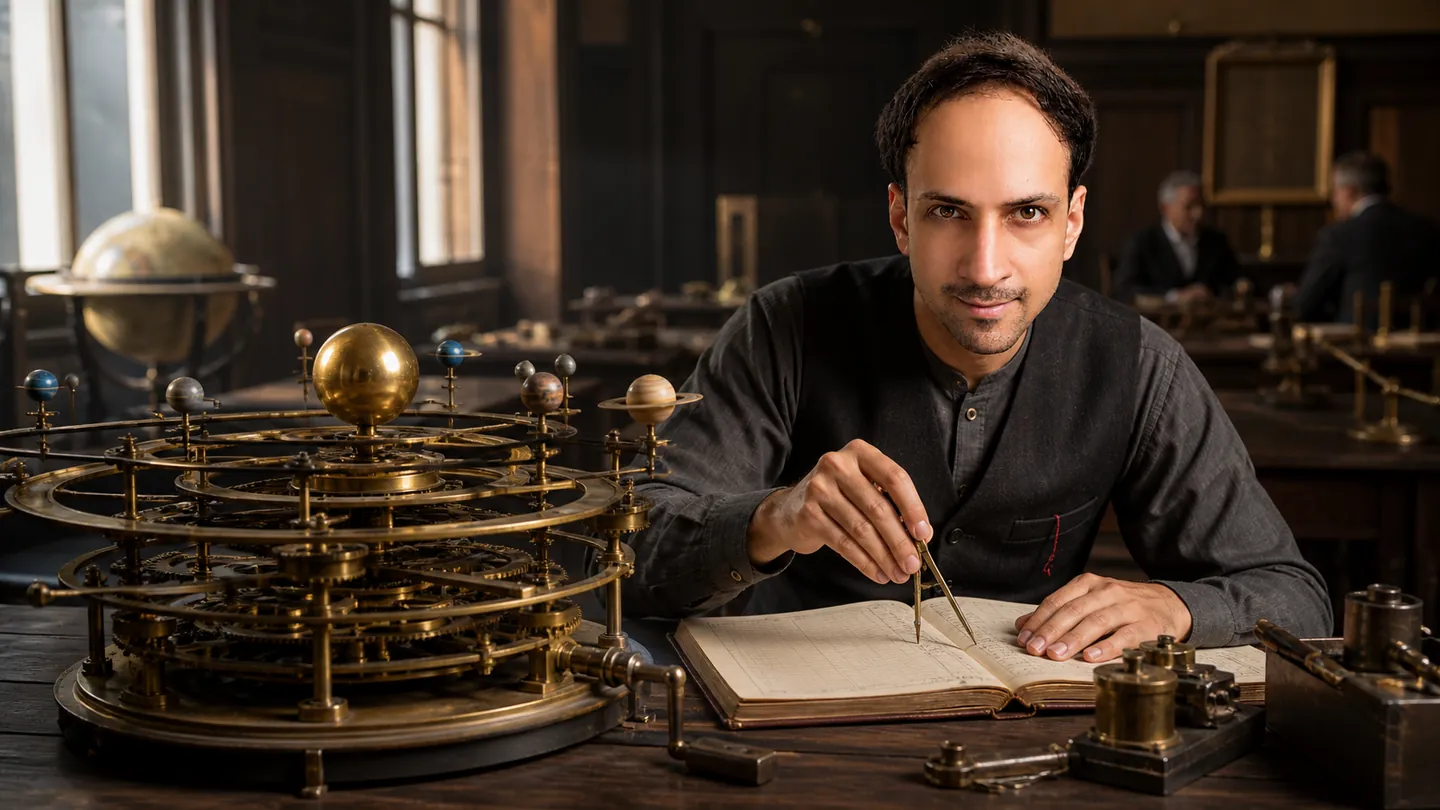
Brass Orrery in the Committee Room — AI Portrait Prompt
صورةAI Portraits

Turn your own photo into a conceptual instrument portrait in an engineering society's committee room with a long teak table. Keeps your face unchanged.

من نص البرومبت

Use the attached reference photo as the identity reference: keep the same face, skin tone, hair and features as the person in that photo, without beautifying, aging or altering them. Compose a wide 16:9 narrative image where environment and subject carry equal meaning at exactly 3808x2144 pixels. Location: an engineering society's committee room with a long teak table. Show them in charcoal suit trousers and a waistcoat over a collarless shirt, walking a pair of dividers across an open ledger. The impossible-looking event must obey this clear system: a benchtop brass orrery whose stacked gear train holds every planet at tonight's true heliocentric position around a polished central sun gives one careful pair of hands direct custody of a calculation. Explore why a machine with no memory chips can still remember mathematics perfectly; direct expression and posture toward unhurried certainty, never melodrama or ad-like confidence. Frame level with the mechanism so its motion and their eyes share one focal plane. Make the composition grant old machined wear the same dignity as their face. Render it as conceptual instrument portraiture uniting believable mechanical computation, machinist-level surface accuracy, warm archival print tonality, and quietly unhurried observational storytelling, using low raking window sun that carves each machined edge into readable shadow and a palette of ebonized wood, dull steel, and one signal-red thread. Photorealistic: this must read as a real photograph from a physical camera, never an illustration, painting, or 3D render. Give the frame volume: faint density deepest in the room, contrast easing at the edges. Resolve real surface detail: floor finish worn along the walked line, skirting marked at shoe height, and corners darker than the open floor. Keep one identity-locked person, credible hands and fingers, natural fabric, and coherent scale, contact, reflections, shadows, airflow, deformation, and materials. Background people only when essential, always secondary and clearly different. Avoid floating weightless gears, sepia steampunk grading, cog-filled head silhouettes, Roman-numeral dials, and oversized watch-movement props. No text, labels, logos, signatures, watermarks, random symbols, plastic skin, excessive bloom, or glossy AI finish.
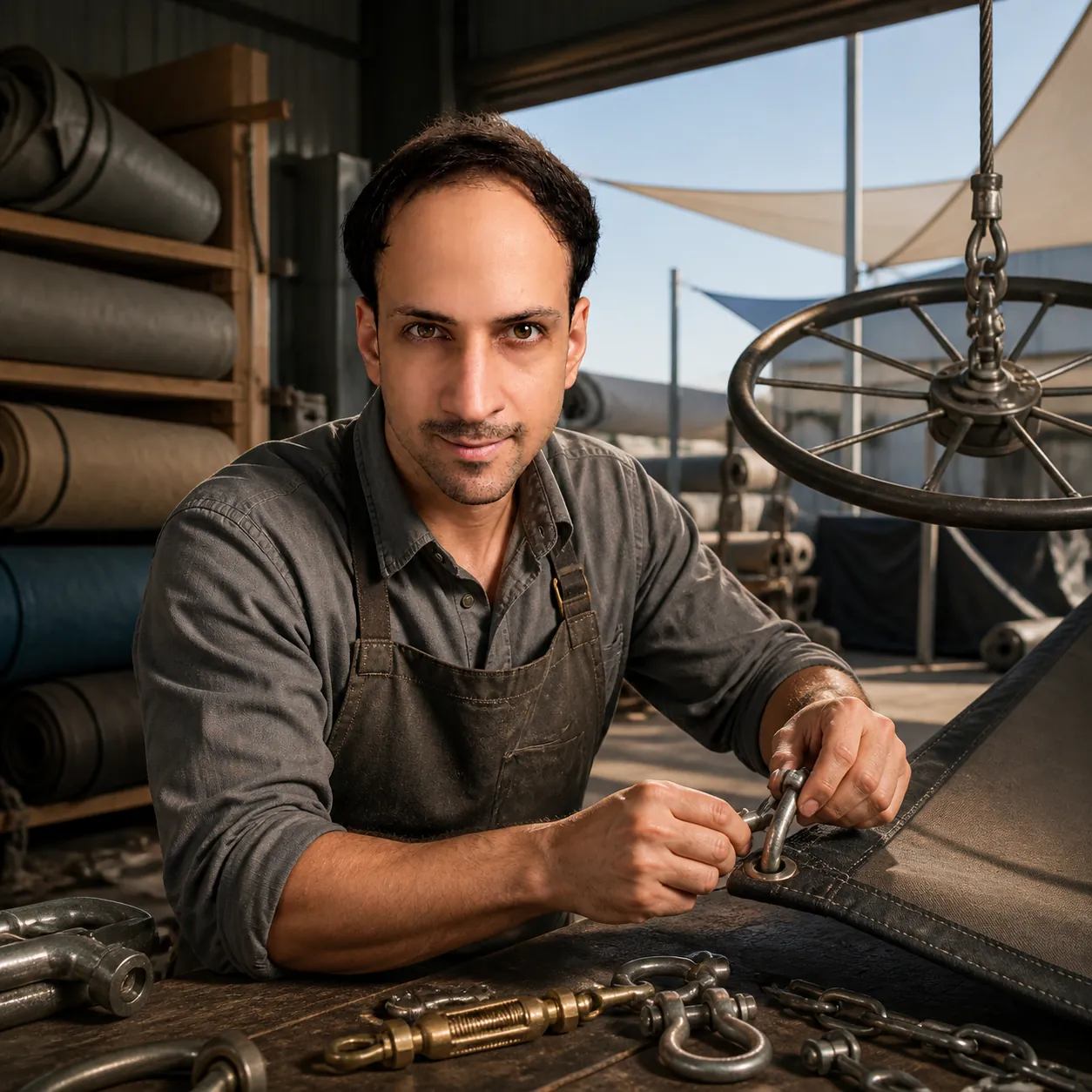
The Wheel That Hangs from Above — AI Portrait Prompt
صورةAI Portraits

Turn your own photo into a portrait in a shade-sail fabricator's floor stacked with rolled canopies and steel fittings. Keeps your face unchanged.

من نص البرومبت

Use the attached reference photo as the identity reference: keep the same face, skin tone, hair and features as the person in that photo, without beautifying, aging or altering them. Create a square 1:1 museum-catalog frame with a strong first read and a slower second read at exactly 2880x2880 pixels. Location: a shade-sail fabricator's floor stacked with rolled canopies and steel fittings. Show them in a dust-grey utility shirt and a canvas waist apron, threading a shackle pin through a canopy corner ring. Build the artwork around this material rule: a spoked wheel under a hung load whose hub hangs from its upper spokes instead of standing on the lower ones reads as impossible from across the room and inevitable from a handspan. Explore why a taut line feels more trustworthy than a solid post once understood; direct expression and posture toward patient conviction, never melodrama or ad-like confidence. Frame level with the widest gap in the structure so clear daylight through it sits beside their face. Make the composition weight the frame so stillness reads as tension, not rest. Render it as exhibition-grade statics portraiture combining precise rigging detail, physically consistent shadows through open gaps, matte natural materials, and disciplined contemporary art direction, using first blue daylight with one warm tungsten pool held on the work and a palette of graphite, raw pine, and one brass turnbuckle glint. Photorealistic: this must read as a real photograph from a physical camera, never an illustration, painting, or 3D render. Resolve real surface detail: cotton that hangs by its own weight, seams that pucker very slightly, and collars softened by washing. Keep one identity-locked person, credible hands and fingers, natural fabric, and coherent scale, contact, reflections, shadows, airflow, deformation, and materials. Background people only when essential, always secondary and clearly different. Avoid magician's-levitation staging, slack lines pretending to carry load, melted wood joints, and hovering furniture ads. No text, labels, logos, signatures, watermarks, random symbols, plastic skin, excessive bloom, or glossy AI finish.
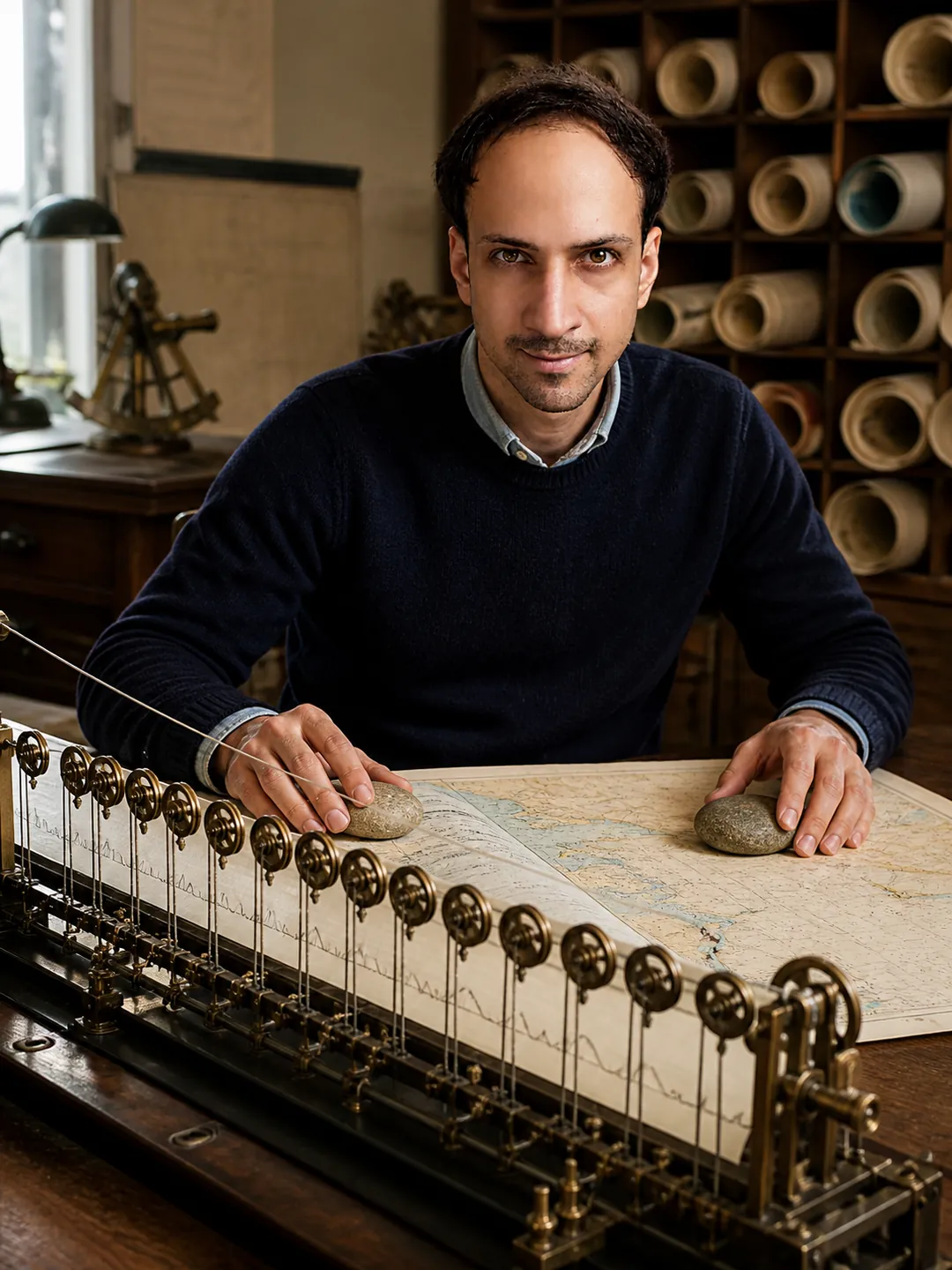
Tide Predictor in the Survey Office — AI Portrait Prompt
صورةAI Portraits

Turn your own photo into a conceptual instrument portrait in a hydrographic survey office with rolled coastal charts in pigeonholes. Keeps your face unchanged.

من نص البرومبت

Use the attached reference photo as the identity reference: keep the same face, skin tone, hair and features as the person in that photo, without beautifying, aging or altering them. Use a formal 3:4 environmental portrait with complete hands and meaningful objects inside frame at exactly 2480x3312 pixels. Location: a hydrographic survey office with rolled coastal charts in pigeonholes. Show them in a navy lambswool sweater over a pale chambray shirt, flattening a rolled chart under two smooth stone weights. Use this advanced image-making device as the core logic: a tide-predicting machine whose fine wire, wrapped over a dozen geared pulleys, sums ocean harmonics into one drawn curve computes what a phone needs silicon for, using geometry and patience. Explore how motion becomes arithmetic the moment its parts are shaped with intent; direct expression and posture toward quiet verification, never melodrama or ad-like confidence. Use an eye-level 85mm portrait perspective with honest depth of field and no distortion. Make the composition let the mechanism's longest line lead toward their steady hands. Render it as conceptual instrument portraiture uniting believable mechanical computation, machinist-level surface accuracy, warm archival print tonality, and quietly unhurried observational storytelling, using diffuse overcast daylight held to gentle contrast so engravings stay legible and a palette of warm umber, pale vellum, and one muted teal accent. Photorealistic: this must read as a real photograph from a physical camera, never an illustration, painting, or 3D render. Resolve real surface detail: brass darkened in the recesses and bright where thumbs land, and lacquer crazed rather than perfect. Keep one identity-locked person, credible hands and fingers, natural fabric, and coherent scale, contact, reflections, shadows, airflow, deformation, and materials. Background people only when essential, always secondary and clearly different. Avoid steampunk goggles, glued-on decorative cogs, glowing holographic overlays, impossible gear meshes, and clock faces. No text, labels, logos, signatures, watermarks, random symbols, plastic skin, excessive bloom, or glossy AI finish.
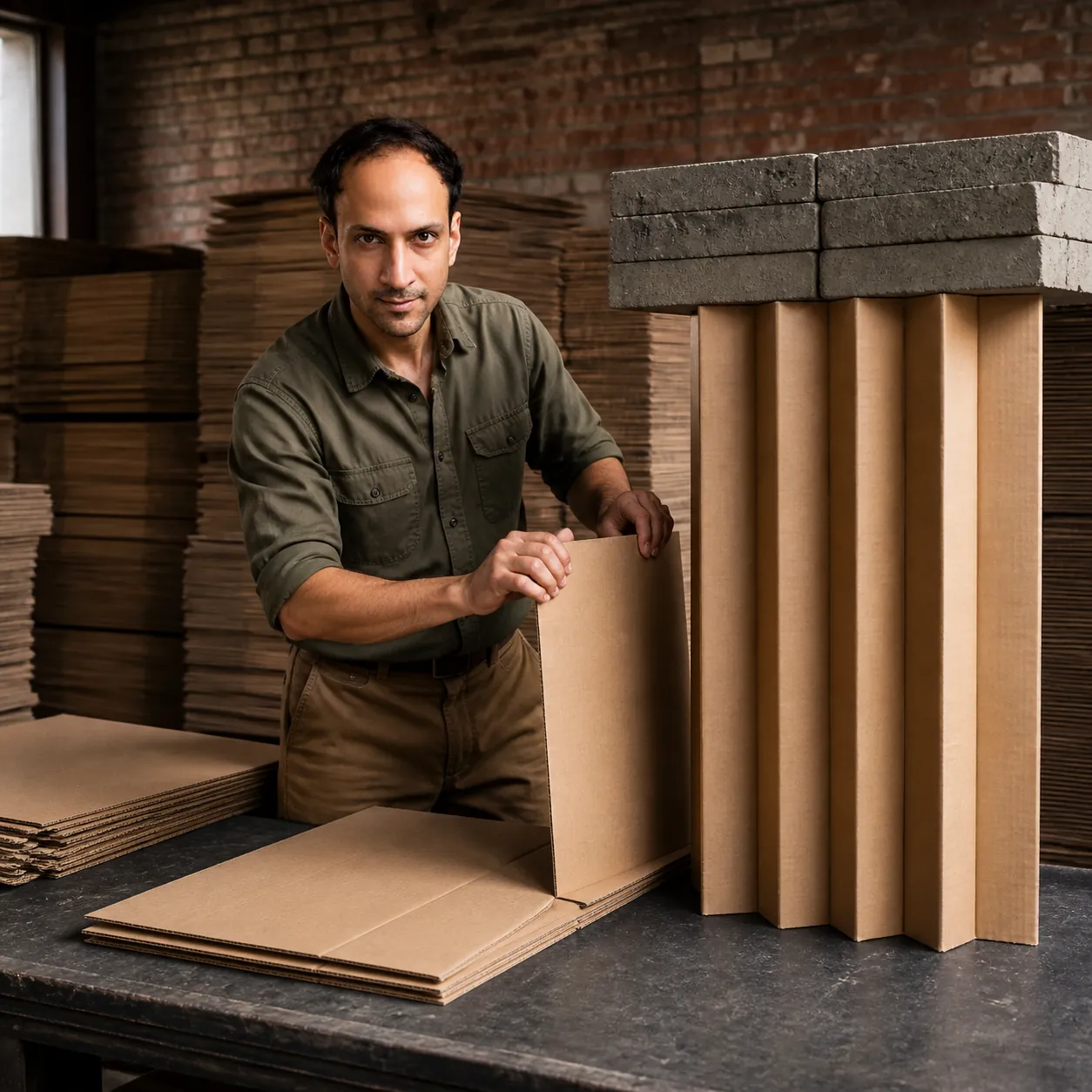
Fluted Column in the Date Shed — AI Portrait Prompt
صورةAI Portraits

Turn your own photo into a museum-workshop portrait in a date-packing shed stacked chest-high with flattened new cartons. Keeps your face unchanged.

من نص البرومبت

Use the attached reference photo as the identity reference: keep the same face, skin tone, hair and features as the person in that photo, without beautifying, aging or altering them. Create a square 1:1 museum-catalog frame with a strong first read and a slower second read at exactly 2880x2880 pixels. Location: a date-packing shed stacked chest-high with flattened new cartons. Show them in a washed olive utility shirt tucked into canvas work trousers, folding one carton up from flat with four practiced creases. Treat this mechanism as the frame’s governing rule: a slender kraft column pleated into crisp vertical flutes that carries a knee-high stack of concrete blocks without flexing reads as an engineering proof while remaining an object of quiet beauty. Explore how a fold multiplies strength without adding a single gram of material; direct expression and posture toward studied wonder, never melodrama or ad-like confidence. Use a composed wide 32mm view that gives the structure headroom without stretching their hands or face. Make the composition show the flat stock and the risen form in one frame. Render it as museum-workshop realism combining honest fiber texture, accurate crease shadows, believable deflection under real weight, and restrained editorial lighting, using soft bounced daylight with one deeper shadow pocket beneath the structure and a palette of pale card, graphite, and a narrow band of brick. Photorealistic: this must read as a real photograph from a physical camera, never an illustration, painting, or 3D render. Resolve real surface detail: leather creased along the lines of use, stitching slightly irregular, and edges burnished from contact. Keep one identity-locked person, credible hands and fingers, natural fabric, and coherent scale, contact, reflections, shadows, airflow, deformation, and materials. Background people only when essential, always secondary and clearly different. Avoid greeting-card kitsch, torn-edge scrapbook collage, cartoon pop-up books, and burning paper drama. No text, labels, logos, signatures, watermarks, random symbols, plastic skin, excessive bloom, or glossy AI finish.
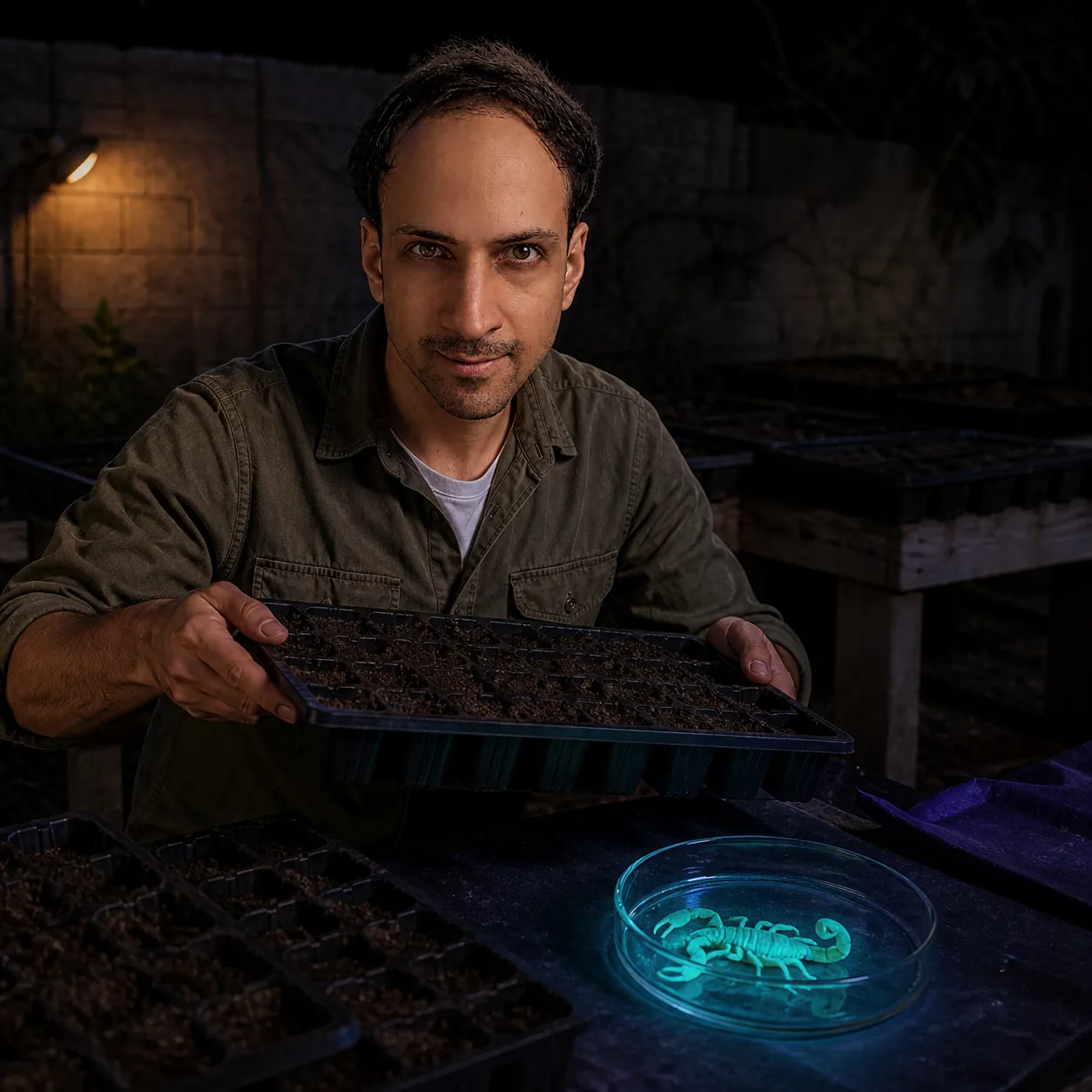
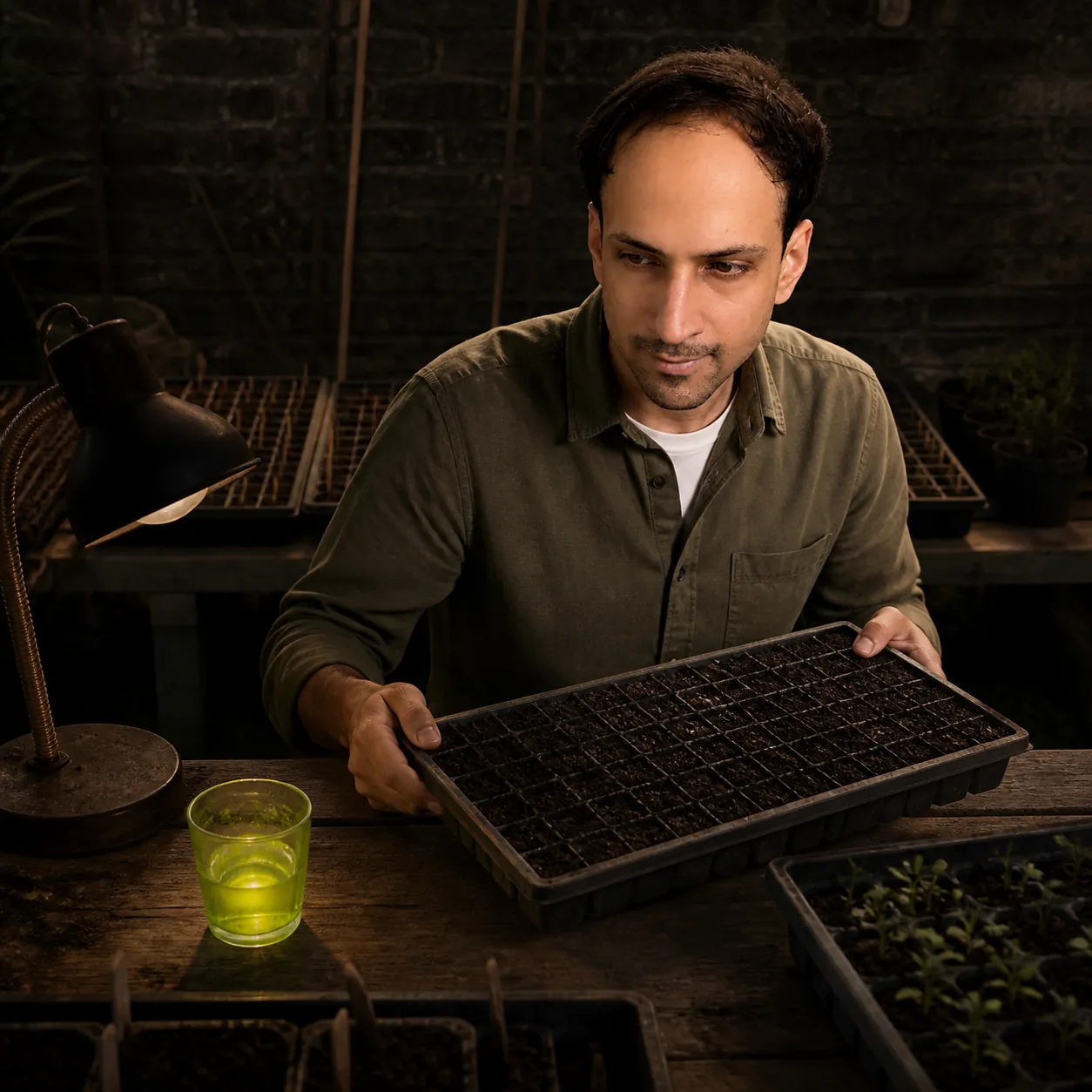
Green Glow in the Nursery Yard — AI Portrait Prompt
صورةAI Portraits

Turn your own photo into a photorealistic portrait in a walled nursery yard where seed trays wait on low trestles. Keeps your face unchanged.

من نص البرومبت

Use the attached reference photo as the identity reference: keep the same face, skin tone, hair and features as the person in that photo, without beautifying, aging or altering them. Create a square 1:1 museum-catalog frame with a strong first read and a slower second read at exactly 2880x2880 pixels. Location: a walled nursery yard where seed trays wait on low trestles. Show them in a faded olive field shirt over a white undershirt, tipping a seed tray level with both hands. Treat this mechanism as the frame’s governing rule: a plain yellow-green tumbler of pre-war uranium glass whose uranyl ions turn invisible ultraviolet into a deep green glow throughout its body takes its second color from light nobody in the room can see. Explore why a color can sit inside an ordinary thing for a century unseen; direct expression and posture toward grave curiosity, never melodrama or ad-like confidence. Use a calm 35mm view from just above the working surface with straight, undistorted edges. Make the composition place the brightest emission off-center and let their attention answer it. Render it as conceptual laboratory portraiture assembled from working ultraviolet apparatus, restrained editorial art direction, believable surface response, and quiet observational framing, using a single low lamp holding the room while unseen ultraviolet does the rest and a palette of unbleached linen, umber, and one stripe of quinine blue. Photorealistic: this must read as a real photograph from a physical camera, never an illustration, painting, or 3D render. Resolve real surface detail: paper fibre visible at cut edges, plastic that shows mould lines, and paint thicker where a brush turned. Keep one identity-locked person, credible hands and fingers, natural fabric, and coherent scale, contact, reflections, shadows, airflow, deformation, and materials. Background people only when essential, always secondary and clearly different. Avoid rave lighting rigs, uniform purple haze, CGI bioluminescent forests, and glowing eyes. No text, labels, logos, signatures, watermarks, random symbols, plastic skin, excessive bloom, or glossy AI finish.
Glow Among the Seed Trays — AI Portrait Prompt
صورةAI Portraits

Turn your own photo into a museum demonstration portrait in a walled nursery yard where seed trays wait on low trestles. Keeps your face unchanged.

من نص البرومبت

Use the attached reference photo as the identity reference: keep the same face, skin tone, hair and features as the person in that photo, without beautifying, aging or altering them. Create a square 1:1 museum-catalog frame with a strong first read and a slower second read at exactly 2880x2880 pixels. Location: a walled nursery yard where seed trays wait on low trestles. Show them in a faded olive field shirt over a white undershirt, tipping a seed tray level with both hands. Make one rigorous physical condition the conceptual engine: a shed scorpion cuticle in a glass dish that answers ultraviolet with a cold cyan outline sharper than the animal ever looked divides one honest frame into an ordinary half and a luminous half. Explore what it means that the plainest surfaces keep the least expected secrets; direct expression and posture toward quiet astonishment, never melodrama or ad-like confidence. Use an eye-level 55mm viewpoint with natural perspective and shadows kept open enough to read their face. Make the composition give the ordinary half as much space as the luminous half. Render it as museum demonstration realism combining honest low-light photography, spectrally plausible glow, plain material texture, and unhurried human presence in frame, using near-darkness carried mostly by emitted light and one weak amber practical and a palette of cool black, ash grey, and a thread of violet-white. Photorealistic: this must read as a real photograph from a physical camera, never an illustration, painting, or 3D render. Resolve real surface detail: fine grit in the texture of concrete, efflorescence at damp edges, and hairline cracks that follow stress. Keep one identity-locked person, credible hands and fingers, natural fabric, and coherent scale, contact, reflections, shadows, airflow, deformation, and materials. Background people only when essential, always secondary and clearly different. Avoid blacklight-party glow, neon signage, glowing body paint, radioactive-green fog, and cartoon toxic-waste barrels. No text, labels, logos, signatures, watermarks, random symbols, plastic skin, excessive bloom, or glossy AI finish.
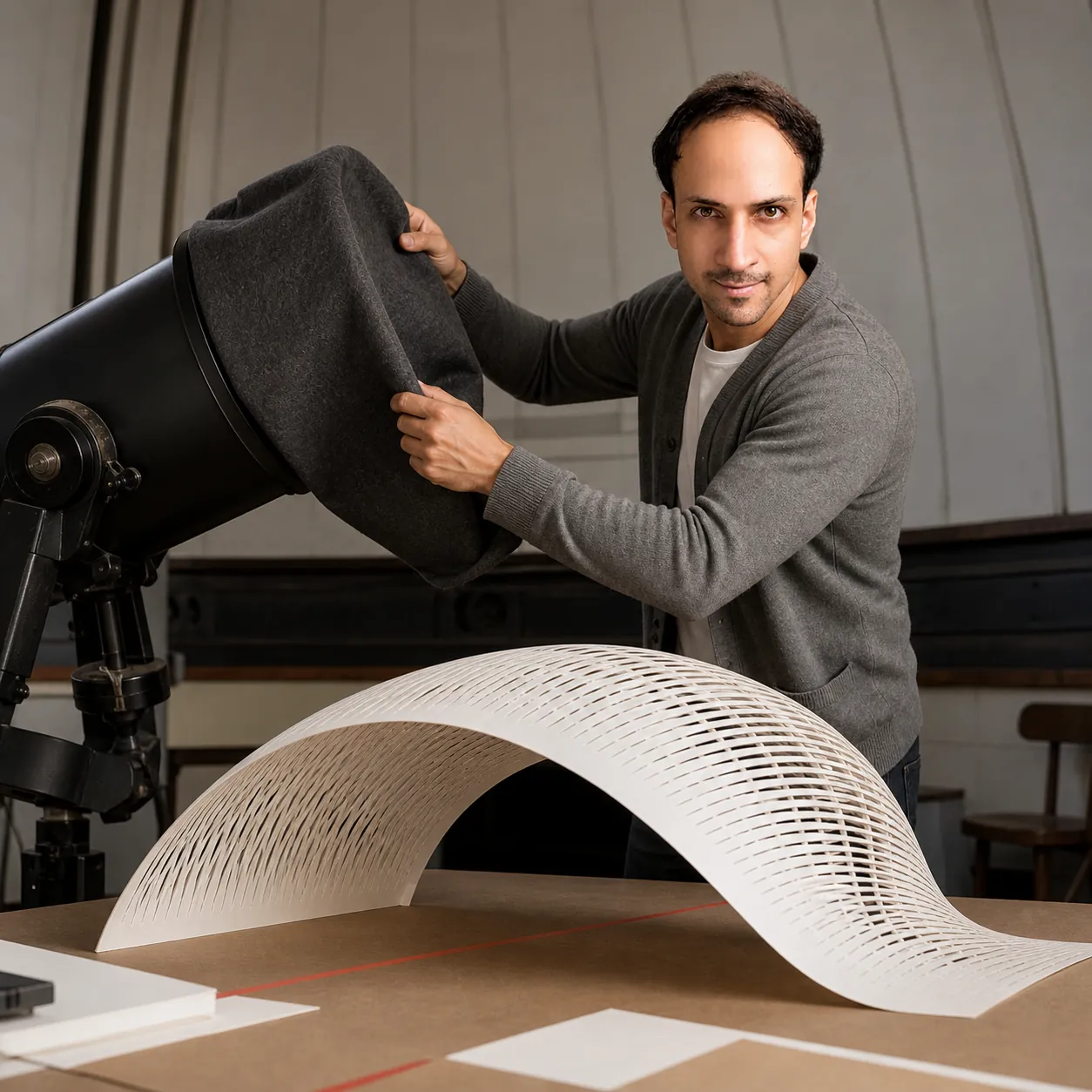
Paper Canopy in the Observatory — AI Portrait Prompt
صورةAI Portraits

Turn your own photo into a portrait in a small university observatory with its dome slit closed for daylight. Keeps your face unchanged.

من نص البرومبت

Use the attached reference photo as the identity reference: keep the same face, skin tone, hair and features as the person in that photo, without beautifying, aging or altering them. Create a square 1:1 museum-catalog frame with a strong first read and a slower second read at exactly 2880x2880 pixels. Location: a small university observatory with its dome slit closed for daylight. Show them in a heather-grey cardigan over a white crew-neck and dark denim, fitting the felt-lined cover over the telescope tube. Build the artwork around this material rule: a flat white sheet whose staggered rows of fine slits let it stretch into a smoothly doubly curved canopy shell puts work the eye reserves for steel onto material sold by the ream. Explore whether strength lives in a material or in the pattern given to it; direct expression and posture toward earned confidence, never melodrama or ad-like confidence. Frame across the tabletop at the structure's own height so the span and their eyes share one focal plane. Make the composition let white paper carry the frame's brightest and quietest values. Render it as gallery-grade structural still-life portraiture built from real folded spans, matte paper materiality, unexaggerated shadow logic, and patient architectural composition, using soft bounced daylight with one deeper shadow pocket beneath the structure and a palette of unbleached kraft, bone white, and one line of vermilion. Photorealistic: this must read as a real photograph from a physical camera, never an illustration, painting, or 3D render. Resolve real surface detail: label-free packaging showing carton fibre, cardboard bruised at the corners, and tape lifting slightly at one end. Keep one identity-locked person, credible hands and fingers, natural fabric, and coherent scale, contact, reflections, shadows, airflow, deformation, and materials. Background people only when essential, always secondary and clearly different. Avoid origami cranes, glowing magical paper, floating confetti, printed lettering on sheets, and weightless CGI folds. No text, labels, logos, signatures, watermarks, random symbols, plastic skin, excessive bloom, or glossy AI finish.
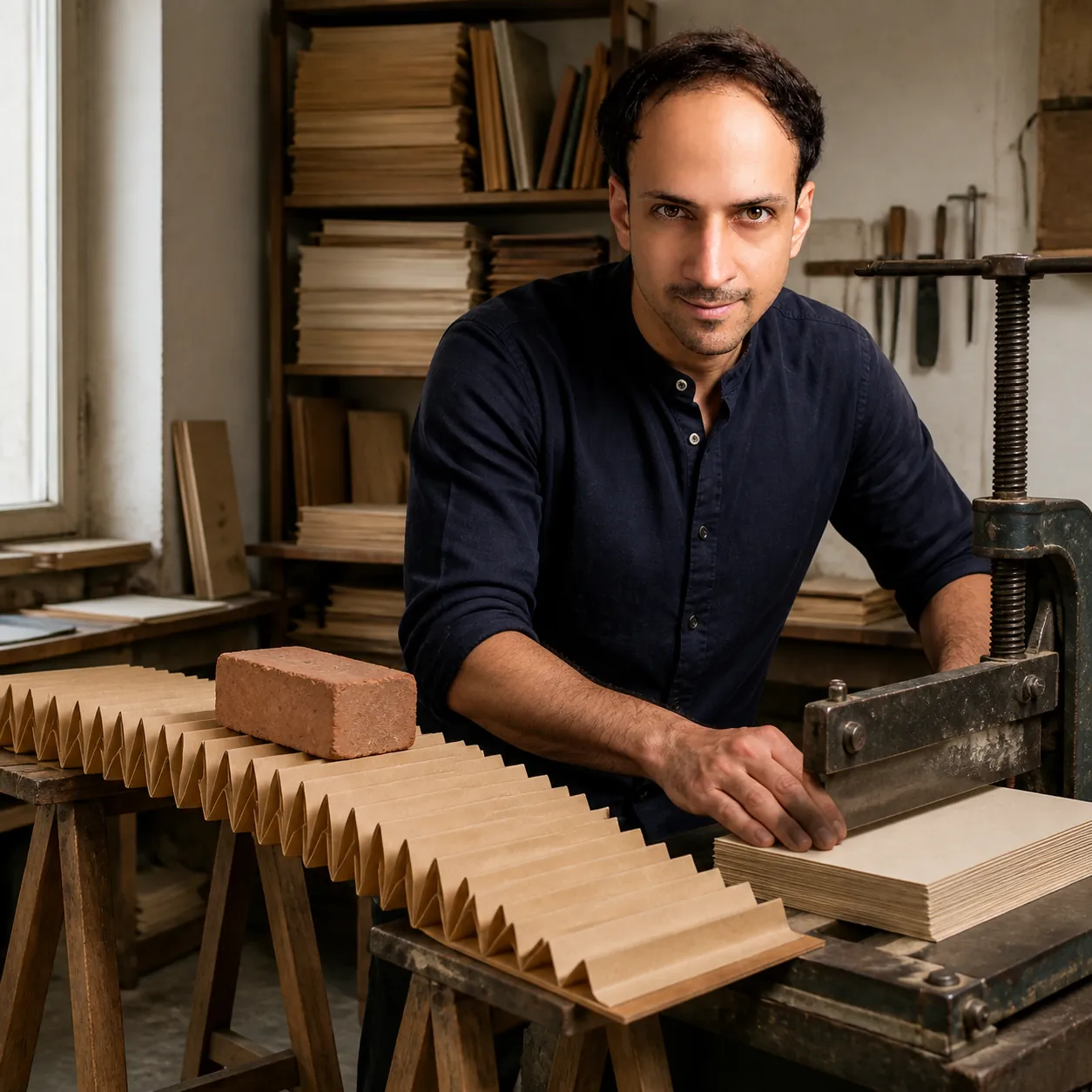
A Paper Bridge Under a Brick — AI Portrait Prompt
صورةAI Portraits

Turn your own photo into a portrait in a bookbinder's atelier with a hand guillotine and racked blank card. Keeps your face unchanged.

من نص البرومبت

Use the attached reference photo as the identity reference: keep the same face, skin tone, hair and features as the person in that photo, without beautifying, aging or altering them. Create a square 1:1 museum-catalog frame with a strong first read and a slower second read at exactly 2880x2880 pixels. Location: a bookbinder's atelier with a hand guillotine and racked blank card. Show them in a collarless indigo work shirt with sleeves rolled past the elbow, settling the guillotine clamp onto a fresh stack of card. Make one rigorous physical condition the conceptual engine: a bridge pleated from one kraft sheet whose deep accordion corrugations span two trestles beneath a single fired brick puts work the eye reserves for steel onto material sold by the ream. Explore why a material that tears between two fingers can be trusted with real weight; direct expression and posture toward patient exactness, never melodrama or ad-like confidence. Use an eye-level 58mm medium-format viewpoint with natural perspective and honest paper texture. Make the composition give the load path one clean diagonal from burden to bearing. Render it as high-concept paper-engineering portraiture built from working cut-and-fold structures, documentary realism, gallery-grade craft styling, and physically truthful load behavior, using flat north window light that keeps every crease edge legible and a palette of unbleached kraft, bone white, and one line of vermilion. Photorealistic: this must read as a real photograph from a physical camera, never an illustration, painting, or 3D render. Resolve real surface detail: true skin texture with pores and fine hair at the hairline, and fabric that creases where it is actually stressed. Keep one identity-locked person, credible hands and fingers, natural fabric, and coherent scale, contact, reflections, shadows, airflow, deformation, and materials. Background people only when essential, always secondary and clearly different. Avoid origami cranes, glowing magical paper, floating confetti, printed lettering on sheets, and weightless CGI folds. No text, labels, logos, signatures, watermarks, random symbols, plastic skin, excessive bloom, or glossy AI finish.
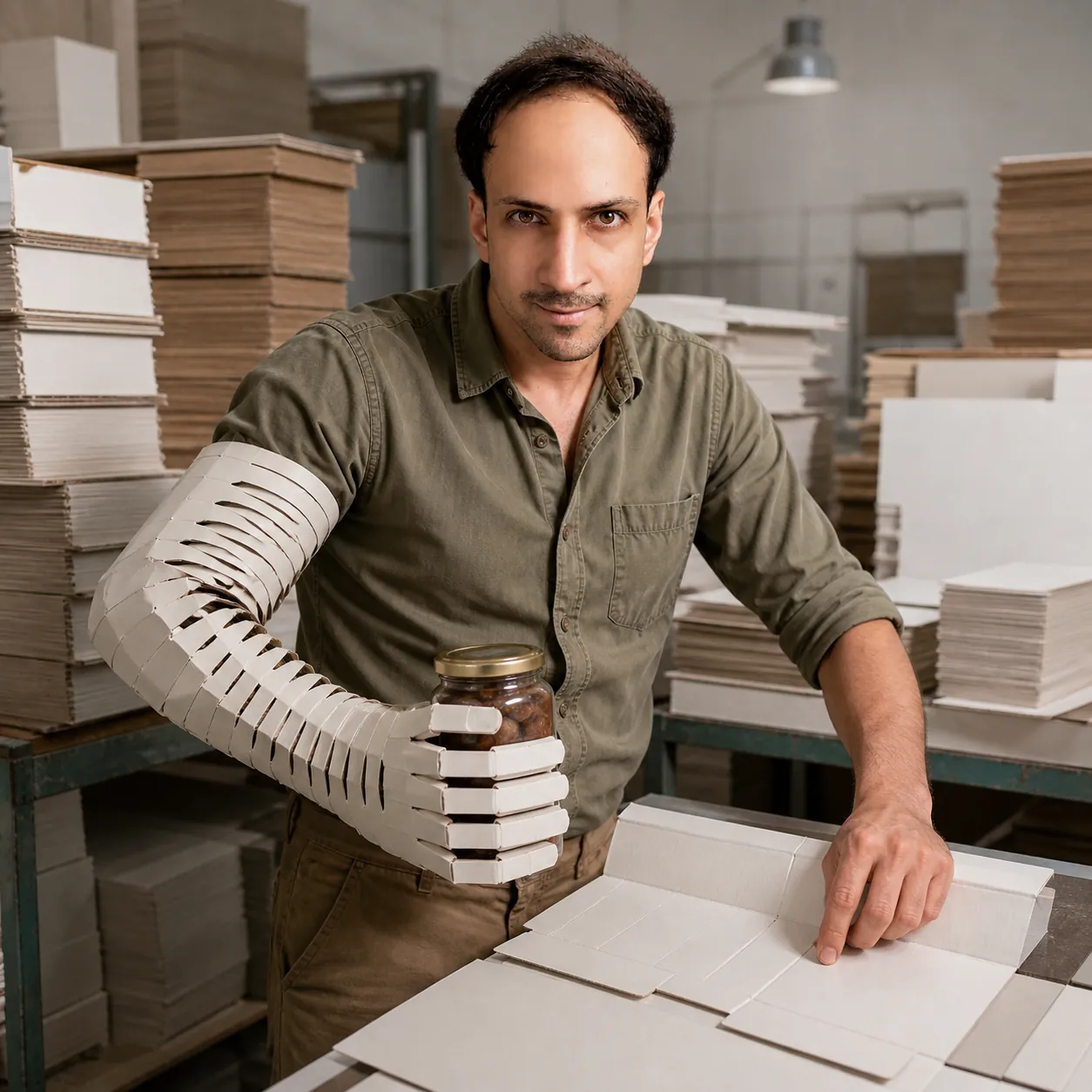
Paper Fingers Grip the Jar — AI Portrait Prompt
صورةAI Portraits

Turn your own photo into a portrait in a date-packing shed stacked chest-high with flattened new cartons. Keeps your face unchanged.

من نص البرومبت

Use the attached reference photo as the identity reference: keep the same face, skin tone, hair and features as the person in that photo, without beautifying, aging or altering them. Create a square 1:1 museum-catalog frame with a strong first read and a slower second read at exactly 2880x2880 pixels. Location: a date-packing shed stacked chest-high with flattened new cartons. Show them in a washed olive utility shirt tucked into canvas work trousers, folding one carton up from flat with four practiced creases. Make one rigorous physical condition the conceptual engine: a kirigami sleeve whose parallel slits buckle into dozens of angled paper fingers that grip a filled glass jar puts work the eye reserves for steel onto material sold by the ream. Explore where the line runs between craft patience and structural engineering; direct expression and posture toward measured astonishment, never melodrama or ad-like confidence. Use an eye-level 58mm medium-format viewpoint with natural perspective and honest paper texture. Make the composition let white paper carry the frame's brightest and quietest values. Render it as high-concept paper-engineering portraiture built from working cut-and-fold structures, documentary realism, gallery-grade craft styling, and physically truthful load behavior, using even overhead workroom light shaped so white surfaces hold visible tone steps and a palette of oat paper, cool slate, and one restrained saffron thread. Photorealistic: this must read as a real photograph from a physical camera, never an illustration, painting, or 3D render. Resolve real surface detail: the difference between a wiped surface and a clean one, faint tide marks on ceramic, and metal dulled unevenly by touch. Keep one identity-locked person, credible hands and fingers, natural fabric, and coherent scale, contact, reflections, shadows, airflow, deformation, and materials. Background people only when essential, always secondary and clearly different. Avoid origami cranes, glowing magical paper, floating confetti, printed lettering on sheets, and weightless CGI folds. No text, labels, logos, signatures, watermarks, random symbols, plastic skin, excessive bloom, or glossy AI finish.